Audio output power refers to the amount of electrical power an audio amplifier, speaker amplifier module, intercom terminal, public address device, multimedia system, or communication endpoint can deliver to a connected speaker or audio load. It is usually expressed in watts and is one of the key parameters used to estimate loudness capability, speaker matching, coverage range, and system reliability.
This parameter is often misunderstood. A higher wattage number does not automatically mean better sound quality. The final listening result depends on amplifier design, speaker sensitivity, impedance, distortion level, power supply capacity, enclosure structure, thermal design, acoustic environment, and how the system is used. In professional design, power must be matched to the speaker and the application, not selected only by the largest number on the datasheet.
The Role of Power in an Audio Chain
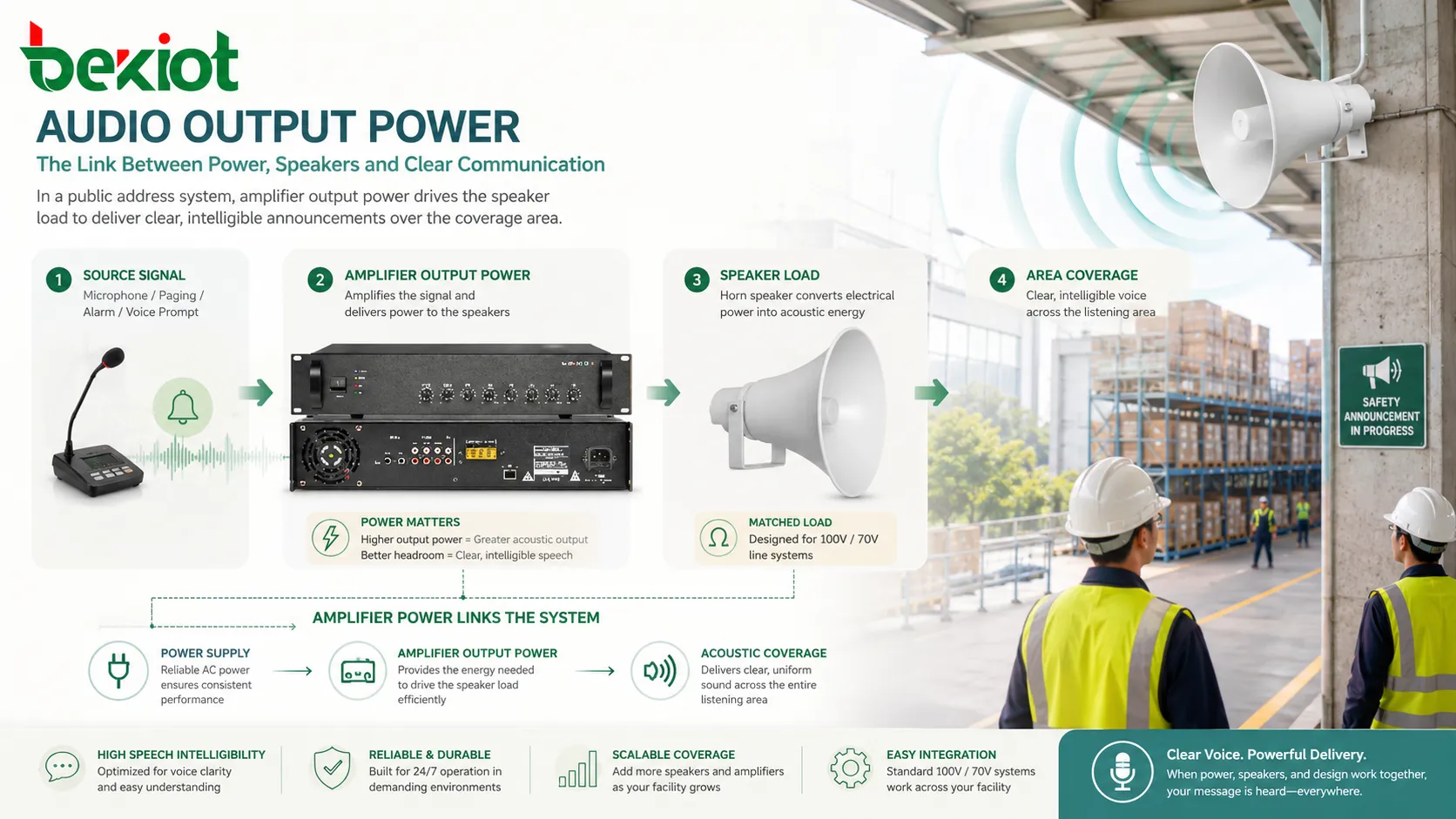
Sound reproduction begins with a source signal, such as a microphone, media file, call audio, alarm tone, paging message, or voice prompt. The signal is processed, amplified, and finally converted into acoustic energy by the speaker. The amplifier output stage provides the electrical energy needed to move the speaker diaphragm.
If the output stage cannot deliver enough power, the sound may be too quiet, compressed, or distorted at higher volume. If the amplifier is much stronger than the speaker can tolerate, the speaker may overheat or suffer mechanical damage. Therefore, power capability must be considered as part of the complete audio path.
In communication systems, the purpose is usually intelligibility rather than music-level loudness. The listener must hear speech clearly, alarms must be recognizable, and announcements must cover the intended area without becoming painful, harsh, or distorted.
How the Rating Is Expressed
Continuous Power
Continuous power describes how much output the device can deliver for a sustained period under defined test conditions. This is often more useful than short-term peak figures because real systems may need to operate for minutes or hours during paging, background music, emergency announcements, or industrial communication.
When comparing products, continuous power should be checked together with load impedance, distortion level, frequency range, supply voltage, and test duration. A wattage figure without conditions can be misleading.
Peak Power
Peak power describes short bursts that the amplifier or speaker may handle briefly. It can look impressive in marketing material but may not represent normal operating capability.
Peak values are useful for understanding headroom, but they should not be the only basis for system selection. A system that claims high peak power may still perform poorly if continuous output, cooling, or distortion control is weak.
RMS Power
RMS power is commonly used to describe effective power for audio signals. It is often treated as a practical indicator of usable amplifier output when the measurement method is clearly stated.
However, the term is sometimes used loosely. Engineers should still check whether the rating is measured at a specific impedance, distortion percentage, frequency, and supply condition.
Rated Load Impedance
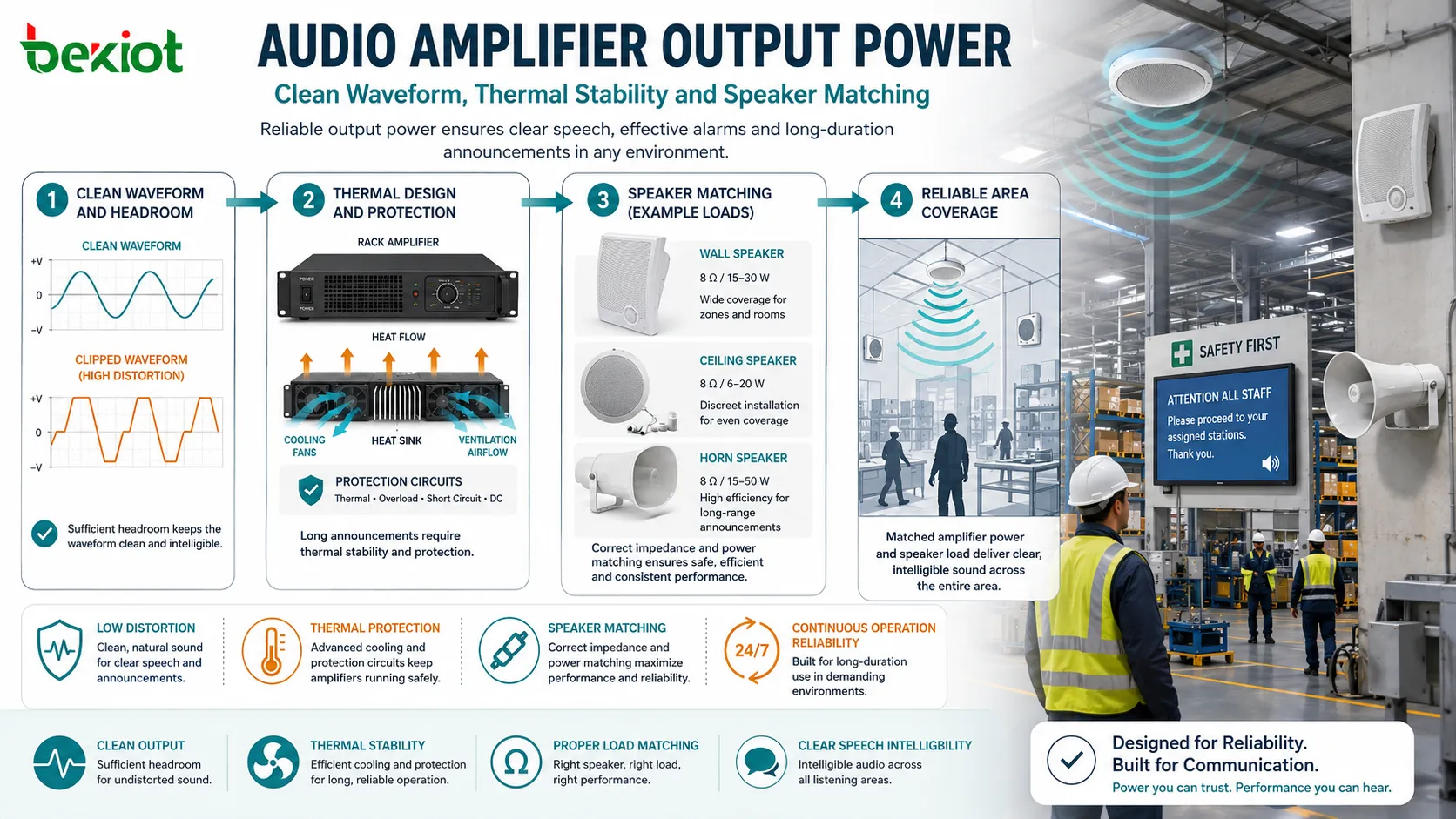
Power output is closely linked to speaker impedance. An amplifier may produce different wattage into 4 ohms, 8 ohms, or other loads. If the speaker impedance is too low, the amplifier may overheat, current-limit, or shut down. If it is too high, available power may be reduced.
Correct load matching protects both amplifier and speaker.
Loudness Is Not Determined by Watts Alone
Many users assume that doubling amplifier wattage will double perceived loudness. In reality, human hearing does not respond linearly to power. A small increase in wattage may create only a modest change in perceived volume.
Speaker sensitivity is equally important. A speaker with higher sensitivity can produce more sound pressure from the same input power. For example, a more efficient speaker may sound louder with less amplifier power than a less efficient speaker driven by a stronger amplifier.
Room size, ceiling height, background noise, wall materials, speaker direction, mounting height, and listener distance also affect perceived loudness. In large or noisy spaces, acoustic design often matters more than simply increasing power.
Clarity, Headroom, and Distortion
Clean Output Range
Good audio systems should operate within a clean output range. When an amplifier is pushed beyond its capability, it may clip the waveform. Clipping creates harsh distortion and can damage speakers, especially high-frequency drivers.
Enough output capacity gives the system headroom. Headroom allows short louder passages, strong speech peaks, alarm tones, or music transients to pass without distortion.
Speech Intelligibility
For voice communication, intelligibility is more important than raw volume. If speech is distorted, too bass-heavy, too sharp, or buried under noise, increasing power may not solve the problem.
Proper equalization, speaker placement, acoustic treatment, noise control, and gain structure are needed to make speech clear.
Thermal Stability
Amplifiers generate heat when delivering power. The higher the output, the more important thermal design becomes. Heat sinks, ventilation, component derating, enclosure design, and protection circuits all affect long-term reliability.
A device may work during a short test but fail during long announcements or continuous operation if thermal capacity is insufficient.
Relationship with Speaker Sensitivity
Speaker sensitivity is usually expressed as sound pressure level at a given distance when the speaker receives a defined power input. It tells how efficiently the speaker converts electrical power into sound.
A high-sensitivity speaker needs less power to reach the same loudness level. A low-sensitivity speaker may require more amplifier power, but it may still be suitable for certain applications if it offers the desired frequency response, durability, or size.
This relationship is important in paging, intercom, public address, conference rooms, emergency broadcast, outdoor announcements, classrooms, and industrial voice systems. Selecting only the amplifier without considering speaker sensitivity can lead to poor results.
Different Output Classes and Design Behavior
Class AB Amplifiers
Class AB amplifiers are widely used where good sound quality and moderate efficiency are needed. They can provide smooth audio performance but usually produce more heat than high-efficiency switching designs.
They may be preferred in some professional audio or traditional amplifier designs where sound quality and predictable behavior are priorities.
Class D Amplifiers
Class D amplifiers use switching technology to achieve high efficiency. They are common in compact devices, battery-powered products, public address equipment, smart speakers, and embedded audio systems.
Their efficiency helps reduce heat and power consumption. However, layout, filtering, electromagnetic compatibility, and power supply design must be handled carefully.
Constant-Voltage Systems
Large distributed audio systems often use 70V or 100V line systems. Instead of matching low-impedance speakers directly, each speaker uses a transformer tap to set power consumption.
This makes it easier to connect many speakers over long cable runs, but total tapped wattage must remain within amplifier capacity with enough safety margin.
Applications in Different Systems
Public Address and Paging
Paging systems need enough output to cover offices, corridors, factories, warehouses, stations, schools, hospitals, hotels, and outdoor areas. The goal is clear announcement delivery over background noise.
Designers must calculate speaker quantity, area coverage, ambient noise, line loss, amplifier margin, and emergency priority requirements.
Intercom and Voice Terminals
Intercom terminals, help points, door stations, industrial phones, and access panels usually use smaller speakers than public address systems. Their output must be strong enough for local communication without creating feedback or distortion.
In noisy environments, speaker placement and acoustic direction are critical. More wattage may be needed, but microphone echo control and enclosure design must also be considered.
Conference and Meeting Rooms
Meeting rooms need balanced output for speech playback, remote participants, media content, and collaboration tools. Excessive power can create echo problems if microphones are active in the same room.
Audio output should be matched with acoustic echo cancellation, speaker placement, room size, and user seating positions.
Consumer Audio and Multimedia
TVs, desktop speakers, soundbars, portable speakers, gaming systems, and home audio devices often advertise power ratings. Users should compare these ratings carefully because measurement methods may differ.
For practical listening, speaker quality, enclosure design, bass response, distortion, and room placement may matter more than the largest wattage figure.
Industrial and Outdoor Sound
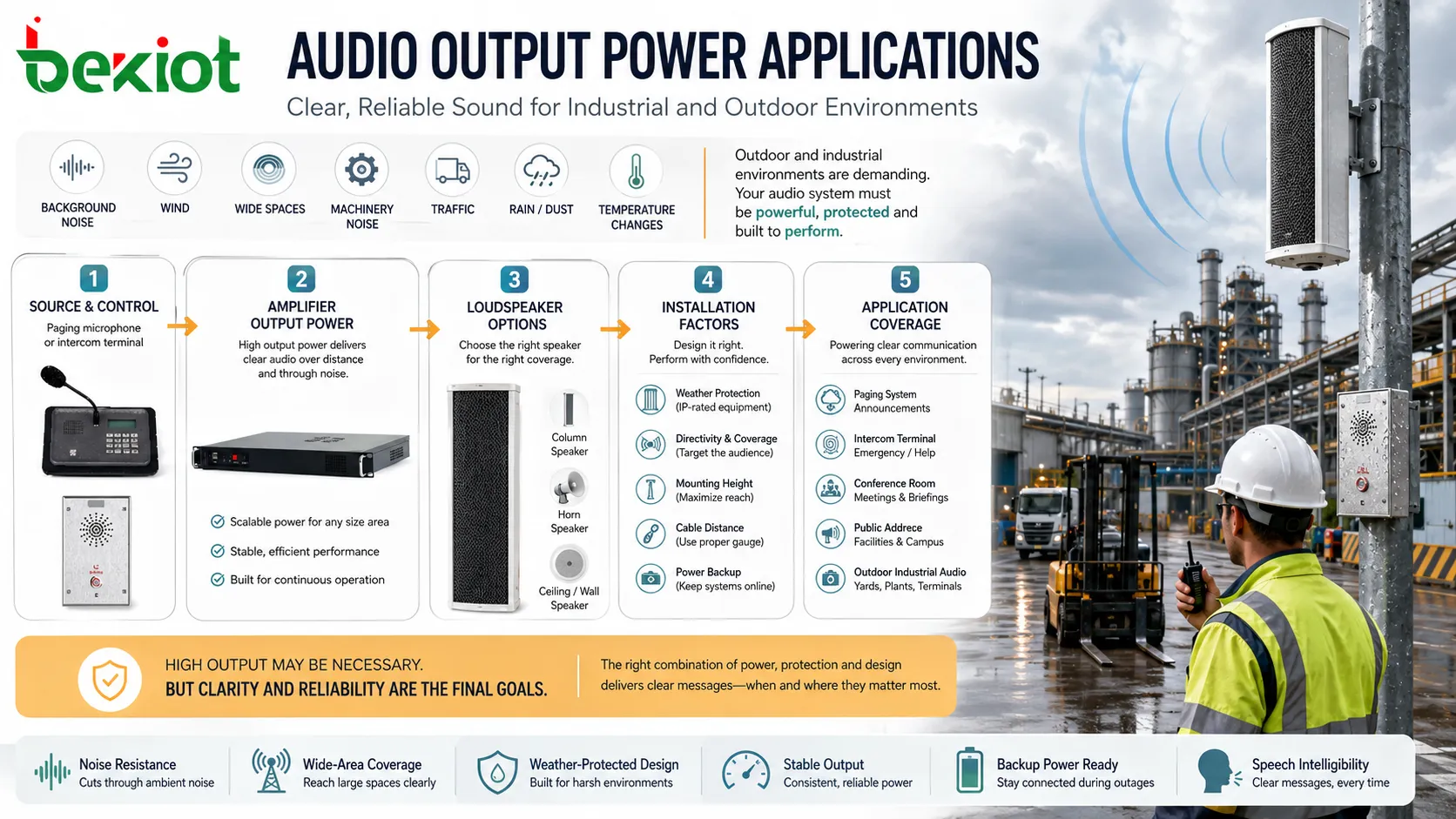
Outdoor and industrial systems face background noise, wind, wide spaces, machinery, traffic, rain, dust, and temperature changes. Output power must be selected together with weather protection, speaker directivity, mounting height, cable length, and power backup.
High output may be necessary, but clarity and reliability remain the final goals.
Power Supply and Efficiency
The amplifier cannot deliver stable output without a suitable power supply. If the supply voltage drops during loud audio, the amplifier may distort, shut down, or reduce output. This is common in undersized adapters, weak batteries, overloaded PoE budgets, or poorly designed power circuits.
Efficiency affects heat and runtime. In battery-powered or PoE-powered devices, efficient amplifier design allows stronger output without excessive energy waste. In large systems, efficiency also affects cooling and operating cost.
Protection circuits may include overcurrent protection, thermal shutdown, short-circuit protection, DC offset protection, and speaker fault detection. These functions help prevent damage but should not be used as a substitute for correct design.
Cable Length and Installation Loss
Speaker cables have resistance. Long cable runs can waste power and reduce delivered output, especially in low-impedance systems. Cable size, distance, and speaker impedance should be considered during installation.
For distributed audio, constant-voltage systems reduce current and make long runs more practical. However, transformer taps, line loss, and total connected load must still be calculated.
Poor wiring can also cause intermittent sound, weak volume, noise, or amplifier protection trips. Cable termination should be secure and clearly labeled.
Selection Logic for Practical Projects
Start by defining the listening area. A small desk terminal, meeting room, corridor, warehouse, outdoor yard, and factory floor require different output strategies.
Next, estimate background noise. A quiet room may need only modest output, while a machine room or transport station requires stronger acoustic coverage and better speaker placement.
Then match amplifier output to speaker rating and sensitivity. The speaker should handle the expected power, and the amplifier should have enough clean headroom without being dangerously oversized.
Finally, test the installed system. Real acoustic results can differ from calculation because of reflections, obstacles, ceiling height, speaker angle, and human listening position.
Common Misunderstandings
Bigger Wattage Is Not Always Better
Excessive power can create distortion, feedback, equipment stress, or uncomfortable listening levels. The right power is the amount needed for clear and reliable coverage.
Speaker Rating Is Not the Same as Loudness
A speaker rated for high power may not be very loud if its sensitivity is low. Power handling and acoustic efficiency are different specifications.
Peak Numbers Can Be Misleading
Peak values may represent very short bursts. Continuous usable power with acceptable distortion is usually more meaningful for system design.
Software Volume Cannot Fix Weak Hardware
Increasing digital volume cannot overcome a weak amplifier, poor speaker, bad placement, or inadequate power supply. It may only create clipping or noise.
Testing and Maintenance
During commissioning, test speech, alert tones, music if required, and maximum expected volume. Listen for distortion, buzzing, rattling, feedback, dropouts, and uneven coverage.
Check amplifier temperature during longer operation. A system that sounds fine for one minute may overheat during continuous paging or emergency announcements.
Inspect cables, speaker terminals, power supplies, mounting brackets, and ventilation paths regularly. Loose connections or blocked cooling can reduce output reliability.
For critical systems, periodic sound level checks and fault monitoring help ensure that the system still performs as intended after changes in room layout, equipment aging, or speaker replacement.
Audio output power should be treated as a system-matching parameter: it must support the speaker, environment, power supply, cable route, and listening purpose together.
FAQ
Can a low-power amplifier still sound loud?
Yes. If the speaker is efficient and the room is small or quiet, a low-power amplifier can produce enough volume for practical use.
What happens if the speaker impedance is too low?
The amplifier may draw excessive current, overheat, distort, enter protection mode, or suffer damage if it is not designed for that load.
Why does the sound distort only at high volume?
The amplifier may be clipping, the speaker may be reaching its mechanical limit, the power supply may be sagging, or the input signal may already be overloaded.
How much safety margin should an audio system have?
The margin depends on application, speaker rating, duty cycle, ambient temperature, and required reliability. Critical paging or emergency systems usually need more conservative design.
Why does one area sound loud while another is unclear?
Uneven coverage may be caused by speaker placement, room reflections, obstacles, cable loss, wrong speaker angle, different background noise levels, or poor zone design.