In many VoIP and audio-video communication projects, SIP-based softswitch platforms are used as the foundation for voice, video, intercom, conference, and dispatch communication. SIP has become widely adopted because of its openness, flexibility, and strong compatibility with different terminals, gateways, servers, and application platforms.
However, system owners often notice an important difference during project planning: some IP phone systems can record SIP calls directly, while others require a separate recording server or external recording solution. This difference is not simply a product feature gap. In most cases, it is closely related to how the SIP server handles call signaling and media streams.
The Architecture Behind the Difference
An IP phone system usually includes SIP terminals, SIP gateways, SIP servers, dispatch consoles, recording services, and sometimes video or paging components. At the surface level, these devices all appear to use SIP. But inside the system, SIP servers may work in different ways.
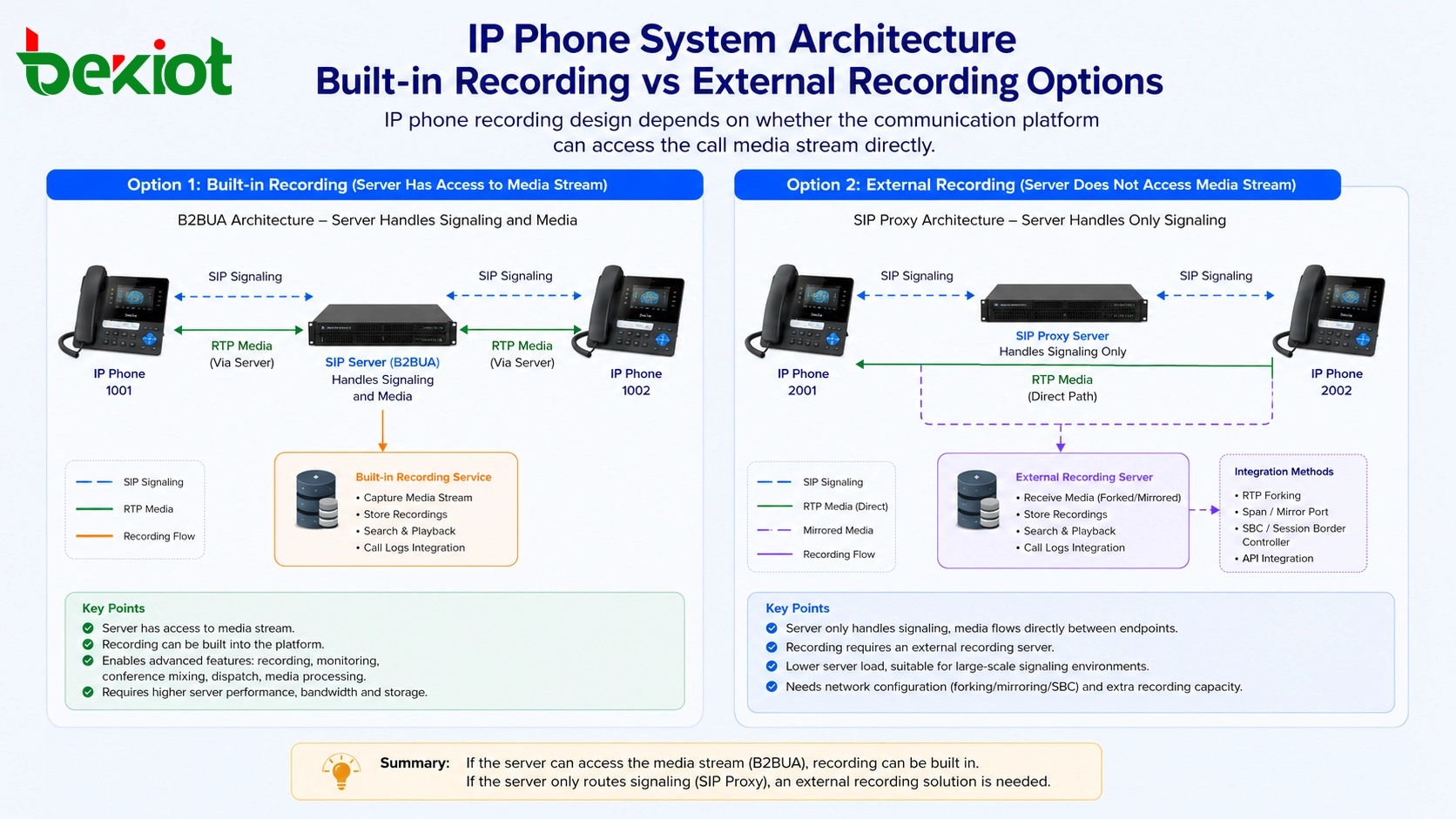
Two important operating models are commonly discussed in SIP communication architecture: B2BUA and SIP Proxy. They both help establish communication sessions, but they handle the call path differently. This difference directly affects whether recording can be implemented inside the communication platform or whether a separate recording system is required.
For project owners, this distinction matters because recording is not only a software checkbox. It involves media routing, storage, bandwidth, server performance, compliance, access permissions, and long-term management. A good solution should therefore be designed according to the actual call flow, not only according to the phone model or PBX interface.
When the Server Controls Both Signaling and Media
B2BUA stands for Back-to-Back User Agent. In this architecture, the SIP server acts as an intermediary between two SIP sessions. When a call request reaches the server, the server terminates that call leg and creates a new call leg toward the target party. In simple terms, the server sits in the middle of the communication path.
This means the platform can process not only SIP signaling but also the media stream. The server may control, modify, relay, or manage RTP media depending on the system design. Because the media passes through the server, functions such as call recording, video recording, media insertion, transcoding, call supervision, conference mixing, and dispatch intervention become easier to implement.
This model is especially useful for systems with complex business logic. Call centers, dispatch platforms, conference systems, emergency communication platforms, and operator workstations often need more than basic call routing. They may need recording, monitoring, call transfer, call takeover, multi-party communication, media processing, and operation logs. A B2BUA-based architecture gives the system more control over these workflows.
If every SIP call media stream passes through the server, recording can usually be implemented inside the platform by capturing or processing the corresponding media data.
Why Built-In Recording Is Easier in This Model
When the server has access to the media stream, built-in recording becomes a natural platform function. The system can capture the voice or video stream, associate it with call records, store it according to defined policies, and make it searchable through a management interface.
This design has several practical advantages. The recording file can be linked with extension numbers, caller IDs, call time, call duration, operator accounts, dispatch events, and service records. For call centers, command centers, security rooms, transportation control, and industrial dispatch, this creates a complete communication trace that can support review, training, responsibility confirmation, and incident analysis.
The trade-off is server load. Since signaling and media are handled by the platform, the server must have enough processing power, network bandwidth, and storage capability. If the system handles many concurrent calls or video sessions, capacity planning becomes very important. Built-in recording is convenient, but it should be supported by proper server resources and storage design.
When the Server Only Routes the Call
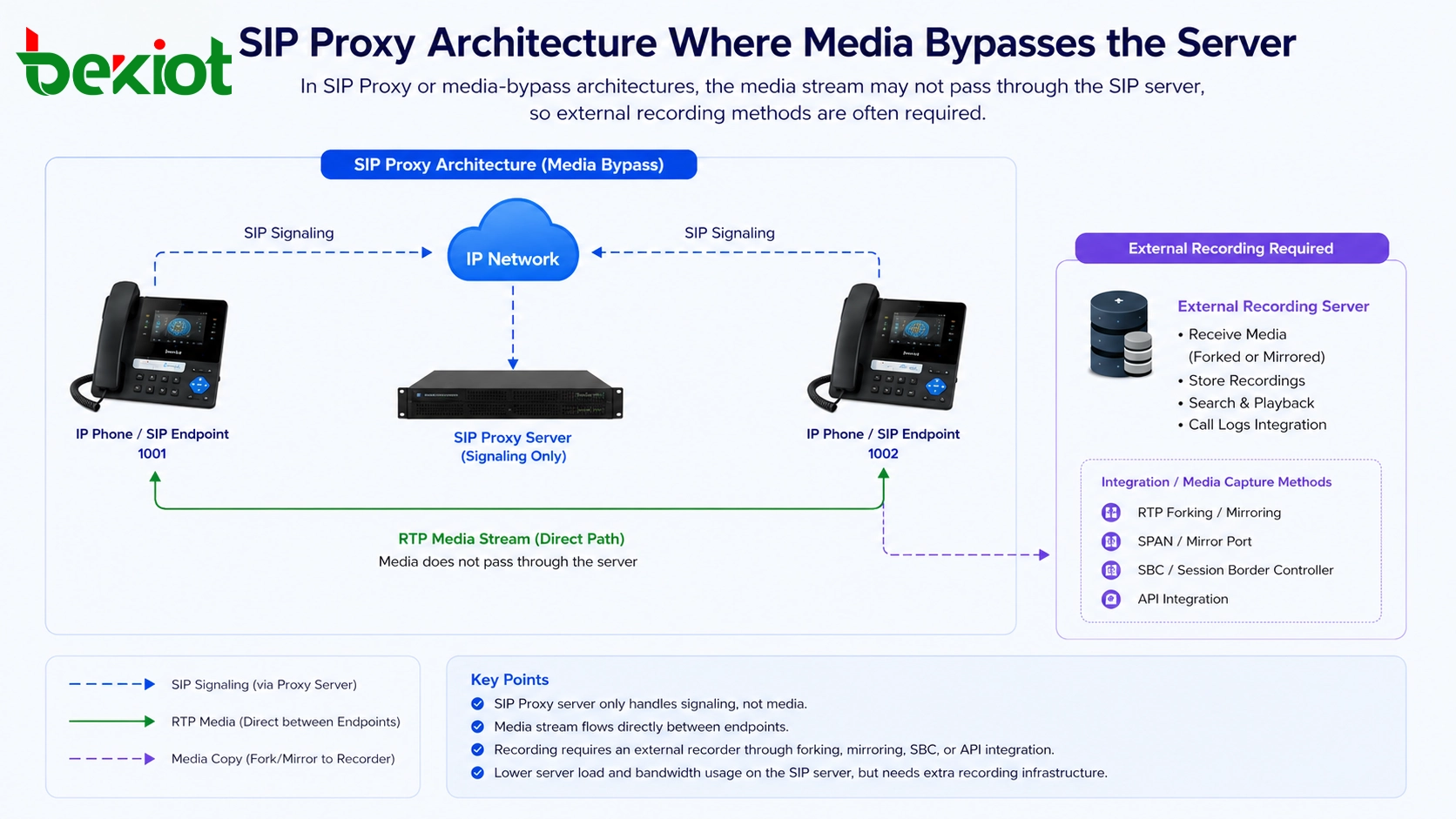
SIP Proxy is another common working model. A SIP Proxy mainly processes signaling. It receives SIP requests, determines where they should go, and routes the requests to the correct user agent. Once the call is established, the media stream may flow directly between the two endpoints instead of passing through the server.
This approach keeps the SIP server simpler. Because the server does not need to handle media, it can focus on call establishment, routing, registration, and signaling control. This can be useful for large-scale signaling environments where lightweight routing and efficient session setup are more important than media processing.
However, this architecture also creates a clear limitation for recording. If the media stream travels directly between two terminals, the server cannot easily capture the voice or video content. The call may be visible at the signaling layer, but the actual media is outside the server’s direct control. As a result, built-in recording is often unavailable or limited in pure Proxy-based systems.
Why an External Recorder May Be Required
When a system does not carry the media stream through the central server, recording usually requires another method. An external recording system may be introduced to receive, mirror, or capture the media. This can be done through different technical approaches depending on the network and platform design.
For example, a recording server may be connected through a media relay, packet mirroring, SIPREC-based recording, gateway-level recording, or a dedicated recording interface. In some projects, recording can also be implemented at the terminal side or gateway side. The best method depends on the existing SIP architecture, network topology, compliance requirements, and recording scope.
This is why two IP phone systems may look similar from the outside but behave very differently in recording deployment. One platform can record calls directly because it already controls the media path. Another platform may need a separate recorder because its server only handles call signaling while the media flows between endpoints.
Choosing the Right Design for Real Projects
The correct recording solution should start with project requirements. If the system is used for an enterprise office with only occasional call review needs, a lightweight recording method may be enough. If the system is used for a call center, command center, emergency dispatch room, public safety platform, or industrial control environment, recording may need to be treated as a core business function.
Important questions should be confirmed before deployment. Does the system need to record all calls or only selected calls? Does it need voice recording only, or voice and video recording together? How many concurrent calls need recording? How long should files be stored? Who can search, play, export, or delete recordings? Should recording be linked with call detail records, dispatch logs, alarm events, or operator accounts?
These decisions affect server sizing, storage planning, database design, access control, network bandwidth, and backup strategy. A built-in recorder may reduce integration complexity, while an external recorder may provide better flexibility for distributed, hybrid, or multi-vendor environments.
Typical Scenarios for Built-In Recording
Call centers and service desks
Call centers often need recording for service quality review, complaint handling, training, and performance management. Since calls may already pass through the platform for queueing, monitoring, whisper coaching, and transfer control, built-in recording is usually a natural part of the system design.
Dispatch and command platforms
Dispatch systems often require voice records, event records, operation logs, and sometimes video records. When the platform controls the call media, recordings can be linked with dispatch events and operator actions, making later review easier.
Conference and collaboration systems
Conference systems usually involve media mixing, multi-party audio, video layout, and session management. Since the platform already processes the media, recording can often be integrated into the same workflow.
Typical Scenarios for External Recording
Large-scale SIP routing networks
In networks where the SIP server mainly performs registration and routing, media may not pass through the central server. External recording is usually more suitable because it can be placed at the network, gateway, or media access layer.
Multi-vendor communication environments
Some projects include different brands of SIP phones, gateways, softswitches, legacy systems, and third-party applications. A separate recording system can provide a more independent recording layer without relying completely on one platform’s built-in capability.
Distributed sites and branch offices
For multi-site organizations, local recording may be needed at branch offices, remote stations, or industrial zones. External recorders or distributed recording nodes can reduce backhaul bandwidth and improve local storage control.
Planning Considerations Before Deployment
Before selecting a recording architecture, the project team should map the actual SIP call flow. It is important to know whether the server handles media or only signaling. This single question often determines whether built-in recording is feasible or whether an external recording system is required.
Storage design should also be planned early. Recording files can grow quickly when the system handles many concurrent calls, long call durations, or video sessions. Retention period, file format, compression method, backup policy, and search performance should be considered before the system goes live.
Security and permission control are equally important. Recordings may contain sensitive business information, personal data, emergency details, or customer conversations. A professional solution should include account permissions, operation logs, export controls, storage protection, and clear management procedures.
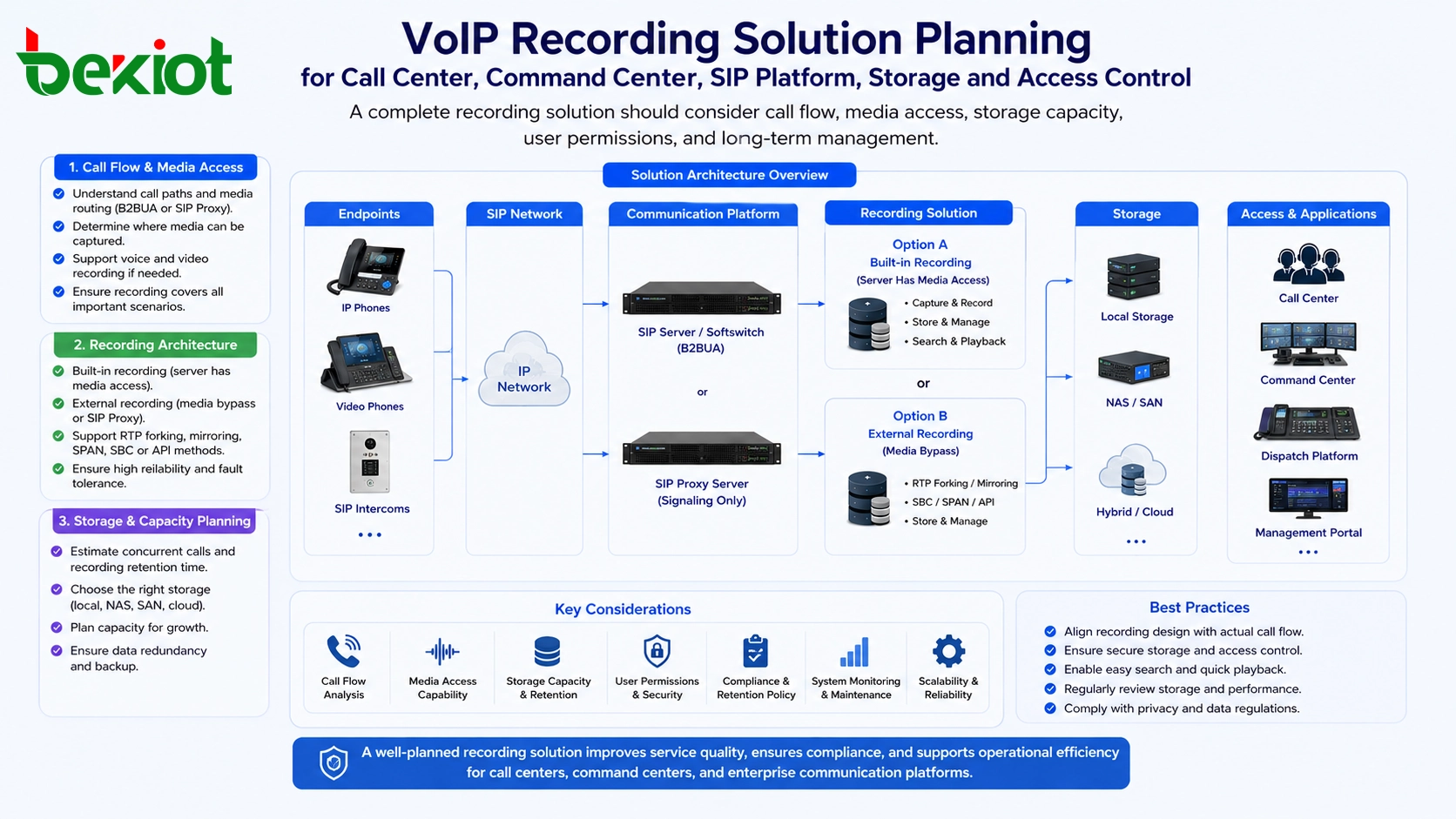
Recommended Solution Logic
A practical design can be divided into three layers. The first layer is the SIP communication platform, which manages registration, authentication, call routing, extension control, and service logic. The second layer is the media handling layer, which determines whether voice and video streams pass through the platform, a media relay, a gateway, or endpoint-to-endpoint paths. The third layer is the recording and management layer, where files are stored, indexed, searched, played, exported, and protected.
If the system uses a B2BUA or media-relay architecture, built-in recording can be efficient and simple to manage. If the system uses a SIP Proxy or media-bypass model, external recording should be planned as a separate functional layer. In hybrid systems, both methods may exist at the same time: some calls are recorded inside the platform, while others are recorded through external servers or gateways.
This layered approach helps project owners avoid misunderstanding. The key question is not whether an IP phone system “has recording” in a general sense. The real question is whether the platform can access the media stream in a controlled and reliable way.
Recording capability should be evaluated from the media path, not only from the SIP registration interface or the phone terminal list.
Business Value of a Proper Recording Strategy
Better traceability
Call recordings help organizations review communication history, confirm instructions, investigate disputes, and analyze emergency handling. When combined with call detail records and event logs, they create a more complete trace of operational activity.
Improved service and training
In customer service and call center environments, recordings support quality inspection, training, script optimization, and performance improvement. Supervisors can review real cases instead of relying only on written notes.
Stronger compliance control
Some industries need clear communication records for safety, supervision, or internal management. A planned recording solution helps define retention rules, access permissions, audit trails, and file protection measures.
More reliable incident review
For command centers, dispatch rooms, industrial sites, and public safety environments, recordings can support post-event review. Voice records, video records, operation logs, and dispatch actions can be reviewed together to improve future response.
Conclusion
The reason some IP phone systems include built-in recording while others need an external recording system is mainly related to SIP media handling architecture. In a B2BUA-based system, the server controls both signaling and media, making built-in call recording easier to implement. In a SIP Proxy-based system, the server mainly routes signaling while media flows between endpoints, so server-side recording becomes difficult without additional recording infrastructure.
For real projects, the best recording design should be selected according to the call flow, media path, concurrent call volume, storage period, compliance needs, and management workflow. A clear architecture review before deployment can prevent future integration problems and help build a recording system that is reliable, searchable, secure, and suitable for long-term operation.
FAQ
Does every SIP phone system support call recording?
No. SIP compatibility only means the system can establish SIP communication. Recording depends on whether the platform can access the media stream or whether an external recorder is added to capture it.
Can recording be added later if the current system does not support it?
In many cases, yes. The project team can add a recording server, media relay, gateway-side recording, network mirroring, or SIPREC-compatible solution. The exact method depends on the existing architecture.
Is external recording always worse than built-in recording?
No. Built-in recording is often simpler when the platform already controls media, but external recording can be more flexible in multi-vendor, distributed, or large-scale networks. The better choice depends on the project structure.
What is the first thing to check before choosing a recording solution?
The first thing is the media path. If the call media passes through the server, built-in recording may be practical. If media flows directly between terminals, external recording is usually required.
Should video calls use the same recording design as voice calls?
Not always. Video recording requires more bandwidth, storage, codec compatibility, and playback management. A system that can record voice may still need additional design for video recording.
How can recording data be protected?
Use role-based access, encrypted storage where required, operation logs, export approval, retention policies, backup planning, and restricted playback permissions. Recording data should be managed as sensitive operational information.