


In many professional communication projects, narrowband trunking systems are still important. They are used in emergency response, industrial coordination, public safety, power grid communication, rescue operations, and other mission-oriented scenarios where ordinary mobile communication may not be enough.
In China, common narrowband trunking technologies include PDT, DMR, TETRA, and other industry-specific systems. Recently, two similar-looking terms often appear in project communication: ePDT and EPDT. Although the names look almost the same, they refer to two different technical systems with different industry backgrounds, application directions, and design priorities.
For system integrators, project owners, and solution designers, confusing ePDT with EPDT can lead to wrong frequency assumptions, incorrect equipment selection, unsuitable network architecture, and communication plans that do not match the real application. The key is to understand that both systems are extended from PDT-related technology, but they serve different industries and solve different problems.
Why the Two Names Are Easy to Confuse
Both are related to PDT technology
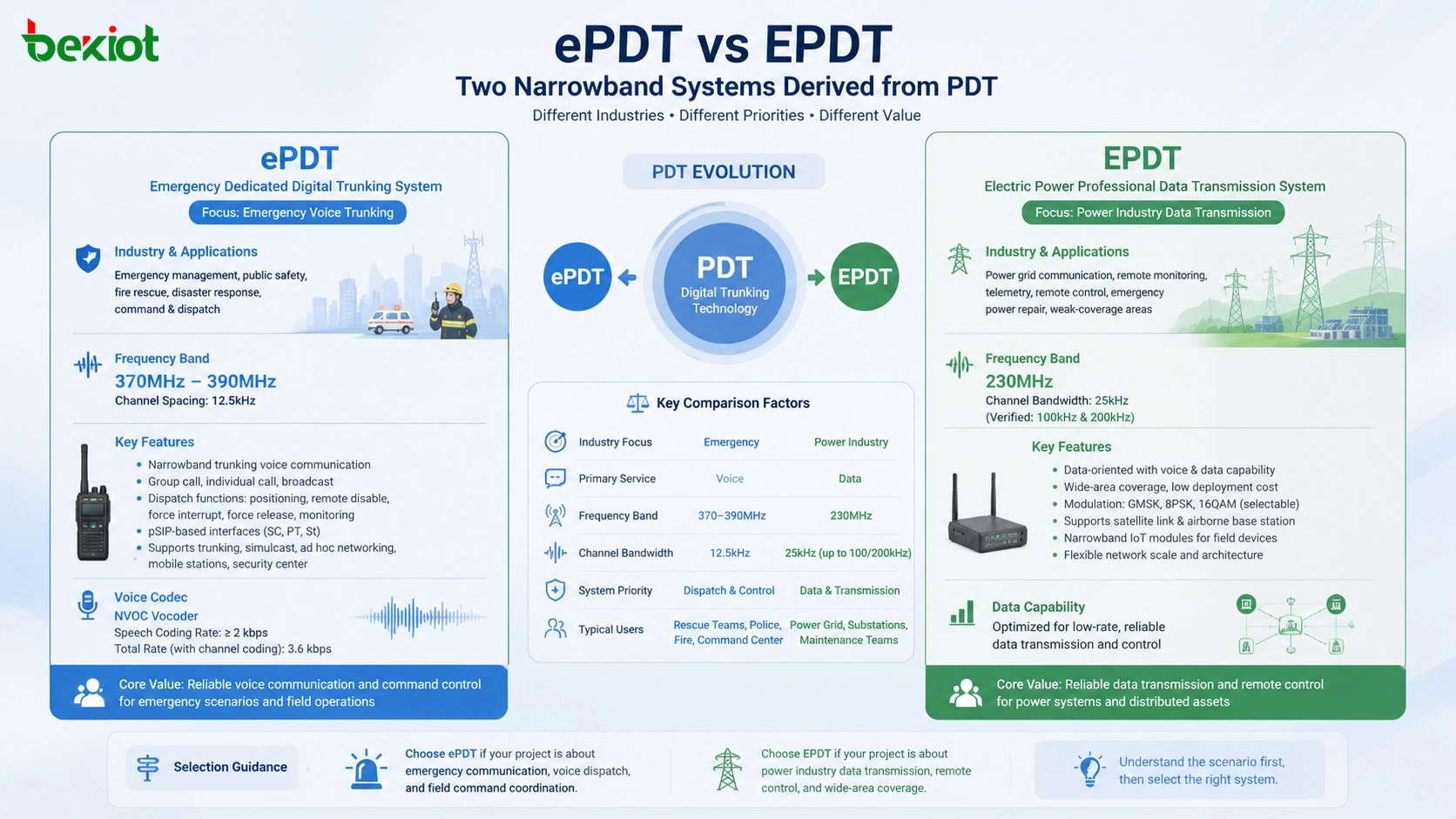
The confusion usually starts from the naming. ePDT and EPDT both include the letters “PDT”, and both systems borrow or extend ideas from PDT digital trunking technology. In project discussions, especially during early-stage requirement collection, people may assume they are only different spellings of the same system.
In fact, this assumption is wrong. ePDT and EPDT belong to different application directions. One is designed mainly for emergency communication and command coordination. The other is designed mainly for power industry data transmission and remote control scenarios.
Wrong identification may affect the whole solution
If the project team misunderstands the system type, the mistake may affect many parts of the solution. Frequency planning, base station design, terminal selection, interface development, dispatch functions, data transmission capability, and industry compliance may all be influenced.
This is why the first step in narrowband project design should not be choosing equipment. The first step should be confirming the customer’s industry, communication objective, application workflow, and system standard. Only after these points are clear can the correct technical route be selected.
ePDT Is Built for Emergency Digital Trunking
It serves emergency communication scenarios
ePDT generally refers to an emergency dedicated digital trunking system. It was developed for emergency management applications and draws on police PDT digital trunking technology. Compared with ordinary narrowband trunking, ePDT pays more attention to emergency operating environments, interconnection capability, explosion-proof application needs, and expanded system forms.
The main application direction of ePDT is voice-based trunking communication. It is used to support emergency command, rescue coordination, field team communication, group dispatch, and communication assurance during emergency events.
The system can include multiple components
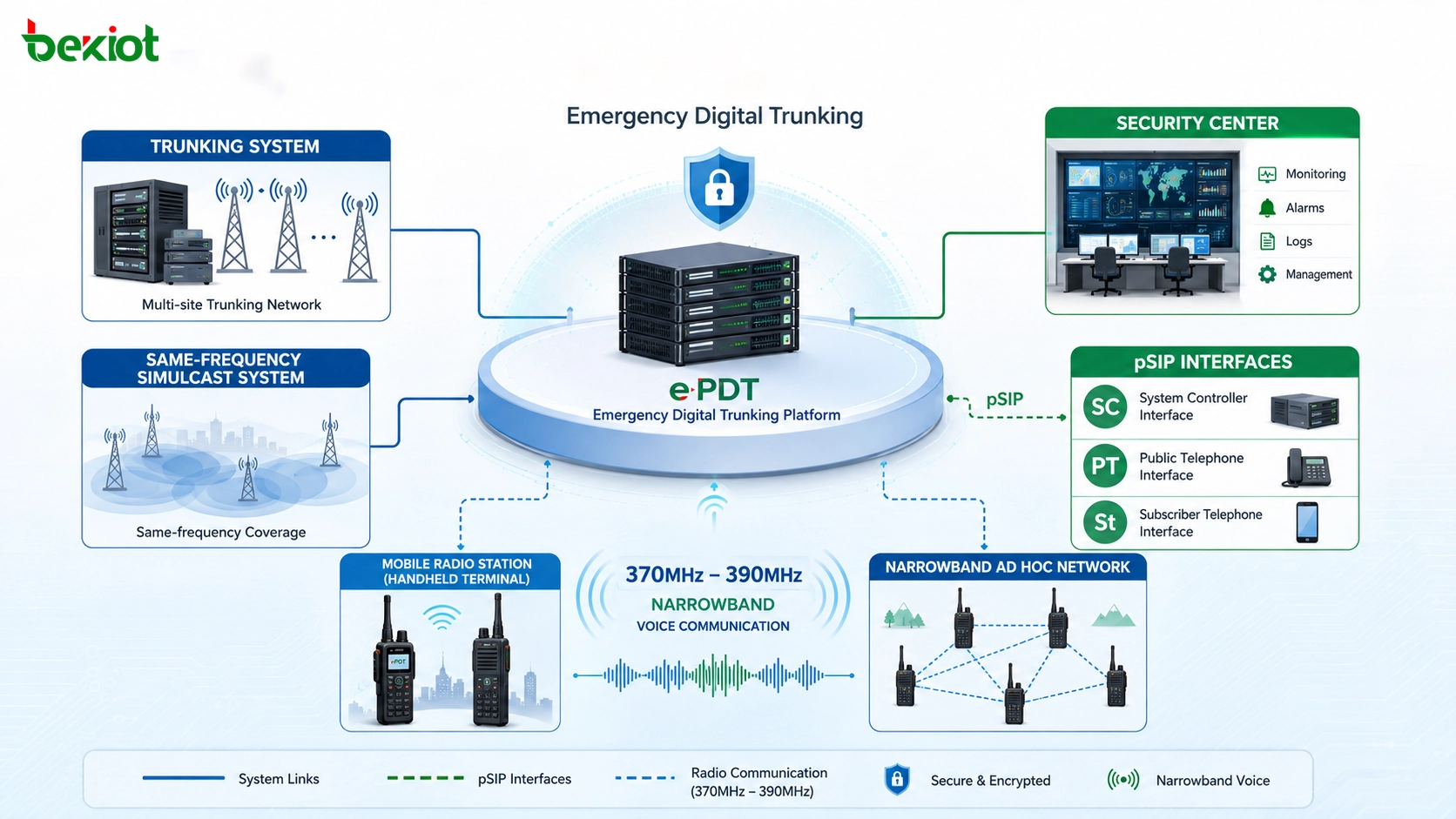
An emergency dedicated digital trunking system may include a trunking system, same-frequency simulcast system, trunking mobile stations, narrowband ad hoc networking, and a security center. Depending on the project scale and scenario, ePDT can be built with one or several of these components.
This makes ePDT suitable for different emergency communication structures. Some projects may need fixed trunking coverage. Some may need temporary field coverage. Some may need ad hoc networking for rescue operations. Some may require a security center to manage authentication and system protection.
pSIP interfaces improve interconnection potential
In interface design, ePDT uses pSIP-based development for SC, PT, and St interfaces. This helps improve system compatibility and expansion potential, especially when the platform needs to connect with dispatch systems, communication gateways, terminals, and other command applications.
For integrators, interface openness is important because emergency communication projects often involve more than one system. Voice trunking may need to work with dispatch consoles, recording systems, IP voice systems, emergency command platforms, and possibly other radio systems.
Key Technical Features of ePDT
Frequency and channel structure
In frequency planning, ePDT uses the 370MHz to 390MHz range and divides carrier channels with a 12.5kHz channel spacing. This narrowband structure is suitable for professional voice communication and trunking dispatch.
The voice codec is required to use the NVOC vocoder. The speech coding rate should be no less than 2 kbps, and the total rate after speech coding plus channel coding should be 3.6 kbps. These parameters show that ePDT is strongly optimized around narrowband digital voice communication.
Dispatch functions focus on command control
Typical ePDT capabilities include individual calls, group calls, broadcast, messages, roaming, and trunking communication functions. It can also support dispatch-related capabilities such as positioning, remote disable, forced interrupt, forced release, and monitoring.
These functions match emergency communication requirements. In rescue and emergency command scenarios, dispatchers need to know where field units are, interrupt lower-priority communication when necessary, control terminals remotely, monitor important channels, and organize communication groups quickly.
EPDT Is Designed for Power Data Transmission
It belongs to the power industry communication field
EPDT refers to the Electric Power Professional Data Transmission communication system. It is an industry-oriented system and is based on technical ideas derived from PDT, but it was developed for the characteristics of the power industry.
Unlike ePDT, which emphasizes emergency voice trunking, EPDT focuses more on data transmission. It is used to support power facility data backhaul, remote control, field communication, emergency power repair, and communication assurance in weak-coverage areas.
The 230MHz band supports wide-area deployment
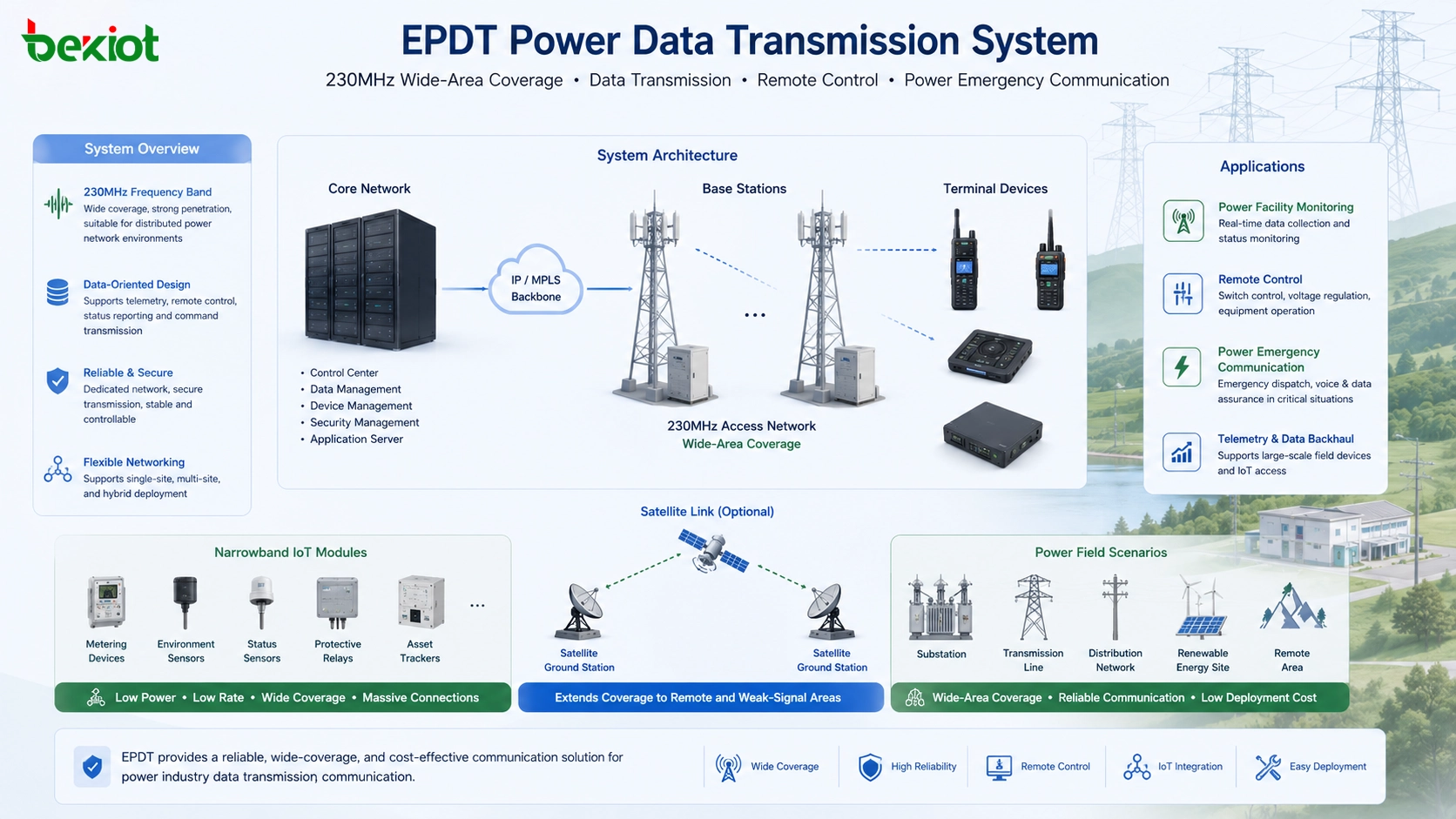
EPDT uses the 230MHz frequency band. Compared with higher-frequency systems, 230MHz communication can provide wide coverage characteristics and lower deployment cost in many power grid scenarios. This makes it useful for distributed power facilities, remote substations, overhead lines, and areas where public communication coverage may be insufficient.
Its original channel bandwidth is adjusted from 12.5kHz to 25kHz, and 100kHz and 200kHz bandwidth simulation verification has also been carried out to improve communication performance. This reflects EPDT’s stronger focus on data capability and transmission performance.
Modulation options support different performance needs
In air interface modulation, EPDT changes from a 4FSK-focused approach to selectable methods such as GMSK, 8PSK, and 16QAM. These options allow the system to adapt to different coverage, capacity, and data transmission requirements.
This is one of the major differences between EPDT and emergency voice-oriented systems. EPDT needs to balance wide-area coverage, data throughput, terminal cost, network flexibility, and application reliability for power industry use cases.
EPDT Architecture and Application Logic
It is designed as a system-level solution
EPDT is not only a terminal-level communication method. It considers a complete system structure, including core network, base stations, terminal devices, and supporting industry modules. It also takes satellite link transmission capability and the feasibility of spaceborne base stations into account for areas with weak communication infrastructure.
This system-level design is useful for power industry scenarios where facilities may be distributed across mountains, rural areas, substations, transmission corridors, and remote maintenance zones. In these environments, communication coverage and data reliability are often more important than ordinary mobile office convenience.
Narrowband IoT modules are important in the ecosystem
In the EPDT industry chain, narrowband IoT modules play an important role. Power applications often need low-rate but reliable data transmission from distributed field devices. These devices may send telemetry data, status information, alarm signals, switching state, or remote-control feedback.
EPDT can therefore support a series of power communication products and applications. It is not limited to voice communication. Its main value is helping power systems transmit data and control information across wide-area environments with practical construction cost.
Where EPDT Provides Project Value
Power emergency and repair scenarios
EPDT can be used in power emergency response, power repair operations, and anti-accident communication scenarios. When public networks are unavailable, congested, or unreliable, a dedicated or semi-dedicated narrowband system can provide a backup communication path.
It can support both voice and data capability, which makes it useful for emergency crews that need communication while also receiving status data from power facilities. In some designs, EPDT can work together with 5G or other communication methods as a fallback or complementary communication layer.
Remote monitoring and control
Power systems contain many remote assets. These assets may need to send operational data or receive control commands. EPDT’s wide coverage and data-oriented design make it suitable for remote monitoring, telemetry, and low-rate control applications.
The system can be built in large or small network structures depending on the project. This network flexibility allows EPDT to be used in different power grid communication scenarios, from local pilot projects to wider regional deployments.
Practical Differences for Project Selection
Industry direction is the first difference
The simplest way to distinguish the two systems is by industry. ePDT is mainly used in emergency management and emergency communication. EPDT is mainly used in the power industry and focuses on data transmission for power systems.
If the customer’s main requirement is field rescue communication, emergency dispatch, voice group calling, and command coordination, ePDT is usually the system direction to study. If the customer’s main requirement is power facility data backhaul, remote monitoring, remote control, and power emergency communication, EPDT is more relevant.
Voice and data priorities are different
ePDT is centered on narrowband trunking voice communication. Its functions are built around group communication, dispatch control, emergency coordination, and field command. Data capability may exist, but voice dispatch is the main application direction.
EPDT is more data-oriented. It still has voice and data capability, but its main value is solving power industry data transmission problems across wide areas. This difference should guide terminal selection, network planning, interface design, and acceptance testing.
Frequency planning is not interchangeable
ePDT uses the 370MHz to 390MHz range with 12.5kHz channel spacing. EPDT uses the 230MHz frequency band and supports wider bandwidth development from 25kHz toward 100kHz and 200kHz verification scenarios.
This means the two systems cannot be treated as the same radio network. Their frequency resources, terminal support, base station planning, link budget, coverage characteristics, and industry approval requirements may be different.
Design Notes for Integrators
Confirm the real requirement before quoting products
Before preparing a solution, integrators should confirm whether the customer is discussing emergency voice trunking or power data transmission. The system name alone is not enough. The project team should ask about industry background, frequency requirements, terminal type, command workflow, data volume, coverage area, and existing communication infrastructure.
This avoids a common problem: using the right-looking terminology but designing the wrong technical system. In narrowband projects, terminology accuracy is closely related to engineering accuracy.
Do not copy one architecture into another industry
An ePDT architecture designed for emergency dispatch should not be copied directly into a power data transmission project. Similarly, an EPDT system designed for power data backhaul should not be used as a simple replacement for emergency voice trunking without checking whether it meets dispatch requirements.
Different industries have different communication priorities. Emergency users may care more about group call control, field coordination, terminal authority, and dispatch intervention. Power users may care more about coverage, telemetry, data reliability, control feedback, and long-term field device management.
Plan interconnection carefully
Many real projects may still require interconnection with existing systems. For example, emergency communication platforms may need to connect with dispatch consoles, IP voice systems, recording platforms, or command centers. Power communication systems may need to connect with data platforms, IoT gateways, SCADA-related systems, or emergency communication networks.
The project team should evaluate protocol openness, gateway requirements, API support, security requirements, and network boundary design during the planning stage instead of leaving these issues to field debugging.
Conclusion
ePDT and EPDT are not the same system. Both are related to PDT development, but they are used in different industries and designed around different priorities. ePDT is an emergency dedicated digital trunking system that focuses on voice communication, emergency command, group calling, dispatch control, and 370MHz to 390MHz narrowband trunking.
EPDT is an electric power professional data transmission communication system. It uses the 230MHz band and is designed to support power industry data backhaul, remote control, narrowband IoT applications, flexible networking, and emergency power communication.
For solution design, the most important step is to clarify the customer’s real application scenario. If the project is about emergency rescue and command voice communication, ePDT should be studied carefully. If the project is about power facility data transmission and remote control, EPDT is the more relevant technical direction. Correct identification at the beginning can prevent wrong product selection, wrong network design, and unnecessary project risk.
FAQ
Can ePDT and EPDT terminals communicate directly with each other?
They should not be assumed to interoperate directly. Even if both systems are related to PDT concepts, their frequency bands, system structures, modulation methods, service priorities, and industry requirements are different. Interconnection would normally require dedicated gateways or system-level integration.
Is EPDT a replacement for 5G in power communication?
No. EPDT is better understood as a complementary or backup communication layer for power industry scenarios. 5G can provide high bandwidth, while EPDT can support wide-area narrowband data and emergency communication where public or broadband networks are weak or unavailable.
Why does ePDT still matter when broadband networks are available?
Emergency communication often values reliability, group control, dispatch authority, and dedicated operation. Broadband networks are useful, but narrowband trunking can still provide stable voice coordination and controlled command communication in demanding field environments.
What should be checked before selecting an EPDT solution?
The project team should check the required data type, device distribution, coverage area, 230MHz resource conditions, terminal ecosystem, base station plan, remote-control requirements, data platform interface, and backup communication strategy.
How can project documents avoid confusing the two systems?
Use the full name at first mention, define the industry scenario clearly, list the frequency band, describe the main service objective, and avoid using ePDT and EPDT as interchangeable abbreviations. A comparison table in the project proposal can also reduce misunderstanding.







