


Audio conferencing systems are still widely used in enterprises, government agencies, operation centers, industrial parks, transportation organizations, utilities, and service departments. Even when video meetings and IP collaboration platforms are available, dial-in conference calls remain important because they are simple, familiar, and accessible from ordinary telephones.
The key question is how the conferencing platform should connect to the public telephone network or an enterprise voice network. Traditional analog line access can work for small systems, but it becomes difficult to manage when many participants need to dial in at the same time. E1 trunk access offers a more efficient and carrier-grade method for connecting audio conferencing systems, especially when stable multi-channel voice access is required.
Why analog access becomes difficult as conferences grow
Early telephone conference bridge systems often connected to telecom operators through analog telephone lines. This approach is easy to understand: each analog line represents one voice path. If a conference system needs to support multiple external participants at the same time, it must connect multiple physical telephone lines.
This becomes inefficient very quickly. For example, if a 16-party audio conference bridge needs 16 participants to dial in through the public telephone network, the system may need 16 analog telephone lines to provide enough access capacity. Each line requires wiring, number management, maintenance, testing, and troubleshooting.
For small offices, a few analog lines may be acceptable. For enterprise-level conferencing, command centers, public service hotlines, dispatch systems, or organizations that hold frequent group calls, analog access creates too much cabling and management work. It also makes expansion less convenient because every additional access channel depends on additional physical line resources.
How an E1 line carries voice channels
E1 is a physical-layer digital transmission standard commonly used in telecom-grade voice service. It was defined under CCITT standards and is often referred to as a primary group signal. Its transmission rate is 2.048 Mbps, which is why many operators and engineers also call it a 2M line.
In telecom environments, E1 is widely used as a digital trunk for voice switching systems. Instead of using many separate analog telephone lines, one E1 trunk can carry multiple digital voice channels over a single physical circuit. This is the main reason it is useful for audio conferencing access.
An E1 frame is based on time-division multiplexing. Each frame is 125 microseconds long and is divided into 32 equal time slots, numbered from CH0 to CH31. Time slot CH0 is used for frame synchronization, and CH16 is commonly used for signaling in PRI-based voice applications. The remaining 30 time slots, CH1 to CH15 and CH17 to CH31, are used as 30 voice channels.
Each time slot carries 8 bits per frame. Since there are 32 time slots, one frame carries 256 bits. Because 8,000 frames are transmitted every second, the total data rate of an E1 primary group signal is 2.048 Mbps. In voice trunk applications, this structure is commonly understood as 32 channels of 64 kbps capacity, with 30 channels available for voice when CH0 and CH16 are reserved for synchronization and signaling.
Why one E1 trunk fits conference dial-in access
The most practical advantage of E1 trunk access is channel density. One E1 line can support 30 simultaneous voice calls. For a telephone conferencing system, this means many participants can call the same conference access number without the system needing a separate analog line for every participant.
This is especially suitable for dial-in audio conference services. Participants only need to remember one unified access number. Behind that number, the E1 trunk provides multiple bearer channels, allowing many users to enter the conference system at the same time.
When capacity is not enough, expansion is also clearer. Instead of adding many independent analog lines, the organization can add another E1 trunk or increase trunk capacity according to the conferencing platform and operator resources. The public dial-in number and user experience can remain more consistent.
Related Product: Becke IPGA-1E1 Trunk Gateway
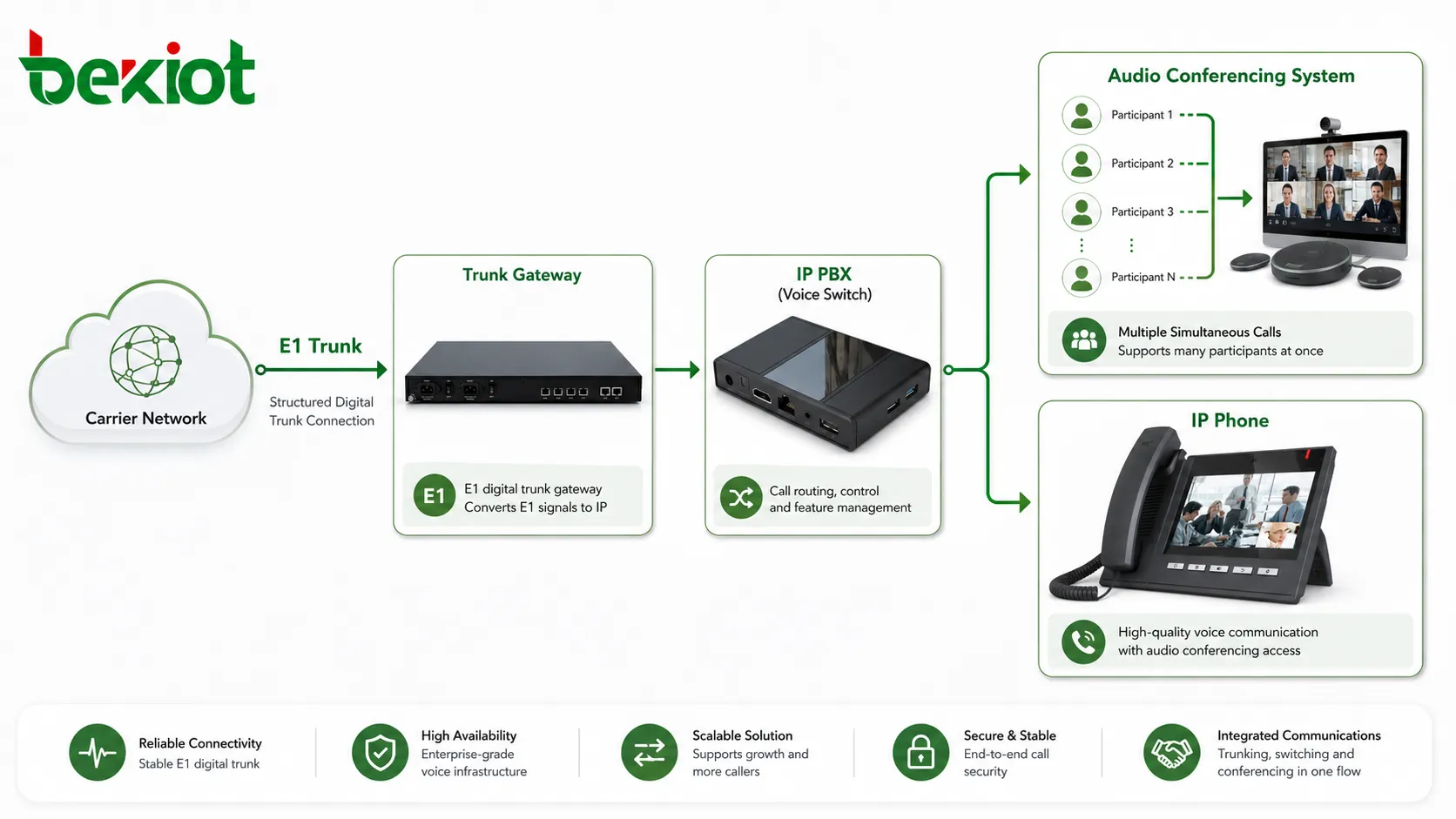
In an IP-based voice environment, an E1 trunk gateway can be used as the conversion and access layer between the carrier E1 circuit and the IP PBX, SIP server, or audio conferencing platform. It allows traditional digital trunk resources to be integrated into modern VoIP and unified communication architectures.
Physical access and interface planning
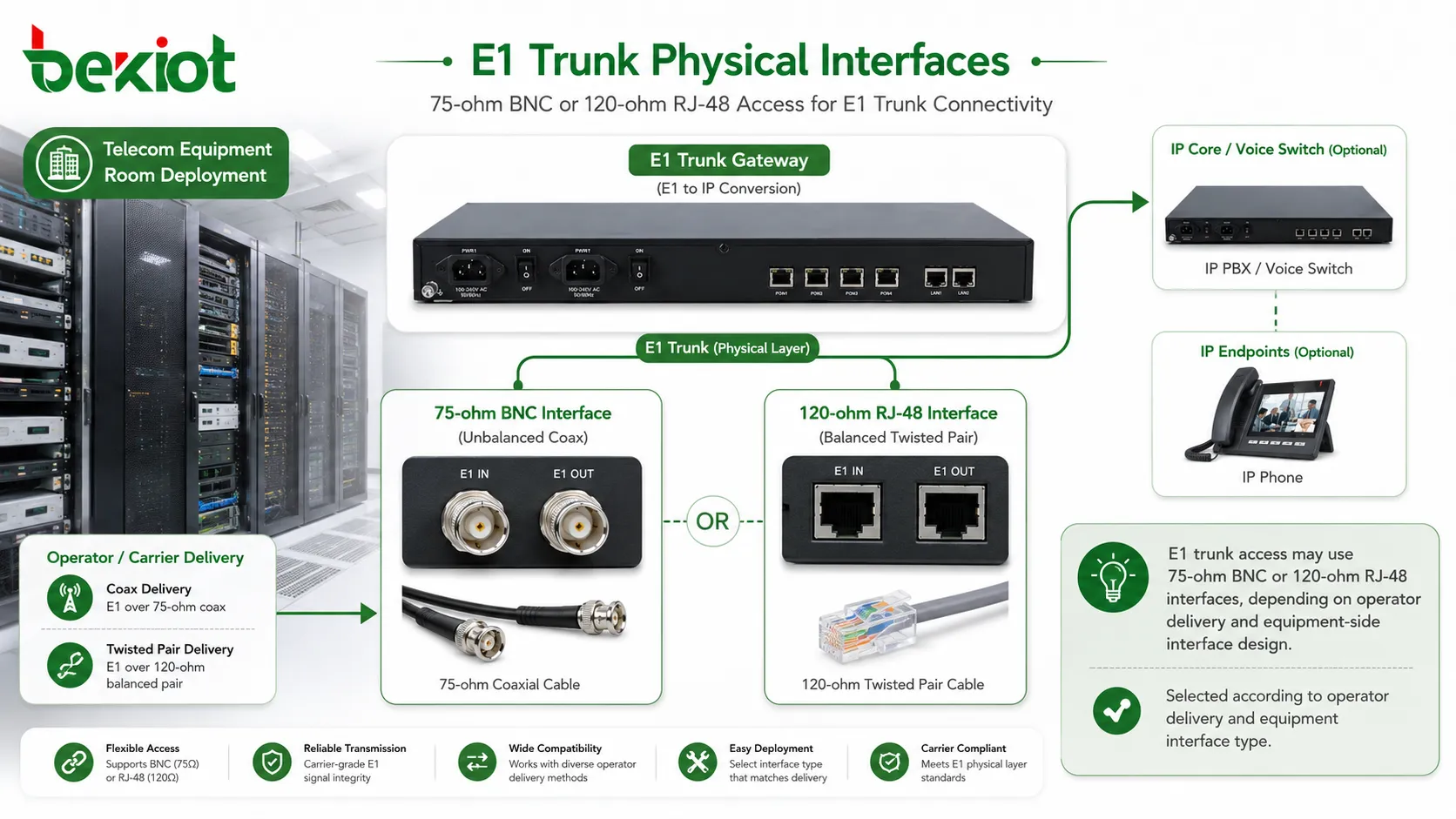
In a typical deployment, the operator delivers the E1 service to the customer’s equipment room through transmission infrastructure such as optical fiber. A transmission or optical conversion device then releases the E1 electrical interface for connection to the customer-side communication equipment.
E1 interfaces are commonly seen in two physical forms under G.703 electrical characteristics. One is the unbalanced 75-ohm interface, usually using dual coaxial BNC connectors. The other is the balanced 120-ohm interface, usually using an RJ-48 twisted-pair connector.
The difference between 75-ohm and 120-ohm access does not necessarily prevent deployment. If the operator side and the equipment side use different physical interface types, a suitable impedance converter or adapter can be used. The key is to plan the interface type clearly before installation and ensure that cabling, connectors, grounding, and transmission distance are handled correctly.
Signal direction and parameter consistency
E1 trunk installation is not only a matter of plugging in a cable. The transmit and receive direction must be connected correctly. When the remote switch or operator device uses one side as receive, the local device should connect to the corresponding transmit port. When the remote side transmits, the local side must receive. Incorrect transmit and receive wiring can prevent the link from coming up.
During commissioning, the two sides should not show signal loss, frame loss, multiframe synchronization loss, slip alarms, or other E1-layer faults. These alarms usually indicate that the physical link, clocking, framing, or parameter configuration is not correct.
Parameter consistency is also critical. Both sides of the E1 interface should use matching settings for framing, signaling, CRC, encoding, clock source, and related trunk parameters. Even a small mismatch may cause channel failure, bit errors, slipping, frame synchronization problems, or unstable call behavior.
For many audio conferencing access projects, the carrier can usually be asked to provide an E1 line with ISDN-PRI signaling, CRC disabled, and PCM30 encoding. These settings should still be confirmed according to the local operator, conferencing platform, trunk gateway, and PBX requirements.
Cleaner voice quality through digital transmission
E1 differs from analog telephone access because it uses digital transmission and structured time slots. This gives it stronger resistance to interference than traditional analog lines. In analog access, line noise, impedance problems, aging copper, and environmental interference may affect call quality.
With E1 digital trunking, voice channels are transmitted in a more controlled digital structure. When the line is correctly provisioned and synchronized, audio quality is usually clearer and more stable. This is important for conferencing, because poor voice quality affects multiple participants at the same time and can reduce meeting efficiency.
In a conference system, clarity is not only a comfort factor. Clearer audio helps participants identify speakers, reduce repeated explanations, and maintain meeting continuity. For command, dispatch, enterprise coordination, and public service meetings, stable voice quality is part of system reliability.
Faster call setup with PRI signaling
Another important advantage of E1 access is signaling efficiency. When E1 uses ISDN-PRI signaling, the signaling information is carried separately from the voice bearer channels. In the common 30-channel voice structure, CH16 is used for signaling while the other 30 channels are used for voice traffic.
This is different from traditional analog line behavior. Analog telephony often relies on tone-based status recognition, such as dial tone, busy tone, ringback tone, or other line-state indications. These methods can be slower and may introduce detection errors in certain environments.
PRI signaling allows call setup, release, caller information, channel assignment, and other call control actions to be transmitted through signaling messages. This enables faster connection handling and reduces the risk of incorrect tone detection. For a conferencing platform that may receive many incoming calls within a short period, faster and more reliable signaling is a practical advantage.
Unified numbering improves user experience
Conference access should be simple for users. If participants must remember different numbers, departments, lines, or backup access methods, meeting participation becomes more complicated. E1 trunk access helps solve this by allowing many concurrent calls behind a unified number.
In a typical audio conference service, users dial one published conference access number. The network and conferencing platform then handle channel assignment and meeting routing. The caller does not need to know whether the system is using one trunk, multiple trunks, or internal routing logic.
This improves usability for regular meetings, emergency briefings, cross-department coordination, and large-group notifications. A unified number also makes it easier for administrators to publish meeting instructions and manage long-term conference access policies.
Scalable access for enterprise and command systems
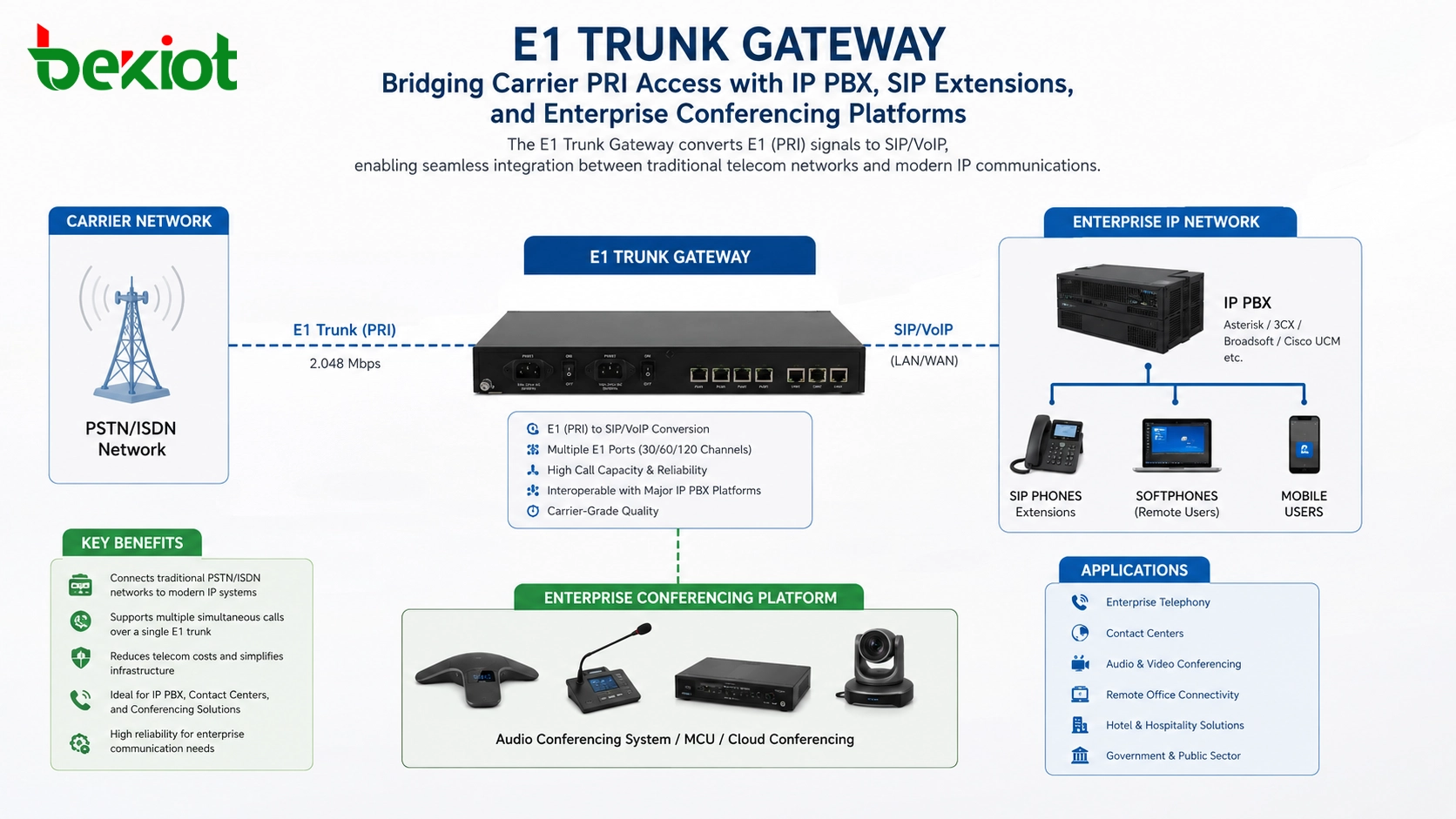
E1 trunk access is not only useful for a single conference bridge. It can also be part of a broader enterprise voice architecture. The trunk may connect to an IP PBX, a SIP-based communication platform, a dispatch system, or a dedicated conferencing server through a trunk gateway.
This architecture is useful when the organization needs to combine legacy telecom access with modern IP communication. External callers enter through the E1 trunk, while internal users may join through SIP extensions, IP phones, softphones, dispatch consoles, or unified communication clients. The gateway and PBX route the calls to the conferencing platform.
For command centers and enterprise communication rooms, this design provides a stable boundary between public network access and internal IP communication. It also allows the organization to keep carrier-grade trunk reliability while building flexible internal voice applications.
When E1 is still a strong option
IP-based voice access and IMS lines are becoming more common, and all-IP voice networks are a long-term development trend. However, E1 remains a strong option in many practical audio conferencing projects because it is mature, predictable, and widely understood by telecom operators and voice engineers.
Organizations may still choose E1 when they need stable inbound call capacity, clear channel allocation, established PRI signaling, reliable carrier interconnection, and compatibility with existing PBX or conferencing infrastructure. In some regions or industries, E1 is still one of the most dependable ways to provide multi-channel voice access.
The best approach is not to treat E1 and IP voice as opposing technologies. In many deployments, E1 is used on the carrier access side, while SIP and IP communication are used inside the enterprise network. A trunk gateway connects these two domains and allows the conferencing system to benefit from both stable digital trunk access and flexible IP routing.
Deployment checklist for project planning
Before deploying E1 access for an audio conferencing system, project teams should evaluate both operator-side conditions and equipment-side requirements. A clear checklist can reduce commissioning problems and shorten project delivery time.
Confirm whether the operator provides E1 as PRI, and confirm the expected signaling mode.
Verify the required number of concurrent inbound and outbound conference calls.
Check whether one E1 trunk with 30 voice channels is sufficient or whether multiple E1 trunks are needed.
Confirm the physical interface type: 75-ohm BNC or 120-ohm RJ-48.
Prepare adapters or impedance conversion if the operator side and device side use different interface types.
Confirm transmit and receive wiring direction before commissioning.
Match E1 framing, clocking, CRC, PCM30, and signaling parameters on both sides.
Check for signal loss, frame loss, multiframe loss, slip alarms, and bit errors.
Test inbound call concurrency, call setup speed, hang-up behavior, caller number delivery, and conference routing.
Plan number publication, trunk failover, capacity expansion, recording, and PBX integration.
Conclusion
E1 trunk access provides a practical and mature method for connecting audio conferencing systems to carrier-grade voice networks. Compared with analog line access, it reduces cabling complexity, supports 30 simultaneous voice channels over one 2.048 Mbps line, enables unified dial-in numbering, improves voice stability, and provides faster call control through PRI signaling.
Its technical structure is also clear. An E1 frame contains 32 time slots, with CH0 used for synchronization, CH16 commonly used for signaling, and 30 channels available for voice. This makes E1 especially suitable for conference systems that need multiple participants to dial in through one access number.
Although IMS and IP-based voice access are becoming increasingly important, E1 remains valuable where stable digital trunking, predictable channel capacity, and carrier-grade interconnection are required. When combined with an E1 trunk gateway and an IP PBX or SIP-based conferencing platform, it can form a reliable bridge between traditional telecom networks and modern enterprise communication systems.
FAQ
How many simultaneous voice calls can one E1 trunk support?
In a common PRI voice configuration, one E1 trunk supports 30 simultaneous voice channels. The remaining time slots are used for synchronization and signaling functions.
Why is E1 better than multiple analog lines for conferencing?
E1 reduces physical wiring, simplifies trunk management, provides digital voice transmission, supports unified dial-in numbering, and allows many concurrent calls over a single structured circuit.
Does E1 work with IP PBX systems?
Yes. An E1 trunk can connect to an IP PBX or SIP-based conferencing system through an E1 trunk gateway. The gateway converts between the traditional digital trunk side and the IP voice network side.
What should be checked if an E1 trunk cannot make calls?
Engineers should check physical interface type, transmit and receive wiring, clock source, framing mode, CRC setting, PRI signaling, PCM30 encoding, alarms, and whether both sides use matching trunk parameters.







