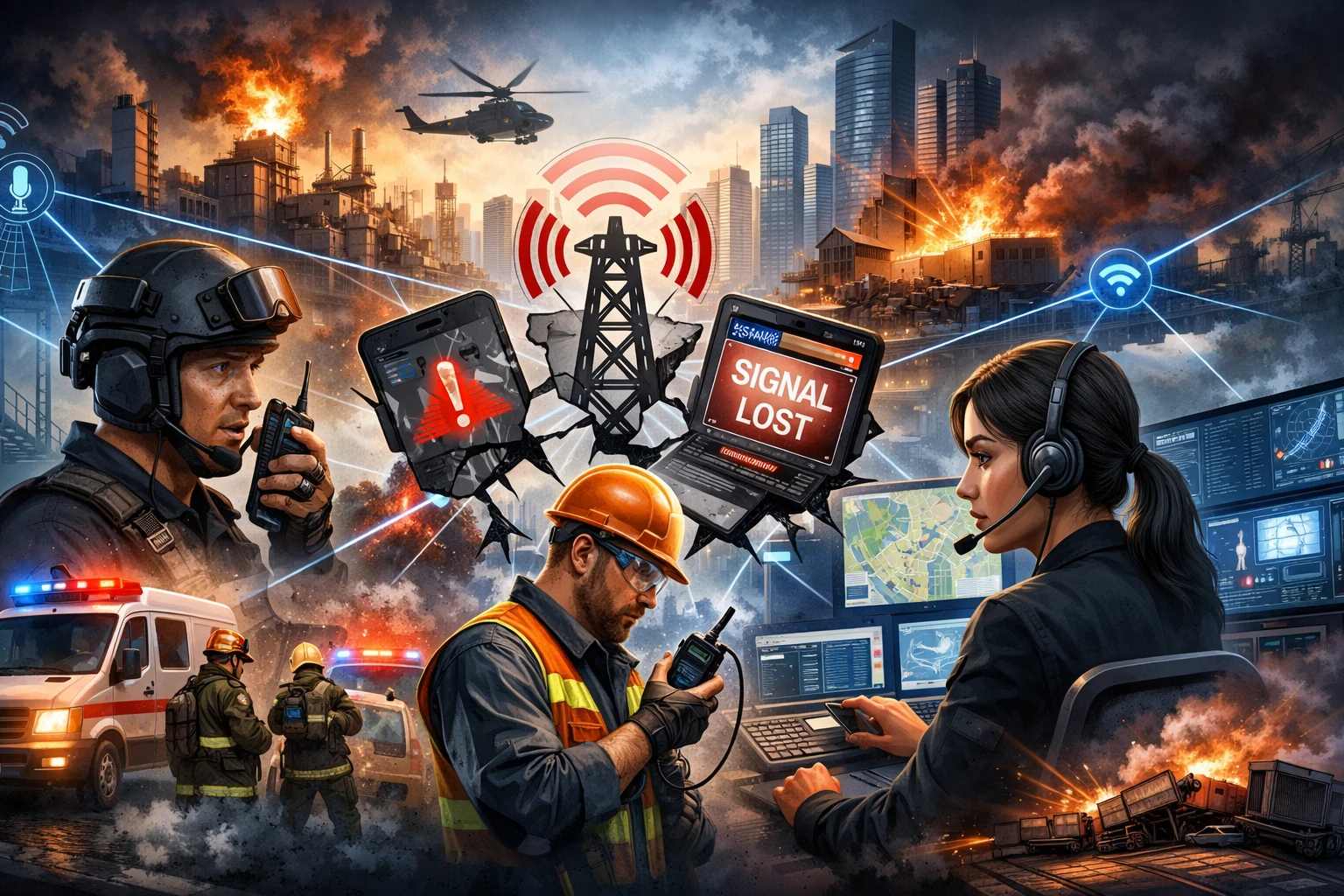
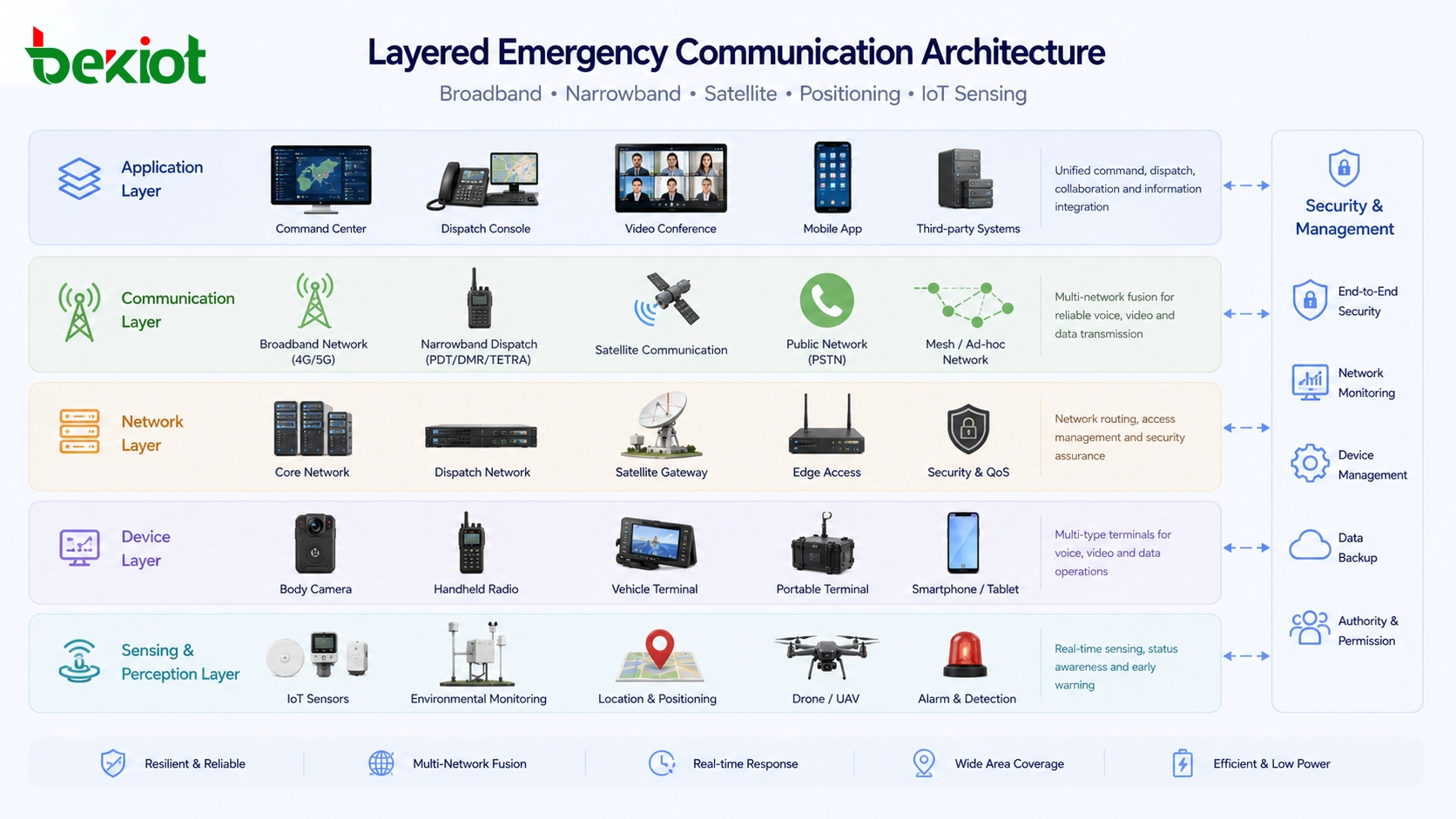
Emergency response communication must continue working when ordinary infrastructure is congested, damaged, unavailable, or unable to cover the incident area. A reliable solution cannot depend on one single network. It should combine broadband transmission, narrowband voice dispatch, satellite backup, positioning, short-message capability, and IoT sensing so that field teams, command vehicles, temporary command posts, and rear command centers can stay connected under complex conditions.
The YJ/T27-2024 specification for emergency command communication capability construction provides an important reference for building this kind of system. It divides field communication technologies into three main groups: broadband communication, narrowband communication, and IoT communication. Together, these technologies cover on-site audio, video, data transmission, command dispatch, location reporting, equipment sensing, and last-resort communication.
Standards help turn equipment into a system
Emergency communication planning should not only focus on buying terminals or deploying a single network. The real goal is to build a capability system that supports teams, command posts, vehicles, aircraft, mobile units, and rear platforms. YJ/T27-2024 gives project planners a framework for evaluating communication teams, technical means, deployment methods, and field support requirements.
In practical projects, this means that broadband links should support video and data return, narrowband systems should support stable voice dispatch, satellite links should protect long-distance communication, and IoT networks should collect field sensing information. These layers should work together rather than operate as isolated subsystems.
A complete solution should also consider fast deployment, self-organizing networking, multi-vendor interoperability, terminal mobility, command center access, and service continuity when the environment changes.
Broadband links carry video and high-speed data
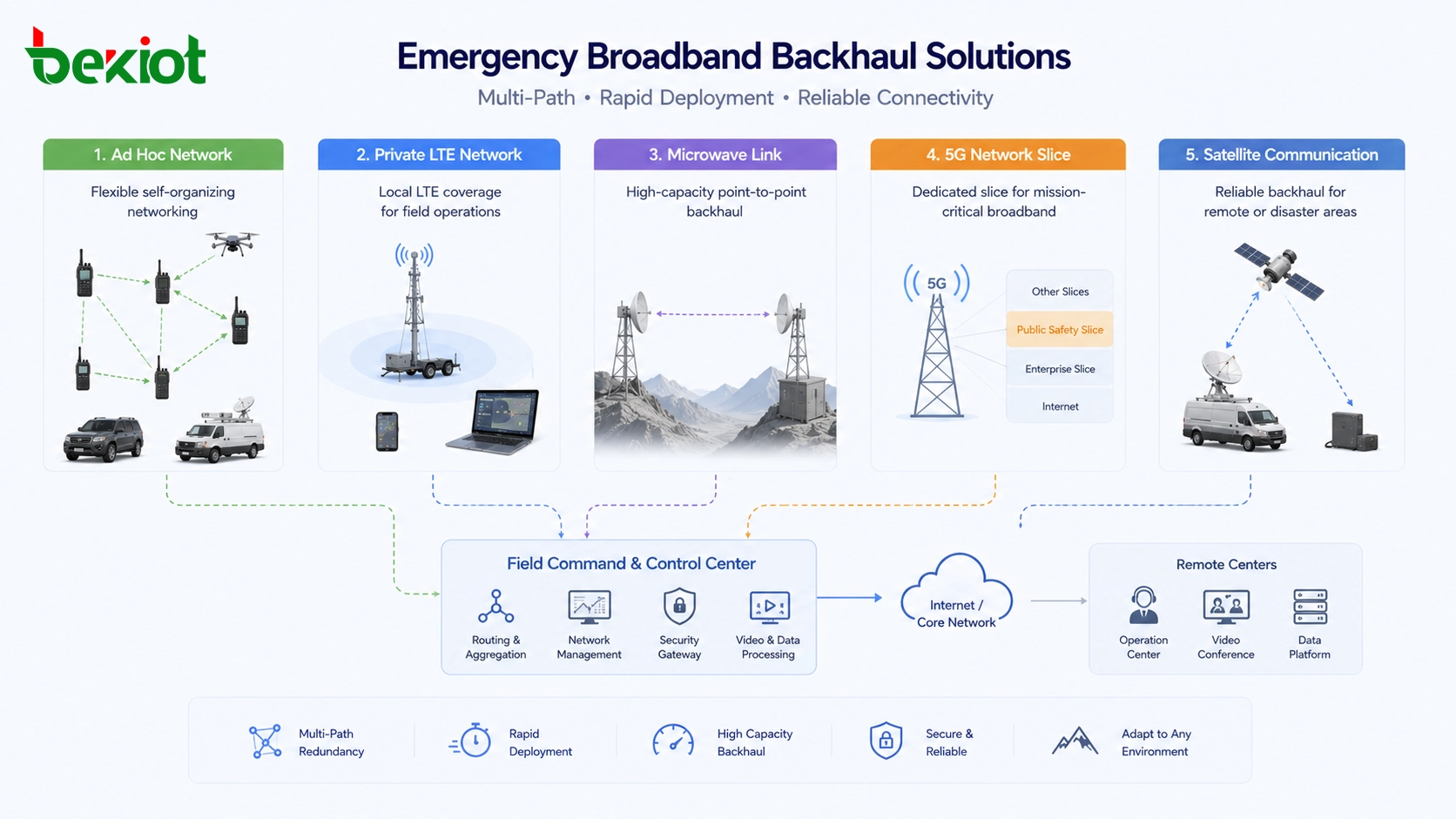
Broadband communication is used when the response site needs video backhaul, multimedia dispatch, large data exchange, map transmission, mobile terminal access, and command platform connectivity. It is especially important for field command vehicles, rescue sites, temporary command posts, drone video return, and mobile team collaboration.
A broadband ad hoc network is suitable for rapid field deployment because it is simple to build, quick to start, and able to form a network automatically. It should support self-organization and self-healing so that communication nodes can adapt when vehicles, teams, or relay points move. Under an open line-of-sight scenario with omnidirectional antennas, a single-hop base station link should support a transmission distance of at least 100 km, with a data rate of at least 30 Mbps and device transmit power not greater than 10 W.
Key technologies may include OFDM, TDMA, ATPC, and interference-resistant same-frequency transmission methods. The network should support multiple frequency bands and flexible topologies, including star, chain, mesh, and hybrid networking. It should also support different terminal forms such as handheld, backpack, vehicle-mounted, and airborne nodes.
Private LTE and 5G support mobile field operations
LTE private networks are useful when a field command area needs broadband wireless coverage for multiple users and multimedia services. They can provide cluster multimedia communication and packet data services for rescue sites, disaster response zones, and temporary command areas. Typical applications include field audio and video calls, command dispatch, location services, and mobile terminal access.
A practical LTE private network should follow LTE-based technical standards such as those defined by CCSA or B-TrunC organizations. It should support peak data rates of at least 100 Mbps downlink and 50 Mbps uplink, while also providing low latency, wide coverage, and strong high-speed mobility. Positioning and timing support such as BeiDou and GPS can improve team coordination and network synchronization.
5G network slicing provides another option when public wireless infrastructure can be used with priority and logical separation. Through QoS priority scheduling and DNN soft slicing, 5G can support secure access for emergency command information networks, voice and video return, mobile individual terminals, IoT data, and wide-narrowband convergence services.
Microwave systems strengthen the backhaul layer
Microwave broadband links are often used to build dedicated high-capacity transmission paths between field nodes, temporary command posts, relay points, and rear centers. Directional microwave transmission can provide high bandwidth, low latency, and flexible networking for disaster rescue and field operations.
A microwave broadband private link should support a transmission rate of at least 200 Mbps and a single-hop distance of at least 5 km. It should also support multi-hop cascade transmission. Under equivalent signal conditions, cascaded transmission should avoid obvious bandwidth loss and should not introduce unnecessary delay. Fast antenna alignment is also important because emergency deployment cannot depend on long engineering preparation.
For difficult terrain or damaged infrastructure, microwave links can act as a temporary backbone, connecting field video, command data, vehicle systems, and local broadband networks to the command center.
Over-the-horizon and satellite links protect continuity
Some incidents occur in remote mountains, offshore areas, large disaster zones, deserts, forests, or regions where terrestrial communication links are unavailable. In these cases, over-the-horizon and satellite technologies become important backup or primary communication methods.
Microwave scatter communication uses tropospheric scattering to build long-distance point-to-point links beyond line of sight. It can be used as a resilient communication method when ordinary terrestrial paths are difficult to establish. A practical system should support point-to-point over-the-horizon communication up to 90 km, with a data rate of at least 4 Mbps and IP transparent transmission.
High-throughput broadband satellite communication can support long-distance broadband access between disaster sites, field command posts, and rear command centers. A single station should support at least 6 Mbps uplink and 40 Mbps downlink. It should also support terminal access within the coverage area, emergency command network services, public Internet communication, and different terminal forms such as portable, vehicle-mounted, and airborne deployment.
Ku-band large-beam satellite communication can provide dedicated point-to-point links with wide-area coverage. It is suitable for single-channel video collection, emergency trunking mobile stations, and basic long-distance transmission when other links are not available.
Voice dispatch still needs narrowband protection
Even when broadband networks are available, narrowband communication remains essential for emergency command. Voice dispatch must be simple, stable, direct, and resilient. It should support team communication when broadband bandwidth is limited or when video and data networks are interrupted.
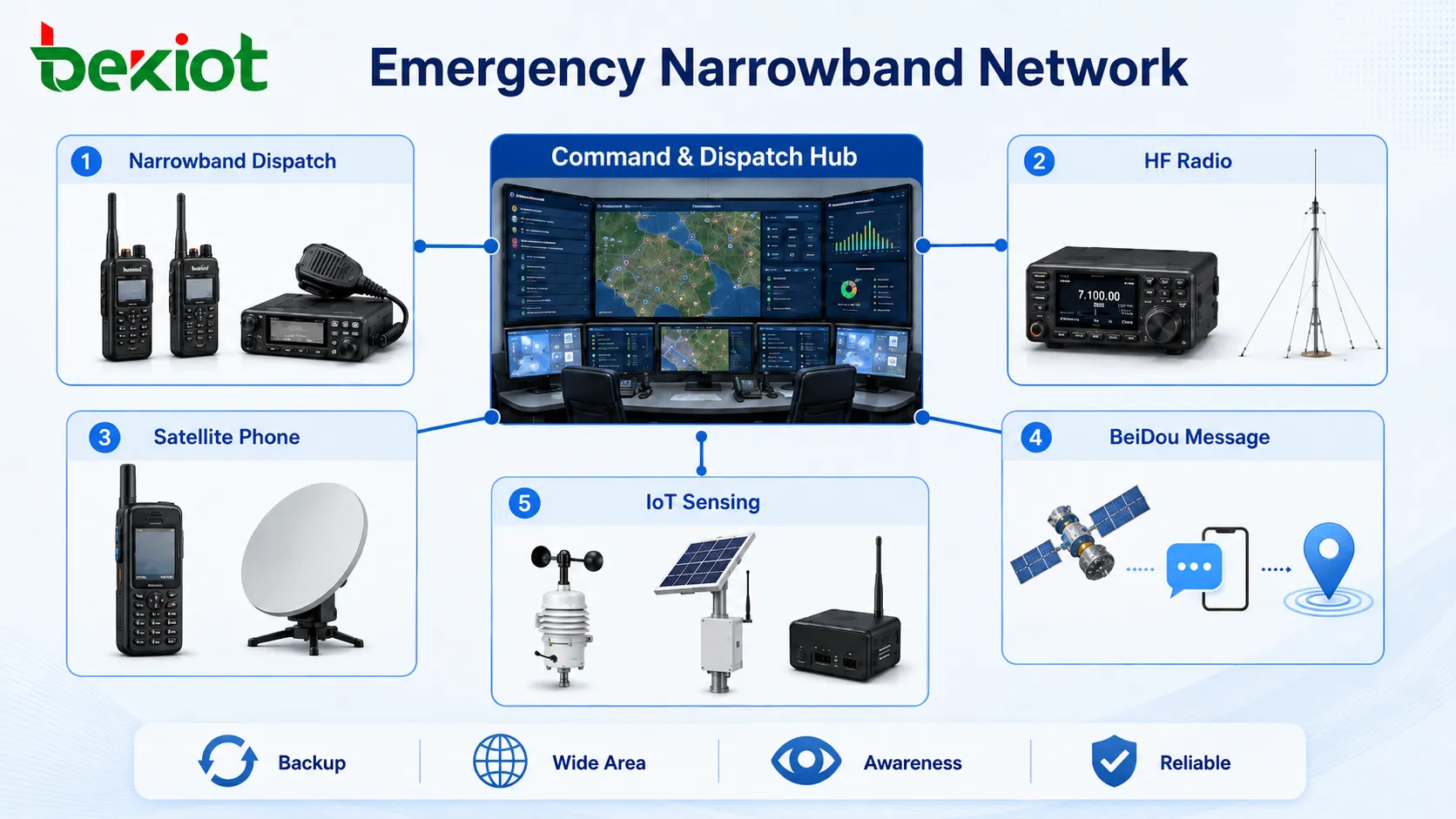
Narrowband trunking communication mainly uses the 370 MHz emergency dedicated frequency range to build command voice networks for disaster rescue and field dispatch. A digital trunking system should support PDT technology, 4FSK modulation, simulcast networking, and multiple working modes such as direct mode, repeater mode, and trunking mode.
The related emergency frequency ranges include 372 MHz to 376 MHz and 382 MHz to 386 MHz. Through IP technology and network switching, narrowband trunking systems can also connect with public PoC systems, supporting convergence between dedicated emergency networks and public communication services.
Self-forming voice networks extend field coverage
Narrowband ad hoc networks are used to extend voice links between teams, vehicles, relay points, and field command posts. Like broadband ad hoc systems, they should support simple deployment, automatic networking, and network self-healing. However, their main task is to protect voice and low-rate data services rather than large multimedia traffic.
A narrowband ad hoc network should support at least four nodes and allow chain, mesh, star, or hybrid automatic networking. It should support voice and data services, allow PDT or DMR handheld and vehicle terminals to access the network, and operate in the 370 MHz emergency dedicated band.
Different terminal forms are also important. Backpack, vehicle-mounted, airborne, and fixed deployment options allow the same communication layer to support walking teams, mobile vehicles, aerial relays, and temporary fixed command points.
HF radio and mobile satellite are last-resort tools
Emergency HF communication uses ionospheric reflection to support long-distance narrowband communication. It is suitable for point-to-point communication when conventional networks are damaged or unavailable. A practical HF system should support the 3 MHz to 30 MHz frequency range, adaptive real-time frequency selection, and anti-interference capability.
Mobile satellite communication also plays an important backup role. Satellite mobile services can provide voice, SMS, and short data communication for emergency rescue teams. Terminals may include handheld, hotspot, and vehicle-mounted forms, allowing field personnel to stay connected even when terrestrial coverage is unavailable.
These technologies may not carry high-bandwidth services, but they provide strong resilience. In emergency planning, a low-rate but available link can be more valuable than a high-speed network that cannot be reached.
Positioning and short messages support command assurance
BeiDou-3 command communication is valuable in extreme conditions because it combines positioning, navigation, timing, and short-message communication. It can support emergency communication, command rescue, disaster reporting, location monitoring, and early warning applications.
BeiDou short-message technology provides a communication path when ordinary networks are unavailable. The system also offers all-weather, wide-area coverage and high reliability. Terminal forms may include handheld devices, wearable single-person equipment, vehicle-mounted terminals, airborne terminals, and shipborne equipment.
For rescue command, positioning and short-message services help the command center know where teams are, where incidents are developing, and whether critical messages have been sent when other networks fail.
Sensor networks add field awareness
IoT communication is used to build equipment sensing and environmental monitoring networks at emergency sites. It can collect information from personnel, environments, vehicles, rescue equipment, and large machinery. This helps the command center understand not only where teams are, but also what conditions they are facing.
Technologies such as LoRa, NB-IoT, ZigBee, and Bluetooth can be used for wireless self-organizing device communication. These methods are suitable for low-power, low-cost, and flexible deployment. They are not designed for high-bandwidth video, but they are effective for small packets, status information, alarms, and sensing data.
Useful IoT data may include personnel vital signs, field environmental factors, equipment operating conditions, gas concentration, temperature, humidity, water level, battery status, and large equipment working state. When this data is integrated with command platforms, video systems, and dispatch workflows, emergency response becomes more data-driven.
Recommended multi-layer solution
A practical emergency communication solution should use different technologies for different tasks. Broadband systems should carry video, high-speed data, mobile terminals, and field command applications. Narrowband systems should protect voice dispatch and team coordination. Satellite and HF systems should provide long-distance and last-resort communication. BeiDou should support positioning and short-message assurance. IoT networks should collect field sensing data.
| Layer | Main Role | Typical Technologies |
|---|---|---|
| Broadband Field Network | Video return, data transmission, multimedia command | Broadband ad hoc network, LTE private network, 5G slicing |
| Backhaul and Relay | Long-distance connection between field and command center | Microwave broadband link, microwave scatter, satellite communication |
| Voice Dispatch | Team command, group calling, basic rescue coordination | PDT trunking, DMR access, narrowband ad hoc networking |
| Fallback Communication | Communication when normal networks fail | HF radio, mobile satellite voice, BeiDou short message |
| Field Sensing | Personnel, environment, and equipment monitoring | LoRa, NB-IoT, ZigBee, Bluetooth |
Planning points before deployment
Before deploying an emergency command communication system, project teams should first define the operating environment. Mountain rescue, urban flood control, industrial accidents, mining rescue, forest fire response, maritime rescue, and earthquake disaster relief may require different combinations of broadband, narrowband, satellite, and IoT technologies.
The communication plan should also consider service priority. Voice dispatch should remain available even when video traffic is heavy. Critical location and short-message data should have fallback paths. Broadband links should be optimized for video and data, while satellite and HF links should be reserved for long-distance or infrastructure-damaged scenarios.
Finally, the system should be tested as a whole. Coverage, mobility, interconnection, bandwidth, latency, voice clarity, video return, power supply, terminal deployment, command center access, and multi-network switching should all be verified under realistic field conditions.
Conclusion
Emergency command communication capability is built by combining multiple technical means rather than relying on a single network. Broadband ad hoc networks, LTE private networks, microwave links, 5G slicing, satellite communication, narrowband trunking, HF radio, BeiDou short message, and IoT sensing each solve a different part of the field communication problem.
A strong solution should provide high-speed video and data where possible, reliable voice dispatch where necessary, and fallback communication when conditions become extreme. By designing broadband, narrowband, satellite, positioning, and sensing layers together, emergency teams can build a more resilient communication system for complex rescue and command scenarios.
FAQ
Should emergency communication planning start with broadband or voice dispatch?
It should start with mission priority. If the task depends on visual command, broadband video return is essential. If the task depends on team coordination in harsh conditions, narrowband voice dispatch must be protected first.
Why is it risky to depend on only one network?
A single network may fail because of congestion, terrain blockage, power loss, base station damage, or limited coverage. Layered networking gives the command team alternative paths when one link becomes unavailable.
When is satellite communication most useful?
Satellite communication is most useful in remote areas, large disaster zones, damaged infrastructure environments, offshore operations, and field sites where terrestrial communication cannot provide stable coverage.
Can IoT sensing replace voice or video communication?
No. IoT sensing provides environmental, personnel, and equipment data. It should complement voice dispatch and video return rather than replace them.
What should be tested before delivery?
The project should test field coverage, terminal mobility, network switching, voice dispatch, video backhaul, satellite fallback, positioning accuracy, IoT data reporting, and command center platform integration.