


Audio conferencing remains one of the most practical multi-party communication services in the telecom and enterprise market. It is easy to use, fast to organize, and widely accepted by business users who need stable voice meetings without complex software preparation. For telecom operators, virtual operators, and service providers with large voice line resources, audio conferencing can become a valuable service model that turns existing network capacity into a profitable, compliant, and scalable business application.
As regulations against nuisance calls become stricter, operators need legitimate voice services that can carry traffic without creating business risk. Enterprise audio conferencing fits this need well. It is a pure business communication application, has clear user demand, supports paid service models, and can help voice resource owners improve line utilization while serving real enterprise collaboration needs.
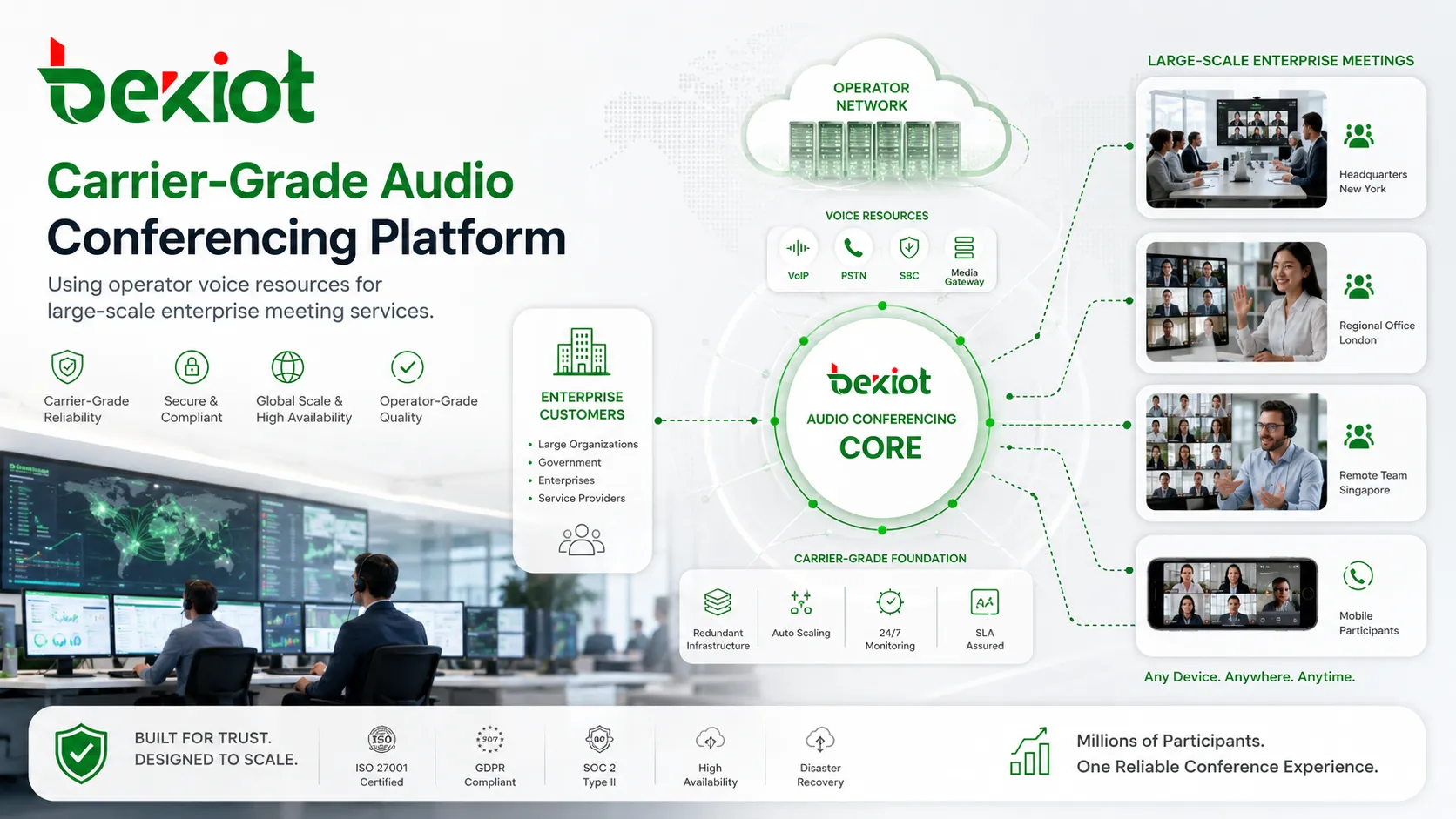
Business Value for Operators and Service Providers
Turning idle voice resources into service revenue
Many operators and virtual operators own a large number of telephone lines, access numbers, trunks, and switching resources. These resources need suitable business traffic to improve utilization. Audio conferencing is a good match because it is based on real enterprise communication demand rather than outbound marketing or high-risk call scenarios.
Unlike nuisance call traffic, conference calling is normally initiated for internal meetings, customer communication, project coordination, supplier negotiation, training, and cross-branch collaboration. This makes it a more sustainable and acceptable voice service for long-term operation.
Higher commercial acceptance
Business users are generally familiar with paying for conference communication services, especially when the service offers stable access, clear audio, convenient joining methods, and reliable multi-party capacity. This gives operators more room to design service packages, enterprise accounts, API access plans, or value-added conferencing products.
For service providers, the key opportunity is not only to provide minutes or lines, but to package voice resources into a complete conferencing platform that enterprises can use directly.
Lower operational risk than uncontrolled call traffic
With stronger control over outbound call behavior in many markets, operators need voice applications that are easier to justify, monitor, and manage. Audio conferencing has a clearer business purpose, more predictable usage behavior, and better alignment with enterprise collaboration scenarios.
When supported by access control, account management, meeting records, and usage reporting, the service can become a structured communication product rather than unmanaged traffic consumption.
Architecture Designed for High-Capacity Operation
Resource server as the core mixing layer
A large-scale conferencing platform needs a dedicated resource layer for audio mixing, participant access, meeting room management, call control, and media processing. This resource server is responsible for handling large concurrent meetings and ensuring that multiple participants can speak and listen in real time.
For carrier-grade operation, the platform should be designed for high capacity and high concurrency from the beginning. It should not only support small internal meetings, but also enterprise customers, multiple simultaneous conferences, and different service packages running on the same infrastructure.
Flexible physical or virtualized deployment
The platform can be deployed on physical servers, virtual machines, or cloud-based infrastructure depending on the operator’s network environment and business model. Physical deployment is suitable for controlled telecom rooms, private data centers, or high-security environments. Virtualized deployment offers faster resource adjustment and easier capacity expansion.
With virtualization, operators can scale conferencing resources by increasing computing capacity, media processing resources, access capacity, and system nodes. This makes expansion more flexible than a fixed hardware-only deployment model.
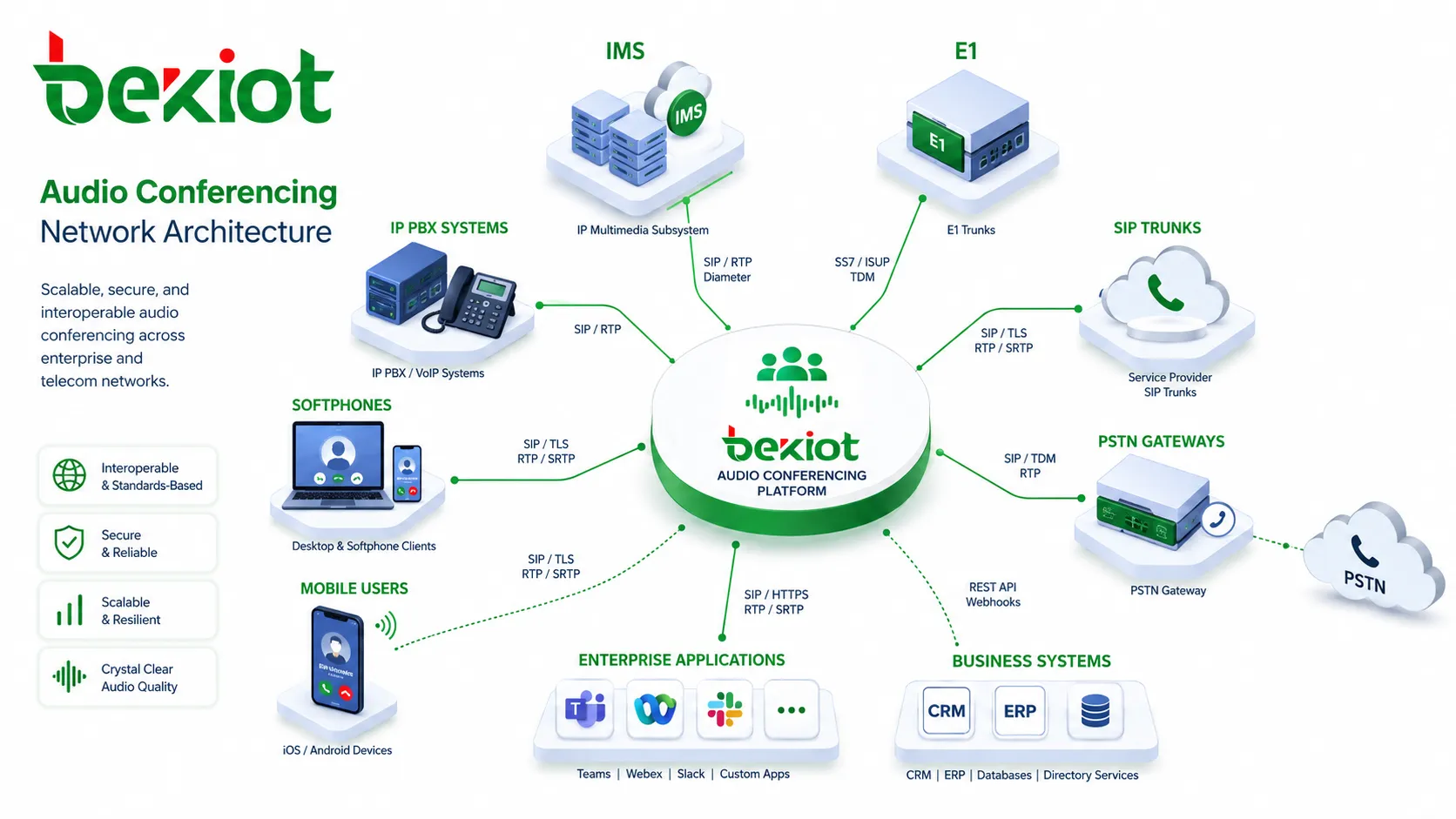
Connection with IMS, E1, SIP, and gateway access
Carrier-grade conferencing should interconnect with different voice access networks. The system may connect with operator IMS platforms, traditional E1 lines, SIP trunks, access gateways, PSTN systems, or IP voice networks. This allows mobile users, fixed-line users, IP phone users, enterprise PBX users, and external participants to join the same conference service.
Interconnection capability is critical because operators often operate mixed environments. Some customers may still use traditional telephony, while others rely on SIP-based enterprise communication systems. A practical platform must support both legacy and IP-based access paths.
Audio Processing and Full-Duplex Experience
Clear mixing for large concurrent meetings
Audio mixing quality directly determines whether the conferencing service feels professional. In a true multi-party meeting, the system must mix voices from multiple participants and distribute the processed audio clearly to all users. Poor mixing can create delay, interruption, clipping, echo, or unnatural conversation flow.
A large-scale platform should support full-duplex conferencing so participants can communicate naturally instead of waiting for one person to finish speaking. This is especially important for business discussions, emergency coordination, customer meetings, and project collaboration where immediate response is required.
Noise handling for different terminals and environments
Participants may join from mobile phones, fixed phones, IP phones, conference terminals, softphones, noisy offices, factory sites, vehicles, meeting rooms, or remote work locations. Different devices and environments create different background noise problems.
The platform should therefore support appropriate noise suppression, echo control, media processing, and audio optimization strategies. A stable voice experience improves customer satisfaction and helps operators build a differentiated conferencing service rather than a basic call connection product.
Low resource consumption with scalable performance
For operators, media processing efficiency matters because it affects server cost, power consumption, capacity planning, and profit margin. A well-designed resource layer should provide high concurrent processing capability while keeping computing resource consumption under control.
This balance is essential for commercial operation. The platform must be able to scale, but it should also allow the service provider to launch conferencing services at a reasonable cost.
Open Interfaces for Service Innovation
API-driven service development
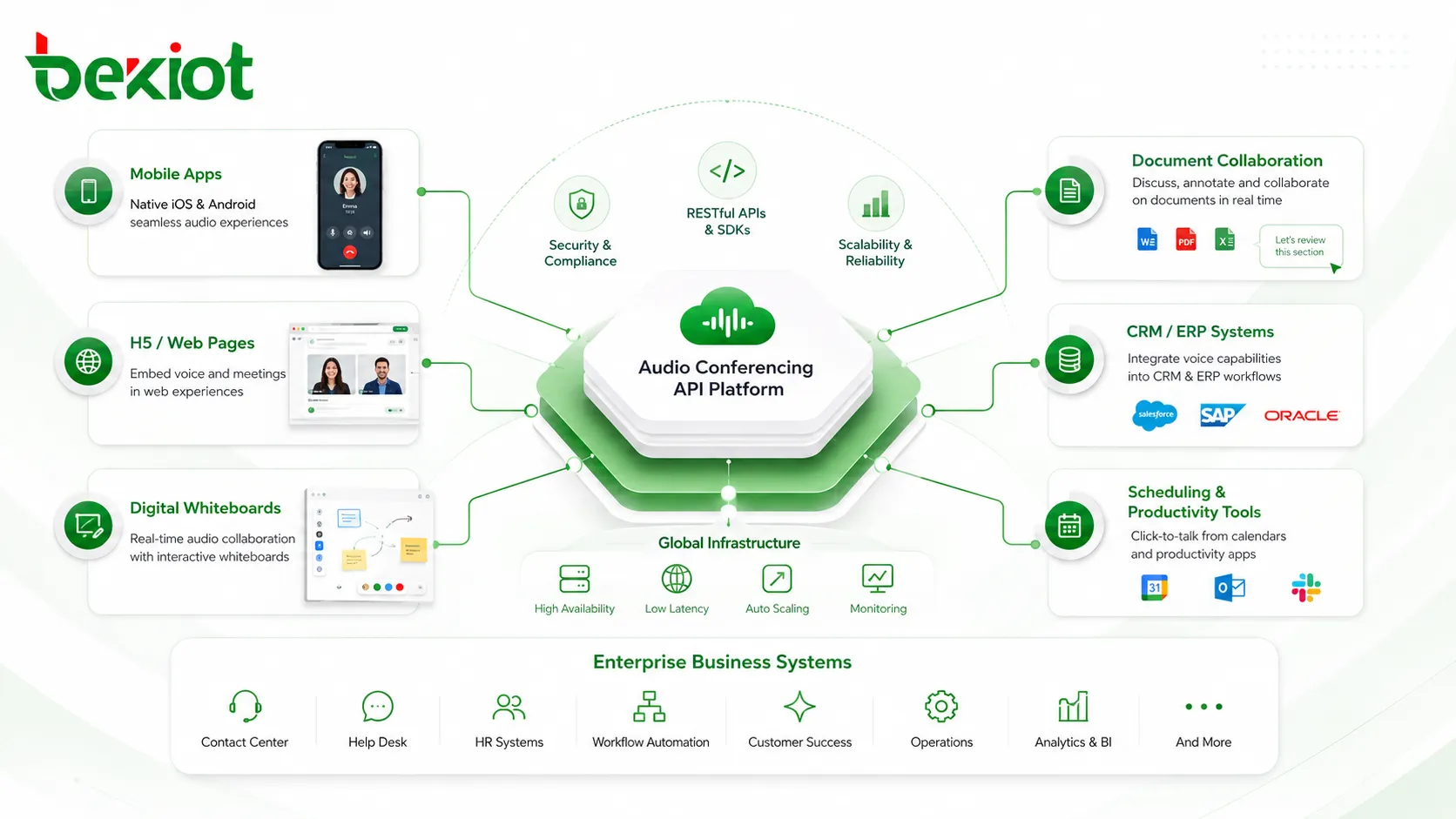
Audio conferencing becomes more valuable when it is not limited to a single fixed product interface. With flexible APIs, operators and platform providers can build customized conferencing applications, enterprise portals, scheduling systems, mobile apps, H5 pages, customer self-service systems, and industry-specific meeting workflows.
APIs allow the conferencing platform to become a service capability rather than a closed application. This is important for operators that want to support different customer segments, including enterprises, government agencies, industrial users, education organizations, and platform-based partners.
Integration with business applications
A conferencing platform can connect with enterprise business systems, OA platforms, customer management systems, scheduling tools, authentication systems, and collaboration software. Users can create meetings, invite participants, manage access numbers, control meeting rooms, or retrieve meeting records from a familiar business interface.
This improves user experience and makes the conferencing service easier to embed into customer workflows. For example, a company can launch a meeting from an internal portal, a field service platform, a project management system, or a customer support application.
API resale and ecosystem expansion
Service providers can also repackage conferencing APIs and offer them to third-party developers, software vendors, system integrators, and enterprise customers. These partners may combine audio conferencing with whiteboard systems, cloud storage, document collaboration, dispatch platforms, customer service tools, or industry applications.
This creates a broader service ecosystem. Instead of selling only conference minutes, the operator can provide conferencing capability as a platform resource that supports multiple business models.
Deployment Path for Large-Scale Operation
Start from access resources and target users
Before deployment, the operator should evaluate available voice resources, including IMS access, E1 lines, SIP trunks, PSTN gateways, numbering resources, existing switching platforms, and data center conditions. The platform design should match both current resources and the target customer groups.
If the main customers are enterprise users, the system should focus on account management, enterprise sub-accounts, meeting room allocation, billing rules, user permissions, and high-quality audio. If the target is platform partners, API stability and developer access become more important.
Plan capacity by commercial scenarios
Capacity planning should consider the expected number of enterprise customers, concurrent conferences, average participant count, peak meeting periods, trunk capacity, media processing load, API request volume, and recording or reporting requirements.
For carrier-grade deployment, average daily usage is not enough. The system should be prepared for peak traffic, large customer meetings, unexpected usage growth, and future expansion. Virtualization can help with flexible scaling, but telecom access, numbering, routing, and security policies must also be planned together.
Design for compatibility and reliability
The platform should support interconnection with traditional program-controlled switches, IMS softswitch platforms, access gateways, SIP-based systems, and third-party business platforms. Compatibility testing should include call setup, conference joining, DTMF, hang-up behavior, abnormal call release, voice quality, and failover routes.
Reliability design should include redundant servers, backup routes, monitoring, logging, system alarms, database protection, and disaster recovery planning. A conferencing service becomes more valuable when customers can rely on it for daily business meetings and urgent coordination.
Management, Billing, and Service Operation
Enterprise account and permission control
Commercial conferencing services should support enterprise-level account management. Operators may need to create customers, departments, users, hosts, meeting rooms, access permissions, service packages, and usage policies. This allows different customers to use the same platform while keeping data and management separated.
Role-based administration can help operators delegate service management to enterprise customers while keeping platform-level control in the operator environment.
Usage records and reporting
Detailed usage records are necessary for billing, customer support, service analysis, and operational optimization. The platform should record meeting duration, participant numbers, access methods, call paths, trunk usage, API activity, and abnormal events.
These records help operators understand customer behavior, adjust service packages, identify high-value accounts, and improve platform reliability.
Service packaging and revenue models
Operators can design different revenue models around the platform, such as monthly enterprise packages, pay-per-use conferencing, dedicated access numbers, API service packages, private customer instances, and industry-specific solutions.
The advantage of a carrier-grade platform is flexibility. It can support direct enterprise service, partner integration, customized projects, and large-scale platform operation at the same time.
Product Fit and Integration Recommendation
For organizations planning SIP voice integration, carrier access interconnection, enterprise conferencing services, or dispatch-related voice platforms, Becke Telcom can be considered as a lightweight solution partner for SIP endpoints, gateway access, voice integration, and system deployment support.
The best deployment result comes from matching the conferencing resource layer with the operator’s existing network, target service model, and customer application scenarios. A well-planned platform can reduce deployment cost, improve resource utilization, support API-based business expansion, and create a stable conferencing service for long-term operation.
Conclusion
A large-scale carrier-grade audio conferencing platform gives operators and service providers a practical way to transform existing voice resources into a compliant and profitable enterprise service. The business model is clear: audio conferencing has real enterprise demand, high user acceptance, lower nuisance-call risk, and strong potential for paid service operation.
From a technical perspective, the platform should support high-capacity full-duplex audio mixing, physical or virtualized deployment, IMS/E1/SIP/PSTN interconnection, strong protocol compatibility, noise handling, low resource consumption, and flexible API-based development. With the right architecture, operators can build a scalable conferencing service that supports enterprise users, application partners, customized platforms, and future communication service innovation.
FAQ
What is the biggest challenge in launching a carrier-grade conferencing service?
The biggest challenge is aligning network access, media capacity, customer management, billing logic, and API integration into one stable commercial platform. A system that only supports basic conferencing may not be enough for long-term operator-level service operation.
Can the platform support both telecom users and internet application users?
Yes. With proper IMS, E1, SIP, PSTN, and API integration, telephone users can join through voice networks while application users join through web portals, H5 pages, mobile apps, or business systems.
How should operators test audio quality before commercial launch?
Testing should include different terminals, network paths, noisy environments, large participant counts, simultaneous meetings, DTMF behavior, echo control, packet loss conditions, and abnormal call release scenarios.
Is virtualization suitable for telecom-grade conferencing?
Virtualization can be suitable when computing resources, network performance, media processing capacity, redundancy, and monitoring are properly designed. It helps operators expand capacity flexibly, but it still requires strict performance testing.
What types of partners can use conferencing APIs?
Software vendors, system integrators, enterprise service platforms, collaboration tool providers, dispatch system developers, customer service platforms, and industry application providers can use conferencing APIs to embed multi-party voice meeting capability into their own products.







