


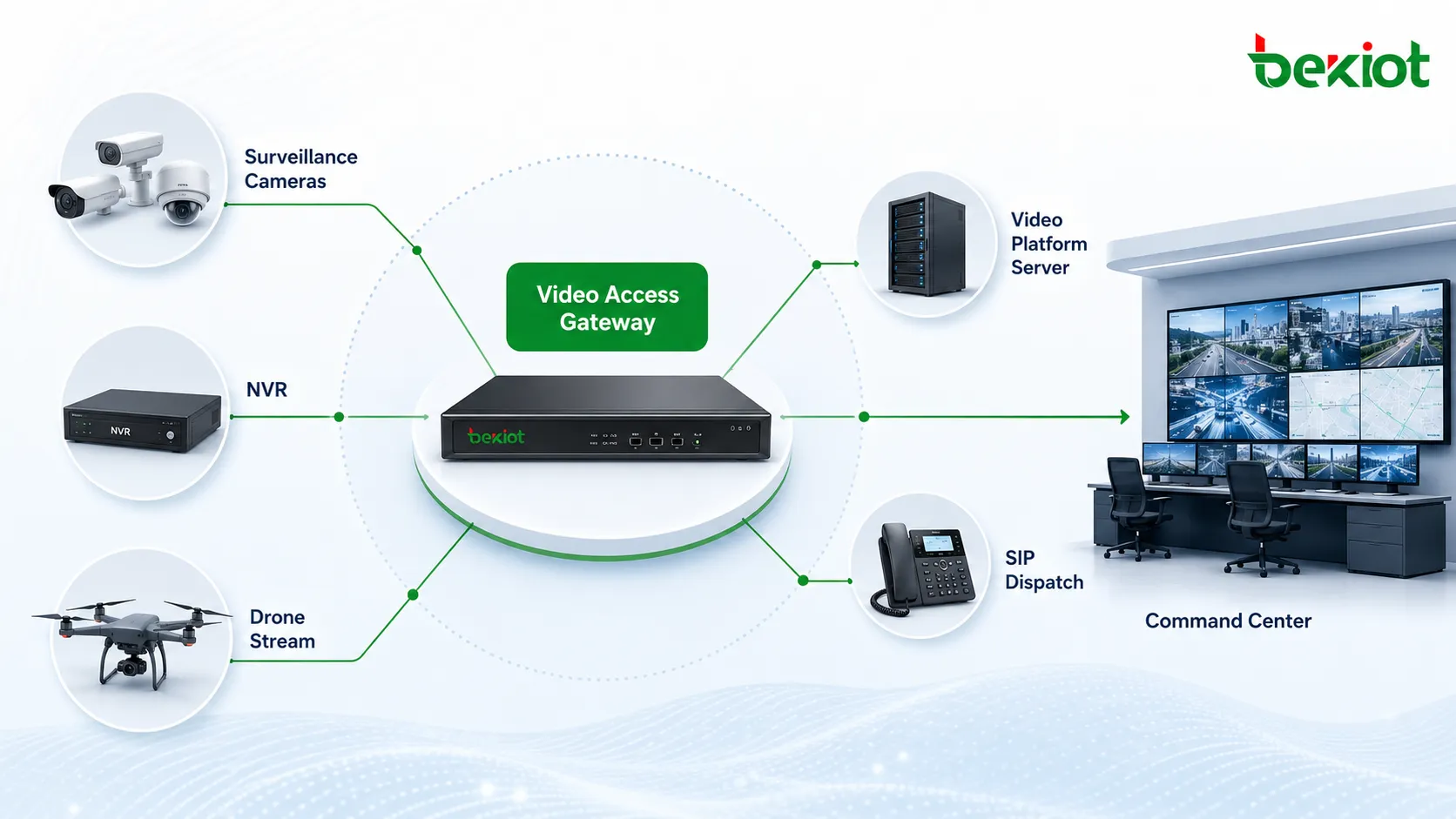
A video access gateway is an essential component in many audio-video convergence projects. Its basic role is to bring different video resources into a unified communication or command platform. In many projects, this means converting surveillance cameras, video platforms, recorders, drones, conferencing systems, and streaming sources into a format that can be used by SIP-based communication systems.
However, simply converting a camera into SIP is not enough. Modern video integration projects require much more than one-way camera access. A practical gateway must support multiple streaming protocols, real video transcoding, unified SIP processing, video monitoring functions, recording, two-way audio, API integration, and stable operation under complex media workloads.
Why Camera-to-SIP Conversion Is Only the First Step
In many converged communication projects, users first ask whether the video access gateway can convert cameras into SIP. This is a reasonable starting point because SIP-based dispatch platforms, video phones, emergency command systems, and converged communication platforms often need to receive video streams through SIP sessions.
But the real project environment is rarely limited to one type of camera or one protocol. A site may already have GB/T 28181 video surveillance platforms, RTSP cameras, NVR systems, RTMP live streams, WebRTC video sources, video conferencing systems, HLS or FLV streams, drone video links, and third-party video platforms. If the gateway only supports GB/T 28181 to SIP or camera-to-SIP conversion, the entire system will soon face integration limits.
A video gateway should be understood as a media access and conversion platform, not just a camera adapter. Its value is to normalize different video resources so that command platforms, dispatch consoles, SIP systems, web clients, and business applications can use those resources in a controlled and reliable way.
Multiple Protocols Are Required in Real Projects
Many basic video gateways only provide GB/T 28181-to-SIP access. This can be useful when a project only needs to bring a national-standard video platform into a SIP-based system. However, this single conversion path is not enough for current video convergence projects.
A more complete video access gateway should support conversion among GB/T 28181, RTSP, RTMP, RTP, FLV, HLS, SIP, and WebRTC. These protocols serve different purposes. RTSP is common in surveillance cameras and NVR devices. RTMP is widely used for live streaming and media publishing. HLS and FLV are common for web playback. WebRTC is useful for browser-based real-time interaction. SIP is important for video calls, dispatch, intercom, and unified communication systems.
The gateway should not only convert one protocol into SIP. It should also allow flexible conversion between different media formats and service scenarios. For example, a video conference stream may need to be pushed to a live streaming platform through SIP-to-RTMP conversion. A dispatch video session may need to be played in a web browser through SIP-to-FLV or SIP-to-WebRTC conversion. A drone RTMP stream may need to enter a command platform as SIP video. These scenarios require flexible media conversion rather than a fixed one-way bridge.
Real Transcoding Is Different From Protocol Conversion
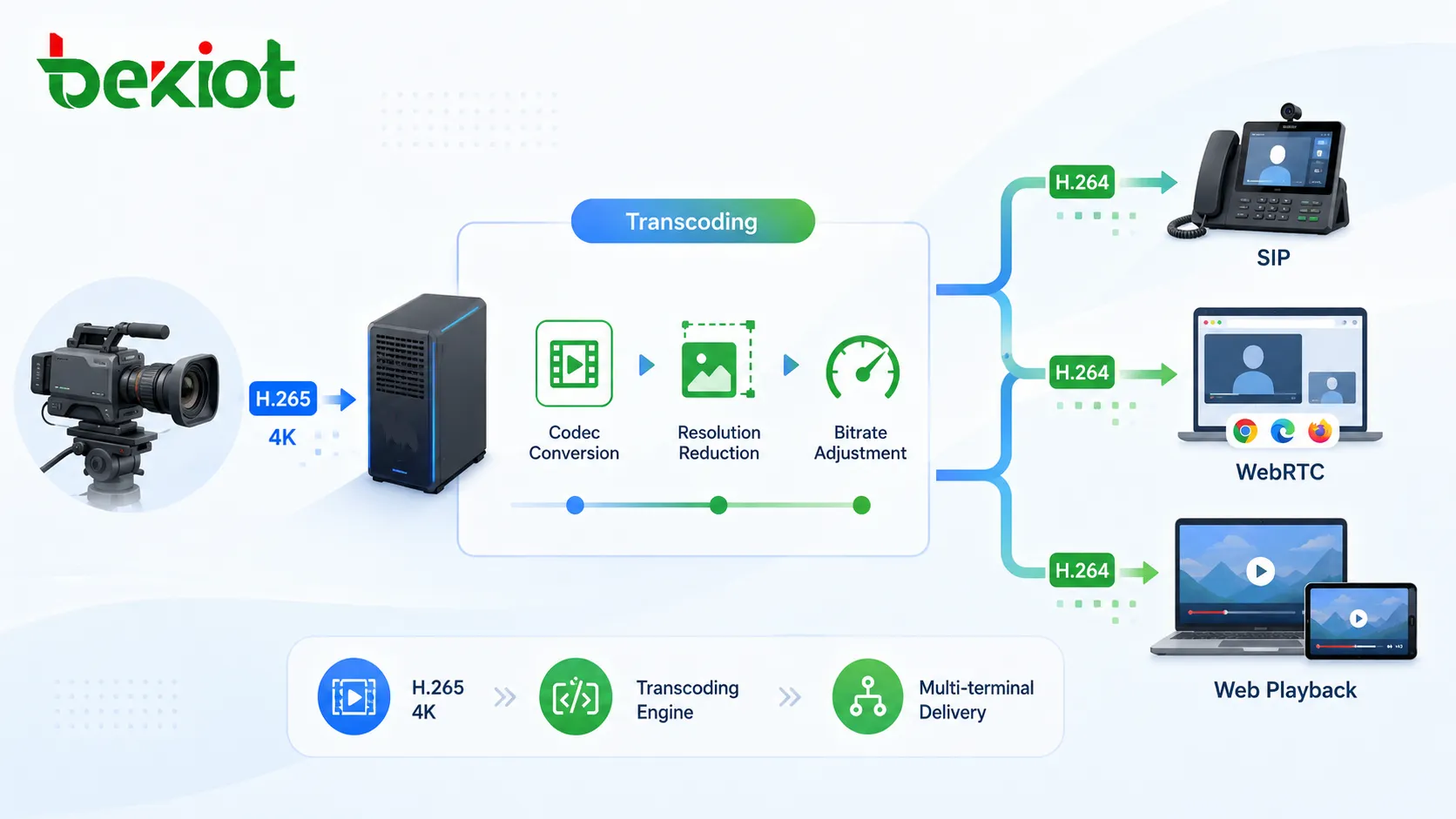
Transcoding is often misunderstood in video gateway projects. Some products describe streaming protocol conversion as transcoding, but this is not accurate. Protocol conversion changes how a stream is packaged or transmitted. Real transcoding decodes the original video and encodes it again with new parameters.
Transcoding becomes necessary when the video codec, resolution, bitrate, frame rate, or compatibility requirement must be changed. In practical surveillance and command projects, this is very common. Many camera systems now use H.265 encoding or 4K video resolution. These streams may be efficient for storage and surveillance platforms, but they may not be directly playable in some SIP communication systems, browser clients, dispatch consoles, or low-bandwidth emergency networks.
A strong video access gateway should therefore work with CPU or GPU-based transcoding resources. It should be able to adjust H.265 to H.264, reduce 4K video to a lower resolution, control bitrate, change frame rate, and create streams suitable for different terminals. Without this capability, the gateway may successfully “connect” a camera but fail to deliver a usable video experience.
A Unified SIP Stack Makes Integration More Stable
SIP is widely used in video intercom, video dispatch, conferencing, IP PBX, emergency communication, and unified communication systems. For a video access gateway, SIP support is not only about registering a stream as a SIP endpoint. The gateway must handle signaling, media negotiation, call control, session management, and compatibility with different SIP platforms.
A unified SIP processing architecture is more reliable than a loose combination of several open-source components. In some gateway products, GB/T 28181, SIP calling, streaming conversion, and WebRTC access are handled by separate software modules. This may work for simple use cases, but it can become difficult to maintain when the project requires flexible conversion, high concurrency, or complex media routing.
A better architecture unifies SIP-related processing and media adaptation into one consistent system logic. This makes it easier to convert between GB/T 28181 and SIP, connect SIP video terminals, support SIP trunking, manage session control, and troubleshoot compatibility problems. It also helps improve upgrade efficiency when new protocols or new project requirements appear.
Performance Matters When Video Workloads Increase
Video access gateways must process much heavier workloads than ordinary signaling gateways. Video streams consume bandwidth, CPU, memory, storage, and sometimes GPU resources. When transcoding, forwarding, recording, previewing, or distributing video streams at the same time, gateway performance becomes a key factor.
In a small project, one or two camera streams may not expose performance problems. In a real command center, however, the system may need to handle dozens or hundreds of video resources, multiple preview windows, simultaneous SIP video calls, recording tasks, and web playback requests. If the gateway architecture is weak, video delay, stream interruption, high resource usage, playback failure, or system crash may occur.
Therefore, project teams should evaluate concurrency, codec type, resolution, bitrate, transcoding requirement, recording demand, and terminal compatibility before choosing a gateway. A gateway that only works in a demonstration environment may not be suitable for continuous operation in emergency command, industrial safety, transportation, campus security, or smart city projects.
Monitoring Functions Should Be Built In
A video access gateway is not just a hidden protocol converter. In many projects, it also needs to provide video monitoring and operational functions. These may include live preview, multi-screen layout, camera grouping, NVR or platform access, video recording, playback, alarm reception, PTZ control, and two-way audio.
This is important because field operators do not only need a video stream. They need to view, control, search, call, record, and share video resources during daily operation or emergency response. If the gateway cannot provide basic monitoring functions, the system may require additional software modules, increasing project complexity.
PTZ control is a typical example. In a command center, the operator may need to adjust a camera angle after receiving an alarm. Two-way audio is another example. A video intercom device may need both video viewing and voice interaction. A practical video gateway should support these business operations rather than only forwarding passive streams.
APIs Help the Gateway Become Part of a Larger Platform
Many video integration projects need to connect with business platforms rather than operate as a standalone device. Emergency command systems, public safety platforms, smart campus systems, industrial control rooms, transportation platforms, and city-level monitoring centers may all need to call video resources from their own user interfaces.
This is where API capability becomes important. A gateway with a complete API can allow third-party systems to request video streams, control cameras, start or stop recordings, receive alarms, manage devices, create sessions, or trigger media conversion according to business workflow.
For example, when an alarm occurs, the business platform can automatically open the related camera, establish a SIP video call, push the stream to a web console, and record the event. Without API integration, these actions may require manual operation across multiple systems.
Better Architecture for Emergency and Dispatch Systems
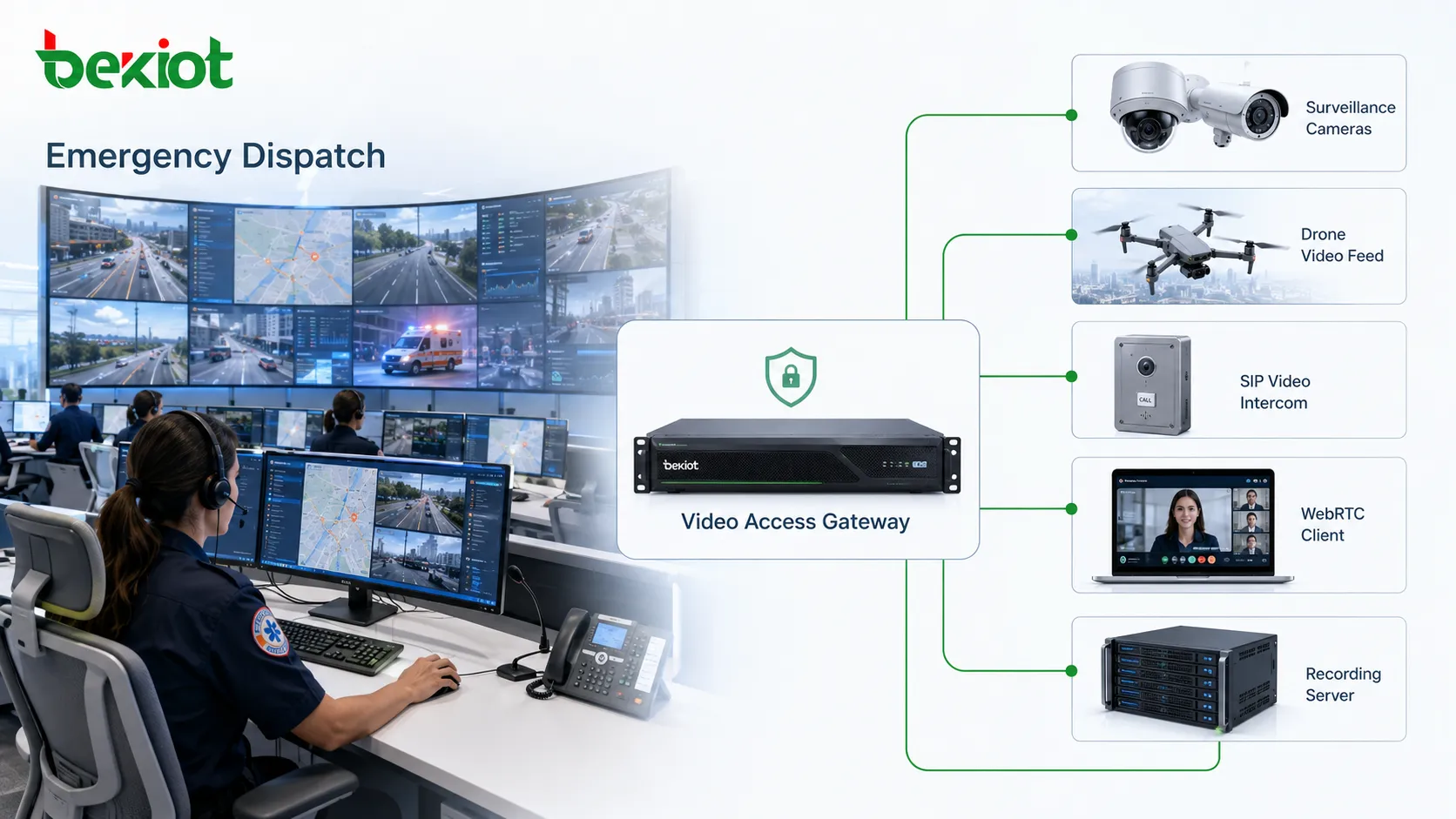
Video access gateways are especially valuable in emergency command and dispatch environments. These systems often need to integrate surveillance video, drone video, mobile video terminals, body cameras, SIP video intercoms, command vehicle feeds, and remote meeting video into one operational view.
In these scenarios, the gateway should support two directions of conversion. It should bring external video resources into the SIP dispatch system, and it should also push SIP or conference video out to web platforms, live platforms, or other command centers when required. This two-way capability makes video sharing more flexible during multi-agency cooperation.
For projects that combine SIP communication, video dispatch, industrial intercom, emergency notification, or command-center workflows, Becke Telcom can be considered as a lightweight solution reference where video access needs to work together with voice, dispatch, gateway, and emergency communication endpoints.
When a Simple Gateway Is Not Enough
A simple camera-to-SIP gateway may be acceptable for a small project with limited video sources, fixed cameras, no transcoding requirement, and only one SIP platform. However, this architecture becomes risky when the project includes different video protocols, 4K cameras, H.265 streams, web playback, live streaming, recording, alarm linkage, or API-based business integration.
The more complex the project becomes, the more important it is to choose a gateway with broad protocol support and stable media processing. Otherwise, project teams may face repeated custom development, separate streaming servers, extra transcoding servers, compatibility problems, and difficult troubleshooting.
A complete video access gateway should reduce system complexity rather than add another isolated box. It should help unify media access, simplify protocol adaptation, and provide a stable bridge between video systems and communication systems.
Practical Deployment Architecture
A typical deployment includes front-end cameras, NVR systems, GB/T 28181 platforms, drone or mobile video sources, video access gateway, transcoding resources, SIP server, dispatch platform, recording server, web playback server, and business application platform.
On the access side, the gateway receives video from RTSP, GB/T 28181, RTMP, WebRTC, FLV, HLS, RTP, or SIP sources. In the media processing layer, it performs protocol conversion, stream forwarding, transcoding, bitrate adaptation, and session control. On the service side, it sends video to SIP terminals, dispatch consoles, web clients, recording systems, or third-party applications.
This architecture allows a command center to use cameras not only as surveillance resources, but also as interactive communication resources. A camera can be called from a SIP terminal, displayed on a dispatch screen, shared with a remote center, converted for web playback, or recorded as part of an incident workflow.
Key Selection Criteria
When selecting a video access gateway, the project team should check whether the device supports the required protocol combinations, not just one conversion path. It should also evaluate codec support, especially H.264 and H.265, as well as resolution handling for 1080p, 4K, and lower-bandwidth output streams.
The second criterion is transcoding performance. The team should calculate how many streams need transcoding at the same time and whether the gateway uses CPU, GPU, or external transcoding servers. The third criterion is SIP compatibility, including registration, trunking, session negotiation, video call behavior, and interworking with the target dispatch platform.
The fourth criterion is business capability. A gateway with monitoring, recording, alarm reception, PTZ control, two-way audio, WebRTC softphone functions, and API support can reduce the need for additional system components. The fifth criterion is maintainability, including logs, diagnostics, stream status, resource usage, upgrade methods, and remote management.
Conclusion
A video access gateway should not be evaluated only by whether it can convert a camera into SIP. Camera-to-SIP conversion is only the entry-level requirement. A modern video gateway should support multiple protocols, real transcoding, unified SIP processing, video monitoring, recording, PTZ control, two-way audio, API integration, and stable media performance.
For audio-video convergence, emergency command, smart security, drone video access, and unified dispatch projects, the gateway is a media integration platform rather than a simple adapter. Choosing the right gateway can reduce development work, improve compatibility, simplify deployment, and make the entire video communication system easier to operate and expand.
FAQ
Can a video access gateway replace an NVR?
Not always. An NVR is mainly designed for camera recording and surveillance management, while a video access gateway focuses on protocol conversion, media access, SIP integration, and platform interconnection. Some gateways may include recording functions, but replacement depends on storage capacity, playback requirements, and project workflow.
Why do some SIP platforms fail to display camera video?
Common reasons include unsupported codec, excessive resolution, incompatible SDP negotiation, incorrect packetization, NAT traversal problems, missing transcoding, or a mismatch between camera stream format and SIP terminal capability.
Is WebRTC support necessary for every project?
WebRTC is not mandatory for every project, but it is useful when users need browser-based real-time viewing, web dispatch consoles, remote collaboration, or softphone functions without installing dedicated client software.
What should be tested before deployment?
Project teams should test protocol access, SIP calling, codec compatibility, transcoding load, stream delay, multi-channel preview, recording, PTZ control, alarm linkage, API calls, failover behavior, and long-duration stability under realistic network conditions.







