


Two-way radios remain one of the most practical communication tools for security teams, construction sites, industrial plants, logistics operations, emergency response, property management, transportation, and outdoor field work. When planning a radio communication system, one common question appears early: should the project use analog radios or digital radios?
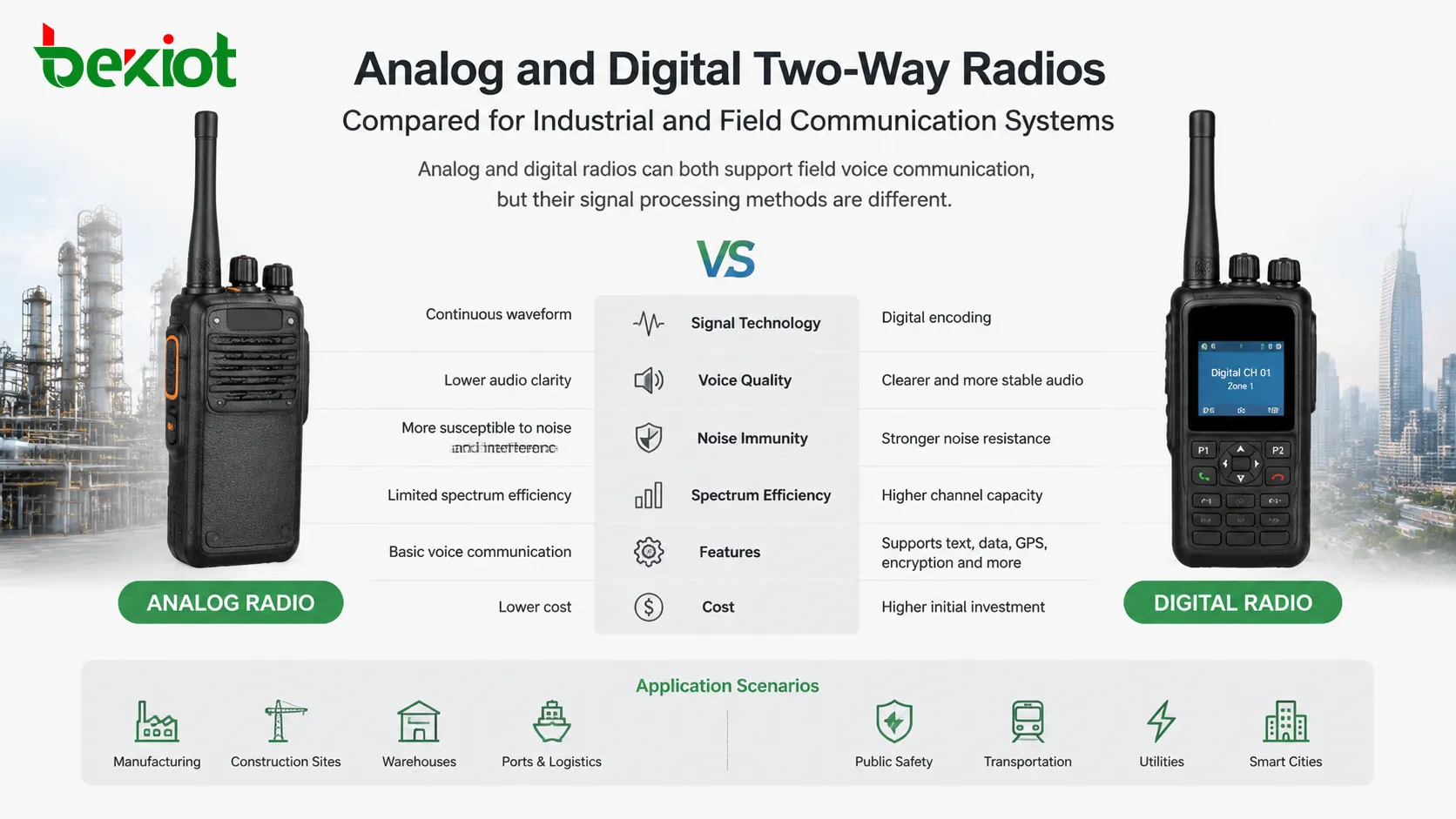
Both technologies can support push-to-talk voice communication, but they work in very different ways. Analog radios transmit continuous voice waveforms, while digital radios convert voice into digital data before transmission. This difference affects audio quality, interference resistance, spectrum efficiency, privacy, system features, project cost, and long-term expansion.
Start with the Communication Scenario
The right choice does not depend only on whether a radio is analog or digital. It depends on where the system will be used, how many users need to communicate, how much interference exists in the environment, whether privacy is required, and whether the project needs more than basic voice calling.
For a small site with simple voice needs, analog radios may still be enough. They are easy to understand, easy to deploy, and often lower in initial cost. For a larger site that requires clearer voice, higher channel efficiency, encryption, group management, text messaging, positioning, or future system integration, digital radios usually provide a stronger long-term foundation.
A practical radio solution should therefore begin with operational needs rather than product appearance. A warehouse, office building, chemical plant, airport, tunnel project, port terminal, mine, campus, and emergency command team may all use two-way radios, but their communication requirements are not the same.
How Analog Radios Handle Voice
Analog radios transmit voice as a continuous waveform. The radio converts the speaker’s voice into an analog radio signal and sends it over the air. The receiving radio converts that signal back into sound. This process is simple and has been widely used for many years.
The advantage of analog communication is its directness. It is easy to operate, easy to understand, and compatible with many legacy systems. For teams that only need basic push-to-talk voice communication over a limited area, analog radios can still be a practical option.
However, analog signals are more vulnerable to noise, distance loss, weak signal conditions, and external interference. As the signal becomes weaker, the audio usually becomes noisier and less clear. Users may hear static, background noise, or broken speech before the communication becomes unusable.
How Digital Radios Process Communication
Digital radios take a different approach. The speaker’s voice is first converted into digital data. The radio then transmits encoded digital information instead of a continuous analog waveform. On the receiving side, the signal is decoded and converted back into voice.
This digital process makes the signal easier to encode, decode, compress, process, and protect. It also allows the system to support more communication features, such as text messages, data transmission, user identification, positioning, emergency alerts, and system management functions.
Digital communication also performs better in many noisy environments. Because the receiver processes digital data, the system can maintain clearer voice quality within its effective coverage area. Instead of gradually becoming full of static, digital audio often remains more stable until the signal becomes too weak to decode properly.
Frequency Resources and Channel Efficiency
Spectrum is a limited resource. In a radio communication project, channel planning is often a key issue, especially when many users, departments, or working groups need to communicate at the same site.
Analog radios usually carry one voice conversation within one assigned channel. For the same spectrum width, the amount of information that can be transmitted is relatively limited. This makes analog systems less efficient when many users need separate groups or when channel resources are restricted.
Digital radios use information more efficiently. Because voice is converted into digital data, the system can support more advanced coding and channel usage methods. In many digital radio systems, the same frequency resources can support more communication capacity or more flexible group management than a traditional analog system.
For large organizations, this becomes an important planning advantage. Security teams, maintenance teams, production teams, logistics teams, and emergency response groups can be organized more clearly without wasting radio resources.
Audio Quality in Real Environments
Voice clarity is one of the most important differences between analog and digital systems. In analog communication, audio quality is directly affected by signal strength, background interference, and environmental noise. When the signal is weak, the user may still hear something, but the sound may become noisy, distorted, or difficult to understand.
Digital radios are designed to preserve speech quality more effectively during transmission. With proper signal coverage, users usually hear clearer and more consistent voice. Digital processing can also reduce some unwanted noise and improve intelligibility in busy work environments.
This does not mean digital radios can ignore coverage design. Any radio system still needs proper frequency planning, antenna layout, repeater placement, and field testing. But within a well-designed coverage area, digital communication usually provides a better user experience for voice clarity and stability.
Privacy and Security Requirements
Analog radio communication is easier to monitor because the voice signal is transmitted in a more direct form. If another receiver is tuned to the same frequency and compatible mode, it may be able to listen to the conversation. This creates a privacy risk for projects that involve security, operations, emergency handling, or sensitive site information.
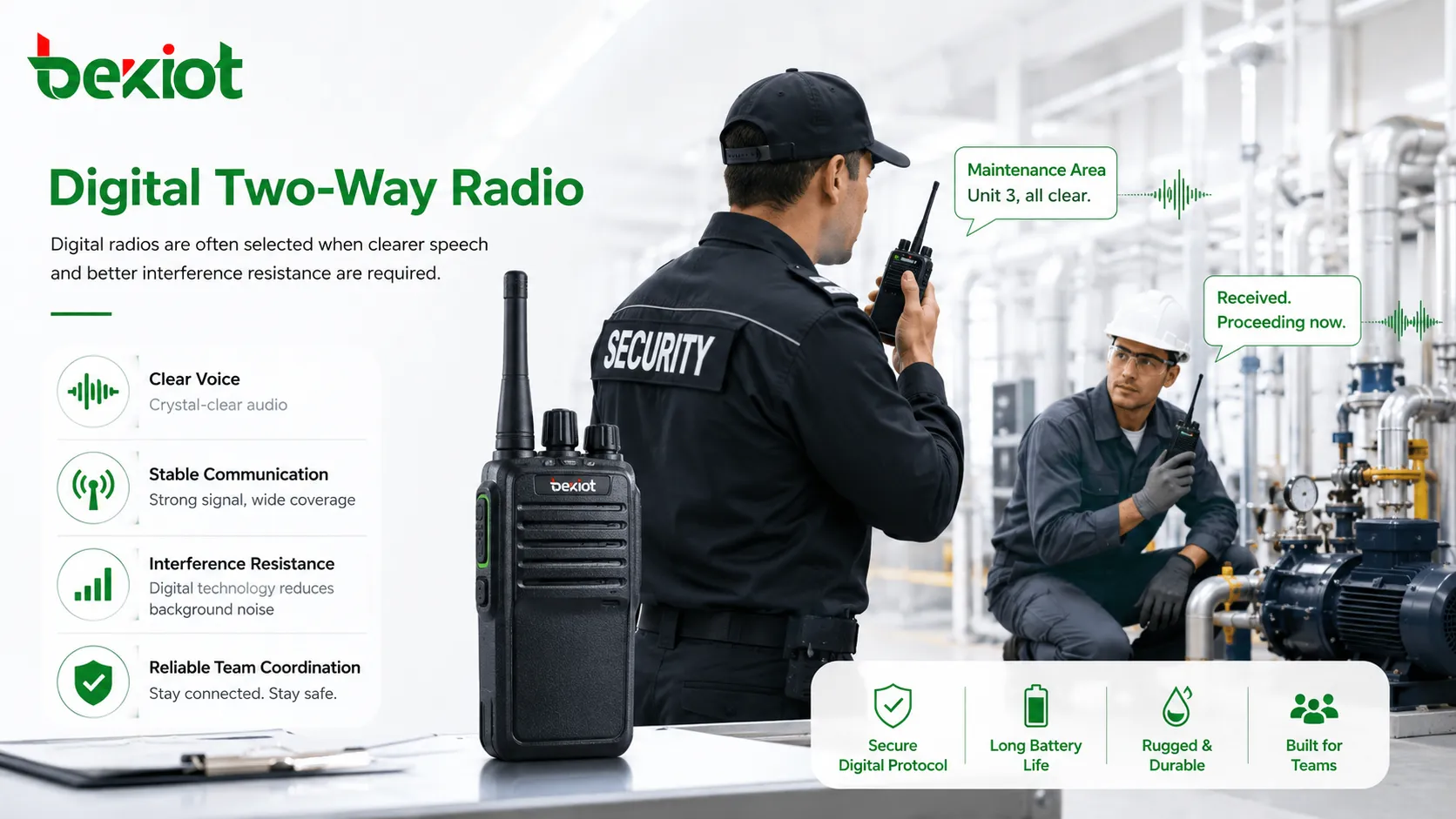
Digital radios provide better privacy options because digital signals can be encoded and encrypted. Encryption does not automatically make every system secure, but it gives project owners a stronger technical path for protecting communication content.
For property security, industrial production, public facility management, emergency response, government-related work, and large enterprise operations, communication privacy may be a real requirement rather than an optional feature. In such scenarios, digital systems are usually more suitable than simple analog systems.
Functions Beyond Basic Voice
Analog radios are mainly used for basic voice communication. They are suitable when the workflow is simple: press the PTT button, speak, release the button, and wait for the reply. This is enough for many small teams and simple duty environments.
Digital radios can support more functions because they transmit information in digital form. Depending on the system design, digital radio platforms may support text messaging, data transmission, emergency alarm, user ID display, call group management, private call, all call, remote monitoring, GPS location, and dispatch system integration.
These functions make digital radios more suitable for modern management. A dispatcher can identify which user is speaking, organize different talk groups, receive emergency alerts, check user location, or connect radio communication with a larger command platform.
Cost and Long-Term Value
Analog radios usually have a lower entry cost. For small teams with limited budgets and basic voice needs, this can be an important advantage. The equipment is simple, training is easy, and the project can be deployed quickly.
Digital radios often require a higher initial investment. The terminals, repeaters, software licenses, dispatch integration, and system planning may cost more than a simple analog system. However, digital radios can provide better spectrum efficiency, clearer voice, stronger privacy, richer features, and better expansion potential.
When evaluating cost, project owners should not only compare the price of one radio. They should compare the complete communication lifecycle. A low-cost analog system may be enough for a small site, but a larger organization may save future upgrade costs by choosing a digital system from the beginning.
Choosing for Different Project Types
| Project Requirement | Analog Radio | Digital Radio |
|---|---|---|
| Basic voice communication | Suitable | Suitable |
| Low initial budget | Usually better | Higher initial investment |
| Interference resistance | Limited | Stronger |
| Voice clarity | More affected by noise | Clearer within effective coverage |
| Spectrum efficiency | Lower | Higher |
| Privacy protection | Weaker | Can support encryption |
| Text, data, and positioning | Usually limited | More expandable |
| Dispatch platform integration | Possible but limited | More suitable for modern systems |
System Design for Small Sites
For small sites, the communication goal is usually simple. Users need fast voice communication between guards, workers, supervisors, or maintenance staff. If the site area is small, the number of users is limited, and privacy requirements are low, analog radios can provide a straightforward solution.
A typical small-site design may include a small number of handheld radios and, if needed, a repeater to extend coverage. The focus should be on clear channel planning, battery management, basic user training, and enough signal coverage for the working area.
Even in a simple analog deployment, the project should avoid casual channel use. Different departments should have clear communication rules, and emergency calling procedures should be defined in advance.
System Design for Larger Operations
For larger operations, digital radios are usually more appropriate. When a project includes multiple teams, wide-area coverage, long working hours, sensitive information, or dispatch management, the system needs more than simple voice.
A digital radio solution can divide users into work groups, support private or group calls, identify users, send emergency alerts, and connect to dispatch platforms. If the project later needs radio-over-IP interconnection, recording, command center operation, or multi-site communication, digital systems are generally easier to expand.
Large industrial plants, logistics parks, airports, ports, rail transit projects, energy sites, mines, and municipal operations often benefit from this type of design. The radio network becomes part of the broader communication system rather than an isolated tool.
Migration from Analog to Digital
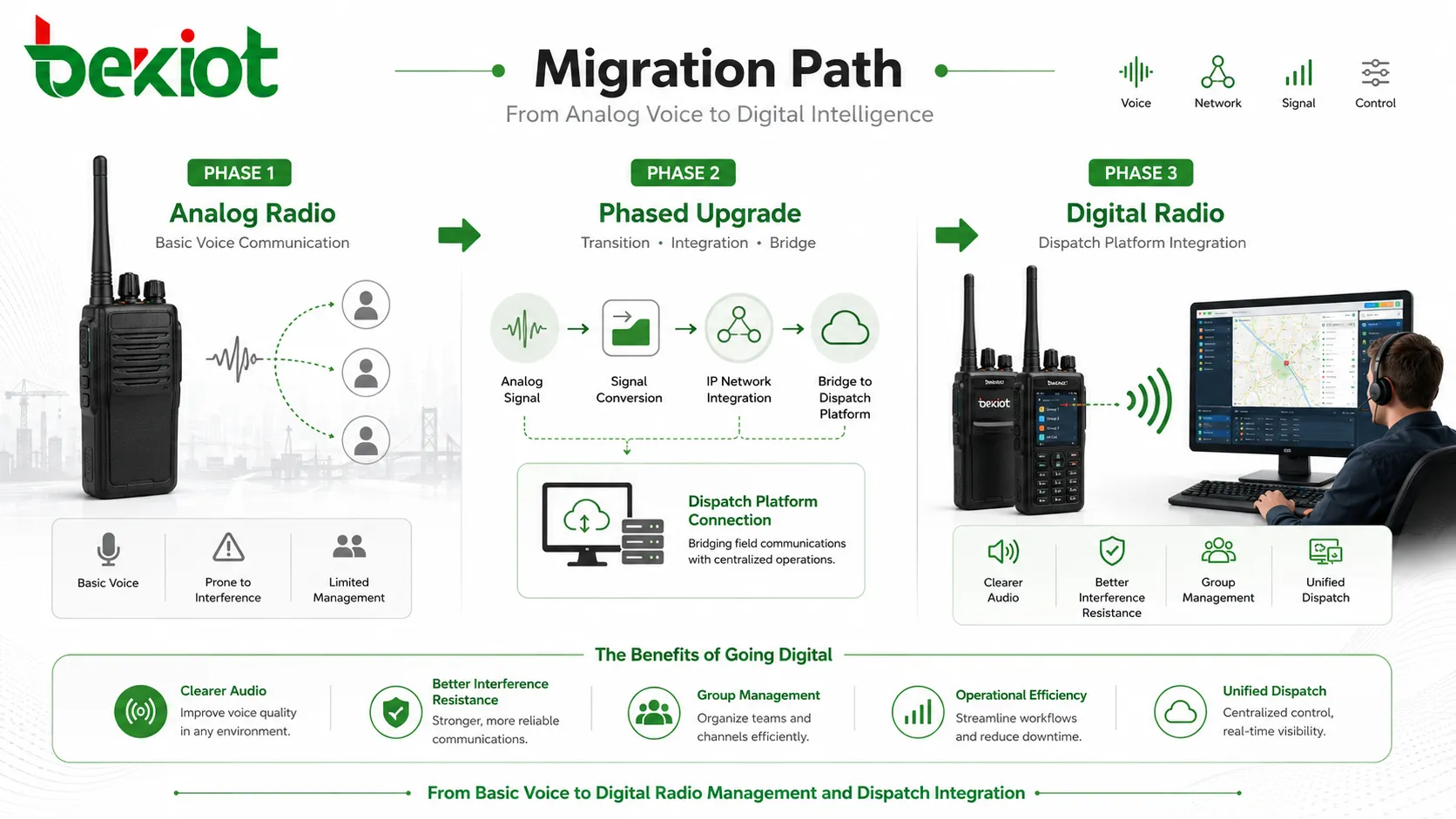
Many organizations already have analog radios in use. Replacing everything at once may not be realistic. A phased migration plan can reduce cost and operational risk.
The project can first identify critical departments that need better voice quality, security, or dispatch functions. These teams can move to digital radios first, while less critical users continue using analog radios during the transition period.
If compatibility is required, the project team should confirm whether the selected digital system can support mixed-mode operation, gateway access, or staged channel migration. A good migration plan should protect the existing investment while preparing the system for future expansion.
Deployment and Testing Considerations
Coverage should be verified in the real site
Radio coverage is affected by buildings, terrain, walls, metal structures, tunnels, equipment rooms, underground areas, and outdoor distance. A system that works well in an office test may perform differently in a real industrial or construction environment.
Before final acceptance, the project team should test key points such as gates, basements, warehouses, production lines, stairways, parking areas, tunnels, and remote corners. This is especially important for safety and emergency communication.
User groups should match the work process
The communication group design should follow the actual operation structure. Security, maintenance, logistics, management, emergency response, and production teams may need separate groups, but they may also need cross-group communication during special events.
Digital systems usually provide more flexible group control, which helps operators organize daily communication and emergency response more clearly.
Security rules should be planned early
If communication privacy matters, encryption and user permission design should be considered during the planning stage. It is better to define security rules before deployment than to add them after users have already built habits around open communication.
For sensitive environments, the system should also define radio ownership, user authorization, lost-device handling, and emergency priority rules.
Recommended Selection Logic
Choose analog radios when the project requires simple voice communication, has a limited number of users, does not require encryption, and has a strict initial budget. Analog systems are still useful for small teams and basic site coordination.
Choose digital radios when the project needs clearer audio, better interference resistance, higher spectrum efficiency, more privacy, user identification, data functions, location services, emergency alarms, or future integration with a dispatch platform.
For long-term professional systems, digital radios usually provide a better foundation. For short-term or low-complexity use, analog radios may remain practical. The best solution is not always the most advanced one; it is the one that matches the site environment, communication workflow, budget, and future expansion plan.
FAQ
Can analog and digital radios communicate with each other directly?
Usually, they cannot communicate directly unless the equipment supports compatible modes or the system is designed with bridging or migration functions. Compatibility should always be confirmed before mixed deployment.
Does digital radio always have longer coverage?
Not always. Coverage depends on power, antenna design, frequency, terrain, repeater placement, and site environment. Digital radios often provide clearer audio within the usable coverage area, but they still require proper coverage planning.
Is analog radio outdated?
No. Analog radio is still useful for simple and low-cost voice communication. It becomes less suitable when the project requires privacy, data functions, advanced group management, or integration with a command platform.
Why do many professional projects prefer digital systems?
Professional projects often require clearer communication, better channel efficiency, user management, encryption, emergency alerts, location services, and dispatch integration. Digital systems are better aligned with these requirements.
What should be tested before final deployment?
The project should test coverage, voice clarity, channel planning, group calling, emergency operation, battery performance, interference conditions, encryption settings, and user operation habits in real working environments.







