


In a tunnel, factory floor, subway platform, engine room, offshore deck, roadside station, or emergency command post, communication failure is often not caused by the absence of equipment. It is caused by unwanted sound covering the message. A loudspeaker may be powerful, a microphone may be sensitive, and a terminal may be connected correctly, but the listener may still fail to understand the instruction if background noise, echo, reverberation, wind, machinery, or traffic noise is not controlled.
This is where acoustic noise reduction becomes important. It is not a single button or one isolated algorithm. It is a combination of acoustic design, microphone placement, speaker direction, enclosure structure, audio filtering, gain control, echo control, signal processing, field testing, and user operation. Its purpose is to increase the useful signal and reduce the influence of unwanted sound so speech, alarms, paging, intercom, and public-address messages can be heard more clearly.
Related solution: /paga-systems/tunnel-pa-and-intercom-solution
Why Noise Control Becomes a System Issue
Many users first think of noise reduction as a microphone feature. In reality, the problem is wider. Noise can enter the system before the microphone, inside the electrical signal path, through acoustic feedback, across the network, from speaker placement, or from the surrounding environment after sound is played. If only one part is optimized while the rest of the system is poorly designed, the final result may still be unclear.
For example, a tunnel public-address system may face vehicle noise, ventilation noise, strong echo, and long reflective surfaces. A factory intercom may face mechanical impact sound, motors, compressors, and operators wearing hearing protection. A hazardous-area amplified telephone may need to keep voice intelligible while resisting dust, water, vibration, and outdoor exposure. These scenarios require combined acoustic and communication engineering.
Noise reduction is therefore best understood as a system-level method for improving communication reliability. It helps the audio path deliver the right message to the right listener under real operating conditions.
Core Technical Principle
Improving the Signal-to-Noise Relationship
The most basic goal is to improve the relationship between useful sound and unwanted sound. In voice communication, the useful signal is normally speech, tone, alarm, prompt, or command audio. The unwanted part may include fan noise, engine sound, traffic, crowd noise, wind, rain, echo, electrical hum, acoustic feedback, or environmental vibration.
If speech is only slightly louder than the background, the listener must guess the words. If speech is clearly above the background and the noise is shaped or reduced, comprehension becomes easier. This is why noise reduction should not be judged only by whether the environment sounds quieter. The key question is whether the important message becomes more intelligible.
Reducing the Unwanted Components
Noise reduction can remove, suppress, mask, or avoid unwanted sound components. A directional microphone can reduce sound from the wrong direction. A filter can reduce low-frequency rumble. A digital algorithm can estimate stable background noise and attenuate it. Speaker placement can reduce echo and feedback. Acoustic absorption can reduce reverberation in enclosed spaces.
Each method has limits. Over-filtering may make speech sound thin. Aggressive suppression may create artificial artifacts. Poor gain settings may reduce both speech and noise. Effective design requires balance between clarity, natural sound, loudness, and reliability.
Preserving Critical Audio
The system must avoid removing important parts of the message. Speech consonants, emergency tones, warning chimes, and instruction phrases often contain high-frequency details that are necessary for understanding. If processing removes these details, the audio may seem less noisy but also less clear.
Good noise reduction keeps the useful information intact while reducing the parts that interfere with recognition. This is especially important in safety communication, where a misunderstood word can change the meaning of an instruction.
Major Advantages
Higher Speech Intelligibility
The most direct advantage is improved speech intelligibility. In noisy areas, listeners may hear that someone is speaking but cannot understand the content. Noise reduction improves the clarity of consonants, syllables, command words, and emergency instructions.
This is valuable in tunnels, workshops, railway platforms, parking structures, emergency shelters, utility sites, and industrial plants. A message such as “evacuate through exit two” must be understood quickly and correctly.
Lower Listening Fatigue
Continuous noise makes people tired. When listeners must concentrate hard to understand speech, fatigue increases. Noise reduction reduces the mental effort required to interpret messages, especially during long shifts or repeated communication.
This improves operator comfort in control rooms, service desks, dispatch centers, and production environments. It also reduces the chance that important information is ignored because users are overloaded by noisy audio.
Better Alarm Recognition
Emergency systems often rely on tones, voice prompts, or public-address announcements. If alarms are masked by background sound, people may react slowly or misunderstand the situation. Noise reduction and acoustic tuning help make alarms more distinguishable from the environment.
In a tunnel or transport facility, this can support evacuation, incident handling, fire response, traffic control, and passenger guidance.
More Stable Intercom Communication
Intercom systems often operate in environments where users cannot move to a quiet area. Workers may need to speak from a roadside emergency phone, tunnel emergency point, factory station, gate intercom, or control-room endpoint. Noise reduction helps keep the conversation usable.
For outdoor or hazardous environments, terminal design also matters. Becke Telcom’s EX-BH621 explosion-proof amplified telephone is an example of a field communication endpoint where rugged construction and IP66 protection support operation in dusty and water-jet-prone industrial conditions; when combined with proper acoustic planning, this type of device can help maintain clearer voice communication in demanding sites.
Common Techniques
Directional Pickup
Directional microphones focus more on the speaker’s direction and less on surrounding noise. This helps in environments where the target speaker is close to the terminal while background noise comes from machinery, traffic, wind, or open space.
Placement is important. Even a good microphone may perform poorly if it is too far from the speaker, pointed in the wrong direction, or exposed to direct wind.
Digital Noise Suppression
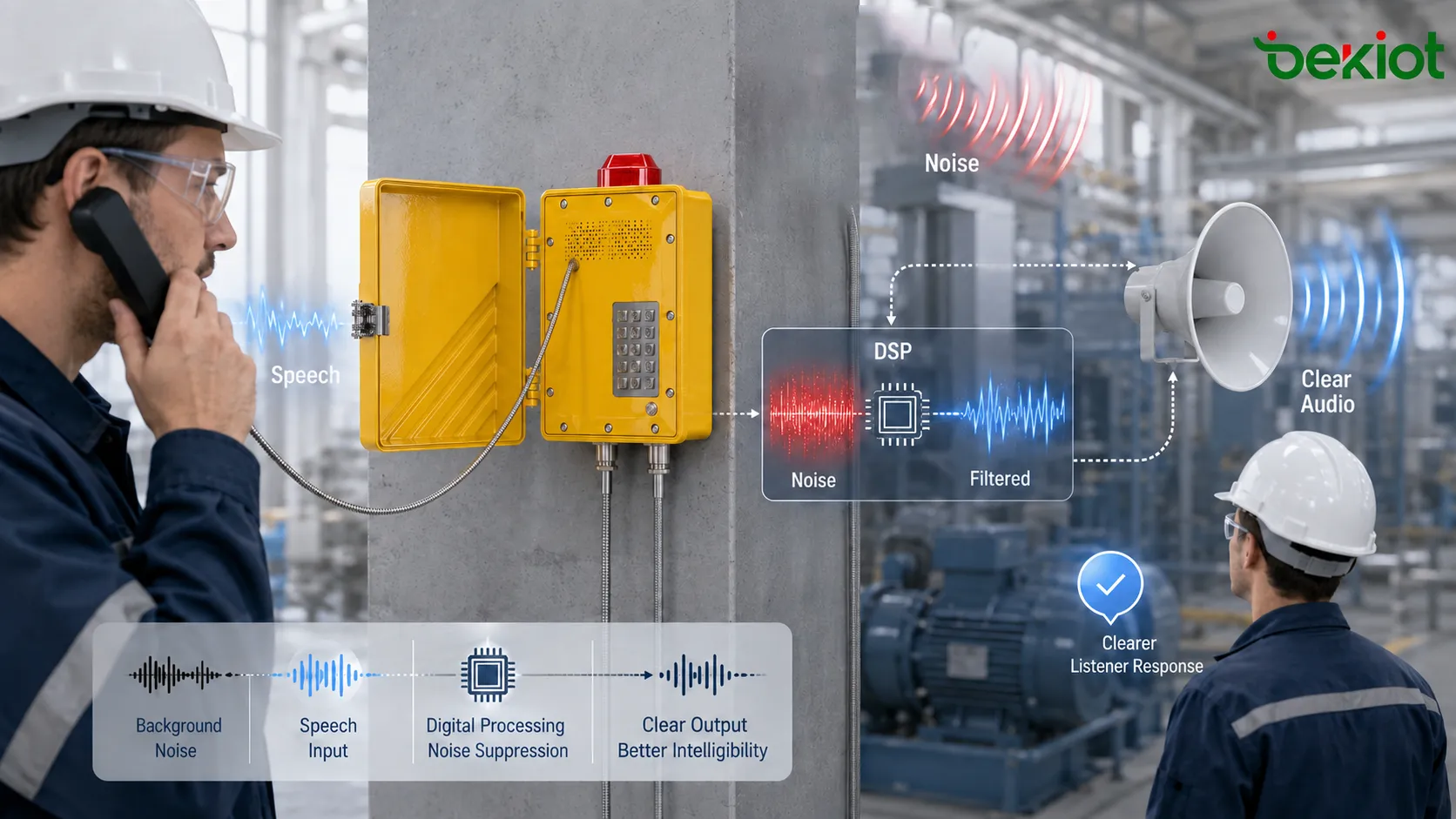
Digital noise suppression analyzes incoming audio and estimates which parts are likely to be noise. Stable background noise can often be reduced without fully removing speech. This is useful for fans, engines, electrical hum, and other continuous sounds.
The algorithm must be tuned carefully. If suppression is too weak, noise remains. If it is too strong, speech may become metallic, choppy, or unnatural.
Echo Cancellation
Echo cancellation reduces the sound that returns from a loudspeaker back into a microphone. It is important in hands-free intercom, conference terminals, public-address talkback, and control-room communication.
Without echo control, users may hear delayed copies of their own voice, or the system may create feedback. Echo cancellation works best when gain, speaker placement, microphone distance, and room acoustics are all considered.
Automatic Gain Control
Automatic gain control adjusts audio level so speech remains within a usable range. It can raise weak speech and reduce overly loud input. This helps when users speak at different distances or volumes.
However, if gain control is poorly configured, it may raise background noise during pauses or compress speech too heavily. It should be tested under real site conditions.
Technique and Value Comparison
| Technique | Main Function | Typical Value | Key Risk |
|---|---|---|---|
| Directional Microphone | Focuses pickup toward the speaker | Reduces off-axis noise and improves speech capture | Poor placement can reduce effectiveness |
| Digital Suppression | Attenuates estimated background noise | Improves clarity in steady noise environments | Overprocessing can damage speech quality |
| Echo Cancellation | Removes returned loudspeaker audio | Supports stable hands-free communication | May fail with excessive reverberation or gain |
| Acoustic Layout | Controls speaker and microphone position | Reduces feedback, echo, and dead zones | Requires field survey and tuning |
| Sound Absorption | Reduces reflections and reverberation | Improves message intelligibility in enclosed spaces | May be difficult in harsh or fire-rated areas |
Application in Tunnel Broadcasting
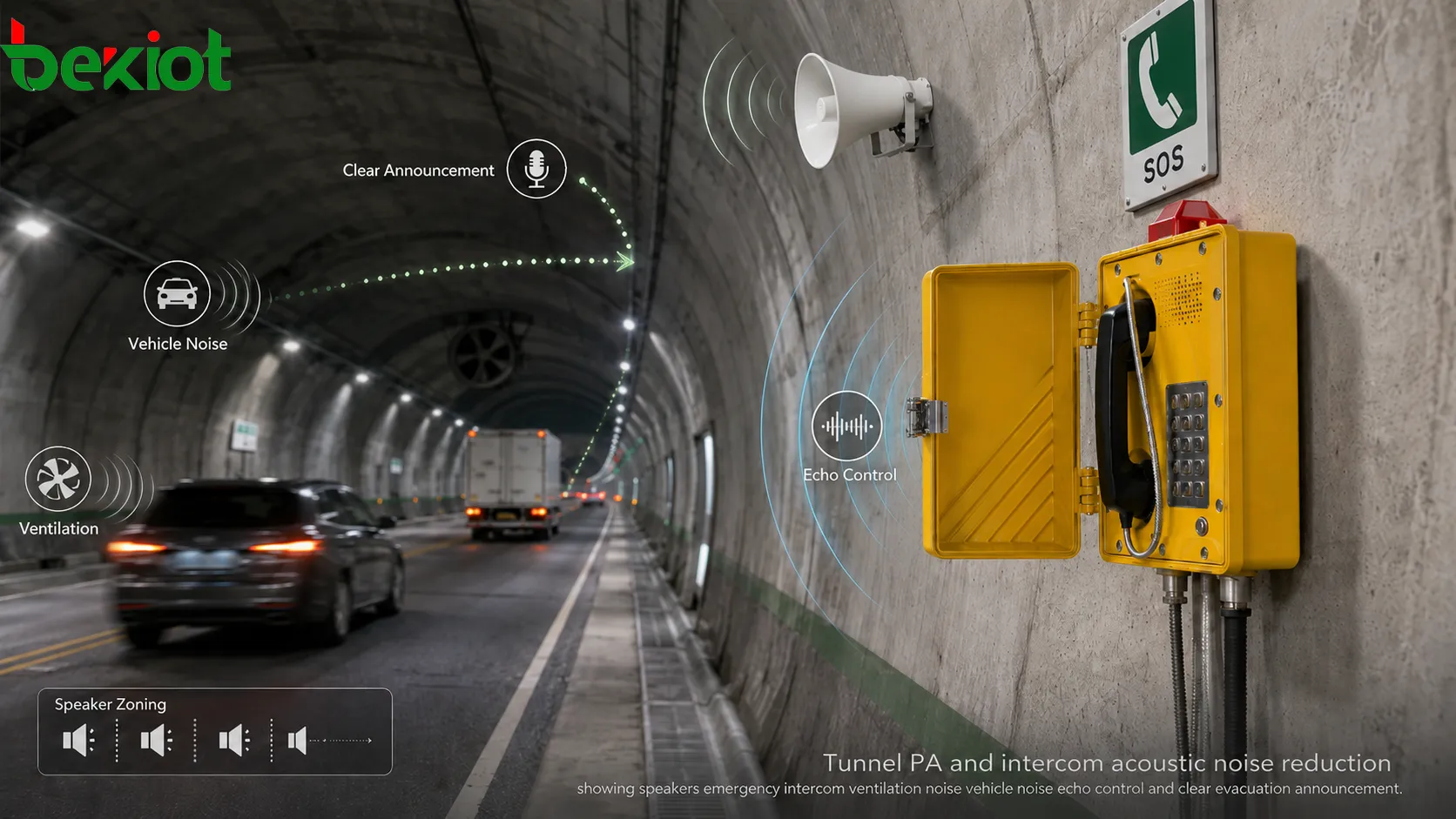
Tunnels are among the most challenging spaces for audio. They are long, reflective, enclosed, and often filled with vehicle noise, ventilation noise, and emergency echo. A loud system does not automatically mean a clear system. If sound reflects repeatedly from hard surfaces, speech may overlap with itself and become difficult to understand.
In tunnel broadcasting, acoustic noise reduction should work together with speaker spacing, direction, delay control, amplifier zoning, message priority, emergency power, and environmental monitoring. The goal is not to make the tunnel quiet; the goal is to make warning messages, evacuation instructions, and operational broadcasts understandable under noisy conditions.
Intercom endpoints in tunnels also need careful planning. Users may speak near traffic lanes, fans, or emergency areas. The microphone, enclosure, mounting height, and audio processing should support voice pickup while reducing environmental disturbance.
Application in Industrial Communication
Industrial environments often include machines, compressors, conveyors, turbines, pumps, cutting equipment, alarms, forklifts, and metal structures. These sounds can cover voice communication and make ordinary phones or speakers difficult to use.
Noise reduction supports production coordination, maintenance reporting, safety confirmation, and emergency calling. For example, a worker at a loud production line may need to contact a control room without moving far from the equipment. A guard station may need to hear and speak clearly while vehicles pass nearby.
Equipment durability also matters in these environments. Dust, water, impact, corrosion, and temperature variation can affect long-term audio performance. An IP66-rated field communication device can help protect enclosure integrity, but installation quality, cable entry sealing, and routine maintenance are still necessary.
Application in Public Address and Paging
Public-address systems need to deliver speech and tones to large areas. Noise reduction in this context includes proper source quality, equalization, speaker layout, amplifier headroom, zone design, and ambient noise sensing.
Some systems adjust output level according to background noise. If the environment becomes louder, the system increases announcement level within safe limits. If the environment becomes quieter, it reduces output to avoid discomfort.
This approach is useful in transport hubs, tunnels, factories, warehouses, campuses, terminals, and emergency shelters where noise changes throughout the day.
Application in Intercom and Help Points
Intercom and help-point systems require two-way communication. The system must capture the speaker’s voice and play the remote party’s voice without creating feedback or echo. Noise reduction, echo cancellation, gain control, and proper enclosure design are essential.
Outdoor help points face wind, rain, road noise, crowd noise, and environmental vibration. Indoor industrial help points may face machinery and reverberation. A good design should allow users to speak naturally without shouting.
For emergency help points, the audio path should be tested with real background noise, not only in a quiet workshop. The user experience during a real incident may be very different from laboratory conditions.
Application in Dispatch and Control Rooms
Dispatchers and control-room operators often monitor several channels at once. If audio from different sources is noisy, uneven, or distorted, operator fatigue increases and important messages may be missed.
Noise reduction in this environment includes headset selection, speaker monitoring layout, audio normalization, channel priority, recording quality, echo management, and workstation acoustics. Operators should be able to distinguish urgent audio from routine background traffic.
For incident review, recording clarity is also important. A noisy recording may satisfy storage requirements but fail to support investigation, training, or accountability.
Field Design Factors
Ambient Noise Survey
Before selecting settings or equipment, engineers should understand the actual noise environment. Noise level, frequency content, peak events, daily variation, and emergency conditions should be considered.
A daytime test in a quiet moment may not represent rush hour, peak production, storm conditions, or emergency ventilation operation.
Microphone and Speaker Position
Microphones should be close enough to the user and protected from direct noise sources where possible. Speakers should face the listening area rather than reflective surfaces or empty zones.
In tunnels and corridors, spacing and direction strongly affect intelligibility. Too many reflections can make louder sound less understandable.
Gain and Level Tuning
Gain should be high enough for audibility but not so high that it creates clipping, feedback, or listener discomfort. Microphone gain, speaker output, amplifier level, and processing thresholds should be tuned as a complete chain.
Changing one value may affect the rest of the system. For example, increasing microphone gain may also increase background noise and echo.
Installation and Commissioning
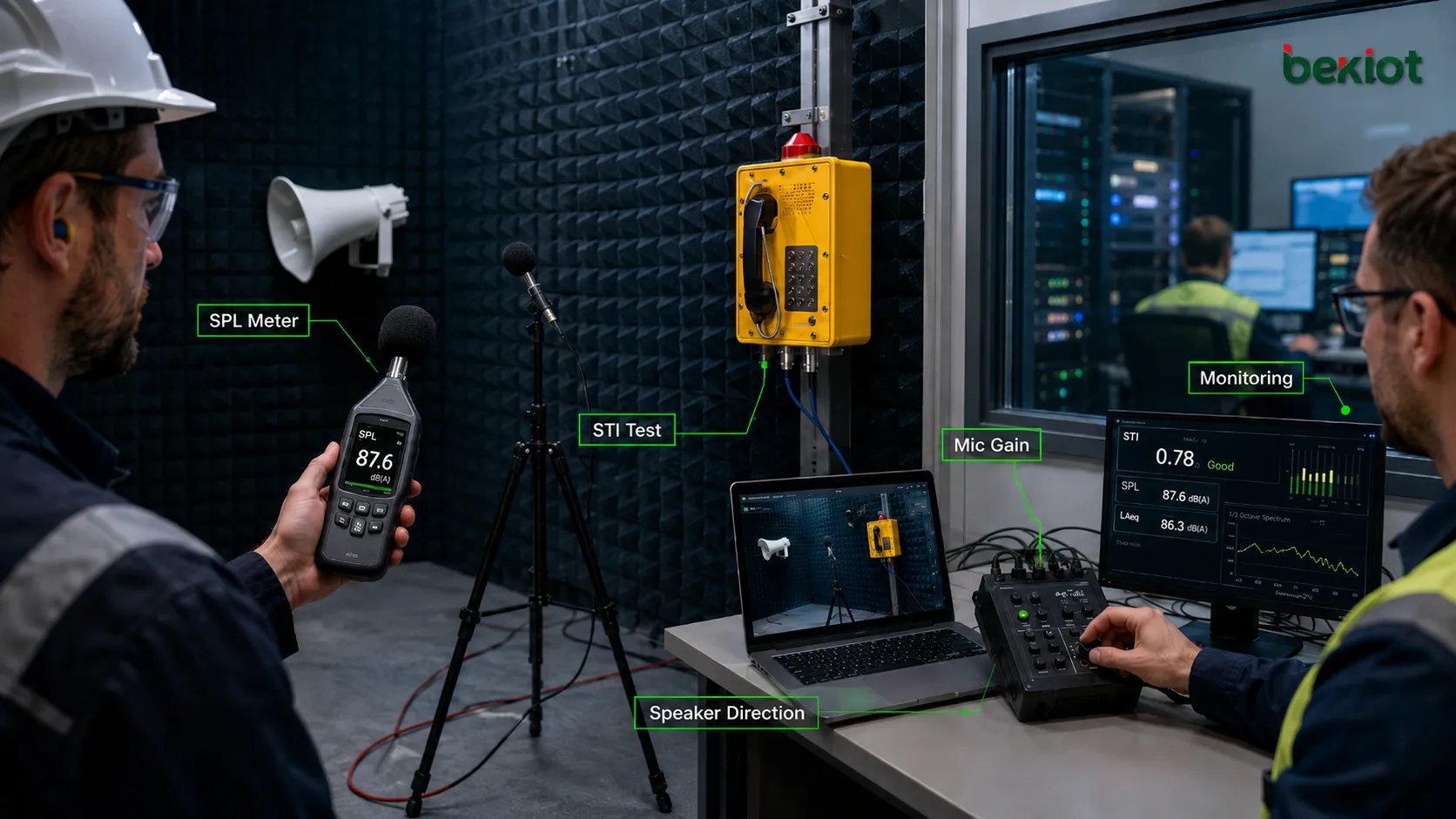
Commissioning should include real speech testing, not only electrical connection tests. Test messages should include short commands, numbers, location names, emergency phrases, and typical operating vocabulary.
Measurements may include sound pressure level, speech transmission index, signal-to-noise ratio, reverberation behavior, and subjective listening tests. In safety systems, formal acceptance criteria may be required by project specifications or local rules.
Installers should test normal operation, emergency broadcast priority, backup power behavior, network delay, microphone pickup, feedback resistance, and recording quality. A system that sounds acceptable at low load may behave differently during an alarm or full-volume broadcast.
Maintenance Techniques
Noise reduction performance can decline over time. Microphones may become blocked by dust, speaker grills may corrode, enclosures may loosen, cables may degrade, firmware settings may change, or background noise may increase after new machinery is installed.
Routine maintenance should check microphone openings, speaker output, enclosure seals, cable glands, grounding, amplifier condition, software settings, network delay, and recording quality. In outdoor or washdown environments, IP-rated enclosures should be inspected for gasket condition and cable-entry integrity.
Periodic listening tests are important. A system can appear online in software while producing unclear audio in the field. Maintenance should include both technical status and actual acoustic performance.
Security and Operational Control
In networked audio systems, noise reduction settings may be part of device configuration. Unauthorized changes can affect audibility, emergency priority, or recording quality. Configuration access should therefore be controlled.
Users should not randomly change gain, suppression strength, echo cancellation, or equalization without documentation. Small changes can create large differences in field performance.
For critical environments, configuration backups and change records should be maintained. If a replacement device is installed, the correct acoustic settings should be restored rather than relying on default values.
Limitations and Misunderstandings
Noise reduction cannot solve every acoustic problem. If a loudspeaker is installed in the wrong direction, if a microphone is too far from the speaker, if the room has severe reverberation, or if the background noise is extremely high, processing alone may not create clear communication.
Another misunderstanding is that stronger suppression is always better. Excessive suppression can remove speech details and create artificial artifacts. The best setting is the one that improves intelligibility without damaging the useful message.
A third misunderstanding is that high output power guarantees clarity. In reflective spaces such as tunnels, more volume may increase echo and reduce comprehension. Acoustic design must balance loudness and intelligibility.
Selection Guidance
Choose equipment and system architecture based on the environment. A quiet office intercom, a roadside emergency point, a tunnel PA speaker, a hazardous-area amplified telephone, and a factory paging terminal have different acoustic requirements.
For harsh industrial or hazardous sites, check not only audio functions but also enclosure protection, installation method, operating temperature, corrosion resistance, power supply, cable entry, and maintenance access. For example, an EX-BH621 deployment should be reviewed together with hazardous-area requirements, IP66 environmental protection needs, mounting position, and communication workflow.
For tunnel projects, audio equipment should be evaluated as part of a complete PA and intercom solution, including zone planning, emergency priority, acoustic simulation, field testing, and long-term maintenance.
Application Value Summary
The value of acoustic noise reduction is strongest where human understanding matters. It helps people hear instructions, report incidents, coordinate teams, recognize alarms, and make decisions under stress.
It also improves system usability. Operators do not need to repeat themselves as often. Listeners experience less fatigue. Recordings become more useful. Emergency messages are easier to identify. Field users can communicate in places where ordinary audio equipment may fail to provide clear speech.
In engineering terms, it improves the quality of the communication channel. In operational terms, it reduces uncertainty at the moment when information must be understood quickly.
Acoustic noise reduction is most effective when treated as a complete audio-system design method that combines environment analysis, equipment selection, signal processing, installation quality, commissioning, and maintenance.
FAQ
Is acoustic noise reduction the same as making the environment quieter?
No. It mainly improves the useful audio signal and reduces the impact of unwanted sound in the communication path. The physical environment may still remain noisy.
Why can speech still be unclear even when the speaker is loud?
Loudness alone does not guarantee intelligibility. Echo, reverberation, poor frequency balance, masking noise, distortion, and wrong speaker placement can make loud speech difficult to understand.
Should noise reduction be enabled at maximum strength?
Not always. Excessive processing may damage speech quality, remove important sound details, or create unnatural artifacts. Settings should be tuned according to the field environment.
How often should field audio systems be retested?
They should be tested after installation, after major configuration changes, after equipment replacement, and periodically during maintenance. Sites with harsh conditions or safety requirements may need more frequent checks.
Can one setting work for every site?
No. Different tunnels, factories, stations, outdoor posts, and control rooms have different noise profiles, echo behavior, and communication needs. Field tuning is usually required.







