


Operating humidity is the range of relative humidity in which a product, device, system, or component can function reliably while powered on and performing its intended operation. It describes how much moisture in the surrounding air the equipment can tolerate during use. For electronic, electrical, communication, industrial, security, medical, and outdoor devices, operating humidity is an important environmental specification because moisture can directly affect reliability, safety, service life, insulation, corrosion, display performance, sensors, connectors, and circuit stability.
A product datasheet may specify operating humidity in a format such as 10% to 90% RH, 5% to 95% RH non-condensing, or 0% to 95% RH depending on the device type and test conditions. RH means relative humidity. A “non-condensing” note is especially important because high humidity without condensation is very different from water droplets forming on circuits, terminals, lenses, displays, microphones, speakers, or connectors.
Operating humidity is widely considered in industrial automation, telecom equipment, outdoor security devices, IP phones, access control systems, servers, routers, sensors, control panels, railway systems, medical devices, warehouses, cold storage, marine sites, tunnels, power facilities, and smart building systems. In these environments, humidity can appear together with temperature change, dust, salt mist, vibration, water spray, chemical vapor, and long-term material aging.
What Is Operating Humidity?
Definition and Core Meaning
Operating humidity refers to the humidity conditions under which equipment is designed to work while it is operating. It is different from storage humidity, which describes the humidity range the product can tolerate when it is not powered on or not in active service. Operating humidity is usually more important for real deployment because internal circuits, power supplies, sensors, displays, buttons, audio parts, and connectors may be affected while the product is energized.
The core meaning is moisture tolerance during active use. If a device is rated for 10% to 90% RH non-condensing, it means the product is intended to work within that relative humidity range as long as condensation does not form. It does not automatically mean the device can operate in rain, fog water accumulation, washdown spray, flooding, steam, or direct water contact.
Operating humidity should always be read together with operating temperature. Relative humidity changes with temperature. A device may operate normally at 90% RH in a stable warm room but experience condensation when temperature drops quickly. This is why humidity, temperature, dew point, enclosure design, and installation location must be evaluated together.
Operating humidity defines the moisture conditions a device can tolerate while working, but it does not automatically mean the device is waterproof or condensation-proof.
Why Operating Humidity Matters
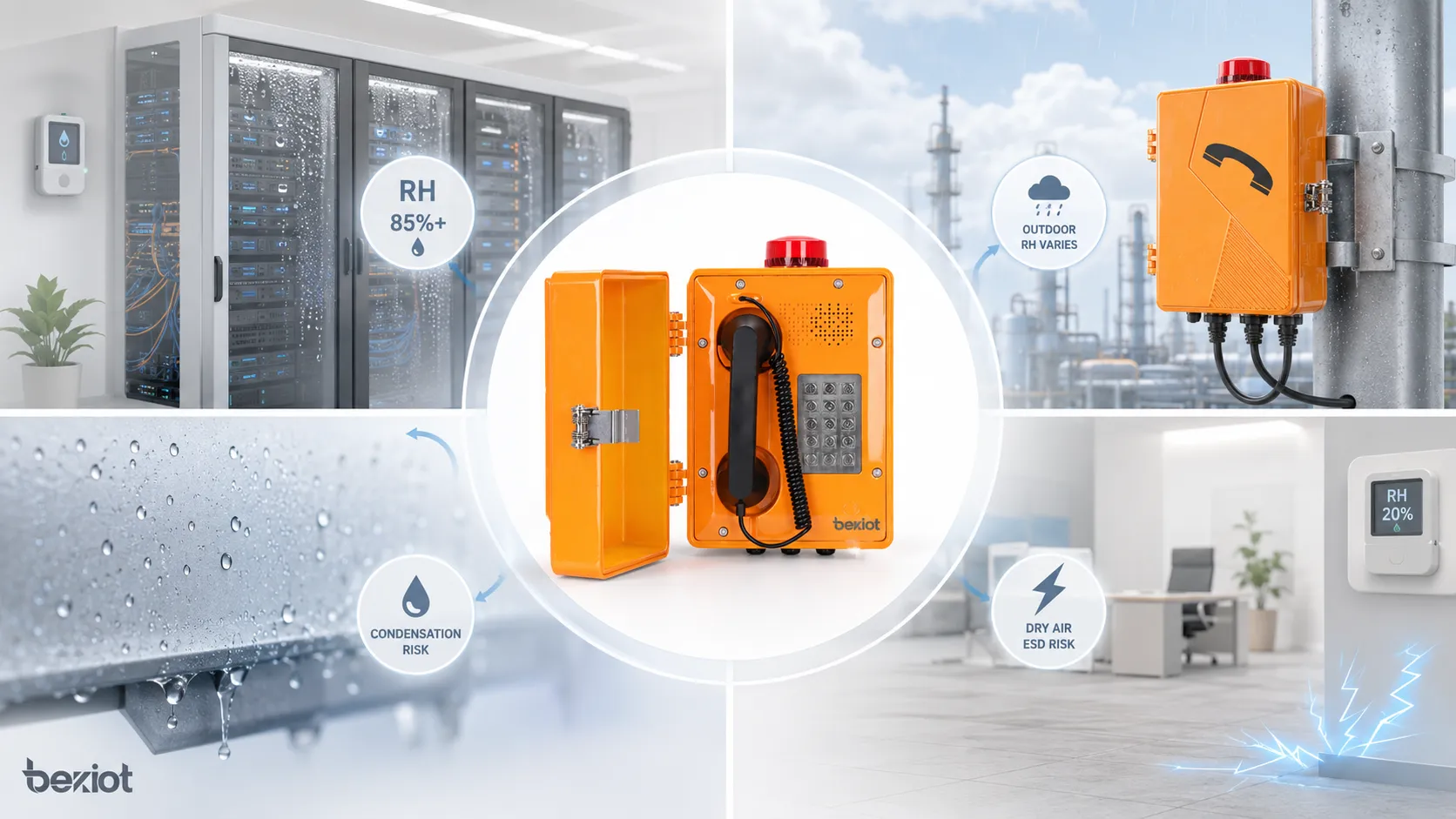
Operating humidity matters because moisture can damage equipment gradually or suddenly. High humidity can accelerate corrosion, reduce insulation resistance, cause leakage current, contaminate circuit boards, affect sensors, fog displays or lenses, deform labels, weaken adhesives, and degrade speaker or microphone performance. In some cases, moisture can create intermittent faults that are difficult to diagnose.
Low humidity can also create problems. Very dry environments may increase electrostatic discharge risk, especially in data centers, electronics manufacturing, laboratories, and office environments with sensitive equipment. Dry air can also affect certain materials, plastics, paper, seals, and user comfort.
For outdoor, industrial, and field equipment, humidity is rarely an isolated factor. Equipment may face humid air during the night, high temperature during the day, condensation in the morning, dust in the environment, salt in coastal areas, or chemical vapor in industrial sites. A reliable product must be evaluated for the actual moisture profile of its installation environment.
How Operating Humidity Works
Relative Humidity and Temperature
Relative humidity describes how much water vapor is present in the air compared with the maximum amount the air can hold at the same temperature. Warm air can hold more moisture than cold air. This means the same amount of water vapor can represent a lower RH at high temperature and a higher RH at low temperature.
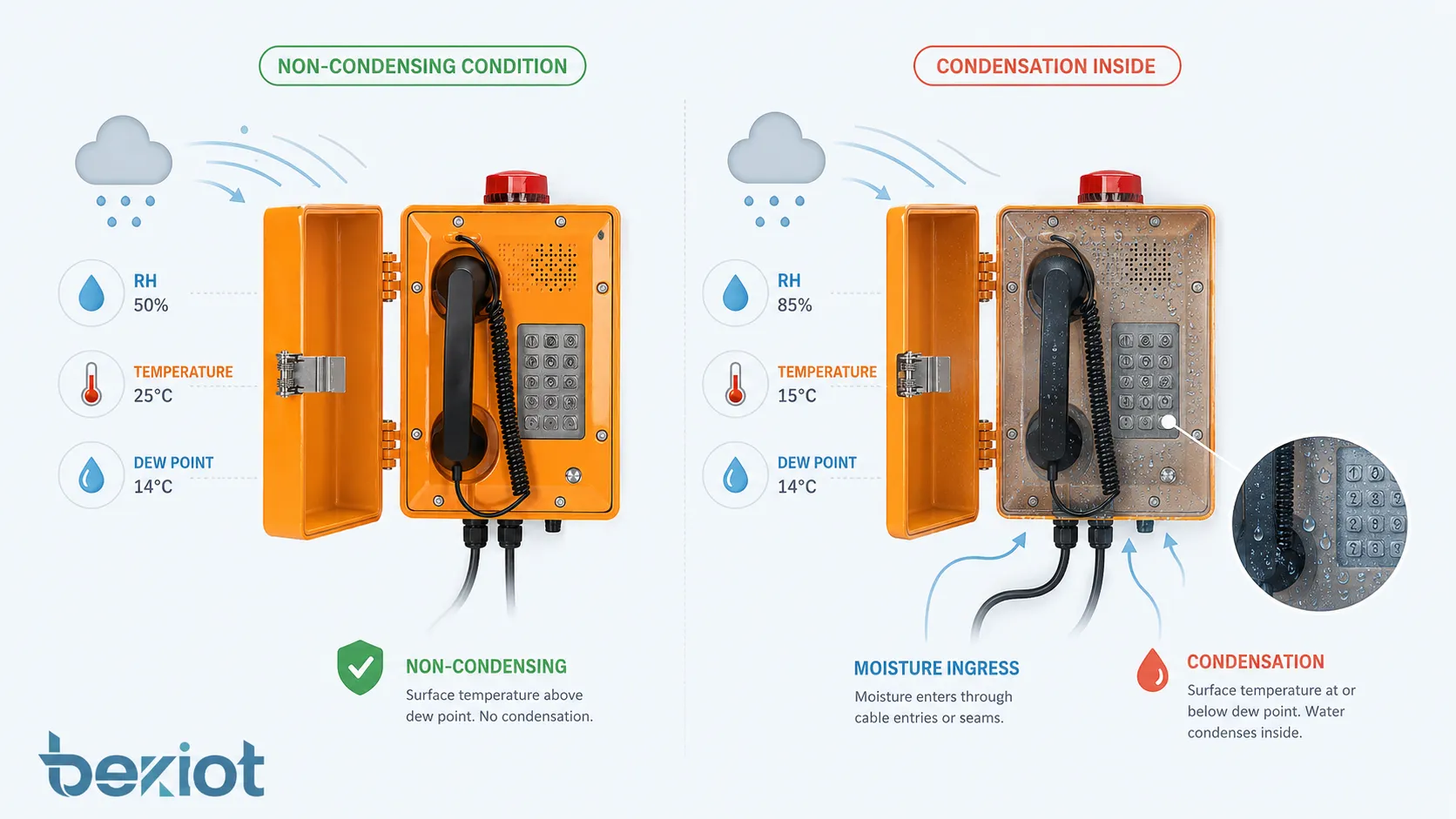
This relationship is important for equipment because temperature changes can turn a safe humidity condition into a condensation risk. If warm humid air enters an enclosure and then cools, the air may reach its dew point and water may condense on internal surfaces.
A device rated for high relative humidity may still fail if condensation forms. Therefore, engineers should not only check the RH percentage. They should also consider temperature cycling, dew point, ventilation, enclosure sealing, and the likelihood of moisture being trapped inside the product.
Non-Condensing Conditions
Many product datasheets specify humidity as “non-condensing.” This means moisture is allowed in the air, but liquid water should not form on or inside the device. Condensation can be much more damaging than humid air because water droplets can bridge electrical contacts, corrode metal parts, fog optical surfaces, and contaminate circuit boards.
Non-condensing conditions are common in controlled indoor environments, data rooms, telecom rooms, offices, and many industrial cabinets. However, field environments may not remain non-condensing. Outdoor cabinets, tunnels, cold storage entrances, coastal sites, and unheated buildings can experience condensation during daily temperature changes.
If the actual installation may produce condensation, the product needs additional design protection such as sealed enclosures, breathable membranes, heaters, conformal coating, drainage, desiccants, humidity control, or better cabinet design.
Dew Point and Moisture Risk
Dew point is the temperature at which air becomes saturated and water vapor begins to condense. When equipment surfaces fall below the dew point, moisture can form on those surfaces. This can happen inside cabinets, inside enclosures, on circuit boards, on connectors, on displays, and on metal housings.
Dew point is often more useful than RH alone for understanding condensation risk. A high RH value at a stable temperature may be less harmful than a rapid temperature drop that causes water droplets to form. Condensation is especially likely during night-to-day transitions, air-conditioned room entry, cold storage door openings, and outdoor cabinet temperature swings.
Good humidity design should evaluate whether the device will experience stable humidity, cyclic humidity, or condensation. These conditions create different levels of stress.
Moisture Ingress and Absorption
Moisture can enter equipment through cable glands, seams, vents, connectors, gaskets, screw holes, damaged seals, porous materials, and pressure changes. Even sealed equipment may experience moisture movement over long periods if the sealing system is not designed correctly.
Some materials also absorb moisture. Plastics, rubber parts, adhesives, labels, insulation materials, and printed circuit board substrates may absorb or release moisture depending on the environment. This can affect dimensions, insulation, bonding strength, and long-term reliability.
Operating humidity should therefore be considered as both an external environmental condition and an internal material stress.
Standards Related to Operating Humidity
IEC 60068 Environmental Testing
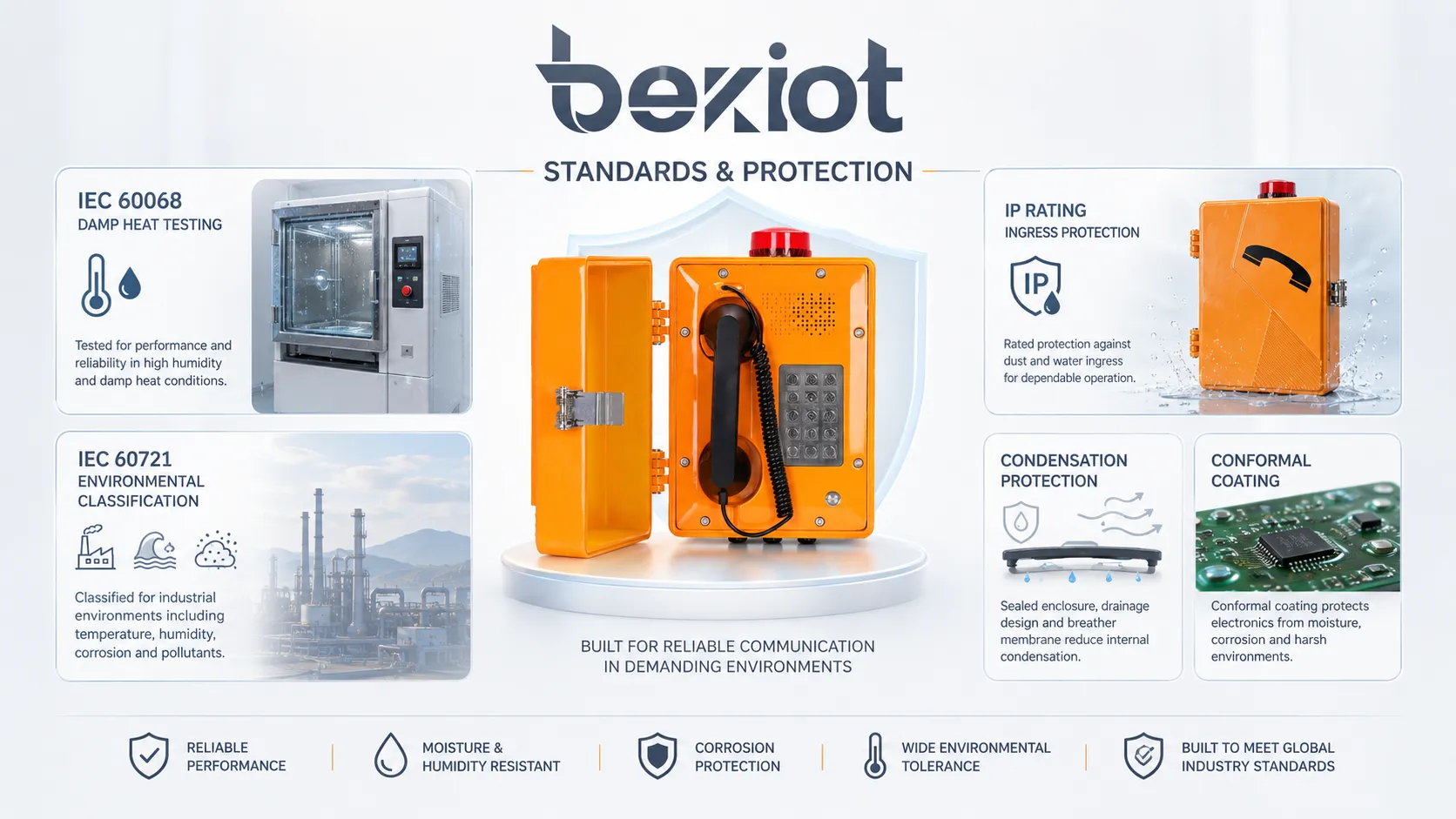
IEC 60068 is a major family of environmental testing standards used to evaluate how electrotechnical products respond to environmental stresses. For humidity-related evaluation, damp heat tests are especially relevant because they help determine how products withstand high humidity, condensation, and changes in electrical or mechanical characteristics.
In practical product testing, damp heat tests may be used to check corrosion resistance, insulation stability, circuit reliability, seal performance, material aging, display behavior, and functional operation under humid conditions. The exact test method, duration, temperature, humidity level, and operating status must be selected according to the product type and application.
IEC 60068 testing should not be understood as one single humidity rating. It is a family of test methods and guidance documents. A product specification should state which test was performed, what conditions were used, and what acceptance criteria were applied.
IEC 60068-2-78 Damp Heat Steady State
IEC 60068-2-78 is associated with damp heat steady-state testing. This type of test exposes a product or component to high humidity and stable temperature conditions for a defined period. It is useful for evaluating long-term exposure to humid air without the repeated temperature swings of cyclic testing.
Steady-state damp heat testing can reveal moisture-related degradation such as reduced insulation resistance, corrosion, material swelling, coating weakness, display abnormality, and functional instability. It is often relevant for electronic products that may operate or be stored in humid environments.
The result of the test depends on severity and duration. A short low-severity test is not equivalent to long-term exposure in a tropical, marine, industrial, or outdoor environment.
IEC 60068-2-30 Damp Heat Cyclic
IEC 60068-2-30 is associated with damp heat cyclic testing. Cyclic damp heat testing exposes products to repeated temperature and humidity cycles, often creating condensation stress. This is useful because many real environments are not stable. Equipment may warm during the day, cool at night, and experience repeated moisture cycles.
Cyclic humidity can be more stressful than steady humidity because expansion, contraction, condensation, evaporation, and moisture migration repeat over time. These cycles can affect seals, solder joints, contacts, connectors, coatings, and mechanical parts.
Products used outdoors, in unconditioned spaces, in transportation, in tunnels, or in field cabinets may benefit from cyclic damp heat evaluation because real environmental conditions often change daily.
IEC 60721 Environmental Classification
IEC 60721 provides a framework for classifying environmental conditions such as climate, temperature, humidity, mechanical stress, and other environmental influences. It helps engineers define the type of environment where a product will be stored, transported, or used.
For operating humidity, environmental classification helps avoid vague descriptions such as “indoor,” “outdoor,” or “industrial.” A weather-protected outdoor cabinet, a climate-controlled office, a tropical outdoor site, a railway tunnel, a cold storage facility, and a chemical plant may all have different humidity risks.
The environmental class does not replace product testing or reliability assessment by itself. It helps define the expected environment so that the correct product requirements and test severities can be selected.
Telecom, Data Center, and Industry Guidelines
Telecom rooms, data centers, equipment rooms, and industrial control rooms may use additional environmental guidelines for temperature and humidity control. These environments often monitor humidity to reduce electrostatic discharge at low humidity and condensation or corrosion risk at high humidity.
Data centers and telecom sites usually require controlled humidity because servers, switches, storage systems, and communication equipment operate continuously. Poor humidity control can increase hardware failure risk and reduce long-term reliability.
Industry-specific guidelines should be checked when equipment is installed in regulated or high-availability environments.
Protection Ratings and Humidity
Operating Humidity Is Not the Same as IP Rating
Operating humidity and IP rating describe different environmental properties. Operating humidity describes the moisture level in the air that the equipment can tolerate while operating. IP rating describes the degree of protection provided by an enclosure against solid objects, dust, accidental contact, and water ingress.
A device may be rated for 95% RH non-condensing but have only limited protection against rain or water spray. Another device may have a strong IP rating but still require humidity control inside the enclosure to prevent condensation. These specifications should not be confused.
For outdoor or harsh environments, users should check operating humidity, operating temperature, IP rating, condensation protection, corrosion resistance, and installation method together.
IP Ratings and Water Ingress
IP ratings under IEC 60529 are commonly used to describe enclosure protection against solids and liquids. The first digit relates to solid object or dust protection, while the second digit relates to water ingress protection. Examples include protection against dripping water, spraying water, water jets, powerful water jets, temporary immersion, or other defined conditions.
IP ratings help evaluate whether an enclosure can resist water entering from outside. However, they do not fully describe internal condensation risk. A sealed enclosure may stop rain from entering but can still trap humid air inside. When temperature changes, that trapped moisture may condense.
This is why IP-rated products may still require breathable membranes, pressure equalization, desiccants, heaters, drain design, or conformal coating depending on the installation environment.
NEMA and UL Type Ratings
In North American projects, NEMA and UL Type ratings may be used for electrical enclosures. These ratings can describe suitability for certain indoor or outdoor conditions such as falling dirt, rain, sleet, windblown dust, hose-directed water, corrosion, oil, coolant, or other environmental exposure depending on the type.
NEMA or UL Type ratings should not be treated as exact equivalents to IP ratings or operating humidity ranges. They have their own scope, test logic, and application context. A product may need both a humidity specification and an enclosure rating to satisfy a project requirement.
When selecting equipment for humid or wet environments, users should check which rating system is required by the project, market, or authority having jurisdiction.
IK Rating and Mechanical Protection
IK rating describes enclosure protection against external mechanical impacts. It does not directly describe humidity performance. However, mechanical damage can weaken humidity and water protection by cracking housings, loosening covers, damaging gaskets, or opening cable entries.
In public, industrial, transportation, or outdoor locations, impact resistance may indirectly help protect against moisture problems. If an enclosure is damaged by impact, humidity and water ingress risk may increase.
For field equipment, IP protection, IK protection, operating humidity, temperature range, material durability, and maintenance inspection should be considered together.
Conformal Coating and Moisture Protection
Conformal coating is a protective layer applied to printed circuit boards to help resist moisture, dust, chemical vapor, and corrosion. It can improve reliability in humid environments, especially when equipment may face condensation or airborne contaminants.
Conformal coating does not make a product waterproof by itself. It is one layer of protection. Enclosure sealing, cable entries, component selection, drainage, and environmental control still matter.
In high-humidity or corrosive environments, conformal coating can be valuable when used as part of a complete moisture protection strategy.
Technical Effects of Humidity on Equipment
Corrosion of Metal Parts
High humidity can accelerate corrosion of metal parts, especially when combined with salt, industrial gases, dust, or chemical contamination. Connectors, terminals, screws, contacts, shielding parts, springs, and PCB traces may all be affected.
Corrosion can increase electrical resistance, cause intermittent contact, weaken mechanical parts, and create visible rust or oxidation. In communication devices, corrosion may affect audio quality, button reliability, power connection, and network stability.
Corrosion control may require suitable materials, coatings, sealed connectors, conformal coating, corrosion-resistant fasteners, and regular maintenance.
Insulation Resistance Reduction
Moisture can reduce insulation resistance between electrical conductors. This may create leakage current, false signals, sensor drift, or circuit instability. In high-voltage or sensitive measurement systems, insulation degradation can become a serious safety and accuracy issue.
Printed circuit boards, terminal blocks, cables, and connectors can all be affected by humidity, especially when dust or ionic contamination is present. Moisture and contamination together can create conductive paths.
Good PCB design, spacing, coating, cleaning, sealing, and environmental testing help reduce this risk.
Condensation on Circuit Boards
Condensation is one of the most serious humidity-related risks. Liquid water on a circuit board can cause short circuits, corrosion, unpredictable signals, and permanent component damage. Even small droplets can create faults if they bridge sensitive areas.
Condensation often occurs when equipment moves from cold to warm humid air, when a cabinet cools at night, when air conditioning changes room conditions, or when outdoor equipment experiences rapid temperature swings.
Preventing condensation requires temperature management, ventilation planning, moisture barriers, pressure equalization, heaters, coatings, or controlled installation practices.
Effect on Displays and Optical Parts
Humidity can affect displays, lenses, camera windows, optical sensors, and indicator windows. Fogging, haze, water marks, delamination, backlight aging, and reduced visibility may occur if moisture enters or condenses inside the optical area.
Outdoor displays, intercoms, cameras, access terminals, and control panels are especially vulnerable because users depend on clear visibility. A fogged display or lens can reduce usability and safety.
Optical parts may require sealing, anti-fog design, ventilation membranes, heaters, hydrophobic coatings, or careful material selection.
Effect on Audio Components
Humidity can affect microphones, speakers, receivers, buzzers, acoustic membranes, and audio ports. Moisture may change sensitivity, reduce volume, cause distortion, corrode contacts, or block acoustic openings with condensation and dust.
Communication equipment installed outdoors, in tunnels, near water, in factories, or in humid public areas should be tested for audio performance under realistic humidity conditions.
Protective membranes, drainage design, sealed acoustic paths, corrosion-resistant materials, and regular inspection can improve audio reliability.
Effect on Sensors and Calibration
Some sensors are sensitive to humidity. Gas sensors, environmental sensors, pressure sensors, optical sensors, capacitive sensors, and touch interfaces may drift or behave differently in humid conditions.
Sensor systems may require compensation algorithms, protective filters, calibration procedures, or environmental isolation. In some cases, humidity itself is part of the measurement and must be accurately monitored.
For measurement devices, humidity effects should be considered during calibration and specification review.
Common Operating Humidity Specifications
10% to 90% RH Non-Condensing
A common specification for many indoor and semi-industrial electronic devices is 10% to 90% RH non-condensing. This range is suitable for many controlled environments but does not necessarily mean the product is suitable for wet outdoor operation or condensation-prone locations.
When this specification appears, users should confirm whether the installation environment remains non-condensing. If the product is installed in a room with stable temperature and humidity control, it may be suitable. If it is installed in an outdoor cabinet, more protection may be needed.
The phrase “non-condensing” should never be ignored.
5% to 95% RH Non-Condensing
A wider specification such as 5% to 95% RH non-condensing indicates that the equipment is designed for a broader humidity range. This may be useful in industrial, telecom, warehouse, or equipment room environments.
However, even 95% RH non-condensing does not equal protection against liquid water. If moisture condenses, the device may still be at risk unless the product is designed for condensation or wet conditions.
Users should check whether the product has humidity testing evidence and whether the enclosure design matches the actual installation.
Condensing Humidity Rating
Some rugged or outdoor products may be tested for conditions involving condensation, damp heat cycles, or more severe moisture exposure. This is different from ordinary non-condensing humidity tolerance.
Condensing conditions are more demanding because liquid water can form on surfaces. Products intended for such environments may need conformal coating, sealed enclosures, drainage, corrosion-resistant materials, and special test validation.
If a project involves outdoor cabinets, tunnels, cold storage, marine sites, or rapid temperature changes, users should ask whether the product has been evaluated for condensation risk.
Storage Humidity Versus Operating Humidity
Storage humidity describes conditions the product can tolerate while it is not operating. Operating humidity describes conditions under which the product can function. A product may survive storage in a humid environment but fail or behave unpredictably if powered on under the same conditions.
Storage ratings are useful for shipping, warehousing, and spare parts management. Operating ratings are more important for installed systems and field performance.
Buyers and engineers should not substitute storage humidity for operating humidity when selecting equipment.
Applications of Operating Humidity Ratings
Industrial Automation and Control
Industrial automation systems often include controllers, sensors, power supplies, switches, gateways, panels, and human-machine interfaces. These devices may operate in factories, process plants, machine rooms, tunnels, warehouses, or cabinets with variable humidity.
High humidity can affect terminals, circuit boards, relays, sensors, and connectors. If the site also contains dust, oil mist, chemicals, or temperature cycling, the risk increases.
Operating humidity ratings help engineers select products that can remain stable in the actual production environment.
Telecommunications and Network Equipment
Routers, switches, gateways, base station equipment, fiber devices, servers, and communication terminals may be installed in equipment rooms, outdoor cabinets, roadside boxes, towers, tunnels, or utility sites. Humidity control is important because network equipment often runs continuously.
Humidity-related failures can interrupt communication services and may be expensive to repair at remote sites. Equipment rooms may use environmental monitoring to track temperature and humidity and generate alarms when conditions move outside acceptable limits.
For telecom deployments, operating humidity should be evaluated with ventilation, cabinet sealing, condensation control, and backup power planning.
Outdoor Security and Access Control
Outdoor cameras, intercoms, card readers, keypads, help points, sensors, and alarm devices may face rain, fog, dew, temperature swings, and high humidity. Operating humidity ratings help determine whether electronics can function reliably under these conditions.
Outdoor security devices also need enclosure protection, cable sealing, corrosion resistance, and physical durability. Humidity can fog lenses, affect microphones, corrode connectors, and cause keypad faults.
A complete outdoor specification should include humidity, temperature, IP rating, IK rating where needed, UV resistance, and installation guidance.
Data Centers and Equipment Rooms
Data centers and equipment rooms control humidity to protect servers, storage, network switches, and power systems. Too little humidity can increase electrostatic discharge risk. Too much humidity can increase condensation and corrosion risk.
Humidity monitoring, HVAC control, airflow management, and environmental alarms are used to keep conditions within the designed range. Equipment specifications should align with the facility’s environmental control strategy.
Operating humidity in these environments is part of high-availability infrastructure management.
Transportation and Tunnel Systems
Transportation and tunnel systems may expose equipment to humidity, condensation, vehicle exhaust, dust, cleaning water, and temperature variation. Communication devices, cameras, sensors, signs, control cabinets, and emergency phones must remain reliable.
Tunnels are especially challenging because air movement, water seepage, vehicle emissions, and temperature gradients can create humid and corrosive conditions.
Operating humidity requirements should be evaluated with IP protection, corrosion resistance, cable sealing, ventilation, and maintenance access.
Marine, Coastal, and Utility Sites
Marine and coastal sites combine high humidity with salt contamination. This can accelerate corrosion and damage connectors, fasteners, circuit boards, and enclosures. Utility sites such as pump stations, water treatment plants, and substations may also face humid air and condensation.
In these environments, a broad operating humidity range alone may not be enough. Salt mist resistance, corrosion-resistant materials, conformal coating, sealed connectors, and maintenance inspection may be required.
Equipment selection should be based on the combined environmental stress, not only RH percentage.
How to Select Equipment Based on Operating Humidity
Read the Datasheet Carefully
The first step is to read the datasheet carefully. Look for operating humidity, storage humidity, operating temperature, storage temperature, IP rating, condensation notes, and environmental test references. The wording matters.
A specification such as 5% to 95% RH non-condensing is not the same as a product tested for condensing damp heat or direct water exposure. If the application includes condensation, ask for more detailed test evidence.
Datasheets should be interpreted based on the actual site environment, not only on the highest RH number shown.
Identify Condensation Risk
Condensation risk should be evaluated before installation. Ask whether the device will experience rapid temperature changes, night cooling, air-conditioned room entry, cold storage transitions, outdoor cabinet exposure, tunnel humidity, or sealed enclosure moisture.
If condensation is likely, consider products with stronger moisture protection or add environmental controls such as heaters, vents, membranes, desiccants, conformal coating, or cabinet climate control.
Preventing condensation is often more important than simply choosing a high non-condensing RH rating.
Check Enclosure and Cable Entry Design
Humidity and water can enter through weak enclosure points. Cable glands, connectors, seams, covers, screws, vents, and service openings should be designed and installed properly. A high-quality enclosure can lose protection if cable entries are poorly sealed.
For outdoor and industrial use, accessories should match the required protection level. Field modifications such as drilling extra holes may reduce sealing performance if not handled correctly.
The installed system should preserve the environmental protection intended by the product design.
Consider Corrosion and Contaminants
Humidity becomes more damaging when combined with salt, dust, chemicals, gases, or industrial pollution. Coastal sites, chemical plants, wastewater facilities, mines, tunnels, and heavy industry may require corrosion-resistant materials and coatings.
Users should ask whether the product has suitable surface treatment, PCB coating, connector protection, and fastener materials for the environment.
A product that works in clean humid air may not survive polluted humid air for the same length of time.
Plan Monitoring and Maintenance
Humidity-sensitive systems should be monitored and maintained. Environmental sensors can track humidity and temperature in cabinets or rooms. Maintenance checks can identify condensation marks, corrosion, damaged seals, loose cable glands, and blocked vents.
Monitoring helps detect conditions that exceed the product rating before failure occurs. Maintenance helps preserve protection over time.
For critical systems, humidity management should be part of the preventive maintenance plan.
Design Methods for Humidity Protection
Sealed Enclosures
Sealed enclosures help prevent external moisture, dust, and water from entering equipment. They are common in outdoor devices, industrial controllers, security terminals, communication devices, and field sensors.
However, sealing must be designed carefully. A fully sealed enclosure can trap humid air inside. If the internal temperature changes, condensation may form. Pressure changes may also stress seals over time.
Sealed design should be combined with proper gasket materials, cable glands, pressure equalization, and condensation management.
Breathable Membranes
Breathable membranes can allow pressure equalization while helping block liquid water and dust. They are often used in outdoor enclosures to reduce pressure stress and moisture buildup.
These membranes are not a universal solution. They must be selected according to airflow, water protection, chemical exposure, installation position, and enclosure volume.
When used correctly, breathable membranes can help reduce condensation risk in sealed equipment.
Heaters and Climate Control
Cabinet heaters, enclosure heaters, and climate control systems can reduce condensation by keeping internal surfaces above the dew point. They are common in outdoor cabinets, cold regions, and humidity-prone installations.
Air conditioners, dehumidifiers, heat exchangers, and ventilation systems may be used in larger cabinets or equipment rooms. These systems should be designed to avoid creating new condensation points.
Climate control is especially useful for critical equipment that must operate continuously in unstable environments.
Conformal Coating
Conformal coating protects circuit boards from moisture, dust, and certain contaminants. It can improve reliability in high-humidity environments and reduce corrosion or leakage current risk.
Coating must be applied correctly. Poor coating coverage, trapped contamination, or wrong material selection can reduce effectiveness. Areas such as connectors, switches, and service contacts may need masking or special treatment.
Conformal coating works best as part of a layered protection strategy.
Drainage and Installation Orientation
Drainage and installation orientation help prevent water accumulation. Outdoor devices should be mounted so that water does not collect near seams, cable entries, speakers, microphones, buttons, or display edges.
Cable loops, downward-facing entries, drip edges, and correct mounting angles can reduce moisture entry. Incorrect installation can defeat the protection of an otherwise well-designed product.
Installation quality is a major part of humidity protection.
Common Problems Caused by Poor Humidity Control
Intermittent Faults
Humidity-related faults are often intermittent. A device may fail in the morning, recover later in the day, and fail again when humidity rises. This makes troubleshooting difficult.
Intermittent faults may be caused by condensation, corrosion, leakage current, connector contamination, or sensor drift. Logs, environmental monitoring, and inspection can help identify the pattern.
If a fault appears only during humid periods, moisture should be investigated as a possible cause.
Corroded Connectors
Connectors are common failure points. Humidity, salt, dust, and pollution can corrode contact surfaces, increasing resistance or causing unstable connections. This may affect power, network, audio, sensor, or control signals.
Corroded connectors may cause random resets, packet loss, poor audio, signal drift, or device offline events. Protective caps, sealed connectors, proper cable glands, and maintenance inspection can reduce risk.
Connector protection is especially important in outdoor and coastal deployments.
Fogged Displays and Lenses
Displays, camera windows, and indicator panels may fog when moisture condenses inside or on the surface. This can reduce visibility and make the device difficult to use.
Fogging is common when temperature changes quickly or when seals allow humid air to enter optical areas. Anti-fog design, heaters, ventilation membranes, and better sealing can help.
For cameras, access terminals, and outdoor panels, visibility is part of operational reliability.
Reduced Audio Performance
Moisture can affect speakers, microphones, buzzers, and acoustic membranes. Users may notice lower volume, distorted sound, blocked microphone pickup, or intermittent audio failure.
Humidity can also combine with dust to block acoustic openings. Outdoor communication devices should include protective membranes, drainage, and maintenance access.
Audio testing under humid conditions is important for emergency phones, intercoms, paging devices, and help points.
Shortened Product Life
Even when humidity does not cause immediate failure, it can shorten product life. Corrosion, material swelling, adhesive weakening, coating degradation, and component stress can accumulate over months or years.
Products installed in humid environments should be selected with long-term durability in mind. A device may pass initial commissioning but fail prematurely if humidity protection is insufficient.
Long-term reliability depends on both product design and maintenance quality.
Maintenance and Monitoring Tips
Monitor Temperature and Humidity Together
Temperature and humidity should be monitored together because condensation depends on both. Monitoring only RH may not reveal the full risk. Dew point or temperature difference between air and equipment surfaces may be more useful in some environments.
Equipment rooms, cabinets, tunnels, cold storage areas, and outdoor enclosures can benefit from environmental sensors. Alerts can notify maintenance teams before conditions become unsafe for equipment.
Combined monitoring supports better preventive maintenance.
Inspect for Condensation Marks
Maintenance teams should inspect devices for condensation marks, water stains, corrosion, fogging, swollen labels, loose seals, rusted screws, and moisture inside covers. These signs may reveal environmental problems even if the device is still working.
Early detection allows repairs before permanent damage occurs. A damaged gasket or loose cable gland can be fixed more easily than a corroded circuit board.
Visual inspection is still valuable even in systems with electronic monitoring.
Check Gaskets and Cable Glands
Gaskets and cable glands should be checked regularly. Over time, seals can harden, crack, compress, loosen, or become contaminated. Cable glands may loosen because of vibration, thermal cycling, or poor installation.
If seals fail, humidity and water can enter the equipment. Replacement parts should match the product design and required protection level.
Seal maintenance helps preserve humidity and ingress protection over the product’s life.
Clean Without Forcing Moisture Inside
Cleaning methods should match the equipment rating. A device with limited water protection should not be sprayed directly. Even IP-rated equipment should be cleaned according to manufacturer instructions because high-pressure water, chemicals, or wrong angles may damage seals and membranes.
Cleaning can improve reliability by removing dust and contaminants, but it can also introduce moisture if done incorrectly.
Maintenance procedures should clearly define acceptable cleaning methods.
Review Environmental Logs
Environmental logs can show whether humidity regularly exceeds the recommended range. They can also show patterns such as night condensation risk, seasonal humidity peaks, or cabinet ventilation problems.
Reviewing logs helps managers decide whether to improve ventilation, add heaters, relocate equipment, replace seals, or select higher-protection devices.
Environmental data supports evidence-based maintenance decisions.
Operating Humidity Versus Similar Terms
Operating Humidity Versus Storage Humidity
Operating humidity describes the humidity range in which equipment can function while powered on and working. Storage humidity describes the range in which the product can be stored without operating.
Storage conditions may be less demanding in some ways because the equipment is not energized, but long-term storage in high humidity can still damage materials, connectors, packaging, and internal parts.
For product selection, operating humidity is usually more important than storage humidity.
Operating Humidity Versus Waterproof Rating
Operating humidity describes moisture in the air. Waterproof or water ingress ratings describe resistance to liquid water entering the enclosure under defined conditions. These are different concepts.
A product may tolerate high humidity but fail if sprayed with water. Another product may resist water jets but still suffer internal condensation if humid air is trapped inside.
Humidity and water ingress should be evaluated separately.
Operating Humidity Versus Condensation Resistance
A high non-condensing humidity rating does not necessarily mean condensation resistance. Condensation resistance requires the product to tolerate or prevent water droplets forming on or inside the device.
Condensation resistance may depend on coatings, enclosure design, heating, drainage, material selection, and specific damp heat cyclic testing.
If condensation is expected, the product specification should clearly address it.
Operating Humidity Versus Environmental Protection
Environmental protection is a broader term that may include temperature, humidity, water ingress, dust, corrosion, UV exposure, impact, vibration, chemical exposure, and altitude. Operating humidity is only one part of environmental protection.
A product selected for harsh environments should be evaluated across all relevant stresses. Focusing only on humidity may miss other risks.
The best selection approach is to define the complete environmental profile of the installation site.
Conclusion
Operating humidity is the humidity range in which equipment can work reliably while powered on and performing its intended function. It is usually expressed as a relative humidity range, often with an important “non-condensing” condition. It should always be evaluated together with operating temperature, dew point, condensation risk, enclosure design, and actual installation conditions.
Relevant standards and methods include IEC 60068 environmental testing for damp heat conditions, IEC 60721 environmental classification for defining environmental conditions, and enclosure protection systems such as IP ratings under IEC 60529. However, operating humidity is not the same as IP rating, waterproofing, corrosion resistance, or condensation resistance.
Operating humidity matters in industrial automation, telecom equipment, outdoor security, data centers, transportation, tunnels, marine sites, utility facilities, and field communication systems. To select reliable equipment, users should read datasheets carefully, identify condensation risk, verify enclosure and cable entry design, consider corrosion and contaminants, and maintain humidity protection over the product’s service life.
FAQ
What is operating humidity in simple terms?
Operating humidity is the range of air moisture in which a device can work normally while it is powered on and in use.
It is usually shown as a relative humidity range, such as 10% to 90% RH non-condensing.
What does RH mean in operating humidity?
RH means relative humidity. It describes the amount of water vapor in the air compared with the maximum amount the air can hold at the same temperature.
Relative humidity changes with temperature, so temperature and humidity should be considered together.
What does non-condensing mean?
Non-condensing means that moisture may be present in the air, but liquid water should not form on or inside the device.
This is important because condensation can cause corrosion, leakage current, short circuits, fogging, and unstable operation.
Is operating humidity the same as waterproof rating?
No. Operating humidity describes moisture in the air. Waterproof or IP water protection describes resistance to liquid water entering the enclosure under defined test conditions.
A product can have a high humidity rating but still not be suitable for rain, water jets, or immersion.
Which standards are related to humidity testing?
IEC 60068 includes environmental testing methods such as damp heat tests. IEC 60068-2-78 is associated with damp heat steady-state testing, while IEC 60068-2-30 is associated with damp heat cyclic testing.
IEC 60721 can also help classify environmental conditions for storage, transport, and use.
Why is condensation more dangerous than high humidity alone?
Condensation creates liquid water on surfaces. Liquid water can bridge electrical contacts, corrode metal parts, fog displays, damage circuit boards, and cause unpredictable faults.
High humidity without condensation is usually less severe than actual water droplets forming inside the equipment.
How can equipment be protected in humid environments?
Protection methods include sealed enclosures, proper cable glands, breathable membranes, heaters, conformal coating, corrosion-resistant materials, drainage design, humidity monitoring, and regular inspection.
The right method depends on whether the environment is humid, condensing, wet, corrosive, dusty, or temperature-cycling.







