


An industrial SIP phone is a rugged voice communication device designed for harsh, noisy, outdoor, public, or mission-critical environments. Unlike ordinary office IP phones, an industrial SIP phone is built with stronger enclosure protection, durable materials, reliable audio components, simplified operation, and support for SIP-based VoIP communication. It allows field users, operators, guards, workers, passengers, maintenance teams, and control rooms to communicate through an IP network.
In modern industrial communication systems, SIP phones are not limited to desk calling. They can work as emergency call stations, wall-mounted industrial telephones, weatherproof phones, tunnel phones, public help points, factory intercoms, roadside communication terminals, access control voice points, and dispatch-connected field endpoints. By using SIP, these devices can register to an IP PBX, SIP server, hosted communication platform, or dispatch system, allowing voice calls to be routed flexibly across sites and departments.
Industrial SIP phones are widely used in factories, power plants, mines, tunnels, ports, railways, airports, highways, warehouses, campuses, hospitals, parking areas, chemical facilities, utility corridors, and public infrastructure. Their value comes from combining rugged hardware with IP-based communication features such as extension calling, call forwarding, group calling, emergency dialing, remote management, call recording, paging linkage, and dispatch integration.
What Is an Industrial SIP Phone?
Definition and Core Meaning
An industrial SIP phone is a SIP-compatible telephone or intercom endpoint designed for industrial and field communication. SIP, or Session Initiation Protocol, is used to establish, manage, and terminate voice sessions over an IP network. The phone uses SIP signaling to register, call, answer, transfer, and manage communication sessions, while the voice media is typically carried through RTP or SRTP depending on system configuration.
The core meaning of an industrial SIP phone is rugged IP voice access. It brings VoIP communication to places where a standard office phone is not suitable. These places may include dusty workshops, wet tunnels, outdoor walls, high-noise production lines, access gates, public areas, utility sites, security checkpoints, and emergency contact points.
In a practical deployment, an industrial SIP phone may have a handset, speaker, microphone, keypad, emergency button, stainless steel panel, weatherproof housing, heavy-duty cable entry, wall-mount structure, or anti-vandal design. Some models focus on two-way calling, while others emphasize emergency intercom, hotline dialing, loudspeaker communication, or connection with dispatch systems.
An industrial SIP phone is not just an IP phone in a stronger case; it is a field communication endpoint designed for reliability, audibility, and fast response in demanding environments.
Industrial SIP Phone Versus Office IP Phone
An office IP phone is normally used on a desk in a controlled indoor environment. It may have a screen, multiple function keys, headset support, and business calling features. Its design assumes clean air, stable temperature, limited moisture, and regular user handling.
An industrial SIP phone is designed for more difficult conditions. It may need to resist dust, rain, splashing water, vibration, impact, temperature variation, corrosion, public misuse, and high background noise. Its user interface is often simpler because field users need quick operation rather than complex menu navigation.
The two devices may both use SIP, but their application logic is different. Office IP phones serve business desktop communication. Industrial SIP phones serve site communication, emergency response, operational coordination, and public assistance in field environments.
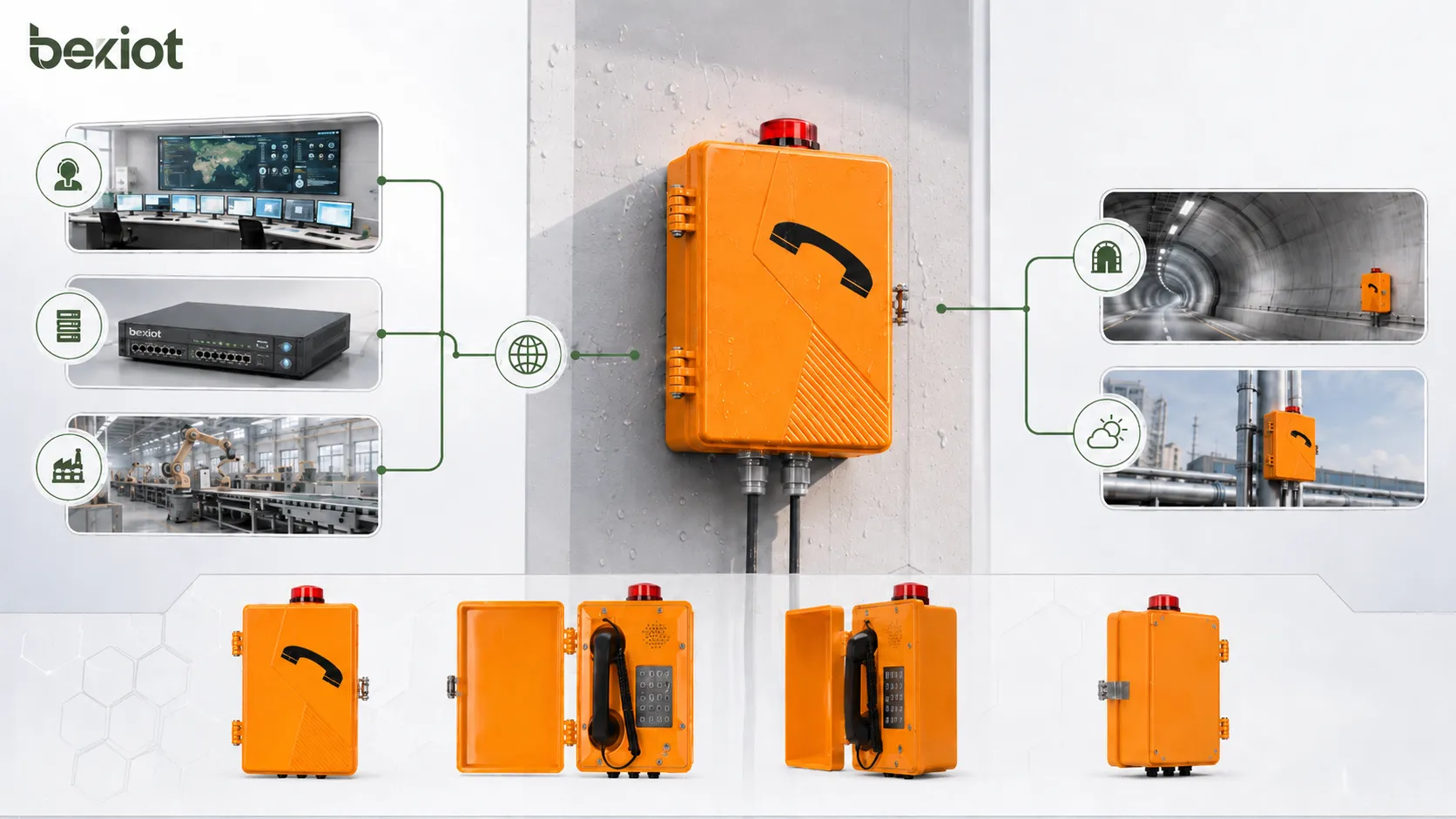
How an Industrial SIP Phone Works
SIP Registration
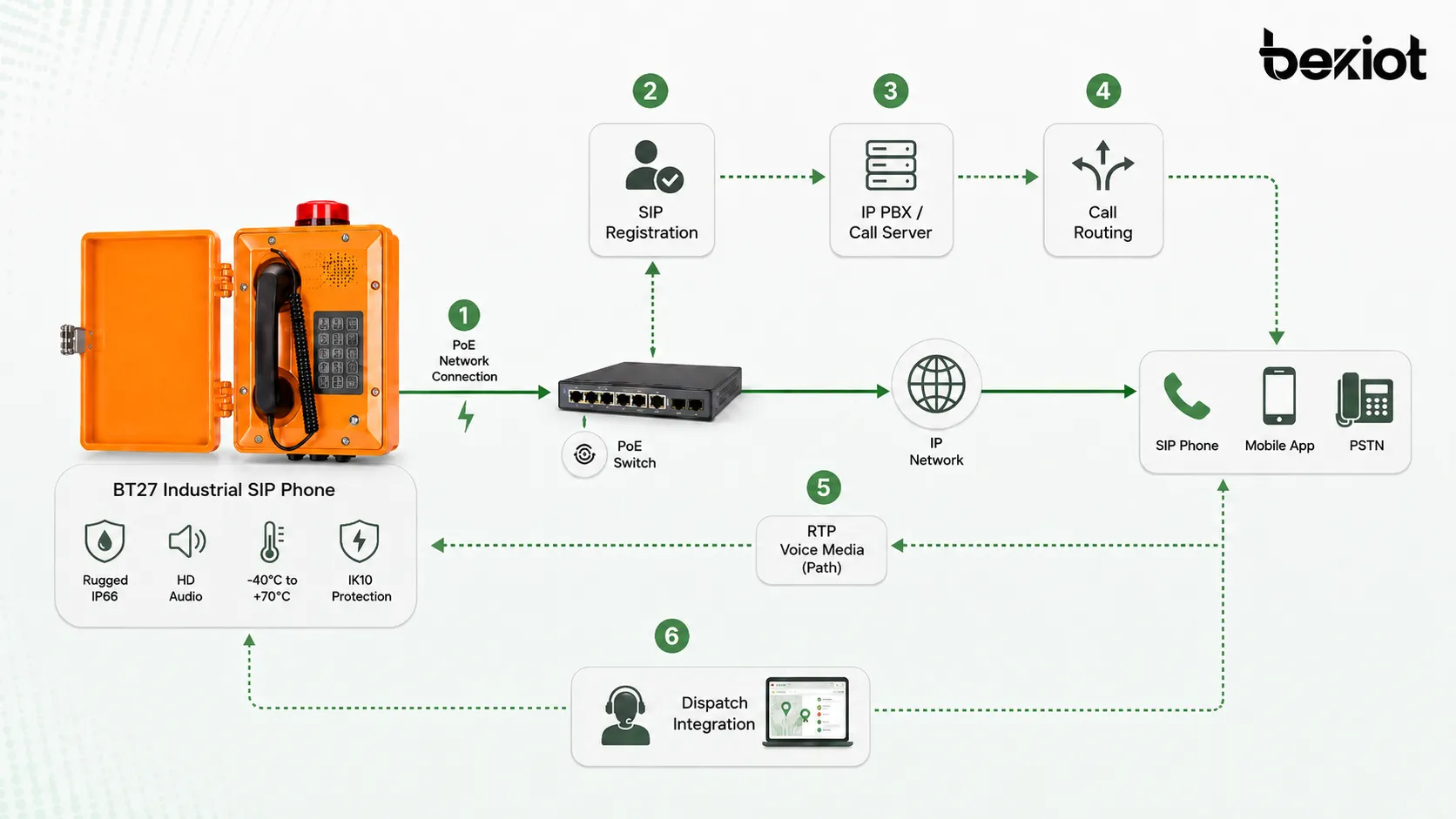
An industrial SIP phone usually works by registering to a SIP server, IP PBX, hosted voice platform, or unified communication system. During registration, the phone identifies itself with a SIP account, extension number, authentication credentials, server address, and network configuration.
Once registered, the phone becomes reachable as an internal extension. Users can call it from a dispatch console, office phone, softphone, mobile SIP client, emergency desk, control room, or another field terminal. The industrial phone can also call preset numbers, emergency contacts, hunt groups, paging groups, or operator extensions depending on configuration.
SIP registration makes industrial phones easier to manage in large systems. Each device can be assigned an extension, location name, department, emergency role, and call route. This helps the control room identify where a call is coming from and respond quickly.
Call Setup and Voice Media
When a user starts a call, the industrial SIP phone sends a SIP request to the communication server. The server checks routing rules and sends the call to the destination. If the receiving side answers, the voice media path is established between the endpoints or through a media server, SBC, gateway, or dispatch platform.
The voice stream is usually transported through RTP. In secure deployments, SRTP may be used to encrypt the media. Codec selection determines how voice is encoded. Common codecs may include G.711, G.722, G.729, Opus, or other codecs depending on endpoint and platform support.
For industrial use, audio clarity is critical. The phone must remain understandable in noisy conditions, across long network paths, or in emergency situations. Therefore, codec configuration, network quality, speaker volume, microphone design, echo control, and noise suppression all matter.
Network and Power Connection
Industrial SIP phones are commonly connected through Ethernet. Many models support PoE, allowing the same network cable to provide both data and power. This simplifies installation because separate power wiring may not be needed near the phone location.
In some projects, phones may use local DC power, fiber network converters, industrial switches, wireless bridges, or outdoor cabinets depending on the installation environment. The network should support stable latency, low packet loss, and suitable Quality of Service for voice traffic.
Critical installations should also consider backup power. If an industrial SIP phone is used for emergency contact, the related switch, server, router, and dispatch platform should remain available during power events.
Call Routing and Dispatch Integration
Industrial SIP phones are often connected to a dispatch or command system. A field user can press a button or dial an extension to reach the control room. The dispatcher can call the field phone, monitor status, record calls, transfer calls, join conferences, or trigger paging based on the event.
Call routing can be simple or advanced. A phone may call one fixed number, such as a security desk. It may also call a ring group, duty room, emergency queue, backup operator, or multi-level escalation path. If the first destination does not answer, the system can route the call to another contact.
In integrated systems, a call from an industrial SIP phone may also display location information, open a related camera view, trigger an alarm record, or create an event log. This makes the SIP phone part of a wider operational response workflow.
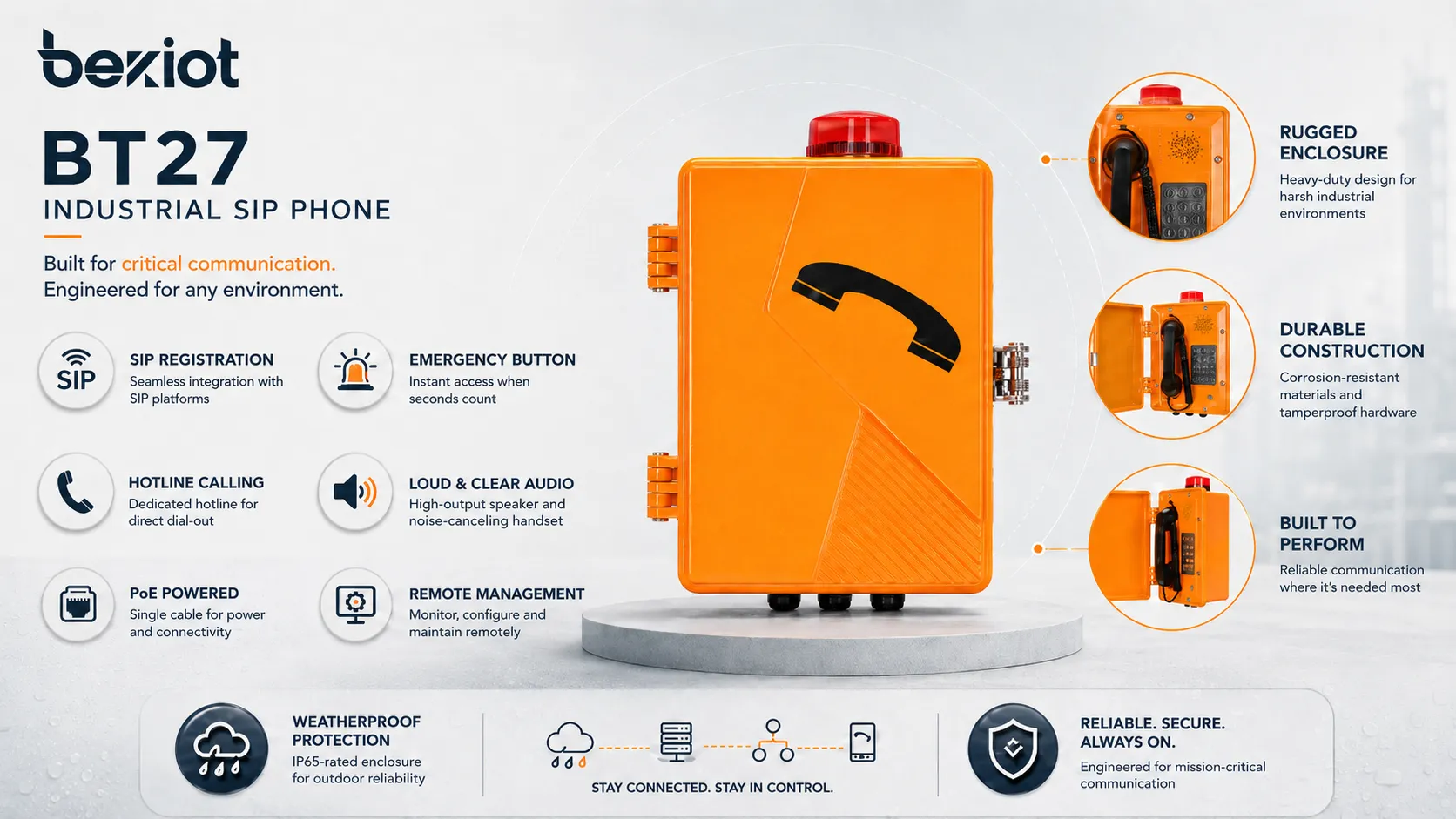
Main Features of Industrial SIP Phones
Rugged Enclosure Design
Rugged enclosure design is one of the most important features of an industrial SIP phone. The housing may be made from aluminum alloy, stainless steel, engineering plastic, reinforced composite, or other durable materials. The goal is to protect internal electronics from dust, water, impact, vibration, and daily field use.
Depending on the product, the enclosure may include weatherproof sealing, corrosion-resistant coating, heavy-duty handset cord, protected keypad, sealed cable entries, tamper-resistant screws, and wall-mount brackets. These details help the device survive industrial and public environments.
A strong enclosure is not only about appearance. It directly affects service life, maintenance frequency, and communication availability.
SIP 2.0 Compatibility
Industrial SIP phones usually support SIP-based communication so they can register to standard IP PBX and SIP server platforms. SIP compatibility makes the device easier to integrate into existing VoIP networks, dispatch platforms, hosted voice systems, and unified communication architectures.
SIP support allows features such as extension dialing, call transfer, call forwarding, hotline calling, ring groups, auto-answer, paging integration, and call recording depending on the server and endpoint configuration.
For project deployment, engineers should verify SIP server compatibility, registration behavior, codec support, DTMF method, NAT traversal, firmware version, and call routing requirements before large-scale installation.
High-Quality Voice and Loud Audio
Industrial sites are often noisy. Machinery, vehicles, ventilation systems, alarms, crowds, wind, and public traffic can make speech difficult to hear. Industrial SIP phones therefore need strong audio performance, suitable speaker volume, reliable microphone pickup, and stable echo control.
Some devices may support hands-free speakerphone, noise reduction, acoustic echo cancellation, adjustable volume, external speaker output, or horn speaker linkage. The right audio design depends on the environment. A tunnel phone, factory wall phone, and parking help point may require different acoustic planning.
Good voice quality should be tested in the real installation location, not only in a quiet office during configuration.
Emergency Button and Hotline Calling
Many industrial SIP phones support emergency button or hotline calling. A user can press one button or lift the handset to automatically call a preset destination. This is useful in emergency stations, help points, elevators, tunnels, parking areas, access gates, and industrial safety locations.
Hotline calling reduces user confusion. In an emergency, users should not need to remember extension numbers or navigate menus. The phone should connect to the correct operator or duty team quickly.
The call destination should be planned carefully. It may be a control room, security desk, emergency queue, dispatcher group, or backup contact. If the first destination is unavailable, escalation routing should be considered.
Remote Management and Monitoring
Remote management helps administrators configure and maintain industrial SIP phones across multiple locations. Depending on product and system support, administrators may manage SIP accounts, network settings, firmware, volume, call buttons, auto-answer rules, and status monitoring from a central platform.
Monitoring is important because field devices may be installed in locations that are not checked every day. If a phone becomes offline, loses registration, or has a network problem, the maintenance team should know before an emergency occurs.
For large facilities, remote management reduces site visits and improves system availability.
Weatherproof and Outdoor Suitability
Outdoor industrial SIP phones may need protection against rain, dust, humidity, sunlight, temperature variation, and corrosion. Weatherproof design may include sealed housing, protected cable entries, corrosion-resistant materials, drain planning, UV-resistant parts, and suitable mounting.
Protection ratings such as IP ratings help describe resistance to dust and water ingress. However, a weatherproof product should still be evaluated together with temperature range, corrosion resistance, impact resistance, power protection, and installation method.
Outdoor suitability should be based on real installation conditions rather than general wording alone.
Becke Telcom BT27 Industrial Phone Series in SIP Communication Projects
Where BT27 Fits in Industrial SIP Phone Deployment
In projects that require rugged field communication, the Becke Telcom BT27 industrial phone series can be positioned as a practical industrial SIP phone and intercom endpoint for harsh environments. It is suitable for scenarios where users need a fixed wall-mounted communication terminal that can connect quickly to an IP PBX, SIP server, dispatch console, security desk, or control room.
The BT27 series is especially relevant for industrial sites, tunnels, corridors, warehouses, power facilities, utility areas, transportation infrastructure, outdoor service points, and locations where ordinary office phones are not durable enough. Its role is to provide reliable voice access at the edge of the communication system.
When used in a SIP communication architecture, the BT27 industrial phone can be assigned an internal extension, emergency call destination, hotline number, or dispatch contact. This allows the field user to reach the right operator without relying on mobile phone coverage or informal communication channels.
Product Recommendation Logic for BT27
The BT27 series is best recommended when the project needs rugged operation, fixed installation, simple user interaction, and stable SIP-based voice communication. It is not selected only because it can make a call. It is selected because the site needs a stronger physical device for long-term operation in demanding conditions.
For example, in a tunnel emergency communication project, BT27 phones can be installed along the tunnel wall and connected to a control center. In a factory, they can be placed near production lines, maintenance points, or safety stations. In a warehouse or logistics yard, they can provide quick contact between field workers and the operations office.
Product selection should consider enclosure protection, installation height, cable entry, audio volume, handset or hands-free usage, SIP compatibility, PoE or local power, call routing, and whether integration with paging, CCTV, or dispatch software is required.
BT27 as an Industrial Intercom Endpoint
In many systems, an industrial SIP phone also functions as an intercom endpoint. The BT27 series can be planned as part of a field intercom network where workers, visitors, guards, operators, and maintenance teams need direct contact with a control point.
This intercom role is important in areas where users may not need a full telephone interface. A simple call button, hotline behavior, or predefined extension can be more useful than complex dialing. The system can route the call to a dispatcher, duty room, gate operator, emergency desk, or maintenance group.
For Becke Telcom BT27 deployments, the best result comes from treating the phone, SIP server, dispatch workflow, network switch, power supply, and maintenance plan as one complete communication system.
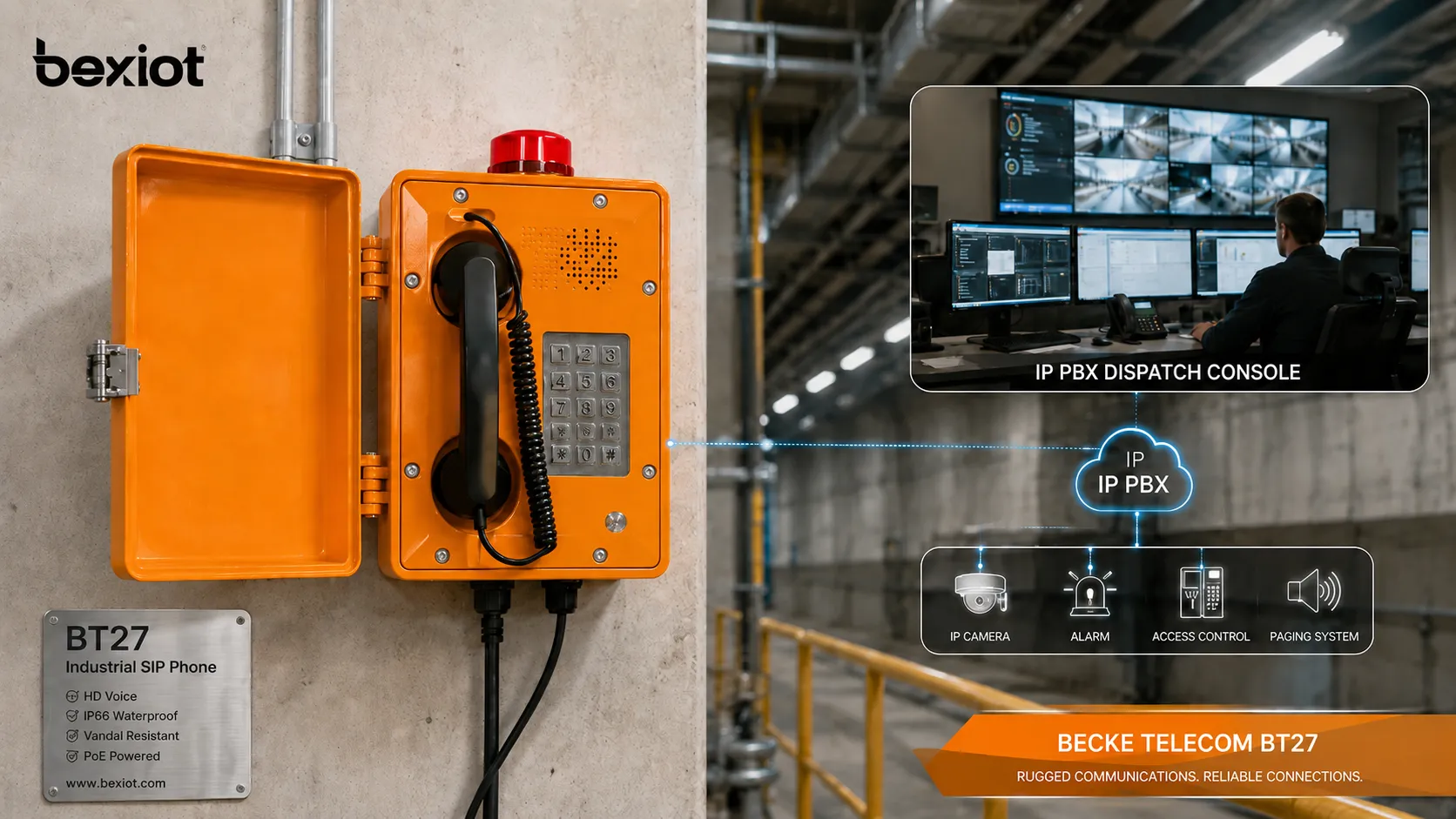
Industrial SIP Phone System Architecture
Endpoint Layer
The endpoint layer includes the industrial SIP phones installed at field locations. These may include wall-mounted phones, weatherproof phones, vandal-resistant phones, emergency phones, clean-area phones, tunnel phones, and help point intercoms.
Each endpoint should be named and numbered according to its location. Clear names such as “Tunnel Zone 3 Phone,” “Gate 2 Intercom,” “Pump Room SIP Phone,” or “Warehouse Dock Emergency Phone” help operators respond quickly.
The endpoint layer is where users interact with the system, so physical design, audio clarity, signage, and accessibility are important.
Network Layer
The network layer connects field endpoints to the communication server. It may include industrial switches, PoE switches, fiber links, routers, VLANs, firewalls, VPNs, wireless bridges, and backup links. For voice quality, the network should provide stable bandwidth, low latency, low packet loss, and proper QoS.
Industrial networks may face electromagnetic interference, long cable runs, outdoor cabinets, harsh temperatures, and power instability. Therefore, network equipment should also match the site environment.
For emergency communication, the network layer should be designed with redundancy and backup power where required.
Communication Server Layer
The communication server layer may include an IP PBX, SIP server, hosted voice system, dispatch server, media server, SBC, or unified communication platform. This layer manages registration, call routing, extensions, groups, permissions, recording, and integration with other systems.
The server decides where calls go. It can route a field phone to a dispatcher, ring a group, transfer calls to backup contacts, record calls, or integrate with paging and alarm workflows.
Server configuration should reflect the real operational structure of the site. Emergency phones, security phones, production phones, and maintenance phones may need different routes and priorities.
Control Room and Dispatch Layer
The control room and dispatch layer is where operators receive, manage, and respond to calls from industrial SIP phones. A dispatcher may see caller ID, device name, location, call status, recording status, and related event information.
In advanced systems, dispatch consoles can integrate voice calls with maps, video monitoring, alarm inputs, paging zones, access control, and incident logs. This helps operators understand the situation and respond more effectively.
Industrial SIP phones become more valuable when they are connected to a control workflow rather than used as isolated devices.
Benefits of Industrial SIP Phones
Reliable Field Communication
Industrial SIP phones provide reliable field communication in places where mobile phones may be inconvenient, unreliable, restricted, or unsafe. A fixed device gives users a known communication point that is always in the same location.
This is important for emergency contact, maintenance coordination, gate communication, tunnel safety, production support, and public assistance. When users know where the phone is and who it calls, response becomes faster.
Fixed communication points also help control rooms identify location more accurately than ordinary mobile calls.
Better Emergency Response
Industrial SIP phones can improve emergency response by providing one-button or hotline access to a responsible operator. A user in trouble can press a button, lift a handset, or dial a short extension to reach the correct team.
The system can route emergency calls to a control room, security desk, maintenance group, dispatcher, or backup contact. It can also support call recording and event logs for later review.
Emergency response improves when the phone is clearly labeled, easy to access, audible, and connected to a tested call path.
Integration With Existing IP Networks
Because industrial SIP phones use IP communication, they can be integrated into existing enterprise or industrial networks. This reduces the need for separate analog telephone wiring in some projects and allows centralized management through IP communication platforms.
SIP integration also supports multi-site deployment. A factory, tunnel, warehouse, and control center can be connected through a common communication plan if the network and server architecture support it.
IP-based design makes routing, recording, monitoring, and system integration more flexible.
Lower Maintenance Compared With Informal Communication
Industrial SIP phones can reduce dependence on informal communication methods such as personal mobile phones, unsecured messaging apps, or ad-hoc radio calls. A fixed SIP phone gives the organization a managed communication endpoint with known configuration, location, and call route.
Managed endpoints can be monitored, maintained, updated, and documented. This improves long-term communication reliability and reduces confusion when staff change shifts or roles.
In critical environments, managed communication is more dependable than relying only on personal devices.
Improved Operational Visibility
Industrial SIP phones can create useful operational records. Call logs can show which field point called, when the call happened, how long it lasted, and whether it was answered. In dispatch systems, calls may also be linked to incidents, alarms, or recordings.
This visibility helps managers review response times, identify frequently used locations, check device availability, and improve staffing or maintenance plans.
Operational visibility turns field communication into measurable infrastructure rather than invisible daily activity.
Applications of Industrial SIP Phones
Factories and Manufacturing Plants
Factories use industrial SIP phones for communication between production lines, control rooms, maintenance teams, warehouses, security offices, and management areas. Phones may be installed near machinery, entrances, safety stations, inspection points, or loading areas.
In noisy areas, high audio output and durable hardware are important. Phones should be easy to operate with gloves or in urgent situations. Hotline calling can help workers reach supervisors or control rooms quickly.
Industrial SIP phones support production coordination, equipment troubleshooting, safety reporting, and emergency communication.
Tunnels and Utility Corridors
Tunnels and utility corridors need reliable fixed communication points because mobile coverage may be weak and emergency response requires location awareness. Industrial SIP phones can be installed along tunnel walls, service passages, refuge areas, or maintenance zones.
Calls can be routed to a tunnel control center, emergency desk, maintenance dispatch, or security operator. The system may also integrate with CCTV, public address, fire alarm, and incident management systems.
In tunnel deployments, enclosure protection, visibility, audio clarity, cable routing, and backup power are especially important.
Transportation Sites
Railways, metro systems, airports, ports, bus terminals, highways, and parking facilities use industrial SIP phones for passenger assistance, staff communication, emergency contact, access point communication, and equipment support.
Public-facing devices may need vandal resistance, weather protection, clear signage, and simple operation. Staff-facing devices may need direct extension calling and dispatch integration.
Industrial SIP phones help connect field locations with operations centers and service teams.
Energy and Utility Facilities
Power plants, substations, water treatment sites, oil and gas facilities, renewable energy sites, and utility networks use industrial SIP phones for maintenance coordination, security communication, emergency reporting, and operational support.
These environments may include outdoor exposure, electrical noise, remote locations, restricted areas, and safety procedures. Communication devices should be rugged and clearly integrated into the site response plan.
Fixed SIP phones help provide dependable contact points where mobile communication may not be sufficient.
Warehouses and Logistics Centers
Warehouses and logistics centers use industrial SIP phones at loading docks, gates, dispatch offices, packing areas, cold storage zones, forklift routes, and equipment rooms. Workers can call supervisors, security, maintenance, or operations teams quickly.
Phones in these environments should withstand dust, impact, temperature variation, and frequent use. If the site is large, extension naming and location mapping become important.
Industrial SIP phones help coordinate movement of goods, vehicles, staff, and maintenance tasks.
Campuses, Hospitals, and Public Facilities
Campuses, hospitals, government buildings, public parks, parking structures, and large facilities may use industrial SIP phones as help points, security intercoms, emergency contact stations, or service communication points.
In these environments, users may be members of the public, visitors, patients, students, or contractors. The device should be easy to understand and clearly labeled. A one-button call function can be more useful than a full keypad.
Industrial SIP phones can connect public assistance points with security desks, reception, facility management, or emergency teams.
Deployment Considerations
Evaluate the Installation Environment
Before selecting an industrial SIP phone, engineers should evaluate the actual installation environment. Important factors include indoor or outdoor location, dust, rain, humidity, temperature, noise level, vibration, corrosion, public access, impact risk, cable routing, power availability, and network access.
A phone used in a clean indoor warehouse may require different protection than one installed in a tunnel, port, chemical plant, or outdoor gate. Product selection should match the harshest credible condition, not only the average environment.
Environmental evaluation helps avoid choosing a device that works during commissioning but fails after long-term exposure.
Plan SIP Registration and Numbering
SIP accounts and extension numbers should be planned before deployment. Each phone should have a clear number, name, location, and call route. The control room should be able to identify the calling location immediately.
Numbering should be logical. For example, tunnel phones may follow zone numbers, warehouse phones may follow dock numbers, and gate phones may follow access point names. Clear naming reduces wrong responses.
SIP configuration should also include authentication, codec order, DTMF method, transport protocol, registration interval, and failover behavior if supported.
Design Emergency Call Routing
Emergency call routing should be designed carefully. A call button or hotline should connect to a monitored destination, not just an office extension that may be unattended. The route may include primary and backup destinations.
The system can ring a dispatcher group, duty room, security desk, maintenance team, or emergency queue. If no one answers, escalation can forward the call to another group or mobile duty number.
Emergency routing should be tested regularly and updated when staffing or shift schedules change.
Check Audio and Acoustic Conditions
Industrial SIP phones should be tested in the real acoustic environment. Engineers should confirm that the caller can hear the operator and that the operator can understand the caller. Background noise, echo, distance from the phone, handset condition, and speaker volume all affect performance.
In high-noise environments, additional acoustic measures may be required. These may include handset-based communication, higher speaker output, noise reduction, visual indicators, or integration with paging systems.
Audio testing should be part of commissioning, not an optional final check.
Provide Network Reliability and Backup Power
Industrial SIP phones depend on IP network availability. Switches, routers, fiber links, servers, and power systems should be reliable enough for the communication role. If the phone is used for emergency contact, the infrastructure behind it should also have backup planning.
PoE switches should have sufficient power budget. Critical switches may require UPS backup. Network paths may need redundancy in large or safety-sensitive sites.
A rugged phone cannot provide reliable communication if the network behind it is fragile.
Successful industrial SIP phone deployment requires matching the device, network, SIP server, call routing, audio environment, and maintenance plan to the real site conditions.
Common Challenges
Using Office Phones in Industrial Areas
A common mistake is installing ordinary office IP phones in industrial areas to reduce cost. These phones may work at first, but they are often not designed for dust, water, impact, temperature variation, or rough handling.
The result may be frequent failure, poor audio, damaged handsets, unreliable buttons, or unsafe operation. For harsh environments, industrial-grade devices should be selected.
Short-term savings can lead to higher long-term maintenance cost.
Poor Network Design
Poor network design can cause registration loss, one-way audio, delayed voice, packet loss, or failed calls. Industrial SIP phones need a stable IP path to the communication server.
Network planning should include IP addressing, VLANs, QoS, firewall rules, PoE power, switch placement, cable distance, surge protection, and monitoring. Remote or outdoor locations may need additional protection.
Voice quality depends on the network as much as on the phone itself.
Unclear Call Routing
If call routing is unclear, emergency or operational calls may reach the wrong person. A phone may ring an unattended office, a closed reception desk, or a group that does not understand the location.
Each industrial SIP phone should have a defined call route based on its purpose. Emergency phones, gate phones, production phones, and service phones may need different destinations and priorities.
Routing should be documented and tested after every system change.
Insufficient Audio Volume
In noisy areas, ordinary audio levels may not be enough. Users may not hear ringing or may struggle to understand the operator. The operator may also hear background noise from the field.
Solutions may include handset design, louder speaker output, noise-reducing microphone, external horn speaker, visual call indicator, or relocation of the phone to a more suitable position.
Audio performance should be selected according to site noise, not only product appearance.
Lack of Maintenance
Industrial SIP phones can be forgotten after installation. Over time, dust, water, cable damage, loose mounting, firmware issues, or network changes may affect operation. If the phone is used only during emergencies, failure may not be noticed until it is needed.
Regular inspection and test calls are essential. Maintenance should check registration status, physical condition, audio quality, call routing, button function, and event logs.
Preventive maintenance helps keep emergency communication ready.
Maintenance and Operation Tips
Perform Regular Test Calls
Regular test calls confirm that the phone can call the correct destination and that the destination can hear the caller clearly. Test results should be recorded for critical phones.
Testing should include emergency buttons, hotline behavior, normal dialing, incoming calls, ring groups, backup routes, and dispatch console display if applicable.
A phone that is installed but never tested cannot be considered reliable.
Monitor SIP Registration
SIP registration monitoring helps administrators detect offline phones. If a phone loses registration, the system should generate an alert or show the device as unavailable.
Registration problems may be caused by network failure, power loss, server configuration, credential errors, firmware issues, or device damage.
Monitoring is especially important for phones installed in remote or rarely visited locations.
Inspect Physical Condition
Physical inspection should check the housing, handset, keypad, call button, cable entry, mounting screws, labels, speaker grille, microphone opening, and signs of water, corrosion, or impact damage.
Public and industrial locations may expose phones to rough handling. Damaged parts should be repaired promptly because physical damage can lead to communication failure.
The enclosure and accessories are part of communication reliability.
Update Firmware Carefully
Firmware updates may improve SIP compatibility, security, audio performance, remote management, and device stability. However, updates should be tested before large-scale deployment, especially in critical systems.
Administrators should record firmware versions, update dates, and rollback plans. Important phones should not be updated during high-risk operating periods without preparation.
Controlled firmware management supports long-term stability.
Review Call Logs and Incident Records
Call logs can show how often phones are used, which locations call most frequently, whether calls are answered, and whether there are repeated failures. This information helps managers improve staffing, routing, and maintenance.
In emergency communication, logs and recordings can support incident review and process improvement. They can show whether the call was made, when it was answered, and how the response developed.
Reviewing records helps turn industrial communication into a measurable operational process.
Industrial SIP Phone Versus Similar Devices
Industrial SIP Phone Versus Analog Industrial Phone
An analog industrial phone uses traditional analog telephone lines or analog gateways, while an industrial SIP phone uses IP networks and SIP communication. Analog phones can be simple and reliable, but SIP phones provide more flexible routing, integration, monitoring, and management.
SIP phones are better suited for IP PBX, dispatch platforms, recording systems, and multi-site communication. Analog phones may still be used in legacy systems or special environments where analog infrastructure remains available.
The right choice depends on existing infrastructure, project requirements, and long-term migration plans.
Industrial SIP Phone Versus SIP Intercom
A SIP intercom usually focuses on two-way intercom communication, often with a call button, speaker, microphone, and sometimes video. An industrial SIP phone may include a handset, keypad, and telephone-style calling behavior. In practice, the two categories often overlap.
If users need to dial different numbers, a phone-style device may be better. If users only need one-button assistance, a SIP intercom may be simpler. If the site needs both, a rugged industrial phone with intercom behavior may be suitable.
Product selection should follow the user workflow rather than the name of the device category.
Industrial SIP Phone Versus Public Address Speaker
A public address speaker sends announcements to an area, usually one-way. An industrial SIP phone supports direct two-way voice communication between a field user and an operator.
Paging is useful for broadcasting information to many people. Industrial SIP phones are useful when someone needs to report a situation, ask for help, or confirm instructions.
Many industrial sites need both paging and two-way phones. The two systems can be integrated through SIP and dispatch platforms.
Industrial SIP Phone Versus Mobile Phone
Mobile phones are flexible, but they depend on battery, signal coverage, user ownership, and personal availability. Industrial SIP phones are fixed, known, and connected to the site communication system.
In emergencies, a fixed phone helps the control room identify the call location. It also remains available for any user at that location, not just one employee.
Mobile phones and industrial SIP phones can complement each other, but fixed phones are often preferred for safety points and operational locations.
Conclusion
An industrial SIP phone is a rugged IP voice endpoint designed for harsh environments, field communication, emergency contact, dispatch integration, and operational coordination. It uses SIP to connect with IP PBX systems, SIP servers, dispatch platforms, hosted voice services, and unified communication networks.
Its key features include rugged enclosure design, SIP compatibility, loud and clear audio, emergency button support, hotline calling, PoE, remote management, weatherproof protection, call routing, monitoring, and integration with dispatch, paging, video, and alarm systems. These features make it suitable for factories, tunnels, ports, railways, warehouses, energy sites, campuses, hospitals, parking areas, and public infrastructure.
Becke Telcom BT27 industrial phone series can be naturally applied as a rugged SIP phone or industrial intercom endpoint in harsh-environment communication projects. When deployed with proper SIP routing, network reliability, audio testing, enclosure protection, and maintenance planning, industrial SIP phones become a dependable foundation for field-to-control-room communication and emergency response.
FAQ
What is an industrial SIP phone in simple terms?
An industrial SIP phone is a rugged IP phone or intercom device designed for harsh environments. It uses SIP to make and receive VoIP calls through an IP network.
It is used in factories, tunnels, warehouses, outdoor sites, security points, and emergency communication locations.
How does an industrial SIP phone work?
It registers to a SIP server, IP PBX, dispatch platform, or hosted communication system. After registration, it can make and receive calls as an internal extension.
SIP controls call setup, while voice media is carried over the IP network through RTP or secure media methods if configured.
What features should an industrial SIP phone have?
Important features include rugged enclosure, SIP compatibility, loud audio, emergency button, hotline dialing, PoE support, weatherproof protection, remote management, call logging, and stable network performance.
The exact requirements depend on the installation environment and communication workflow.
Where is the Becke Telcom BT27 industrial phone series suitable?
Becke Telcom BT27 industrial phone series is suitable for harsh-environment communication points such as factories, tunnels, warehouses, utility areas, transportation sites, outdoor service points, and control-room-connected field locations.
It can be used as a rugged SIP phone or intercom endpoint for field users to contact operators, dispatchers, security desks, or duty rooms.
What is the difference between an industrial SIP phone and a SIP intercom?
A SIP intercom usually focuses on one-button or station-to-station communication, while an industrial SIP phone may include a handset, keypad, and telephone-style calling features.
In many real projects, the two functions overlap. The right choice depends on whether the user needs simple help-point calling, full dialing, or both.
Why is audio testing important for industrial SIP phones?
Industrial sites often have noise from machinery, vehicles, ventilation, alarms, or public activity. A phone that sounds clear in an office may not be clear in the actual installation environment.
Real-site audio testing confirms whether users and operators can understand each other during normal and emergency conditions.







