What Is Wideband Voice? Audio Benefits, Technical Features, and Applications
Wideband voice is a voice communication technology that captures and transmits a wider range of speech frequencies than traditional narrowband telephone audio. It is often associated with HD Voice because it makes spoken communication sound clearer, fuller, and more natural. In practical terms, wideband voice allows listeners to hear more details in human speech, especially consonants, tone, and vocal texture.
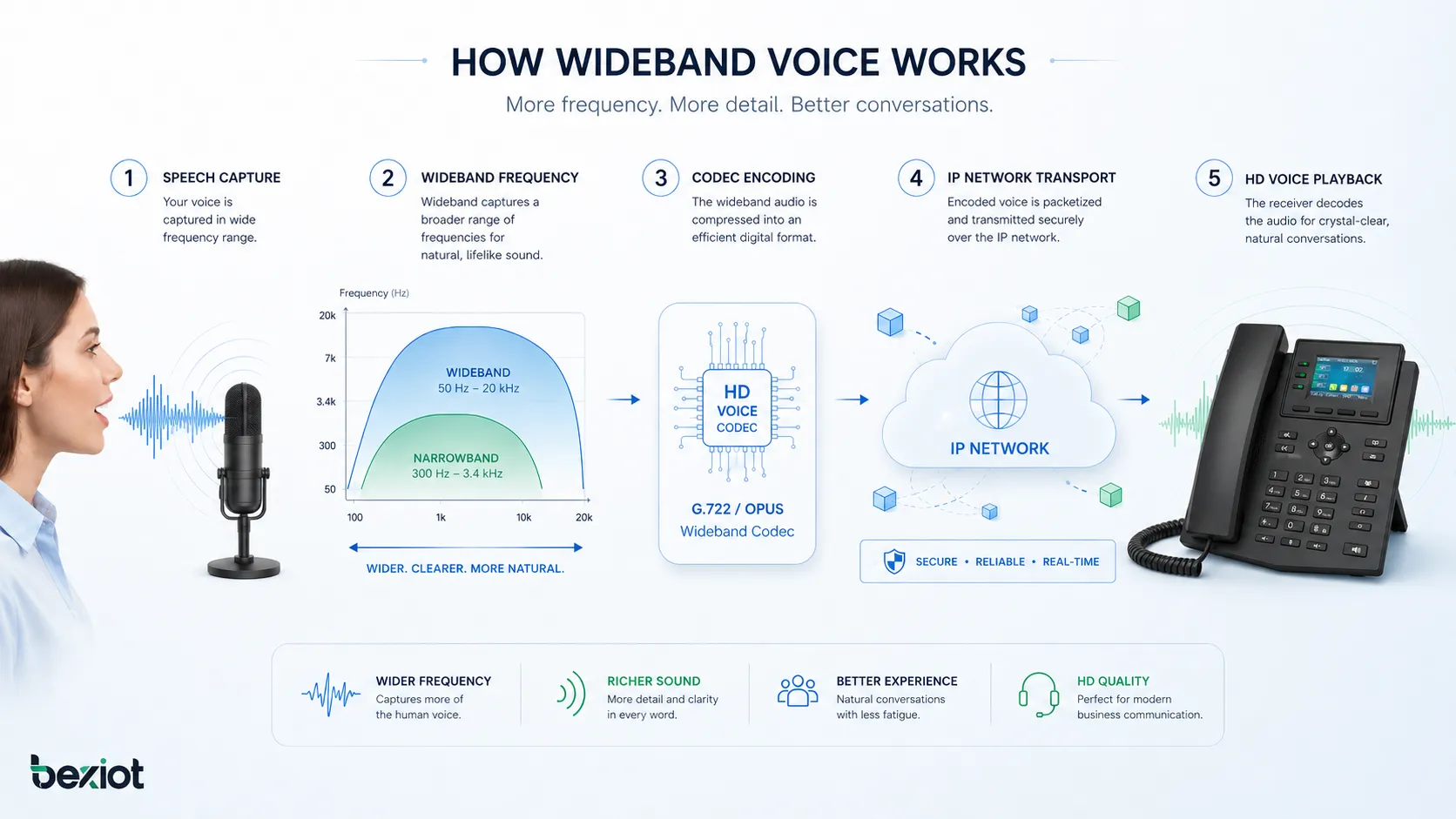
Traditional telephone calls were designed for a limited voice frequency range, commonly around 300 Hz to 3.4 kHz. This range is enough for basic speech understanding, but it removes many natural speech details. Wideband voice typically extends the audio bandwidth to around 50 Hz to 7 kHz, depending on codec and system design. This wider frequency range improves intelligibility and reduces the “thin” or “muffled” feeling of old telephone audio.
Wideband voice is widely used in VoIP systems, IP phones, SIP communication, mobile HD voice, video conferencing, contact centers, unified communications, remote meetings, dispatch systems, telemedicine, online education, customer support, intercom systems, and professional collaboration platforms. Its value is especially clear when users need to understand speech quickly, accurately, and comfortably.
What Is Wideband Voice?
Definition and Core Meaning
Wideband voice refers to voice communication that uses a broader audio frequency range than narrowband voice. In telephony, narrowband voice is usually limited to a smaller part of the speech spectrum. Wideband voice captures and transmits more low-frequency warmth and high-frequency speech detail, making the voice sound closer to natural face-to-face conversation.
The core meaning of wideband voice is improved speech reproduction. It does not simply make the call louder. Instead, it preserves more useful speech information so that words are easier to recognize and conversations feel less tiring. This is why wideband voice is commonly used in modern IP communication and HD voice services.
A wideband voice experience depends on several parts working together. The microphone must capture wideband audio, the codec must encode it, the network must carry it with acceptable quality, and the receiving device must reproduce it through a suitable speaker or headset.
Wideband voice improves communication by carrying more of the natural speech spectrum than traditional narrowband telephone audio.
Wideband Voice and HD Voice
Wideband voice and HD Voice are closely related terms. Wideband voice describes the technical audio bandwidth improvement. HD Voice is often used as a marketing or service term to describe calls that sound clearer and more natural because they use wideband audio and suitable codecs.
For users, the difference is simple: a wideband or HD voice call usually sounds more open, realistic, and easier to understand than a traditional narrowband call. People may notice that voices sound less compressed, less metallic, and less tiring during long conversations.
However, HD Voice requires end-to-end support. If one endpoint, network segment, gateway, trunk, or carrier path falls back to narrowband audio, the call may lose the wideband benefit.

How Wideband Voice Works
Wider Speech Frequency Range
Human speech contains energy across a broad range of frequencies. Traditional telephone audio removes much of this spectrum to save bandwidth and match legacy network limitations. Wideband voice keeps more of the speech spectrum, especially the higher-frequency details that help distinguish consonants such as “s,” “f,” “t,” “k,” and “sh.”
These high-frequency details are important for speech intelligibility. When they are missing, listeners may still understand the general conversation, but they may need more mental effort. Names, numbers, technical terms, and similar-sounding words may be harder to distinguish.
Wideband voice makes speech recognition easier by preserving more acoustic information. This is useful in business calls, technical support, dispatch communication, healthcare consultation, and any situation where accuracy matters.
Codec Encoding and Decoding
A codec is responsible for converting voice into a digital stream and then converting it back into audio at the receiving side. Wideband voice requires codecs that support wideband audio. Common examples include G.722, AMR-WB, Opus, and EVS, depending on the communication platform and network type.
G.722 is widely used in VoIP and SIP environments. AMR-WB is commonly associated with mobile HD voice. Opus is widely used in real-time internet communication, conferencing, and WebRTC because it supports flexible bitrates and audio bandwidths. EVS is used in modern mobile and advanced voice services.
The codec affects sound quality, bandwidth usage, delay, packet-loss behavior, and interoperability. A wideband-capable system must negotiate a codec that both sides support.
End-to-End Wideband Path
Wideband voice requires an end-to-end wideband path. This means the caller’s device, the receiving device, the communication server, the media path, and any gateways or trunks involved must support wideband audio. If any part of the call path only supports narrowband audio, the call may be downgraded.
For example, two IP phones on the same SIP system may use G.722 and enjoy wideband audio. But if the call passes through a PSTN gateway that only supports narrowband voice, the audio may be limited to narrowband quality.
This is why wideband voice deployment should consider the whole communication path, not only the endpoint device.
Network Transport Quality
Wideband voice still depends on network quality. Even if the codec supports high-quality speech, packet loss, jitter, delay, congestion, or poor Wi-Fi can reduce the user experience. Real-time voice requires stable packet delivery.
Quality of Service settings, suitable bandwidth, VLAN planning, jitter buffers, network monitoring, and endpoint configuration can help preserve wideband voice quality. In enterprise networks, voice traffic is often prioritized to reduce the impact of ordinary data traffic.
A good wideband voice system combines codec support with reliable network design.
Technical Features of Wideband Voice
Extended Audio Bandwidth
The most important technical feature of wideband voice is extended audio bandwidth. Compared with narrowband telephony, wideband voice captures and reproduces a broader portion of the speech spectrum. This improves vocal detail and makes conversations sound more natural.
Narrowband voice is often enough for basic communication, but it removes useful speech cues. Wideband voice restores more of those cues. This is especially helpful when listeners need to understand unfamiliar names, technical words, accents, emergency instructions, or fast speech.
The result is not only better sound quality but also better communication efficiency.
Wideband Codecs
Wideband voice depends on codecs that can carry the wider audio spectrum. G.722, AMR-WB, Opus, and EVS are common examples. Each codec has different design goals and deployment environments.
G.722 is common in enterprise VoIP because it provides good quality with relatively simple implementation. AMR-WB is common in mobile networks. Opus is highly flexible and can support speech and music across different network conditions. EVS supports advanced voice services in modern mobile networks.
Codec selection should consider compatibility, bandwidth, licensing, platform support, processing load, and expected call environment.
Higher Sampling Rate
Wideband voice typically uses a higher sampling rate than narrowband audio. Traditional narrowband telephone audio commonly uses 8 kHz sampling, while wideband voice commonly uses 16 kHz sampling. A higher sampling rate allows the system to represent higher-frequency speech details.
Sampling rate is not the only factor in audio quality, but it is an important technical foundation. The microphone, codec, packetization, network quality, and speaker also affect the final sound.
A wideband-capable endpoint should support appropriate sampling, audio processing, and playback components.
Improved Speech Intelligibility
Wideband voice improves speech intelligibility by preserving more vocal information. Listeners can more easily distinguish similar-sounding words and consonants. This reduces misunderstanding during calls.
Improved intelligibility is valuable in professional environments where mistakes can be costly. Technical support agents, dispatchers, doctors, engineers, customer service teams, and remote workers all benefit from clearer speech.
Better intelligibility also helps in calls involving accents, background noise, or poor listening conditions.
Compatibility with IP Communication
Wideband voice is well suited to IP communication because packet networks can carry different codecs and media formats more flexibly than legacy circuit-switched systems. IP phones, softphones, conferencing platforms, and cloud communication services can negotiate wideband codecs when both sides support them.
This flexibility is one reason wideband voice became common in VoIP and unified communication systems. It allows organizations to improve audio quality without depending entirely on old telephone network limitations.
However, compatibility must still be verified across endpoints, servers, gateways, and external trunks.
Audio Benefits of Wideband Voice
Clearer Speech
The most obvious benefit of wideband voice is clearer speech. Voices sound more natural, and words are easier to understand. This can reduce the need for repetition during calls.
Clearer speech is especially important when callers discuss numbers, addresses, technical instructions, safety procedures, or names. In narrowband calls, these details may be more likely to be misheard.
Wideband voice helps communication feel closer to an in-person conversation.
Less Listening Fatigue
Listening fatigue occurs when people must concentrate hard to understand unclear audio. Narrowband audio can sound compressed or thin, causing the listener to work harder during long calls. Wideband voice reduces this problem by providing more natural speech cues.
This benefit is important in contact centers, remote meetings, technical support, medical consultations, and long conference calls. When audio is easier to understand, users can stay focused longer.
Less listening fatigue can improve productivity and reduce communication stress.
Better Accent and Language Recognition
Wideband voice can help listeners understand different accents and languages more accurately. Higher-frequency speech details are often important for distinguishing sounds, especially in multilingual communication.
In global business, customer service, healthcare, education, and remote collaboration, people may speak with different accents or use technical vocabulary. Clearer voice reproduction helps reduce misunderstanding.
This does not eliminate every language barrier, but it improves the audio foundation for better comprehension.
Improved Naturalness
Wideband voice sounds more natural because it preserves more of the speaker’s vocal character. Voices may sound warmer, more open, and less artificial. This helps conversations feel more human and less mechanical.
Naturalness is important in customer service and collaboration. A more natural voice can make a conversation feel more comfortable and professional. It also helps remote meetings feel less distant.
Natural voice quality supports better human connection in digital communication.
Better Performance in Professional Communication
Professional communication often requires accuracy and speed. Wideband voice helps users understand instructions, confirm details, and respond more confidently. This can improve the quality of teamwork and decision-making.
In a control room, dispatch center, support desk, or technical service environment, clear audio is not only a comfort feature. It can directly affect operational efficiency and response quality.
Wideband voice supports more reliable communication in these demanding workflows.

Wideband Voice Versus Narrowband Voice
Frequency Range Difference
Narrowband voice uses a limited frequency range that supports basic speech communication. Wideband voice uses a broader range that captures more speech detail. This is the technical reason wideband calls sound clearer and more natural.
Narrowband audio may make voices sound telephone-like, compressed, or muffled. Wideband audio makes voices sound more open and realistic. The difference is especially noticeable when users switch from a legacy phone call to a high-quality VoIP or HD voice call.
The frequency range difference is the foundation of the user experience difference.
Call Quality Difference
Narrowband calls can be reliable and bandwidth-efficient, but they do not deliver the same clarity as wideband calls. Wideband voice improves call quality by preserving more speech information.
In quiet conditions with simple conversations, narrowband may be acceptable. In professional, noisy, multilingual, or technical communication, wideband voice provides a clear advantage.
Call quality should be judged by intelligibility and user comfort, not only by whether the call connects successfully.
Network and Device Requirements
Narrowband voice generally has lower bandwidth and compatibility requirements. It is widely supported by legacy systems. Wideband voice requires compatible codecs, endpoints, and media paths.
Many modern IP phones, softphones, mobile networks, and conferencing systems support wideband voice. However, older gateways, analog trunks, PSTN paths, and legacy endpoints may limit calls to narrowband quality.
Organizations planning wideband voice should check device and network compatibility before expecting every call to sound wideband.
Use Case Difference
Narrowband voice may still be used for basic telephony, legacy interconnection, emergency fallback, or low-bandwidth environments. Wideband voice is preferred when speech clarity and user experience are important.
For example, wideband voice is valuable in customer support, executive meetings, telemedicine, remote training, dispatch coordination, and technical collaboration. These scenarios benefit from clearer and more natural voice communication.
Both types may coexist in real communication networks, but wideband voice is usually the better choice where supported.
Common Wideband Voice Codecs
G.722
G.722 is one of the most common wideband codecs in VoIP and SIP-based communication systems. It supports wideband speech and is widely implemented in IP phones, PBX platforms, conferencing systems, and enterprise communication devices.
G.722 is valued because it provides clear voice quality and broad compatibility in many IP environments. It is often used for internal enterprise calls where both endpoints support wideband audio.
Because G.722 may not always pass through all external trunks or legacy gateways, call path testing is important.
AMR-WB
AMR-WB, also known as Adaptive Multi-Rate Wideband, is commonly used in mobile HD voice services. It allows mobile networks to deliver clearer speech than traditional narrowband mobile voice.
AMR-WB is designed for mobile network conditions and can adapt to different bitrates. It is widely associated with cellular HD voice services.
Users often experience AMR-WB as clearer mobile calls when both phones and the mobile network support HD voice.
Opus
Opus is a flexible codec used in WebRTC, conferencing, collaboration platforms, and internet-based communication. It can support narrowband, wideband, super-wideband, and fullband audio depending on configuration and network conditions.
Opus is popular because it performs well across variable networks and can handle speech and music. It is especially useful in browser-based communication, video meetings, and real-time collaboration tools.
For modern internet communication, Opus is one of the most versatile audio codecs.
EVS
EVS, or Enhanced Voice Services, is an advanced codec used in modern mobile networks and high-quality voice services. It can support improved audio quality beyond traditional wideband in supported environments.
EVS is designed to improve voice clarity, music quality, and performance under certain network conditions. It is associated with advanced mobile voice experiences.
Its availability depends on network, device, carrier, and service support.
Applications of Wideband Voice
VoIP and IP Phone Systems
Wideband voice is widely used in VoIP and IP phone systems. Modern IP phones can support wideband codecs such as G.722, allowing users to experience clearer internal calls and better audio quality than legacy telephone systems.
In office environments, this can improve daily communication between departments, branch offices, remote workers, and support teams. Wideband voice is especially useful for conference calls and collaborative discussions.
To achieve wideband quality, endpoints, PBX, network, and call path must support the selected wideband codec.
Video Conferencing and Remote Meetings
Video conferencing platforms rely heavily on good audio. Even when video quality is high, poor voice quality can make meetings difficult. Wideband voice improves clarity and makes remote conversations more natural.
In remote meetings, participants may use laptops, headsets, conference microphones, room systems, or mobile devices. Wideband audio helps bridge differences between these devices and improves the overall meeting experience.
Clear voice is often more important than high-resolution video for effective collaboration.
Contact Centers and Customer Service
Contact centers can benefit from wideband voice because agents and customers need to understand each other quickly. Clearer audio can reduce repeated questions, improve first-call resolution, and make conversations feel more professional.
Wideband voice is useful when customers provide names, addresses, account numbers, technical symptoms, or detailed service requests. It can also reduce listening fatigue for agents who handle many calls each day.
Contact centers should combine wideband voice with good headsets, noise control, call routing, and quality monitoring.
Telemedicine and Healthcare Communication
Telemedicine and healthcare communication require accurate understanding. Doctors, nurses, patients, and support staff may discuss symptoms, medication names, appointment details, or urgent instructions. Wideband voice helps improve clarity in these conversations.
In healthcare, misunderstandings can have serious consequences. Better audio does not replace professional communication procedures, but it supports safer and clearer interaction.
Wideband voice is also useful for remote consultations, nurse call centers, medical hotlines, and healthcare collaboration platforms.
Dispatch and Operational Communication
Dispatch and operational communication often involve fast instructions, status updates, and team coordination. Wideband voice can make commands and responses easier to understand, especially in high-pressure situations.
Applications may include security dispatch, transportation control, industrial coordination, utility maintenance, emergency response, facility management, and field service communication.
In these environments, wideband voice should be combined with reliable networks, priority handling, suitable endpoints, and clear operating procedures.
Online Education and Training
Online education and training platforms benefit from wideband voice because instructors and learners depend on speech clarity. Wideband audio helps students understand explanations, questions, pronunciation, and discussion more easily.
This is especially important for language learning, technical training, remote workshops, and interactive classes. Poor voice quality can reduce attention and increase fatigue.
Wideband voice helps make remote teaching feel more direct and engaging.
Deployment Considerations
Endpoint Support
Wideband voice requires endpoint support. IP phones, softphones, mobile clients, conference devices, headsets, microphones, and speakers must support wideband audio to deliver the expected result.
A wideband codec alone is not enough if the microphone or speaker is low quality. The endpoint should capture and reproduce wideband frequencies clearly. Headset quality can also have a major impact.
Before rollout, organizations should test wideband voice on the actual devices users will use.
Codec Negotiation
Communication systems must negotiate a common codec between endpoints. If both sides support G.722, Opus, AMR-WB, or another wideband codec, wideband audio may be used. If not, the system may fall back to a narrowband codec.
Codec order and policy matter. Administrators should configure codec preferences carefully so that wideband codecs are used where appropriate without breaking interoperability with legacy systems.
A good codec plan balances quality, compatibility, bandwidth, and system performance.
Network Quality
Network quality affects wideband voice performance. Packet loss, jitter, delay, and congestion can make even a wideband call sound poor. Quality of Service can help prioritize voice packets and improve stability.
Organizations should assess LAN, WAN, Wi-Fi, VPN, and internet paths used for voice. Remote workers may need special attention because their home networks and public internet paths may vary.
Wideband voice deployment should include network testing, monitoring, and troubleshooting procedures.
Gateway and Trunk Compatibility
Gateways and trunks can limit wideband voice. If a call passes through a PSTN gateway, analog interface, or carrier trunk that only supports narrowband audio, the call may be downgraded. This is common when wideband IP systems interconnect with legacy telephone networks.
Internal calls may sound wideband while external calls sound narrowband. This does not necessarily mean the IP phone is defective. It may reflect codec or trunk limitations in the call path.
Administrators should document where wideband voice is supported and where narrowband fallback is expected.
Acoustic Environment
Wideband voice improves the transmitted speech spectrum, but room acoustics still matter. Echo, reverberation, background noise, poor microphone placement, and low-quality speakers can reduce the benefit.
Meeting rooms should use suitable microphones and speaker placement. Contact centers should use good headsets and noise control. Industrial or public areas may require specialized endpoints and audio processing.
Good acoustic design helps users experience the full benefit of wideband voice.
Wideband voice quality depends on the whole chain: microphone, codec, network, server, gateway, receiving endpoint, and acoustic environment.
Common Challenges
Fallback to Narrowband
One common challenge is fallback to narrowband audio. This may happen when one endpoint does not support a wideband codec, when codec negotiation fails, or when the call passes through a narrowband-only gateway.
Users may notice that some calls sound clear while others sound like traditional telephone calls. This often indicates different call paths or endpoint capabilities.
Troubleshooting should check codec negotiation, endpoint settings, PBX configuration, trunk support, and gateway behavior.
Inconsistent User Experience
Wideband voice may not be consistent across all calls. Internal calls may use G.722, mobile calls may use AMR-WB, conferencing may use Opus, and PSTN calls may use narrowband codecs. Users may not understand why call quality changes.
Administrators should set expectations and document supported scenarios. Training and support materials can explain why HD voice may depend on both parties and the network path.
Consistency improves when devices, codecs, and networks are standardized.
Bandwidth and Capacity Planning
Wideband voice may require more bandwidth than some narrowband codecs, depending on codec and packetization. While the increase is usually manageable on modern networks, capacity planning is still important for large deployments.
Contact centers, conference systems, branch offices, and remote sites should estimate concurrent call volume and network capacity. Quality of Service can help protect voice traffic during congestion.
Bandwidth planning prevents quality problems during peak usage.
Poor Endpoint Quality
A system may support wideband codecs, but users may still experience poor audio if microphones, headsets, speakers, or acoustic design are weak. Low-cost or damaged audio devices can limit clarity.
Endpoint testing is therefore important. A wideband softphone with a poor laptop microphone may not sound as good as a properly designed IP phone or professional headset.
Audio quality should be tested from the user’s actual working environment.
Overlooking External Calls
Organizations may enable wideband voice internally but overlook external call paths. Calls to customers, suppliers, mobile numbers, or PSTN users may not remain wideband. This can create different experiences between internal and external communication.
External wideband support depends on carrier services, interconnection, codecs, and endpoint compatibility. Some hosted voice and mobile HD voice paths can support wideband, while others may not.
External call quality should be evaluated separately from internal IP calling.
Maintenance and Optimization Tips
Monitor Codec Usage
Administrators should monitor which codecs are actually used in calls. A system may be configured for wideband voice, but real calls may still use narrowband codecs because of endpoint settings, trunk policy, or negotiation order.
Call detail records, SIP traces, media server logs, and endpoint diagnostics can help identify codec use. This information is useful for troubleshooting and optimization.
Monitoring codec usage helps confirm whether wideband voice is working as intended.
Test Representative Call Paths
Wideband voice should be tested across representative call paths. These may include internal extension-to-extension calls, branch calls, remote worker calls, conference calls, mobile calls, trunk calls, and contact center calls.
Testing only one simple internal call is not enough. Different paths may use different codecs, gateways, and network segments.
Regular testing helps maintain consistent call quality after system changes.
Update Endpoint Firmware and Software
Endpoint firmware and softphone software should be kept updated. Updates may improve codec support, audio processing, bug fixes, security, and compatibility with communication platforms.
Old firmware may limit codec negotiation or create audio quality issues. In large deployments, firmware management should be planned and tested before rollout.
Regular updates support better stability and long-term audio performance.
Use Quality Headsets and Microphones
Users who spend much time on calls should use suitable headsets or microphones. A good headset can improve microphone pickup, reduce background noise, and reproduce wideband audio more clearly.
Contact center agents, remote workers, trainers, doctors, and conference participants can all benefit from better audio devices. Poor accessories can waste the advantage of wideband voice.
Audio equipment selection should be part of wideband voice deployment planning.
Review QoS and Network Performance
Quality of Service and network performance should be reviewed regularly. Network changes, new applications, Wi-Fi congestion, VPN use, or increased traffic can affect voice quality.
Monitoring packet loss, jitter, latency, MOS scores, and call quality reports can help administrators identify problems early.
Wideband voice performs best on a stable, well-managed network.
Wideband Voice Versus Similar Audio Terms
Wideband Voice Versus HD Voice
Wideband voice is the technical concept of carrying a wider speech frequency range. HD Voice is commonly used as a service or product term for clearer voice communication based on wideband audio.
In many practical conversations, the two terms are used together. However, wideband voice describes the audio bandwidth, while HD Voice describes the user-facing quality experience.
A true HD voice experience requires more than a label. It requires endpoint, codec, and network support.
Wideband Voice Versus Super-Wideband Voice
Super-wideband voice extends audio quality beyond ordinary wideband. It can carry more high-frequency detail and may sound even more natural, especially in modern conferencing and advanced mobile voice services.
However, super-wideband requires additional codec and endpoint support. It may also require more bandwidth and processing resources depending on the codec.
Wideband voice remains a practical and widely supported improvement over narrowband telephony.
Wideband Voice Versus Fullband Audio
Fullband audio can cover a much wider frequency range, closer to high-quality audio and music reproduction. It is often used in advanced conferencing, media production, streaming, and collaboration tools where audio quality expectations are higher.
For speech-only communication, wideband voice already provides a major improvement over narrowband. Fullband audio may be useful when music, rich sound, or very high-quality voice is required.
The right choice depends on use case, bandwidth, endpoint quality, and platform support.
Conclusion
Wideband voice is a voice communication technology that transmits a wider speech frequency range than traditional narrowband telephone audio. It improves clarity, naturalness, intelligibility, and listening comfort, making conversations easier to understand and less tiring.
It works through wideband audio capture, wideband codecs, suitable sampling rates, reliable real-time transport, and compatible endpoints. Common wideband or advanced voice codecs include G.722, AMR-WB, Opus, and EVS. However, the full benefit requires end-to-end support across devices, servers, gateways, trunks, and networks.
Wideband voice is used in VoIP, IP phone systems, video conferencing, contact centers, mobile HD voice, telemedicine, online education, dispatch communication, and professional collaboration. When deployed with good endpoints, codec planning, network quality, and acoustic design, it becomes a practical foundation for clearer and more effective voice communication.
FAQ
What is wideband voice in simple terms?
Wideband voice is clearer voice communication that carries more speech detail than traditional telephone audio. It makes calls sound more natural and easier to understand.
It is often associated with HD Voice in VoIP, mobile, and conferencing systems.
What is the difference between narrowband and wideband voice?
Narrowband voice carries a limited speech frequency range, while wideband voice carries a wider range. This wider range preserves more speech detail and improves clarity.
Narrowband may sound thin or muffled, while wideband sounds more natural and open.
Which codecs support wideband voice?
Common wideband voice codecs include G.722, AMR-WB, Opus, and EVS. The right codec depends on the communication system, endpoints, network, and service environment.
Both sides of the call must support a compatible wideband codec to achieve wideband quality.
Why does a wideband-capable phone sometimes sound narrowband?
A wideband-capable phone may fall back to narrowband if the other endpoint, PBX, gateway, carrier trunk, or call path does not support a wideband codec.
Wideband voice requires end-to-end support across the complete media path.
Where is wideband voice commonly used?
Wideband voice is commonly used in VoIP systems, IP phones, mobile HD voice, video conferencing, contact centers, telemedicine, online education, remote meetings, and dispatch communication.
It is useful wherever clear and natural speech is important.