Salt spray testing is an accelerated corrosion test used to evaluate how metals, coatings, plated parts, fasteners, enclosures, connectors, and finished products respond to a controlled salt-laden environment. It is widely used in manufacturing, marine equipment, transportation, telecom infrastructure, industrial electronics, outdoor communication devices, electrical enclosures, hazardous-area products, and protective coating validation.
The purpose is not to perfectly copy every outdoor condition. Instead, the test creates a repeatable corrosive atmosphere so engineers, quality teams, and buyers can compare material choices, coating systems, surface treatments, sealing designs, and production consistency. For products installed in coastal, offshore, chemical, mining, tunnel, port, petrochemical, and heavy industrial environments, this test is often part of a broader environmental reliability assessment.
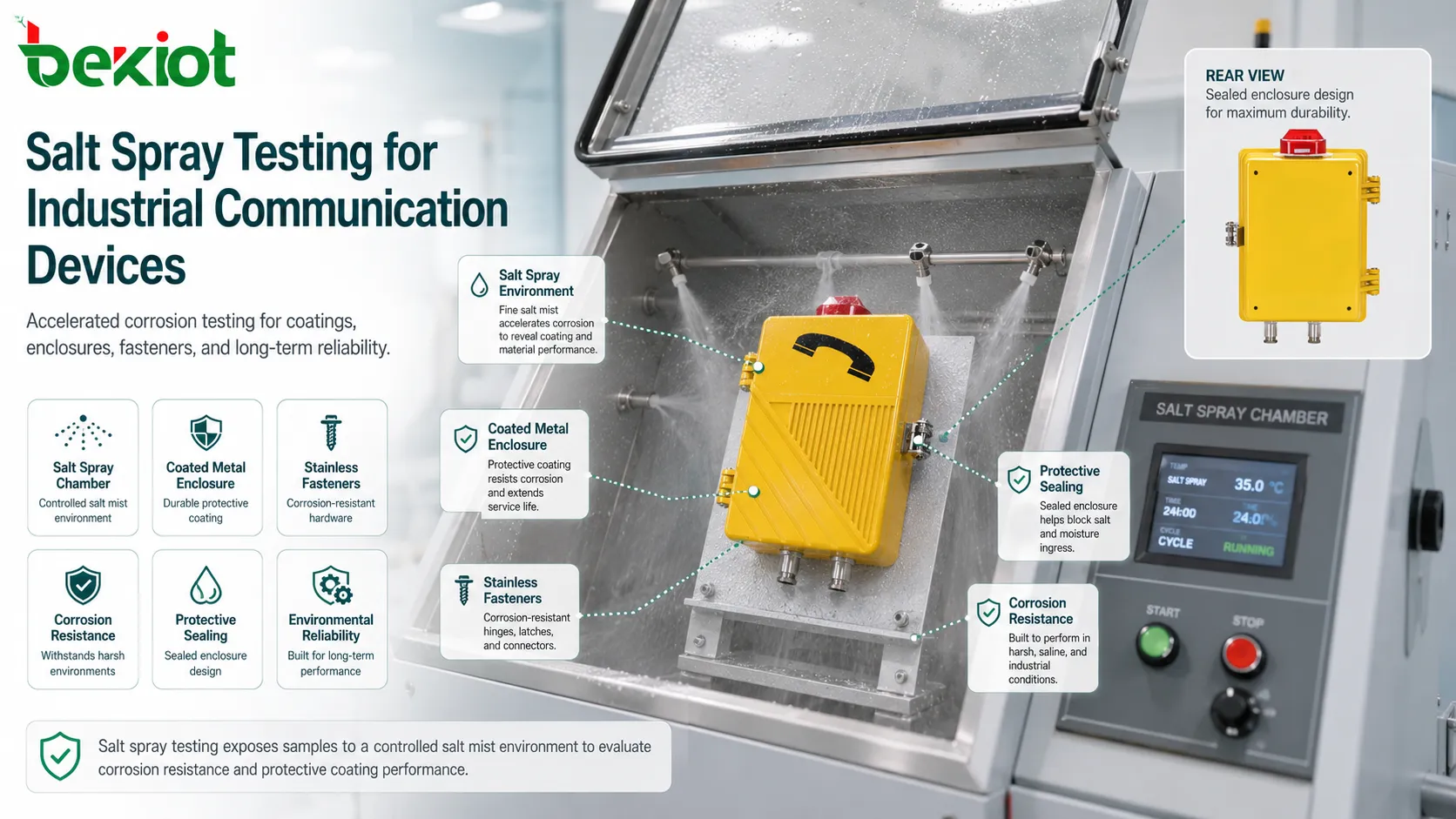
Why Accelerated Corrosion Checks Matter
Outdoor and industrial equipment is exposed to rain, humidity, salt particles, chemical vapor, dust, temperature changes, and surface contamination. In coastal or offshore locations, chloride deposits can remain on surfaces and accelerate corrosion. In chemical and industrial plants, acidic or alkaline substances may attack coatings, fasteners, cable glands, connectors, hinges, and enclosure seams.
Corrosion can create far more than surface discoloration. It may weaken metal parts, damage protective coatings, increase contact resistance, affect grounding continuity, block buttons, reduce sealing performance, stain visible surfaces, and make field maintenance difficult. For electrical and communication products, corrosion may eventually affect safety, signal quality, audio reliability, and service life.
An accelerated test helps detect weak designs before mass deployment. It can reveal whether a coating is too thin, a fastener material is unsuitable, a cut edge is poorly protected, a plating process is unstable, or a sealing structure allows salt-laden moisture to reach internal components.
What Happens Inside the Test Chamber
Controlled Salt Mist Exposure
In a typical neutral salt spray test, samples are placed inside a chamber and exposed to a continuous salt mist under controlled conditions. The test solution, temperature, spray distribution, collection rate, sample angle, and chamber environment are managed according to the selected standard or project specification.
This controlled environment allows different samples to be compared under similar test conditions. For example, two coating systems, two enclosure materials, or two batches of fasteners can be evaluated side by side to identify differences in corrosion behavior.
Specimen Preparation
Before testing, samples are usually cleaned, inspected, labeled, and positioned according to the procedure. If the test includes coated panels, the coating thickness, surface finish, curing quality, and edge protection may be recorded. If the test includes a finished product, openings, cable entries, screws, labels, seals, and mounting surfaces may need special attention.
Preparation must be consistent. Oil, fingerprints, scratches, cleaning residues, or incorrect sample placement can affect results. A poor test setup may create misleading failures or hide real weaknesses.
Exposure Duration
Test duration may be specified in hours, cycles, or project-defined periods. Common durations can range from short screening tests to long exposure periods depending on the material, coating, industry, and customer requirement.
However, more hours do not automatically mean a product will last the same number of years outdoors. Salt spray exposure is an accelerated laboratory condition, not a direct calendar-life forecast. Results should be interpreted together with real environment, coating type, field history, and other environmental tests.
Inspection and Evaluation
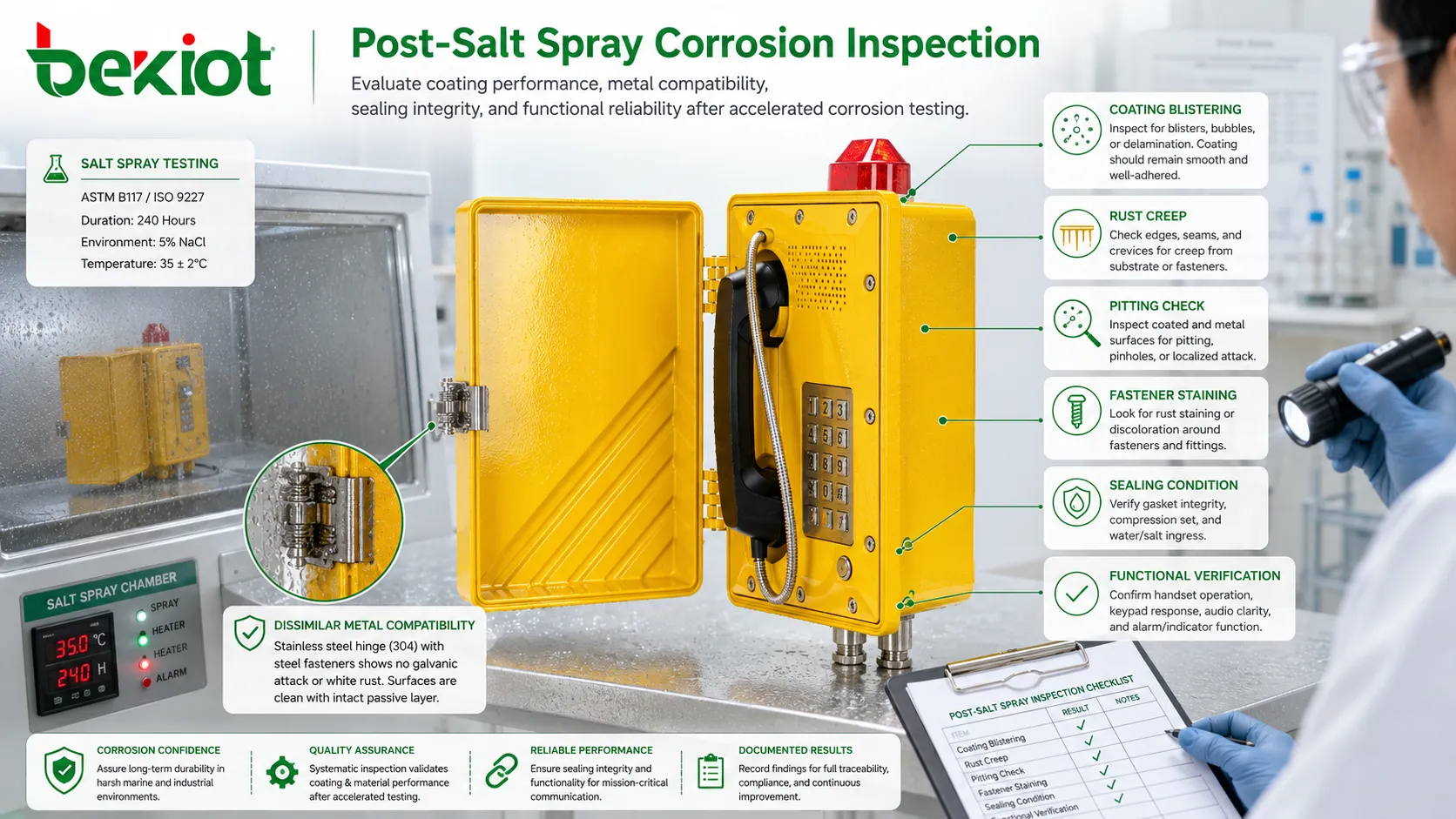
After exposure, samples are inspected for rust, blistering, coating creep, pitting, discoloration, cracking, peeling, swelling, corrosion around scratches, corrosion at cut edges, fastener staining, and functional failure. Some evaluations focus on appearance, while others focus on whether the product still functions properly.
For finished equipment, functional inspection may include button operation, enclosure sealing, connector condition, speaker grille condition, cable gland integrity, grounding continuity, label legibility, and internal moisture evidence. This is especially important when the product is expected to operate in harsh field environments.
Main Standards Used in Practice
ISO 9227
ISO 9227 is commonly referenced for corrosion tests in artificial atmospheres. It includes neutral salt spray, acetic acid salt spray, and copper-accelerated acetic acid salt spray methods. These test types are used for metallic materials with or without corrosion protection.
In procurement and quality documents, ISO 9227 is often used when buyers want a recognized method for comparing coating systems, plated parts, metal samples, or protected components. The exact test type and duration should always be stated clearly rather than only saying “salt spray tested.”
ASTM B117
ASTM B117 is widely known as a standard practice for operating salt spray or salt fog apparatus. It describes how to create and maintain a controlled corrosive environment for exposed specimens.
It is widely used in coating comparison, production quality control, supplier qualification, and material screening. One important point is that ASTM B117 results should not be treated as a standalone guarantee of natural outdoor service life. They are comparative laboratory data, not a perfect model of every field environment.
IEC 60068-2-11
IEC 60068-2-11 is used in environmental testing for electrotechnical products, components, equipment, and materials exposed to salt mist. It is relevant when evaluating electrical or electronic products that may be affected by corrosion in a salt-laden atmosphere.
For communication devices, control panels, outdoor terminals, alarms, and electrical enclosures, this type of test can help confirm whether the product design maintains comparative corrosion resistance under defined laboratory exposure.
IEC 60068-2-52
IEC 60068-2-52 focuses on cyclic salt mist testing. Cyclic methods may include alternating salt mist exposure and other environmental phases, making them useful for components or equipment intended to withstand salt-laden atmospheres.
Cyclic testing can sometimes better represent changing field conditions than continuous salt fog alone, because real environments often include wet and dry periods. The correct method should be selected based on the product, industry, and expected application environment.
Protection Ratings and Test Results
Salt spray hours are sometimes treated like a simple product rating, but this can be misleading. A statement such as “passed 500 hours” or “passed 1,000 hours” only makes sense when the test method, sample type, inspection criteria, and acceptance rules are known.
Protection ratings such as IP ratings, IK ratings, NEMA enclosure types, hazardous-area certifications, and coating classes may describe different aspects of performance. IP ratings focus on dust and water ingress. IK ratings focus on impact resistance. Salt spray testing focuses on corrosion behavior in a salt-laden environment. These are related but not interchangeable.
A product may have a high IP rating but still use unsuitable screws for coastal exposure. Another product may have strong corrosion resistance but limited impact resistance. For outdoor industrial equipment, environmental protection should be assessed as a complete system rather than a single test number.
| Requirement Type | What It Evaluates | Why It Matters |
|---|---|---|
| Salt Spray Test | Corrosion behavior of metals, coatings, fasteners, and assemblies under salt mist exposure. | Helps compare corrosion protection and production consistency. |
| IP Rating | Resistance to dust and water ingress. | Protects internal electronics from particles and moisture entry. |
| IK Rating | Resistance to mechanical impact. | Reduces damage to enclosures, coatings, and exposed parts. |
| Coating Thickness | Protective layer build and coverage. | Affects barrier performance, edge protection, and service durability. |
| Material Grade | Base material corrosion resistance, such as stainless steel or coated aluminum. | Determines how the product behaves if the coating is scratched or exposed. |
Materials and Surface Treatments
Stainless Steel
Stainless steel is often selected for outdoor, marine, food processing, and industrial environments because it forms a passive protective surface layer. Grades such as 304 and 316 are common, with 316 generally offering better resistance in chloride-rich environments.
Even stainless steel can show staining, pitting, or crevice corrosion under aggressive salt exposure, especially around joints, scratches, trapped moisture, or contaminated surfaces. Salt spray testing can help compare grades, finishes, weld quality, and fastener compatibility.
Aluminum and Anodized Aluminum
Aluminum is lightweight and naturally forms an oxide layer. Anodizing or coating can further improve surface durability and corrosion resistance. It is often used in enclosures, panels, communication housings, and outdoor hardware.
When aluminum contacts dissimilar metals in a wet salt environment, galvanic corrosion may occur. Proper fastener selection, isolation washers, coatings, and drainage design are important for long-term protection.
Powder Coating
Powder coating provides a durable protective finish for metal housings and panels. It can improve appearance, abrasion resistance, and corrosion protection when surface preparation and curing are properly controlled.
The weak points are often edges, holes, welded areas, scratches, or areas with poor pretreatment. Salt spray testing can reveal coating adhesion problems, edge creep, blistering, and underfilm corrosion.
Galvanizing and Zinc-Rich Protection
Galvanizing and zinc-rich coatings protect steel by providing a sacrificial layer. Zinc corrodes preferentially, helping protect the steel beneath. This method is widely used for outdoor steel structures, brackets, supports, and mounting hardware.
Test results depend on coating thickness, surface preparation, zinc quality, exposure condition, and whether the part has cut edges or damaged areas. Salt spray testing can compare coating systems but should be interpreted with field environment in mind.
Plating and Passivation
Small components such as screws, terminals, brackets, and connectors may use plating, passivation, or conversion coating. These parts are easy to overlook, but they can become the first visible corrosion points in a finished product.
A strong enclosure with weak fasteners may still fail customer expectations. Therefore, complete product testing should include exposed screws, hinges, springs, terminals, labels, and cable entry hardware.
Corrosion resistance is not determined by the main housing alone. Fasteners, seams, coatings, cable glands, labels, hinges, and exposed edges often decide how a product looks and performs after years in the field.
Application Value for Industrial Equipment
Industrial communication equipment, outdoor emergency terminals, explosion-proof telephones, loudspeaker phones, paging devices, access control stations, and alarm units may be installed in corrosive environments where ordinary indoor materials are not enough. Salt spray testing helps manufacturers and buyers evaluate whether the enclosure, coating, fasteners, cable entries, and visible parts can withstand demanding exposure.
For example, the Becke Telcom EX-BH621 explosion-proof amplified telephone can be considered in industrial projects where rugged communication, hazardous-area suitability, amplified audio, and corrosion-aware enclosure design are important. In such applications, salt spray testing supports material verification by checking whether exposed parts remain resistant to salt-laden moisture and whether the device can maintain reliable communication in harsh field conditions.
The practical value is not only cosmetic. A corroded button, blocked grille, rusty screw, damaged cable gland, or weakened enclosure can affect daily operation and emergency communication. For petrochemical sites, coastal plants, offshore platforms, tunnels, mining areas, ports, and energy facilities, corrosion protection is part of reliability engineering.
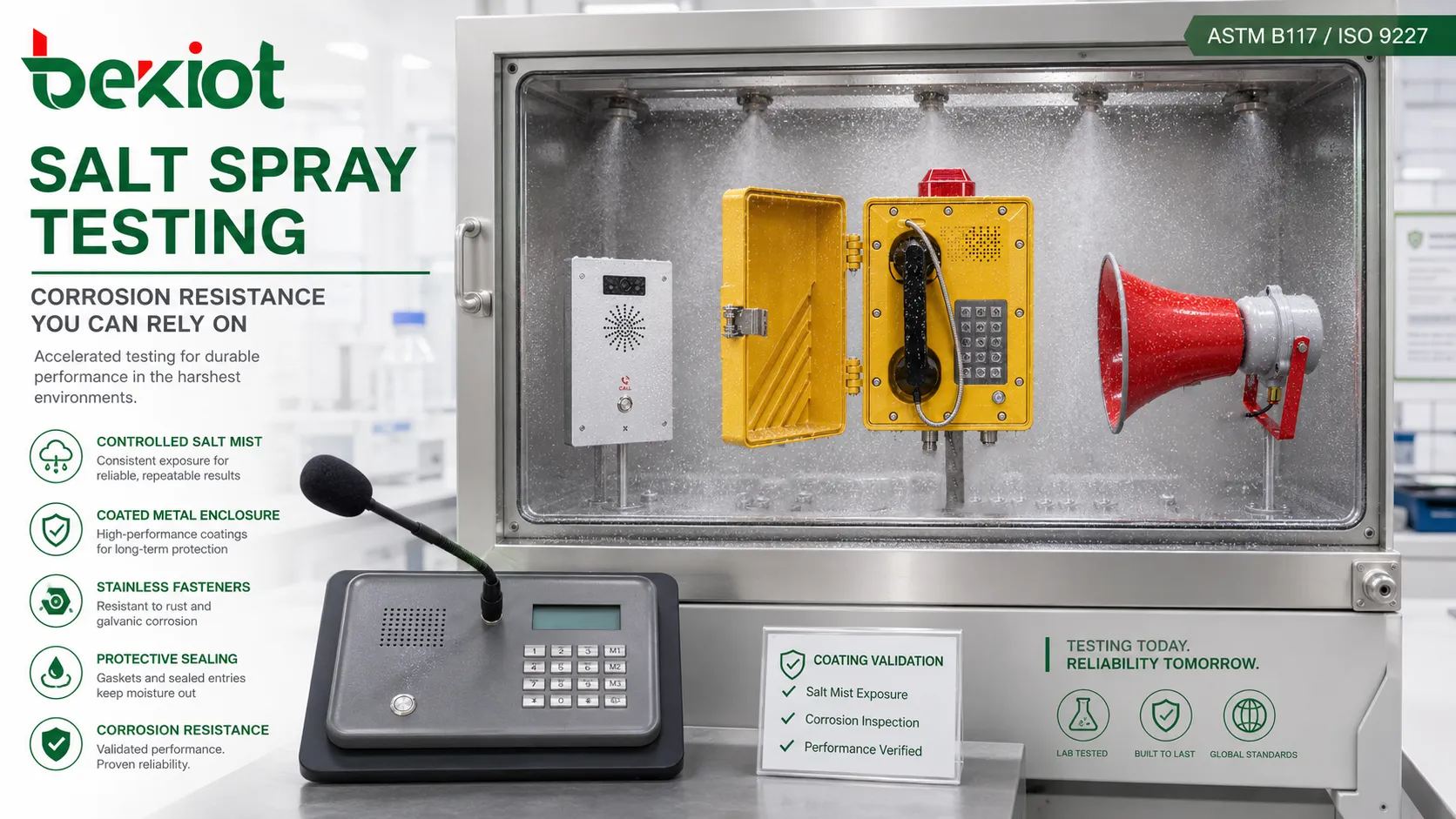
Where This Test Is Commonly Applied
Marine and Coastal Equipment
Marine and coastal environments expose equipment to salt particles, humidity, wind, and frequent wet-dry cycles. Products installed near ports, ships, offshore platforms, coastal roads, and seaside industrial sites often need stronger corrosion protection than ordinary outdoor equipment.
Salt spray testing helps compare materials and coatings before deployment. It is especially useful for brackets, enclosures, panels, outdoor terminals, lighting fixtures, sensors, communication devices, and mounting accessories.
Transportation and Infrastructure
Railways, highways, bridges, tunnels, airports, and metro systems may expose equipment to rain, salt, deicing chemicals, pollution, vibration, and public use. Outdoor cabinets, emergency phones, signaling devices, cameras, loudspeakers, and intercoms often need corrosion-resistant materials.
Testing supports procurement and quality control by showing whether selected materials can handle aggressive exposure. It also helps identify whether additional protection is needed for fasteners, joints, and mounting points.
Petrochemical and Energy Sites
Petrochemical plants, refineries, LNG facilities, power stations, and offshore energy sites may combine salt, chemicals, humidity, and hazardous-area requirements. Equipment must remain safe, sealed, and functional under long-term exposure.
In these environments, corrosion resistance should be evaluated together with explosion-proof construction, ingress protection, mechanical durability, grounding, cable gland sealing, and maintenance procedures.
Electrical and Electronic Products
Electrical and electronic equipment may suffer from corrosion at terminals, connectors, grounding points, screws, shields, and internal conductive parts. Even small corrosion deposits can affect contact reliability or serviceability.
Salt mist testing is useful for evaluating electrotechnical products and components where salt-laden air may degrade performance. Functional checks after exposure are important because appearance alone may not show electrical reliability.
Outdoor Communication Systems
Outdoor communication devices may include SIP intercoms, industrial phones, emergency call points, speakers, paging terminals, control boxes, and field-mounted gateways. These devices often have buttons, microphones, speakers, labels, LEDs, and cable entries that must remain usable after exposure.
For communication systems, the test should consider both external corrosion and functional performance. A device may still look acceptable but fail if a microphone grille, button seal, or connector contact becomes degraded.
How to Read Test Reports
Check the Standard and Method
A report should clearly state which standard and test method were used. Neutral salt spray, acetic acid salt spray, copper-accelerated acetic acid salt spray, and cyclic salt mist tests are not the same. The test method strongly affects result interpretation.
If a supplier only states “salt spray passed” without method, duration, acceptance criteria, and sample description, the claim is incomplete. Buyers should request full test details.
Review Exposure Time Carefully
Exposure time should be understood as laboratory test duration, not guaranteed outdoor service years. A 500-hour or 1,000-hour result may support comparison, but it does not directly predict exact lifetime in a coastal plant or offshore platform.
Real performance depends on coating system, installation, cleaning, scratches, UV exposure, chemical exposure, wet-dry cycling, temperature, and maintenance.
Look at Acceptance Criteria
Different projects may define failure differently. Some may allow slight discoloration but reject red rust. Others may focus on coating blistering, rust creep from scribe marks, pitting depth, functional failure, or corrosion at critical components.
Acceptance criteria should match the product purpose. For a decorative panel, appearance may matter most. For an emergency communication device, functional reliability may be more important.
Confirm Sample Type
Testing a flat coated panel is not the same as testing a finished product. A panel may show coating quality, but a full product reveals performance at screws, seams, labels, cable entries, welds, hinges, buttons, and assemblies.
For field equipment, both material samples and finished product testing may be useful. The product-level test is often better for identifying real assembly weaknesses.
Design Factors That Affect Results
Salt spray performance is influenced by material grade, coating thickness, pretreatment, curing process, edge coverage, drainage design, fastener compatibility, sealing design, and assembly quality. Small design choices can make a large difference.
Flat surfaces may perform well, while cut edges and screw holes may corrode quickly. A sealed enclosure may resist water entry, while a poorly selected cable gland may corrode or loosen. A thick coating may still fail if surface preparation is poor.
Designers should also consider how the product will be installed. Wall-mounted devices, pole-mounted equipment, offshore units, tunnel devices, and chemical plant terminals may face different salt accumulation and cleaning conditions.
Common Mistakes in Interpretation
Equating Hours with Years
The most common mistake is assuming test hours convert directly into outdoor years. Laboratory exposure is accelerated and simplified. Natural environments include UV, pollution, dry periods, rain washing, chemical deposits, mechanical wear, temperature changes, and maintenance.
Salt spray results are best used for comparison and screening, not as an exact lifetime prediction.
Ignoring Functional Testing
Some products pass appearance checks but lose function. A connector may corrode internally, a button may become stiff, or a speaker grille may trap deposits. For electrical and communication devices, functional checks after exposure are essential.
Inspection should include the parts users actually touch and the interfaces technicians maintain.
Testing Only the Best Sample
A single carefully prepared sample may not represent normal production. Quality teams should test representative production samples, including normal fasteners, real labels, actual cable glands, and standard assembly processes.
Batch variation, coating process drift, and supplier changes can affect corrosion performance over time.
Overlooking Mixed Materials
Products often combine steel, stainless steel, aluminum, copper alloy, plastic, rubber, and coatings. When dissimilar metals are exposed to salt moisture, galvanic effects may occur.
Material compatibility should be reviewed at screws, brackets, terminals, hinges, grounding points, and mounting interfaces.
Procurement and Quality Control Tips
When specifying corrosion resistance, avoid vague wording. Instead of saying “good salt spray resistance,” define the test standard, method, exposure duration, sample type, acceptance criteria, coating requirements, and whether functional checks are required after exposure.
For outdoor industrial equipment, the specification may include enclosure material, coating system, fastener grade, IP rating, impact resistance, operating temperature, cable gland material, UV resistance, and salt spray test requirement. This creates a clearer basis for supplier comparison.
Quality control should continue after product approval. If a supplier changes coating powder, pretreatment process, fastener material, gasket supplier, or production line, corrosion performance may change. Periodic testing and incoming inspection help keep results consistent.
Maintenance After Field Installation
Even corrosion-resistant equipment should be maintained. In coastal or chemical environments, salt deposits and contaminants may accumulate on surfaces. Periodic cleaning with compatible methods can help reduce surface attack and preserve appearance.
Maintenance teams should inspect scratches, coating damage, rust stains, loose fasteners, blocked drainage points, cable gland corrosion, and seal aging. Early repair is usually easier than replacing a heavily corroded product later.
For communication and emergency devices, maintenance should include functional testing. Buttons, speakers, microphones, visual indicators, network status, call routing, and alarm outputs should be checked because corrosion-related failures may affect both hardware and system operation.
FAQ
Can plastic parts be evaluated in salt spray conditions?
Yes, but the goal is different. Plastics do not rust like metals, but salt exposure may affect inserts, coatings, labels, screws, seals, surface finish, or assemblies that combine plastic with metal parts.
Why do screws rust before the enclosure surface?
Fasteners may use a different material or coating from the enclosure. They may also have exposed edges, tool marks, or contact points that collect salt moisture. Fastener selection should be part of the corrosion design.
Should samples be scratched before testing?
Some test plans include a scribed or scratched area to evaluate coating creep and underfilm corrosion. Whether this is required depends on the selected standard, coating type, and project acceptance criteria.
Can a product pass salt spray testing but fail outdoors?
Yes. Outdoor environments include UV exposure, temperature cycling, pollution, cleaning chemicals, mechanical damage, wet-dry cycles, and installation effects that may not be fully represented by one laboratory test.
What information should be requested from a supplier?
Request the test standard, test method, duration, sample description, coating system, material grade, acceptance criteria, photos before and after testing, functional check results, and whether the tested sample matches normal production.