


The RoHS Directive is one of the most important compliance frameworks in the electrical and electronic product industry. It is widely referenced in product specifications, declarations of conformity, supplier material statements, and export documentation for devices sold into the European market. Whether the product is a power supply, industrial telephone, SIP intercom, IP phone, gateway, control panel, lighting unit, or consumer device, RoHS often appears alongside other compliance information because it directly affects material selection and market access.
In simple terms, RoHS limits the use of certain hazardous substances in electrical and electronic equipment. Its purpose is not to define performance, waterproofing, or impact resistance. Instead, it focuses on chemical content and the environmental and health risks associated with electrical and electronic products, especially during recycling, recovery, disposal, and waste handling.
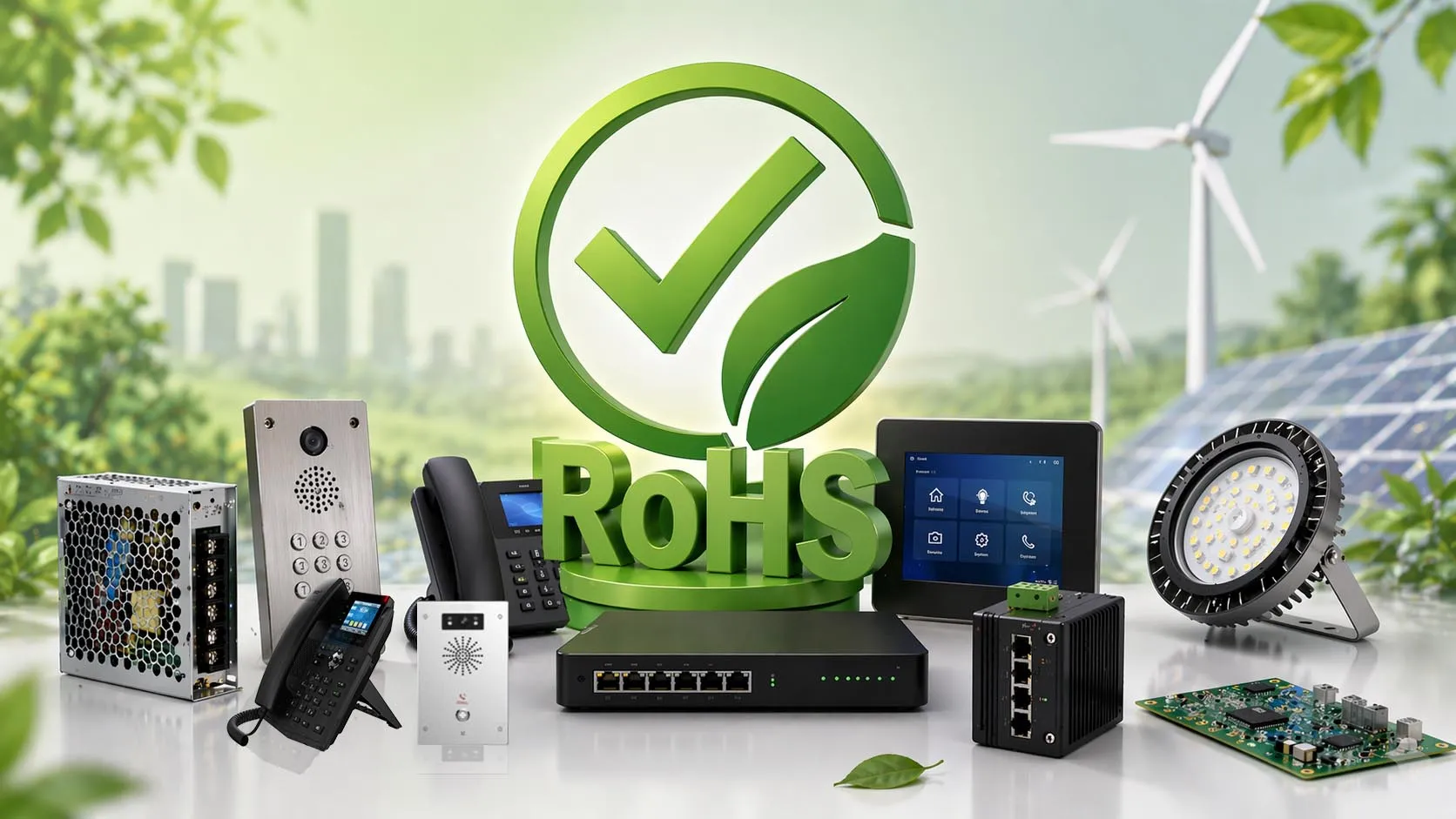
RoHS is a substance-restriction framework for electrical and electronic equipment, not a product performance rating.
What Is the RoHS Directive?
Meaning of RoHS
RoHS stands for Restriction of Hazardous Substances. In the EU, the current legal framework is based on Directive 2011/65/EU, the recast RoHS directive, together with later amendments that updated the restricted substance list. The directive applies to electrical and electronic equipment placed on the EU market and is designed to reduce the use of hazardous substances that may affect people, animals, and the environment during product life cycle and waste treatment.
That is why RoHS is closely connected with material compliance and environmental responsibility. It is less about how a product performs in service and more about what the product is made of. For manufacturers and buyers, this makes RoHS a key requirement in design review, sourcing, supplier control, and market entry planning.
Why RoHS matters
Electrical and electronic equipment can contain metals, flame retardants, plasticisers, coatings, solders, cable compounds, and other materials that create environmental and health risks if they are not controlled. RoHS addresses that problem by restricting specific substances and by pushing manufacturers toward safer alternatives where substitution is technically and economically realistic.
As a result, RoHS has become a basic compliance expectation across many supply chains. Even where a product is sold outside the EU, procurement teams often still ask for RoHS status because the directive has shaped global design practice, supplier declarations, testing workflows, and material databases.
RoHS answers a material-compliance question: whether restricted hazardous substances are controlled within legal limits. It does not answer whether a product is waterproof, dustproof, or impact resistant.
Core RoHS Standards and Legal Framework
The main EU framework
The core EU legal basis is Directive 2011/65/EU on the restriction of the use of certain hazardous substances in electrical and electronic equipment. It applies to electrical and electronic equipment within the directive’s scope and Annex I categories, including household equipment, IT and telecommunications equipment, lighting equipment, medical devices, monitoring and control instruments, and a broad “other EEE” category that captures many additional products placed on the market.
For most manufacturers, the practical takeaway is clear: if the product is electrical or electronic equipment and is intended for the EU market, RoHS should be checked early in the design and sourcing stage rather than treated as a late paperwork issue. Material selection, cable design, PCB components, coatings, plastics, and supplier declarations all influence whether compliance can be demonstrated smoothly.
Restricted substances and limits
Under the current framework, RoHS restricts ten substances. For most of them, the maximum concentration tolerated by weight in homogeneous materials is 0.1%. Cadmium is more stringent at 0.01%. These limits are assessed at the homogeneous material level, which means the evaluation is not only done at finished-product level but also at the level of individual uniform materials and material layers inside the product.
That point is important in real projects. A compliant enclosure, cable assembly, PCB, or keypad is not simply judged by the total product mass. The solder, plating, insulation, plastic housing, paint layer, adhesive, and other homogeneous materials may each need to be considered separately in documentation or testing strategy.
| Restricted substance | Maximum concentration by weight in homogeneous materials |
|---|---|
| Lead (Pb) | 0.1% |
| Mercury (Hg) | 0.1% |
| Cadmium (Cd) | 0.01% |
| Hexavalent chromium (Cr6+) | 0.1% |
| Polybrominated biphenyls (PBB) | 0.1% |
| Polybrominated diphenyl ethers (PBDE) | 0.1% |
| Bis(2-ethylhexyl) phthalate (DEHP) | 0.1% |
| Butyl benzyl phthalate (BBP) | 0.1% |
| Dibutyl phthalate (DBP) | 0.1% |
| Diisobutyl phthalate (DIBP) | 0.1% |
Supporting standards and technical documentation
In day-to-day compliance work, companies also refer to supporting standards and documentation methods. A well-known example is EN IEC 63000, which is used to structure the technical documentation that supports RoHS assessment. In practice, this means RoHS compliance is usually demonstrated through a combination of supplier declarations, bills of materials, risk assessment, material review, controlled evidence files, and targeted laboratory testing when needed.
That is also why many compliance teams avoid using the phrase “RoHS certificate” too casually. RoHS is better understood as a legal compliance status supported by technical documentation and conformity assessment, not as a single universal certificate issued by one global authority.
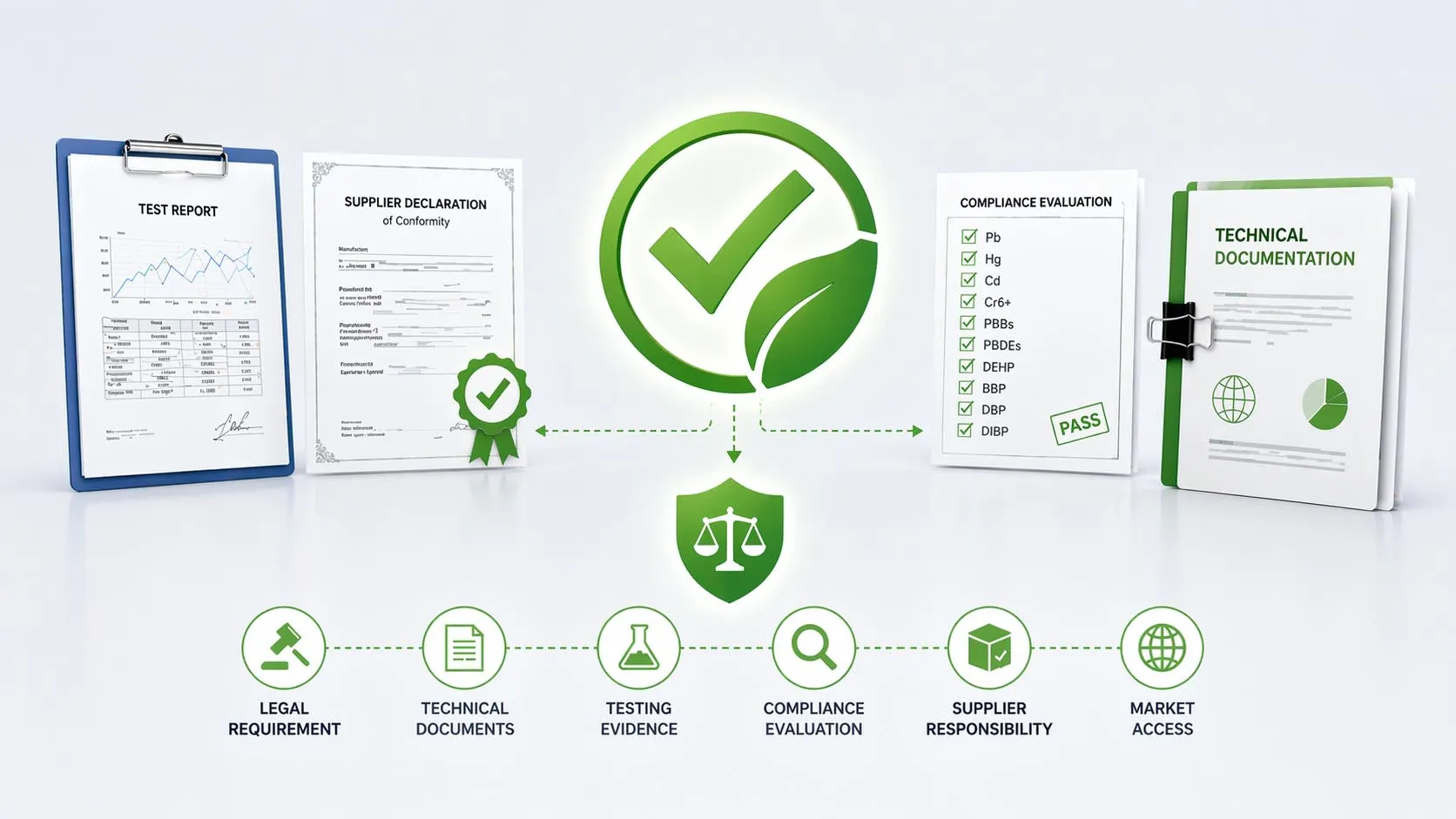
RoHS compliance is usually supported by technical documentation, supplier evidence, and risk-based verification rather than by one standalone universal certificate.
RoHS and Protection Ratings: What Is the Difference?
RoHS is not an IP rating
One of the most common misunderstandings is treating RoHS as if it were a protection level like IP65, IP66, or IP67. That is not correct. IP ratings belong to a different system used to classify enclosure protection against dust and liquids. A product can be RoHS compliant and still have a low, high, or unspecified IP rating, because the two requirements measure different things.
For example, an outdoor emergency phone may be advertised as RoHS compliant and IP66. In that case, RoHS refers to restricted hazardous substances in the product materials, while IP66 refers to enclosure protection against dust ingress and powerful water jets. The two labels can appear together on the same datasheet, but they are not interchangeable.
RoHS is not an IK impact rating
The same distinction applies to IK ratings. IK codes are used to describe protection against external mechanical impacts. They tell buyers how robust an enclosure is against impact or vandal resistance conditions, while RoHS tells buyers whether certain hazardous substances are controlled within the legal limits.
This difference matters in industrial and public safety products. A help point, industrial intercom, access terminal, or explosion-protected communication device may need RoHS compliance for market access, IP protection for dust and water resistance, and IK protection for mechanical durability. Each requirement answers a separate engineering and regulatory question.
RoHS, IP, and IK often appear together in product literature, but they belong to different compliance layers: RoHS covers hazardous substances, IP covers ingress protection, and IK covers mechanical impact resistance.
How to present them correctly in product content
In product pages and technical articles, the safest approach is to separate these claims clearly. RoHS should be presented under compliance, environmental, or regulatory information. IP should be presented under enclosure protection. IK should be presented under mechanical impact resistance. When these terms are mixed together without explanation, buyers may misunderstand what the product has actually been evaluated for.
This is especially important for B2B products sold into infrastructure, industrial, transport, and public safety projects, where procurement teams often compare compliance marks, environmental ratings, ingress protection, operating temperature, and certification status side by side.
Where RoHS Applies in Real Products
Consumer and office electronics
RoHS is commonly associated with computers, monitors, routers, switches, printers, power supplies, adapters, and other mainstream electronics. In these categories, compliance is already expected by most buyers and distributors. Even when the end user does not actively ask about restricted substances, the importer, brand owner, or online marketplace may still require evidence.
Because these products use multiple components sourced from different suppliers, RoHS compliance usually depends on disciplined supplier management and documentation control. A single non-compliant cable compound, connector plastic, solder alloy, or coating can create a problem for the finished product.
Industrial and communication equipment
RoHS also matters in industrial and communication systems such as industrial telephones, SIP intercoms, IP phones, voice gateways, paging equipment, control panels, dispatch terminals, alarm devices, and network accessories. These products may additionally carry IP ratings, IK ratings, EMC requirements, and sector-specific approvals, but RoHS remains a separate material compliance obligation.
For manufacturers in this space, the challenge is often more complex because the product may combine metal housings, keypads, microphone parts, display modules, PCBs, cable glands, elastomers, flame-retardant plastics, coated fasteners, and industrial connectors. Each of those material groups can affect the evidence file used to support compliance.
Lighting, medical, and control systems
Lighting products, medical devices, monitoring instruments, and control equipment also sit within the broader RoHS framework, although some timing details and exemptions have differed historically depending on category and amendment stage. This is one reason RoHS work is rarely just a sourcing task. It is a regulatory and engineering coordination task that touches product planning, design, testing, documentation, and lifecycle management.
In practice, teams often review RoHS during new product development, supplier onboarding, design change approval, and export preparation. That makes it relevant not only for high-volume consumer products but also for niche industrial equipment and project-based devices.

RoHS applies across many product families, from office electronics to industrial communication equipment, lighting, and control systems.
Why RoHS Compliance Matters in Business
Market access and sales readiness
For many manufacturers and exporters, RoHS is ultimately a market access issue. If a product falls within scope and cannot be supported with adequate compliance evidence, it may face barriers in distribution, import review, tender qualification, or customer approval. That is why RoHS is often reviewed together with CE marking, technical files, declarations, and lab evidence during launch preparation.
From a commercial perspective, strong RoHS control also improves response speed when customers ask for declarations, substance statements, or compliance packs. In competitive B2B sales, that responsiveness often matters almost as much as the product specification itself.
Supply chain discipline and design control
RoHS encourages better internal control over materials and supplier quality. It pushes manufacturers to understand what goes into plastics, solders, coatings, and cable materials, and to create a traceable compliance record rather than relying on assumptions. Over time, this usually improves change management and reduces compliance surprises.
That benefit extends beyond the EU. Once a company builds a disciplined material compliance process, it becomes easier to answer related customer requirements, compare supplier data, and align RoHS with other environmental or market-entry obligations.
How Manufacturers Usually Demonstrate RoHS Compliance
Technical evidence instead of guesswork
A sound RoHS process normally includes supplier declarations, material declarations, controlled bills of materials, part-level reviews, and a documented assessment method. Where the risk is higher or the evidence is incomplete, companies may add laboratory testing for specific substances or materials. The goal is not to test everything blindly, but to build a defensible technical basis for the compliance conclusion.
This is why experienced teams treat RoHS as a documentation system as much as a testing topic. If the evidence chain is weak, late testing alone may not solve the problem efficiently.
Declaration of conformity, marking, and exemptions
Within the EU framework, manufacturers are expected to prepare the technical documentation, carry out the conformity assessment procedure, and apply the relevant declaration and marking route required for the product. RoHS also includes exemptions in Annexes III and IV for certain applications, and these exemptions are time-limited and reviewed over time rather than granted as permanent blanket permissions.
That means a product can be compliant because it stays below the concentration limits, or because a valid exemption applies to a specific use case. Either way, the logic should be clear in the product’s compliance file. For businesses selling into Great Britain, separate UK RoHS regulations also need to be checked rather than assuming EU paperwork alone is always enough.
Good RoHS practice is not only about passing a test. It is about being able to explain, with evidence, why the product is compliant and which parts, materials, or exemptions support that conclusion.
Conclusion
The RoHS Directive is a substance-restriction framework for electrical and electronic equipment, not a waterproofing or protection rating system. Its role is to limit hazardous substances in products placed on the market, support safer recovery and disposal of waste electronics, and push industry toward better material choices and cleaner supply chains.
For manufacturers, importers, and project buyers, RoHS matters because it affects product design, supplier management, technical documentation, and market access. It is often shown together with IP and IK ratings in datasheets, but those marks describe different aspects of a product. RoHS addresses hazardous substance restrictions, IP addresses dust and water ingress, and IK addresses mechanical impact resistance.
In short, if you are writing product pages, reviewing compliance files, or planning exports for electrical and electronic products, RoHS should be treated as a core regulatory requirement with its own scope, limits, evidence rules, and practical business impact.
FAQ
Is RoHS a certification?
Strictly speaking, RoHS is a legal compliance requirement, not a single universal certification program. In practice, companies usually support RoHS claims with technical documentation, supplier evidence, declarations, and testing where needed.
What substances does RoHS restrict?
The current EU RoHS framework restricts ten substances: lead, mercury, cadmium, hexavalent chromium, PBB, PBDE, DEHP, BBP, DBP, and DIBP.
Does RoHS define IP65, IP66, or IP67?
No. Those are ingress protection ratings. RoHS does not define enclosure protection against dust or water. A product may carry both RoHS and IP ratings, but they refer to different requirements.
Can a product be RoHS compliant and still need an IK rating?
Yes. RoHS compliance and IK impact protection address different issues. RoHS focuses on hazardous substances, while IK ratings describe resistance to external mechanical impacts.
What is a homogeneous material in RoHS?
In RoHS language, a homogeneous material is one material of uniform composition throughout, or a material combination that cannot be mechanically separated into different materials. This is the level at which the concentration limits are typically assessed.
Does RoHS apply only in the EU?
The RoHS Directive is an EU framework, but similar requirements and market expectations exist elsewhere. For example, Great Britain has its own RoHS regulations and compliance route, so businesses should check the destination market carefully.
Do industrial communication products need RoHS?
Many do. Industrial telephones, SIP intercoms, gateways, control terminals, and related electronic equipment often need RoHS review when they are placed on regulated markets and fall within the scope of the applicable rules.







