


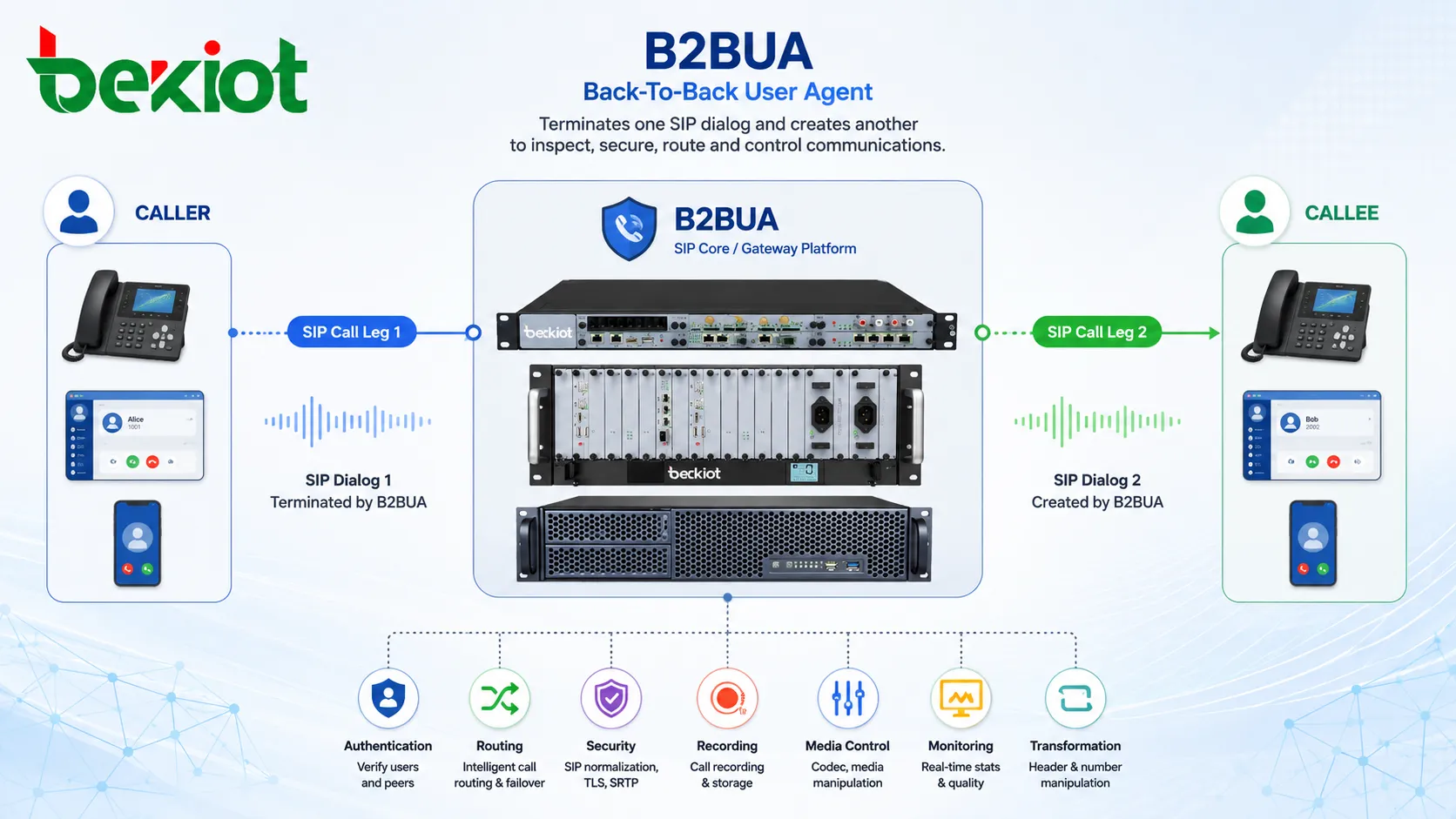
A Back-To-Back User Agent, commonly known as B2BUA, is a communication network element used in SIP and VoIP systems to manage calls by acting as two separate user agents placed back to back. Instead of simply forwarding SIP messages like a basic proxy, a B2BUA terminates one call leg and creates another call leg toward the next party.
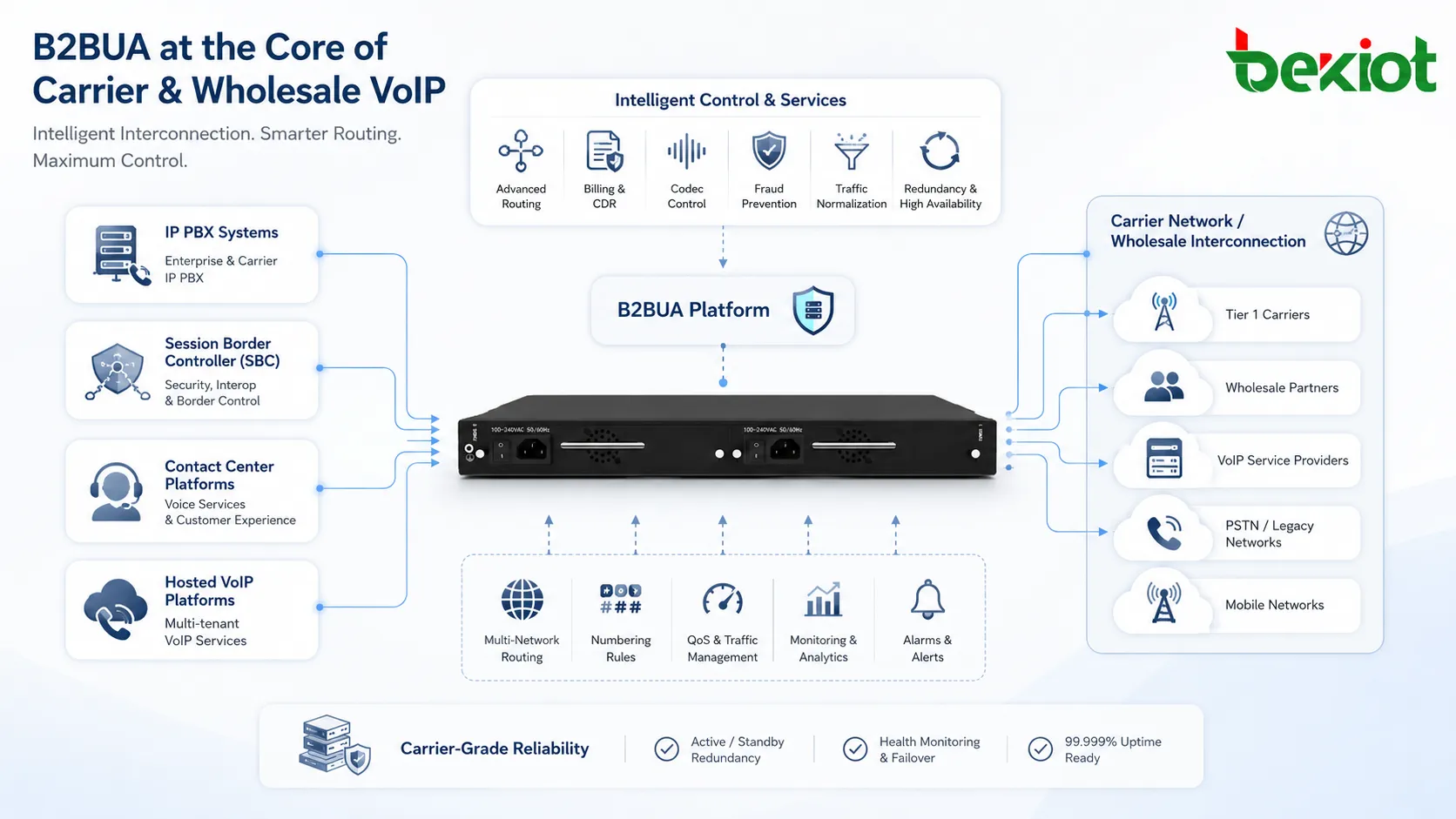
This means the B2BUA sits in the middle of a session and controls both sides of the communication. It can inspect, modify, route, authenticate, record, bridge, monitor, or transform call signaling and sometimes media. Because of this control, B2BUA is widely used in IP PBX systems, session border controllers, SIP application servers, hosted VoIP platforms, contact centers, carrier networks, unified communications systems, and enterprise voice gateways.
A Different Way to Think About SIP Call Control
In a simple SIP network, users may imagine a call flowing directly from caller to callee. In reality, many professional VoIP systems need a middle layer that can control the call. This middle layer may need to apply security rules, hide network details, solve compatibility issues, manage billing, enforce routing policies, or provide services such as recording and call transfer.
A B2BUA provides this middle layer by behaving like the called party toward the original caller and like the caller toward the final destination. To the first endpoint, the B2BUA looks like the other side of the call. To the second endpoint, it also behaves as the opposite side. This gives the platform much more control than a stateless forwarding device.
For enterprise and carrier voice systems, this design is valuable because SIP calls often cross different networks, vendors, codecs, numbering plans, security zones, and service platforms. The B2BUA helps normalize these differences and maintain predictable call behavior.
What a B2BUA Actually Does
Terminates and Recreates SIP Dialogs
The defining behavior of a B2BUA is that it terminates one SIP dialog and creates a new SIP dialog on the other side. The caller does not maintain one uninterrupted SIP dialog directly with the callee. Instead, the B2BUA manages two related but separate dialogs.
This structure allows the B2BUA to make decisions independently for each side. It can accept a call from one endpoint, apply internal logic, and then decide whether to create a second call leg to another endpoint, trunk, gateway, queue, IVR, or media application.
Controls Signaling Behavior
A B2BUA can modify SIP headers, caller ID, contact information, routing fields, session timers, codec negotiation, and call status handling. This is useful when different systems interpret SIP messages differently or when network policies require signaling normalization.
For example, a SIP trunk provider may require a specific header format, while the internal PBX may use another format. A B2BUA can adapt these messages so both sides can communicate successfully.
Applies Call Logic
Because it controls the session, a B2BUA can apply call logic such as call forwarding, call transfer, call hold, call parking, call recording, call screening, number rewriting, caller authentication, least-cost routing, failover routing, and time-based routing.
This makes B2BUA especially important in systems that do more than basic call delivery. Most modern business communication platforms rely on B2BUA-like behavior to provide advanced calling services.
May Anchor Media
Some B2BUAs handle only signaling, while others also anchor media. When media is anchored, RTP audio packets pass through the B2BUA or an associated media relay. This enables recording, transcoding, NAT traversal, lawful intercept support, media security control, tone detection, announcements, conferencing, and quality monitoring.
Media anchoring adds control but also increases bandwidth, processing, and latency considerations. For this reason, some systems anchor media only when necessary.
How It Works During a Call
A typical SIP call involving a B2BUA begins when the caller sends an INVITE request. The B2BUA receives the request and treats it as the endpoint of the first dialog. It then checks routing rules, authentication status, number format, service policy, and destination availability.
If the call is allowed, the B2BUA creates a new INVITE toward the destination. This second dialog may look similar to the first one, but it is not simply a forwarded copy. The B2BUA may modify headers, change codecs, adjust caller ID, select another trunk, insert media parameters, or apply security rules.
When the destination answers, the B2BUA coordinates the response back to the original caller. During the session, it may continue to process re-INVITEs, UPDATE messages, BYE requests, hold events, transfer actions, session refreshes, and media changes. When either side hangs up, the B2BUA clears both call legs according to its call control logic.
A B2BUA is not just passing messages through. It is actively participating in the call and making each side believe it is communicating with a real endpoint.
Compared with SIP Proxy
A SIP proxy and a B2BUA may both sit in the path of SIP signaling, but they behave differently. A proxy mainly routes SIP requests and responses. A B2BUA terminates and recreates sessions, which gives it deeper call control.
| Network Element | Main Behavior | Typical Strength |
|---|---|---|
| SIP Proxy | Forwards SIP requests and responses according to routing rules. | Efficient routing, registration support, and scalable signaling distribution. |
| B2BUA | Terminates one SIP dialog and creates another dialog toward the destination. | Deep call control, service logic, interoperability, security, and media handling. |
| SBC | Often uses B2BUA behavior at network borders. | Security, NAT traversal, topology hiding, policy enforcement, and trunk control. |
| Media Server | May interact with B2BUA logic to play audio, record, bridge, or conference calls. | Voice prompts, IVR, conferencing, recording, announcements, and media services. |
A proxy is usually lighter and more transparent, while a B2BUA is more powerful but more involved. The right choice depends on whether the system only needs routing or also needs service control, security, media handling, and interoperability support.
Why Its Important in VoIP Networks
Solves Interoperability Problems
SIP is a standard protocol, but different vendors and platforms may implement details differently. Header formats, codec negotiation, session timers, DTMF methods, transfer behavior, and NAT handling may vary between endpoints, PBX systems, gateways, and carriers.
A B2BUA can normalize these differences. It can rewrite messages, adjust session parameters, and make two systems communicate even when their native behavior does not match perfectly.
Improves Security Boundaries
A B2BUA can hide internal network topology from external systems. Instead of exposing internal IP addresses, extensions, server names, or routing details, the B2BUA presents controlled information to the outside network.
This is one reason B2BUA behavior is common in session border controllers. It helps protect enterprise and carrier networks by enforcing signaling policies and limiting direct exposure between internal and external SIP domains.
Supports Advanced Calling Services
Many voice services require direct call control. Call recording, IVR, queue routing, announcements, conferencing, click-to-call, call transfer, call pickup, outbound campaign dialing, and number masking often depend on B2BUA-style session handling.
Because the B2BUA owns the call legs, it can insert or remove media services, redirect calls, change destinations, or maintain control even when the call is moved between users or applications.
Enables Policy-Based Routing
Enterprise and carrier networks often route calls based on cost, destination, trunk status, caller identity, time of day, location, priority, service class, or failover rules. A B2BUA can make these decisions during call setup and adjust behavior when conditions change.
For example, if one SIP trunk fails, the B2BUA can attempt another route. If a number requires special formatting, it can rewrite the dialed number before sending the call onward.
Typical Uses
IP PBX Call Control
Many IP PBX systems use B2BUA behavior to manage calls between extensions, trunks, queues, voicemail, IVR menus, and external numbers. The PBX does not only route SIP messages; it controls the user experience and applies business communication rules.
This allows features such as call hold, transfer, call forwarding, call recording, presence-based routing, ring groups, and voicemail routing to work consistently across different endpoints.
Session Border Controllers
Session border controllers often operate as B2BUAs at the edge of a VoIP network. They separate internal SIP systems from external carriers, partners, remote users, or public networks.
In this role, the B2BUA supports topology hiding, NAT traversal, SIP normalization, media anchoring, encryption policies, access control, denial-of-service protection, and trunk interoperability.
Hosted VoIP and Cloud Calling
Cloud calling platforms use B2BUA functions to control sessions for thousands or millions of users. The platform may need to route calls across regions, enforce tenant policies, support number masking, record calls, connect softphones, and integrate with contact center applications.
B2BUA architecture makes it possible to control each call leg while keeping users, tenants, carriers, and applications logically separated.
Contact Center Platforms
Contact centers rely on call control. Calls may enter through SIP trunks, pass through IVR menus, wait in queues, connect to agents, transfer to supervisors, record media, and generate reporting data.
A B2BUA helps manage these complex call flows by controlling both signaling and, when needed, media. It can also connect with CRM systems, workforce platforms, call recording tools, and analytics systems.
Carrier and Wholesale VoIP
Carriers and wholesale VoIP providers use B2BUA systems to manage interconnection, routing, billing, codec control, numbering rules, fraud prevention, and traffic normalization between many networks.
At carrier scale, B2BUA performance, redundancy, and routing intelligence are critical because high call volumes must be processed reliably.
Technical Capabilities to Evaluate
SIP Header Manipulation
SIP header manipulation allows the B2BUA to adapt call signaling between different systems. It may rewrite From, To, Contact, Record-Route, P-Asserted-Identity, Diversion, Remote-Party-ID, or custom headers.
This capability is useful for interoperability, caller ID control, routing, privacy, trunk compatibility, and carrier requirements. However, header manipulation should be documented clearly because incorrect changes can break call flows.
Codec Negotiation and Transcoding
A B2BUA may help negotiate codecs between endpoints. If both sides support a common codec, the call can proceed without transcoding. If they do not, the B2BUA or media server may need to transcode audio between formats.
Transcoding improves compatibility but consumes processing resources and may add delay. It should be used where necessary, not as a default solution for every call.
NAT Traversal
SIP and RTP can be difficult across NAT because signaling messages may contain private IP addresses and media streams may need special routing. A B2BUA can help solve this by anchoring media, rewriting connection information, and controlling how endpoints communicate through firewalls.
This is important for remote workers, branch offices, hosted PBX users, and SIP trunk connections over public or mixed networks.
Call State Management
Because the B2BUA is part of the call, it maintains call state. It knows whether the call is ringing, answered, held, transferred, failed, disconnected, or redirected. This state awareness enables advanced services and accurate reporting.
Call state management is also useful for troubleshooting. Administrators can see where a call failed, which leg disconnected, and which response codes were involved.
Media Services Integration
A B2BUA may connect calls to media services such as IVR, recording, announcements, conference bridges, voicemail, speech recognition, DTMF detection, or tone generation. These services require the system to control the session rather than simply forward it.
Media integration is one of the reasons B2BUA is central to modern communication platforms.
Design Considerations for Deployment
Deploying a B2BUA requires careful planning because it becomes a control point in the voice network. If it fails or is overloaded, calls may be affected. Redundancy, capacity planning, monitoring, backup routes, and high availability should be considered for production environments.
Security is also important. Since the B2BUA processes call signaling and may handle media, it should be protected from unauthorized access, SIP scanning, registration attacks, toll fraud attempts, malformed packets, and denial-of-service traffic.
Interoperability testing should include real endpoints, SIP trunks, gateways, softphones, recording systems, transfer scenarios, DTMF methods, emergency calls, failover routes, and codec combinations. Many B2BUA issues appear only in specific call flows.
A B2BUA adds control and flexibility, but it also becomes responsible for call behavior. Careful design, monitoring, and testing are essential.
Common Problems and Troubleshooting Points
One-Way Audio
One-way audio may occur when signaling is successful but RTP media cannot flow correctly. Causes may include NAT issues, incorrect SDP rewriting, firewall rules, codec mismatch, media anchoring problems, or routing errors.
When troubleshooting, engineers should check both SIP signaling and RTP paths. A successful SIP 200 OK does not guarantee that audio media is working correctly.
Failed Transfers
Call transfer can be complex because it may involve REFER messages, re-INVITEs, new call legs, media changes, and different endpoint behaviors. A B2BUA may need to manage or translate transfer behavior between systems.
Failed transfers often require examining SIP traces from both sides of the B2BUA rather than only one endpoint.
Caller ID Problems
Caller ID may display incorrectly if headers are rewritten improperly or if carrier requirements are not met. This can affect outbound calls, forwarded calls, privacy settings, and multi-tenant platforms.
Administrators should verify which identity headers are required by each trunk, PBX, and endpoint group.
Codec Negotiation Failure
If two sides cannot agree on a codec, the call may fail or connect without audio. A B2BUA may solve this through codec filtering or transcoding, but incorrect codec policy can also create problems.
Codec lists should be planned according to endpoint capability, bandwidth, recording needs, and carrier support.
Operational Benefits
B2BUA improves operational control by giving administrators a clear place to enforce voice policies. Instead of relying on every endpoint to behave correctly, the B2BUA can centralize routing, security, and service logic.
It also improves visibility. Because call legs pass through a controlled system, administrators can collect call records, signaling traces, quality metrics, routing results, failure codes, and service usage data.
For organizations with multiple branches, SIP providers, vendors, and communication applications, B2BUA helps reduce fragmentation. It becomes a coordination layer that connects different parts of the communication environment.
Limitations of B2BUA
A B2BUA is powerful, but it is not always the simplest option. It introduces processing responsibility, configuration complexity, and possible latency. If deployed unnecessarily, it may make a network harder to troubleshoot.
Because it changes or terminates SIP dialogs, a B2BUA may affect end-to-end transparency. Some SIP features that work directly between endpoints may need special handling when a B2BUA is in the path.
Media anchoring can also increase resource usage. When all RTP traffic passes through the B2BUA or media relay, bandwidth and processing requirements become higher. Capacity planning is therefore important.
Best Implementation
Start by defining what the B2BUA must control. It may be used for security, routing, interoperability, recording, NAT traversal, contact center logic, or carrier interconnection. Each goal requires different configuration choices.
Keep routing rules and header manipulation documented. SIP behavior can become difficult to understand when many transformations are applied over time. Clear documentation helps future troubleshooting and prevents accidental changes.
Monitor both signaling and media. SIP call success, RTP flow, packet loss, jitter, codec negotiation, session timers, and disconnect reasons should all be visible. This gives engineers a complete view of call performance.
Use redundancy for critical environments. If the B2BUA is central to call control, high availability and failover design are necessary to prevent communication interruption.
FAQ
Is a B2BUA the same as a SIP proxy?
No. A SIP proxy mainly forwards SIP messages, while a B2BUA terminates one SIP dialog and creates another. This gives the B2BUA deeper control over call behavior.
Does every VoIP system need a B2BUA?
Not every simple system needs one, but many enterprise, hosted, carrier, contact center, and SBC deployments use B2BUA behavior because they require call control, security, routing, media handling, or interoperability features.
Can a B2BUA solve NAT problems?
Yes, many B2BUA systems help with NAT traversal by rewriting signaling information and anchoring media. However, firewall rules, RTP port ranges, endpoint settings, and network design must still be configured correctly.
Does a B2BUA always handle RTP media?
No. Some B2BUAs handle only signaling, while others also anchor or process media. Media anchoring is used when features such as recording, transcoding, NAT traversal, or media monitoring are required.
Why is B2BUA important for SIP trunking?
In SIP trunking, B2BUA behavior helps normalize signaling between enterprise PBX systems and carriers. It can manage caller ID, codec policy, security boundaries, failover routes, NAT traversal, and provider-specific SIP requirements.







