


Pulse-Code Modulation, commonly known as PCM, is a digital audio encoding method that converts analog sound into a sequence of digital values. It is one of the most important foundations of modern audio technology and is widely used in telephony, VoIP systems, audio recording, broadcasting, digital storage, intercom systems, conferencing platforms, embedded devices, and professional communication networks.
PCM does not compress audio in the same way that codecs such as MP3, AAC, Opus, or G.729 do. Instead, it represents the original analog waveform by measuring it at regular time intervals and storing each measurement as a digital number. Because of this direct structure, PCM is often used when reliability, compatibility, predictable quality, and simple processing are more important than reducing file size or bandwidth as much as possible.
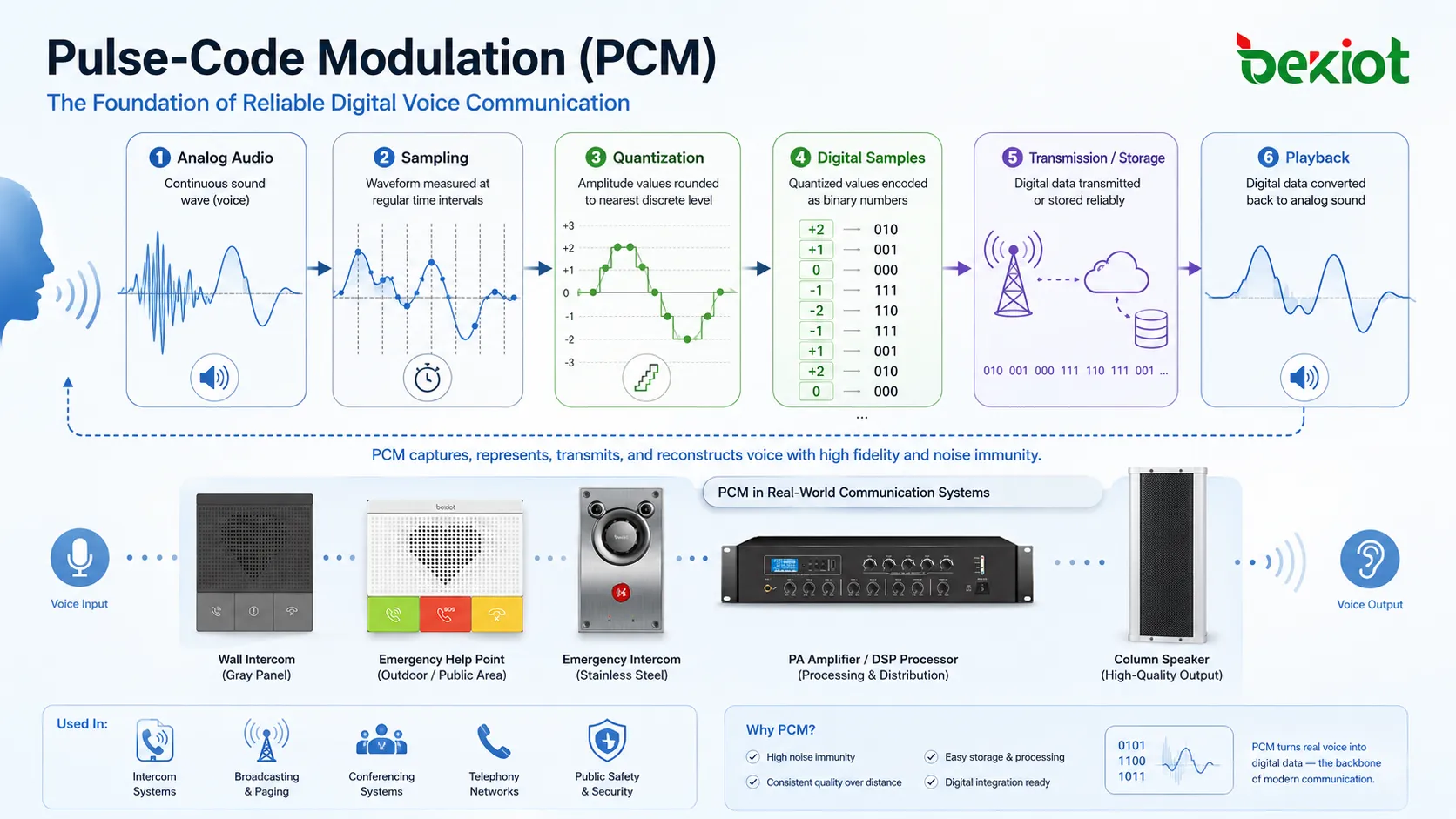
From Analog Sound to Digital Values
Sound in the real world is continuous. A person’s voice, a musical note, or a microphone signal changes smoothly over time. Computers and digital communication systems, however, need discrete values. PCM creates this bridge by sampling the analog signal repeatedly and assigning a digital value to each sample.
The process can be understood as taking many snapshots of an audio waveform. Each snapshot records the signal level at a specific moment. When enough samples are captured per second and each sample has enough precision, the digital version can represent the original sound with high accuracy.
This is why PCM is used as a reference format in many audio systems. It provides a clear and structured way to move audio from the analog world into digital networks, processors, files, and playback devices.
How PCM Works
Sampling
Sampling is the first step in PCM. The analog audio signal is measured at regular intervals. The number of measurements taken per second is called the sampling rate. A higher sampling rate captures more detail about how the signal changes over time.
For example, traditional telephony often uses an 8 kHz sampling rate, which means the audio is sampled 8,000 times per second. CD-quality audio uses 44.1 kHz, while professional audio and some communication systems may use 48 kHz or higher. The required sampling rate depends on the frequency range that needs to be preserved.
Quantization
After sampling, each measured value must be rounded to a digital level. This process is called quantization. The number of available levels depends on bit depth. A higher bit depth allows more precise representation of signal amplitude.
For example, 8-bit PCM has fewer possible levels than 16-bit PCM. Fewer levels can introduce more quantization noise, while higher bit depth provides better dynamic range and cleaner audio. Voice communication can often use lower precision than music production, but the required quality depends on the application.
Coding
Once the signal is sampled and quantized, each value is encoded into binary data. This digital stream can then be stored in a file, transmitted through a network, processed by software, or converted back into analog sound by a digital-to-analog converter.
The coding step makes audio compatible with digital systems. Instead of handling a continuously changing voltage, the system handles numbers. This is what allows audio to be copied, routed, mixed, analyzed, recorded, and transported in a predictable way.
Reconstruction
When PCM audio is played back, the digital values are converted back into an analog waveform. A digital-to-analog converter reconstructs the signal from the samples and outputs sound through speakers, headphones, amplifiers, or communication endpoints.
The quality of reconstruction depends on sampling rate, bit depth, clock accuracy, filtering, digital-to-analog converter quality, and the playback chain. PCM provides the digital representation, but the final listening experience still depends on the complete audio system.
Why PCM Became a Core Audio Format
PCM became widely adopted because it is straightforward, stable, and easy for digital systems to process. Unlike complex compressed formats, PCM stores audio in a direct sample-based structure. This makes editing, mixing, measuring, transmitting, and converting audio easier.
In professional audio and communication systems, predictable behavior is valuable. Engineers need to understand how audio is represented, what bandwidth it requires, and how it will behave across devices. PCM provides that predictability.
Another reason for its importance is compatibility. Many audio formats, codecs, telephony standards, and media systems either use PCM directly or convert audio into PCM internally before further processing.
PCM is not only an audio format. It is a digital foundation that allows sound to be measured, stored, transmitted, processed, and reproduced with consistent structure.
Audio Benefits of PCM
Clear and Predictable Sound Quality
PCM can provide clear audio because it represents the signal directly without perceptual compression. When the sampling rate and bit depth are suitable, PCM preserves speech and sound with high accuracy.
This makes PCM useful in systems where audio quality should not depend heavily on compression decisions. Recording, broadcasting, call monitoring, voice analysis, and professional communication workflows often benefit from this predictability.
Low Processing Complexity
PCM is relatively easy for devices and software to process. Since the audio is already represented as samples, systems can apply gain control, mixing, filtering, echo cancellation, noise reduction, recording, waveform analysis, and playback without first decoding a complex compressed format.
This simplicity is important in real-time communication. Lower processing complexity can reduce delay, improve reliability, and make implementation easier across embedded devices, communication terminals, and media servers.
Good Compatibility
PCM is supported by many devices, operating systems, audio interfaces, telephony systems, media platforms, and professional tools. This broad support makes it a common choice when audio needs to move between different systems.
For example, a recorded voice file, a call center recording, a conferencing platform, a SIP gateway, and an audio editor may all handle PCM-based audio with fewer compatibility problems than more specialized formats.
Useful for Editing and Analysis
Because PCM data is sample-based, it is convenient for editing and analysis. Audio software can cut, normalize, mix, filter, visualize, or measure PCM audio directly. Speech recognition systems and voice analytics tools may also convert incoming audio into PCM before analysis.
This is one reason PCM remains important even when final delivery uses compressed codecs. Audio may be captured, processed, and edited as PCM before being encoded into another format.
Technical Characteristics That Matter
Sampling Rate
The sampling rate determines how often the audio signal is measured per second. In voice communication, 8 kHz is associated with narrowband speech, while 16 kHz or higher supports wider speech frequency range and better clarity. Music, broadcast, and professional audio typically use higher sampling rates.
Choosing the right sampling rate is a balance. Higher sampling rates can capture more audio detail, but they also require more storage, processing, and transmission bandwidth. For many voice systems, the goal is not maximum audio range, but clear and efficient speech transmission.
Bit Depth
Bit depth determines how precisely each audio sample can represent signal amplitude. A higher bit depth provides more dynamic range and reduces quantization noise. Common PCM bit depths include 8-bit, 16-bit, 24-bit, and sometimes 32-bit floating-point in production environments.
Voice communication systems may use lower bit depths than studio recording because speech has different requirements from music. However, insufficient bit depth can make audio sound noisy or less natural.
Bitrate
PCM bitrate is determined by sampling rate, bit depth, and number of channels. For example, uncompressed 16-bit mono audio at 8 kHz requires less bandwidth than 16-bit stereo audio at 48 kHz.
This matters in network planning. PCM can deliver reliable quality, but it may consume more bandwidth than compressed codecs. Organizations should choose PCM parameters based on application needs, network capacity, and audio quality requirements.
Mono and Stereo Channels
Voice communication usually uses mono audio because one channel is enough for speech. Music, broadcast, and media production may use stereo or multi-channel PCM to preserve spatial information.
Using more channels increases data size. For enterprise communication, mono PCM is often preferred because it is simpler, more efficient, and sufficient for spoken communication.
Clock Accuracy
PCM depends on stable sampling timing. If the sampling clock is unstable, audio may experience clicks, drift, distortion, or synchronization problems. This is especially important in professional audio, telephony gateways, digital mixing systems, and synchronized broadcast environments.
Clocking issues can become more complex when audio passes between multiple devices or systems. Proper synchronization helps maintain clean and stable PCM audio.
PCM in Telephony and Voice Communication
PCM has a long history in digital telephony. Traditional digital phone networks use PCM-based methods to convert analog voice into digital channels. In many systems, speech is sampled at 8 kHz and encoded using 8-bit companding methods such as A-law or μ-law.
These telephony PCM formats were designed to make voice understandable while fitting into fixed digital channel structures. Although they do not provide high-fidelity audio, they are efficient, predictable, and widely supported.
In modern VoIP, PCM-based codecs such as G.711 are still widely used. G.711 offers simple encoding, low delay, and strong compatibility, but it uses more bandwidth than compressed codecs such as G.729 or Opus at lower bitrates.
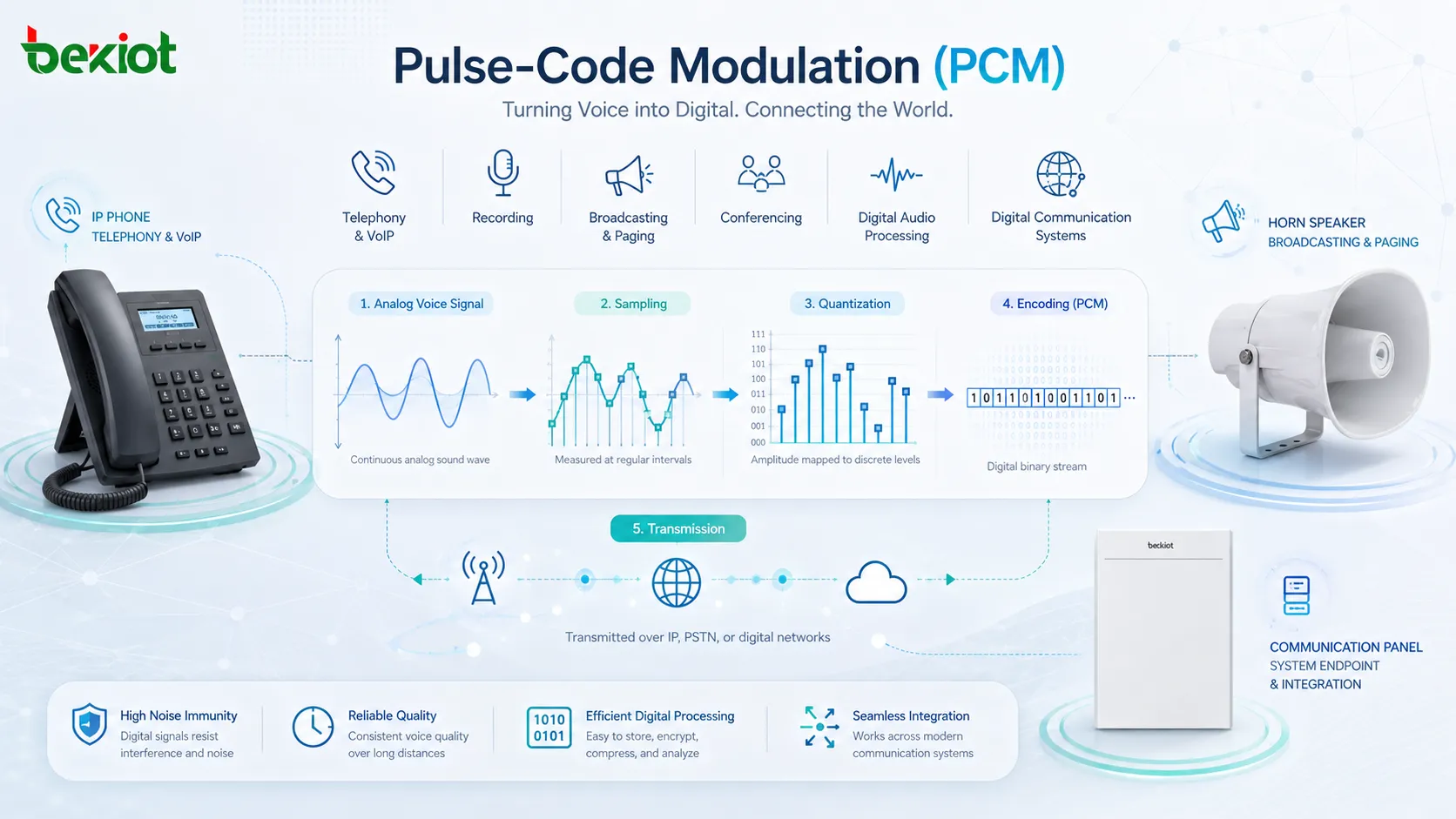
Where PCM Is Commonly Used
VoIP and SIP Systems
VoIP systems often use PCM-based codecs when low delay and compatibility are important. G.711, for example, is commonly used in SIP phones, IP PBX systems, gateways, contact centers, and carrier interconnection.
PCM-based voice can sound clear when the network is stable. However, because it is not highly compressed, administrators must plan bandwidth carefully, especially when many simultaneous calls are active.
Audio Recording
PCM is a standard choice for recording because it preserves audio in a direct and editable form. WAV files, for example, often store PCM audio. This makes the format useful for call recording, meetings, interviews, broadcast production, training materials, and quality monitoring.
Recording systems may later convert PCM audio to compressed formats for storage efficiency, but PCM is often preferred during capture or editing because it avoids repeated compression loss.
Broadcasting and Media Production
Broadcast and media production workflows often use PCM because it provides high-quality, predictable audio. Engineers can edit, mix, process, and master PCM audio with precision.
Even when final media is distributed in compressed form, PCM may be used throughout production to maintain quality until the final export stage.
Embedded Audio Devices
Many embedded systems use PCM internally because it is straightforward to process. Devices such as intercoms, alarms, voice terminals, recorders, announcement systems, digital assistants, and communication modules may capture or play PCM audio.
PCM can be useful when the device needs reliable playback, simple processing, or compatibility with other digital audio components.
Speech Recognition and Voice AI
Speech recognition systems often require audio in a PCM format or convert input audio into PCM before analysis. Stable sampling rate, bit depth, and clean audio input help improve recognition performance.
For voice AI, PCM provides a practical input format for feature extraction, acoustic modeling, transcription, and command recognition. However, speech recognition quality still depends on microphone quality, background noise, speaker clarity, and model design.
PCM Compared with Compressed Audio Codecs
PCM is uncompressed or lightly structured compared with many modern audio codecs. This gives it predictable quality and low processing complexity, but it also means larger data size. Compressed codecs reduce bitrate by removing or representing audio more efficiently, but they require more encoding and decoding work.
| Audio Method | Main Advantage | Typical Limitation |
|---|---|---|
| PCM | Direct representation, low delay, high compatibility, easy processing. | Requires more bandwidth and storage than compressed formats. |
| G.711 | PCM-based telephony codec with strong compatibility and low delay. | Higher bitrate than many compressed voice codecs. |
| Opus | Flexible codec for voice, music, low delay, and variable bandwidth. | More complex processing and compatibility planning may be required. |
| MP3 or AAC | Efficient storage and delivery for music and media content. | Not ideal for all real-time communication or repeated editing workflows. |
In practice, many systems use both approaches. PCM may be used for capture, internal processing, and editing, while compressed codecs may be used for storage, streaming, or bandwidth-limited transmission.
Practical Advantages in Communication Systems
PCM is especially valuable where low latency matters. Because PCM does not require heavy compression algorithms, it can reduce processing delay. This is helpful in real-time voice communication, intercom systems, dispatch audio, conferencing, and gateway conversion.
Another advantage is troubleshooting clarity. When audio is represented in a direct PCM form, engineers can inspect waveforms, measure levels, detect clipping, analyze noise, and process the signal more easily. This makes PCM useful in diagnostics and quality assurance.
Compatibility is also important. PCM-based audio can pass through many tools and systems without needing special decoders. This reduces integration problems when audio must be recorded, stored, monitored, converted, or analyzed by different platforms.
Design Considerations Before Using PCM
Bandwidth Planning
PCM can consume more bandwidth than compressed audio. In a small system, this may not matter. In a large VoIP deployment, contact center, or multi-site communication network, the total bandwidth requirement can become significant.
Administrators should calculate expected concurrent sessions, sampling rate, bit depth, channel count, packet overhead, and network conditions before selecting PCM-based transmission for large-scale use.
Storage Requirements
PCM audio files are larger than compressed files. For recording systems, this affects storage cost, retention planning, backup strategy, and archive performance.
Some systems record in PCM for quality and then convert to a compressed format for long-term storage. This can balance quality and storage efficiency.
Audio Quality Target
Not every application needs high sampling rates or high bit depth. A voice paging system, a telephone call, a music production studio, and a speech recognition engine have different requirements.
The selected PCM settings should match the real purpose of the audio. Higher specifications are not always better if they create unnecessary bandwidth or storage burden.
Interoperability
PCM compatibility is broad, but details still matter. A system using 8 kHz μ-law PCM may not directly match another system expecting 16 kHz linear PCM. File containers, byte order, sample format, and channel structure may also affect interoperability.
Clear format definitions help avoid playback errors, distorted audio, speed changes, or failed integration.
PCM is simple in concept, but implementation details such as sampling rate, bit depth, companding law, and channel format determine whether systems can work together correctly.
Maintenance and Troubleshooting Tips
When PCM audio sounds poor, the issue is not always the PCM format itself. Technicians should check microphone level, analog-to-digital conversion quality, clipping, noise floor, clock stability, sampling rate mismatch, network packet loss, playback device quality, and gain settings.
If audio plays too fast or too slow, the sampling rate may be interpreted incorrectly. If the audio sounds distorted, the system may be using the wrong sample format, byte order, companding law, or bit depth. If the audio is noisy, the analog input stage or quantization settings may need review.
For VoIP systems, PCM-based codecs may perform well on a stable network but suffer when packet loss or jitter occurs. Since PCM does not use advanced compression recovery by itself, network quality and jitter buffer configuration remain important.
When PCM Is the Right Choice
PCM is a strong choice when the system needs low delay, high compatibility, predictable audio quality, simple processing, or accurate editing. It is commonly selected for internal audio processing, professional recording, telephony compatibility, speech analysis, and systems where audio should remain as close as possible to the sampled source.
It may not be the best choice when bandwidth or storage is extremely limited. In those cases, compressed codecs may provide better efficiency. The decision should be based on the balance between quality, delay, processing complexity, bandwidth, storage, and interoperability.
FAQ
Is PCM a codec?
PCM is often described as an audio encoding method rather than a compression codec. It represents audio samples directly as digital values. Some telephony codecs, such as G.711, are based on PCM principles.
Is PCM better than MP3?
PCM and MP3 serve different purposes. PCM provides direct, uncompressed audio that is good for editing, recording, and processing. MP3 reduces file size through compression and is better for storage or distribution where smaller files are needed.
Why is PCM used in telephony?
PCM is used in telephony because it provides predictable voice quality, low delay, and reliable digital representation. Traditional digital telephony and G.711 VoIP codecs are closely connected to PCM-based voice encoding.
Does higher PCM sampling rate always mean better audio?
Not always. A higher sampling rate can capture a wider frequency range, but the benefit depends on the source, microphone, playback system, and application. For ordinary speech, extremely high sampling rates may add data size without meaningful improvement.
What causes PCM audio distortion?
Common causes include clipping, wrong bit depth interpretation, sampling rate mismatch, incorrect byte order, wrong companding law, poor analog input quality, excessive gain, or playback device problems.







