


Primary Rate Interface (PRI) is a digital telecommunications service based on ISDN that provides multiple voice channels and one dedicated signaling channel on a single circuit. It was widely adopted by enterprises, contact centers, hotels, government organizations, and large institutions that needed more capacity and better call control than traditional analog trunk lines could provide.
In practical terms, PRI allows a PBX or voice gateway to connect to a carrier network through a structured digital trunk. Instead of using many separate analog lines, an organization can use one PRI link to carry multiple simultaneous calls while relying on a dedicated channel for call setup, teardown, and supplementary signaling. This improves scalability, simplifies trunk management, and supports more professional enterprise telephony services.
Although SIP trunks and IP-based communications are now more common in new deployments, PRI remains an important topic in enterprise telephony. Many businesses still operate PRI-based systems, maintain PRI as part of a hybrid voice architecture, or use PRI gateways during migration from legacy PBX infrastructure to IP communications.

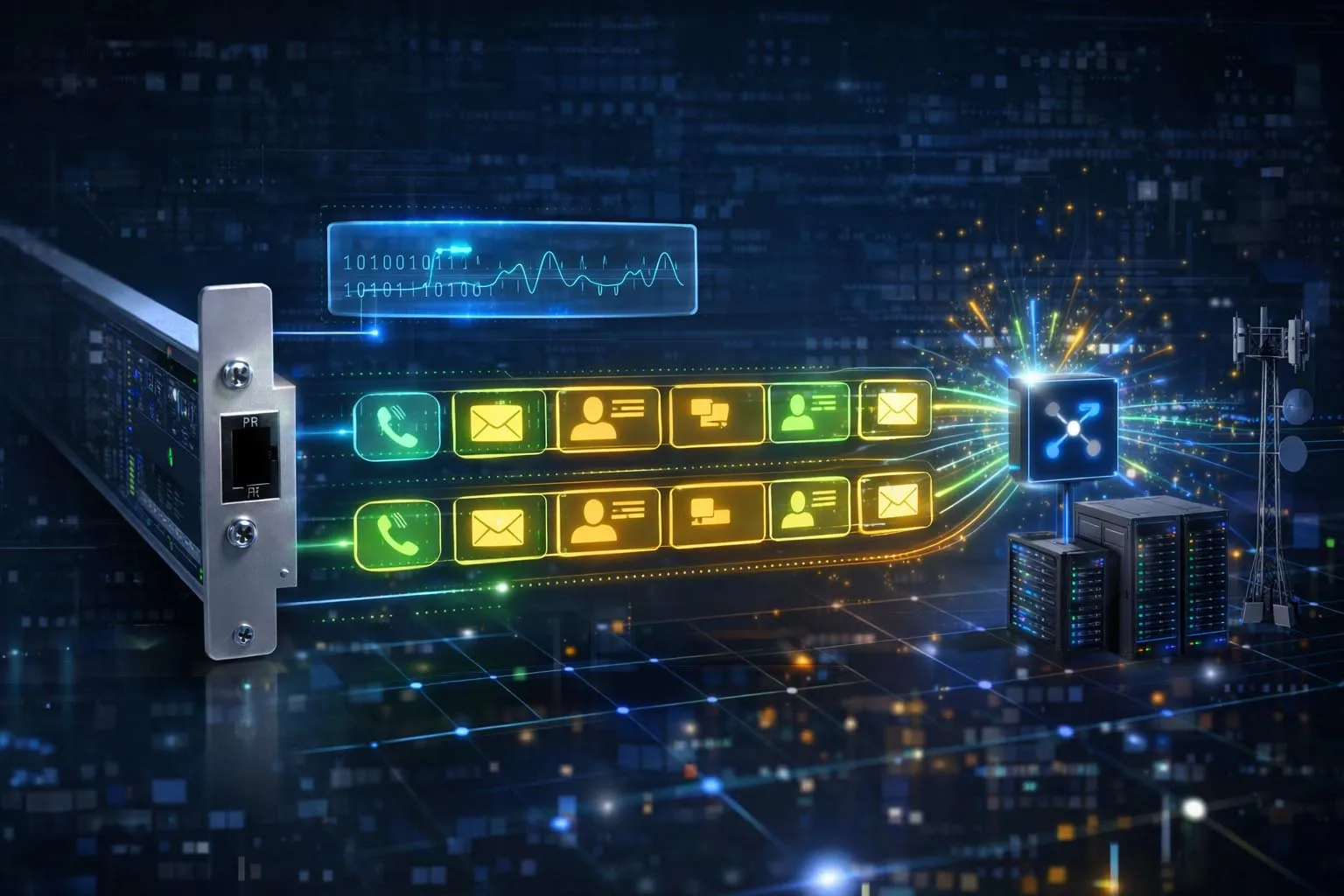
Primary Rate Interface consolidates multiple simultaneous calls and signaling into a structured digital trunk between enterprise equipment and the carrier network.
What Primary Rate Interface Means in Telephony
A Digital ISDN Trunk for Enterprise Voice
Primary Rate Interface is the higher-capacity form of ISDN access used mainly by business and institutional telephony systems. It is designed for environments that need a larger number of concurrent calls than Basic Rate Interface can provide. In most business deployments, PRI is connected to a PBX, key system, media gateway, or integrated access device rather than to a single user endpoint.
The core idea behind PRI is structured channelization. The bearer channels carry user traffic, usually voice calls, while the data channel handles signaling and control information. This separation gives the system more reliable call setup and more advanced telephony behavior than a collection of independent analog lines.
For many organizations, PRI represented a major step forward in enterprise communications because it combined capacity, predictability, and feature support in one carrier-grade interface. It became a standard way to bring business telephony into office buildings, campuses, hospitals, and distributed operations before SIP trunking became dominant.
PRI vs BRI and Other Trunk Types
PRI is often contrasted with Basic Rate Interface (BRI). BRI is intended for small-scale access and typically provides two bearer channels plus one signaling channel. PRI is the business-scale version, offering many more bearer channels and a higher-capacity physical interface suitable for PBXs and enterprise call volumes.
PRI is also different from analog trunks. With analog trunks, each line generally supports one call and relies on analog signaling behavior that is more limited and less efficient for scale. PRI centralizes many call paths into one digital facility, making expansion and management easier for organizations with growing traffic requirements.
Compared with modern SIP trunks, PRI is more tightly bound to traditional telecom circuits, T1 or E1 framing, and time-division voice architecture. SIP trunks are more flexible in IP networks, but PRI remains relevant wherever legacy PBXs, carrier handoff standards, or transitional voice architectures still play an operational role.
PRI is best understood as a structured digital business trunk: multiple bearer channels for calls, one signaling channel for control, and a standardized way to connect enterprise telephony systems to the public network.
Channel Structure and Core Features of PRI
B Channels and D Channel
The most recognizable feature of PRI is its channel layout. The B channels carry the user traffic, usually voice but sometimes data depending on the environment. The D channel is reserved for signaling, which includes call establishment, call clearing, status exchange, and supplementary service information.
This separation makes PRI efficient and orderly. Instead of using the same line path for both audio and control tones as older analog systems often do, PRI keeps call media and call control logically separated. The result is more consistent trunk behavior and support for richer enterprise calling features.
From an operations perspective, the dedicated signaling channel is one of the main reasons PRI became so important in business telephony. It enables a PBX to manage many calls on one trunk group while preserving accurate call state information and a more advanced service model.
T1 PRI and E1 PRI Formats
PRI is commonly delivered in two regional formats. In North America and some related markets, PRI is often associated with T1 framing and is commonly described as 23B + 1D, meaning 23 bearer channels and 1 signaling channel. In many other regions, PRI is based on E1 framing and is commonly described as 30B + 1D, with an additional channel used for framing and synchronization at the physical layer.
This difference is important in system selection and carrier interconnection. A PBX, gateway, or trunk interface module must match the PRI standard used by the carrier and the region. Organizations working across multiple countries or upgrading international sites often need to account for this T1/E1 difference during planning.
Even though both variants are called PRI, they are not physically identical. The channel counts, framing conventions, and associated telecom environments differ. Good deployment planning therefore starts with the local carrier handoff standard rather than assuming every PRI interface is the same.
Predictable Capacity and Call Handling
PRI gives organizations a defined number of simultaneous call channels. That predictability was a major advantage for enterprise operations. A business could size its trunk group around expected inbound and outbound traffic, then add additional PRI circuits as call demand increased.
This made PRI especially suitable for reception teams, call centers, branch offices, service desks, and institutions with regular business-hour peaks. Capacity planning was easier than with a patchwork of analog lines, and the digital nature of the service improved consistency in call setup and routing behavior.
Many PBX platforms also used PRI to implement DID, hunt group routing, operator services, and centralized external line access. As a result, PRI was not just about transport capacity. It also supported cleaner and more professional enterprise call distribution.
PRI channel structures vary by region, with T1-based and E1-based implementations supporting different bearer capacities.
Network Architecture of Primary Rate Interface
Carrier Network to Customer Premises
A typical PRI deployment begins at the carrier side, where the service provider delivers a digital trunk to the customer premises. That handoff may arrive through a smart jack, network termination device, CSU/DSU function, integrated access unit, or managed carrier demarcation equipment, depending on the region and service model.
From there, the PRI circuit is connected to enterprise voice equipment such as a PBX, digital voice gateway, or unified communications platform with a PRI interface card. The enterprise system then uses the trunk to place outbound calls to the public network and receive inbound calls from external users.
At the architectural level, PRI sits between the internal voice domain and the carrier switching environment. It acts as the structured trunk boundary where enterprise call control meets public telecom signaling and numbering services.
PBX-Centric Architecture
In the classic enterprise model, the PBX is the central control point. Extensions, operator consoles, voicemail systems, and contact center functions remain inside the organization, while the PRI trunk provides access to outside numbers and incoming DID ranges. The PBX decides how calls are distributed internally, and PRI provides the digital path to the carrier.
This architecture became common because it reduced the need for individual external lines at each desk. Instead, users shared a centralized trunk resource pool. That lowered complexity, improved management, and allowed enterprises to build a structured numbering plan across departments, floors, or sites.
In larger environments, multiple PRI circuits could be grouped for resilience and scale. If a business needed more concurrent call capacity, additional PRI trunks could be added to the trunk group. This modular model made PRI practical for organizations with steady growth or seasonal traffic variation.
Gateway and Hybrid Voice Architecture
PRI is also common in hybrid environments where legacy telephony and IP telephony must coexist. In this model, a voice gateway bridges PRI-based carrier access or PBX connectivity with SIP, IP PBX, or unified communications platforms. The gateway handles media conversion, signaling interworking, and route mapping between the traditional and IP domains.
This architecture remains important in migrations. Many businesses move to SIP phones, softphones, or UC platforms but still keep an existing PRI service during transition. A gateway allows the enterprise to preserve carrier connectivity and numbering continuity while modernizing the internal voice environment step by step.
Hybrid PRI architecture is also useful in locations where SIP trunks are not yet preferred, where a legacy PBX remains business-critical, or where phased migration is safer than full cutover. In such cases, PRI becomes part of a broader interoperability strategy rather than an isolated legacy link.
Even in modern deployments, PRI often survives not as the final target architecture, but as a stable interconnect layer during migration, backup planning, or legacy system integration.
Key Features of Primary Rate Interface
Multiple Simultaneous Calls on One Circuit
The primary operational benefit of PRI is call aggregation. A single PRI facility supports many concurrent calls, which is far more efficient than maintaining the same capacity through separate analog trunks. This is one of the reasons PRI was widely adopted by medium and large enterprises.
With channel-based capacity, administrators can plan external call resources more systematically. They can align trunk counts with expected call volumes, department needs, and peak traffic periods. This gives the organization a more controlled and scalable approach to public network access.
Dedicated Signaling for Better Call Control
The D channel supports more robust signaling than analog line methods and allows the PBX or gateway to manage call states cleanly. This improves interoperability with enterprise telephony features such as direct inward dialing, call transfer behavior, hunt groups, attendant services, and some supplementary features offered by the carrier.
Better signaling also helps during troubleshooting and provisioning. The carrier and enterprise team can analyze call setup status, channel behavior, and service configuration more precisely than they usually can with simple analog trunks.
Enterprise Numbering and DID Support
PRI is commonly used with Direct Inward Dialing (DID), which allows outside callers to reach specific internal extensions without going through a manual operator. This was highly valuable for corporate offices, departments, medical facilities, universities, and government institutions that needed a professional external numbering structure.
When DID is paired with PRI, the PBX can receive a block of public numbers and route calls internally according to the enterprise dial plan. That gives users the appearance of individual public reachability while keeping the switching intelligence centralized inside the PBX.
Reliable Fit for Time-Division Voice Systems
PRI aligns naturally with traditional TDM PBXs and carrier switching systems. For organizations operating long-lived digital telephony environments, PRI offered a clean, standards-based way to connect internal call platforms to carrier services without the complexity of VoIP conversion.
This made PRI especially appealing in sectors where stability, predictable behavior, and long equipment life cycles were valued. Many organizations kept PRI in service for years because it delivered dependable trunking for mature voice infrastructures.

PRI supports PBX trunking, DID services, and hybrid architectures where legacy voice systems connect to modern IP platforms through gateways.
Common Applications of PRI
Enterprise PBX Trunking
One of the most common PRI applications is connecting a business PBX to the public telephone network. This allows all desk phones, departmental extensions, operator positions, and internal telephony functions to share a centralized digital trunk resource for external calling.
This model was widely used in corporate headquarters, hotels, hospitals, factories, office towers, and public institutions. It remains relevant anywhere legacy PBX equipment is still in active service or where organizations prefer proven digital trunking for existing telephony operations.
Call Centers and High-Volume Voice Environments
PRI has historically been a strong fit for contact centers and other high-call-volume operations. Because it provides a defined pool of simultaneous channels, it works well for environments with predictable external calling demand, including customer service, reservations, dispatch, and administrative coordination.
In these settings, PRI supports inbound and outbound traffic concentration while allowing the PBX or contact center platform to manage queue routing, agent access, and published business numbers in an organized way.
Branch Connectivity and Multi-Site Telephony
In multi-site organizations, PRI may be used at headquarters, regional offices, or branch locations depending on traffic needs. Some enterprises deploy PRI centrally and route branch traffic through the main PBX, while others use local PRI circuits at larger sites for regional breakout and numbering independence.
This flexibility made PRI suitable for distributed enterprises before SIP WAN architectures became widespread. Even today, some multi-site organizations continue to use PRI in legacy or mixed-network environments where equipment life cycle, carrier availability, or migration timing shapes the design.
Legacy-to-IP Migration Projects
Another important application is migration. When an organization wants to move from a legacy PBX to IP telephony, PRI often remains in the architecture during the transition period. A PRI-to-SIP gateway can preserve carrier connectivity while allowing new IP endpoints, IP PBXs, or UC platforms to come online gradually.
This reduces migration risk. The business can maintain existing numbers, carrier services, and established call flows while modernizing the internal communications platform in stages rather than through a disruptive full replacement.
PRI vs SIP Trunk: Practical Comparison
Why PRI Was the Standard for So Long
PRI became a long-term enterprise standard because it matched the needs of the era: structured digital trunking, clear capacity planning, strong PBX compatibility, and carrier-grade voice delivery. For organizations using TDM voice systems, it offered a mature and highly interoperable interface.
Its operational model was easy to understand. Each trunk had a defined number of channels, and the enterprise sized those channels according to call demand. That simplicity contributed to PRI’s long presence in business telephony.
Why Many Networks Now Prefer SIP
SIP trunks are more flexible in IP networks and often integrate more naturally with modern UC, cloud PBX, and distributed enterprise architectures. They can be easier to scale, easier to centralize across sites, and better aligned with all-IP transformation strategies.
However, that does not make PRI irrelevant. Many businesses still depend on PRI because of carrier availability, existing PBX investment, regulatory conditions, or the need for stable transition planning. In such cases, PRI remains operationally valuable even if SIP is the long-term direction.
Deployment Considerations for PRI
Interface Compatibility and Regional Standards
Before deploying PRI, the organization must confirm whether the carrier handoff is T1-based or E1-based and ensure the PBX or gateway supports the required framing, clocking, signaling, and line interface standards. A mismatch here can prevent service activation even if the overall architecture is correct.
It is also important to verify local numbering plans, DID allocation, caller ID behavior, and supplementary services. PRI is standardized, but real deployment details still vary by region, carrier, and legacy telecom environment.
Capacity Planning and Resilience
Since PRI provides a fixed number of bearer channels per circuit, administrators should size trunks based on busy-hour traffic rather than average daily use. Organizations with critical inbound services or significant outbound peaks often deploy multiple PRI circuits for both scale and redundancy.
Good planning also considers failover. If one trunk fails, what happens to inbound DIDs and outbound call capacity? In mature designs, additional PRI circuits, alternate routes, or SIP backup paths are used to reduce service disruption.
Migration Strategy
For organizations moving toward IP communications, PRI should be evaluated not only as a current service but also as part of the migration path. The key question is whether PRI will remain the long-term carrier interface, serve as a transitional trunk, or become a backup connection behind a newer SIP-based core.
That decision influences gateway selection, numbering design, route policy, and investment timing. A thoughtful PRI strategy can reduce disruption and protect service continuity while the broader telephony platform evolves.
FAQ
What is the difference between PRI and ISDN?
ISDN is the broader digital telecom framework, while PRI is one of its access forms designed for larger-capacity business and institutional deployments. In simple terms, PRI is a business-grade ISDN trunk implementation.
How many channels does a PRI line provide?
That depends on the regional format. T1-based PRI is commonly described as 23B + 1D, while E1-based PRI is commonly described as 30B + 1D with an additional framing timeslot in the E1 structure.
Is PRI still used today?
Yes. Although many new systems prefer SIP trunks, PRI is still used in legacy PBX environments, regulated or conservative telecom infrastructures, and migration projects where stable digital trunking is still required.
Can PRI work with an IP PBX?
Yes. An IP PBX can use PRI through a compatible interface module or, more commonly, through a voice gateway that converts between PRI signaling and SIP or other IP-based call control.
What are the main benefits of PRI?
The main benefits include multiple simultaneous call channels on one circuit, dedicated signaling for better call control, strong PBX compatibility, DID support, and a proven fit for enterprise digital voice systems.







