Packet Loss Concealment, often abbreviated as PLC, is an audio recovery technique used in packet-based communication systems to reduce the audible impact of lost or late packets. In real-time voice and audio networks, some packets may never reach the receiver because of congestion, jitter, wireless instability, buffer underflow, or other transport problems. When that happens, the receiver still has to continue playback on time. Packet Loss Concealment helps the decoder fill in the missing audio interval so the listener hears a more continuous signal instead of abrupt gaps, clicks, or severe speech breakup.
This function is especially important in VoIP, IP intercom, conferencing, WebRTC, mobile audio, and other low-latency systems where retransmission is often too slow to help live playback. In those environments, the goal is not perfect reconstruction of the original waveform. The real goal is perceptual continuity. A good PLC algorithm tries to make missing audio less noticeable, preserve conversational intelligibility, and prevent short network impairments from turning into a poor user experience.
Understanding Packet Loss Concealment
What Packet Loss Concealment Means
Packet Loss Concealment is a decoder-side method that hides or reduces the effect of missing audio packets during playback. Instead of stopping output when a frame is lost, the receiving side estimates what should have been heard in that time interval and generates substitute audio. Depending on the codec and algorithm, that substitute may be based on previously received speech patterns, waveform repetition, noise shaping, interpolation, model-based synthesis, or a transition toward comfort noise or silence.
In practical communication systems, PLC is not treated as a luxury feature. It is one of the core techniques that allows packet voice to remain usable over imperfect networks. Short, occasional loss events may be almost invisible to the user when PLC is effective. Without it, even light packet loss can create very noticeable breaks in speech, harsh distortions, or sudden audio dropouts.
Why PLC Exists in Real-Time Audio
Real-time communication is fundamentally different from file transfer. In a voice call, the receiver cannot wait too long for missing packets because conversation depends on low end-to-end delay. If a packet arrives too late, it may be as useless as a packet that never arrived at all. That is why packet voice systems need mechanisms that operate immediately at playout time, not only transport-layer recovery methods.
PLC exists to solve exactly that timing problem. It allows playback to continue even when the network is not perfect. Instead of insisting on complete delivery, the receiver makes an informed approximation that protects speech continuity. This is one reason PLC is such an important part of audio robustness in modern IP communications.
From a user perspective, PLC is often invisible when it works well. People may only notice that a call still sounds acceptable even though the network briefly degraded. From a system perspective, however, PLC is doing critical work at the moment when the stream would otherwise fall apart.

Packet Loss Concealment helps the receiver smooth over missing audio packets so speech remains more continuous during real-time communication.
How Packet Loss Concealment Works
Receiver-Side Reconstruction of Missing Audio
When a packet is lost, the decoder usually knows the expected frame timing even though the actual encoded audio data is missing. A PLC-capable decoder then generates replacement audio for that missing interval. In a simple implementation, it may repeat part of the previous waveform with gradual energy adjustment. In more advanced implementations, it may estimate pitch, spectral envelope, voicing, and signal evolution so the replacement sounds more natural, especially for speech.
The exact method depends on the codec design and the signal type. Speech-oriented codecs often use model-based prediction because conversational voice contains patterns that can be estimated for a short duration. Music and mixed-content audio are harder to conceal because the structure may change more rapidly. That is why PLC usually performs best on short loss events and on speech content rather than on long missing segments or complex full-band audio.
What Happens During Consecutive Packet Loss
PLC is typically most effective when losses are isolated or brief. If one packet disappears, the decoder may create a substitute that is nearly unnoticeable. If several packets disappear in sequence, the algorithm has much less reliable context. At that point, the synthetic output may gradually decay, transition toward comfort noise, or become more obviously artificial. In other words, PLC can soften the effect of loss, but it cannot fully cancel the impact of severe or extended impairment.
This limitation is important for system design. PLC should be seen as a resilience tool, not a license to ignore network quality. Good packet networks, proper QoS, codec selection, and jitter management still matter. PLC improves the listening experience when the network misbehaves, but it does not replace the need for a healthy media path.
Packet Loss Concealment does not recover the original packet. It creates a plausible short-term substitute so real-time audio can continue without collapsing into obvious gaps.
Core Features of Packet Loss Concealment
Low-Latency Loss Hiding
One of the most important features of PLC is that it works in real time. Because it runs at the decoder and acts immediately when playout would otherwise be interrupted, it supports low-latency communication better than techniques that depend on waiting for retransmission. This makes it well suited to telephone calls, live intercom sessions, conferencing, and other interactive audio applications.
That low-latency behavior is also why PLC is so valuable in unstable network conditions such as Wi-Fi roaming, mobile access, or congested enterprise paths. Users can continue speaking and listening naturally while the receiver masks short bursts of impairment. Even when the concealment is not perfect, the call often remains more usable than it would without PLC.
Perceptual Smoothing of Speech Interruptions
PLC is designed around perception rather than bit-perfect restoration. The algorithm tries to preserve intelligibility, maintain rhythm, and avoid sharp discontinuities that are distracting to the listener. In speech, that can mean extending pitch cycles, estimating the missing waveform, or fading smoothly instead of inserting hard silence.
This makes PLC especially effective in voice-centric systems. Human listeners can tolerate some approximation if continuity is preserved and the voice still sounds stable enough to understand. A well-implemented PLC function takes advantage of that perceptual reality by prioritizing what the user hears rather than what the missing packet mathematically contained.
Codec-Level Integration
Another important feature is that PLC is often tightly integrated with the codec decoder. Many modern codecs include codec-aware PLC behavior because the decoder already has access to the signal model, frame boundaries, and recent audio history. This improves concealment quality compared with a purely generic method operating outside the codec context.
Codec-level integration also allows different complexity and quality trade-offs. Some implementations focus on low computational cost for embedded devices or IP phones. Others aim for better audio naturalness in software clients, conferencing systems, or premium communication endpoints. The result is that PLC is not one single algorithm, but a family of strategies adapted to different codecs, devices, and operating conditions.
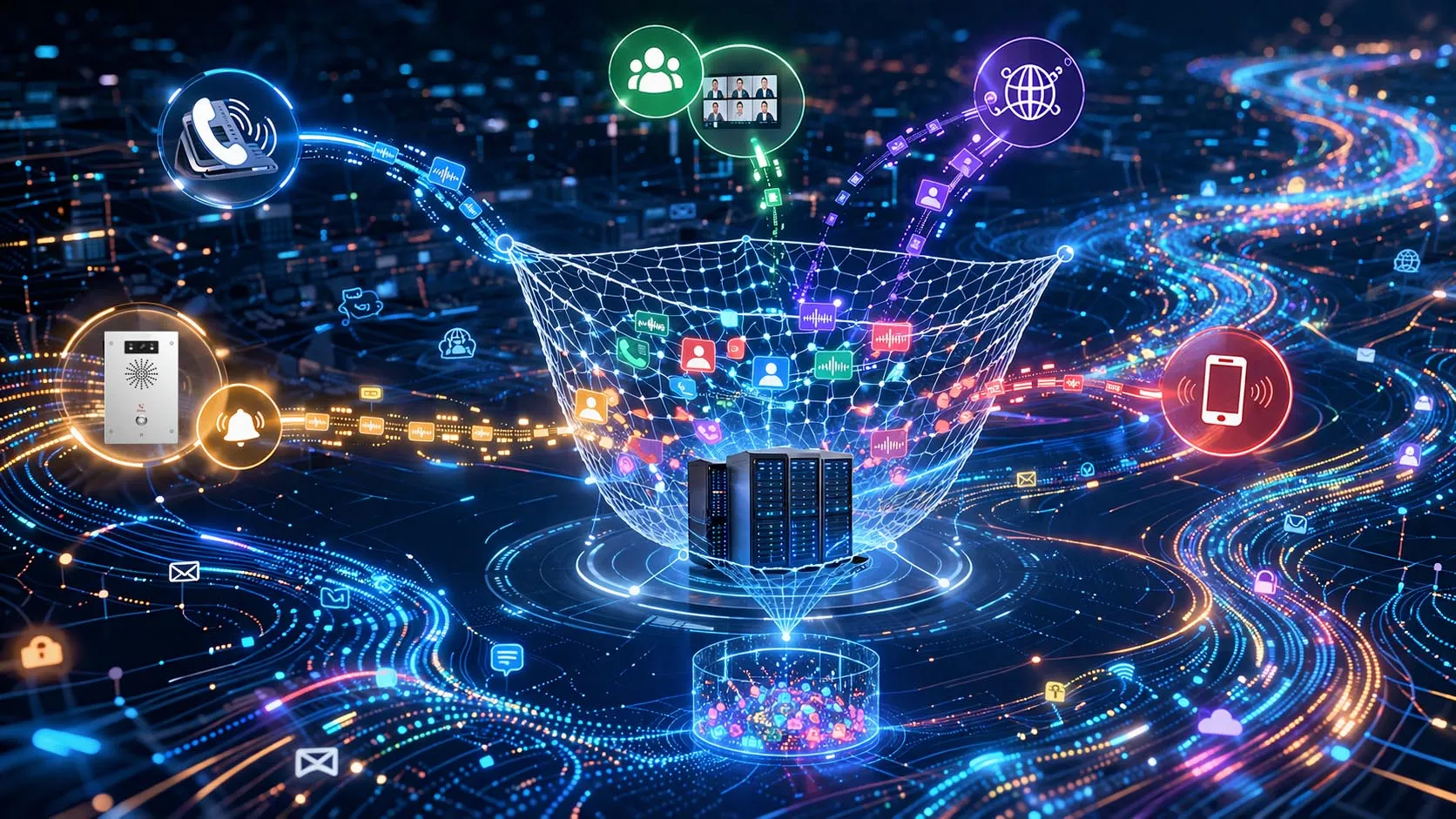
PLC is most valuable when it quickly smooths short loss events and preserves understandable, continuous speech.
System Value of Packet Loss Concealment
Better Audio Continuity in Imperfect Networks
The main system value of PLC is that it improves service resilience under real-world network conditions. Enterprise LANs, WAN links, public internet paths, wireless access, and mobile networks can all experience transient packet loss. Without concealment, those impairments are heard directly as breaks and harsh distortions. With PLC, many of those brief events become softer and less disruptive.
This means user experience improves even when the transport path is not ideal. Calls may remain understandable during short bursts of congestion, brief roaming events, or minor wireless instability. In practice, that can be the difference between a conversation that feels slightly rough and a conversation that feels unreliable.
Improved Service Perception and Operational Tolerance
PLC also improves the perceived quality margin of a communication platform. Systems with effective concealment can tolerate small impairment spikes without immediately generating complaints. This is valuable in distributed organizations, public safety communication paths, branch networks, campus deployments, and industrial sites where the network is shared with other services and cannot always remain perfectly clean.
Operationally, PLC does not eliminate the need for monitoring, but it reduces the user-facing impact of short network problems. That gives support teams a little more tolerance during transient conditions and helps platforms appear more stable from the caller’s perspective. In many environments, this improves confidence in the communication system even before broader network optimization is completed.
The business value of PLC is not that it fixes the network. Its value is that it protects user experience when the network briefly fails to deliver every packet on time.
Packet Loss Concealment Compared with Related Techniques
PLC vs. Jitter Buffer
PLC is often mentioned alongside jitter buffers, but they solve different problems. A jitter buffer absorbs variation in packet arrival time by holding packets briefly before playout. Its job is to smooth timing irregularity. PLC, by contrast, acts when audio data is missing or unusable at playout time. In many systems, both functions work together: the jitter buffer reduces late loss, and PLC masks what still cannot be played.
This distinction matters because people sometimes assume any audio smoothing function is PLC. It is not. Jitter management addresses timing variation; concealment addresses missing content. A strong real-time audio system usually needs both, carefully balanced to avoid excessive delay while still protecting speech quality.
PLC vs. FEC and Retransmission
Forward Error Correction, or FEC, adds redundancy so a receiver can recover from certain packet losses using extra information sent in the stream. Retransmission asks for missing data again, which may work in buffered media delivery but is often too slow for live conversation. PLC is different from both. It does not recover the original packet from redundancy or request it again. Instead, it synthesizes a perceptually acceptable replacement based on locally available context.
In advanced systems, these methods may complement one another. FEC can reduce the number of losses that require concealment, while PLC handles the losses that still occur. Retransmission may help in noninteractive or lightly buffered modes, but live voice often depends more heavily on PLC because timing constraints are strict.
Technical Design Considerations
Signal Type, Codec Choice, and Burst Length
The effectiveness of PLC depends on the type of audio being carried. Speech generally conceals better than music because it has short-term patterns and predictable structure. Narrowband and wideband voice codecs can often make very short losses less noticeable, especially when packets are small and loss events are isolated. Longer bursts are harder because the decoder has less trustworthy recent information from which to estimate the missing signal.
Codec behavior is equally important. Some codecs are known for stronger packet-loss robustness than others, and implementations can vary in both quality and computational cost. Packetization interval also matters. Smaller packets can reduce the audible impact of a single loss event, while larger packets increase efficiency but make each loss event more significant. These trade-offs influence how well PLC performs in practice.
Monitoring Concealment Metrics
From an operational viewpoint, concealment should not be treated as a hidden internal detail only. Many voice platforms expose quality statistics related to loss and concealment because these metrics help explain why users hear degraded audio. A call may not show catastrophic packet loss on paper, yet concealment events may reveal that packets were late, discarded, or effectively lost at the receiver.
These metrics are useful for troubleshooting because they connect transport impairment to user experience. If concealment counts are rising, engineers know the system is actively compensating for media problems. That can lead them to investigate WAN quality, Wi-Fi design, QoS behavior, jitter buffer settings, roaming patterns, or endpoint performance rather than treating the issue as a vague “bad call” complaint.
Applications of Packet Loss Concealment
VoIP Phones and UC Platforms
One of the most common applications of PLC is VoIP telephony. IP phones, softphones, SIP clients, and unified communication platforms all rely on packet-based transport that may experience occasional loss. PLC helps these systems maintain more stable speech quality during minor network impairment, especially in enterprise environments where voice shares infrastructure with data traffic.
This matters not only for desk phone calls, but also for branch office deployments, remote workers, and hybrid work scenarios. Calls often traverse multiple switches, WAN links, VPNs, and internet segments before reaching the far end. PLC provides a valuable last-line defense against the audible effect of short packet loss events anywhere along that path.
Intercom, Paging, and Emergency Communication
PLC is also important in SIP intercom, public address, dispatch, and emergency communication systems. These environments may involve industrial wireless bridges, long-distance IP links, outdoor access points, or mixed-service infrastructure where short impairments can occur. Because intelligibility is critical, concealment helps keep speech understandable when the network is briefly unstable.
In operational environments such as transportation hubs, factories, campuses, hospitals, and public safety facilities, short audio interruptions can affect response speed and user confidence. PLC cannot replace good network engineering, but it helps protect the usability of live voice paths in the moments when network conditions are less than ideal.
Conferencing, WebRTC, and Mobile Audio
Modern conferencing and browser-based media systems also rely heavily on packet-loss resilience. Meetings conducted across the public internet, mobile access links, or changing Wi-Fi conditions frequently experience some amount of packet loss or late arrival. PLC helps remote participants hear smoother speech and maintain conversational flow even when the underlying path is imperfect.
Mobile audio is another strong use case because radio conditions fluctuate constantly. A well-designed PLC function improves continuity during short transmission gaps, handoffs, and variable channel conditions. This is one reason concealment remains a core component of practical real-time audio design across both fixed and mobile communication products.
Wherever live voice must continue through imperfect IP transport, PLC adds resilience by making short impairments less audible and less disruptive to conversation.
Best Practices for Using PLC Effectively
Do Not Rely on PLC Alone
Although PLC is highly valuable, it should never be treated as a substitute for proper network design. Excessive packet loss, poor QoS, overloaded wireless channels, and mismanaged buffers will still damage audio quality. PLC is strongest when it handles occasional or short impairments, not when it is asked to hide persistent transport failure.
That is why organizations should pair PLC-capable endpoints and codecs with solid QoS policy, careful Wi-Fi planning, WAN monitoring, and appropriate packetization settings. Good audio quality comes from layered design: healthy transport first, resilience mechanisms second.
Match Codec and Endpoint Strategy to the Environment
Different deployments have different needs. A desk phone on a stable LAN may prioritize simplicity and low computational overhead. A mobile soft client or browser-based meeting platform may need more advanced robustness strategies because its network conditions vary more sharply. Choosing endpoints, codecs, and media settings with realistic network conditions in mind can improve how much value PLC actually delivers.
It is also useful to monitor user complaints together with call-quality metrics. If concealment events are frequent, that is a sign the system is depending heavily on loss masking and may benefit from broader network improvement. In other words, PLC should be appreciated both as an audio-quality feature and as a signal that transport quality still matters.
Conclusion
Why Packet Loss Concealment Matters
Packet Loss Concealment is a key audio resilience technique used in VoIP and real-time media systems to reduce the audible impact of missing packets. By synthesizing short substitute audio at the receiver, it helps preserve continuity, maintain intelligibility, and soften the user-facing effect of brief network impairment. It is especially valuable in interactive communication where waiting for retransmission would add too much delay.
Its importance comes from practical reality. Real networks are imperfect, and live conversations cannot pause every time a packet goes missing. PLC helps communication systems remain usable, professional, and more tolerant under everyday conditions. When combined with good codec design, jitter management, QoS, and monitoring, it becomes an essential part of stable voice and audio delivery.
FAQ
Is Packet Loss Concealment the same as error correction?
No. Packet Loss Concealment does not recover the original packet through added redundancy in the way Forward Error Correction does. Instead, it creates a replacement audio segment locally at the receiver based on the recent signal and codec context.
That is why PLC is best understood as a perceptual recovery technique rather than a data recovery technique. It aims to keep the audio sounding continuous even when the original media data is unavailable.
Does PLC eliminate the need for a good network?
No. PLC improves tolerance to short or occasional loss, but it cannot fully hide severe or persistent packet loss. If the network path is unstable for long periods, users will still hear distortion, robotic speech, fading, or dropouts.
Good QoS, healthy Wi-Fi design, controlled latency, and appropriate jitter buffering are still essential. PLC works best as part of a broader voice-quality strategy rather than as the only protection mechanism.
Where is Packet Loss Concealment commonly used?
PLC is commonly used in VoIP phones, softphones, SIP intercoms, conferencing systems, WebRTC platforms, mobile audio clients, and many other packet-based real-time communication products. It is especially useful wherever low delay matters and occasional packet loss is unavoidable.
Typical environments include enterprise communications, remote work calling, campus voice systems, industrial IP communication, public address and intercom systems, and cloud-based collaboration platforms.
Why do concealment metrics matter in call monitoring?
Concealment metrics matter because they show how often the receiver had to compensate for missing, late, or unusable audio frames. These measurements help engineers understand not only that packet impairment occurred, but also that the listener’s experience was affected enough to require masking.
In practice, this makes concealment statistics useful for diagnosing wireless issues, QoS problems, WAN instability, and endpoint timing behavior. They connect technical transport behavior to what users actually hear on calls.