


Modern call center and unified communication systems are no longer built with a single gateway, proxy, or media server. A complete platform usually includes web portals, APIs, SIP signaling, WebRTC access, media processing, security control, load balancing, monitoring, and cloud-native deployment. In this architecture, Kamailio and Nginx are often mentioned together, but they are not direct competitors.
The better way to understand them is to see them as two infrastructure layers working at different protocol boundaries. Kamailio protects and routes SIP and WebRTC signaling, while Nginx manages web traffic, HTTPS access, API gateway functions, and application-layer delivery. When designed together, they form a stronger communication architecture for high-concurrency call centers, enterprise voice platforms, and Web + VoIP + video systems.
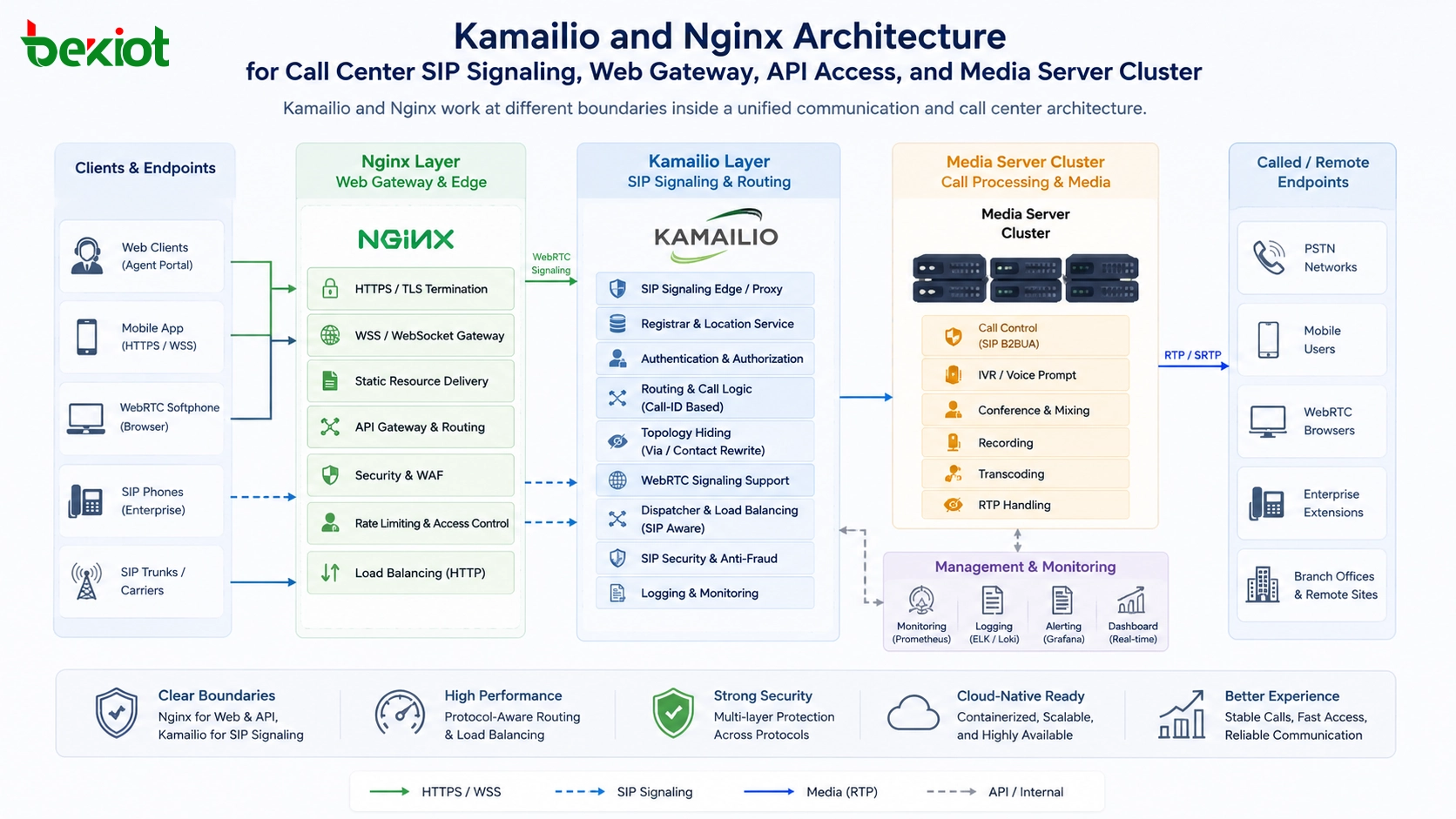
Different Boundaries in the Same Communication Platform
Kamailio is designed for communication protocol boundaries. It understands SIP signaling, SIP transactions, Call-ID continuity, registration behavior, topology hiding, and IMS-related access functions. In IMS environments, it can act as a P-CSCF role where user equipment communicates with the core network through a controlled signaling entry point.
This means Kamailio can perform protocol-aware decisions that ordinary web gateways cannot handle. It can parse SIP messages according to protocol rules, reject malformed signaling, rewrite Via and Contact headers to hide internal topology, and route all signaling belonging to the same call through a consistent path.
Nginx works at a different boundary. It is mainly responsible for HTTP, HTTPS, WebSocket, gRPC, QUIC, reverse proxy, static resource delivery, API gateway logic, edge authentication, traffic limiting, and application routing. In Kubernetes environments, it is commonly used as an Ingress Controller to define north-south traffic entry for microservices and service mesh deployments.
The key architectural point is simple: Kamailio defines a rigid protocol boundary based on SIP, IMS, and telecom signaling standards, while Nginx defines a flexible application traffic boundary based on business rules and programmable policies.
Solution Positioning for Call Center Platforms
For a call center or unified communication platform, Kamailio and Nginx should be planned as complementary infrastructure rather than interchangeable components. Nginx protects and distributes web traffic, while Kamailio protects and distributes communication signaling.
A typical platform may use Nginx as the HTTPS and WSS gateway for web portals, agent workstations, API requests, and WebRTC browser access. The same system can use Kamailio as the SIP boundary gateway for softphones, SIP trunks, WebRTC signaling, registration, routing, and signaling load balancing toward media servers such as FreeSWITCH clusters.
This division makes the architecture cleaner. Web access, authentication, static content, and API requests stay on the Nginx side. SIP registration, call setup, transaction routing, NAT traversal assistance, and media-server dispatch stay on the Kamailio side.
Protocol-Aware Design Versus Flexible Traffic Pipelines
Kamailio follows a protocol-driven module model. Its modules are organized around communication layers such as transport handling, transaction management, authentication, user location, dispatcher routing, IMS functions, WebSocket support, and media proxy integration. In a complete SIP platform, modules such as transaction management, authentication, user location, dispatcher, WebSocket, and RTP engine integration often work together.
The original technical logic highlights that Kamailio has more than 200 modules, and a large part of them focus on communication scenarios such as SIP routing, IMS, WebRTC, media proxying, NAT traversal, registration, and telecom security. This makes it suitable for building communication network elements rather than general web traffic gateways.
Nginx follows an event-driven request pipeline. Its modules are inserted into processing stages such as rewrite, access, content, header filtering, body filtering, and logging. This makes Nginx very suitable for building flexible HTTP and API traffic workflows. It can combine native modules, Lua logic through OpenResty, security modules, media modules, and third-party extensions.
The difference is not about which one is stronger. Kamailio modules are protocol function blocks for communication systems. Nginx modules are processing-stage plugins for web and application traffic pipelines.
Security Architecture Across Web and SIP Layers
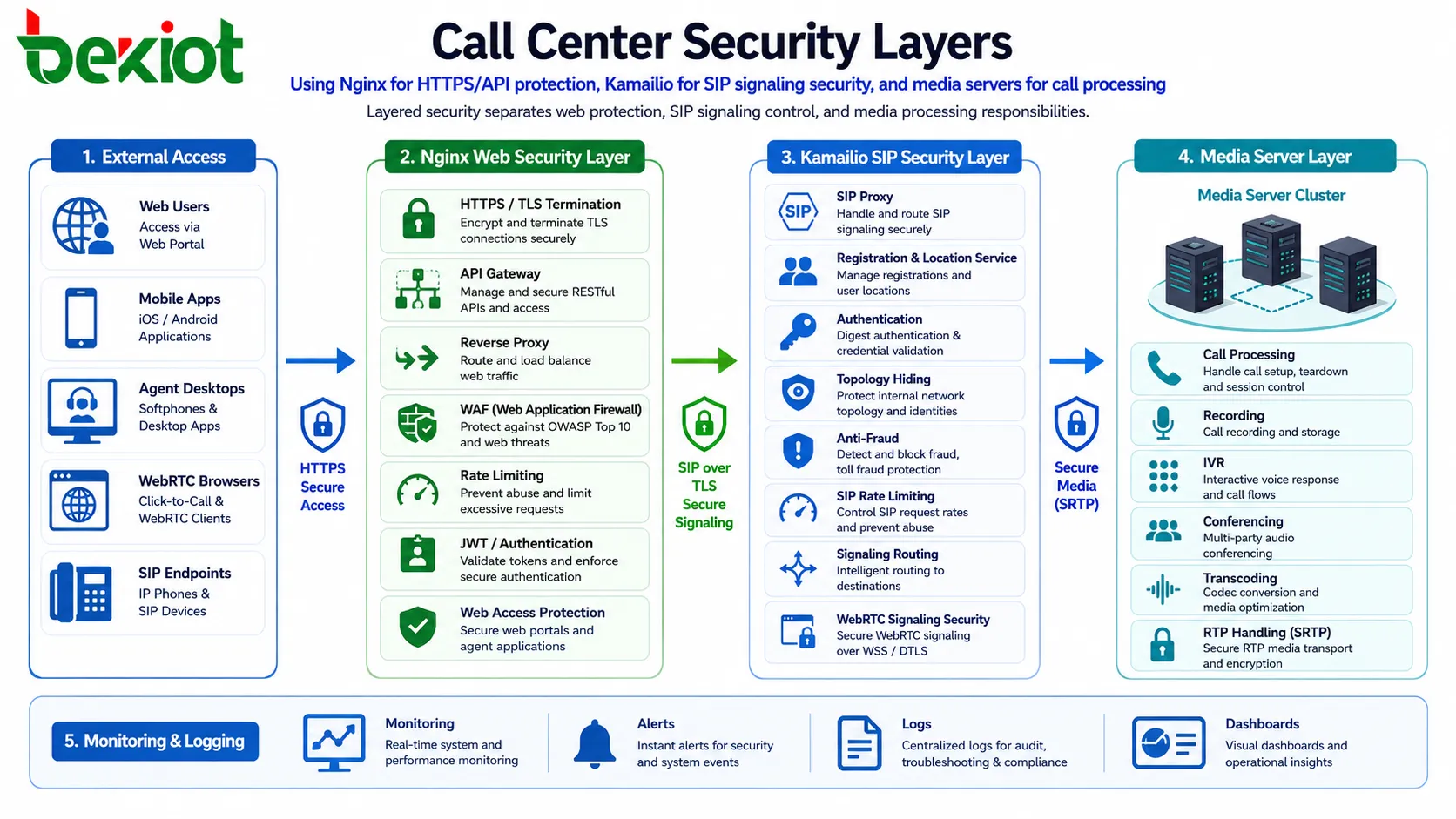
Security should not be handled at only one entry point. A communication platform normally needs layered protection across web access, SIP signaling, media processing, authentication, topology exposure, and operational auditing.
On the SIP side, Kamailio can support SIPS, TLS for SIP, IPSec tunnel scenarios, SIP rate limiting, authentication modules, topology hiding, Via and Contact header rewriting, abnormal INVITE detection, and structured logging. These capabilities help defend against SIP flooding, registration abuse, malformed signaling, call fraud, and internal network exposure.
On the web side, Nginx can support TLS 1.3, OCSP Stapling, HSTS, ModSecurity WAF, request limiting, JWT verification, OAuth2 proxying, IP-based policy control, non-root operation, and hardened configuration templates. This helps defend against web attacks, API abuse, SQL injection, XSS, credential misuse, and weak edge access control.
In a stronger call center architecture, Nginx filters malicious HTTP and API traffic before it reaches web services, Kamailio cleans and controls SIP signaling before it reaches the media layer, and the media server focuses on call processing, recording, transcoding, and RTP handling. This creates cross-protocol defense instead of relying on a single security device.
Load Distribution for Calls and Web Requests
Load balancing is one of the most important differences between Kamailio and Nginx. Nginx is excellent at distributing HTTP requests and TCP connections. Kamailio is built to distribute SIP transactions while preserving call continuity.
For SIP environments, call continuity is critical. A call is not a single request. It includes INVITE, provisional responses, ACK, re-INVITE, UPDATE, BYE, and other signaling messages. Kamailio can use Call-ID-aware routing so that signaling belonging to the same call is sent to the same media server. This avoids broken call control and reduces the risk of RTP path issues.
Kamailio can also perform SIP-aware health checks. Instead of only checking whether a TCP port is open, it can send SIP OPTIONS and confirm whether the target server returns a valid 200 OK response. It can support dispatcher-based routing, failure retry, timed probing, automatic node removal, automatic recovery, and dynamic weight adjustment through database-driven configuration.
Nginx focuses on general web and application traffic distribution. It supports algorithms and methods such as IP Hash, least connections, cookie-based hashing, passive health checks, backup nodes, keepalive connection reuse, and dynamic upstream management in advanced deployments. The original article notes that keepalive connection reuse can improve QPS by more than 30% in high-concurrency web scenarios by reducing repeated TCP handshakes.
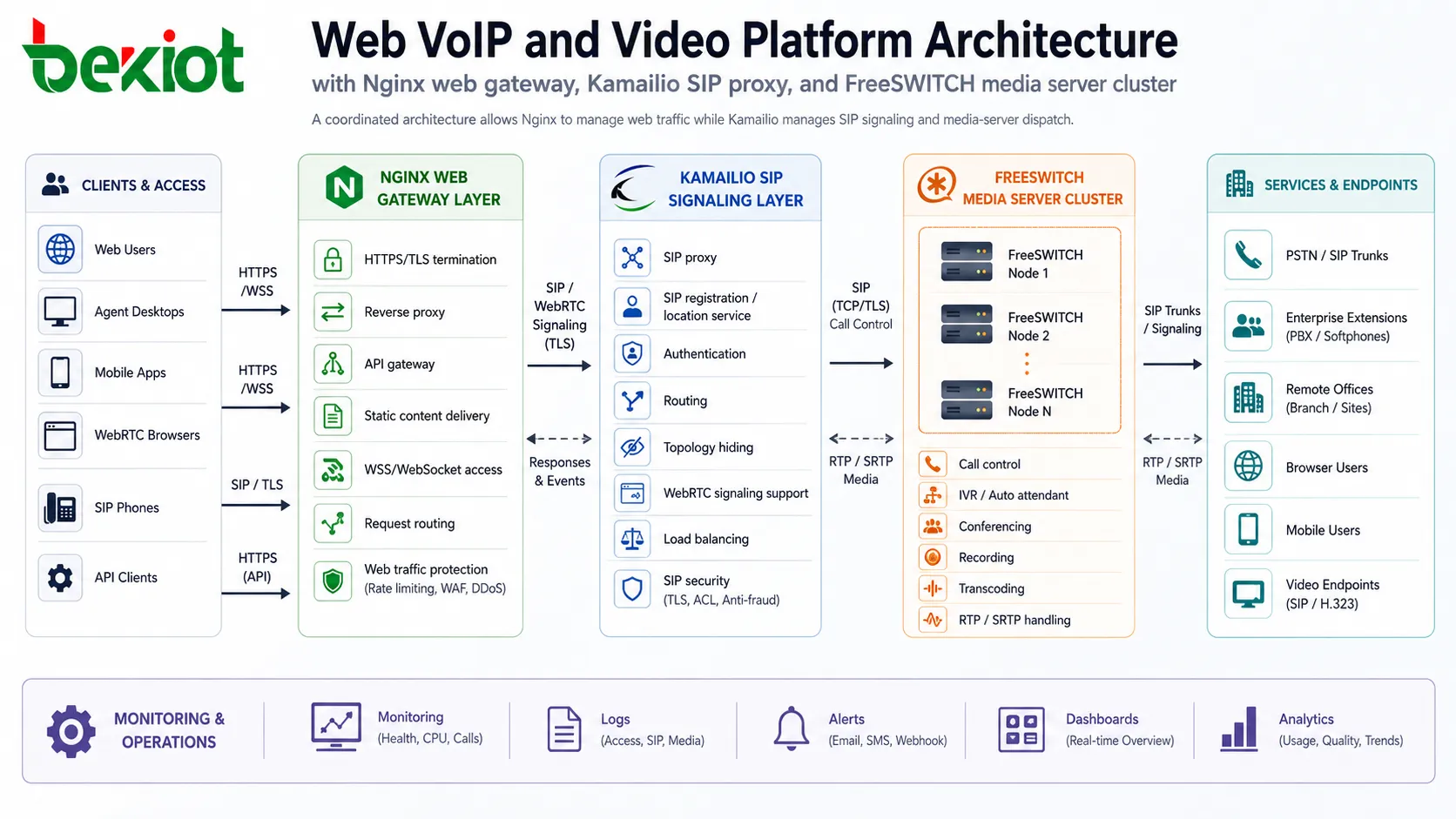
Reference Architecture for Web, VoIP, and Video
A practical enterprise communication platform can use a coordinated architecture where Nginx handles web access and Kamailio handles SIP signaling. This is especially suitable for call center platforms, WebRTC communication systems, cloud PBX platforms, and unified communication solutions.
For browser users, Nginx can receive HTTPS and WSS traffic. Static resources can be served directly by Nginx, API requests can be load balanced to backend microservices, and WebRTC signaling can be proxied to the SIP signaling layer through secure WebSocket access.
For SIP softphones, IP phones, or SIP trunks, Kamailio can act as the SIP edge and routing layer. It can route signaling by Call-ID, dispatch calls to a media server cluster, protect the SIP boundary, hide topology, apply authentication rules, and coordinate with RTP engine components for NAT traversal and media path control.
Cloud-Native Deployment and Edge Evolution
As call center and communication platforms move toward cloud-native infrastructure, Kamailio and Nginx can also evolve beyond traditional standalone deployment. Nginx can operate as an Ingress Controller, API gateway, or edge reverse proxy in Kubernetes environments. Kamailio can be containerized and deployed as a SIP signaling layer for elastic communication services.
In service mesh environments, Nginx and Kamailio can work with sidecar patterns, traffic policy control, observability tools, and automated deployment workflows. Nginx manages web and API ingress, while Kamailio manages SIP and WebRTC signaling flows that require communication-specific routing rules.
At 5G MEC edge nodes, a similar separation can be used. Nginx processes local web requests, API access, and edge application traffic, while Kamailio processes local VoIP calls, SIP signaling, WebRTC access, and communication policy routing. This reduces delay and keeps real-time communication closer to the user.
Recommended Deployment Structure
| Layer | Recommended Component | Main Responsibility |
|---|---|---|
| Web access layer | Nginx | Handles HTTPS, WSS, static resources, reverse proxy, API access, and web traffic distribution |
| SIP signaling layer | Kamailio | Handles SIP registration, routing, Call-ID-aware dispatch, signaling security, and WebRTC signaling |
| Media processing layer | Media server cluster | Handles call media, recording, IVR, conferencing, transcoding, and RTP processing |
| Application service layer | Business microservices | Handles agent desktop, CRM integration, reporting, queue logic, and management APIs |
| Security layer | Nginx and Kamailio combined | Provides web security, SIP protection, authentication, topology hiding, and structured logs |
| Observability layer | Logging and monitoring systems | Collects JSON logs, SIP metrics, HTTP metrics, alerts, and Prometheus-compatible indicators |
Selection Principles for Real Projects
Kamailio should be selected when the project requires deep SIP or WebRTC signaling control. Typical requirements include SIP routing, IMS integration, registration control, Call-ID-based dispatch, anti-fraud protection, topology hiding, and multi-media-server distribution.
Nginx should be selected when the project requires strong web traffic control. Typical requirements include HTTPS termination, API routing, reverse proxy, static resource delivery, WebSocket access, application-layer authentication, WAF protection, and Kubernetes Ingress management.
In most modern call center projects, the correct answer is not Kamailio or Nginx, but Kamailio plus Nginx. Nginx handles the web and application boundary, while Kamailio handles the communication signaling boundary. Each tool should be placed where its protocol model is strongest.
A stable communication platform is not built by forcing one component to do everything. It is built by assigning each boundary to the component that understands that boundary best.
Application Scenarios
This architecture is suitable for cloud call centers, SIP trunk platforms, enterprise communication platforms, WebRTC contact centers, cloud PBX systems, dispatch communication systems, video customer service platforms, and unified communication systems that combine web applications with real-time voice and video.
For high-concurrency call centers, Kamailio can reduce signaling pressure on media servers by acting as the SIP edge and routing layer. Nginx can reduce pressure on business servers by handling static resources, HTTPS termination, reverse proxy, rate limiting, and API distribution.
For WebRTC platforms, Nginx can secure browser access and WSS entry, while Kamailio can route WebRTC signaling into the SIP communication layer. This makes it easier to connect browser users, SIP phones, softphones, media servers, and backend business systems.
Implementation Checklist
Before deployment, the project team should define the traffic boundary clearly. SIP signaling, WebRTC signaling, HTTP API requests, static resources, media traffic, and management traffic should not be mixed into one unclear path.
For Kamailio, planning should include SIP domain rules, registration strategy, dispatcher groups, Call-ID routing, SIP OPTIONS health checks, failure routes, authentication, topology hiding, WebSocket access, NAT traversal, and structured logging.
For Nginx, planning should include HTTPS certificates, WSS gateway rules, API upstreams, request limits, WAF policies, JWT or OAuth2 verification, static resource caching, keepalive settings, log format, and service discovery integration.
For the full platform, planning should also include monitoring, Prometheus metrics, centralized logs, failover testing, gray release policy, cloud-native scaling, and cross-team operation processes between web engineers and telecom engineers.
Operational Benefits
Clearer System Boundaries
Separating the web boundary from the SIP signaling boundary makes the platform easier to design, troubleshoot, secure, and scale. Each layer has a clear responsibility and fewer hidden dependencies.
Higher Reliability Under Load
Kamailio can keep SIP calls on consistent signaling paths, while Nginx can efficiently distribute web requests and reuse backend connections. This improves stability during high-concurrency traffic peaks.
Stronger Cross-Protocol Security
Web attacks and SIP attacks require different defense methods. Combining Nginx and Kamailio allows the platform to apply the right security control at the right protocol layer.
Better Support for WebRTC and Cloud Communication
WebRTC platforms need both browser-side access control and SIP signaling intelligence. Nginx and Kamailio together can support secure WSS access, SIP routing, NAT traversal, and media-server coordination.
More Flexible Cloud-Native Evolution
The architecture can evolve toward Kubernetes, service mesh, API gateway, SIP edge proxy, and edge computing deployment. This helps communication platforms scale without losing protocol-specific control.
FAQ
Can Nginx replace Kamailio in a SIP call center architecture?
Not in a complete SIP signaling architecture. Nginx can proxy TCP or WebSocket traffic, but it does not provide the same SIP transaction awareness, Call-ID routing, registration logic, topology hiding, or SIP-specific failure handling that Kamailio provides.
Can Kamailio serve web pages or APIs like Nginx?
No. Kamailio is not designed as a general web server or API gateway. It should focus on SIP and WebRTC signaling, while web applications, static files, API routing, and HTTPS gateway functions should remain on the Nginx side.
Where should WebRTC signaling enter the system?
A common design is to let browser traffic enter through Nginx over HTTPS or WSS, then forward the signaling path to Kamailio when SIP/WebRTC processing is required. The exact design depends on security policy, certificate management, and routing requirements.
How should logs be unified across Nginx and Kamailio?
Both layers should output structured logs, preferably in JSON format. A shared trace ID, call ID, user ID, or session ID strategy can help engineers correlate web requests, SIP transactions, media events, and application actions during troubleshooting.
What team skills are needed to maintain this architecture?
The platform usually requires cooperation between web infrastructure engineers, SIP engineers, media server engineers, security engineers, and operations teams. Clear ownership is important because Nginx and Kamailio solve different technical problems.







