


Precision Time Protocol, commonly known as PTP, is a network time synchronization technology designed to align clocks across devices with very high accuracy. It is widely used in systems where ordinary time synchronization is not precise enough, such as telecom networks, power substations, industrial automation, financial trading, broadcasting, test laboratories, data centers, and real-time control environments.
Unlike basic clock setting methods that only keep devices roughly aligned, PTP is built for environments where microseconds, nanoseconds, or tightly controlled timing relationships may matter. It helps different devices agree on the same time reference, reducing timing drift and improving coordination between distributed systems.
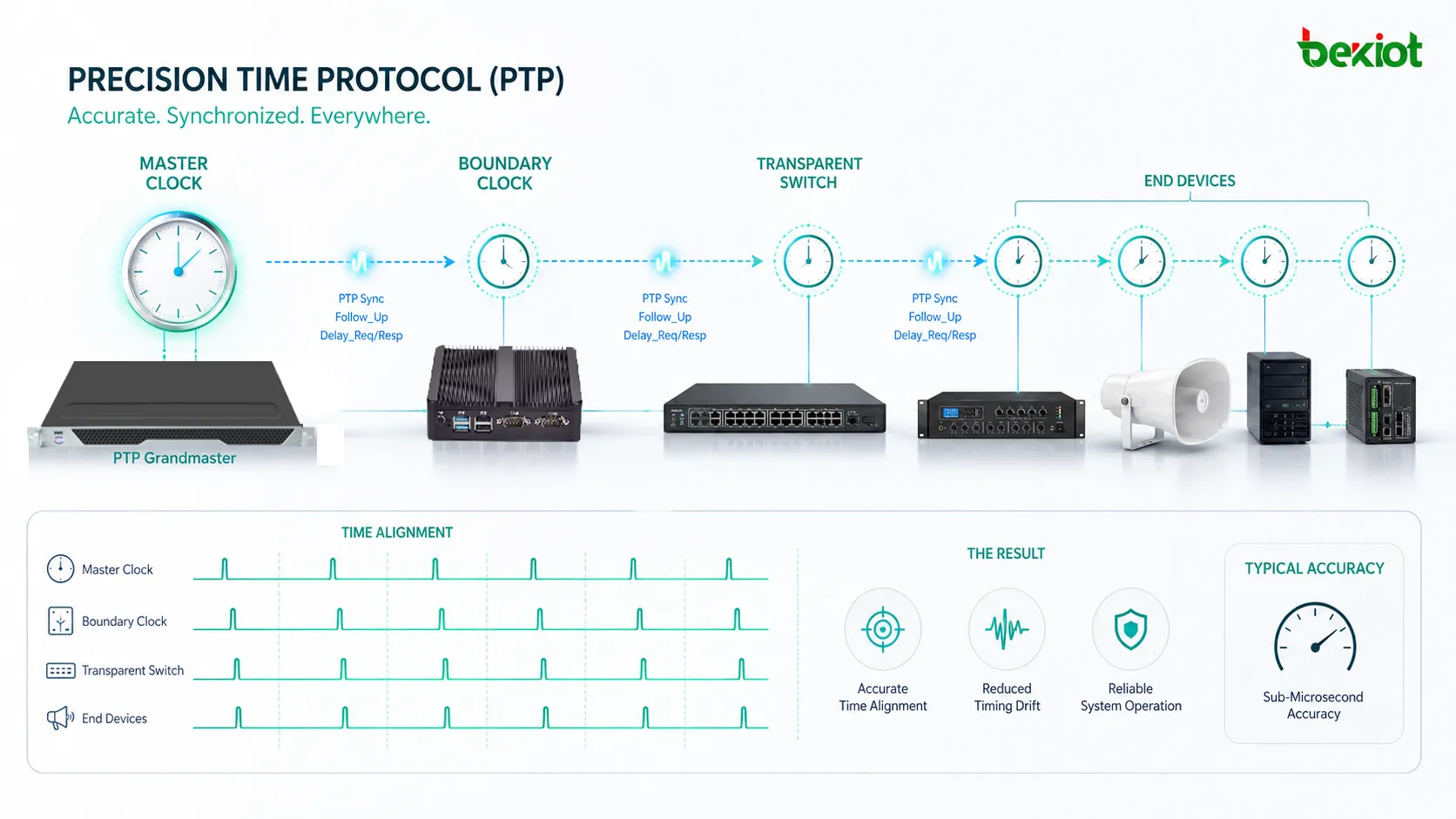
Why Accurate Time Matters in Modern Networks
Many digital systems depend on timing. A telecom base station must coordinate radio signals. A power grid device must timestamp events accurately. A factory controller may need to trigger actions in a precise sequence. A broadcast studio may need cameras, audio devices, and production systems to remain synchronized.
If clocks drift apart, systems may still appear to work at first, but problems can appear in subtle ways. Logs may show events in the wrong order, control systems may respond late, network measurements may become unreliable, and distributed applications may lose coordination.
PTP provides a way to distribute precise time across a network so that equipment can operate under a shared time reference. This is especially valuable when devices are installed across multiple racks, rooms, buildings, substations, factories, or network segments.
The Synchronization Chain
Grandmaster Clock
The grandmaster clock is the main time source in a PTP system. It provides the reference time that other devices follow. This clock may be connected to GNSS, an atomic clock, a telecom timing source, or another trusted time reference.
When several possible time sources are available, the network can use selection rules to choose the best available master. This helps the system maintain stable synchronization even if one time source fails or becomes less reliable.
Ordinary Clock
An ordinary clock is usually an endpoint device that participates in synchronization. It may act as a master in simple networks or as a slave that follows the time provided by the grandmaster.
Examples may include industrial controllers, measurement devices, servers, cameras, telecom equipment, audio devices, or protection relays. These devices adjust their local clocks based on timing messages received from the network.
Boundary Clock
A boundary clock is used inside network equipment such as switches or routers. It receives timing from an upstream master and then acts as a timing source for downstream devices.
This improves scalability and accuracy in larger networks because each network segment can synchronize through a local timing-aware node instead of relying only on end-to-end message paths.
Transparent Clock
A transparent clock does not become the master for downstream devices. Instead, it measures the delay that timing messages experience while passing through the switch or network device, then corrects the timing information accordingly.
This helps reduce timing error caused by variable switch residence time. In high-precision networks, transparent clocks can significantly improve synchronization quality.
How Timing Messages Create Alignment
PTP works by exchanging timing messages between clocks. These messages allow a receiving device to estimate the time difference between its local clock and the reference clock. The device can then adjust its time or frequency to stay aligned.
The process typically involves synchronization messages, follow-up information, delay requests, and delay responses. By comparing message timestamps, the receiving device calculates both clock offset and network delay.
In simplified terms, the system asks two questions: how far is my clock from the master clock, and how long did the timing message take to travel across the network? Once these values are estimated, the device can correct its local clock.
Important Clock Roles and Network Elements
| Element | Main Role | Typical Use |
|---|---|---|
| Grandmaster Clock | Provides the primary reference time for the network. | Telecom timing, power systems, industrial control, broadcast networks. |
| Ordinary Clock | Acts as an endpoint that follows or provides time. | Servers, controllers, relays, cameras, endpoints, measurement devices. |
| Boundary Clock | Receives time upstream and redistributes it downstream. | Large networks, segmented industrial systems, telecom transport networks. |
| Transparent Clock | Corrects timing messages for network device delay. | Precision Ethernet switches and timing-aware network infrastructure. |
| Slave Clock | Adjusts its local clock according to the selected master. | End devices requiring accurate synchronization. |
What Makes the Protocol Precise
Hardware Timestamping
One reason PTP can achieve high accuracy is hardware timestamping. Instead of recording message time only in software, the network interface or timing hardware records the moment when packets enter or leave the device.
This reduces uncertainty caused by operating system scheduling, software queues, driver delays, and application processing. Hardware timestamping is especially important when nanosecond-level or sub-microsecond synchronization is required.
Delay Measurement
The protocol estimates network delay between master and slave devices. This matters because a timing message does not arrive instantly. If the receiver ignores path delay, it may correct its clock incorrectly.
Delay measurement works best when the network path is stable and symmetrical. If the path changes frequently or upstream and downstream delays are very different, accuracy may be affected.
Best Master Clock Selection
PTP networks can use a selection process to determine which clock should become the master. The decision may consider clock accuracy, priority, class, stability, and other timing quality values.
This is useful when redundant time sources are available. If the main source becomes unavailable, the network can switch to another suitable clock rather than losing synchronization completely.
Timing-Aware Switching
Ordinary Ethernet switches can forward packets, but they may not handle timing traffic with the precision required for demanding applications. Timing-aware switches with boundary clock or transparent clock support can reduce timing error across the network.
For large deployments, network infrastructure is just as important as endpoint support. A precise clock at the source cannot deliver accurate time if the network path introduces uncontrolled delay variation.
High-accuracy synchronization depends on the full timing path: reference source, master clock, network switches, timestamping method, endpoint behavior, and configuration discipline.
Benefits for Critical Systems
Higher Event Accuracy
When devices share a precise time base, event records become easier to compare. This is important for troubleshooting, fault analysis, forensic review, automation logs, protection events, and performance measurement.
Accurate timestamps help teams understand the true order of events. Without synchronized time, logs from different devices may create confusion during incident analysis.
Better Coordination
Some systems need coordinated action across multiple devices. PTP allows distributed equipment to operate according to a shared time reference, which can improve control accuracy and system behavior.
This is useful in industrial automation, telecom radio coordination, audio/video production, and power grid protection where timing relationships affect performance.
Reduced Timing Drift
All clocks drift over time. Temperature, oscillator quality, hardware aging, and power conditions can cause local clocks to move away from the reference. PTP continuously corrects this drift by exchanging timing information.
Regular correction helps devices remain aligned even when they operate for long periods without manual adjustment.
Improved Network Measurement
Precise time synchronization supports better network measurement and monitoring. Latency, packet timing, service performance, and system events can be measured more accurately when clocks are aligned.
This is valuable in telecom, finance, data centers, test labs, and real-time service platforms.
Support for Automation and Real-Time Control
In automation systems, precise timing can support scheduled actions, coordinated motion, measurement alignment, and deterministic communication. Devices can execute operations based on a shared clock rather than relying only on local timing.
This improves predictability in environments where timing errors can affect process quality or safety.

Where High-Accuracy Time Is Used
Telecommunications
Telecom networks use precise timing for mobile base stations, transport networks, packet synchronization, and frequency alignment. Accurate time helps radio systems coordinate transmissions and maintain service quality.
As networks become more software-defined and packet-based, timing distribution over Ethernet and IP infrastructure becomes increasingly important.
Power and Energy Systems
Power substations and grid automation systems rely on accurate timestamps for fault recording, protection coordination, synchrophasor measurement, and event analysis. When a fault occurs, engineers need to know exactly when different devices detected it.
Precise time improves analysis and helps teams understand grid behavior across distributed equipment.
Industrial Automation
Factories and process plants may use time synchronization for motion control, measurement systems, machine coordination, data logging, and distributed control. Accurate time helps devices coordinate actions and align production data.
In advanced automation environments, timing quality can directly affect process repeatability and system diagnostics.
Broadcast and Professional Media
Broadcast facilities use precise timing to align audio, video, cameras, production systems, and media networks. Synchronization helps prevent drift, lip-sync errors, and production timing problems.
IP-based media workflows often depend on precise network timing because audio and video streams may move through packet networks instead of traditional dedicated signal paths.
Financial Trading
Financial systems use accurate timestamps for transaction ordering, audit trails, latency measurement, regulatory reporting, and trade analysis. Even very small timing differences can matter in high-speed trading environments.
PTP helps trading infrastructure maintain a more reliable time base across servers, network devices, and measurement systems.
Data Centers and Test Labs
Data centers and laboratories use precise time for distributed logging, performance testing, packet analysis, storage systems, security monitoring, and scientific measurement. Accurate timestamps make data easier to correlate across many devices.
In test environments, timing accuracy may be essential for validating equipment behavior and comparing results across instruments.
Network Design Considerations
Choose the Right Profile
PTP can be configured through different profiles for different industries and use cases. A telecom network, power substation, broadcast system, and industrial automation network may not use identical settings.
The profile defines important behavior such as message intervals, delay mechanism, transport method, clock selection, and performance expectations. Choosing the wrong profile can reduce interoperability.
Use Timing-Aware Infrastructure
For high accuracy, switches and routers should support timing-aware functions. Boundary clocks and transparent clocks reduce error introduced by network devices.
If ordinary switches are used in a demanding environment, packet delay variation may reduce synchronization performance even if endpoints support PTP.
Control Network Load
Heavy congestion can affect timing traffic. Although PTP messages are small, they are sensitive to delay variation. Quality of service, network segmentation, and proper traffic engineering can help protect timing packets.
Critical timing networks should avoid unnecessary path changes and uncontrolled broadcast or multicast behavior.
Plan Redundancy
Time synchronization may be mission-critical. If the grandmaster clock fails, the network should have a backup strategy. Redundant clocks, holdover capability, multiple reference sources, and monitored failover can improve resilience.
Redundancy should be tested. A backup clock is only useful if devices can switch smoothly without large time jumps or loss of synchronization.
Monitor Time Quality
Administrators should monitor clock state, offset, path delay, grandmaster identity, lock status, holdover condition, and timing alarms. Without monitoring, synchronization problems may go unnoticed until applications fail or logs become inconsistent.
Time quality should be part of normal system health monitoring, especially in telecom, power, broadcast, industrial, and financial environments.
Comparison with NTP
Network Time Protocol, or NTP, is widely used for general-purpose time synchronization across IT systems. It is suitable for many servers, computers, applications, and ordinary network services. However, it usually does not provide the same precision as PTP in properly designed hardware-supported environments.
PTP is used when tighter timing is required. It benefits from hardware timestamping, timing-aware network equipment, and profiles designed for specific industries. This makes it more suitable for telecom, automation, power, broadcast, and measurement applications.
The choice is not always either-or. Many organizations use NTP for general IT systems and PTP for specialized systems that require higher precision.
| Time Method | Typical Strength | Common Use |
|---|---|---|
| NTP | Simple, widely supported, suitable for general IT timekeeping. | Servers, computers, applications, logs, ordinary enterprise networks. |
| PTP | High precision with hardware support and timing-aware networks. | Telecom, power grids, automation, finance, broadcast, measurement systems. |
| GNSS Time | Provides external reference time from satellite systems. | Grandmaster clocks, telecom timing, remote sites, critical infrastructure. |
Common Problems and Troubleshooting
Large Clock Offset
A large offset means a device is not closely aligned with the reference clock. Causes may include wrong profile settings, unsupported timestamping, unstable network delay, poor clock quality, or incorrect master selection.
Check whether the endpoint is locked to the intended grandmaster and whether hardware timestamping is active.
Frequent Master Changes
If devices frequently switch between masters, the network may have unstable clock selection, misconfigured priorities, unreliable reference sources, or competing grandmaster clocks.
Clock priority and quality values should be planned so the expected master is selected consistently and backup clocks take over only when appropriate.
Unstable Path Delay
Path delay variation can reduce accuracy. It may be caused by network congestion, non-timing-aware switches, changing routes, multicast issues, or overloaded network devices.
Timing traffic should use stable paths and, where required, switches that support boundary or transparent clock functions.
Device Interoperability Issues
Different vendors and industries may use different profiles, message intervals, transport modes, and default settings. Devices may not synchronize correctly if their configuration does not match.
Interoperability testing should be done before large-scale deployment, especially in mixed-vendor environments.
Deployment Best Practices
Start by defining the accuracy requirement. Not every system needs nanosecond-level synchronization. The required precision should come from the application, not from a general desire for the highest possible number.
Choose suitable time sources and grandmaster clocks. The master clock should have a reliable reference, stable oscillator, monitored status, and backup strategy if the application is critical.
Use compatible profiles across devices. Mixing profile settings without planning can create synchronization failures or inconsistent behavior.
Protect timing traffic. Use timing-aware switches, QoS, VLANs, stable routing, and network monitoring where the application requires high accuracy.
Test failover and holdover. Disconnect the primary reference in a controlled test and observe whether the system remains stable. This reveals whether backup timing design works as expected.
A successful deployment is not defined only by selecting a precise clock. It is defined by keeping the entire timing chain stable, monitored, and aligned with the application requirement.
Maintenance and Long-Term Operation
Time synchronization should be maintained like any other critical infrastructure service. Administrators should review clock logs, offset trends, grandmaster status, firmware versions, network changes, and alarm history.
Network changes can affect timing performance. Replacing a switch, changing VLANs, adding routing paths, or modifying QoS rules may alter delay behavior. Timing should be retested after major network changes.
Backup clocks and holdover sources should also be checked periodically. A backup system that is never tested may fail when the primary source is lost.
FAQ
Can PTP run over Wi-Fi?
It can technically be carried over wireless networks in some environments, but Wi-Fi usually introduces variable delay that makes high-accuracy synchronization difficult. Wired Ethernet is preferred for precision use cases.
Does every switch need to support timing functions?
Not always, but timing-aware switches become important when high accuracy is required across multiple network hops. Ordinary switches may be acceptable for less demanding applications.
What happens if the grandmaster loses its external reference?
A good clock may enter holdover mode and continue providing time based on its internal oscillator. The quality of holdover depends on oscillator stability and how long the external reference is unavailable.
Can PTP and NTP be used together?
Yes. Many environments use PTP for high-precision systems and NTP for general IT systems. Care should be taken so that each device follows the correct time source for its role.
Why do two devices show different accuracy even on the same network?
Differences may come from timestamping support, oscillator quality, profile settings, switch path, firmware behavior, network load, or whether each device is using the same grandmaster and delay mechanism.







