Power over Ethernet, usually shortened to PoE, refers to the ability to carry both data and electrical power through the same Ethernet cable. In practical terms, this means a network switch or injector can power a compatible edge device without requiring a separate local power adapter. The specific standard discussed in this article is IEEE 802.3af, the original widely adopted PoE standard that established a common way to deliver power safely over twisted-pair Ethernet cabling.
Although newer standards such as 802.3at and 802.3bt now support higher power levels, 802.3af remains highly relevant. It is still widely used for IP phones, basic wireless access points, compact IP cameras, intercoms, card readers, and many other networked devices that do not need large power budgets. For many enterprise and industrial deployments, 802.3af is still the most practical balance between simplicity, compatibility, and installation cost.
What Is IEEE 802.3af PoE?
The basic definition
IEEE 802.3af is the original standardized form of PoE for Ethernet networks. It defines how electrical power is detected, negotiated, and delivered from power sourcing equipment, or PSE, to a powered device, or PD, over standard Ethernet cabling. In everyday deployment language, the PSE is usually a PoE switch port or a midspan injector, while the PD is the endpoint device such as an IP phone, camera, or wireless terminal.
The standard solved an important deployment problem. Before standardized PoE, many network devices needed both a data cable and a nearby AC outlet. With 802.3af, installers could place devices where they were most useful rather than only where power sockets happened to be available. That change helped accelerate the adoption of IP telephony, ceiling-mounted wireless access points, and network-based building devices.
Why 802.3af still matters
It is easy to assume that the original PoE standard has become outdated, but that is not really how most real networks work. A large number of edge devices still operate well within the 802.3af power envelope. If a device only needs modest power, using 802.3af can simplify switch selection, lower power planning pressure, and improve backward compatibility across mixed environments.
That is why many enterprise, transport, industrial, and commercial projects still include 802.3af endpoints even when the broader network also supports PoE+ or higher. The original standard remains part of the practical foundation of modern edge networking, especially for devices that prioritize stable communication over high power draw.
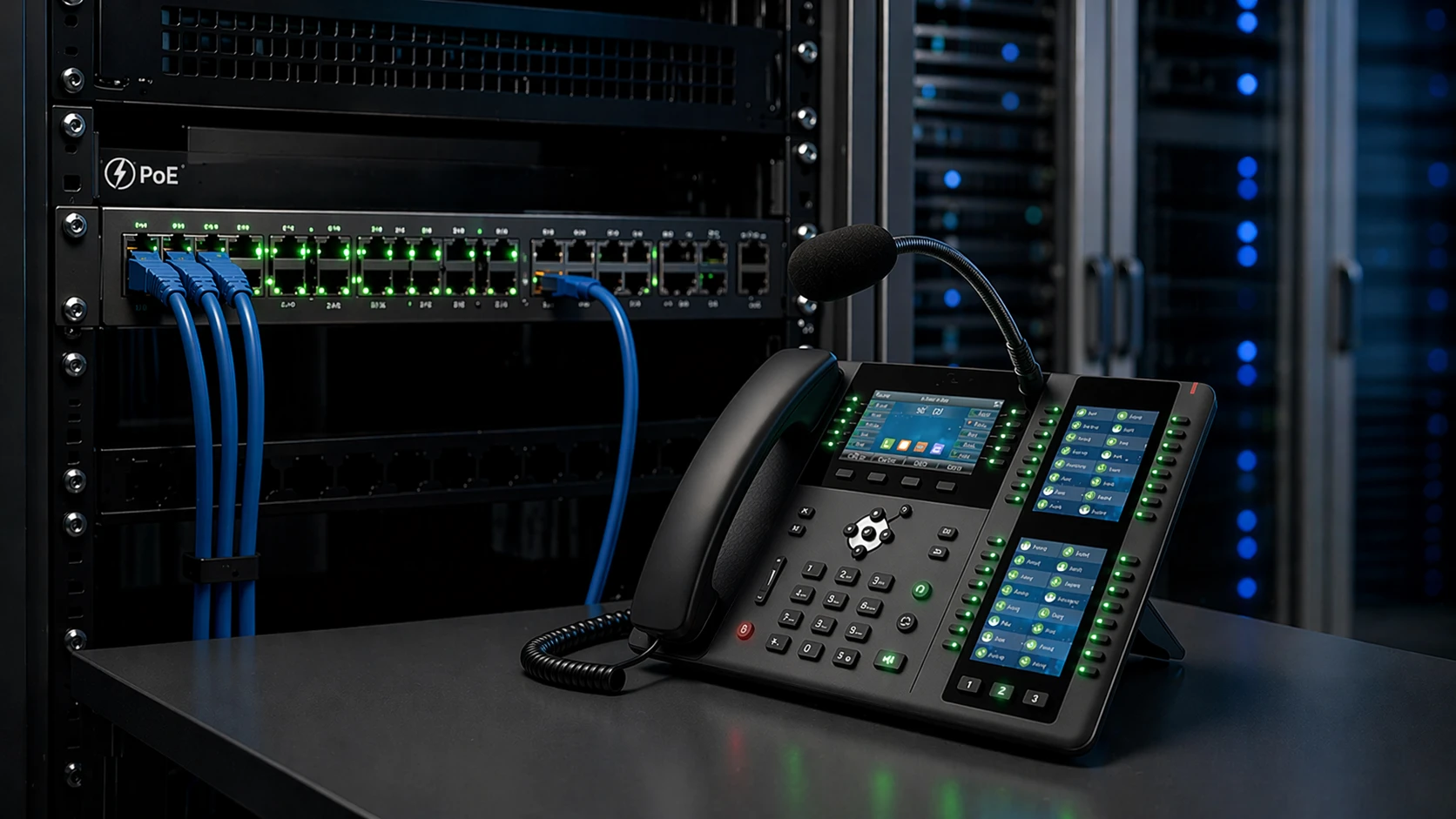
A typical 802.3af deployment uses one Ethernet cable to carry both network connectivity and power to a compatible endpoint such as an IP phone.
How Does 802.3af PoE Work?
Power sourcing equipment and powered devices
Every 802.3af deployment starts with two roles. The first is the power sourcing equipment. This is the side that provides power, usually a PoE-capable Ethernet switch or a standalone injector. The second is the powered device, meaning the endpoint designed to accept power over Ethernet. The standard exists so these two sides can recognize each other and interact safely.
That safety step matters. A PoE-capable switch does not simply push power onto every copper port all the time. It first checks whether a connected device is actually designed to receive PoE. This prevents accidental power delivery to non-PoE equipment and makes mixed deployments much easier to manage.
Detection, classification, and power delivery
In simplified terms, 802.3af works in stages. First, the PSE performs detection to verify that a valid powered device is connected. Then it may perform classification to estimate the device's power needs. After that, the port applies operating power and continues monitoring the link so it can maintain or remove power as required.
From a deployment perspective, this is one of the reasons PoE feels so practical. Installers can connect a compliant device and let the network handle the rest. The switch determines whether the endpoint is eligible for power, allocates a suitable budget, and keeps the device online without needing a separate electrical installation at the endpoint location.
Why 15.4 W does not mean the endpoint gets 15.4 W
One of the most common misunderstandings about 802.3af is the power number itself. The standard is commonly described as supplying up to 15.4 watts, but that figure refers to the maximum power available at the sourcing side. Because some power is lost over the cable, the maximum guaranteed power available to the powered device is lower.
In most technical summaries, that usable maximum at the device side is listed as 12.95 watts. This difference matters in real product selection. A device can be called PoE powered, but if its actual draw under full operation exceeds the 802.3af limit at the PD side, it may need 802.3at instead. This is why careful power budgeting matters even in otherwise simple Ethernet installations.
Technical Characteristics of 802.3af
Power level and cabling model
IEEE 802.3af is commonly associated with up to 15.4 watts from the PSE and up to 12.95 watts available at the PD. In deployment terms, that makes it suitable for moderate-power endpoints rather than high-load devices. It was designed around standard twisted-pair Ethernet cabling and became widely associated with 10/100 and Gigabit Ethernet environments as networks evolved.
In practical projects, this means 802.3af usually works well for voice terminals, modest video devices, access control components, compact intercom terminals, and light-duty wireless endpoints. When heaters, pan-tilt-zoom mechanics, larger displays, or more powerful radios are involved, planners often move to PoE+ or beyond.
Compatibility and coexistence with newer PoE generations
Another reason 802.3af remains useful is ecosystem compatibility. Modern PoE networks often contain a mixture of devices across several power classes. A newer switch may support 802.3af, 802.3at, and 802.3bt on different ports or on the same platform, while many endpoints still consume only 802.3af-level power.
This backward continuity helps organizations upgrade gradually. They do not need to replace every phone, intercom, or camera just because the switching layer has moved to a newer standard. As long as the PSE and PD negotiate correctly, low-power devices can continue operating normally in a broader mixed-power environment.
Relationship to PoE injectors and midspans
Not every 802.3af deployment begins with a PoE switch. In many retrofit scenarios, a site may already have non-PoE switches in place. In that case, a midspan injector can be inserted between the switch and the endpoint to add power while preserving the Ethernet data path. This is often useful when only a handful of edge devices need PoE.
That makes 802.3af especially friendly to phased upgrades. An organization can start with a few injected IP phones or access points, then later move to integrated PoE switching as the number of powered endpoints grows. The standard supports both approaches without changing the endpoint logic.
Main Uses of 802.3af PoE
IP phones and communication terminals
One of the classic uses of 802.3af is IP telephony. IP phones benefit greatly from single-cable deployment because they need both network access and dependable operating power. PoE simplifies desk installations, helps keep cable runs cleaner, and allows power to be backed by centralized UPS systems through the switching layer rather than by local adapters on every desk.
This is one reason PoE became closely associated with enterprise telephony in the first place. Even today, many desk phones, wall phones, SIP intercoms, and compact paging terminals fit comfortably within the 802.3af power envelope.
Wireless access points and light network infrastructure
Wireless access points are another common 802.3af application, especially in earlier Wi-Fi generations or in low-power indoor deployments. Ceiling placement becomes much easier when no dedicated AC outlet is required. A single structured cabling run can provide both the uplink and the operating power.
Not every modern access point can stay within 802.3af power limits, but many smaller or feature-limited models still can. That makes the standard useful in offices, schools, retail areas, temporary spaces, and branch environments where moderate performance is acceptable and installation simplicity is important.
IP cameras, intercoms, and access control endpoints
802.3af is also widely used for security and facility systems. Fixed IP cameras, compact video or audio intercoms, door stations, badge readers, and some alarm or sensor gateways often use PoE because they are installed at network edge locations where local power may be inconvenient or expensive to provide.
In these scenarios, centralized power delivery has a second advantage: maintenance becomes easier. When endpoints are powered through managed switches, administrators can monitor port power states, plan power budgets more clearly, and in some environments remotely power-cycle problem devices without sending someone onsite.
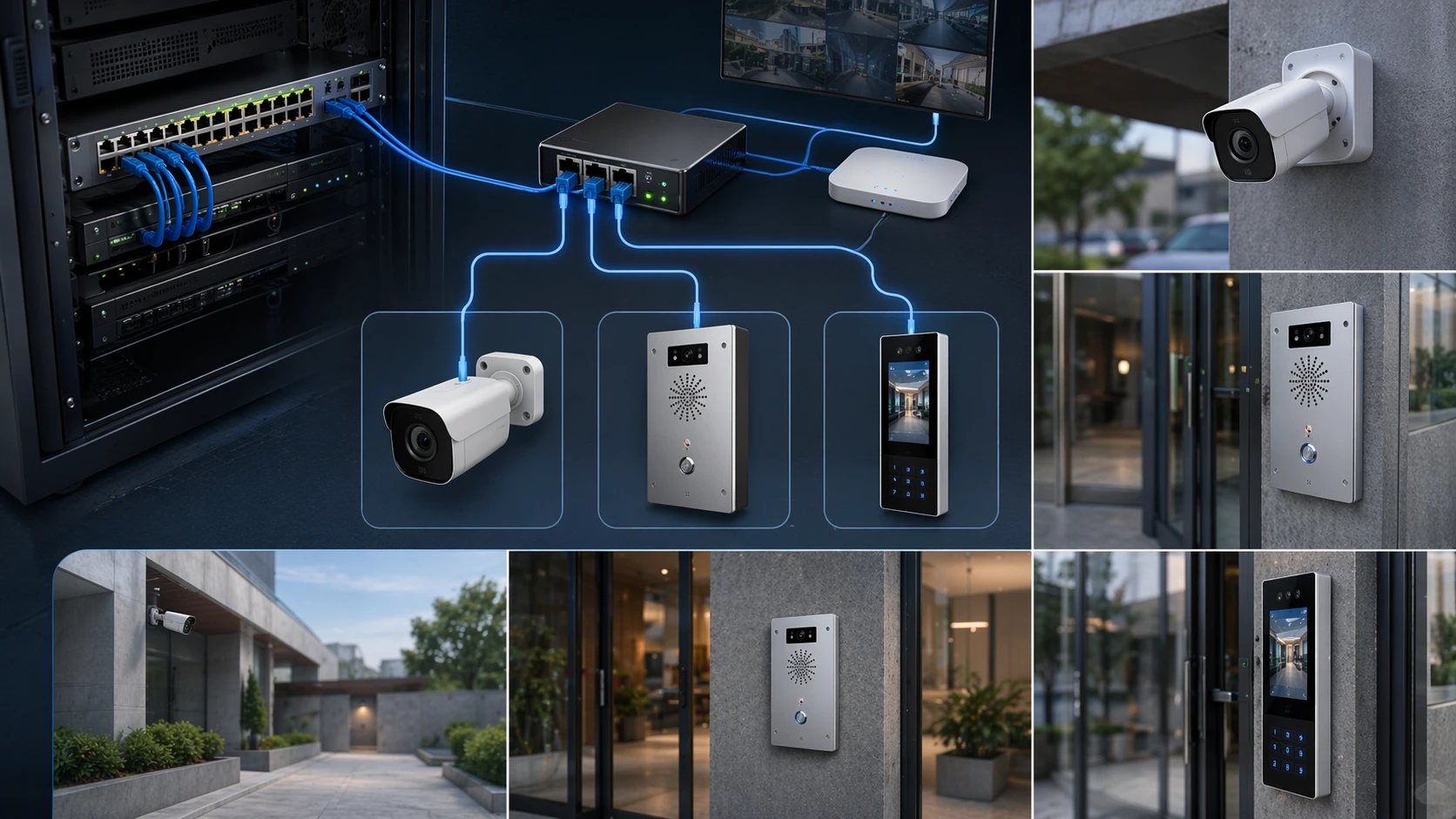
802.3af PoE is commonly used for edge devices such as fixed cameras, intercom terminals, and access control readers where one-cable installation reduces field complexity.
Benefits of 802.3af in Real Deployments
Simpler installation
The most obvious benefit is also the one that matters most in practice: fewer cables and fewer local power supplies. Using a single Ethernet run for both data and power reduces installation effort, avoids dependence on nearby wall outlets, and gives designers more flexibility in device placement.
This is especially valuable in corridors, lobbies, classrooms, warehouses, terminals, control points, and retrofit projects where adding electrical infrastructure would be slower or more expensive than extending structured cabling.
Centralized power management
PoE moves much of the power logic back into the network layer. Instead of relying on many scattered adapters, the organization can manage power from switch infrastructure or centrally placed injectors. This can improve resilience when the switching layer is backed by UPS systems and can also simplify troubleshooting when an endpoint fails to boot.
For communication systems, centralized power is often more valuable than people first expect. If desk phones, intercoms, or paging devices are powered by the network and the core switching path has backup power, voice and alerting services may remain available even when local AC power in user areas is interrupted.
Cleaner scaling for distributed endpoints
When a project expands from a few devices to dozens or hundreds, 802.3af helps keep the edge design more consistent. Installers do not have to plan separate outlet availability for every endpoint. Instead, they can calculate switch power budgets and port counts as part of the network design process.
This is one reason PoE became such an important part of modern unified communications and smart building deployments. The value is not just in powering one device. It is in giving distributed endpoints a more repeatable, supportable deployment model across the whole site.
802.3af vs PoE+ and Newer Standards
Where 802.3af is enough
802.3af is usually enough when the endpoint performs a focused job with a modest power profile. Typical examples include many desk phones, basic intercom stations, compact access points, badge readers, and fixed cameras without heavy auxiliary functions. In these cases, moving to a higher PoE class may not provide any practical advantage.
For this reason, many networks continue using 802.3af endpoints even when the switching hardware itself supports higher-power standards. Matching the endpoint to the correct power level is often more efficient than assuming every device should use the newest standard available.
When 802.3at or 802.3bt is the better choice
PoE+ under IEEE 802.3at is typically chosen when the device needs more power than 802.3af can reliably guarantee. This often applies to dual-radio access points, PTZ cameras, larger intercom panels, video phones with more demanding features, or devices with heating or auxiliary peripherals.
For still higher power demands, 802.3bt becomes relevant. That includes larger displays, advanced wireless infrastructure, industrial devices, or specialized field equipment. The choice is not really about which standard sounds more advanced. It is about whether the endpoint's real operating requirement fits within the available power budget.
Design and Deployment Tips
Check the device-side power requirement, not just the marketing label
When evaluating a device, do not stop at the phrase “PoE supported.” Check the actual power draw and the required PoE class. Some endpoints can boot on 802.3af but disable certain functions unless more power is available. Others may work under ideal conditions but become unstable when accessories, low temperatures, or full-feature operation raise power consumption.
This is why specification review matters. Good deployment planning starts with the real PD power requirement, then works backward through cable length, switch power budget, redundancy expectations, and environmental conditions.
Plan switch power budgets early
In small deployments, PoE can feel nearly automatic. In larger projects, power budget planning becomes essential. A switch may have many PoE-capable ports, but its total available power may still be lower than the combined maximum draw of all connected endpoints. Designers should check both per-port limits and total chassis or power-supply capacity.
This is especially important in communication systems, schools, transport nodes, and security deployments where many devices may be installed at once. A switch with enough Ethernet ports is not necessarily a switch with enough power budget.
Use PoE as part of a broader reliability strategy
PoE works best when it is tied to broader network resilience planning. That can include UPS protection for PoE switches, segmented voice VLANs, clear labeling of critical endpoints, and monitoring tools that can show both link state and power state. In communication-heavy environments, those details can make the difference between a system that merely works and one that remains usable during disruption.
For sites deploying IP phones, intercoms, paging stations, or light industrial endpoints, 802.3af is often more than a convenience feature. It becomes part of the operational design of the whole edge network.
Applications Across Different Industries
Enterprise offices and campus networks
In offices, schools, and campus environments, 802.3af is most often associated with phones, entry intercoms, wall devices, and lightweight access points. These are classic cases where one-cable deployment reduces installation complexity and makes relocation or reconfiguration easier over time.
The standard also works well in phased infrastructure projects because it allows sites to deploy communication and access devices without waiting for additional local power construction in every corner of the building.
Commercial buildings and public facilities
Commercial properties, hospitals, transport buildings, hotels, and public service locations often rely on distributed low-power network endpoints. Card readers, help points, desk phones, compact paging devices, and monitoring terminals can all benefit from standardized PoE delivery.
In these environments, centralized power and simplified maintenance are often just as valuable as the original installation savings. Network teams can manage a large number of distributed devices with less dependency on local adapters and field-side electrical changes.
Industrial and semi-industrial communication points
Even in industrial or ruggedized environments, some networked devices still fall well within 802.3af limits. Industrial IP phones, compact operator panels, field intercom stations, monitoring terminals, or lightweight sensing gateways may use 802.3af when the device design is optimized for moderate power draw.
Here, the advantage is not just convenience. It is controlled deployment. A single Ethernet cable can simplify cabinet layouts, reduce accessory parts, and make it easier to standardize how low-power field endpoints are installed across multiple locations.
FAQ
Is 802.3af the same as PoE+?
No. 802.3af is the original PoE standard, while PoE+ refers to IEEE 802.3at. The later standard supports a higher power level than 802.3af.
How much power does 802.3af provide?
802.3af is commonly described as providing up to 15.4 watts at the PSE side, with up to 12.95 watts guaranteed at the powered device after cable loss is taken into account.
Can an 802.3af switch power an IP phone?
Yes, many IP phones are designed specifically to work within the 802.3af power budget. However, some advanced phones with larger displays or extra features may require more power.
What devices usually use 802.3af?
Typical examples include IP phones, compact wireless access points, fixed IP cameras, intercom terminals, badge readers, and other modest-power network endpoints.
Does PoE reduce the need for local power adapters?
Yes. That is one of its main deployment benefits. The network cable can provide both data and electrical power, which often removes the need for a separate local adapter at the endpoint.
When should I choose 802.3at instead of 802.3af?
You should move to 802.3at when the endpoint's actual power requirement exceeds what 802.3af can reliably provide, or when the device enables important functions only under a higher PoE class.