PoC, short for Push-to-Talk over Cellular, is a broadband-based group communication method that lets users press a button and speak instantly with one person or an entire talk group over public or private mobile networks. Instead of relying only on traditional narrowband radio infrastructure, PoC uses cellular data networks such as 4G LTE and 5G, and in many deployments it can also work over Wi-Fi. That makes it attractive to organizations that want faster deployment, wider coverage, richer features, and easier scaling than a purely conventional radio system can often provide.
Related Products:ROIP(Radio Over IP )_RoIP Gateway Equipment & Software
In practical business use, PoC sits between consumer mobile calling and professional two-way radio operations. It keeps the simplicity of “press, speak, release,” but adds modern software capabilities such as web dispatch, GPS location, messaging, multimedia sharing, user management, and service expansion across multiple sites. For transport teams, security companies, utilities, campuses, field service organizations, and many other operational environments, PoC can become a highly efficient tool for daily coordination and incident response.
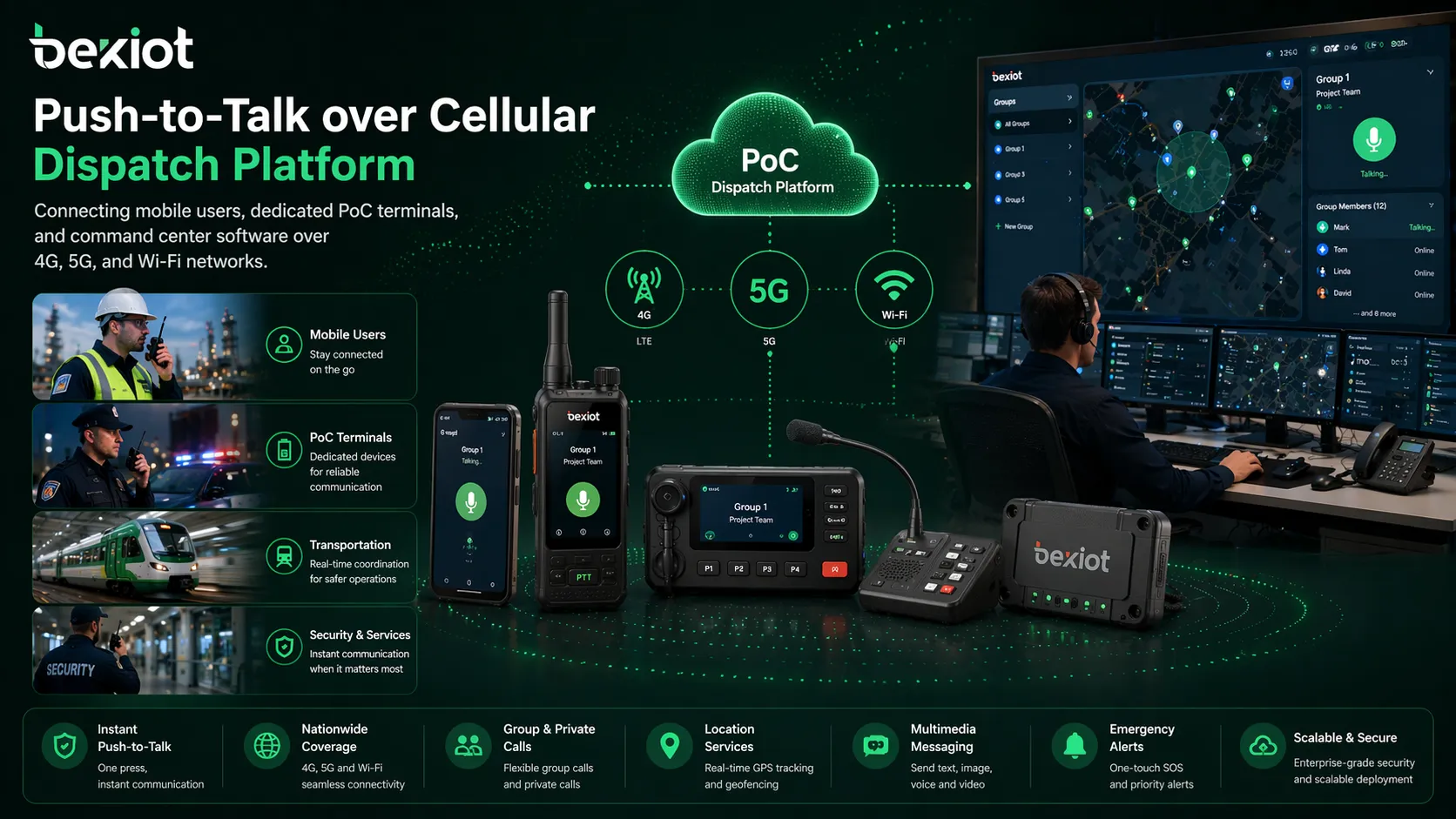
What Does PoC Mean in Communication Systems?
PoC is broadband push-to-talk rather than ordinary voice calling
A normal mobile phone call is usually one-to-one and full duplex, meaning both sides can speak at the same time. PoC is different. It is designed around fast group communication, operational control, and one-to-many workflows. A user presses the PTT key, takes the floor, delivers a short message, and releases the channel so another user can respond. This operating style is familiar to radio users, but PoC delivers it through cellular and IP-based networks.
That difference matters because operational teams often do not need a long conversational call. They need short, clear, directed instructions: dispatch a guard, reroute a driver, report an alarm, confirm an arrival, or request assistance. PoC is built for exactly that style of communication. It reduces dialing steps, cuts waiting time, and allows multiple authorized listeners to hear the same instruction at once.
PoC is related to, but not identical with, mission-critical MCPTT
In the wider standards world, 3GPP standardized Mission Critical Push-to-Talk (MCPTT) in Release 13, then expanded the mission-critical service family with MCData and MCVideo in Release 14. That standards path is especially relevant to public safety and other highly demanding environments. In the commercial market, however, the term PoC is often used more broadly for push-to-talk services delivered over cellular networks, whether they are carrier-hosted, cloud-based, private-platform-based, or aligned with mission-critical standards.
For this reason, buyers should understand that not every PoC product offers the same service level. Some commercial offerings are excellent for enterprise coordination and field operations, while some mission-critical environments require stricter attention to standards compliance, quality of service, interoperability, priority handling, and certification. In other words, “PoC” is a broad category, not a single technical tier.
How PoC Works
Core service architecture
A PoC system usually includes user devices, a PoC application or firmware client, a service platform, and a management or dispatch interface. When the user presses the PTT button, the device sends signaling through the network to the service platform, which controls talk group membership, floor control, permissions, and media delivery. Depending on the system design, the service may run in the cloud, in a carrier environment, or on a private enterprise platform.
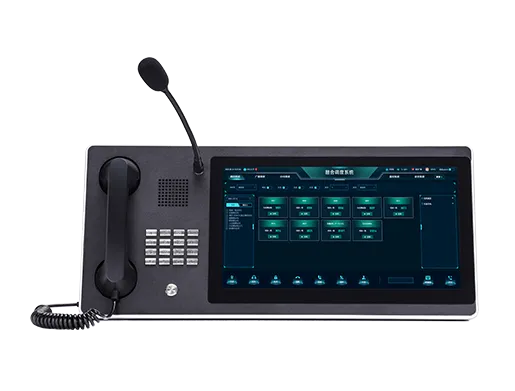
Because the service is IP-based, PoC can extend beyond handheld terminals. It may include smartphone apps, vehicle units, desktop dispatch consoles, wearable terminals, and integrated control room interfaces. That broader endpoint flexibility is one of the main reasons PoC is increasingly used for distributed teams that need unified communications across different roles and devices.
Networks used by PoC
Most PoC solutions operate over 3G, 4G LTE, and 5G networks, and many also support WLAN or Wi-Fi access. This gives organizations the ability to communicate far beyond the limited footprint of a single local radio repeater. A team can stay connected across cities, regions, or nationwide operations, provided the underlying broadband network is available and the service platform is properly configured.
At the same time, network dependency is one of the planning realities of PoC. Performance depends on coverage quality, backhaul conditions, device capability, and platform design. For routine enterprise coordination, public broadband may be sufficient. For higher-assurance operations, organizations often pay close attention to priority, resilience, fallback design, and interworking with existing radio systems.
From handheld button press to dispatcher visibility
Modern PoC systems are no longer limited to voice only. A dispatcher may see user status, location, talk groups, alerts, and even live video feeds in the same operational view. Some platforms also support messaging, file sharing, geofencing, emergency alerts, and activity monitoring. As a result, PoC is increasingly positioned not just as a “radio replacement,” but as a lightweight operational communication and dispatch environment.
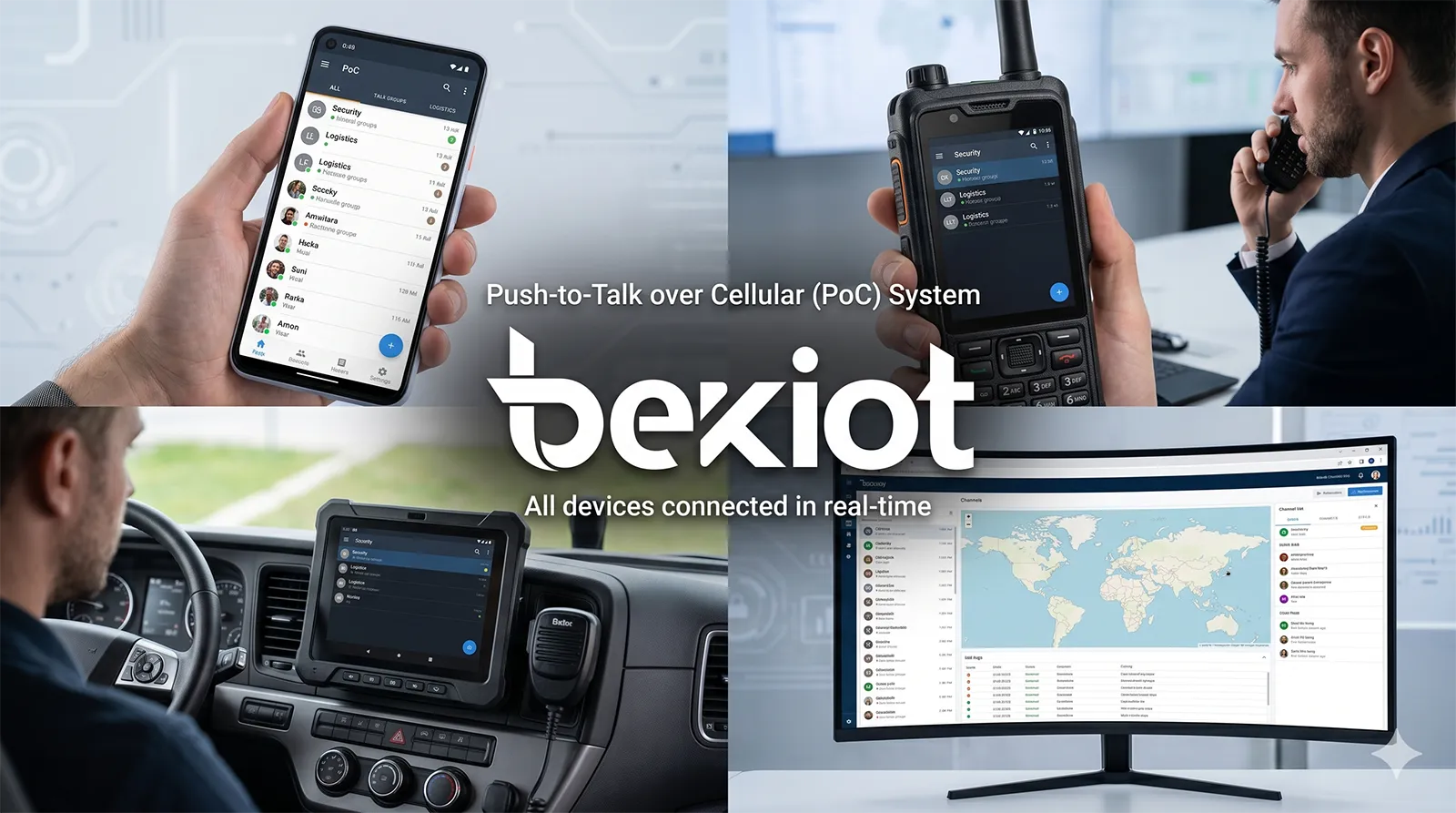
Main Features of PoC
Instant group calling and talk group management
The signature feature of PoC is instant group communication. Instead of dialing multiple individuals, a supervisor can speak once and reach a whole team. Users can be organized into talk groups by department, shift, building, route, region, or incident type. This structure is highly useful in logistics, transport, property management, security patrol, campus operations, and industrial field coordination.
Group design is important because it helps prevent communication overload. A driver does not need to hear every maintenance conversation, and a security officer does not need every housekeeping update. Well-structured PoC talk groups make communication faster, cleaner, and more relevant.
Dispatch, mapping, and operational visibility
Many current PoC platforms include browser-based or software dispatch tools. These tools may support real-time communication, talk group control, user administration, monitoring, and map-based positioning. For managers and control room teams, this adds an operational layer that is difficult to achieve with a simple consumer calling workflow.
Location visibility can be particularly valuable in field operations. If a security officer triggers an alert, a dispatcher can identify the user’s position, check nearby personnel, and coordinate a response more quickly. In transport, the same principle can support driver coordination and route-level supervision. In utilities or maintenance work, it can shorten the time between fault reporting and technician deployment.
Multimedia communication beyond voice
Another important strength of PoC is that many platforms can combine voice with text, photo, video, and file sharing. This is useful when spoken words alone are not enough. A field worker can send an image of equipment damage, a security team can share a live view, or a dispatcher can push detailed instructions to a mobile unit without relying on a separate consumer app.
This richer communication model improves situational awareness. Instead of asking several follow-up questions, the control room can often see the issue directly, compare location information, and make a faster decision. In practical terms, PoC helps move operations from pure voice dispatch to voice-plus-context coordination.
Emergency alerting, encryption, and interoperability options
Depending on the platform, PoC solutions may support emergency buttons, user priorities, end-to-end encryption, remote monitoring, geofencing, and interworking with land mobile radio environments. This does not mean every product delivers the same level of resilience or mission-critical assurance, but it does show why PoC has become more than a basic push-to-talk app category.
For many organizations, the most valuable feature is not replacing every legacy system immediately. It is adding broadband communication to existing operations. In some deployments, PoC can augment current radio systems, extend communications to smartphone users, and link dispatch workflows across mixed user groups.
Benefits of PoC for Businesses and Organizations
Wider coverage without building a full radio network
Traditional radio systems can be excellent in many environments, but they may require dedicated infrastructure planning, licensing, site engineering, and expansion work. PoC can often be deployed faster because it leverages broadband networks that already exist. For organizations with geographically distributed teams, this can reduce rollout complexity and speed up implementation.
This is one of the biggest reasons PoC is attractive for commercial users. A company with branches in different cities can place users on the same communication platform without building a separate radio footprint in every location. That greatly simplifies expansion, seasonal staffing, and cross-region coordination.
Lower operational friction and predictable scaling
Many PoC services are offered through subscription-style commercial models, which can make budgeting easier for organizations that prefer operating expenditure over large upfront capital investment. User accounts, talk groups, and service permissions can often be added or adjusted quickly, so scaling the system is less disruptive than replacing hardware-heavy infrastructure every time the organization grows.
Operationally, PoC also reduces friction in day-to-day communication. Users do not need to dial everyone individually, wait for multiple answers, or repeat the same message several times. A single transmission can reach the right group immediately, which improves coordination speed during both routine tasks and fast-moving incidents.
Better coordination through shared awareness
The real benefit of PoC is not just speaking faster. It is creating a shared operational picture. When voice, location, dispatch control, status, and multimedia are brought together, teams can make decisions with less delay and less misunderstanding. This is especially valuable when work is mobile, distributed, or time-sensitive.
For example, a transport supervisor can redirect a vehicle, notify the depot, and update the relevant group in one workflow. A campus security team can receive an alarm, identify the closest responder, and escalate the event if needed. A field service manager can match nearby technicians to a problem site more efficiently than with separate voice and messaging tools.
Flexible endpoint choices
Another practical advantage is endpoint flexibility. Some users may prefer rugged dedicated PoC terminals with a physical PTT button. Others may use smartphones, vehicle-mounted units, tablets, or desktop dispatch positions. This flexibility allows organizations to match the device to the role rather than forcing all users into the same hardware model.
That matters in mixed environments. A patrol officer, a warehouse coordinator, a dispatcher, and a maintenance supervisor may all need different interfaces, but they can still operate within one communication framework. PoC supports that kind of role-based communications design well.
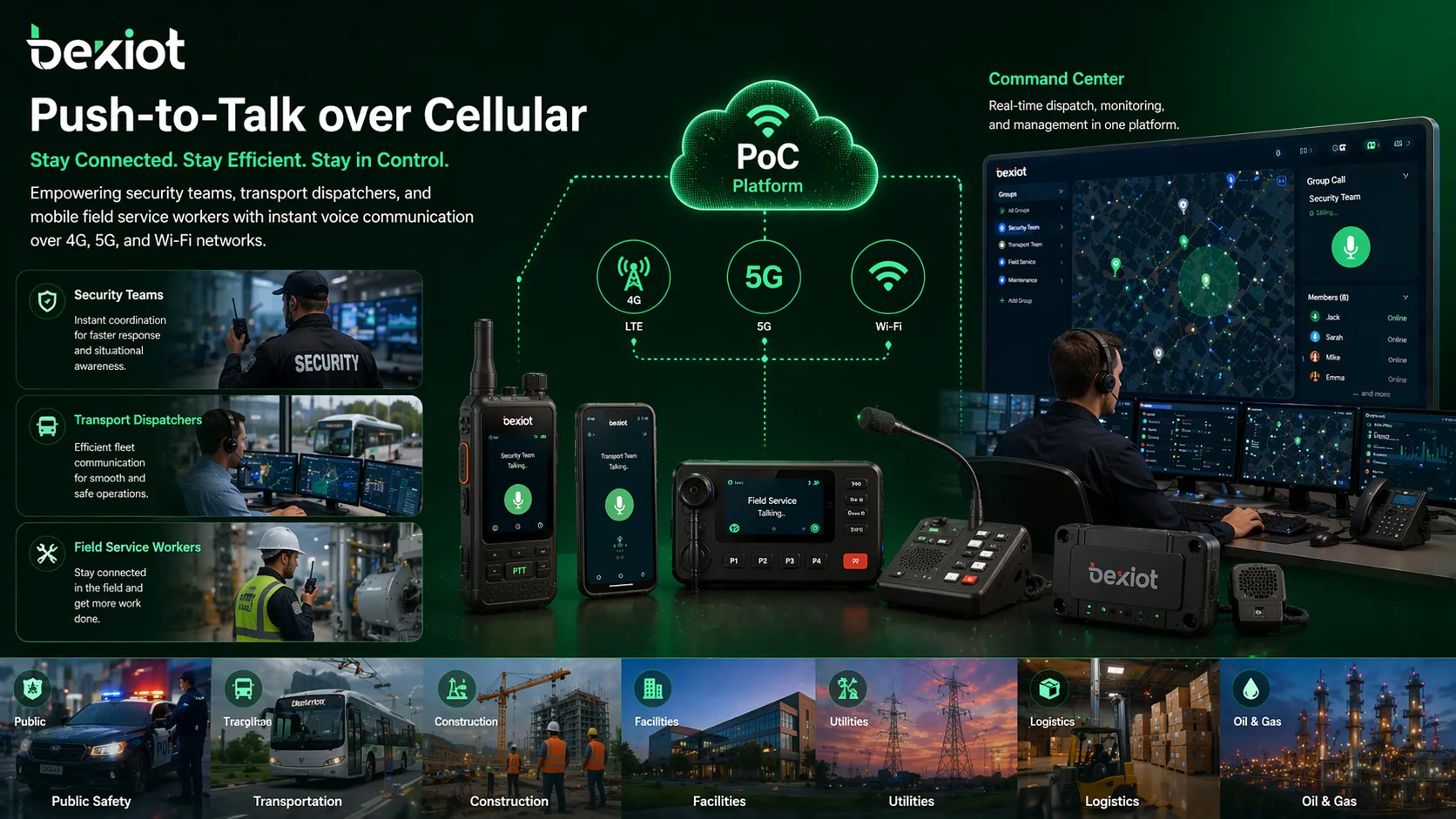
Common PoC Application Scenarios
Transport, fleet, and logistics operations
Transport and logistics teams often need instant route updates, arrival confirmations, exception handling, and multi-user coordination. PoC works well here because it supports quick group calling and broad-area coverage. Dispatchers, drivers, supervisors, and depot teams can stay connected on one platform without relying only on one-to-one voice calls.
It is particularly useful when operations span large service areas. A company can organize talk groups by route, region, terminal, or shift, and then manage exceptional events such as delays, vehicle changes, security incidents, or service disruptions with less communication overhead.
Private security and campus safety
Security operations need fast reporting, coordinated movement, and clear escalation paths. PoC can support patrol teams, gate positions, control rooms, event staff, and mobile supervisors through immediate group communication. If the platform includes location, mapping, and alerting, it can also strengthen situational awareness during incidents.
For campuses, business parks, hospitals, hotels, and public venues, PoC offers a practical way to connect safety personnel without requiring every user to carry a traditional radio-only device. It can also support mixed-role communications where security, facilities, and management teams need controlled interaction.
Utilities, maintenance, and field service
Utilities and field service organizations often send workers across dispersed service territories. PoC can help coordinate task dispatch, status reporting, technician safety, and incident escalation. When multimedia and location are available, the control center can understand site conditions faster and assign the most appropriate support.
In maintenance-heavy environments, this also improves documentation and workflow continuity. A worker can report a fault, share an image, receive instructions, and stay connected with supervisors through a single communications environment rather than switching among unrelated tools.
Construction, industrial operations, and temporary projects
PoC is also suitable for project-based environments such as construction sites, temporary operations, event security, and mobile engineering teams. These environments often need fast deployment and flexible scaling. New users, subcontractors, or temporary teams can be added more easily than building a new site-specific radio network for every short-term project.
In industrial operations, PoC is often considered as part of a broader communications architecture that may also include SIP intercoms, paging, control room dispatch, alarms, and sometimes existing radio systems. In these cases, PoC is not a standalone island. It becomes one communication layer inside a larger operational ecosystem.
PoC vs Traditional Two-Way Radio
Coverage and infrastructure model
The clearest difference is coverage strategy. Traditional radio systems depend on radio infrastructure, licensed spectrum strategies, and local RF planning. PoC depends on broadband availability and service platform design. If your team works across very wide public-network coverage areas, PoC can offer major reach advantages. If your environment requires highly controlled RF behavior in specific critical zones, traditional radio may still remain essential.
That is why many real deployments use augmentation rather than strict replacement. Broadband PoC extends communications, while radio continues to play a role where its characteristics are operationally valuable. The right answer often depends on risk level, geography, resilience targets, and workflow requirements.
Feature richness and user workflow
PoC generally offers richer application-layer features than conventional voice-only radio, especially around software dispatch, mapping, messaging, and multimedia. Traditional radio, however, can still be extremely effective for direct voice operations where simplicity, established workflows, and dedicated RF performance are the priority.
For many enterprises, the comparison should not be framed as “old versus new.” It should be framed as “what communication model best supports the operation.” In some organizations, PoC becomes the primary daily coordination tool. In others, it complements existing radio assets and expands communications to broader user groups.
What to Consider Before Choosing a PoC Solution
Coverage, resilience, and service level
Before deployment, organizations should assess actual coverage conditions in their operating areas, including indoor spaces, basements, tunnels, rural routes, or remote service zones. A PoC platform is only as strong as the network environment and fallback strategy behind it. If communication continuity is critical, resilience planning matters as much as feature lists.
Buyers should also distinguish between ordinary commercial coordination requirements and higher-level mission-critical expectations. Not every operational team needs full mission-critical architecture, but teams with life-safety obligations, high consequence incidents, or strict response requirements should evaluate standards alignment, priority handling, interoperability, and backup design carefully.
Device strategy and system integration
It is important to decide whether users will operate through smartphones, dedicated PoC handhelds, in-vehicle units, dispatcher desktops, or a combination of these. Device choice affects usability, training, battery life, emergency handling, and operating discipline. A physical PTT button may be preferable for some roles, while app-based access may be sufficient for others.
Integration planning is equally important. In many enterprise and industrial projects, PoC delivers the most value when it is connected to dispatch platforms, SIP voice systems, alarms, incident workflows, or even existing radio resources. Organizations should therefore evaluate not only the device features, but also the broader communication architecture.
PoC is most effective when it is selected as part of an operations workflow, not just as a standalone device purchase. The real value comes from matching coverage, dispatch logic, user roles, and integration needs to the actual field environment.
Conclusion
PoC, or Push-to-Talk over Cellular, is a modern way to deliver fast group communications over broadband networks. It keeps the familiar push-to-talk experience, but adds the flexibility of mobile apps, dedicated terminals, dispatch software, location, messaging, multimedia, and wide-area deployment. For commercial and enterprise users, that makes it a practical communication model for faster coordination and easier scaling.
Its best use cases are environments where teams are mobile, distributed, and operationally time-sensitive. Transport, logistics, security, campuses, field service, utilities, and many industrial operations can benefit from PoC when the platform is matched to the right coverage model and workflow design. For more demanding environments, PoC can also be evaluated alongside standards-based mission-critical services and existing radio systems rather than being treated as a one-size-fits-all replacement.
If you are planning a communications solution that combines PoC, SIP intercom, paging, dispatch, or radio integration, Becke Telcom can help evaluate the right architecture for your operational scenario.
FAQ
What is the full meaning of PoC in telecom?
In this context, PoC means Push-to-Talk over Cellular. It refers to push-to-talk communication delivered over mobile broadband networks such as 4G LTE, 5G, or Wi-Fi-connected IP environments.
Is PoC the same as a walkie-talkie?
Not exactly. The user experience can feel similar because both use push-to-talk group communication, but PoC relies on broadband networks and software platforms, while a traditional walkie-talkie usually relies on dedicated radio technology and RF infrastructure.
Can PoC work on smartphones?
Yes. Many PoC solutions support smartphones through dedicated applications, and many also support rugged handheld terminals, vehicle devices, and web-based dispatch consoles.
What are the main benefits of PoC?
The main benefits are wide-area coverage, fast group communication, flexible device options, easier scaling, richer dispatch features, and the ability to combine voice with location, messaging, and sometimes video or file sharing.
Which industries commonly use PoC?
Common users include transport, logistics, private security, campus operations, utilities, field service, hospitality, construction, and organizations that need fast coordination across multiple sites or mobile teams.