


In many places, mobile coverage still depends on whether a ground base station is nearby. Mountains, oceans, deserts, remote highways, disaster zones, aircraft routes, offshore operations, and unmanned areas may still experience weak signal or complete service loss. Non-Terrestrial Networks, usually called NTN, are designed to solve this coverage gap by extending mobile communication from the ground into space and the sky.
NTN does not replace 4G or 5G. Instead, it expands the mobile network by using satellites and high-altitude platforms as part of the communication infrastructure. For future 6G networks, this means communication will no longer rely only on terrestrial base stations. It will become an integrated air-space-ground system that can support people, vehicles, vessels, aircraft, emergency teams, and IoT devices in places where traditional mobile coverage is limited.
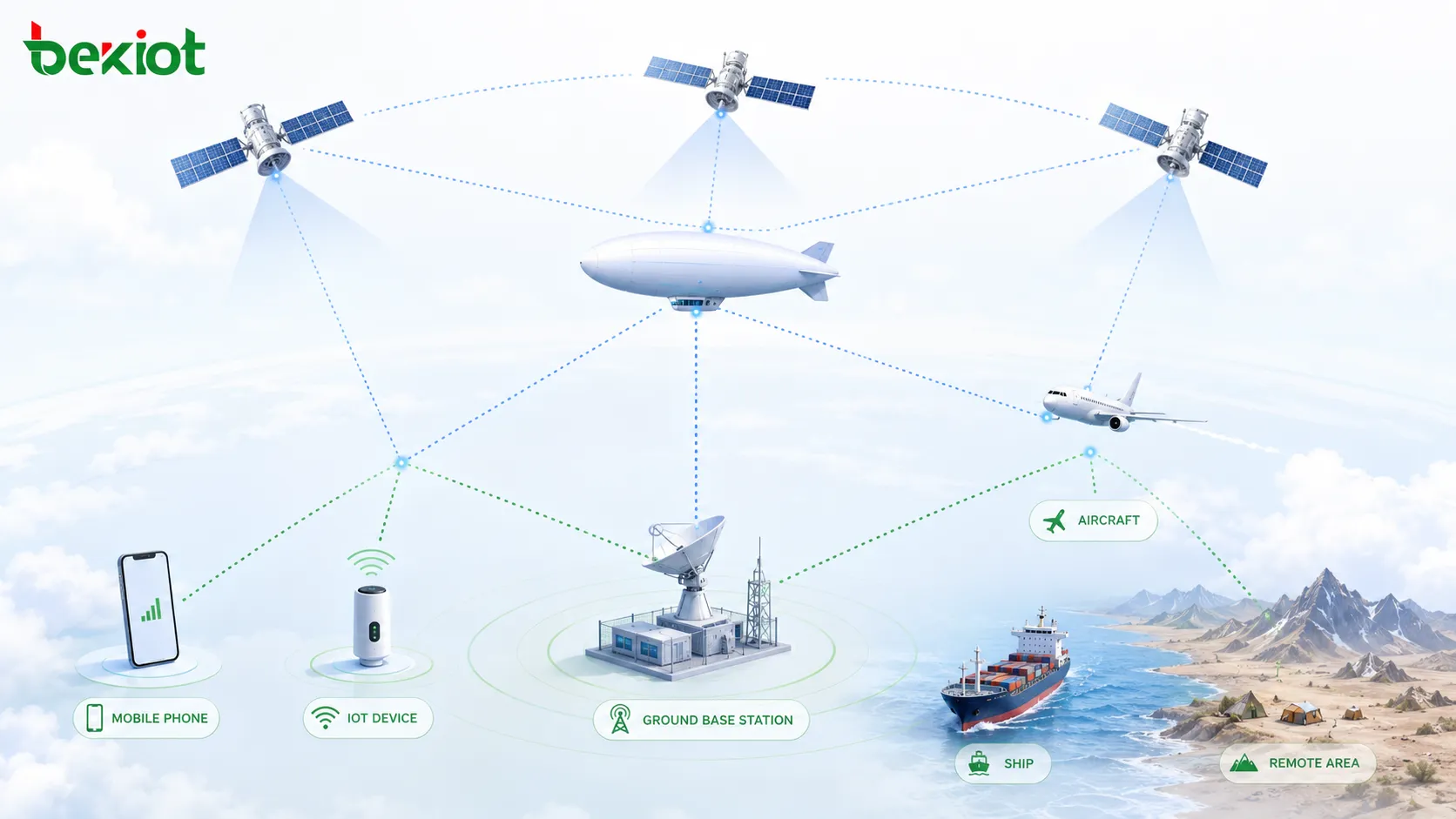
What NTN Means in Future Mobile Networks
NTN stands for Non-Terrestrial Networks. It refers to communication networks that use non-ground infrastructure such as satellites, high-altitude platform stations, airborne communication nodes, and related space-air access systems. Compared with conventional terrestrial mobile networks, NTN expands the signal source from ground base stations to space-based and aerial platforms.
Today’s 4G and 5G networks mainly depend on towers, base stations, fiber backhaul, power supply, and regional deployment density. These systems work well in cities, campuses, highways, factories, ports, and population centers. However, they are difficult or expensive to deploy in sparsely populated regions, oceans, mountains, remote industrial sites, and disaster-affected areas.
NTN fills this gap. By using satellite and high-altitude coverage, it can provide communication access where ground networks are absent, damaged, or overloaded. In simple terms, NTN gives mobile communication another coverage layer above the ground network.
Why NTN Is Important for 6G
6G is expected to move beyond the idea of a purely terrestrial mobile network. Instead of only improving ground-based 5G capacity and latency, 6G will likely combine terrestrial networks, satellite communication, airborne platforms, edge computing, AI-driven network control, and massive IoT access into a more flexible system.
NTN is one of the key technologies behind this direction. It helps mobile networks extend from cities to remote areas, from land to sea, from ground routes to aviation corridors, and from human communication to machine communication. This makes NTN an important foundation for global coverage, emergency communication, remote sensing, unmanned systems, and wide-area IoT.
The technical meaning is clear: 6G will not only be faster than 5G. It will also aim to be more available, more resilient, and more continuous across different environments. NTN gives future networks a way to serve locations that traditional base station construction cannot cover efficiently.
From Special Satellite Phones to Ordinary Devices
In the past, satellite communication often required dedicated satellite phones, large antennas, expensive terminals, and specialized service plans. For ordinary users, this made satellite access feel distant, costly, and inconvenient.
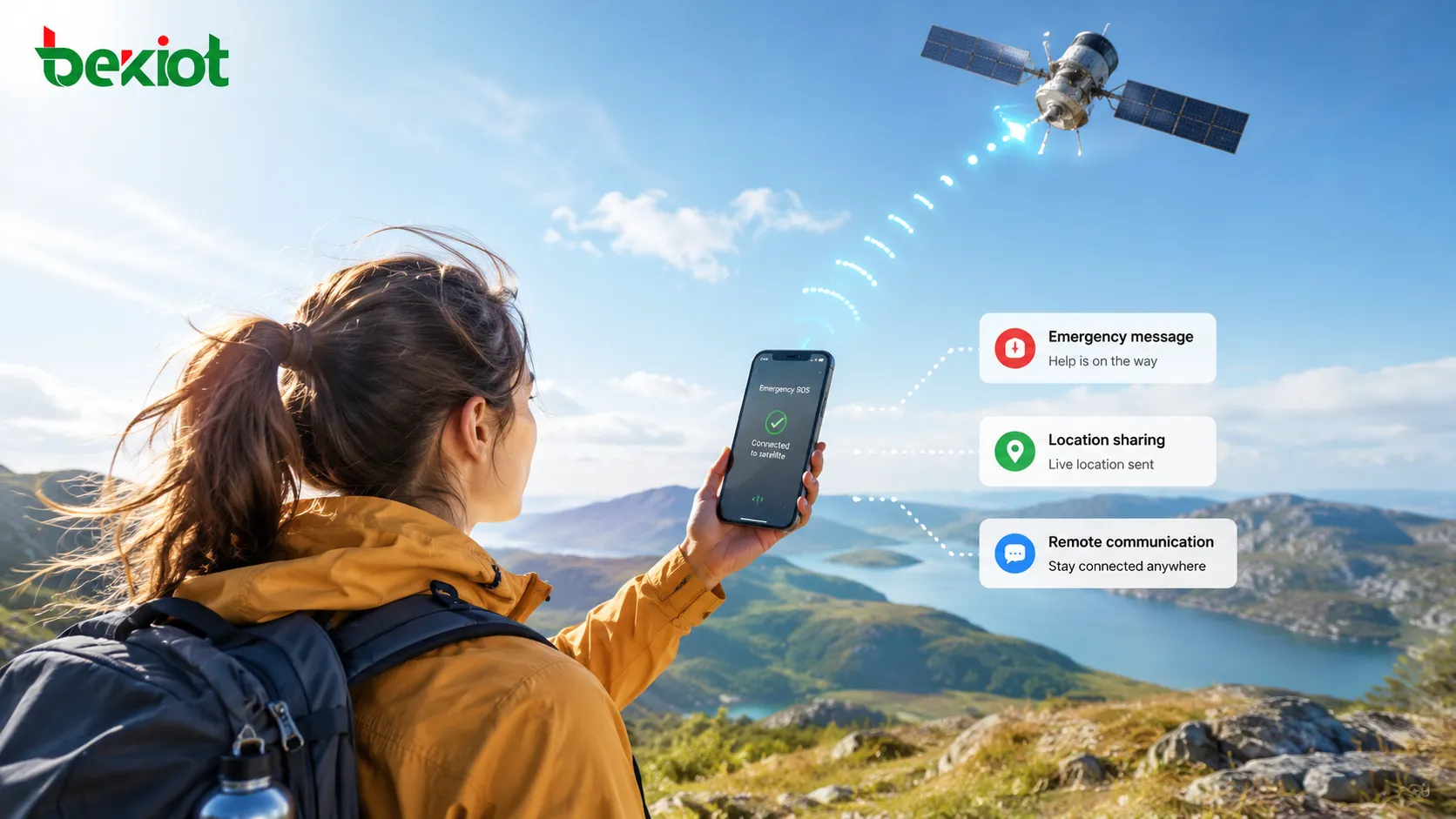
NTN changes this experience by introducing standardized integration between satellite systems and mobile communication systems. The long-term goal is that users may access satellite-assisted services through ordinary mobile devices, without changing SIM cards, replacing phone numbers, or carrying bulky satellite phones.
This does not mean every mobile phone will immediately support high-speed satellite broadband. Early services may focus on emergency messaging, location reporting, short data transmission, or limited voice/data functions. However, the direction is significant: satellite connectivity is moving closer to the mainstream mobile ecosystem.
Standardization Makes NTN More Practical
One reason NTN is becoming important is that it is not just an isolated satellite communication concept. NTN has been included in international mobile communication standardization work, including 3GPP-related evolution. This helps device manufacturers, network equipment vendors, operators, satellite companies, chip suppliers, and application providers work with a more consistent technical framework.
Standardization matters because communication systems must interoperate. If every satellite operator, device maker, and telecom platform uses a completely independent technical route, large-scale adoption becomes difficult. With common rules for access, signaling, mobility, service continuity, and device behavior, NTN can become part of the broader mobile network ecosystem.
For industry users, this means NTN can gradually move from custom satellite projects toward more scalable commercial solutions. For telecom operators, it creates a path to combine terrestrial mobile networks with satellite coverage. For device makers, it supports a clearer roadmap for future terminals and modules.
Coverage Beyond Traditional Base Stations
The most direct advantage of NTN is wider coverage. Ground base stations need site acquisition, tower construction, power supply, transmission links, maintenance access, and enough user density to justify investment. In remote or harsh environments, this can be difficult.
NTN can cover areas that are hard to serve with conventional infrastructure. Low Earth orbit satellites can provide lower-latency and wide-area service. Higher orbit satellites can cover very large regions. High-altitude platform stations can provide regional coverage from the stratosphere or aerial layer. These resources can be combined with terrestrial networks to reduce blind spots.
This is especially useful for oceans, remote mountains, deserts, forests, border regions, polar areas, rural zones, long-distance transportation routes, and temporary field operations. Instead of building base stations everywhere, NTN provides an additional coverage layer where ground deployment is impractical.
A Stronger Backup for Emergency Communication
Emergency communication is one of the most important NTN use cases. During earthquakes, floods, typhoons, landslides, wildfires, and major accidents, ground base stations may lose power, fiber links may be damaged, and mobile networks may become overloaded. When this happens, the ability to send a message, report a location, or request help can become critical.
NTN can provide a backup communication path when the terrestrial network is unavailable. For ordinary users, this may mean sending an emergency message or location from a remote place. For rescue teams, it may mean maintaining basic data access, command coordination, field reporting, or emergency device connectivity when local infrastructure is damaged.
In emergency system design, NTN should be viewed as a resilience layer. It can work together with command vehicles, satellite terminals, 4G/5G bonding routers, radio systems, temporary base stations, drones, and dispatch platforms. The result is a more robust communication framework for disaster response and public safety.
Better Safety for Travel, Outdoor Work, and Mobility
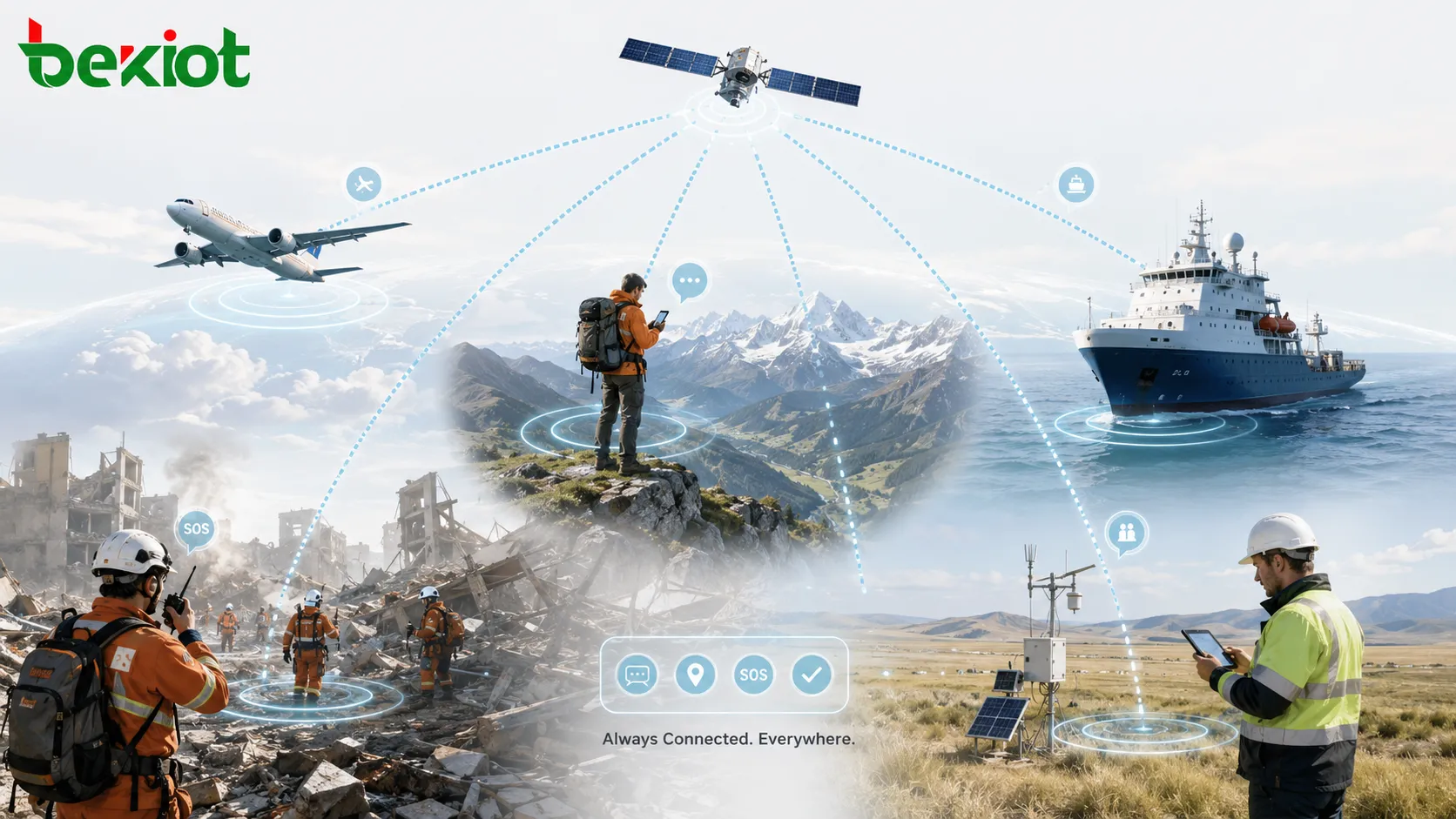
NTN also improves communication safety for people and assets in motion. Outdoor travelers, long-distance drivers, maritime crews, aviation users, scientific teams, field engineers, and emergency workers may all enter areas where ground mobile coverage becomes unreliable.
In these scenarios, even a low-bandwidth connection can be valuable. A user may only need to send a short message, share a location, report safety, trigger an emergency alert, or receive critical instructions. NTN can provide a communication path in situations where a normal mobile phone would otherwise show no service.
For vehicles, vessels, aircraft, and field teams, NTN can also support tracking, status reporting, remote telemetry, and basic data exchange. This makes it valuable for logistics, maritime operations, aviation support, border patrol, forestry, mining, energy, and long-distance transportation.
How NTN Supports Wide-Area IoT
NTN is not only for mobile phone users. It also has strong value for the Internet of Things. Many IoT devices are deployed exactly where terrestrial networks are weak: outdoor cameras, power transmission monitoring terminals, pipeline sensors, remote weather stations, livestock tracking devices, maritime asset trackers, environmental monitoring points, and field security devices.
Traditional IoT networks often rely on cellular coverage, LoRa gateways, private wireless networks, fiber access, or local base stations. These options work well in controlled areas, but they become harder to maintain when devices are spread across very large or remote regions.
NTN can help keep these devices connected. A sensor may not need high bandwidth, but it may need reliable periodic data upload. A remote monitoring device may only transmit alarm data, location, temperature, pressure, humidity, battery status, or equipment state. For these use cases, satellite-assisted IoT can be more practical than building ground coverage everywhere.
Key Technical Elements in NTN Deployment
NTN deployment involves more than launching satellites. A complete system includes satellite or aerial access nodes, ground gateway stations, user terminals, mobile core network integration, service platforms, spectrum planning, antenna design, mobility management, delay compensation, and network security.
Different orbital systems have different characteristics. Low Earth orbit satellites can provide lower latency and more flexible service, but require a larger constellation for continuous coverage. Geostationary satellites can cover large areas, but usually have higher latency. High-altitude platforms may support regional service and can be useful for temporary or targeted coverage.
Terminal design is another key factor. For ordinary mobile devices, power consumption, antenna capability, signal strength, chip support, and service availability must be carefully balanced. For industrial terminals, the focus may include rugged design, low power consumption, long operating life, environmental protection, and stable remote management.
Challenges That Still Need Engineering Solutions
Although NTN has clear advantages, it also faces technical and commercial challenges. Satellite links may have higher latency than terrestrial links, especially depending on orbit type. Bandwidth may be limited compared with dense urban 5G networks. Terminal power consumption, antenna performance, indoor penetration, weather influence, and service pricing must also be considered.
Mobility management is another challenge. A device may move between terrestrial networks and satellite networks, or between different satellite beams. The network must manage handover, signaling, timing, frequency offset, and service continuity. These requirements are more complex than a normal ground-only mobile network.
For project design, NTN should not be treated as a universal replacement for fiber, Wi-Fi, private LTE, LoRa, or 5G. It should be used where it creates clear value: coverage extension, emergency backup, remote IoT, mobile asset tracking, maritime access, aviation corridors, and resilient communication.
Practical Architecture for Industry Solutions
A practical NTN solution may combine terrestrial 5G, satellite access, IoT terminals, cloud platforms, command centers, and local edge systems. In normal conditions, the device may use terrestrial mobile networks. When the device moves outside coverage or when terrestrial infrastructure fails, the system can switch to satellite-assisted communication.
In an emergency communication project, NTN may work with field command vehicles, portable satellite terminals, radio systems, temporary base stations, UAV relays, GIS platforms, and dispatch systems. In an IoT project, NTN may connect remote sensors to cloud dashboards, alarm platforms, maintenance systems, and asset management platforms.
The best solution is often hybrid. Terrestrial networks provide high bandwidth and low cost where coverage exists. NTN provides wide-area reach and resilience where terrestrial networks are unavailable. Together, they create a more complete communication framework for future connected services.
Where NTN Creates the Most Value
NTN is especially suitable for scenarios that require coverage beyond normal ground infrastructure. These include emergency rescue, maritime operations, aviation routes, remote tourism, long-distance logistics, energy infrastructure, forest fire prevention, environmental monitoring, agriculture, animal tracking, field research, and remote industrial automation.
For consumer users, the most visible value may be emergency messaging and location sharing. For industry users, the strongest value may be wide-area device connectivity and remote asset visibility. For governments and operators, NTN provides a way to improve national communication resilience and reduce coverage blind spots.
For communication solution providers, NTN also creates opportunities to integrate satellite access with voice dispatch, emergency communication, IoT monitoring, public safety platforms, and field command systems. The value is not only the satellite link itself, but how that link is connected with real operational workflows.
Conclusion
NTN is a key technology direction for 6G because it extends communication beyond terrestrial base stations. By integrating satellites, high-altitude platforms, ground networks, mobile devices, and IoT terminals, NTN can support wider coverage, emergency access, outdoor safety, maritime and aviation communication, remote monitoring, and future air-space-ground network integration.
The most important point is that NTN is not designed to replace 5G. It complements terrestrial networks and makes future communication more continuous, resilient, and globally available. As standards mature, satellite resources expand, and ordinary devices gain better satellite capability, NTN will become an important part of the next-generation communication landscape.
FAQ
Will NTN work indoors like normal mobile coverage?
NTN usually depends on satellite or aerial signal paths, so indoor performance may be limited by walls, roofs, metal structures, and antenna orientation. Outdoor or near-window usage is typically more suitable, especially for direct-to-device satellite services.
Can NTN provide the same speed as urban 5G?
Not in most early deployments. NTN is mainly valuable for coverage, continuity, and resilience. High-speed services may be possible in some satellite systems, but dense urban 5G will usually provide higher capacity and lower cost where ground infrastructure is available.
What types of IoT devices benefit most from NTN?
Devices that are remote, mobile, widely distributed, or hard to maintain benefit the most. Examples include maritime trackers, pipeline sensors, power line monitoring terminals, field weather stations, wildlife trackers, and emergency alarm devices.
What should be considered before using NTN in an industry project?
Project teams should evaluate coverage area, terminal type, power supply, antenna placement, data volume, reporting interval, latency tolerance, service cost, cybersecurity, platform integration, and whether terrestrial networks can be used as the primary or backup path.







