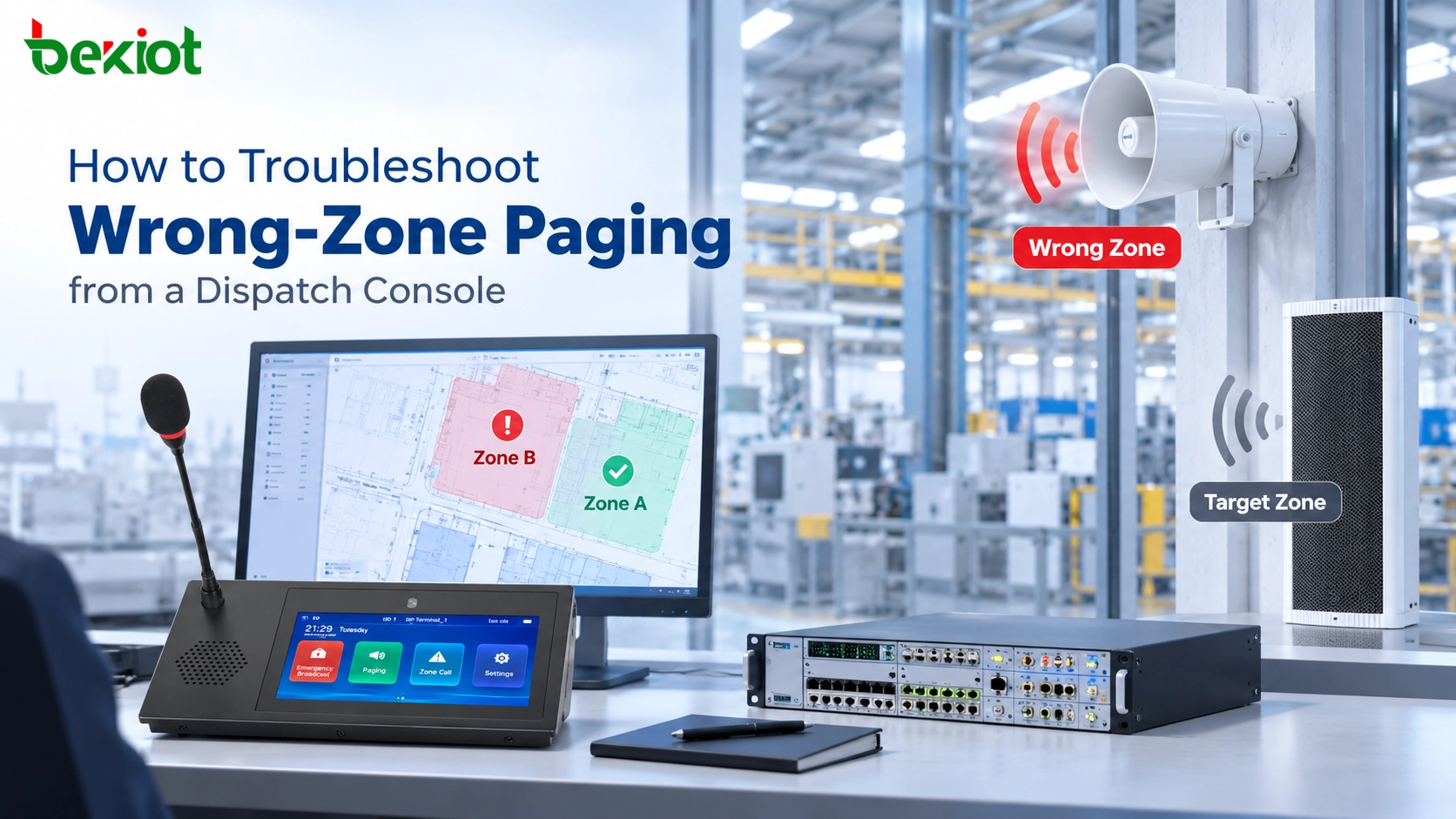
Satellite IoT is becoming an important connectivity option for industries that need to collect data from remote assets, mobile equipment, offshore facilities, long-distance infrastructure, and areas where terrestrial networks are unavailable or unreliable. As launch costs decline, satellite manufacturing becomes more industrialized, and satellite communication services become more accessible, satellite-based IoT is moving from a specialized technology into a practical solution for real projects.
Unlike conventional IoT systems that depend mainly on 4G/5G coverage, wired networks, or local private networks such as LoRa, satellite IoT can provide data transmission across wide and difficult-to-cover areas. It is especially valuable for oil and gas pipelines, power transmission corridors, railway routes, maritime vessels, environmental monitoring stations, emergency response systems, and remote industrial sites.
A Broader Connectivity Layer for Remote Assets
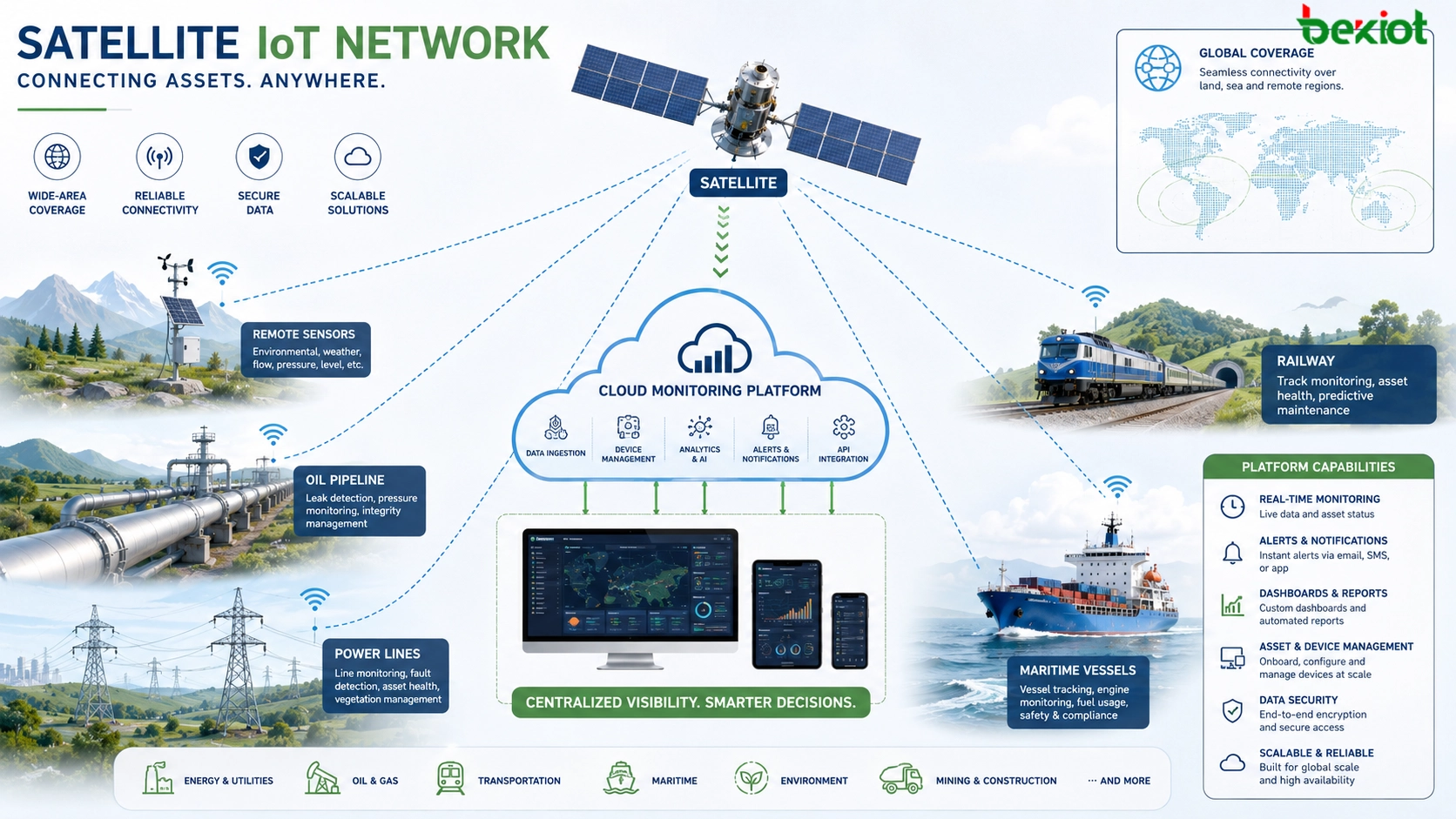
Most IoT data transmission today still relies on mobile operator networks or private local networks. Operator networks can provide strong performance where 4G or 5G coverage is available, but they cannot fully solve communication problems in deserts, mountains, oceans, border regions, forests, pipelines, and other remote areas.
Private LoRa systems can be cost-effective for local area deployments, but they require gateways, power supply, site planning, maintenance, and network management. When the deployment area becomes very large, the number of access points and supporting infrastructure can increase quickly. This may raise the total cost and make long-term maintenance more complicated.
Satellite IoT solves this problem by using satellite links as the communication path. It is not limited by local base station coverage and can be deployed in locations where terrestrial networks are weak, damaged, or unavailable. For cross-regional infrastructure such as oil pipelines, power lines, railway corridors, and ocean-going vessels, satellite transmission can often be a more practical and economical choice than building a large number of ground network sites.
Industry Momentum Is Accelerating
Satellite IoT is gaining attention because satellite resources are becoming richer and more commercially available. The launch of new satellite groups, the expansion of low-earth-orbit and other satellite systems, and the entry of more telecom operators into satellite service markets are changing the industry landscape.
One example is the development of the Geely constellation. After the launch of its 06 group satellites, the number of in-orbit satellites reached 64, giving the constellation operational capability. In China, the Ministry of Industry and Information Technology has also issued satellite operation licenses to China Unicom and China Mobile, showing that satellite communication is becoming more closely connected with mainstream telecom and IoT services.
These developments matter because satellite systems are not only used for broadband access or emergency communication. One of their important application directions is IoT data transmission. As more satellite operators, device vendors, and industry integrators enter the market, satellite IoT products and service packages are expected to become more mature.
Fast Deployment Without Heavy Local Infrastructure
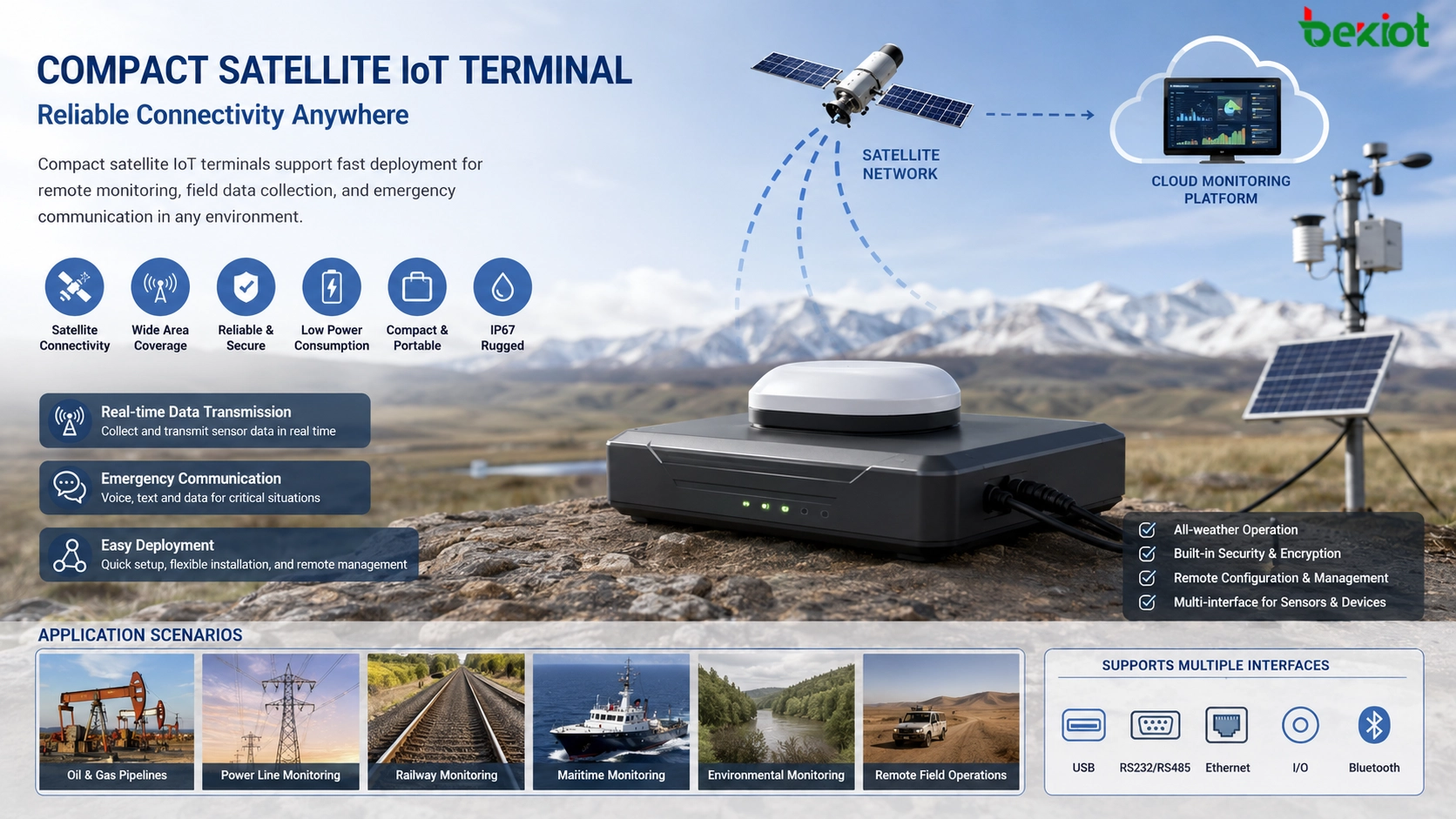
Modern satellite IoT terminals are very different from traditional large satellite communication devices. Many terminals are now highly integrated, compact, and easier to install. In some scenarios, deployment can be completed within minutes, especially when the terminal is designed for plug-and-play field operation.
This is important for remote monitoring projects. A field team may need to install a sensor station, emergency call device, environmental monitoring node, equipment status terminal, or remote control unit in an area without network infrastructure. If the communication terminal can be quickly powered, aligned, configured, and connected, the project timeline becomes much shorter.
Satellite IoT also reduces the need for repeated ground network construction. Instead of building local towers, repeaters, wired access points, or many private gateways, the terminal can transmit data through satellite links. This makes satellite IoT suitable for temporary projects, emergency deployments, mobile operations, and remote sites where civil construction is difficult.
Bandwidth Is Sufficient for Many IoT Tasks
Satellite IoT is not always designed for high-bandwidth video or large file transmission. Its real value is stable data connectivity for devices that send small or medium-size data packets. Many satellite IoT terminals can provide data bandwidth from tens of Kbps to hundreds of Kbps, which is enough for a wide range of industrial IoT applications.
Typical use cases include sensor data upload, equipment status reporting, alarm transmission, remote telemetry, control signaling, location tracking, environmental data collection, pipeline pressure monitoring, power line status reporting, and emergency message transmission. These applications often need reliability and coverage more than very high bandwidth.
Satellite IoT can also support two-way communication. This means the monitoring center can not only receive data from field devices, but also send commands, configuration updates, control messages, or status requests back to the terminal. For unattended sites and distributed assets, two-way data transmission improves remote operation capability.
Better Management for Industry Private Networks
Satellite IoT can be organized as a dedicated data network for industry users. Instead of relying only on public terrestrial networks, enterprises can build a more controlled communication environment for their own devices, assets, and monitoring platforms.
For large-scale industry projects, the system can allocate satellite resources, manage terminal groups, adjust service plans, and support different access policies according to project requirements. Satellite beams and terminal resources can be planned more flexibly for users with large-area operations.
This makes satellite IoT useful for companies that operate distributed infrastructure across provinces, countries, offshore areas, or remote regions. A unified data network can make device management, data routing, alarm handling, and remote maintenance more consistent.
Higher Reliability During Disasters and Network Outages
One of the strongest advantages of satellite IoT is reliability when ground infrastructure fails. Natural disasters, floods, earthquakes, landslides, typhoons, fires, and power failures can damage base stations, optical cables, local gateways, and power supply systems. When terrestrial infrastructure is interrupted, satellite links can still provide an independent communication path.
This makes satellite IoT valuable for emergency monitoring and disaster response. A flood monitoring station, emergency call terminal, remote weather station, or field sensor can continue sending data even when nearby ground networks are unavailable. For emergency management teams, this continuity can help maintain situational awareness during the most critical period.
Some satellite IoT terminals use C-band transmission, which can provide stable performance in harsh weather conditions. In addition, certain terminals may support multi-mode communication, allowing the device to switch between available satellite systems or communication paths when needed. This helps improve service continuity for critical applications.
Lower Equipment and Service Costs Over Time
In the past, satellite communication was often considered expensive and difficult to use. Equipment costs, service fees, and system complexity limited its adoption. However, this situation is changing as satellite manufacturing becomes more industrialized, launch costs decline, and satellite resources become more abundant.
Satellite IoT terminals are becoming smaller, more integrated, and more affordable. In industries such as oil, power, transportation, and remote infrastructure monitoring, satellite IoT has already started to appear in practical projects. As the supply chain matures, the cost of terminals and services is expected to continue decreasing.
Cost should also be evaluated from a system perspective. In some remote projects, satellite IoT may reduce the need for towers, repeater stations, wired networks, maintenance visits, and complex field infrastructure. Even if the communication service has a recurring fee, the total cost may still be reasonable compared with building and maintaining a wide-area ground network.
Lower Power Consumption for Outdoor Applications
Power consumption is a key factor for outdoor IoT. Many devices are deployed in locations where grid power is unavailable, unstable, or expensive to provide. A practical satellite IoT terminal should work with batteries, solar panels, or low-power field systems.
With the development of phased-array antennas, low-earth-orbit satellite technologies, compact RF modules, and low-power communication designs, satellite IoT terminals are becoming more suitable for outdoor and unattended deployments. Lower power consumption makes it easier to support long-term monitoring in remote environments.
For example, a pipeline monitoring station, river water level sensor, remote power tower monitoring node, or wildlife observation device may only need to send small data packets at intervals. In these scenarios, low-power satellite IoT terminals can extend operating time and reduce maintenance frequency.
Strong Fit for Long-Distance Infrastructure
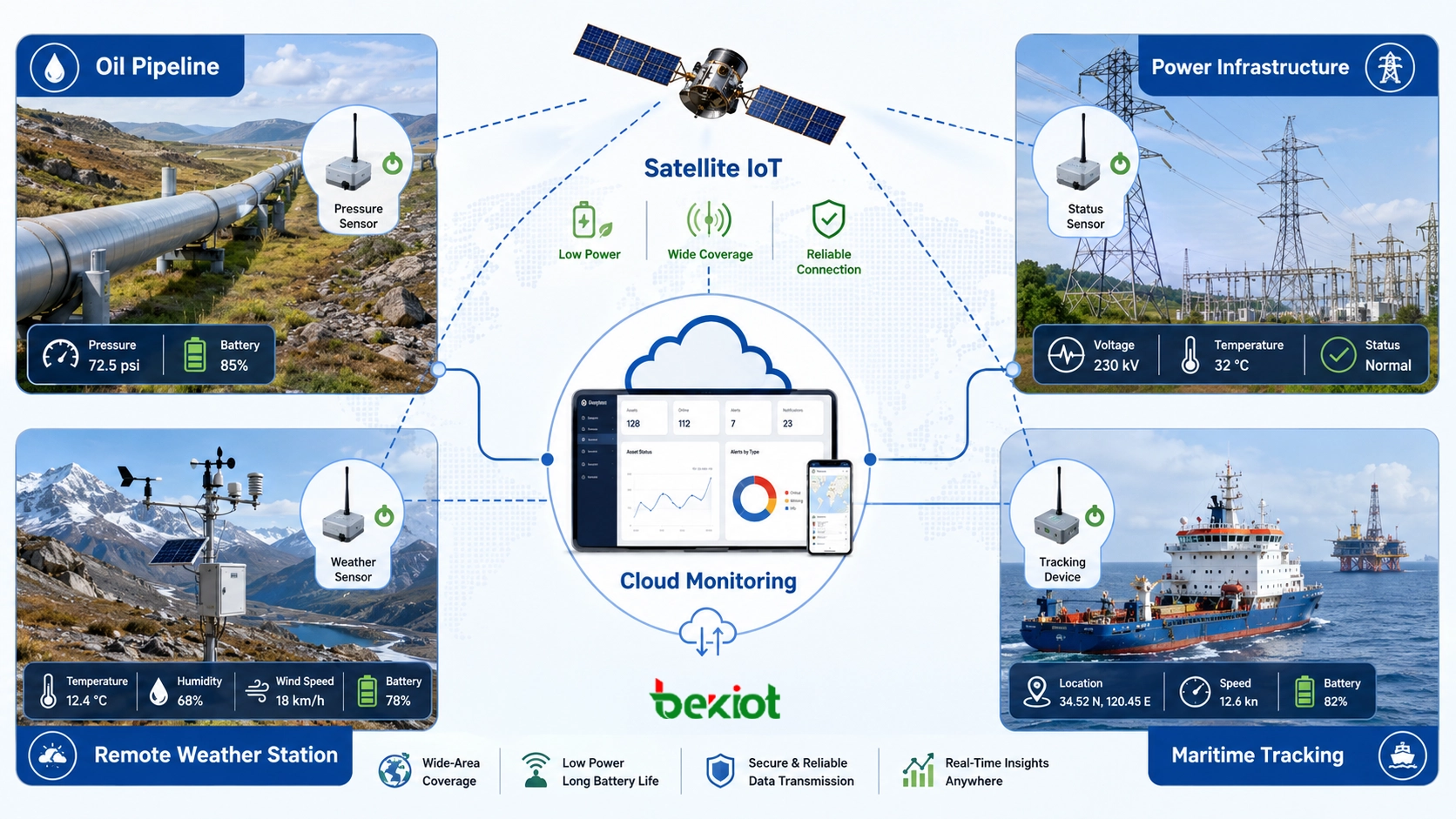
Long-distance infrastructure is one of the most suitable application areas for satellite IoT. Oil and gas pipelines may cross deserts, mountains, grasslands, and remote industrial regions. Power transmission lines may pass through areas where cellular coverage is unstable. Railways may include long sections outside city networks. Maritime assets may remain outside terrestrial coverage for long periods.
In these cases, the value of satellite IoT is not only connectivity. It also supports preventive maintenance, safety monitoring, asset tracking, fault alerts, and remote operation. Instead of waiting for manual inspection or delayed reports, operators can receive regular data from distributed assets.
This can improve operational efficiency. For example, pipeline operators can monitor pressure and leakage risks. Power companies can track tower status and environmental conditions. Railway operators can collect data from remote sites. Maritime operators can monitor vessel position and equipment status across open waters.
Useful for Emergency and Temporary Networks
Satellite IoT is also well suited for emergency communication and temporary field networks. When a disaster happens, response teams may need to deploy sensors, emergency terminals, portable stations, rescue equipment trackers, and command support devices quickly.
Because satellite IoT does not depend entirely on local ground networks, it can provide a backup communication path for field information. It can support data reporting from temporary shelters, rescue areas, flood control sites, forest fire zones, landslide monitoring points, and emergency supply stations.
In an integrated emergency communication architecture, satellite IoT can work together with radios, 4G/5G routers, command vehicles, drones, portable power systems, and dispatch platforms. The satellite link provides wide-area resilience, while local communication systems handle on-site coordination.
Technical Architecture for Satellite IoT Projects
A typical satellite IoT system includes field sensors, satellite IoT terminals, satellite links, ground gateway stations, cloud platforms, application servers, and monitoring dashboards. The sensor collects data, the terminal packages and transmits the data, the satellite network forwards it, and the application platform processes it for monitoring, alarms, reporting, or control.
In industrial projects, the system may also integrate with SCADA platforms, GIS maps, alarm systems, maintenance systems, asset management platforms, or emergency command platforms. Data can be visualized by location, device type, alarm level, operation status, or historical trend.
For critical deployments, the architecture should consider terminal power supply, antenna installation angle, satellite visibility, data reporting interval, encryption, device authentication, cloud interface, local data backup, and failover strategy. A well-designed system is not only about the satellite link; it must also match the operational workflow of the industry user.
Where Satellite IoT Provides the Most Value
Satellite IoT is not intended to replace every terrestrial IoT network. In urban areas, factories, campuses, and places with strong fiber, Wi-Fi, NB-IoT, LoRa, or 4G/5G coverage, terrestrial networks may still be more cost-effective and provide higher bandwidth.
The strongest value of satellite IoT appears where coverage is the main problem. Remote locations, mobile assets, offshore environments, disaster areas, large outdoor routes, and cross-regional infrastructure are typical examples. In these cases, satellite IoT can provide a practical communication layer that terrestrial networks cannot always guarantee.
The best architecture is often hybrid. Terrestrial networks can be used where they are available, while satellite IoT provides coverage extension, backup communication, and remote access. This hybrid model can balance cost, bandwidth, reliability, and deployment flexibility.
Conclusion
Satellite IoT offers clear advantages in wide-area coverage, remote deployment, reliable communication, two-way data transmission, easier field installation, lower infrastructure dependence, and improving cost performance. It is especially suitable for remote monitoring, long-distance infrastructure, maritime operations, emergency response, environmental sensing, and outdoor industrial IoT.
As satellite resources increase, telecom operators expand satellite service capabilities, terminal devices become smaller, and power consumption continues to decrease, satellite IoT will become more practical for industry users. For organizations that need reliable data links beyond the reach of terrestrial networks, satellite IoT is no longer only a future concept. It is becoming a deployable solution for real-world operations.
FAQ
Does satellite IoT require a clear view of the sky?
In most cases, yes. The terminal should be installed where it has suitable satellite visibility. Buildings, metal structures, mountains, dense forests, or incorrect antenna angles may affect signal quality, so site selection and antenna placement should be checked before deployment.
Is satellite IoT suitable for real-time video transmission?
It depends on the satellite service type and available bandwidth. Many satellite IoT systems are optimized for small data packets rather than continuous video. For video applications, high-throughput satellite terminals or hybrid backhaul solutions may be required.
How can satellite IoT data be secured?
Security can be improved through device authentication, encrypted transmission, VPN access, platform permission control, secure APIs, and regular key or credential management. Critical infrastructure projects should include cybersecurity planning from the design stage.
What should be considered when choosing a satellite IoT terminal?
Important factors include supported satellite network, data rate, power consumption, antenna type, environmental protection level, operating temperature, interface options, installation method, cloud platform compatibility, and long-term service cost.