


Noise reduction is a set of audio processing methods used to make voice communication clearer by reducing unwanted background sound. In communication systems, it helps users hear speech more accurately in places where machinery, wind, traffic, alarms, crowds, ventilation systems, or electrical interference may affect call quality. It is widely used in IP phones, intercoms, dispatch consoles, emergency call boxes, public address systems, radios, headsets, video conferencing terminals, and industrial communication devices.
For business and industrial users, noise reduction is not only a comfort feature. It can directly affect safety, response speed, command accuracy, recording quality, and customer service efficiency. A clear voice channel helps operators confirm instructions, report incidents, coordinate field teams, and reduce repeated calls caused by unclear speech.
Why Clear Audio Matters in Real Communication
Voice quality affects decision-making
In daily office calls, poor audio may only cause inconvenience. In industrial plants, transportation hubs, emergency centers, hospitals, warehouses, tunnels, and public safety environments, poor voice quality can delay action or create misunderstanding. A short sentence such as “stop the pump,” “evacuate gate two,” or “send maintenance to line three” must be heard correctly the first time.
Background noise makes this difficult because microphones do not naturally understand which sound is important. They capture a mixture of speech, machine vibration, alarm tones, wind, echo, and environmental reflections. Noise reduction technology analyzes the captured signal and attempts to preserve the human voice while lowering unwanted sound components.
It supports both live calls and recorded evidence
Many modern communication systems record calls for quality review, incident investigation, compliance, and operational traceability. If the original audio is full of noise, the recorded file may be difficult to review later. Noise reduction improves not only the live conversation but also the usefulness of stored communication records.
This is especially important in control rooms, emergency response systems, railway dispatch, industrial command centers, and security operations. When voice records need to support investigation or process improvement, intelligibility becomes part of the system value.
How It Works in Communication Devices
Digital signal processing
Most modern noise reduction systems use digital signal processing, often called DSP. After the microphone captures sound, the audio signal is converted and analyzed by software or a dedicated audio processor. The processor identifies patterns that are more likely to be noise and reduces them before the signal is sent to the listener, recorder, or dispatch platform.
DSP can be built into endpoint devices, communication servers, recording systems, conference platforms, or software applications. In many projects, the best performance comes from combining good acoustic hardware with suitable software algorithms. A strong algorithm cannot fully compensate for a poorly placed microphone or a damaged speaker enclosure.
Speech detection and noise modeling
Noise reduction often depends on voice activity detection. The system estimates when a person is speaking and when only background noise is present. During non-speech moments, it can build a noise profile. During speech, it tries to suppress the noise while keeping the voice natural.
The challenge is balance. If the system removes too little noise, the call remains unclear. If it removes too much, the speaker may sound robotic, thin, or distorted. Good voice communication design aims for clear intelligibility without making the audio unnatural.
Echo control and acoustic design
Noise reduction is often used together with echo cancellation. Echo happens when a loudspeaker output returns to the microphone and is sent back into the call. This is common in hands-free phones, intercoms, paging terminals, conference rooms, tunnel phones, and public call stations.
Effective echo control depends on device layout, speaker volume, microphone direction, enclosure structure, and audio processing. In field communication devices, housing design and installation position can be just as important as software. A device mounted near reflective walls, metal panels, or loud machines may need careful tuning.
Core Features to Evaluate
Background noise suppression
The basic function is to reduce steady or semi-steady background noise, such as fans, engines, pumps, air conditioning, server rooms, traffic, power equipment, or general machinery hum. This improves listening comfort and makes speech easier to understand during long calls.
In industrial sites, background noise is rarely smooth or predictable. Equipment may start and stop, alarms may sound, vehicles may pass, and workers may speak from different distances. A useful system should handle changing noise without cutting off the beginning or end of words.
Wind and outdoor interference control
Outdoor communication points often face wind noise. Wind creates low-frequency bursts across the microphone and can make speech almost impossible to understand. This problem is common in emergency call boxes, tunnel entrances, ports, substations, roadways, parking areas, bridges, and open industrial yards.
Good outdoor design may combine microphone placement, windproof acoustic material, weather-resistant housing, and DSP-based filtering. For outdoor devices, noise reduction should be evaluated together with waterproofing, dust protection, temperature range, and mechanical durability.
Automatic gain and volume stability
Automatic gain control helps balance voice volume when speakers stand at different distances from the microphone or speak at different loudness levels. It can make quiet speech more audible and prevent loud speech from becoming uncomfortable or distorted.
However, gain control must be tuned carefully. If it raises the volume too aggressively during silent moments, it may also increase background noise. In professional systems, gain control, noise reduction, echo cancellation, and speaker volume should be configured as a complete audio chain.
| Feature | Main Purpose | Typical Benefit |
|---|---|---|
| Noise suppression | Reduces background sound around the speaker | Improves speech intelligibility in noisy workplaces |
| Echo cancellation | Prevents loudspeaker audio from returning into the microphone | Supports clearer hands-free calls and intercom conversations |
| Automatic gain control | Balances voice volume | Helps users hear both quiet and loud speakers more consistently |
| Wind noise reduction | Controls outdoor microphone interference | Improves call quality in open areas, roads, ports, and tunnels |
| Voice activity detection | Identifies speech and non-speech periods | Allows more accurate processing and cleaner audio transmission |
| Acoustic hardware design | Improves microphone and speaker performance | Reduces reliance on software correction alone |
Where It Is Used
Industrial phones and emergency communication
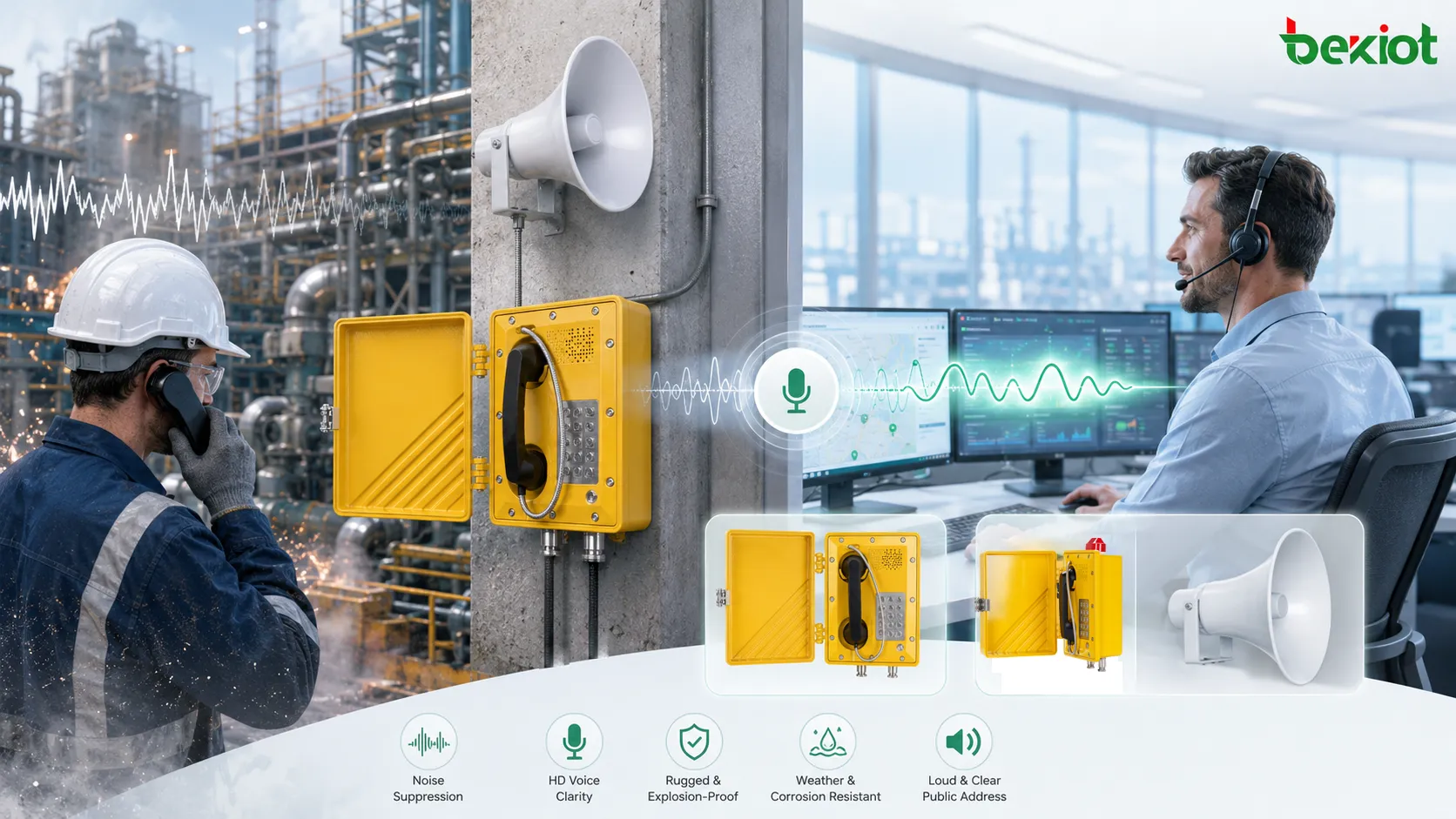
Factories, chemical plants, power stations, mines, steel mills, oil and gas sites, and logistics facilities often have high ambient noise. Workers may need to call a control room, report a fault, request assistance, or confirm an emergency instruction while standing near machines, compressors, pumps, conveyors, or vehicles.
In hazardous or heavy-duty environments, rugged endpoint design matters as much as the audio algorithm. For example, Becke Telcom’s EX-BH621 explosion-proof loudspeaker telephone can be considered for industrial sites where fixed voice communication needs to remain clear, durable, and suitable for demanding field conditions.
Dispatch centers and command rooms
Dispatch systems depend on fast voice coordination. Operators may communicate with field phones, SIP intercoms, radio gateways, mobile users, public address zones, and emergency call points. If one noisy endpoint enters the system, it can affect the whole conversation and make group coordination harder.
Noise reduction helps dispatchers focus on the caller’s voice rather than the environment behind the caller. It is especially useful when multiple calls, alarms, maps, video feeds, and radio channels are handled at the same time.

Public address and intercom systems
Noise reduction can support intercom and paging systems by improving the source audio before it is broadcast. When operators make announcements through microphones or SIP paging consoles, background sound from the control room can reduce message clarity. Cleaner input audio makes the final announcement easier to understand.
This is useful in schools, hospitals, stations, warehouses, factories, and campuses where announcements may be made during routine operations and emergency events. Clear source audio is especially important when the message is played across large areas or through multiple speaker zones.
Call centers and service hotlines
In customer service environments, noise reduction improves the experience for both agents and callers. It helps reduce keyboard noise, nearby conversations, ventilation sound, and office background activity. This can lower listening fatigue and improve call handling consistency.
For service teams that record calls, cleaner audio also supports training, quality monitoring, dispute review, and speech analytics. If automatic speech recognition is used, better audio quality can improve transcription accuracy.
Benefits for System Designers and Users
Better intelligibility in difficult environments
The most direct benefit is speech intelligibility. Users do not need to repeat the same message as often, and operators can understand calls more quickly. This improves work efficiency in routine communication and can reduce response time during incidents.
Noise reduction is especially valuable where workers wear helmets, gloves, masks, hearing protection, or protective clothing. In these environments, natural speech may already be less clear, so the communication device must provide additional support.
Improved reliability of emergency workflows
Emergency workflows often involve multiple steps: a caller reports a problem, the control room confirms location, the dispatcher assigns personnel, alarms or broadcasts are triggered, and records are saved. If the first voice call is unclear, the whole workflow may slow down.
A well-designed audio path improves the reliability of the response chain. It does not replace procedures, training, or system redundancy, but it helps each step work with fewer communication errors.
Clear audio is not only a device specification. It is part of the complete communication workflow, from the microphone at the field endpoint to the operator console, recording platform, and response procedure.
Selection and Deployment Considerations
Start with the noise environment
Before selecting a device or software feature, project teams should understand the real noise environment. A quiet office, a windy roadside call box, a compressor room, a subway tunnel, and a chemical plant loading area do not create the same audio problem. The noise type, intensity, frequency range, and direction all affect product selection.
Site testing is useful when possible. A product that performs well in a meeting room may not perform the same way near motors, horns, alarms, or outdoor wind. For important projects, field testing should include typical user distance, mounting height, network conditions, and actual operating noise.
Match hardware and software together
Noise reduction should not be viewed as a software checkbox only. Microphone quality, speaker placement, housing material, acoustic chamber design, cable shielding, power stability, mounting location, and network codec all influence final voice quality.
For IP-based systems, codec selection also matters. High-compression codecs may reduce bandwidth but can affect speech quality, especially after noise processing. For command, emergency, and industrial communication, audio clarity should be evaluated alongside bandwidth planning and system compatibility.
Avoid over-processing
Too much processing can damage speech. Users may hear pumping effects, missing syllables, metallic sound, or unnatural voice texture. This may be acceptable for casual communication, but it is not ideal for dispatch, emergency, or recorded evidence systems.
Professional tuning aims to reduce noise while preserving speech characteristics. In larger systems, endpoint-level processing and platform-level processing should be coordinated so the same audio is not aggressively processed multiple times.
Common Application Scenarios
Manufacturing and heavy industry
Manufacturing plants use noise reduction in industrial phones, SIP intercoms, paging microphones, wireless headsets, and operator terminals. It helps workers communicate around machines, production lines, loading docks, testing rooms, and maintenance areas.
In these environments, the system should also support rugged cabling, clear call routing, alarm integration, and easy maintenance. Audio quality is one part of a broader communication reliability requirement.
Transportation and public facilities
Roadside emergency phones, tunnel intercoms, railway platform call points, airport service phones, bus stations, ports, and parking facilities all face variable noise. Vehicles, crowds, wind, public announcements, and alarms can interfere with calls.
Noise reduction helps operators understand location, incident type, user condition, and required assistance. When combined with video, GIS, call recording, and dispatch software, clearer audio supports better situational awareness.
Healthcare, education, and commercial buildings
Hospitals, schools, campuses, shopping centers, hotels, and office complexes use noise reduction in nurse call systems, intercoms, security phones, reception desks, paging systems, and control rooms. These sites may not be as loud as industrial plants, but they often require calm, accurate, and fast communication.
In public-facing environments, better audio also improves user confidence. People are more likely to trust an emergency or help point when they can clearly hear the operator and be clearly understood in return.
Conclusion
Noise reduction is an important feature in modern voice communication systems. It reduces background sound, improves speech clarity, supports dispatch accuracy, strengthens emergency workflows, and improves the value of recorded communication. In industrial and public environments, it should be evaluated as part of the complete audio path rather than as a single isolated function.
The best results come from combining suitable endpoint hardware, microphone and speaker design, DSP algorithms, echo control, codec planning, installation quality, and real site testing. When these elements work together, communication becomes clearer, faster, and more reliable in the environments where voice clarity matters most.
FAQ
Does noise reduction remove all background sound?
No. It reduces unwanted sound but does not create perfect silence. Some background audio may remain because the system must preserve natural speech and avoid cutting important voice details.
Can noise reduction replace hearing protection in loud workplaces?
No. Noise reduction improves communication audio, but it does not protect workers from harmful environmental noise. Hearing protection and workplace safety controls are still required where sound levels exceed safe limits.
Will noise reduction affect emergency alarm tones?
It depends on system design. If alarms need to be heard through the same audio channel, processing should be tested carefully so important tones are not suppressed or distorted.
Is cloud-based noise reduction suitable for emergency systems?
It may be useful in some service environments, but critical communication systems should consider latency, network availability, data privacy, and offline operation. Local processing is often preferred for field emergency devices.
Can analog phones use noise reduction?
Yes, but the available methods depend on the device and system architecture. Some analog endpoints use acoustic design or built-in electronics, while IP gateways or recording platforms may provide additional processing after the audio is converted.
How should noise reduction be tested before deployment?
Testing should use real site noise, normal speaking distance, actual mounting position, expected network codec, and typical call routing. A lab test alone may not reveal wind, echo, vibration, or machinery noise problems.







