


Vandal resistance describes the ability of equipment, enclosures, terminals, and public-use devices to withstand deliberate damage, rough handling, impact, tampering, prying, scratching, forced access, and environmental abuse. It is commonly considered when designing or selecting emergency phones, intercoms, access control panels, public kiosks, cameras, call buttons, control stations, ticketing terminals, elevators, parking systems, and industrial communication endpoints.
In practical projects, vandal resistance is not a single feature or one universal certificate. It is the result of mechanical strength, material selection, impact rating, tamper-resistant hardware, protected cabling, secure mounting, weather sealing, anti-corrosion design, and easy maintenance. A product may look strong on the outside, but true vandal-resistant performance depends on how the whole device survives real public or industrial abuse over time.
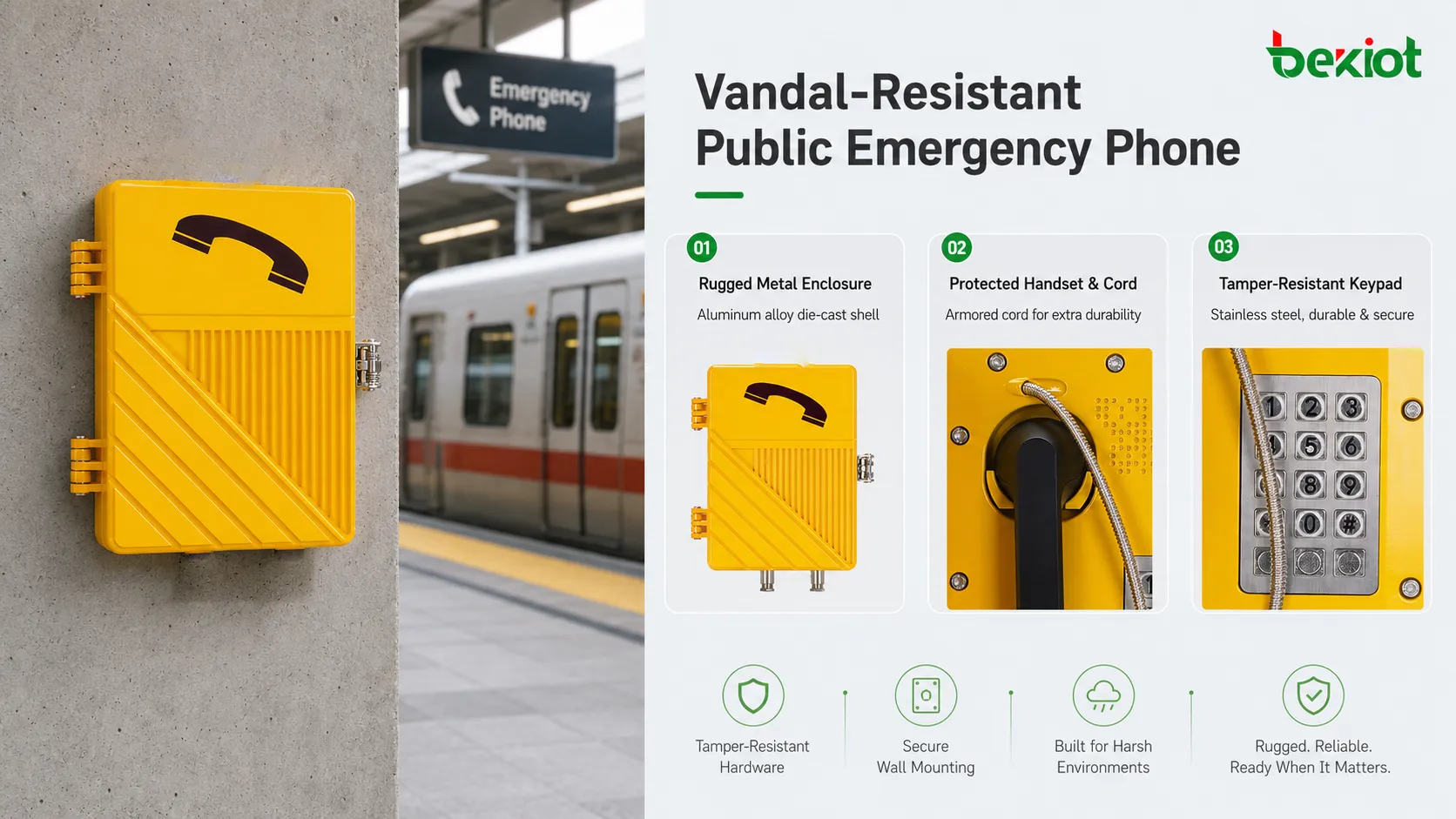
Why Vandal Resistance Matters
Public equipment is exposed to unpredictable behavior
Devices installed in public spaces are used by many people and are often unattended for long periods. They may face accidental knocks, intentional impact, pulling, scratching, graffiti, forced opening, button abuse, liquid exposure, and attempts to remove covers or cables. In some locations, equipment must continue working even after repeated misuse.
This is why vandal resistance is important for airports, rail stations, tunnels, parking lots, campuses, prisons, hospitals, shopping centers, roadside help points, public safety sites, industrial gates, logistics yards, and outdoor utility areas. The more accessible a device is, the more carefully its mechanical protection should be considered.
Failure can affect safety and service continuity
A damaged public device is not only a maintenance problem. If an emergency phone, help point, access panel, alarm button, camera, or intercom fails when someone needs assistance, the result can affect response time and user safety. Vandal resistance helps keep essential services available in places where supervision is limited.
For operators, stronger equipment also reduces repeated repair calls, spare part costs, downtime, and negative public perception. A device that remains presentable and functional after years of use supports both safety and operational reliability.
How Vandal-Resistant Design Works
Strength starts with the enclosure
The enclosure is the first line of defense. Vandal-resistant products often use stainless steel, thick aluminum alloy, zinc alloy, heavy-duty polycarbonate, reinforced engineering plastic, or powder-coated steel. The enclosure should resist impact, bending, corrosion, and unauthorized opening while still allowing normal operation, heat dissipation, sound transmission, and service access.
Design details matter. Rounded edges reduce pry points. Recessed buttons reduce direct impact. Flush-mounted front plates reduce the chance of grabbing or tearing. Protected speaker grilles reduce puncture risk. Internal hinges and concealed fasteners make forced entry more difficult.
Controls must survive repeated abuse
Buttons, keypads, handsets, microphones, speakers, card readers, displays, and touch areas are more exposed than the body of the device. If these parts fail easily, the enclosure rating alone is not enough. A vandal-resistant device should use components that can handle repeated pressing, impact, dirt, moisture, and cleaning.
For communication terminals, acoustic openings require special attention. The microphone and speaker need protection from tools, liquid, dust, and deliberate blockage, but they must still allow clear voice transmission. The best design balances protection and usability rather than simply covering every opening with heavy metal.
Installation is part of the protection
Even a rugged device can be damaged if it is mounted poorly. Exposed cable loops, weak brackets, accessible rear screws, loose wall anchors, unprotected conduit, or oversized gaps around the device can create attack points. Vandal-resistant deployment should include secure mounting surfaces, correct fasteners, protected cable routing, and proper sealing.
For high-risk areas, installers may use recessed mounting, back boxes, anti-tamper screws, internal cable entry, reinforced poles, protective frames, or surveillance coverage. The goal is to reduce both the chance of attack and the time available for someone to cause meaningful damage.
Standards and Ratings to Understand
IK rating and mechanical impact protection
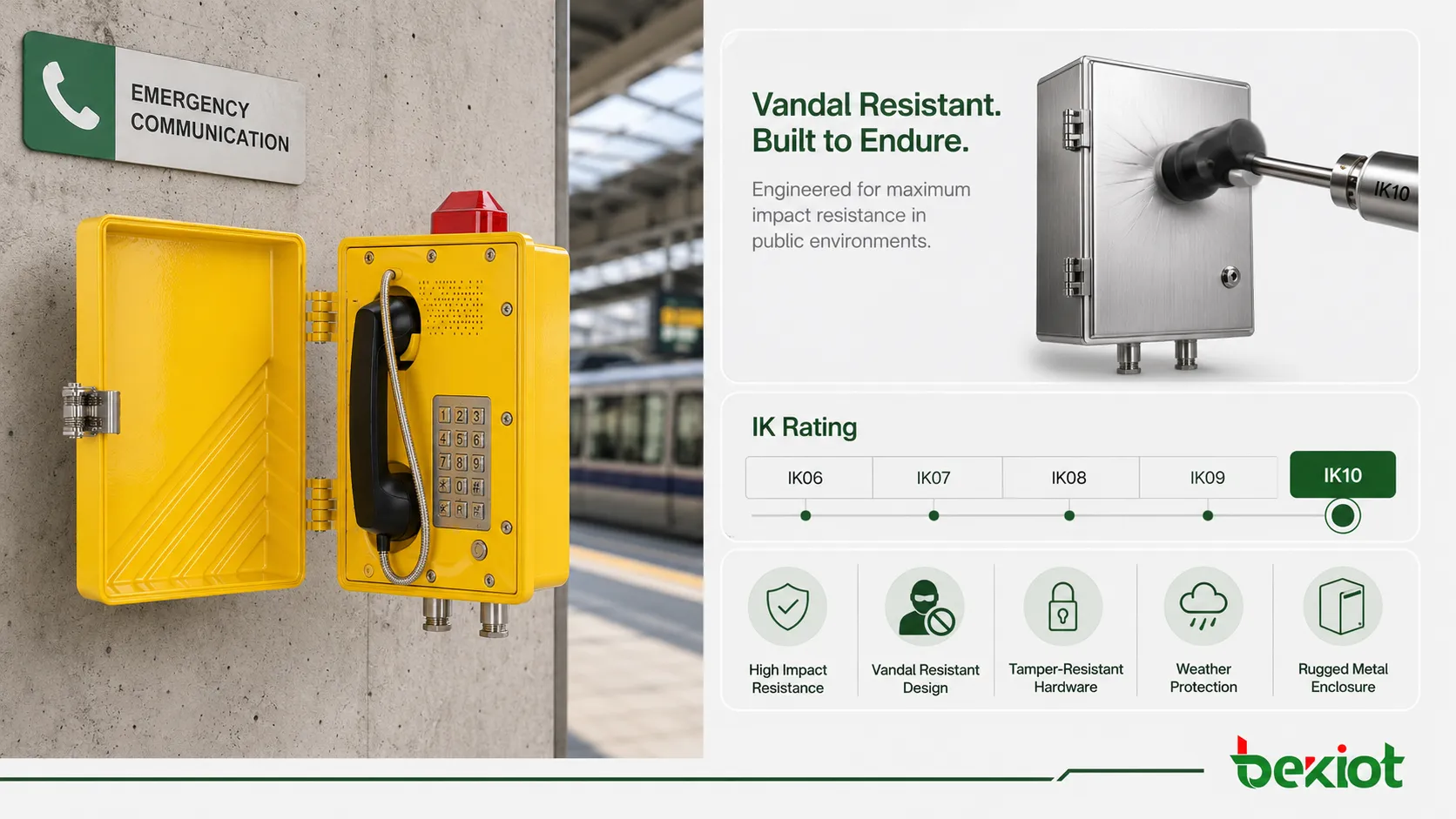
The most widely used reference for mechanical impact protection is the IK code. IEC 62262 classifies the degree of protection provided by electrical enclosures against external mechanical impacts. The code runs from IK00 to IK10, with higher values representing higher tested impact energy.
For example, IK08 represents 5 joules, IK09 represents 10 joules, and IK10 represents 20 joules of impact energy. In product selection, IK10 is often associated with high impact resistance, but it should not be treated as a complete vandal-proof guarantee. It tests a defined impact condition; it does not cover every possible real-world attack.
IP rating and environmental sealing
IP rating is different from IK rating. IEC 60529 defines the IP code for protection against solid objects and water ingress. A device may be IK10 for impact but still have poor water resistance. Another device may be IP66 for dust and water jets but not designed for heavy mechanical abuse.
For outdoor vandal-resistant equipment, both ratings are often important. Public-use devices may need impact resistance, rain protection, dust protection, UV resistance, corrosion protection, drainage design, and temperature stability. A strong enclosure that allows water ingress can still fail in service.
Tamper resistance and security hardware
Tamper resistance is related to vandal resistance but focuses more on preventing unauthorized opening, removal, or manipulation. It may include special screws, concealed hinges, internal brackets, cable entry from the rear, locked access panels, alarm contacts, reinforced mounting plates, and anti-pry edges.
Unlike IK and IP ratings, tamper resistance is often evaluated through product design, project requirements, and site risk rather than a single universal rating. For critical locations, buyers should ask how the device resists opening, cable removal, component theft, and repeated misuse, not only whether it has a high impact rating.
| Protection Item | What It Indicates | Why It Matters |
|---|---|---|
| IK rating | Resistance to defined external mechanical impact | Helps compare enclosure impact strength for public and industrial devices |
| IP rating | Resistance to dust and water ingress | Supports outdoor, washdown, dusty, or wet environments |
| Material thickness | Structural strength of the housing or faceplate | Reduces deformation, bending, and forced entry risk |
| Tamper-resistant screws | Difficulty of unauthorized opening | Protects internal wiring, electronics, and service components |
| Protected cable entry | How wiring enters the device | Prevents cable pulling, cutting, and water ingress at weak points |
| Secure mounting | Strength of wall, pole, or recessed installation | Prevents removal, loosening, vibration damage, and repeated impact failure |
Protection Ratings in Practical Selection
IK10 is useful, but not the whole answer
IK10 is often requested for vandal-resistant equipment because it is the highest common IK rating in many product datasheets. It indicates that the enclosure has been tested against a defined 20-joule mechanical impact. This is useful for comparing impact performance, especially for public terminals, call stations, intercoms, and cameras.
However, vandalism does not always follow a standard test. Real attacks may involve prying, repeated blows, sharp tools, pulling cables, burning, liquid pouring, graffiti, or attempts to block microphones and speakers. A good specification should combine IK rating with material design, tamper protection, environmental sealing, and maintainability.
Material choice affects both strength and lifecycle
Stainless steel is common in public and harsh environments because it offers strength, corrosion resistance, and a clean appearance. Aluminum alloy may provide a strong but lighter enclosure. Polycarbonate can resist impact while allowing transparent windows or covers. Powder-coated steel can be economical but may require careful corrosion protection if the coating is damaged.
The right material depends on location. Coastal sites may need corrosion resistance. Transport stations may need scratch resistance and easy cleaning. Industrial areas may need chemical resistance. Prisons and custody suites may require special anti-ligature and anti-tamper design beyond ordinary public equipment.
Deployment Benefits
Lower maintenance pressure
Vandal-resistant devices reduce the frequency of repairs caused by broken buttons, cracked covers, damaged cables, loose panels, dented housings, and forced access. This is especially valuable for assets distributed across many locations, such as road networks, campuses, transport stations, industrial parks, and public service areas.
Lower maintenance pressure does not mean the device never needs inspection. It means the device is more likely to remain operational between scheduled service visits and less likely to require emergency repair after ordinary abuse.
More reliable emergency access
Emergency and help-point devices must work at the moment of need. Vandal resistance helps preserve button function, audio quality, wiring integrity, signage visibility, and enclosure protection. This is important in locations where users may depend on a fixed communication point because mobile coverage is weak, restricted, or unavailable.
A reliable public device also improves confidence. People are more likely to use a help point, emergency phone, or intercom when it appears intact, clean, accessible, and clearly functional.
Better lifecycle cost control
A rugged device may cost more at purchase, but it can reduce total lifecycle cost by lowering repair frequency, replacement rate, site visits, service interruptions, and security risks. In high-abuse locations, choosing a lower-cost lightweight device may become more expensive after repeated failures.
Lifecycle cost should include spare parts, labor, downtime, public safety risk, service contract impact, and the operational cost of an unavailable device. This is why public infrastructure and industrial sites often specify vandal-resistant construction from the beginning.
Maintenance and Inspection Tips
Check impact-prone parts first
During inspection, technicians should check the parts most likely to be attacked or damaged: buttons, faceplates, handset cords, hinges, speaker grilles, microphone openings, display windows, card reader areas, screws, locks, and cable entry points. Small damage can become a larger failure if left untreated.
For communication devices, technicians should test both mechanical condition and voice performance. A device may look acceptable but have a blocked microphone, distorted speaker, damaged cable, or unreliable call button.
Keep fasteners and seals in good condition
Tamper-resistant screws and sealed covers should be replaced with approved parts if they are missing, stripped, corroded, or damaged. Ordinary screws may be easier to remove and may reduce the original tamper-resistant design. Gaskets, seals, and cable glands should also be checked because impact and repeated opening can affect water protection.
If the device has an IP rating, maintenance work must preserve it. A poorly fitted cover, wrong screw length, missing gasket, or unsealed cable entry can turn a rugged outdoor product into a water-damaged failure point.
Use inspection records to identify high-risk sites
Repeated damage at the same location may indicate that the issue is not only the device. Poor lighting, hidden corners, lack of surveillance, weak mounting surfaces, exposed cables, or social behavior patterns may increase the risk. Maintenance records can help operators identify where additional protection or relocation is needed.
Useful actions may include moving the device to a more visible location, adding CCTV coverage, improving lighting, using recessed mounting, protecting cable routes, adding signage, or selecting a higher-grade enclosure for that specific site.
Vandal resistance is strongest when product design, site selection, mounting method, cable protection, inspection routine, and security planning work together.
Common Applications
Transportation and public infrastructure
Railway platforms, subway stations, airports, tunnels, roadside emergency points, bus terminals, parking garages, elevators, and bridges often need vandal-resistant devices. These sites combine high public access, long operating hours, environmental exposure, and safety-critical communication requirements.
Typical devices include emergency phones, help points, intercoms, information panels, cameras, alarm buttons, access control units, ticketing terminals, and public address control points. In these locations, impact resistance should be paired with clear visibility and simple operation.
Industrial sites and utilities
Factories, power plants, substations, water treatment facilities, ports, warehouses, mining sites, and logistics yards use rugged devices to resist accidental impact, tool contact, vehicle vibration, and harsh handling. Although the damage may not always be intentional, the design requirement is similar: the device must remain usable after physical stress.
Industrial applications may also require ingress protection, corrosion resistance, chemical resistance, wide temperature operation, and compatibility with communication or control systems. Vandal resistance should be evaluated together with environmental and electrical requirements.
Security-sensitive buildings
Prisons, courts, hospitals, schools, campuses, stadiums, hotels, banks, and government buildings may use vandal-resistant terminals in public corridors, entrances, interview rooms, nurse stations, parking areas, and security posts. These devices help maintain communication and access control where misuse is possible.
In some facilities, additional requirements may apply, such as anti-ligature design, cleanability, privacy, accessibility, fire safety, or integration with building security systems. A generic rugged device may not be enough for specialized environments.
Specification Mistakes to Avoid
Confusing vandal resistance with weather resistance
A weatherproof device is not automatically vandal-resistant. IP ratings describe resistance to dust and water, not deliberate impact or tampering. Likewise, a high-impact enclosure is not automatically suitable for outdoor rain, humidity, salt, or dust unless the environmental sealing is also specified.
For outdoor public equipment, specifications should normally consider IK rating, IP rating, corrosion resistance, UV stability, mounting design, cable protection, and maintenance access together.
Ignoring the weakest component
A strong enclosure can still fail if the button, display, cable, hinge, lock, grille, or mounting bracket is weak. Vandal-resistant performance is determined by the weakest exposed part. This is why complete product design matters more than a single impressive material description.
Project teams should review product drawings, installation details, service procedures, and spare part availability. A rugged front plate is useful only if the rest of the device is equally suitable for the environment.
Overlooking accessibility and usability
Protection should not make the device difficult to use. Emergency buttons must be easy to find and operate. Intercom audio must remain clear. Displays must stay readable. People with different physical abilities should be able to use the device when needed.
Good vandal-resistant design protects the device without hiding its purpose. The equipment should remain obvious, reachable, intuitive, and reliable under stress.
Conclusion
Vandal resistance is the ability of equipment to remain functional and serviceable when exposed to deliberate damage, rough handling, impact, tampering, and harsh public or industrial use. It is especially important for emergency phones, intercoms, public terminals, cameras, access panels, and control devices installed in accessible locations.
The most effective approach combines IK impact rating, IP environmental protection, strong materials, secure mounting, protected cabling, tamper-resistant hardware, maintainable components, and site risk planning. Instead of treating vandal resistance as a single label, project teams should evaluate the complete device and its installation environment.
FAQ
Does a vandal-resistant product mean it cannot be damaged?
No. It means the product is designed to resist a defined level of abuse or impact better than ordinary equipment. Extreme tools, repeated attacks, fire, or improper installation can still damage it.
Is IK10 always required for public equipment?
Not always. IK10 is useful in high-abuse areas, but lower ratings may be acceptable in supervised indoor spaces. The correct level depends on location risk, public access, service importance, and replacement cost.
Can a damaged enclosure keep its original protection rating?
It depends on the damage. Dents, cracks, loose covers, broken seals, or distorted joints may reduce impact protection, ingress protection, or tamper resistance. Damaged equipment should be inspected before it is treated as still compliant.
Are tamper-resistant screws enough to stop vandalism?
No. Special screws help prevent easy opening, but they cannot protect weak panels, exposed cables, fragile buttons, or poor mounting. They should be part of a broader design strategy.
Should vandal-resistant devices be installed in hidden locations to protect them?
Usually no. Hidden locations may reduce casual contact, but they can also invite misuse and make emergency devices harder to find. Visible placement, good lighting, and secure mounting often provide better protection.
How can operators reduce graffiti and surface damage?
Operators can use durable finishes, smooth surfaces, anti-graffiti coatings, regular cleaning schedules, visible placement, and surveillance where appropriate. Fast cleaning also discourages repeated marking in many public areas.







