


Mean Opinion Score, commonly known as MOS, is a quality rating method used to describe how users perceive the audio quality of a voice, video, or communication service. It is widely used in VoIP, IP telephony, contact centers, video conferencing, mobile networks, broadcast systems, and enterprise communication platforms.
Instead of only looking at technical measurements such as packet loss, jitter, latency, or codec bitrate, MOS focuses on the final listening experience. In simple terms, it answers one practical question: how good does the audio sound to a human listener?
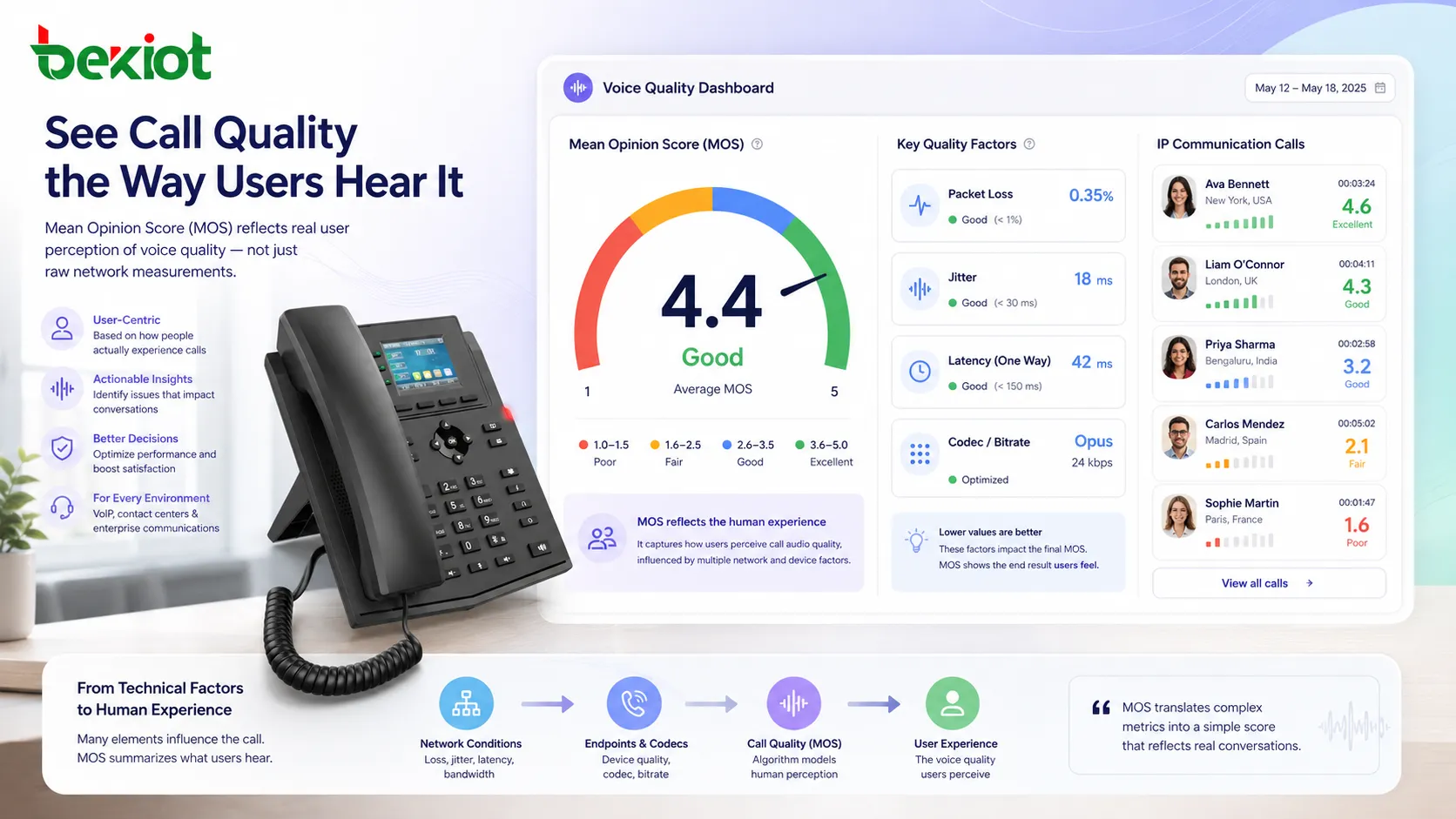
What Mean Opinion Score Means
MOS is usually expressed as a score from 1 to 5. A score close to 5 means excellent audio quality, while a score close to 1 means very poor audio quality. In voice communication, a higher MOS usually indicates clearer speech, fewer distortions, better intelligibility, and a more natural conversation experience.
The term “opinion score” comes from subjective listening tests, where multiple listeners rate audio samples based on perceived quality. The average of these ratings becomes the mean opinion score. Although modern systems often estimate MOS automatically through algorithms, the concept is still based on human perception.
MOS is useful because technical metrics alone do not always explain user experience. For example, two calls may have the same packet loss rate, but different codecs, noise suppression settings, echo control, or jitter buffer behavior may produce very different listening results.
Typical MOS Rating Scale
The traditional MOS scale gives administrators, engineers, and service providers a simple way to interpret audio quality. While exact thresholds may vary by system and testing method, the following structure is commonly used for voice quality evaluation.
| MOS Range | Perceived Quality | Typical User Experience |
|---|---|---|
| 4.5–5.0 | Excellent | Very clear voice, natural speech, minimal distortion, highly comfortable conversation. |
| 4.0–4.4 | Good | Clear and reliable voice quality with minor imperfections that most users may not notice. |
| 3.5–3.9 | Fair | Understandable speech, but users may notice compression, delay, noise, or occasional artifacts. |
| 3.0–3.4 | Poor | Conversation is possible, but quality issues may affect comfort, professionalism, or efficiency. |
| Below 3.0 | Bad | Frequent distortion, unclear speech, interruptions, or delay may make communication difficult. |
For business voice systems, a MOS above 4.0 is usually considered acceptable for professional communication. Scores below this level may still allow conversation, but they often indicate problems that should be investigated.
How MOS Is Measured
Subjective Listening Tests
The original MOS method is based on human listeners. A group of participants listen to audio samples and rate the perceived quality. The final score is calculated by averaging all listener ratings. This approach is valuable because it directly reflects human perception.
However, subjective testing requires time, controlled test conditions, and multiple participants. It is not practical for continuous monitoring of live networks, large VoIP deployments, or real-time service assurance.
Objective Estimation Methods
Modern communication systems often estimate MOS through objective algorithms. These methods analyze audio signals, codec behavior, packet loss, jitter, delay, and other network conditions to predict perceived quality. Some methods compare a degraded audio signal with a reference signal, while others estimate quality without requiring the original source.
Objective MOS estimation is useful for monitoring live systems because it can be automated. Network management platforms, session border controllers, IP PBX systems, softswitches, and VoIP monitoring tools may provide MOS values for each call or media stream.
Network-Based MOS Calculation
Many VoIP systems calculate estimated MOS from real-time transport statistics. These may include RTP packet loss, jitter, round-trip delay, codec type, burst loss, and concealment behavior. The result is not the same as a controlled listening test, but it gives administrators a practical indicator of likely call quality.
Network-based MOS is especially useful for troubleshooting because it can be linked to specific calls, users, gateways, sites, trunks, or time periods. This helps technical teams identify whether poor audio is caused by local LAN issues, WAN congestion, codec mismatch, endpoint problems, or service provider conditions.
MOS is not just a number for reports. It is a bridge between technical network performance and the real listening experience of users.
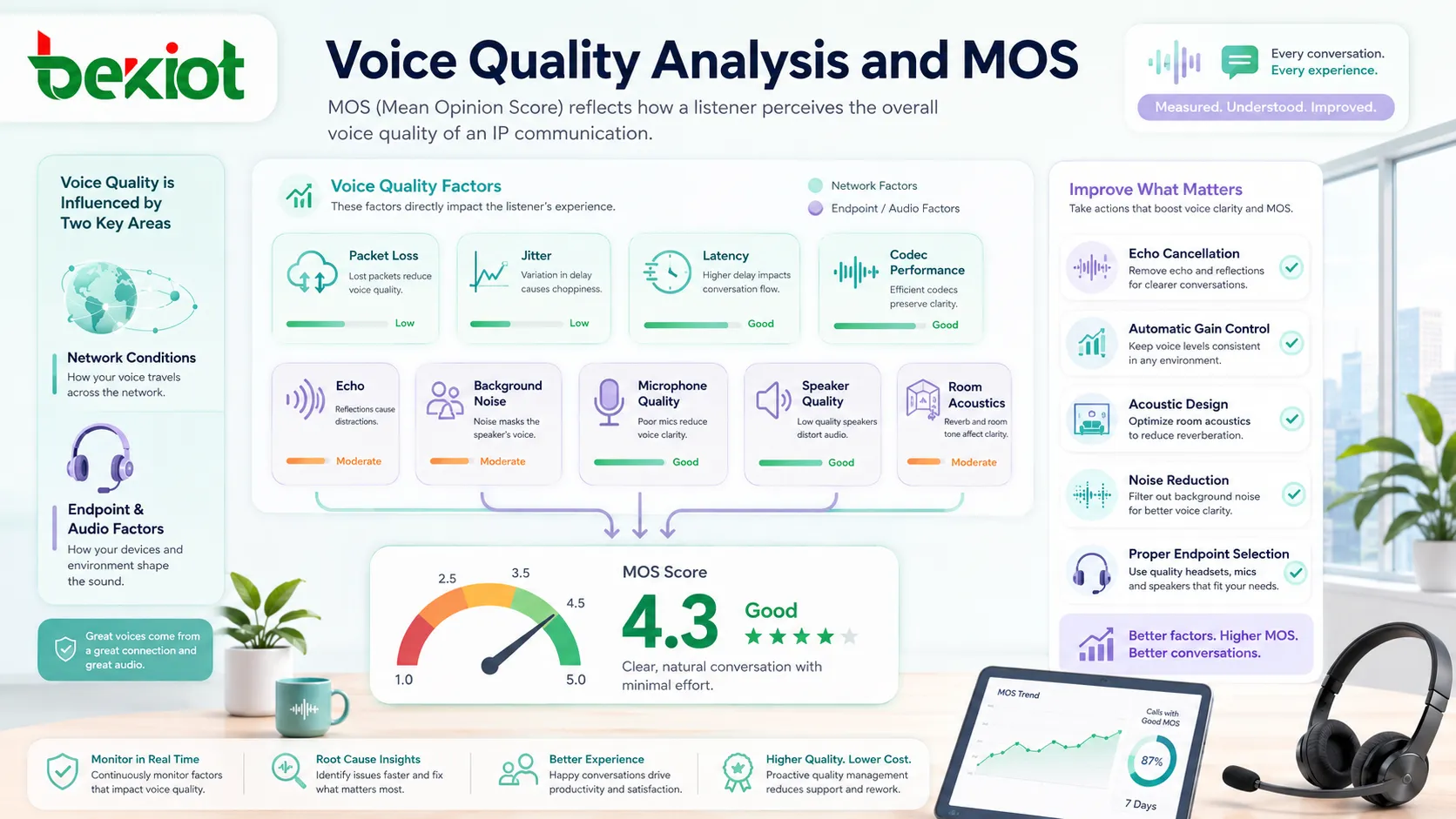
Key Factors That Affect MOS
Packet Loss
Packet loss occurs when voice packets fail to reach their destination. In VoIP systems, packet loss can cause gaps, robotic sound, clipped words, or short audio dropouts. Even a small amount of packet loss can reduce MOS if the loss happens in bursts or during important speech segments.
Some codecs and systems use packet loss concealment to reduce the impact, but concealment cannot fully restore missing voice information. Consistent packet delivery remains essential for high MOS.
Jitter
Jitter is the variation in packet arrival time. Voice communication requires packets to arrive in a steady sequence. When packets arrive too early, too late, or unevenly, the receiving device must use a jitter buffer to smooth playback.
A properly configured jitter buffer can improve audio stability, but excessive jitter may increase delay or cause packets to be discarded. Both outcomes can lower MOS and make conversations feel less natural.
Latency
Latency is the time it takes for speech to travel from one speaker to the other. Low latency supports natural conversation, while high latency creates awkward pauses, talk-over, and delayed responses.
MOS can be affected by latency even when the audio itself is clear. A call may sound clean but still feel uncomfortable if the delay is too high for interactive communication.
Codec Selection
Audio codecs compress and decompress voice signals. Different codecs offer different trade-offs between bandwidth, quality, complexity, and resilience. Wideband codecs usually deliver better speech clarity than narrowband codecs, but they may require more bandwidth and endpoint support.
Codec mismatch, unnecessary transcoding, or using a low-bitrate codec on a high-quality network can reduce MOS. Choosing the right codec for the network environment is an important part of voice quality planning.
Echo and Noise
Echo, background noise, electrical interference, poor microphones, low-quality speakers, and room acoustics can all reduce perceived voice quality. These issues may not always appear as network faults, but they directly affect the user’s listening experience.
Echo cancellation, automatic gain control, acoustic design, noise reduction, and proper endpoint selection can improve MOS by making speech clearer and easier to understand.
Audio Benefits of Using MOS
Improves Voice Quality Management
MOS gives technical teams a simple way to monitor voice quality across complex communication networks. Instead of reviewing many separate technical metrics, administrators can use MOS as a high-level indicator of user-perceived quality.
This is useful for enterprise telephony, SIP trunking, hosted PBX, contact centers, dispatch systems, and unified communication platforms where voice quality directly affects service reliability and customer satisfaction.
Helps Detect Hidden Audio Problems
Some audio issues are difficult to identify by looking at bandwidth usage alone. A network may appear lightly loaded but still produce poor call quality because of jitter, routing instability, endpoint configuration, codec negotiation, or packet bursts.
MOS helps reveal these hidden problems by showing whether the final voice experience is acceptable. When MOS drops, engineers can investigate related metrics to locate the root cause.
Supports Better User Experience
Users usually describe call quality in simple terms such as “clear,” “delayed,” “broken,” or “robotic.” MOS provides a structured way to convert these subjective experiences into measurable quality levels.
By monitoring MOS, organizations can identify recurring problems before users submit complaints. This improves communication reliability and reduces frustration in daily operations.
Enables Service-Level Monitoring
Service providers and enterprise IT teams can use MOS as part of voice service quality reporting. It can help compare sites, carriers, links, devices, or communication platforms over time.
For managed voice services, MOS can support service-level discussions because it connects network performance to user-perceived audio quality.
Technical Features in MOS Monitoring
Per-Call Quality Scoring
Many VoIP monitoring systems calculate MOS for each call. This allows administrators to see whether a specific call had acceptable quality and whether problems occurred at the beginning, middle, or end of the session.
Per-call scoring is especially valuable when troubleshooting user complaints. Instead of relying only on the user’s description, engineers can review call records, RTP statistics, codec information, and MOS trends.
Real-Time Alerts
Some platforms provide alerts when MOS falls below a defined threshold. For example, a system may notify administrators when MOS drops below 3.5 for multiple calls at the same site or during a specific time window.
Real-time alerting helps teams respond quickly to network congestion, service provider issues, misconfigured QoS policies, or failing endpoints.
Historical Trend Analysis
MOS data becomes more useful when tracked over time. Historical reports can show whether voice quality is improving, degrading, or affected by specific business hours, WAN links, software upgrades, or network changes.
Trend analysis also helps with capacity planning. If MOS regularly drops during peak traffic periods, the organization may need bandwidth upgrades, QoS adjustments, codec changes, or network segmentation.
Integration with QoS Metrics
MOS monitoring works best when combined with quality of service metrics. These may include packet loss, jitter, latency, bandwidth usage, DSCP marking, queue behavior, and link utilization.
When MOS and QoS data are reviewed together, engineers can move from symptom to cause. For example, a low MOS score may be linked to packet loss on a WAN circuit or incorrect prioritization of RTP traffic.
Endpoint and Codec Visibility
Advanced monitoring tools can show which endpoints, codecs, gateways, trunks, or networks are associated with lower MOS. This visibility is important because voice quality problems are not always caused by the core network.
A poor headset, outdated firmware, overloaded gateway, incorrect codec priority, or wireless connection issue can all reduce MOS even when the main network is functioning normally.
Common Applications
VoIP and IP PBX Systems
MOS is widely used in VoIP and IP PBX systems to evaluate call quality between extensions, branches, SIP trunks, gateways, and remote users. It helps administrators understand whether the voice service is delivering business-grade performance.
In multi-site deployments, MOS can reveal whether a specific office, WAN link, or carrier route is creating audio problems. This makes troubleshooting faster and more targeted.
Contact Centers
Contact centers depend heavily on clear voice communication. Poor audio can reduce agent efficiency, damage customer trust, and increase call handling time. MOS monitoring helps supervisors and IT teams identify whether low-quality calls are affecting service performance.
When integrated with call records, MOS can also help evaluate whether quality issues are related to specific campaigns, agents, locations, headsets, softphones, or network paths.
Video Conferencing and Collaboration
Even in video meetings, audio quality is often more important than image quality. Users may tolerate reduced video resolution, but unclear speech can quickly make a meeting ineffective. MOS can be used to assess the voice component of conferencing platforms.
For hybrid work environments, MOS helps IT teams evaluate the quality of calls from home networks, office networks, VPN connections, Wi-Fi access points, and cloud communication services.
Mobile and Carrier Networks
Mobile operators and service providers use MOS-related testing to evaluate voice service quality across radio networks, VoLTE, Wi-Fi calling, roaming routes, and interconnection paths. This helps them compare coverage areas, optimize network parameters, and maintain customer experience.
In carrier environments, MOS may be used alongside drive testing, network probes, service assurance platforms, and customer experience analytics.
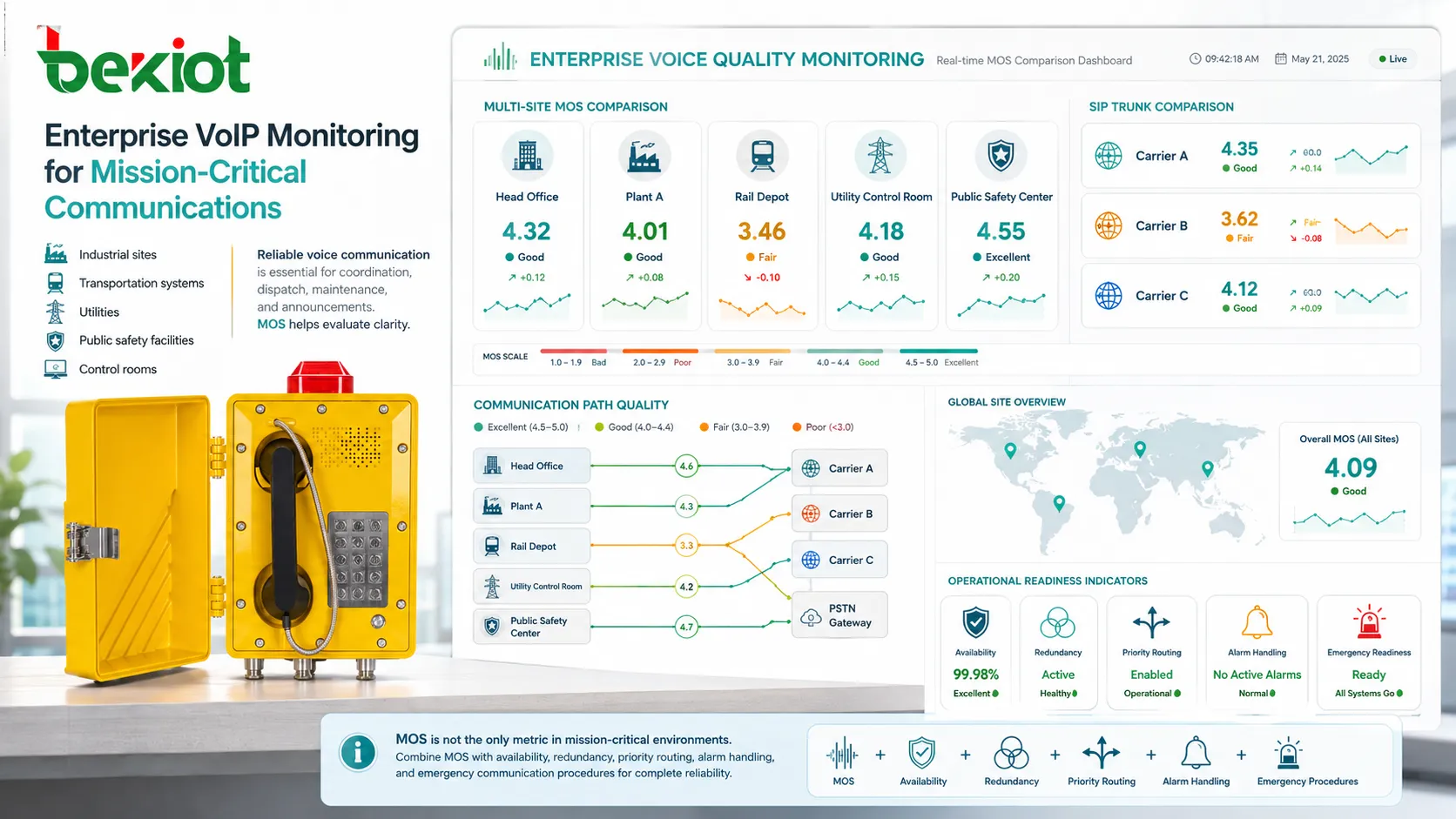
Industrial and Mission-Critical Communication
Industrial sites, transportation systems, utilities, public safety facilities, and control rooms require reliable voice communication. MOS can help evaluate whether operational voice systems are clear enough for coordination, dispatch, maintenance, and routine announcements.
For mission-critical environments, MOS should not be the only measurement. It should be combined with availability, redundancy, priority routing, alarm handling, and emergency communication procedures.
How MOS Helps Troubleshooting
When users report poor audio, MOS can help confirm whether the issue is isolated or widespread. Engineers can compare MOS values across calls, users, sites, codecs, and time periods to identify patterns.
For example, if low MOS appears only on calls through one SIP trunk, the problem may involve carrier routing or trunk configuration. If low MOS appears only for remote workers, the cause may involve home internet quality, VPN overhead, Wi-Fi instability, or endpoint settings.
If MOS drops during peak hours, congestion or QoS misconfiguration may be involved. If MOS is low despite stable network metrics, endpoint audio devices, echo cancellation, transcoding, or codec selection should be reviewed.
Limitations of MOS
MOS is useful, but it should not be treated as a complete diagnosis by itself. A single score cannot fully explain why audio quality is poor. It indicates the likely user experience, but engineers still need supporting data to identify the root cause.
Different systems may calculate MOS in different ways. A score from one monitoring tool may not be directly comparable with a score from another tool unless the same method, codec assumptions, and measurement conditions are used.
MOS also focuses mainly on perceived quality. It may not fully reflect operational requirements such as call setup success, emergency availability, device registration stability, failover behavior, or recording compliance.
A good MOS score means users are likely hearing acceptable audio, but it does not replace full network, endpoint, and service availability monitoring.
Best Practices for Improving MOS
To improve MOS, organizations should begin with network stability. Voice traffic should be prioritized through proper QoS policies, sufficient bandwidth, stable routing, and low-latency network paths. RTP traffic should not compete equally with heavy file transfers, backups, or video streams on congested links.
Codec planning is also important. Wideband codecs can improve clarity when bandwidth and endpoint support are available. However, unnecessary transcoding should be avoided because it can add delay and reduce audio quality.
Endpoint quality should not be ignored. Good microphones, headsets, speakers, firmware updates, echo cancellation, and correct gain settings all influence perceived voice quality. In many cases, poor MOS may be related to user equipment rather than the core communication platform.
Regular monitoring is the final step. MOS should be reviewed together with packet loss, jitter, latency, call failure rates, SIP errors, registration status, and user complaints. This provides a complete view of communication performance.
FAQ
Is MOS measured only for VoIP calls?
No. MOS is commonly used in VoIP, but it can also apply to mobile voice, video conferencing audio, streaming media, broadcast audio, and other systems where perceived audio quality matters.
Can a call with high MOS still have problems?
Yes. A call may have good audio quality but still experience issues such as call setup delay, dropped calls, incorrect routing, one-way audio, or poor system availability. MOS measures perceived audio quality, not the entire communication service.
Why do two monitoring tools show different MOS values?
Different tools may use different algorithms, assumptions, sampling points, codec models, or packet analysis methods. Because of this, MOS values should be compared carefully, especially across different vendors or platforms.
What MOS value should a business voice system target?
Many business voice systems aim for a MOS above 4.0 for comfortable professional communication. However, the acceptable target may depend on the application, codec, network conditions, user expectations, and whether the system is used for routine or critical communication.
Does increasing bandwidth always improve MOS?
Not always. More bandwidth can help if congestion is the problem, but MOS may also be affected by jitter, latency, packet loss, codec choice, endpoint quality, Wi-Fi instability, echo, or configuration errors. Bandwidth is only one part of voice quality.







