IP66 is a specific enclosure protection rating used to show how well a product resists the ingress of dust and water under the conditions defined by the applicable standard. When a device is marked IP66, it is being identified as dust-tight and protected against powerful water jets. In practical engineering and purchasing work, that makes IP66 one of the most useful ratings for outdoor, industrial, transport, marine-support, utility, and infrastructure equipment.
You will find IP66 on many products that are expected to work beyond clean indoor conditions. Typical examples include industrial telephones, emergency intercoms, outdoor help points, field control stations, network cabinets, operator panels, camera housings, junction boxes, loudspeakers, public address terminals, lighting enclosures, and weather-exposed communication devices. In those applications, the point of the rating is not simply to sound rugged. It is to indicate a defined level of protection against two common real-world threats: fine dust and strong water exposure from outside the enclosure.
Even so, IP66 is often oversimplified. Some people read it as a general promise that a product is fully waterproof, indestructible, or suitable for any harsh environment. That is not how the IP code is meant to be used. IP66 tells you something important about ingress protection, but it does not answer every question about field suitability. Materials, corrosion resistance, UV stability, sealing quality, cable entries, mounting orientation, impact resistance, cleaning method, and the overall installation design still matter.
What Is IP66 Protection Rating?
IP66 belongs to the IP code system used to classify the degree of protection provided by enclosures. The letters IP are commonly read as Ingress Protection, and the two digits that follow describe protection against solid foreign objects and water ingress.
In the designation IP66, the first digit is 6 and the second digit is also 6. The first digit describes protection against solids, especially dust. A 6 means the enclosure is dust-tight within the IP code system. The second digit describes protection against water. A 6 means the enclosure is protected against powerful water jets under the standard test conditions.
That combination makes IP66 attractive in real projects. It gives specifiers a stronger water-ingress baseline than IP65 while still keeping the rating focused on jet exposure rather than immersion. For this reason, IP66 is widely used where equipment must survive dust, rain, washdown spray, storm exposure, or cleaning water, but where continuous immersion is not the intended design condition.
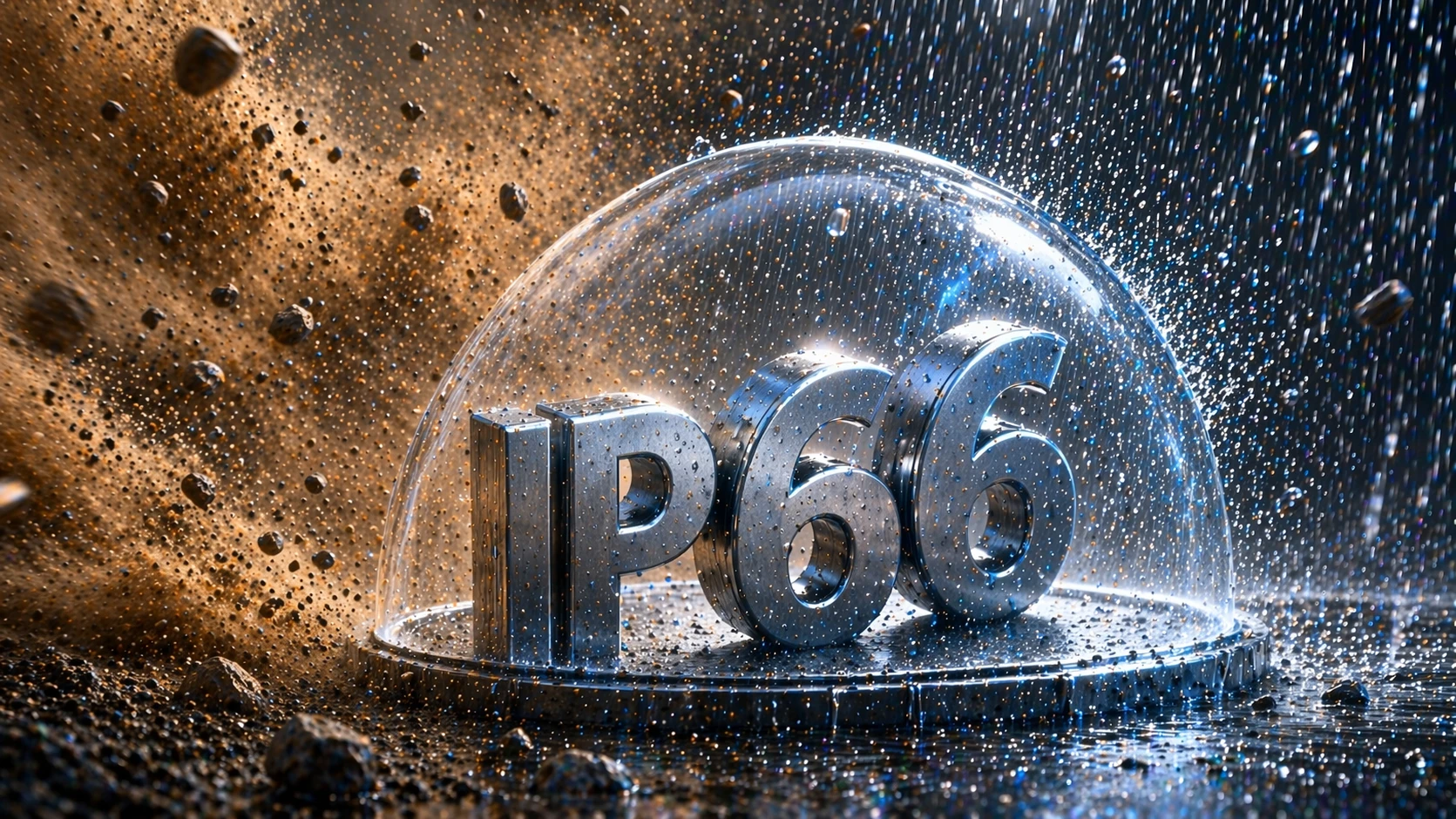
IP66 is commonly specified for outdoor and industrial equipment that must resist both dust ingress and stronger water-jet exposure.
Which Standard Defines IP66?
The IP code framework is defined by IEC 60529, the international standard for degrees of protection provided by enclosures. This is the core reference behind IP66 and the broader IP classification system. In engineering documents, tenders, and datasheets, the rating may appear through IEC 60529 itself or through regional adoptions based on the same framework.
This matters because IP66 is not just a marketing phrase. It belongs to a formal, standardized classification language. That is why it is useful in procurement and technical comparison. Instead of relying on loose wording such as weatherproof, splash resistant, or heavy-duty, engineers can use IP66 as a much clearer shorthand for a defined dust and water protection level.
At the same time, the rating should still be interpreted correctly. The standard classifies enclosure protection under specified test conditions. It does not automatically prove that every installed product will perform the same way under every field condition. Real-life results still depend on design quality, accessories, cable glands, door closures, maintenance, and installation practice.
What Does the First “6” Mean in IP66?
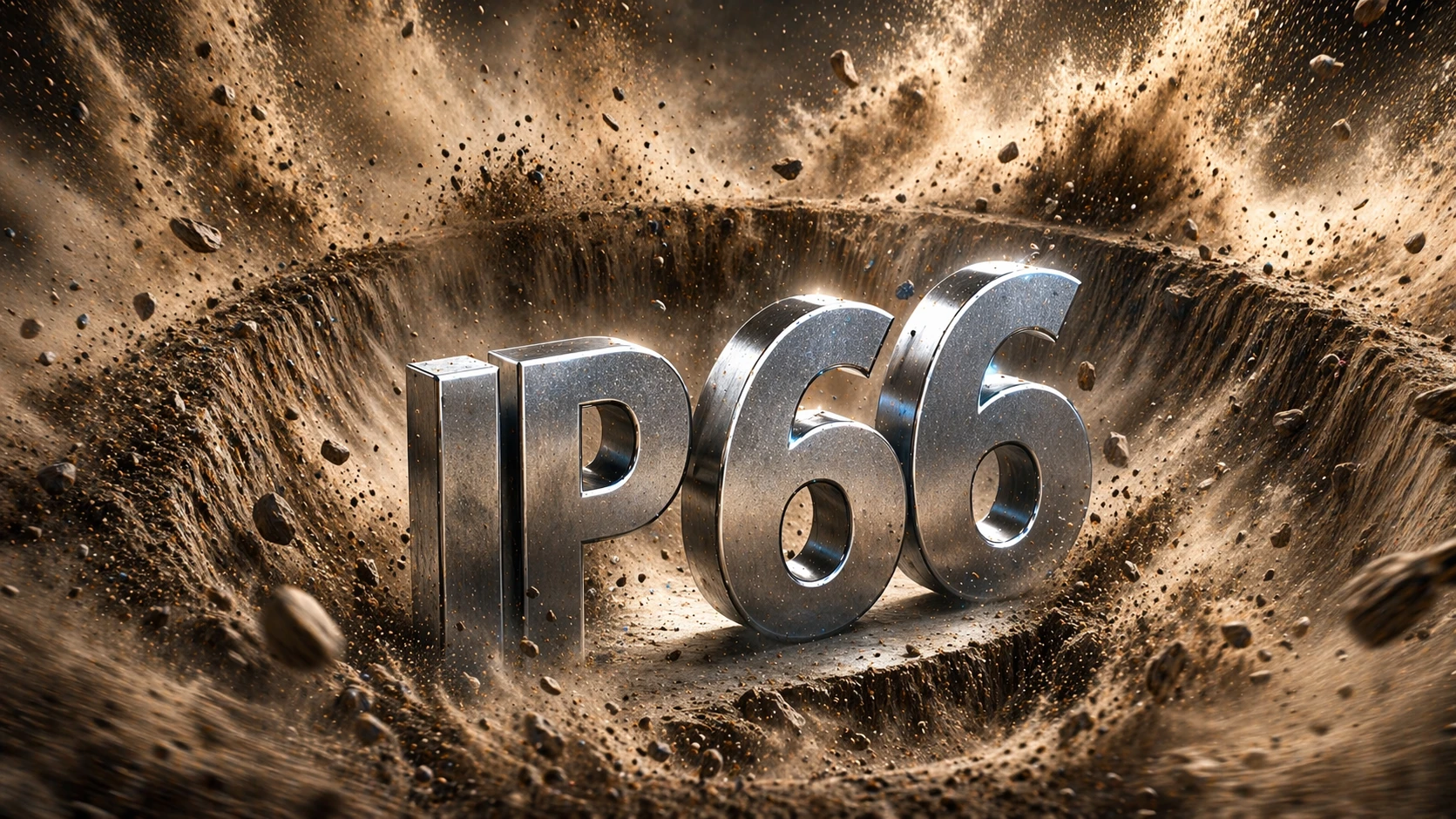
The first characteristic numeral in IP66 is 6, which refers to protection against solid foreign objects, especially dust. In practical terms, it means the enclosure is dust-tight. Within the basic IP code system, that is the highest standard level for dust ingress protection.
This is important because dust can create more than cosmetic problems. Fine particles can contaminate contacts, block acoustic openings, affect connectors, interfere with cooling paths, reduce display readability, and shorten equipment life. In industrial sites, ports, transport hubs, warehouses, mines, utility areas, tunnels, and roadside installations, dust is often an everyday operating condition rather than an occasional nuisance.
Still, the dust-tight classification applies to the enclosure as tested and assembled. It does not mean poor installation can be ignored. A high-rated enclosure can still perform badly if unused cable entries are left open, seals are damaged, or accessory interfaces do not match the intended assembly method.
IP5X indicates dust-protected construction rather than full dust-tight sealing.
IP6X indicates dust-tight protection under the IP code framework.
In IP66, this first numeral is what supports use in dusty industrial and outdoor environments.
What Does the Second “6” Mean in IP66?
The second characteristic numeral in IP66 is 6, which relates to water ingress protection. In practical terms, this means the enclosure is protected against powerful water jets under the conditions defined by the IP standard.
This is the point that separates IP66 from IP65. Both ratings are dust-tight, but IP66 is intended for a stronger jet-water exposure category. In real applications, that can matter in outdoor infrastructure, marine-adjacent installations, industrial washdown zones, utility equipment, port-side devices, and communication systems exposed to demanding weather or cleaning conditions.
However, a powerful-water-jet rating should not be confused with immersion protection. IP66 is about external water-jet exposure. It does not mean the product is intended to operate underwater or remain safe during flooding. That distinction is one of the most important things to understand when comparing IP66 with higher immersion-related ratings such as IP67 or IP68.
The second “6” in IP66 refers to protection against powerful water jets, making it useful where equipment faces stronger washdown or weather exposure.
How IP66 Compares with IP65, IP67, and IP68
One of the most common selection mistakes is assuming that all high IP ratings mean roughly the same thing. They do not. The difference between the second digits can change the type of water exposure the enclosure is designed to resist.
IP65 and IP66 both indicate dust-tight construction. The difference is in the water test level. IP65 is associated with water jets, while IP66 is associated with more severe water-jet exposure. That is why IP66 is often chosen when the environment is more aggressive or when stronger cleaning spray is expected.
IP67 changes the discussion. Instead of focusing on stronger jets, it brings in temporary immersion protection. IP68 goes further and refers to continuous or special immersion conditions as defined by the manufacturer and applicable test arrangement. That means IP66 is not automatically “better” or “worse” than IP67 in a universal sense. It is designed for a different kind of water exposure.
Choose IP66 when dust-tight protection and stronger external water-jet resistance are both needed.
Choose IP67 or IP68 when immersion is a realistic risk rather than only rain or jet exposure.
Match the rating to the exposure pattern instead of assuming the highest-looking number always solves the problem.
Is IP66 the Same as Waterproof?
In everyday conversation, many buyers call IP66 products waterproof. That description is understandable, but it is not technically precise. From an engineering point of view, IP66 means the enclosure has a specific degree of protection against powerful water jets. That is a defined and useful statement. It is not the same as saying the product can handle every possible water condition.
This difference matters in specification work. A product that performs well in rain, spray, and jet exposure may still be the wrong choice for flood-prone, submerged, or immersion-related installation conditions. If the actual environment involves standing water, burial, drainage failure, or accidental submersion, an immersion-oriented rating may be the safer basis for selection.
The most practical way to read IP66 is this: it is a strong enclosure rating for dust and external water exposure, but it must still be compared against the real operating environment rather than turned into a vague catch-all promise.
IP66 and Other Protection Ratings
IP66 is an important protection rating, but it is only one part of overall equipment suitability. In real projects, it is often assessed alongside other characteristics such as mechanical impact resistance, material strength, anti-corrosion performance, UV resistance, temperature tolerance, flame behavior, chemical resistance, and hazardous-area compliance where required.
For example, an outdoor communication terminal might need IP66 for dust and water-jet protection, IK10 for vandal or impact resistance, and a corrosion-resistant housing material for use in coastal or chemical environments. A product for explosive atmospheres may need IP66 as part of the enclosure strategy, but IP66 alone does not replace ATEX, IECEx, or other hazardous-area requirements.
Another common source of confusion is the relationship between IP ratings and NEMA enclosure types. These systems can be compared in some cases, but they are not identical or fully interchangeable. That is why serious projects should avoid treating an IP66 claim as a one-line substitute for every other enclosure specification.
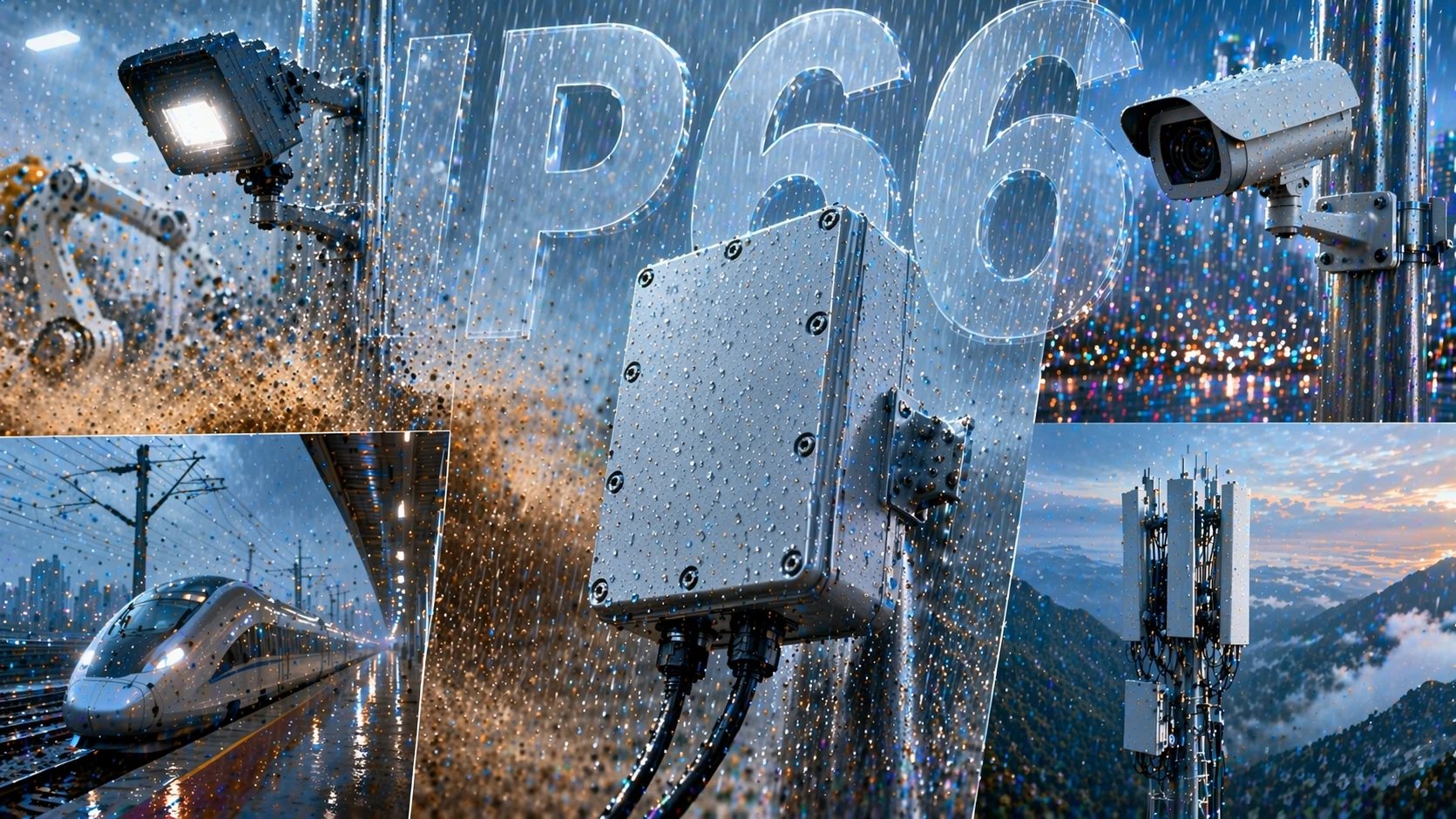
IP66 is widely used in industrial, utility, transport, and outdoor communication applications where strong enclosure protection is required.
Why IP66 Matters in Product Selection
Enclosure failure often starts with ordinary exposure rather than dramatic events. Dust enters slowly through weak seals. Water reaches electronics during cleaning, storms, or hose-down maintenance. Corrosion begins around compromised openings. Contacts become unreliable. Audio quality drops. Displays fog. Boards fail. In many cases, the right enclosure rating reduces these risks before they become service problems.
IP66 is especially attractive because it offers a strong balance between practical field protection and broad usability. It is often chosen when designers need a tougher enclosure than standard indoor or lightly protected products can offer, but where immersion ratings may not be necessary. This helps make IP66 a common and cost-effective choice for many exposed systems.
It is particularly relevant for equipment installed on plant walls, transport platforms, tunnel approaches, roadside cabinets, public infrastructure, energy facilities, washdown-prone service areas, outdoor campus sites, and industrial production zones where dust and forceful water exposure are part of normal life.
Typical Applications of IP66 Equipment
Because IP66 combines dust-tight sealing with stronger water-jet resistance, it appears in many sectors where enclosure durability directly affects uptime and maintenance. The rating is common across industrial electronics, communication equipment, building systems, and infrastructure devices.
Industrial communication and emergency devices
Industrial telephones, help points, intercom stations, and emergency communication terminals often use IP66 to remain dependable in dusty sites, exposed corridors, loading zones, and outdoor process areas.
Transport and public infrastructure
Rail platforms, roadside systems, tunnels, parking facilities, ports, depots, and station-side equipment often benefit from IP66 because weather exposure and cleaning spray are realistic operating conditions.
Utility and energy installations
Field enclosures, local control points, monitoring housings, and communication boxes in power, water, renewable energy, and municipal utility projects frequently adopt IP66 for reliable outdoor service.
Outdoor networking and security equipment
Camera housings, access control interfaces, wireless equipment enclosures, and edge communication cabinets often rely on IP66 where dust, rain, and forceful external water exposure must be considered.
Marine-adjacent and heavy-duty outdoor sites
Ports, ship-support areas, coastal facilities, and industrial wash zones often specify IP66 when ordinary weather protection is not enough and the enclosure may face more severe spray or cleaning conditions.
How to Evaluate an IP66 Claim Properly
An IP66 mark is useful, but buyers should still read the detailed documentation carefully. One key question is whether the rating applies to the complete assembled product, only to the bare enclosure, or only under a specific mounting method. In some designs, the claimed protection level depends on using approved glands, seals, covers, and accessory combinations.
It is also important to consider how the unit will actually be installed. Cable direction, wall mounting, door closures, drainage paths, field modifications, and maintenance access can all affect real performance. A product that tests well in one configuration can be compromised by poor installation practice in the field.
Check the complete assembly: The overall IP66 result depends on the weakest point in the installed system.
Review installation requirements: Incorrect glands, damaged seals, or poor accessory choices can reduce real ingress protection.
Match the exposure profile: Strong water jets are not the same as immersion, flooding, steam cleaning, or chemical washdown.
Look beyond IP: Impact, corrosion, UV, material compatibility, and application-specific standards may still be critical.
FAQ
What does IP66 mean in simple terms?
It means the enclosure is dust-tight and protected against powerful water jets under the conditions defined by the IP code standard.
Is IP66 better than IP65?
For stronger water-jet exposure, yes. Both are dust-tight, but IP66 is designed for a more demanding water-jet condition than IP65.
Can IP66 equipment be submerged in water?
No. IP66 is not an immersion rating. If submersion is possible, a rating such as IP67 or IP68 may be more appropriate depending on the application.
Is IP66 suitable for outdoor use?
Yes, in many cases. IP66 is widely used for outdoor and exposed equipment where dust, rain, strong spray, or washdown conditions are realistic.
Does IP66 replace other protection requirements?
No. IP66 only addresses ingress protection against dust and water under the IP code framework. Other requirements, such as IK impact rating, corrosion resistance, or hazardous-area certification, may still be necessary.
Conclusion
IP66 is one of the most practical and widely specified enclosure ratings for demanding outdoor and industrial applications. Under the IEC 60529 framework, it tells you that the enclosure is dust-tight and protected against powerful water jets. That combination makes it highly relevant for communication devices, control equipment, infrastructure systems, utility enclosures, and exposed electronics that must keep working in dirty and wet environments.
At the same time, IP66 should be read accurately. It is not a generic promise of unlimited waterproofing, and it is not a substitute for every other environmental requirement. It is a specific ingress protection classification. Used correctly, it helps engineers, buyers, and integrators choose equipment with a stronger and more reliable enclosure baseline for real-world service conditions.