


IP65 is a specific ingress protection rating used to describe how well an enclosure resists the entry of dust and water under the conditions defined by the relevant standard. In practical terms, when a product is marked IP65, it is being presented as dust-tight and protected against water jets. That makes the rating highly relevant for electrical and electronic equipment used in outdoor, industrial, utility, transport, and semi-exposed commercial environments.
This rating appears on a wide range of products, including industrial telephones, intercom stations, control boxes, field enclosures, outdoor access devices, lighting products, network cabinets, operator panels, and electronic housings. In all of those cases, the IP65 mark helps buyers quickly understand that the enclosure has a meaningful level of protection against two of the most common environmental risks: airborne dust and projected water.
At the same time, IP65 is often misunderstood. Some people treat it as a universal sign that a product is fully waterproof, ready for immersion, or automatically suitable for any harsh environment. That is not how the IP code works. IP65 is a defined enclosure rating within a standardized classification system. It tells you something important, but not everything, about field suitability. To evaluate the real application fit, you still need to consider installation method, materials, corrosion exposure, UV exposure, impact resistance, maintenance routines, and any other project-specific demands.
What Is IP65 Protection Rating?
IP65 is part of the IP code system used to classify the degree of protection provided by an enclosure. The letters IP stand for Ingress Protection or, in many technical references, International Protection. The two digits that follow indicate how the enclosure performs against solid foreign objects and water ingress.
In IP65, the first digit is 6 and the second digit is 5. The first digit refers to solid particle protection. A 6 means the enclosure is dust-tight, which is the highest standard level for protection against dust ingress in the basic IP code system. The second digit refers to water protection. A 5 means the enclosure is protected against water jets under the defined test conditions.
For engineers, installers, and equipment buyers, this rating provides a practical baseline. It indicates that the enclosure is built for environments where ordinary indoor protection is not enough, but where the product is not necessarily intended for full submersion. That is why IP65 is such a common specification in industrial communication products, outdoor terminals, site control equipment, and utility-side electronics.
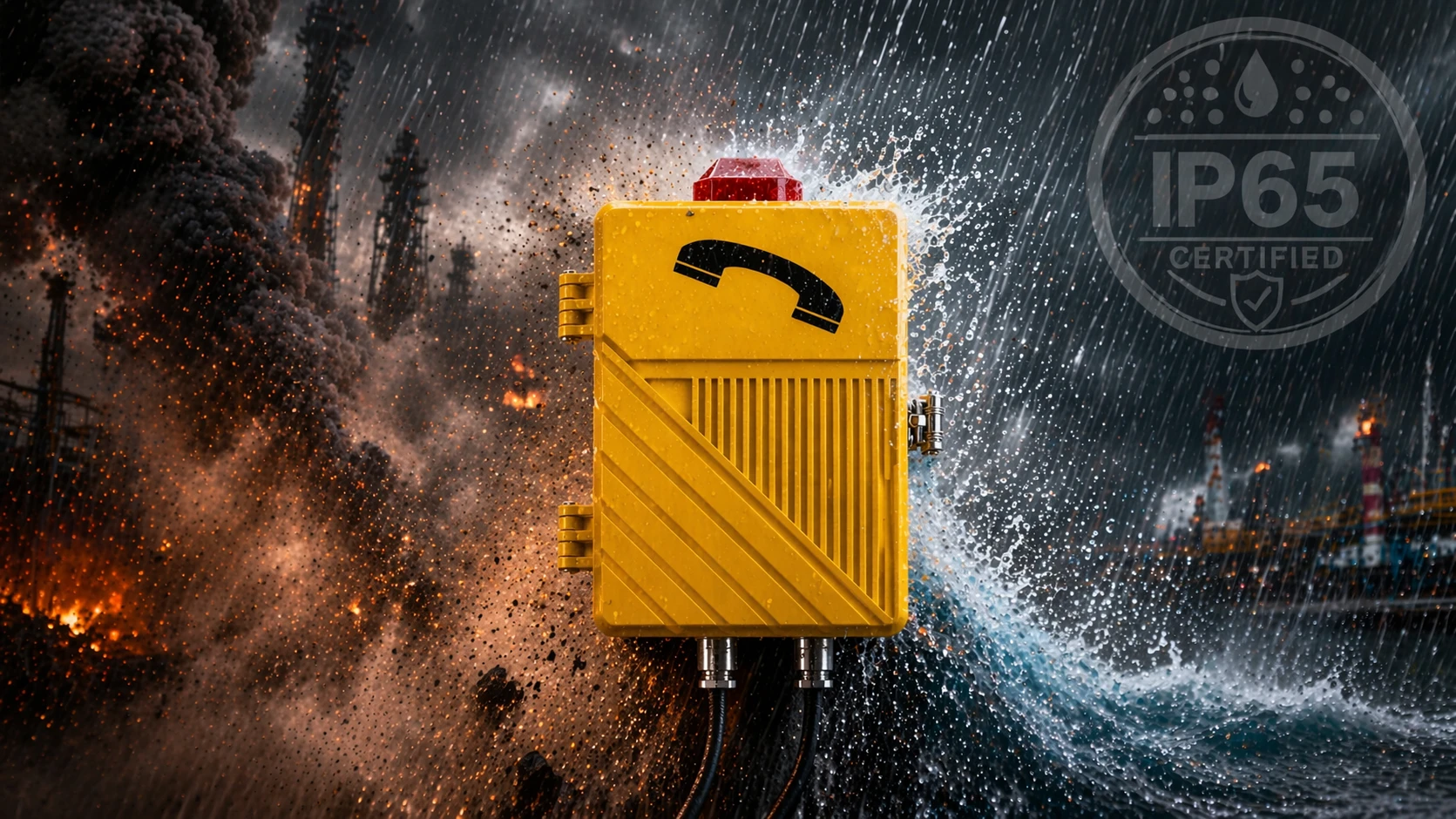
IP65 is widely used for outdoor and industrial equipment that must resist dust exposure and projected water without requiring immersion protection.
Which Standard Defines IP65?
The IP code framework is defined by IEC 60529, the international standard that classifies degrees of protection provided by enclosures. This is the core reference for understanding what an IP code means and how the protection levels are structured. When a product datasheet claims IP65, it is normally pointing to this standardized classification system or to a regional adoption derived from it.
In practical specification work, you may see the same framework referenced through IEC, EN, or national adoptions of IEC 60529. The important point is that IP65 is not just a marketing phrase. It belongs to a formal test and classification language used across electrical and electronic products worldwide.
This is also why the rating is useful in procurement. Instead of relying on vague wording such as weather-resistant, water-resistant, or heavy-duty, the IP code gives a structured way to compare enclosure protection. It does not replace a full engineering review, but it gives a much more reliable starting point than marketing language alone.
What Does the “6” Mean in IP65?
The first characteristic numeral in IP65 is 6. This describes protection against solid foreign objects, especially dust. In practical terms, it means the enclosure is considered dust-tight within the IP code framework.
This matters because dust is more than a cleanliness issue. Fine particles can affect electronics, mechanical contacts, displays, connectors, acoustic paths, cooling behavior, and long-term reliability. In industrial plants, transport environments, warehouses, ports, mining-support areas, and outdoor roadside installations, dust exposure is often unavoidable. A dust-tight enclosure can therefore make a major difference to service life and maintenance requirements.
However, the presence of a “6” does not mean every opening, cable entry, accessory, or improperly installed gland is automatically safe in all field conditions. The real dust protection of the installed system depends on the whole assembly and the way it is mounted. A well-rated enclosure can still perform poorly if installation quality is weak.
IP0X–IP5X represent progressively lower levels of solid-object and dust protection.
IP6X represents the highest standard basic level for protection against dust ingress.
In IP65, this first digit is what makes the enclosure suitable for dusty working environments.
What Does the “5” Mean in IP65?
The second characteristic numeral in IP65 is 5, which relates to protection against water. In practical terms, it means the enclosure is protected against water jets under the specified conditions of the IP code system.
This is a highly useful level for products exposed to rain, washdown splashing, hose-directed water from a moderate source, or routine outdoor weather exposure. It does not mean the product is designed for submersion. It means the enclosure has a defined level of resistance against projected water from outside the housing.
That distinction is extremely important in product selection. Many failures happen not because a product lacks any water resistance, but because the chosen IP level does not match the real exposure pattern. An enclosure exposed to rainfall and occasional washdown may work well at IP65. An enclosure expected to survive flooding, immersion, or high-pressure high-temperature washdown may require a different rating entirely.

The “5” in IP65 refers to protection against water jets, making the rating practical for rain-exposed and lightly washed industrial or outdoor equipment.
How IP65 Compares with Other IP Ratings
One of the most common mistakes in equipment selection is assuming that all high IP ratings are basically interchangeable. They are not. Even small differences in the second digit can change what the enclosure is intended to handle.
IP54 typically offers a lower level of dust protection and a lower level of water protection than IP65. It may be acceptable for sheltered or semi-protected installations, but it is generally a weaker choice where dust exposure is heavier or water jets are realistic.
IP65 is often chosen when a product must be fully protected against dust ingress and also resist projected water. This makes it a strong all-round rating for many exposed installations.
IP66 is commonly selected where stronger water jet exposure is expected. IP67 and IP68 move the discussion toward immersion-related protection rather than only water jets. That is why IP65 should not automatically be treated as equivalent to submersible protection.
Choose IP65 when dust-tight construction and water-jet resistance are both needed.
Choose higher water ratings when exposure goes beyond ordinary jets or rain.
Check the exact exposure type before assuming that any “high IP” device will do the job.
Is IP65 the Same as Waterproof?
In casual conversation, many people describe IP65 products as waterproof. That wording is understandable, but it is not precise. From an engineering point of view, IP65 does not simply mean “waterproof” in an unlimited sense. It means the enclosure has a specified degree of protection against water jets. That is narrower and more useful than a vague waterproof claim.
This distinction matters because project decisions are often made from quick label reading. If a buyer sees IP65 and assumes the product can be submerged, buried in standing water, or installed in locations prone to flooding, the rating may be misunderstood. The result can be premature failure, warranty disputes, or unnecessary maintenance costs.
A better habit is to read IP65 as a specific engineering classification: dust-tight plus protection against water jets. Then compare that rating with the actual site conditions rather than translating it into an imprecise marketing term.
IP65 and Other Protection Ratings
IP65 is important, but it is only one part of an enclosure’s field suitability. In real projects, engineers often evaluate IP together with other characteristics such as impact resistance, corrosion resistance, UV stability, material compatibility, flame behavior, anti-vandal performance, and hazardous-area certification where relevant.
For example, an outdoor communication terminal may need IP65 for dust and water protection, IK10 for mechanical impact resistance, and a suitable corrosion-resistant housing material if the unit is installed in a coastal or chemical environment. In hazardous locations, IP protection may also be relevant, but it does not replace explosion-protection requirements.
This is why IP65 should be read as a meaningful but incomplete part of the total specification. It tells you how the enclosure handles ingress, not how the product handles every environmental, mechanical, or safety challenge.
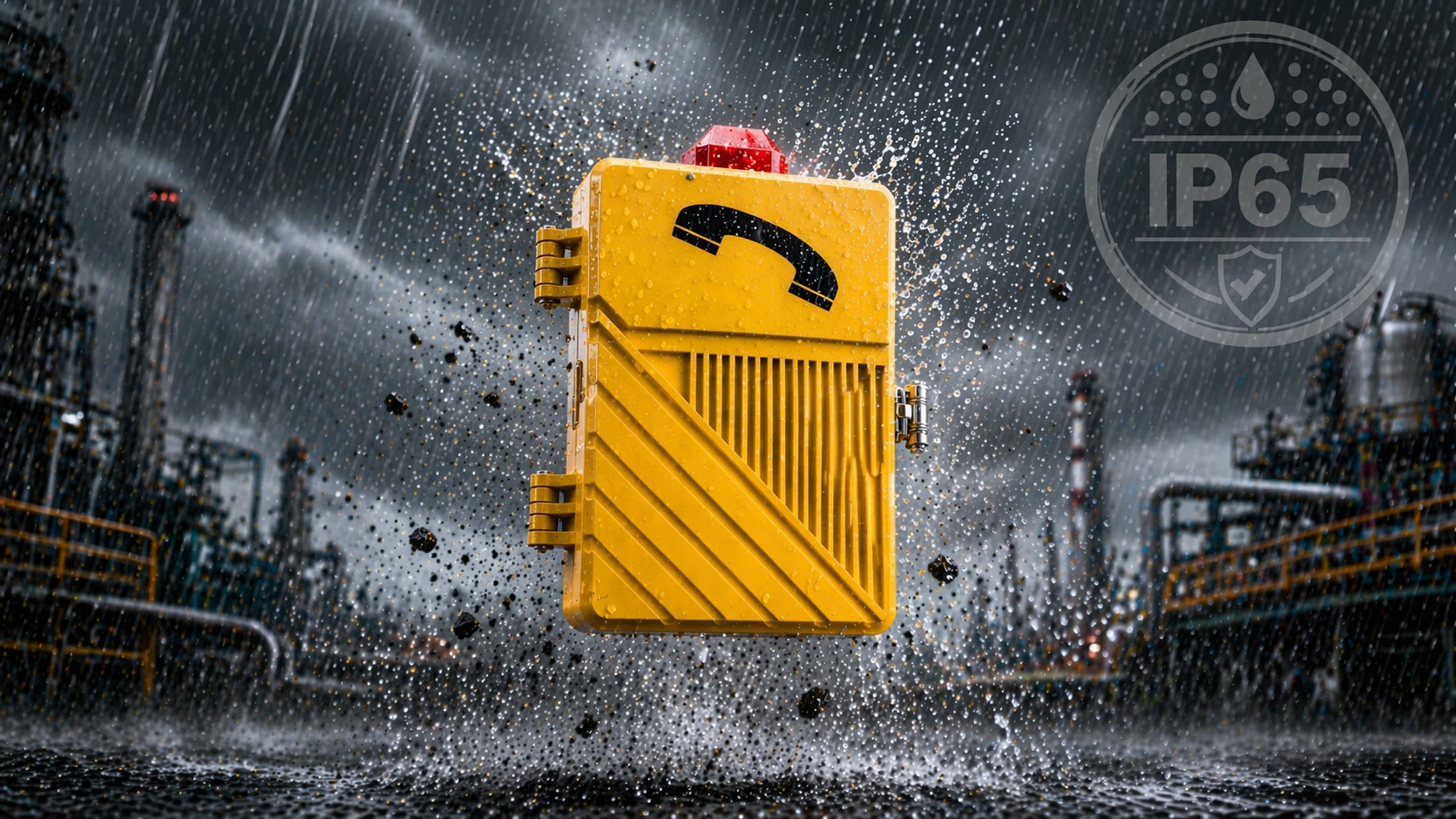
IP65 is often specified for industrial and outdoor equipment that must handle dust exposure, rain, and projected water in daily operation.
Why IP65 Matters in Product Selection
For many products, enclosure protection directly affects uptime and maintenance. Dust intrusion can contaminate electronics, reduce acoustic performance, block vents, and shorten service life. Water ingress can damage circuitry, create intermittent faults, trigger corrosion, or lead to total equipment failure. Choosing the right IP rating therefore has practical consequences far beyond compliance language in a datasheet.
IP65 is often selected because it provides a balanced level of protection for real working environments. It is stronger than many indoor-oriented ratings, yet it does not imply the complexity or cost associated with more extreme protection levels that may not be necessary for the application. In that sense, IP65 is one of the most practical ratings in industrial and infrastructure equipment design.
It is especially useful in projects where the device is mounted outdoors under shelter, on factory walls, at transport stations, in utility areas, near loading zones, or in other places where dust and water exposure are likely but continuous immersion is not part of the design condition.
Typical Applications of IP65 Equipment
Because IP65 sits at a practical middle ground between light-duty indoor protection and more extreme immersion-oriented ratings, it appears across a very wide range of applications. Many industries view IP65 as a strong default for exposed electronics and communication equipment.
Industrial communication terminals
Wall-mounted intercoms, industrial telephones, help points, and field communication stations often use IP65 enclosures to handle dust, rain, and routine washdown exposure.
Control boxes and operator panels
Machine-side control points, junction boxes, and local operator interfaces commonly use IP65 where dust and splashing or projected water are realistic site conditions.
Outdoor access and security equipment
Card readers, access control housings, surveillance support equipment, and gate-side terminals often rely on IP65 for dependable outdoor operation.
Transport and infrastructure systems
Equipment installed in stations, platforms, tunnels, roadside cabinets, parking facilities, and utility service areas often benefits from IP65 as a minimum practical enclosure level.
Commercial and public installations
Outdoor signage electronics, building-side communication devices, campus help points, and service terminals frequently use IP65 when they are exposed to dust and weather but not meant for immersion.
How to Evaluate an IP65 Claim Properly
An IP65 marking is useful, but buyers should still read the product documentation carefully. One important question is whether the rating applies to the complete assembled product, to the enclosure only, or to a specific mounting arrangement. In some products, the rating only applies when all cable entries, covers, seals, and accessories are installed exactly as specified.
It is also important to check whether the rating applies during normal operation, after installation, and in the actual orientation used in the field. Some products perform differently depending on how they are mounted or whether optional accessories are fitted.
Check the full assembly: The overall IP rating depends on the weakest point in the installed system.
Review installation instructions: Incorrect glands, missing seals, or poor cable routing can undermine real protection.
Confirm the exposure profile: Rain and hose spray are not the same as immersion or flood conditions.
Consider other risks: Impact, corrosion, UV exposure, chemicals, and temperature cycling may require extra specification review.
FAQ
What does IP65 mean in simple terms?
It means the enclosure is dust-tight and protected against water jets under the conditions defined by the IP code standard.
Is IP65 suitable for outdoor use?
Yes, in many cases. IP65 is widely used for outdoor and exposed equipment, especially where rain, dust, and projected water are expected but immersion is not part of the operating condition.
Can an IP65 product be submerged in water?
No. IP65 is not an immersion rating. If submersion is possible, a higher rating intended for immersion-related exposure may be needed.
Is IP65 better than IP54?
Yes. IP65 provides a higher level of protection against both dust and water than IP54.
Is IP65 the same as IK10?
No. IP65 describes protection against dust and water ingress. IK10 describes resistance to mechanical impact. They address different protection concerns.
Does IP65 guarantee total field durability?
No. It is an important enclosure rating, but overall durability also depends on housing materials, mounting, seals, accessories, installation quality, and the broader environmental conditions.
Conclusion
IP65 is one of the most practical and widely used enclosure protection ratings in modern electrical and electronic equipment. Under the IEC 60529 framework, it tells you that the enclosure is dust-tight and protected against water jets. That makes it highly relevant for industrial, outdoor, infrastructure, and semi-exposed commercial applications where ordinary indoor protection is not enough.
At the same time, IP65 should be read accurately rather than loosely. It is not a catch-all claim for full waterproofing or universal ruggedness. It is a specific ingress protection classification. The most effective way to use it is in context: combine the IP65 rating with the actual site conditions, mounting arrangement, material requirements, and any other ratings the project demands. When used that way, IP65 becomes a reliable engineering tool for product selection rather than just another item on a specification sheet.







