IP67 is one of the most widely recognized enclosure protection ratings used on electrical and electronic equipment. In practical terms, it tells buyers, engineers, and system integrators that a product has been designed and tested for two important kinds of environmental protection: complete resistance to dust ingress within the IP code framework, and protection against temporary immersion in water under defined test conditions.
That combination makes IP67 highly relevant in real-world product selection. Many devices are not only exposed to airborne dust, rain, splashing, and washdown, but also face a more serious risk: accidental submersion, pooled water, flooding around the installation point, or temporary immersion during handling, maintenance, transport, or severe weather. In those situations, a rating such as IP65 or IP66 may not fully address the real exposure pattern. IP67 is often specified when the enclosure must tolerate both dust-heavy environments and short-term immersion events.
At the same time, IP67 is frequently misunderstood. It is often used as a synonym for waterproof, rugged, or outdoor-ready, but those shortcuts can hide important engineering differences. IP67 says something specific and useful about ingress protection, yet it does not by itself guarantee long-term underwater use, chemical resistance, UV durability, impact strength, corrosion performance, or suitability for every harsh environment. To use the rating correctly, it helps to understand the standard behind it, what each digit means, and how IP67 differs from nearby ratings such as IP65, IP66, and IP68.
What Is IP67 Protection Rating?
IP67 belongs to the IP code system for classifying the degree of protection provided by enclosures. The letters IP are commonly read as Ingress Protection. The first digit refers to protection against solid foreign objects such as dust, while the second digit refers to protection against water ingress.
In the code IP67, the first digit is 6 and the second digit is 7. The first digit means the enclosure is dust-tight within the standard classification system. The second digit means the enclosure is protected against the harmful effects of temporary immersion in water under defined conditions of time and pressure.
This matters because IP67 is not simply “better than IP66” in a vague, all-purpose way. It is designed for a different water-exposure profile. IP66 focuses on powerful external water jets. IP67 shifts the focus to temporary immersion. In specification work, that difference is critical. A product chosen for rain and hose-down exposure is not always the same product that should be chosen for a realistic short-term submersion risk.
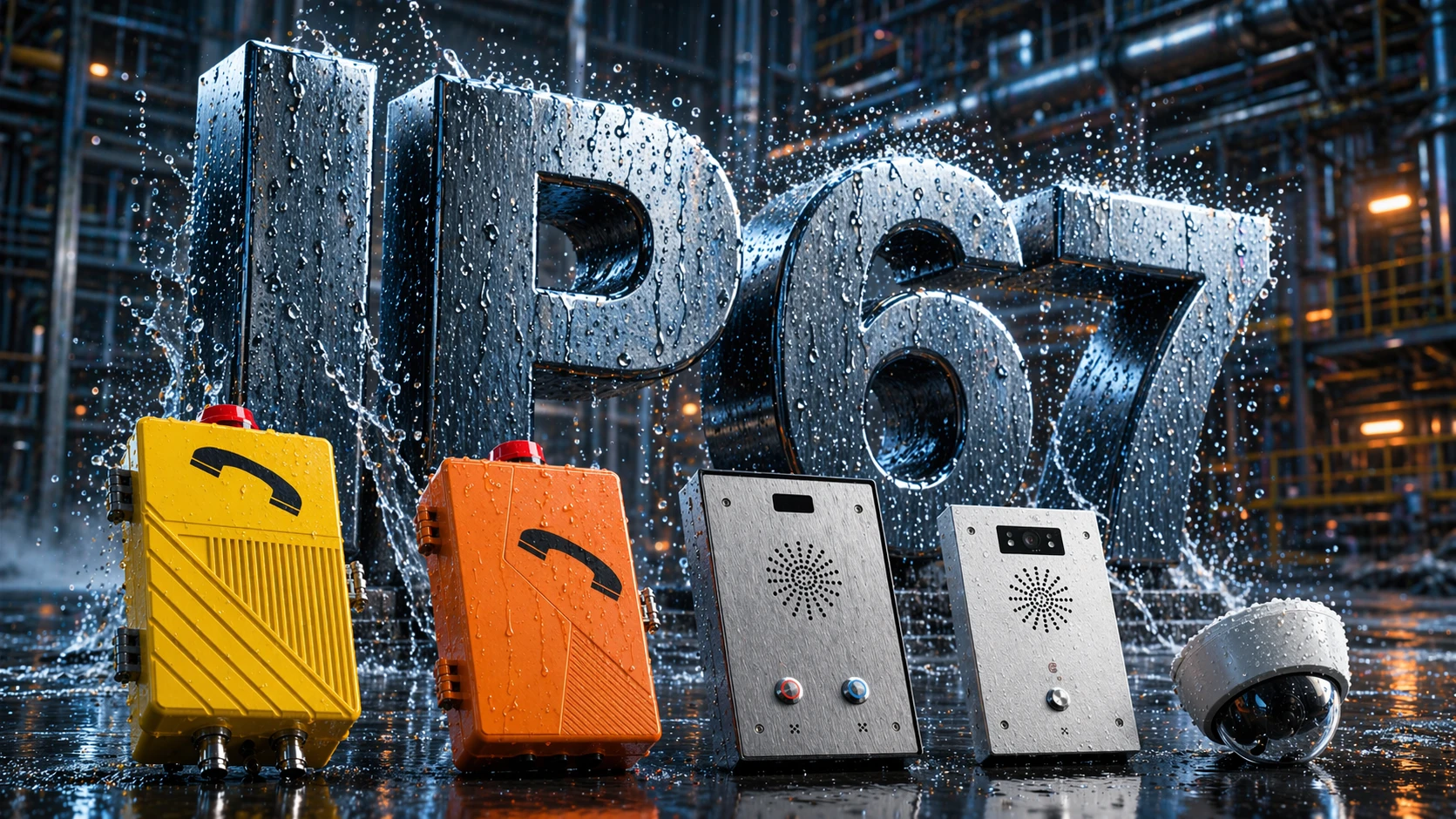
IP67 is commonly specified when equipment must remain dust-tight and also survive temporary immersion rather than only rain or spray exposure.
Which Standard Defines IP67?
The IP code system is defined by IEC 60529, the international standard used to classify degrees of protection provided by enclosures. This standard gives technical meaning to ratings such as IP65, IP66, IP67, and IP68. In procurement documents and product datasheets, IP67 is therefore not just a marketing phrase. It refers to a recognized enclosure classification framework.
That formal structure is one reason IP ratings are so useful. Instead of relying on vague language such as waterproof, weatherproof, sealed, or heavy-duty, manufacturers and buyers can refer to a defined protection code. This improves technical communication across vendors, consultants, system integrators, and end users.
Still, the rating must be interpreted correctly. An IP67 test result describes how an enclosure performs under the defined test conditions of the IP standard. It does not automatically cover every installation detail or every environmental threat. Cable glands, connectors, door latches, seals, mounting orientation, accessory selection, and field modifications can all influence real-life performance.
What Does the First “6” Mean in IP67?
The first characteristic numeral in IP67 is 6. This refers to protection against solid foreign objects and, more specifically, indicates that the enclosure is dust-tight. Within the basic IP framework, this is the highest standard level for dust ingress protection.
Dust-tight construction is not a minor detail. Fine dust can block acoustic paths, contaminate connectors, reduce heat dissipation, affect moving parts, impair contact reliability, and shorten service life. In manufacturing plants, logistics areas, tunnels, ports, mines, roadside installations, utility compounds, and outdoor infrastructure environments, dust is often a normal operating condition rather than an exceptional one.
In practice, the first “6” makes IP67 attractive for equipment used in dirty environments where enclosure integrity directly affects reliability. Industrial telephones, intercom terminals, camera housings, outdoor network cabinets, local operator stations, junction boxes, access control devices, and field sensors often depend on this level of dust sealing.
IP5X indicates dust-protected construction.
IP6X indicates dust-tight construction.
In IP67, the first numeral confirms that dust ingress protection is already at the highest basic IP level.
What Does the Second “7” Mean in IP67?
The second characteristic numeral in IP67 is 7, which means protection against the harmful effects of temporary immersion in water under the defined test conditions. This is the point that gives IP67 its distinct place in enclosure selection.
In practical terms, temporary immersion protection is meant for situations where equipment may briefly end up in water rather than only being exposed to spray, splashing, rain, or hose-down cleaning. This can happen when a device is mounted low to the ground, installed near drainage points, used in wet industrial areas, transported through flooded surroundings, dropped into shallow water, or exposed to short-term pooling during storms.
It is also important to understand what the second “7” does not mean. It does not mean the product is automatically suitable for permanent underwater use, deep-water deployment, high-pressure washdown, steam cleaning, chemical washdown, or long-term immersion. Those are different exposure conditions, and they may call for a different rating or additional product-specific qualifications.
The second “7” in IP67 refers to temporary immersion protection, which addresses short-term submersion risk rather than only rain or external spray.
How IP67 Compares with IP65, IP66, and IP68
One of the most common mistakes in product selection is assuming that the larger the second digit, the more universally protected the product becomes. In reality, the second numeral changes the type of water exposure being addressed, not just a simple severity ranking that applies to every use case.
IP65 and IP66 are focused on water jets. Both are dust-tight, but they are intended for products that must resist external water impact rather than immersion. IP65 suits many outdoor and industrial uses involving ordinary jet exposure. IP66 raises the jet condition to a more demanding level. These ratings are excellent where rain, washdown, or strong spray matter most.
IP67, however, shifts the design target toward temporary immersion. This makes it a better fit when accidental submersion is plausible. Equipment in hand-carried use, low-level field mounting, utility chambers, trackside environments, wet process zones, or exposed outdoor installations may benefit from this different protection profile.
IP68 goes beyond IP67 by addressing continuous or special immersion conditions defined by the manufacturer and applicable test arrangement. That means IP68 is not simply “IP67 plus one number.” It usually involves deeper or longer immersion expectations, and the exact meaning may depend on product-specific documentation.
Choose IP65 when dust-tight sealing and water-jet resistance are needed for ordinary outdoor or industrial exposure.
Choose IP66 when the equipment must handle stronger external water-jet conditions.
Choose IP67 when temporary immersion is a realistic risk.
Choose IP68 when the design must support defined long-term or deeper immersion conditions.
Is IP67 the Same as Waterproof?
In casual language, many people call IP67 products waterproof. That wording is understandable, but it is not the most precise technical description. A better engineering interpretation is that IP67 indicates a specific level of ingress protection against dust and temporary immersion in water under standardized conditions.
This distinction matters because the real world includes many different water challenges. A device that can survive temporary immersion may still be the wrong choice for high-pressure washdown, saltwater exposure, hot-water cleaning, continuous underwater use, condensation-heavy environments, or harsh chemical washdown. In other words, the label “waterproof” is too broad to replace real environmental assessment.
The most practical way to read IP67 is this: it provides strong protection for products that must resist dust and short-term submersion, but it should still be matched to the actual service environment instead of being treated as a universal answer to every wet-location problem.
How Temporary Immersion Protection Is Commonly Understood
In everyday engineering references, IPX7 is commonly associated with temporary immersion conditions around 0.15 to 1.0 metres for 30 minutes, depending on the product dimensions and the test setup. That common interpretation is why IP67 is often described as suitable for short-term submersion events rather than only rainfall or hose-down exposure.
Even so, experienced engineers know not to stop at the shorthand. The geometry of the enclosure, the height of the product, the cable entries, connector caps, membrane vents, and installation state all influence how well an actual assembly performs in the field. A bare enclosure, a fully assembled product, and a field-installed system are not always equivalent.
This is especially important when accessories are involved. A product body may be designed for IP67, but the final installation can lose that level if connectors are left open, glands are mismatched, plugs are not fitted correctly, or seals are damaged during service.
IP67 and Other Protection Ratings
IP67 is valuable, but it is only one part of full environmental suitability. Many products need to be evaluated across several dimensions at the same time. Depending on the application, a buyer may also need to consider impact resistance, corrosion resistance, UV stability, operating temperature, chemical compatibility, cable durability, flame behavior, vandal resistance, and, where applicable, hazardous-area compliance.
For example, an outdoor emergency communication unit might require IP67 for dust and temporary immersion protection, IK10 for impact resistance, and a corrosion-resistant housing to survive coastal or chemical-site exposure. A hazardous-area terminal may also require ATEX or IECEx compliance. IP67 alone does not replace those requirements.
Another common misunderstanding concerns the relationship between IP ratings and NEMA enclosure types. They are related in the sense that both deal with enclosure performance, but they are not identical systems. NEMA ratings consider additional characteristics beyond basic ingress protection, which is why the two systems should not be treated as automatically equivalent.
Why IP67 Matters in Product Selection
Many enclosure failures happen during ordinary service rather than during dramatic accidents. Water enters through a poorly sealed connector. Dust collects around acoustic openings. Rainwater pools around low-mounted equipment. Cleaning water reaches a vulnerable cable interface. A device is briefly submerged during transport or installation. These are exactly the kinds of practical risks that make IP67 valuable.
For many projects, IP67 offers a strong middle ground. It gives more water protection than common spray-focused ratings, yet avoids the assumptions that often come with more specialized long-term immersion claims. That is one reason it appears so often on industrial electronics, outdoor communication products, transport systems, security equipment, sensors, and networked field devices.
The rating is especially useful when a product may occasionally face a more serious water event than rain or splashing, but continuous submersion is not part of its intended service model. In those cases, IP67 can be a very practical and cost-effective protection target.
Typical Applications of IP67 Equipment
Because IP67 combines dust-tight sealing with temporary immersion protection, it is common in many sectors where equipment is used outside clean indoor conditions and where accidental short-term submersion is plausible.
Industrial communication devices
Industrial telephones, emergency intercoms, call stations, paging terminals, and weather-exposed communication endpoints often benefit from IP67 when installed in factories, ports, tunnels, loading areas, process plants, and utility sites.
Outdoor networking and security systems
Outdoor cameras, wireless access point housings, edge cabinets, access control readers, and field networking devices often use IP67 when rain, dust, and occasional immersion risk must all be considered.
Transport and infrastructure installations
Roadside systems, rail-side devices, parking equipment, station-side hardware, marine-support facilities, and utility monitoring points often specify IP67 when installation points are exposed to dirty and wet surroundings.
Portable and field-deployed equipment
Hand-carried terminals, maintenance tools, rugged communication devices, and temporary-deployment electronics often use IP67 because the chance of dropping them into water or using them in severe outdoor conditions is realistic.
Sensors, junction boxes, and remote control points
Distributed sensors, local control boxes, remote I/O housings, and field instrumentation are common IP67 candidates when enclosure integrity directly affects uptime and service reliability.
How to Evaluate an IP67 Claim Properly
An IP67 marking is useful, but serious buyers should still look at the technical documentation carefully. The first question is whether the rating applies to the fully assembled product, to a particular configuration, or only to the bare enclosure. In some cases, the protection level depends on using specific connectors, cable glands, sealing caps, mounting methods, or approved accessories.
The second question is how the product will actually be installed. Wall orientation, gland direction, connector mating state, service openings, maintenance practice, and field modifications can all affect real ingress performance. A high-quality design can still fail in the field if the installation method undermines the sealing strategy.
Check the complete assembly: The final protection level is limited by the weakest installed component.
Review connector conditions: Some products achieve IP67 only when connectors are mated or capped correctly.
Match the water exposure type: Temporary immersion is different from powerful jets, hot-water washdown, and continuous submersion.
Look beyond IP: Impact, corrosion, UV, chemical exposure, and application-specific compliance may still be critical.
FAQ
What does IP67 mean in simple terms?
It means the enclosure is dust-tight and protected against the harmful effects of temporary immersion in water under the defined test conditions of the IP code framework.
Is IP67 better than IP66?
Not in every situation. IP66 is focused on powerful water jets, while IP67 is focused on temporary immersion. The better choice depends on the actual exposure pattern.
Can IP67 equipment be used underwater all the time?
No. IP67 is for temporary immersion, not permanent underwater operation. Continuous or deeper immersion usually points toward a product-specific IP68 design or another specialized solution.
Is IP67 suitable for outdoor use?
Yes, in many applications. It is widely used for outdoor products because it combines dust-tight sealing with stronger water protection than ordinary rain- or spray-focused ratings.
Does IP67 guarantee full environmental durability?
No. IP67 addresses ingress protection against dust and temporary immersion. Other factors such as impact, corrosion, UV, temperature, chemical exposure, and hazardous-area compliance may still need separate evaluation.
Conclusion
IP67 is one of the most practical and widely specified enclosure ratings for equipment used in exposed industrial, outdoor, transport, utility, and communication environments. Under the IEC 60529 framework, it tells you that the enclosure is dust-tight and protected against temporary immersion in water. That combination makes it highly relevant where ordinary spray resistance is not enough and accidental short-term submersion is a realistic risk.
At the same time, IP67 should be used accurately. It is not a generic promise of unlimited waterproofing, and it is not a substitute for every other environmental requirement. It is a defined ingress protection classification with a specific engineering purpose. Used correctly, it helps designers, buyers, and integrators choose equipment with a stronger and more realistic enclosure baseline for demanding field conditions.