


Interoperability is the ability of different systems, devices, applications, or platforms to exchange information and use that information effectively. In practical terms, it means more than a simple connection between two technologies. True interoperability requires one system not only to send data to another, but also to make that data understandable, usable, and actionable within the receiving environment.
This is why interoperability is such an important concept in modern digital infrastructure. Organizations rarely rely on one vendor, one application, or one network domain for everything. They operate combinations of cloud services, on-premises platforms, mobile devices, industrial systems, collaboration tools, security controls, databases, and third-party services. If those components cannot work together in a predictable way, operations become slower, more expensive, and more fragile.
Interoperability is therefore a strategic capability as well as a technical one. It affects how efficiently data moves, how quickly teams can respond, how easily platforms can be expanded, and how well businesses can integrate new services without rebuilding the entire environment each time. In fields such as healthcare, public safety, industrial automation, cloud computing, enterprise software, and unified communications, interoperability is often the difference between isolated digital tools and a coordinated operating system for the organization.

Interoperability allows different systems to exchange data and use it meaningfully across technical and organizational boundaries.
What Interoperability Means
More Than Simple Connectivity
Many people confuse interoperability with basic connectivity, but the two are not the same. Two systems may be connected through a cable, a network link, an API, or a cloud gateway, yet still fail to interoperate effectively. If the receiving side cannot parse the message correctly, interpret its meaning, trust its source, or act on it in a useful way, then the connection exists without full interoperability.
This distinction matters because modern IT environments are full of connected systems that still operate in silos. Data may technically move from one platform to another, but if field names do not match, event meanings are inconsistent, workflows are broken, or identity models are incompatible, the organization still faces manual work, delays, and error risk. Interoperability aims to remove those barriers by making exchange both possible and meaningful.
In that sense, interoperability is best viewed as cooperative operation. Different systems do not have to be identical, but they need enough shared structure, standards, and trust to work together successfully.
Interoperability vs Integration vs Compatibility
Interoperability is also related to, but different from, integration and compatibility. Integration usually refers to the technical work of connecting systems or building links between them. Compatibility often means that products or components can function together at a basic level. Interoperability goes further by emphasizing reliable exchange, shared interpretation, and practical use of information across systems.
For example, two applications may be integrated through an interface, yet still require manual cleanup because their data models do not align. Two devices may be compatible on the same network, yet still fail to coordinate alarms or control actions because their event definitions differ. Interoperability is the broader outcome in which connected systems can actually cooperate with minimal friction.
Interoperability is not just about moving data. It is about moving data in a way that preserves meaning, supports action, and reduces the need for manual translation.
How Interoperability Works
Shared Standards and Interfaces
Interoperability usually begins with agreed methods of communication. These may include open standards, data schemas, communication protocols, APIs, message formats, event models, identity frameworks, and security controls. Without shared rules, every connection becomes a custom translation project, which makes large-scale interoperability expensive and difficult to sustain.
Standards help establish common expectations. They define how data is structured, how requests and responses are formatted, how sessions are authenticated, how events are categorized, and how errors are reported. In some environments, this may involve web APIs and JSON. In others, it may involve SIP for communications, OPC UA for industrial data exchange, FHIR for healthcare data, or standardized log and telemetry models in cloud operations.
The more widely a standard is adopted, the easier it becomes to add new systems without rebuilding every integration from scratch. That is one of the biggest reasons interoperability is often linked to standards-based architecture.
Data Exchange, Interpretation, and Use
Once shared interfaces exist, systems still need to process information correctly. This means the receiving side must be able to identify what the data represents, how it relates to other records or events, and what action should follow. A message that arrives successfully but cannot be interpreted in context is only partially useful.
For example, one platform may send an alarm, an inventory update, a user identity change, a medical record item, or a call event. The receiving system must recognize the meaning of those fields and handle them appropriately. This often requires mapping, validation, normalization, and semantic alignment so that “the same thing” means the same thing on both sides of the exchange.
That is why mature interoperability often includes not only transport standards, but also data governance, metadata design, field mapping, and workflow logic.
Identity, Trust, and Security
Interoperability also depends on trust. Systems that exchange information must know who is sending the data, whether the sender is authorized, whether the message has been altered, and whether the receiving side is allowed to store or act on the information. Security is therefore not separate from interoperability. In many environments, it is a core part of making interoperability safe and sustainable.
This is especially important in healthcare, finance, government, industrial control, and cloud environments where sensitive data or critical operations are involved. Secure authentication, encryption, access control, auditability, and policy enforcement all influence whether interoperable exchange can happen at scale without introducing unacceptable risk.
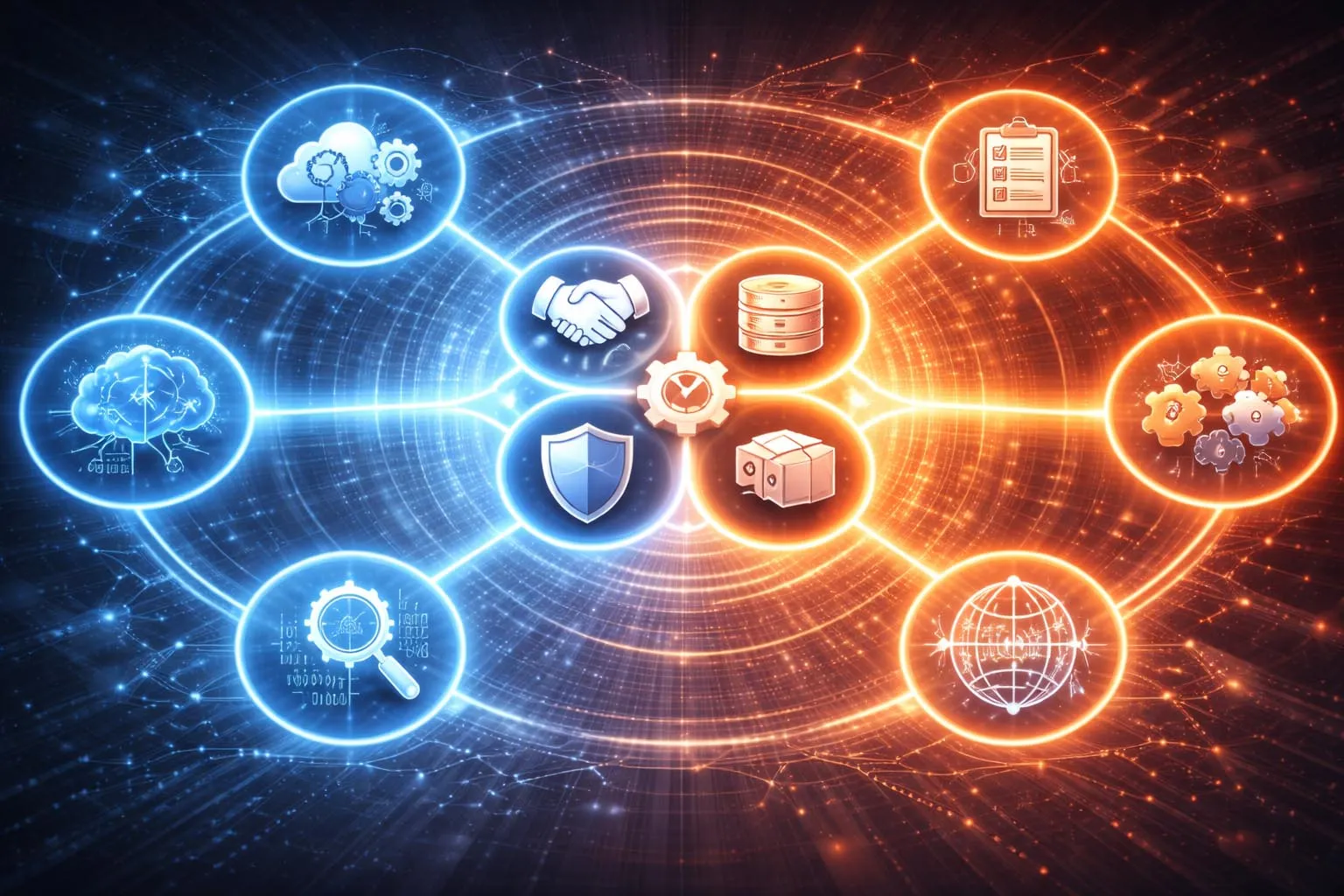
Interoperability works through shared interfaces, data models, semantic mapping, and trusted exchange between connected systems.
Layers of Interoperability
Technical Interoperability
The first layer is technical interoperability. This refers to the basic ability of systems to connect and exchange data through defined interfaces, protocols, and transport mechanisms. At this layer, the focus is on connectivity, message transport, session handling, device communication, and interface availability.
Examples include a cloud application calling an external API, a SIP device registering with a communications server, an industrial controller publishing telemetry to a supervisory platform, or a hospital system sending records through a standardized exchange format. Technical interoperability is essential, but it is only the starting point.
Syntactic and Semantic Interoperability
Beyond connectivity, systems also need to agree on structure and meaning. Syntactic interoperability focuses on consistent data formatting, such as message syntax, field order, and schema compliance. Semantic interoperability goes deeper by ensuring that the meaning of the exchanged information is understood consistently across systems.
This is where many projects succeed or fail. Two systems may exchange structured messages perfectly, yet still misinterpret the content because categories, labels, units, priorities, or business rules do not match. Semantic interoperability reduces that risk by aligning definitions and interpretation rather than only transmission.
Organizational and Process Interoperability
In real-world operations, interoperability often extends beyond technology into process and governance. Different departments, business units, vendors, and partner organizations may need shared policies, responsibilities, timing rules, escalation procedures, and operating assumptions in order to make system exchange useful in practice.
For example, a security platform may exchange alerts correctly with a ticketing system, but if ownership is unclear and response procedures are inconsistent, the operational value is limited. Similarly, data may move between clinical systems or industrial platforms, but unless workflows and accountability are aligned, the organization may still face delays and manual work. This broader dimension is sometimes called organizational interoperability.
Strong interoperability usually combines three things: systems can connect, data keeps its meaning, and the receiving organization knows how to act on it.
Benefits of Interoperability
Better Efficiency and Less Manual Work
One of the biggest benefits of interoperability is operational efficiency. When systems exchange and use information consistently, teams spend less time re-entering data, reconciling records, translating formats, or checking whether different platforms are describing the same event in different ways. That reduces delays and lowers the risk of human error.
This is valuable in almost every industry. Enterprise teams can synchronize data between applications more easily, healthcare providers can reduce information fragmentation, manufacturers can connect plant data with supervisory systems, and communications teams can link voice platforms with business workflows and security tools.
Faster Decision-Making
Interoperability improves decision-making because it reduces information silos. When data from multiple systems can be combined and understood consistently, operators, analysts, and managers gain a more complete view of what is happening. That makes it easier to monitor operations, identify issues, respond to incidents, and coordinate across departments.
In time-sensitive environments such as public safety, healthcare, logistics, industrial operations, and network management, faster access to usable information can directly improve outcomes. The value of interoperability is not just in data movement, but in the speed and confidence it enables.
Greater Flexibility and Vendor Choice
Interoperability also makes organizations more flexible. If platforms depend entirely on proprietary internal formats or closed ecosystems, it becomes harder to add new tools, change vendors, or modernize parts of the architecture gradually. Interoperable design reduces that lock-in by allowing systems from different suppliers to coexist more effectively.
This matters for long-term strategy. Businesses rarely replace every system at once. More often, they evolve through phased upgrades, cloud migration, gateway deployment, mergers, multi-site expansion, or integration with partners and service providers. Interoperability makes those transitions more manageable.
Improved Scalability and Resilience
When systems are designed to interoperate predictably, organizations can scale more smoothly. New sites, applications, devices, or services can be introduced with less custom engineering. Interoperability also supports resilience because information can move across systems and domains more reliably, reducing dependence on isolated islands of functionality.
For example, interoperable communications, monitoring, and dispatch environments can support continuity across multiple locations. In enterprise software, interoperable services can help maintain operations even as applications are modernized or redistributed across cloud and on-premises environments.
Common Applications of Interoperability
Enterprise Software and Business Systems
In enterprise IT, interoperability is widely used to connect ERP systems, CRM platforms, identity services, finance software, analytics tools, customer support platforms, document systems, and workflow applications. The goal is to let information move between business systems without repeated manual re-entry or fragmented reporting.
For example, a customer update in one system may need to appear in a billing platform, a service desk, and a communications workflow. If those systems interoperate well, the business can operate with greater consistency and speed.
Cloud, Hybrid, and Multi-Platform Environments
Interoperability is especially important in cloud and hybrid environments where organizations use a mix of public cloud services, private infrastructure, SaaS applications, APIs, and local systems. These environments depend on interoperable identity, data exchange, automation, monitoring, and workload coordination.
Without interoperability, cloud adoption can create new silos instead of reducing them. With it, organizations can connect services across environments, maintain consistent policy, and support gradual modernization without disrupting every dependent system.
Healthcare Information Exchange
Healthcare is one of the most visible interoperability domains because clinical systems, laboratories, imaging platforms, pharmacies, payers, and care providers often need timely access to shared data. In this context, interoperability supports safer care coordination, reduced duplication, and better continuity of information across different organizations and applications.
The challenge here is not only technical exchange, but also semantic consistency, privacy control, patient identity alignment, and regulatory compliance. That makes healthcare interoperability both highly valuable and operationally demanding.
Industrial Systems and IoT
In industrial operations, interoperability supports communication between controllers, sensors, gateways, SCADA platforms, historians, analytics systems, maintenance software, and enterprise reporting tools. It helps connect operational technology with supervisory and business systems so that field data can be monitored, analyzed, and acted on more efficiently.
This is especially useful in manufacturing, utilities, transport, smart buildings, energy networks, and remote site operations. Interoperability allows organizations to bring together devices and platforms that may come from different vendors and may have been deployed at different times.
Communications, Telephony, and Public Safety
Interoperability is also central to communications systems such as SIP telephony, dispatch platforms, radio-over-IP systems, emergency communication networks, intercoms, paging systems, and collaboration platforms. Different endpoints, gateways, PBXs, radios, operator consoles, and control systems often need to share call status, audio paths, alarms, location data, or event information.
In these environments, interoperability improves cross-network communication, multi-agency coordination, and system integration. It is especially important where voice, video, alarm, and dispatch workflows must operate across mixed technologies or multi-vendor deployments.
The practical value of interoperability is easiest to see in environments where many systems must cooperate under time pressure, across multiple vendors, or over long technology life cycles.
Challenges to Achieving Interoperability
Legacy Systems and Proprietary Designs
One of the most common barriers to interoperability is the presence of legacy systems that were not designed for modern open exchange. Older platforms may use proprietary protocols, undocumented data structures, limited APIs, or fixed operational assumptions that make integration difficult. Even when gateways are available, the resulting interoperability may still be partial.
Organizations often face this challenge during modernization projects, especially in industry, healthcare, and communications infrastructure where equipment may remain in service for many years.
Inconsistent Data Models and Terminology
Another challenge is that different systems often describe the same thing in different ways. They may use different field names, status codes, event priorities, identifiers, units, or workflows. These differences may seem minor at first, but they can create major friction when systems need to exchange and act on shared information automatically.
This is why interoperability requires more than interface access. It also requires data design, governance, mapping, and sometimes organizational agreement about which definitions will be treated as authoritative.
Security, Privacy, and Governance Constraints
Interoperability must be balanced with security and policy control. The easier it becomes for systems to exchange data, the more important it is to manage permissions, audit trails, encryption, data minimization, identity validation, and compliance requirements. In some environments, the main difficulty is not connecting systems, but connecting them safely and lawfully.
Strong governance helps resolve this tension. It ensures that interoperability supports business value without undermining privacy, safety, or risk management requirements.
Best Practices for Building Interoperable Systems
Prefer Open Standards Where Practical
Open standards are often the most sustainable foundation for interoperability because they reduce dependence on custom one-off interfaces. When widely adopted standards exist, they usually make future expansion, vendor diversity, and long-term maintenance easier.
That does not mean every environment can be standardized instantly. But using open, well-documented interfaces whenever practical usually improves interoperability over time.
Define Data Meaning Early
Many projects focus first on transport and only later discover that the data itself is ambiguous. A better approach is to define business meaning, field logic, event categories, units, identities, and workflow expectations early in the design process. This improves both technical exchange and operational usefulness.
Design for Governance, Not Just Connection
Interoperability should include ownership, version control, testing, monitoring, and security review. Connections that work initially but are not governed well often become brittle as systems evolve. Strong governance turns interoperability into a durable capability rather than a temporary project outcome.
FAQ
What is interoperability in simple terms?
Interoperability is the ability of different systems to exchange information and use that information correctly. It means systems can work together, not just connect.
What is the difference between interoperability and integration?
Integration usually means connecting systems technically. Interoperability is the broader outcome in which connected systems can exchange, interpret, and use information with minimal friction.
Why is interoperability important?
It reduces information silos, improves efficiency, supports better decisions, increases flexibility, and makes it easier to connect systems from different vendors or different technology generations.
Where is interoperability commonly used?
It is widely used in enterprise software, cloud environments, healthcare data exchange, industrial automation, IoT systems, telecommunications, emergency communications, and public safety networks.
Does interoperability require open standards?
Not always, but open standards usually make interoperability easier to achieve, expand, and maintain. They reduce custom translation work and support broader multi-vendor cooperation.







