


Interactive Voice Response (IVR) is an automated telephone system that allows callers to interact with a business or service platform by using keypad input, spoken commands, or both. Instead of waiting immediately for a live operator, the caller hears prompts, selects options, provides information, and is then routed to self-service functions, the right queue, or a specific agent workflow. In practical terms, IVR acts as the front door of many business phone systems and contact centers.
IVR has remained important for decades because it solves a very common communication problem: many inbound calls are repetitive, predictable, or need structured routing before a human conversation begins. A caller may want to check an order status, reach billing, choose a language, confirm office hours, authenticate an account, request a callback, or report an incident. IVR provides a consistent framework for handling these requests efficiently without requiring every call to start with a live receptionist or agent.
Modern IVR systems are also more flexible than the old stereotype of a long and frustrating phone tree. Today’s deployments can combine prerecorded prompts, text-to-speech, DTMF keypad input, speech recognition, CRM integration, skills-based routing, callback logic, analytics, and cloud contact center workflows. As a result, IVR is now used not only to reduce manual call handling, but also to improve customer access, accelerate service resolution, and support high-volume communications across enterprise, government, healthcare, financial, and industrial environments.
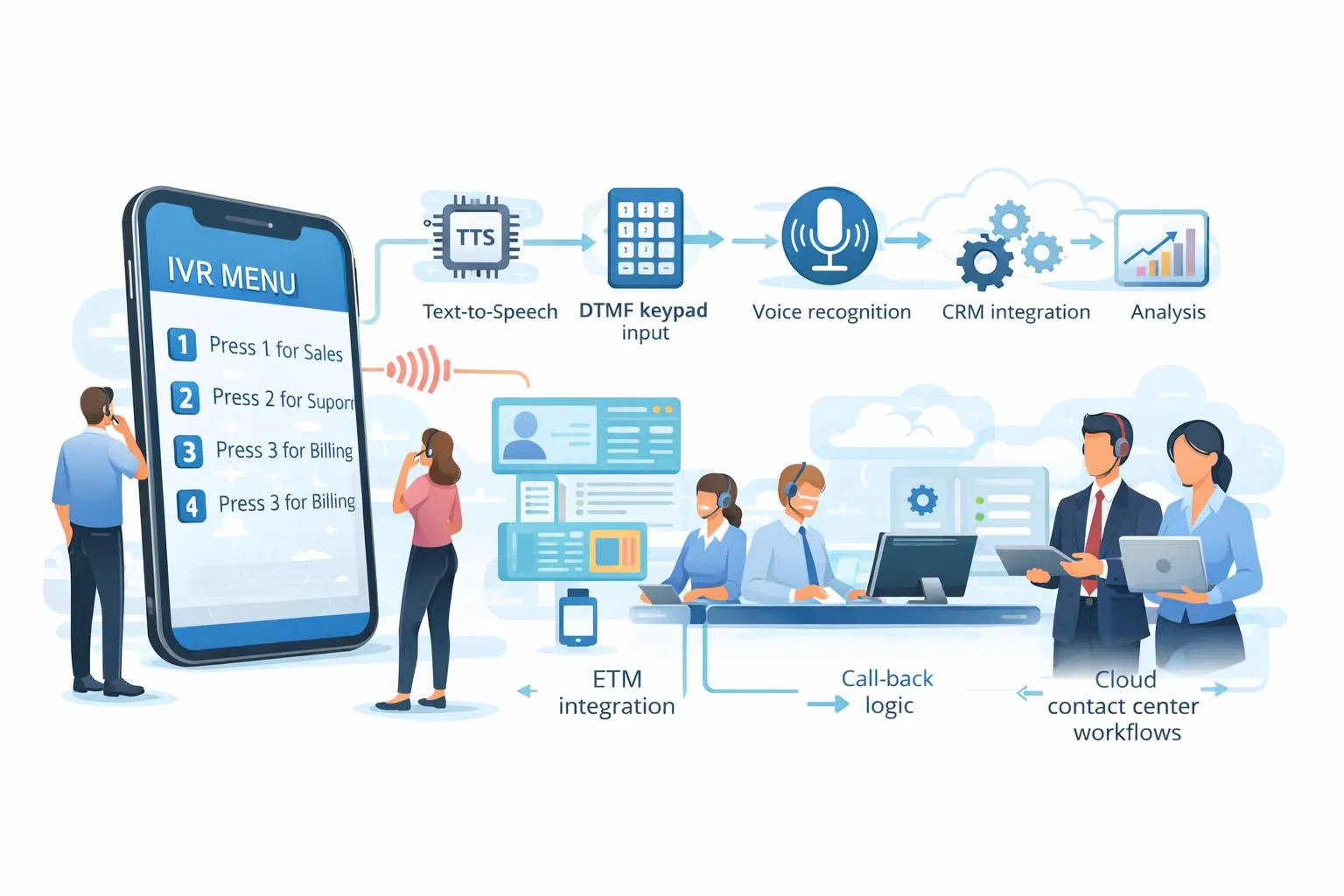
IVR acts as the first interaction layer for many business phone systems, helping callers navigate services and reach the right destination.
What IVR Means in Telephony
An Automated Voice Interface for Callers
At its core, IVR is a voice interface that sits between the inbound call and the service logic behind it. When a caller reaches the number, the system answers with a greeting and then presents one or more interaction paths. Those paths may be very simple, such as “Press 1 for sales, press 2 for support,” or more advanced, such as asking the caller to say an intent, enter an account number, or confirm an appointment.
The defining feature of IVR is interactivity. The system does not simply play a message and disconnect. It accepts user input, evaluates that input against configured rules or workflows, and then determines the next action. That action may be routing the call, retrieving information, collecting data, triggering a workflow, or transferring the caller to an agent with the interaction context already attached.
This is why IVR is often treated as both a telephony feature and a workflow engine. It combines voice prompts with logic, data collection, and routing behavior so that incoming calls can be processed in a structured and scalable way.
More Than a Simple Phone Tree
Many people associate IVR only with traditional touch-tone menus, but that is only one part of the broader concept. Some IVR systems are menu-driven and use DTMF keypad selection. Others are speech-enabled and allow callers to respond with natural phrases or guided spoken choices. Some modern implementations also integrate with chatbots, speech analytics, CRM records, ticketing systems, and AI-assisted self-service flows.
That evolution matters because the role of IVR has expanded. In older deployments, IVR mainly reduced switchboard workload by sending callers to the right extension or department. In modern customer service and enterprise communications, IVR often plays a bigger role in identity capture, intent classification, automation, self-service completion, and context handoff to the next system or human agent.
IVR is not just a recorded menu. It is a call-handling logic layer that can collect information, guide the caller, and connect telephony with business workflows.
How Interactive Voice Response Works
Call Arrival, Greeting, and Prompt Logic
An IVR interaction begins when an inbound call reaches the telephony platform, SIP trunk, PBX, contact center, or cloud communications service that hosts the IVR application. The system answers the call automatically and plays an initial greeting. From there, the call enters a predefined logic flow, sometimes called a call flow, script, or journey. This flow determines what the caller hears next and what kinds of input are accepted.
The prompt logic may branch immediately based on time of day, number dialed, caller language, business hours, location, or customer profile. For example, one DID might trigger a sales IVR, while another triggers technical support. After-hours calls may be sent to voicemail, emergency lines, on-call staff, or callback workflows. The IVR therefore acts as a decision engine from the first seconds of the call.
Well-designed prompt logic is essential because callers need to understand quickly what the system expects from them. Clear prompts reduce abandonment, shorten handling time, and increase the chance that the caller reaches the correct service path on the first attempt.
Caller Input Through DTMF and Speech
Once the IVR presents a menu or question, it waits for caller input. In classic IVR, that input is provided through DTMF tones generated by pressing keys on the phone keypad. DTMF remains widely used because it is reliable, easy to design for, and predictable across many telephony environments. It is especially useful when the system needs numeric input such as account IDs, menu selections, PIN codes, or option branches.
Many modern IVR systems also support speech input. In these cases, the system can accept spoken commands or phrases and map them to intents, menu options, or workflow steps. Speech recognition allows a more natural experience, especially when callers do not want to memorize menu structures or when accessibility and hands-free interaction are important. Some platforms use guided speech input, while others support more conversational intent capture.
In practice, strong IVR designs often support both methods. Speech can improve convenience and customer experience, while DTMF provides a dependable fallback when recognition confidence is low, the call is noisy, or the caller prefers keypad interaction.
Routing, Self-Service, and Agent Transfer
After receiving the input, the IVR decides what to do next. If the caller selected a department or expressed a recognized intent, the system may route the call to the correct queue, extension, team, or geographic site. If the request can be resolved through automation, the IVR may provide self-service instead of transferring to an agent. For example, it may play an account balance, confirm a delivery window, report office hours, or collect structured incident details before ending the call.
When agent transfer is required, the best IVR designs do more than just move the call. They pass context. That can include the menu path, caller ID, language choice, account number, authentication state, reason for contact, or self-service attempts already completed. This context reduces repetition for the caller and helps agents start from a better position.
In advanced contact center environments, the IVR can also interact with queue logic, callback systems, customer records, and routing engines so that the caller is directed not just to any available agent, but to the most appropriate one.
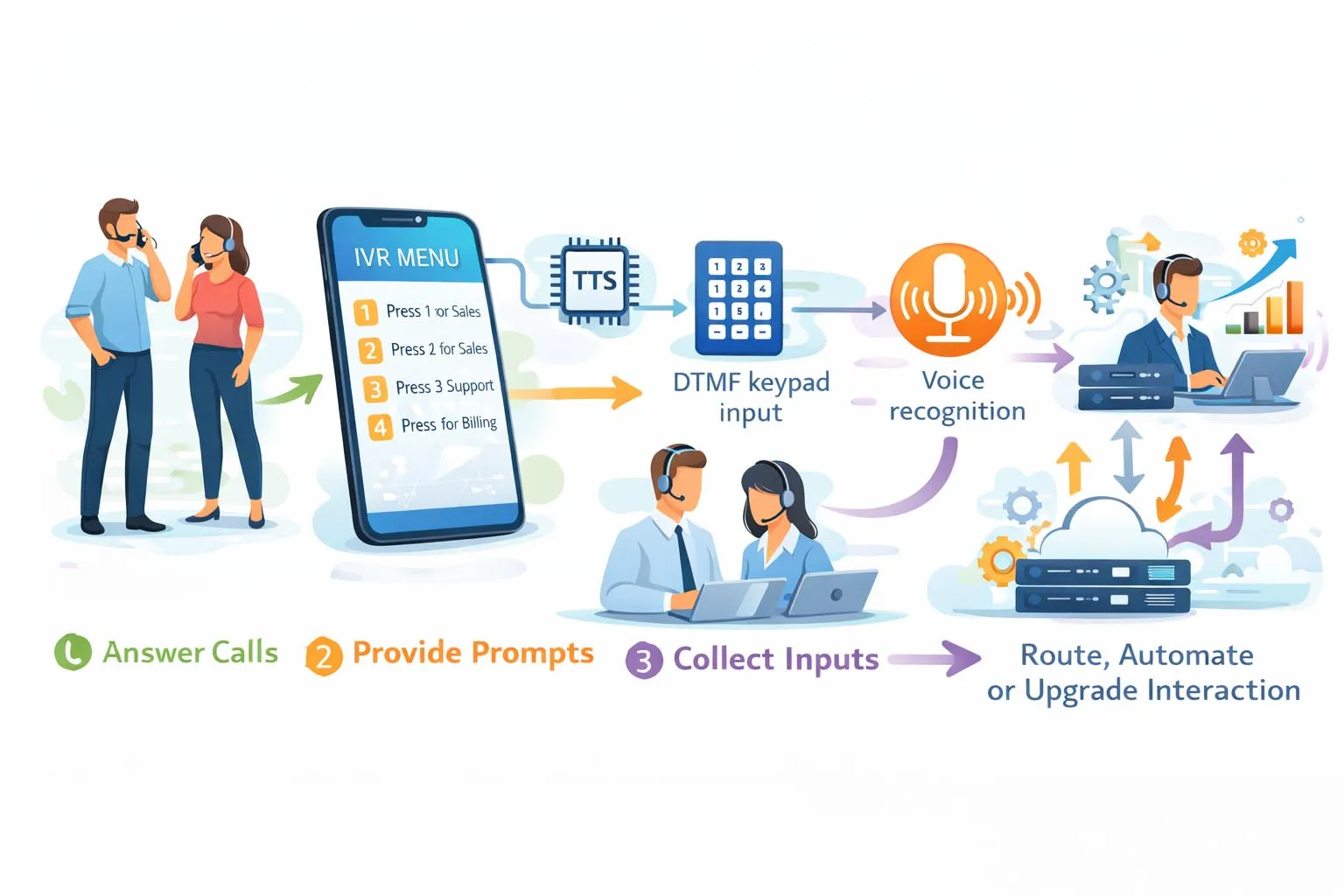
IVR works by answering the call, presenting prompts, collecting input, and then routing, automating, or escalating the interaction.
Core Features of IVR
Automated Greetings and Menu Navigation
One of the most basic and essential IVR features is automated call answering with menu navigation. This allows businesses to greet callers consistently, provide initial guidance, and organize inbound traffic without relying on a live person to answer every call. The menu can be simple for small organizations or multi-level for more complex service structures.
Menu navigation remains useful because it creates order in high-volume call environments. It helps direct callers toward the right service path and reduces the number of misrouted calls that would otherwise consume agent time. Even when speech-enabled interaction is available, a clear fallback menu often remains an important feature for reliability and user confidence.
Self-Service Information Access
IVR is widely valued for self-service. Instead of waiting for an agent to answer basic questions, callers can complete routine tasks directly within the call flow. These tasks may include hearing business hours, checking order or case status, confirming balances, receiving appointment details, obtaining location information, or reporting a simple issue.
This self-service capability is especially valuable when call volumes are high, service demand extends beyond office hours, or the business wants to reserve live agents for more complex interactions. It improves availability because the IVR can respond 24/7, even when full staffing is not present.
Speech Recognition and Natural Input
Speech-enabled IVR allows callers to speak instead of using only keypad selections. This improves usability in many environments, especially for mobile callers, hands-free situations, multilingual flows, and customer journeys where callers may not know the exact menu branch they need. A well-designed speech IVR can reduce menu depth and make the interaction feel more direct.
At the same time, speech features require careful prompt design, recognition tuning, fallback handling, and noise-aware testing. For that reason, speech recognition is powerful, but it works best when supported by clear intents, confirmation logic, and a dependable backup path such as DTMF or agent transfer.
Routing and Queue Integration
Another major IVR feature is routing control. IVR can send calls to the correct department, skill group, language queue, branch office, on-call destination, or escalation team based on caller input and business logic. This is often the feature that delivers the most immediate operational value because it reduces manual transfer activity and improves first-contact direction.
In contact center settings, IVR routing can be integrated with queue policies, customer identification, priority rules, business hours, callback offers, and CRM data. This transforms IVR from a simple menu into a front-end orchestration layer for inbound communication.
Prompt Playback, TTS, and Dynamic Messaging
IVR systems can play prerecorded prompts, but many also support text-to-speech (TTS) for dynamic information. TTS is useful when messages change often, when data must be read from a database or application, or when the business wants to avoid re-recording prompts for every update. Dynamic messaging can be used for balances, order numbers, queue announcements, incident notices, temporary closures, or campaign-specific information.
This capability makes IVR more adaptable. Instead of serving only static menus, the system can provide timely, personalized, or situation-specific guidance during the call.
The strongest IVR systems combine three layers well: easy entry, effective self-service, and smooth handoff when automation is no longer the best path.
Benefits of IVR
Improved Call Handling Efficiency
One of the biggest benefits of IVR is efficiency. It reduces the need for agents or reception staff to handle every routine step of an inbound call. Instead of spending time on repetitive redirection and simple information requests, staff can focus on issues that genuinely require human judgment, empathy, or technical expertise.
This efficiency becomes even more valuable as call volume grows. Businesses can absorb more inbound activity without increasing staffing at the same rate, and callers can reach the correct service path more quickly. That makes IVR attractive not only to contact centers, but also to multi-site organizations, healthcare facilities, utility providers, and service operations with large call loads.
Better Availability and 24/7 Access
IVR makes services available even when full staffing is not. A caller can still receive guidance, complete basic self-service actions, or be routed to an emergency, on-call, or voicemail path after normal business hours. This improves accessibility and gives organizations a more professional and dependable inbound communication experience.
In many sectors, this is a major advantage. Hospitals, logistics providers, public utilities, maintenance services, and distributed enterprises often receive calls outside core office hours. IVR allows them to respond in a structured way even when live response is limited.
More Accurate Routing and Lower Transfer Rates
When designed well, IVR improves routing accuracy by capturing the caller’s need early in the interaction. This reduces the number of calls that reach the wrong department or require multiple transfers before resolution begins. Lower transfer rates save time for both callers and agents and often improve overall customer experience.
This benefit is especially noticeable when the IVR is connected to customer data, language preferences, or skills-based queue logic. In those environments, the caller is not just routed generically. The system can match the call to the most suitable destination from the start.
Scalable Communication for Growing Organizations
IVR also supports scalability. As organizations expand locations, services, languages, or inbound channels, IVR provides a repeatable framework for structuring the call experience. New departments, campaigns, support lines, and service workflows can often be added through configuration rather than by redesigning the entire voice environment from zero.
That makes IVR particularly useful in growing enterprises and cloud communication platforms where service logic must evolve without constant dependence on manual call handling.
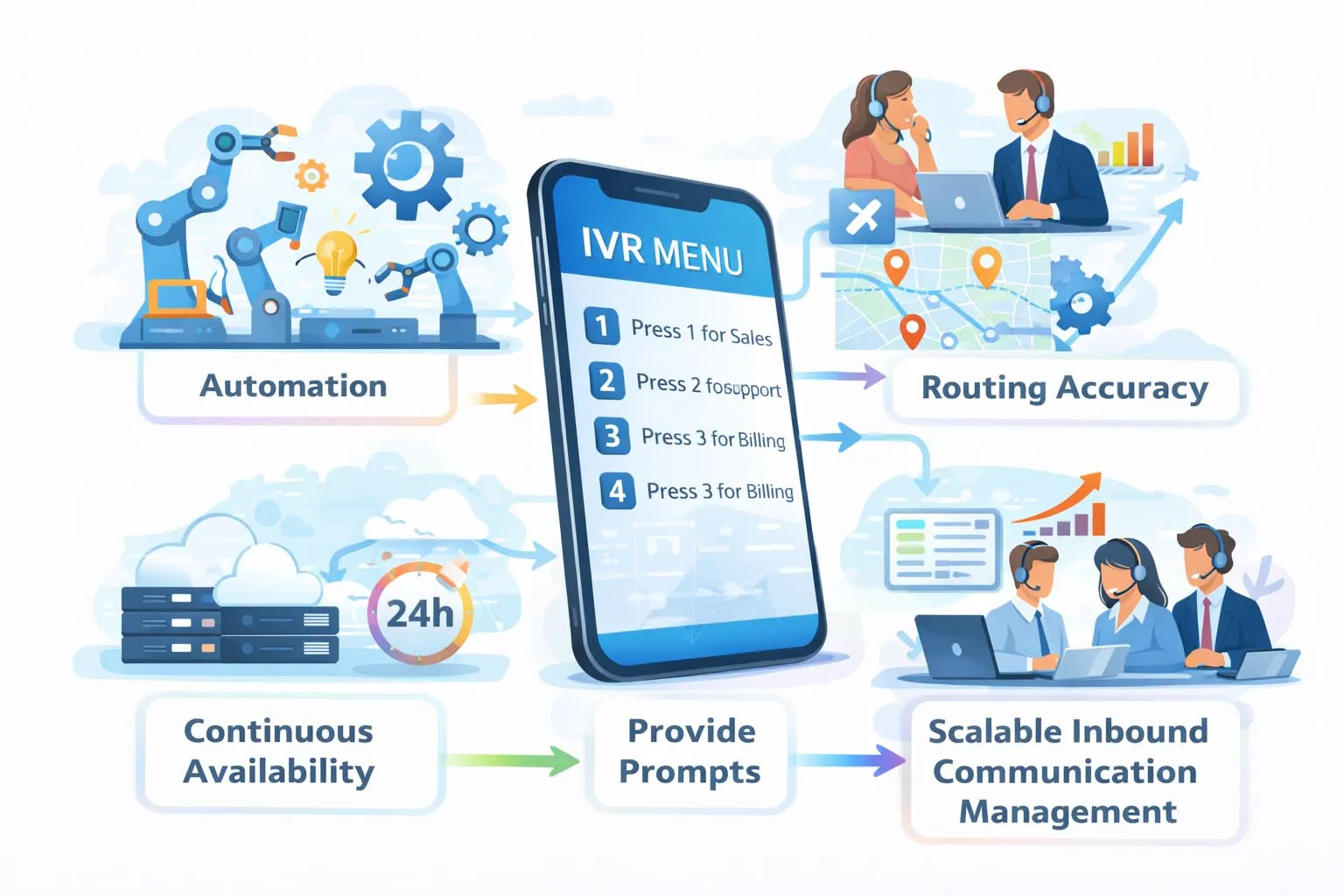
IVR creates value through automation, routing accuracy, continuous availability, and scalable inbound communication management.
Applications of IVR
Customer Service and Contact Centers
The best-known application of IVR is in customer service and contact center environments. Businesses use IVR to greet callers, collect intent, route by department, identify customers, offer self-service, announce wait times, and transfer interactions to the right queue. This is common in retail, telecom, software support, insurance, utilities, and many other service-driven sectors.
In this setting, IVR helps reduce queue pressure, improve first-contact routing, and standardize the inbound experience. It also makes it easier to support high call volumes during peak periods, promotions, outages, or seasonal demand.
Healthcare and Appointment Management
Healthcare organizations frequently use IVR for appointment reminders, clinic navigation, department routing, prescription lines, patient information capture, and after-hours guidance. A patient may call to confirm an appointment, hear location details, reach a specific unit, or leave information for a return call. IVR helps structure these high-volume routine interactions more efficiently.
Because healthcare communication often involves time-sensitive but repetitive tasks, IVR is useful for reducing front-desk call burden while still giving patients a dependable access path. In larger systems, IVR can also support language selection and integration with scheduling workflows.
Banking, Payments, and Account Services
Financial institutions and payment-related services often use IVR for account access, balance information, payment routing, branch information, card support, and basic authentication. IVR is well suited to these environments because the interactions are often structured, security-sensitive, and high volume.
When integrated with account systems, IVR can provide fast self-service and reduce agent load for routine requests. It also allows the business to set clear security checkpoints before any live transfer or sensitive transaction path begins.
Logistics, Field Service, and Multi-Site Operations
IVR is also valuable in logistics, maintenance, field service, and distributed enterprise environments. Callers may need to report faults, reach a regional branch, check delivery status, connect to on-call teams, or be directed according to geography and service type. IVR can capture location, issue category, urgency, and contact details before passing the interaction onward.
In these operational settings, IVR acts as an intake and routing layer for real-world service coordination. It is not only a customer service tool, but also an operational communication tool.
Government, Utilities, and Public Services
Public sector bodies, educational institutions, and utility services often use IVR to manage high inbound call volumes around information access, outage notices, service requests, form guidance, and departmental navigation. Because these organizations may serve large populations with repetitive informational needs, IVR can provide consistent front-line communication without overwhelming staff.
It is particularly useful when the organization needs to deliver standard messages quickly during service changes, disruptions, billing periods, or public-information events.
IVR works best in environments where large numbers of callers need fast structure: the right message, the right path, or the right agent, without unnecessary delay.
Deployment and Design Considerations
On-Premises, PBX-Integrated, and Cloud IVR
IVR can be deployed in several ways. Some organizations use PBX-integrated IVR or contact center applications hosted on-premises. Others use cloud contact center or UCaaS platforms that provide visual flow builders, speech integration, analytics, and routing logic as managed services. Hybrid approaches are also common, especially when legacy telephony, SIP trunks, and modern CRM or cloud workflows must coexist.
The right deployment model depends on scale, integration requirements, security policy, support structure, and how quickly the business wants to change call flows. Cloud platforms often offer faster iteration and easier scaling, while on-premises deployments may be preferred in environments with strict control, existing telephony investments, or specialized integration needs.
Design for Clarity, Not Just Automation
One of the most important IVR design principles is clarity. A heavily automated system is not automatically a good one. Menus should be understandable, prompt length should be controlled, high-frequency actions should be easy to reach, and fallback options should be obvious. If callers repeatedly fail to choose correctly, the IVR may reduce rather than improve efficiency.
Strong IVR design usually means limiting unnecessary menu depth, using plain language, confirming important inputs, and offering a graceful route to a live person when automation is no longer helping. The goal is not to trap the caller in self-service. The goal is to guide the caller efficiently to the best available outcome.
Maintain, Measure, and Improve
IVR should be treated as a living operational system, not a one-time recording project. Organizations should review routing accuracy, abandonment points, misroutes, speech recognition outcomes, menu usage, and containment rates over time. Business hours, departments, services, and caller behavior all change, and the IVR should evolve with them.
Regular maintenance also includes checking recordings, TTS behavior, transfer rules, emergency logic, and integration with downstream systems. A technically functioning IVR can still perform poorly if the prompts are outdated or the call flow no longer reflects real business operations.
FAQ
What is IVR in simple terms?
IVR is an automated phone system that lets callers interact through keypad input or speech so they can get information, choose options, or reach the right department without starting immediately with a live agent.
What is the difference between IVR and an auto attendant?
An auto attendant usually focuses on basic call answering and menu-based routing, while IVR often includes deeper interaction such as self-service, data collection, account input, speech recognition, and workflow integration.
Does IVR only use keypad input?
No. Many IVR systems still use DTMF keypad input, but modern platforms often support speech recognition as well. Many deployments use both so speech can improve convenience and DTMF can remain a reliable fallback.
What are the main benefits of IVR?
The main benefits include better call routing, lower agent workload for repetitive tasks, 24/7 availability for routine interactions, more scalable inbound call handling, and improved service consistency.
Where is IVR commonly used?
IVR is commonly used in customer service, healthcare, banking, utilities, logistics, public services, and enterprise communications anywhere structured inbound call handling and basic self-service are valuable.







