


Interactive Connectivity Establishment (ICE) is a network traversal framework used to establish media and data connections between two endpoints when direct connectivity is complicated by NAT devices, firewalls, multiple interfaces, or changing network conditions. In practice, ICE is most often associated with WebRTC, SIP-based real-time media, and other interactive communications systems that need to find a working path between peers as automatically as possible.
The reason ICE matters is simple: on modern networks, endpoints rarely sit on openly reachable public IP addresses. They are often behind home routers, enterprise firewalls, carrier NAT, or cloud edge layers. Even when two devices can exchange signaling messages, that does not mean their audio, video, or data streams can flow directly. ICE solves this by gathering possible network paths, exchanging them with the remote side, testing which combinations actually work, and selecting the best available path for the session.
ICE is not a replacement for STUN or TURN. Instead, it is the coordination framework that uses those technologies together. STUN helps an endpoint discover how it appears from outside the NAT, while TURN provides a relay path when direct peer-to-peer connectivity is not possible. ICE organizes these possibilities into a structured decision process so that real-time applications can connect more reliably and with less manual network configuration.
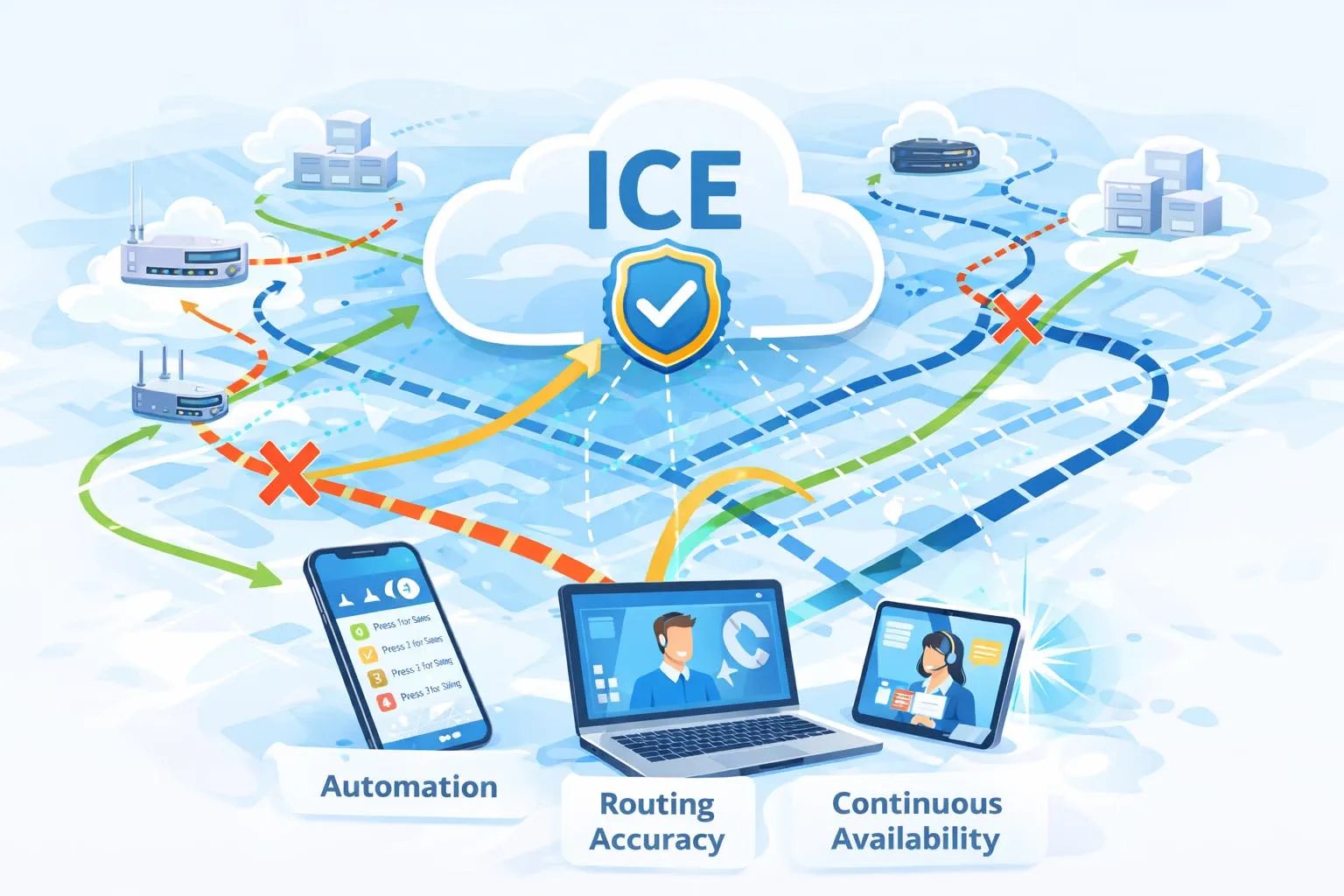
ICE helps real-time endpoints discover, test, and select the best available network path for voice, video, or data sessions.
What ICE Means in Real-Time Networking
A Connectivity Framework, Not Just One Protocol Message
ICE is best understood as a complete connectivity framework rather than a single packet format or a simple server feature. Its job is to coordinate candidate discovery, candidate exchange, connectivity checks, and final path selection between two endpoints. The IETF defines ICE in RFC 8445 as a protocol for NAT traversal for UDP-based communication, and that specification explicitly states that ICE makes use of STUN and TURN.
This broader framework view is important because many people first encounter ICE only as a configuration field, such as an iceServers array in WebRTC or a NAT traversal option in a SIP platform. Under the surface, however, ICE is managing a full decision process. It is deciding which local interfaces are usable, which reflexive or relayed addresses are available, which peer combinations are worth checking, and which working path should be nominated for the session.
Why Direct Connectivity Is Hard on the Internet
On a simple public network, two devices could exchange addresses and send packets directly. Real deployments are rarely that simple. Devices often sit behind NAT, which rewrites source addresses and ports. Firewalls may block unsolicited inbound traffic. Mobile devices may switch between Wi-Fi and cellular networks. Enterprise users may sit behind layered security gateways, while cloud-hosted services may have their own ingress and egress policies.
Because of this, a valid-looking address in signaling is not enough. The address may only be reachable in one direction, may only work temporarily, or may not be reachable at all from the remote peer. ICE addresses that uncertainty by collecting multiple connectivity options and testing them in the actual network environment rather than assuming that one announced address will work.
ICE does not guess the one perfect route in advance. It gathers plausible paths, verifies them through checks, and then keeps the path that works best in the real network.
How ICE Works
Candidate Gathering
The first stage of ICE is candidate gathering. Each endpoint collects possible addresses and ports that might be usable for the session. These are called ICE candidates. In browser-based WebRTC, the platform emits these candidates as it discovers them. MDN describes an ICE candidate as the protocols and routing information needed for WebRTC to communicate with a remote device, and notes that several candidates are usually proposed until both sides agree on the best one.
Candidate gathering usually produces several types of possibilities. A host candidate comes directly from the endpoint’s local interfaces. A server reflexive candidate, often written as srflx, is learned through STUN and reflects the public-facing address and port allocated by the NAT. A relay candidate is allocated through TURN when traffic must pass through a relay server. Some flows can also produce a peer reflexive candidate during connectivity checks. The goal is not to predict the winner immediately, but to build a workable set of options.
Candidate Exchange Through Signaling
Once candidates are gathered, the endpoints need to exchange them. ICE itself does not define a single universal signaling system for this step. In WebRTC, candidates are typically sent over the application’s signaling channel, while in SIP and other media systems they may be conveyed through SDP and related signaling flows. The important point is that both sides need visibility into the other side’s possible paths before they can begin testing them.
This stage is why an ICE-enabled deployment still needs signaling design. ICE helps media connectivity, but it depends on a separate mechanism to move candidate information between peers. If signaling is broken, ICE never gets enough information to do its job. In well-designed systems, signaling and ICE work together: signaling carries session descriptions and candidates, while ICE validates which candidate pairs are truly reachable.
Candidate Pairing and Connectivity Checks
After exchange, ICE forms candidate pairs by combining local and remote candidates in priority order. It then performs connectivity checks using STUN-based transactions. These checks determine whether packets can actually flow between the paired candidates. RFC 8445 describes this as the phase in which candidate pairs are checked and, eventually, one or more working pairs are selected for use by the session.
This is the heart of ICE. Instead of assuming that a host address, a reflexive address, or a relay address will work, ICE actively tests them. Some pairs fail immediately because of NAT filtering or firewall policy. Some work but are less preferred because they involve relaying. Some succeed quickly and become strong candidates for nomination. ICE uses these results to converge on the best viable path rather than relying on static configuration guesses.
Nomination and Selected Candidate Pair
When checks succeed, ICE chooses a selected candidate pair. In simplified terms, the controlling side nominates the pair that should carry media, and the session begins using it for ongoing transmission. If a direct path works, ICE will usually prefer that over a relayed path because it tends to reduce latency and relay cost. If only a relay works, ICE can still complete the session through TURN.
This final selection step is what makes ICE practical for real-time communications. The application does not need the user to manually decide which network interface or public mapping should be used. ICE drives the decision from live checks and then hands the chosen path to the media engine so the call, video session, or data exchange can proceed.
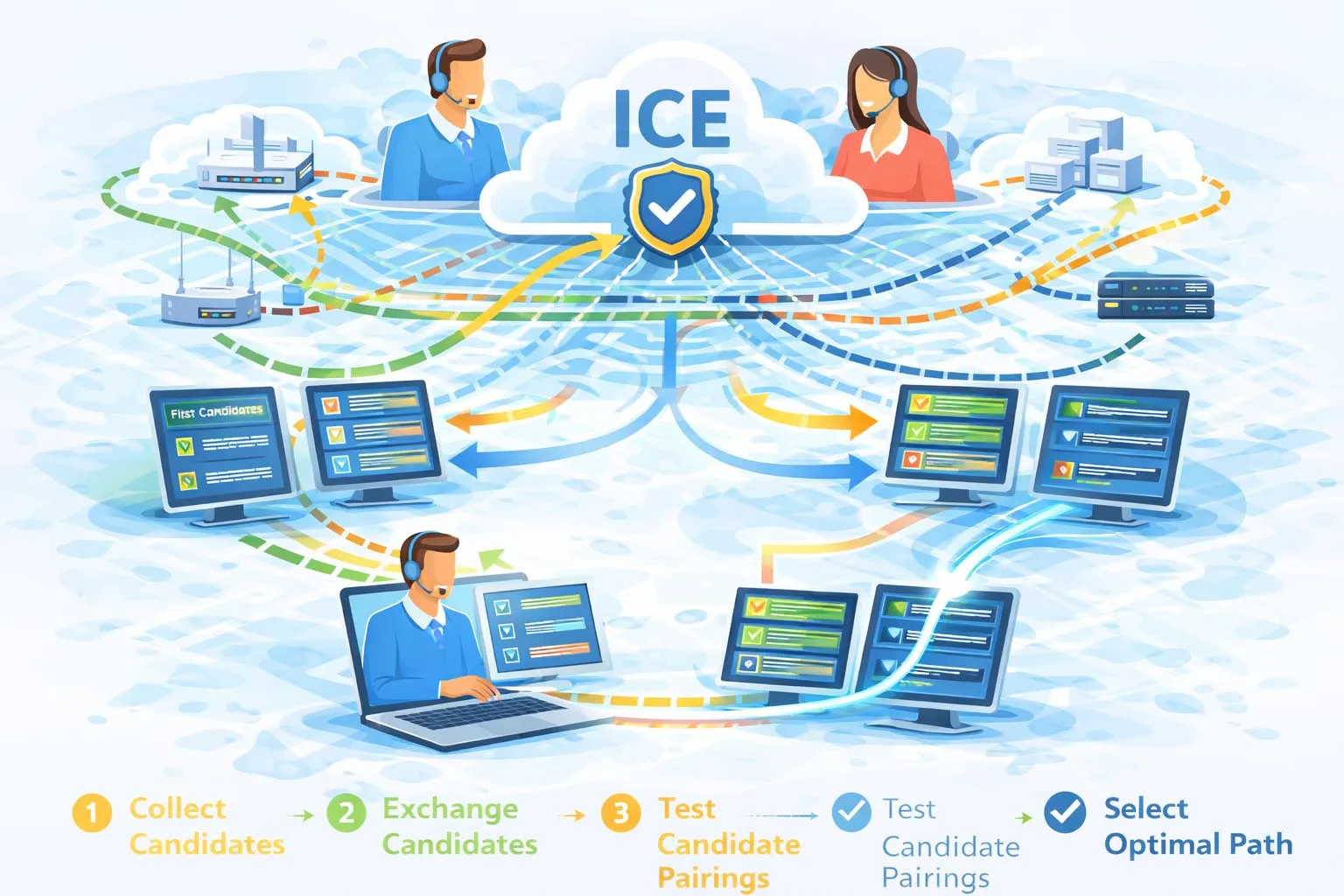
ICE works by gathering candidates, exchanging them, testing candidate pairs, and selecting the best path that actually succeeds.
The Relationship Between ICE, STUN, and TURN
What STUN Contributes
STUN is a tool protocol for NAT traversal, not a complete end-to-end solution by itself. RFC 8489 describes STUN as a protocol that serves as a tool for other protocols in dealing with NAT traversal and notes that it can help an endpoint discover the IP address and port allocated by a NAT. In ICE, STUN is used both for candidate gathering and for connectivity checks.
In practical terms, STUN helps answer the question, “How does my endpoint appear from outside the local network?” That answer becomes a server reflexive candidate. In many cases, this is enough to enable a direct peer-to-peer path, especially when NAT behavior is permissive enough for the checks to succeed. But STUN alone cannot guarantee success in every topology.
What TURN Contributes
TURN fills the gap when a direct path is not possible. RFC 8656 defines TURN as a relay protocol that allows a host behind NAT to use an intermediate node to exchange packets with peers. In ICE terms, TURN produces relay candidates that can always serve as a fallback path if direct or reflexive candidate pairs fail.
TURN is often essential in restrictive enterprise networks, symmetric NAT scenarios, mobile networks, or any environment where direct UDP path creation is unreliable. The tradeoff is that relayed media usually adds latency, consumes relay bandwidth, and increases infrastructure cost. ICE therefore prefers direct connectivity when possible, but TURN is what makes session establishment dependable when direct options fail.
Why ICE Needs Both
ICE is the orchestration layer that brings STUN and TURN together. STUN alone gives discovery and testing, while TURN provides a fallback relay. ICE decides how to use them: gather host, reflexive, and relay candidates; prioritize them; run checks; and nominate the best working pair. This is why many explanations describe ICE as the control brain of NAT traversal rather than just another traversal mechanism.
In operational terms, well-run real-time platforms nearly always deploy STUN and TURN together under ICE, because reliability matters more than assuming the ideal network path will exist. Direct connectivity is the preferred outcome, but relay-based success is far better than call failure.
STUN helps discover and test paths, TURN provides a relay when direct paths fail, and ICE decides which of those options should carry the session.
Modern ICE Behavior and Trickle ICE
Why Trickle ICE Matters
Traditional ICE waits until a substantial set of candidates has been gathered before progressing through the full exchange and check process. Trickle ICE, defined in RFC 8838, improves this by allowing candidates to be exchanged incrementally as soon as they become available. The RFC explains that this lets candidate gathering and connectivity checks proceed in parallel, which can considerably accelerate session establishment.
This improvement matters in user experience. Instead of waiting for all possible candidate collection to finish before checks begin, the endpoints can start working with early candidates and keep adding new ones as they are discovered. In practice, this often reduces setup delay in WebRTC and other interactive applications, especially when relay allocation or multi-interface discovery would otherwise slow down the initial handshake.
Failure Timing and ICE Robustness
Modern ICE behavior has also been refined after RFC 8445. RFC 8863 updates RFC 8445 and RFC 8838 by requiring an ICE agent to wait a minimum amount of time before declaring ICE failure, even when no candidate pairs remain to check. This change improves robustness by preventing premature failure in edge timing cases.
That detail is operationally important because real networks are messy. Delayed candidate arrival, late signaling, or out-of-order checks can create conditions where a session would appear failed too early if the timeout logic were too aggressive. The RFC 8863 update reflects the practical lesson that successful connectivity establishment sometimes needs a small amount of extra patience.
Benefits of ICE
Higher Session Success Rates
The clearest benefit of ICE is reliability. By collecting multiple path options and verifying them with real connectivity checks, ICE significantly increases the probability that a call or media session will connect successfully across varied networks. This is especially valuable on consumer broadband, mobile access, hotel Wi-Fi, enterprise LANs, and other environments where NAT and firewall behavior cannot be predicted cleanly in advance.
Without ICE, applications would either depend on one announced address that might fail or fall back too quickly to expensive relay use. ICE provides a structured way to try direct, reflexive, and relayed paths in a priority-driven manner, which improves the odds of successful setup while still aiming for the most efficient route.
Lower Latency When Direct Paths Work
Because ICE prefers viable direct paths over relayed ones, it can help preserve low latency and better media quality when the network permits direct peer communication. That matters for voice, video, interactive streaming, cloud gaming, remote collaboration, and other low-latency real-time use cases where unnecessary relaying adds cost and delay.
Relay is important for reliability, but direct transport is usually better for performance. ICE balances those goals by testing the direct options first and keeping TURN as the dependable fallback.
Better Adaptation Across Heterogeneous Networks
Modern endpoints often have multiple interfaces, such as Ethernet, Wi-Fi, VPN tunnels, and cellular links. ICE can gather candidates from these different paths and let connectivity checks reveal which one is actually usable for the session. This makes ICE far more adaptable than fixed single-address assumptions.
That adaptability is also helpful in cloud and hybrid deployments. A browser in a home office, a mobile phone on carrier NAT, and a media server in the cloud can still negotiate a practical path because ICE turns network diversity into a tested decision space rather than a deployment obstacle.

ICE is widely used wherever low-latency media must cross NAT, firewall, and multi-network boundaries with minimal user intervention.
Uses and Applications of ICE
WebRTC Voice, Video, and Data Channels
The most visible modern use of ICE is WebRTC. Browsers use ICE to establish peer connections for audio, video, and data channels. MDN’s WebRTC protocol documentation describes ICE as the framework that allows browsers to connect with peers despite NAT, firewalls, and the possibility that relay may be needed. This makes ICE fundamental to browser-based video calls, voice chat, live collaboration, and peer data exchange.
Because browser users connect from highly variable networks, ICE is one of the key reasons WebRTC can work at scale on the public internet. It gives applications a standards-based way to discover connectivity and recover gracefully when a direct path is not possible.
SIP, VoIP, and Unified Communications
ICE is also used in SIP-based voice and video systems, especially where endpoints and media servers need to communicate across NAT boundaries. In enterprise VoIP, remote users, branch offices, mobile softphones, and cloud media services often sit behind different network domains. ICE improves the reliability of media establishment in those mixed environments.
This is particularly relevant when organizations want secure remote calling without relying entirely on static one-to-one NAT rules. ICE helps endpoints negotiate a working media path more dynamically, which is valuable in modern hybrid work and distributed communications deployments.
Streaming Ingest and Low-Latency Media Workflows
ICE is increasingly relevant in modern streaming workflows that use WebRTC-style transport for contribution or ingest. RFC 9725, the WebRTC-HTTP Ingestion Protocol, explicitly states that SDP offer-answer exchange is a fundamental step in establishing an ICE and DTLS session between a client and a media server. That shows how ICE extends beyond browser-to-browser calling into real-time media contribution and delivery systems.
In these use cases, the goal is still the same: establish the most effective path possible for real-time traffic. The endpoints may be encoders and servers rather than human-operated browsers, but ICE remains the mechanism that helps the path come together across complex networks.
Industrial, IoT, and Edge Real-Time Systems
Wherever real-time peer or edge communication must traverse private networks, ICE can be useful. This includes certain industrial video systems, edge collaboration tools, telemetry sessions, and remote assistance platforms that rely on interactive media instead of purely request-response traffic. The benefit is not that ICE is unique to industry, but that it solves a general connectivity problem common to many distributed edge environments.
As these systems incorporate more browser-based control, WebRTC transport, or hybrid cloud-edge interaction, ICE becomes a practical part of the communications stack rather than a browser-only concept.
Deployment Considerations
TURN Capacity and Geographic Placement
Even though ICE prefers direct paths, real deployments should assume that TURN will be needed for a meaningful share of sessions. That means TURN capacity planning matters. If relay is undersized, ICE may still identify a relay path, but the resulting media quality will suffer under load. Geographic placement also matters because relay distance directly affects latency.
Organizations deploying real-time media at scale should therefore treat TURN as production infrastructure, not just a rarely used backup. The best ICE design is one where direct connectivity is common, but relay service is still strong enough to make failures rare when direct paths are blocked.
Observability and Troubleshooting
ICE failures can be difficult to diagnose if the platform exposes only a generic “connection failed” message. Useful deployments log candidate types, candidate pair results, relay usage, and timing behavior so engineers can distinguish signaling issues from connectivity-check failures and TURN-allocation problems. Candidate-level visibility makes it much easier to understand why a session succeeded directly, succeeded via relay, or failed outright.
This is especially important in mixed enterprise environments where VPN clients, firewall policy, endpoint security software, and browser differences can all influence the result. Good observability turns ICE from a mysterious background mechanism into an operationally manageable part of the media platform.
Security and Privacy
ICE candidate exchange reveals network information that applications need in order to connect, so privacy handling and candidate policy matter. Modern browsers and platforms increasingly balance connectivity with privacy protection, and administrators should be aware of how host candidates, relay usage, and logging policies interact with corporate security requirements.
At the same time, TURN credentials, access control, and abuse prevention should be handled carefully. A TURN server is not only a helper service; it is also a resource that can be consumed heavily if not secured and monitored properly.
In production, ICE is not just an algorithm. It is a service design concern that includes signaling, relay capacity, monitoring, and policy control.
FAQ
What is ICE in simple terms?
ICE is a NAT traversal framework that helps two endpoints find a working path for real-time media or data by gathering possible routes, testing them, and selecting the best one.
Does ICE replace STUN or TURN?
No. ICE uses STUN and TURN. STUN helps discover public-facing mappings and perform checks, while TURN provides a relay when direct connectivity is not possible.
What are ICE candidates?
ICE candidates are possible network addresses and ports an endpoint can use for communication. Common candidate types include host, server reflexive, peer reflexive, and relay candidates.
Why is ICE important for WebRTC?
WebRTC sessions often involve users behind NAT, firewalls, and changing networks. ICE gives WebRTC a standardized way to discover and validate connectivity paths so sessions can be established more reliably.
What is Trickle ICE?
Trickle ICE is an extension that allows candidates to be exchanged incrementally as they are discovered, so connectivity checks can begin earlier and session setup can often complete faster.







