IECEx explosion-proof certification is an international conformity assessment system for equipment, services, and personnel used in explosive atmospheres. It is built around the IEC 60079 and related standards, which define how Ex equipment should be designed, tested, marked, installed, inspected, repaired, and maintained. In practical terms, IECEx helps manufacturers, system integrators, plant owners, and regulators use a common technical language when evaluating equipment intended for hazardous areas.
Although people often call it an “explosion-proof certification,” IECEx is broader than a single protection method. It is not the same as flameproof protection, intrinsic safety, or Ex t enclosure protection. Instead, IECEx is the certification framework that can apply to many different Ex protection concepts, depending on the type of equipment, the hazardous material present, and the level of protection required at the installation site.
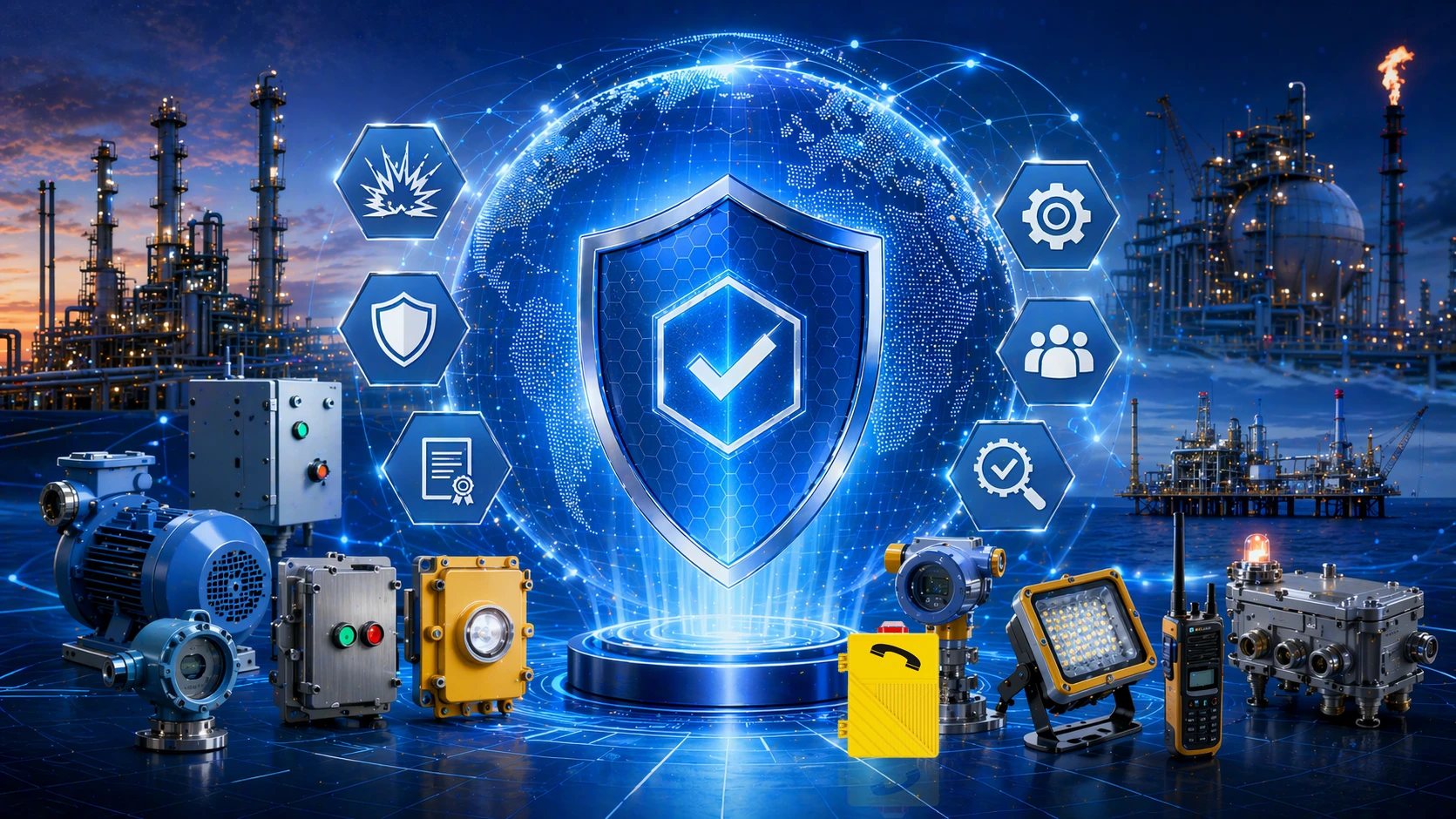
IECEx provides an international framework for assessing Ex equipment, related services, and competence in explosive atmosphere applications.
What Does IECEx Mean?
IECEx stands for the IEC System for Certification to Standards Relating to Equipment for Use in Explosive Atmospheres. It was established to support international trade and technical consistency for Ex products and services. Instead of each market relying only on local interpretations, IECEx offers a globally recognized system based on IEC standards and third-party assessment.
This matters because hazardous area equipment is rarely chosen on appearance alone. Buyers need proof that the equipment has been evaluated against recognized standards, that the manufacturing process is controlled, and that the product marking can be understood by engineers responsible for zone classification, installation, and maintenance.
In other words, IECEx is about confidence. It helps confirm that a device intended for a potentially explosive gas or dust environment has been assessed in a structured and traceable way. That can be especially important for industrial telephones, signaling devices, junction boxes, sensors, cameras, lighting, control stations, analyzers, motors, and network equipment deployed in oil and gas, chemical, mining, marine, and heavy industry facilities.
How IECEx Certification Works
IECEx does not work like a single sticker that means the same thing for every product. The process typically combines several layers of conformity assessment. First, the product design is tested and reviewed against the applicable IEC standards. Then the manufacturer’s production quality system is assessed. Finally, the certified product is issued documentation and marking that identify the applicable protection concept, equipment group, EPL, gas or dust group, and temperature-related limits.
For equipment, the two documents most commonly discussed are the IECEx Test Report (ExTR) and the IECEx Certificate of Conformity (CoC). The ExTR records the technical assessment and testing. The CoC is the formal certificate that identifies the certified product and its scope. In addition, manufacturers are assessed under the IECEx quality framework so that production units remain consistent with the certified design.
IECEx also extends beyond equipment. The system includes certification for service facilities performing Ex-related work such as repair, overhaul, inspection, and maintenance, and it also includes personnel competence schemes. That broader coverage is one reason IECEx is often treated as more than a product label. It is an ecosystem for managing Ex safety throughout the equipment life cycle.
Core Standards Behind IECEx Certification
IECEx is built on standards, not on marketing language. The exact standards depend on the product and the intended application, but several documents appear repeatedly in hazardous area projects.
IEC 60079-0: General Requirements
This is the foundation for many Ex equipment certifications. It sets out general design, testing, construction, and marking requirements for equipment used in explosive atmospheres. If an item is certified with a specific protection concept such as Ex d, Ex e, Ex i, or Ex t, the relevant product standard is typically read alongside IEC 60079-0.
IEC 60079-14: Design, Selection, and Erection
This standard is highly important on the user side. Even properly certified equipment can become unsafe if it is installed incorrectly. IEC 60079-14 covers the design, selection, and installation of electrical equipment in hazardous areas, making it essential for engineering contractors, plant designers, and commissioning teams.
IEC 60079-17: Inspection and Maintenance
Ex compliance does not end after the first installation. IEC 60079-17 focuses on inspection and maintenance so that the condition of the installation remains aligned with Ex safety requirements during operation. This is particularly relevant where corrosion, vibration, dust accumulation, cable damage, or unauthorized modifications can affect protection integrity over time.
IEC 60079-31: Protection by Enclosure for Dust
Where combustible dust is present, IEC 60079-31 is especially important. It addresses equipment protection by enclosure with the Ex t concept and is frequently referenced in dust hazardous area projects such as grain handling, food processing, wood processing, powder handling, and certain chemical production lines.
Area Classification Standards
For gas hazardous areas, IEC 60079-10-1 is used for classification. For combustible dust hazardous areas, IEC 60079-10-2 is used. These standards help determine whether a location is Zone 0, 1, or 2 for gas, or Zone 20, 21, or 22 for dust. The selected zone then affects what level of equipment protection is appropriate.
The IECEx framework relies on coordinated standards covering equipment design, installation, inspection, maintenance, and zone classification.
Is IECEx the Same as ATEX?
No. IECEx and ATEX are closely related in practice, but they are not identical. IECEx is an international certification system based on IEC standards. ATEX is the European regulatory framework for equipment and workplaces in explosive atmospheres. Many manufacturers pursue both because IECEx helps with global technical acceptance, while ATEX is often required for access to the European market.
The technical markings can look similar because both systems rely on comparable Ex concepts and standards logic. However, the legal basis, documentation path, market scope, and conformity assessment rules are not exactly the same. For export-oriented manufacturers, it is common to see a product carry both IECEx and ATEX-related markings when the target markets demand them.
Understanding Protection Ratings in IECEx
When people mention “protection ratings” in the context of IECEx, they are usually referring to several different marking elements rather than one single rating. This is an important point. IECEx does not reduce protection to a simple number. Engineers read a combination of markings to understand where and how the equipment can be used.
1. Equipment Protection Level (EPL)
EPL shows the level of protection the equipment provides in relation to the probability of explosive atmospheres being present. For gas atmospheres, common EPL markings include Ga, Gb, and Gc. For dust atmospheres, common markings include Da, Db, and Dc. In general terms, higher protection levels correspond to more demanding zones.
As a practical rule, Zone 0 gas areas typically require Ga equipment, Zone 1 usually uses Gb or better, and Zone 2 generally uses Gc or better. For dust, Zone 20 commonly corresponds to Da, Zone 21 to Db or better, and Zone 22 to Dc or better. The final selection still depends on the actual classification study and installation design.
2. Ex Protection Concept
The marking also identifies the protection method. Examples include Ex d for flameproof enclosure, Ex e for increased safety, Ex i for intrinsic safety, Ex p for pressurization, Ex m for encapsulation, and Ex t for protection by enclosure in dust environments. Different technologies fit different equipment types. A field telephone, junction box, transmitter, camera, lighting fixture, or control panel may not all use the same Ex concept.
3. Gas or Dust Group
Hazardous substances are grouped according to ignition characteristics. Gas groups such as IIA, IIB, and IIC indicate increasing severity, with IIC generally associated with more demanding conditions. Dust equipment is marked with IIIA, IIIB, or IIIC depending on the nature of the combustible material, with conductive dusts falling into the more demanding categories.
4. Temperature Class or Maximum Surface Temperature
For gas atmospheres, equipment may be marked with a temperature class such as T1 through T6. This indicates the maximum surface temperature allowed under the certification conditions. For dust applications, the marking often states a maximum surface temperature directly. This is critical because the equipment surface must remain below the ignition temperature of the surrounding hazardous material.
5. IP Rating
IP rating is not unique to IECEx, but it remains highly relevant. IEC 60529 ingress protection ratings such as IP66 or IP67 indicate resistance to dust and water ingress. In hazardous area projects, a suitable IP rating helps support environmental durability, especially outdoors or in dusty washdown environments. However, IP rating alone never proves Ex suitability. A device can have a high IP rating without being IECEx certified.

Engineers read IECEx equipment markings as a package: protection concept, EPL, group, temperature-related limits, and environmental protection all matter.
Typical IECEx Marking Example
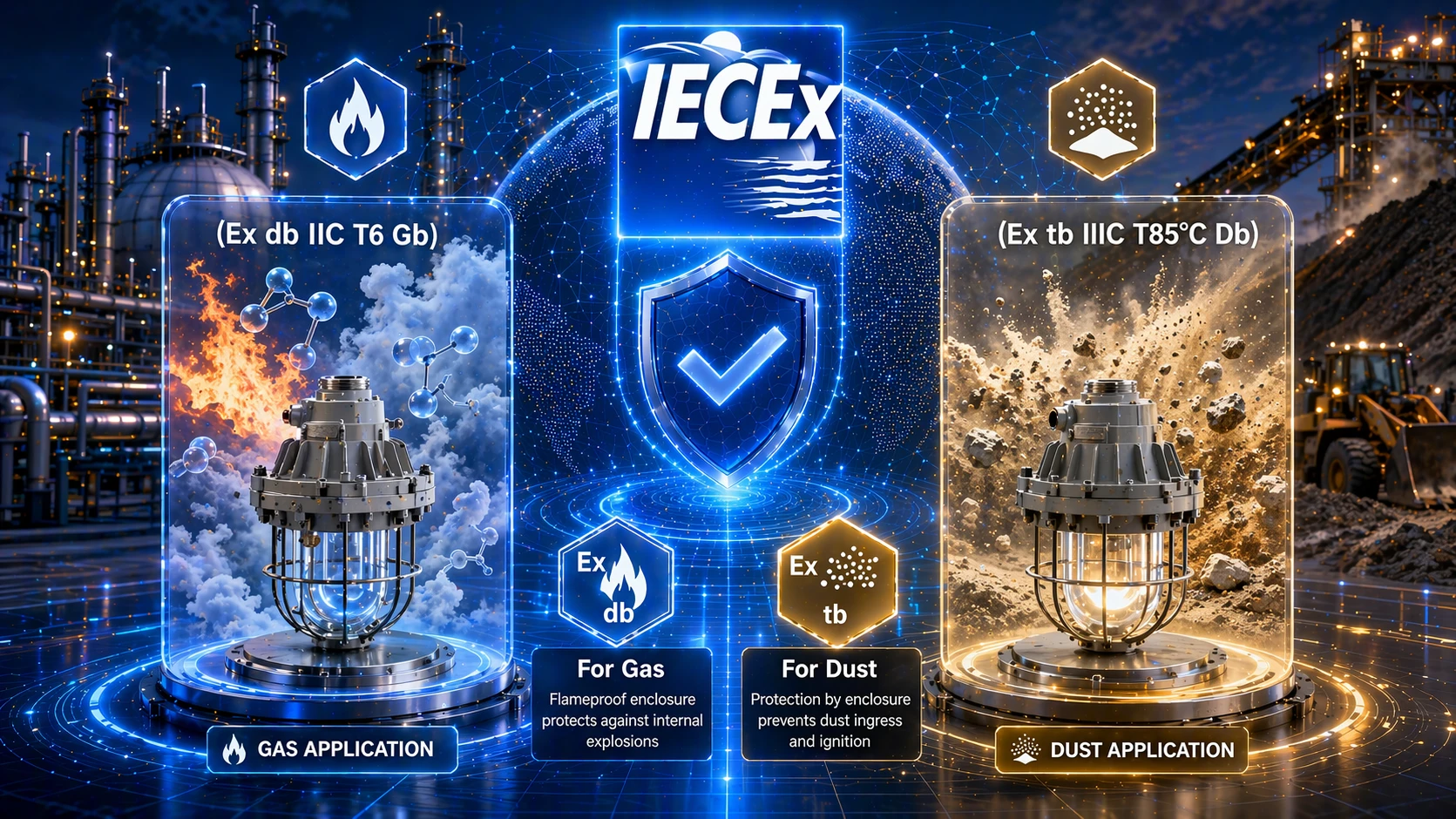
A typical marking may look something like this: Ex db IIC T6 Gb for a gas application or Ex tb IIIC T85°C Db for a dust application. Those short codes carry a lot of meaning. They indicate the applicable protection concept, the hazardous substance group, the temperature limitation, and the EPL. Engineers use this information together with the zone classification report and installation rules to decide whether a product is suitable.
This is why hazardous area selection should never be reduced to a label such as “explosion-proof.” That phrase is too broad to support serious engineering decisions. The real decision depends on the full marking, the standard scope, the ambient conditions, the cable entries, the accessory selection, and the site classification itself.
Main Benefits of IECEx Certification
One of the biggest benefits of IECEx is technical consistency. It gives project teams a common basis for evaluating Ex products across international supply chains. This can simplify specification work, reduce confusion during cross-border procurement, and support a clearer review process for engineering contractors and end users.
Another benefit is credibility. IECEx certification helps demonstrate that the product has been assessed by an approved body and produced under a controlled quality system. That can be important when the equipment is intended for critical communication, alarm signaling, emergency shutdown support, process instrumentation, or field operations in high-risk areas.
IECEx also supports lifecycle confidence. Because the system extends into service facility certification and competence-related schemes, it encourages a broader view of Ex safety that includes installation, maintenance, and repair practices, not just factory testing.
Common Applications of IECEx-Certified Equipment
IECEx-certified equipment is widely used in industries where flammable gases, vapors, mists, or combustible dusts may be present.
Oil and Gas
Upstream, midstream, and downstream facilities rely on Ex-certified equipment for communication, instrumentation, lighting, process monitoring, alarm systems, and control points. Refineries, LNG plants, offshore platforms, tank farms, compressor stations, and loading areas often require strict hazardous area compliance.
Chemical and Petrochemical Plants
Chemical processes can involve volatile solvents, gases, and dust-producing materials. IECEx-certified telephones, paging stations, signal beacons, push-button stations, analyzers, and cameras are commonly specified where safe operation depends on reliable equipment in classified areas.
Mining and Heavy Industry
Mining applications may involve gas hazards, dust hazards, moisture, vibration, and mechanical stress. Certification helps confirm that the selected equipment is suitable not only for the hazardous atmosphere but also for the broader operational environment.
Marine, Offshore, and Energy Facilities
Offshore platforms, FPSOs, drilling units, and marine terminals often combine corrosive environments with hazardous area requirements. In these locations, IECEx certification is often considered together with ingress protection, corrosion resistance, material selection, and long-term maintenance planning.
Food, Grain, and Powder Handling
Combustible dust hazards are not limited to heavy chemicals. Grain handling, sugar processing, feed mills, flour mills, pharmaceutical plants, and powder transfer systems may all require certified equipment for dust zones, particularly where fine particles can form explosive dust clouds.
How to Select IECEx Equipment Correctly
The first step is never the product catalog. It is the hazardous area classification. Without a proper zone classification and substance assessment, equipment selection can quickly become inaccurate. Engineers need to know whether the hazard is gas or dust, which group applies, what ignition characteristics matter, and whether the location is indoor, outdoor, wet, corrosive, or subject to mechanical impact.
The second step is to match the equipment marking to the application. This includes EPL, Ex concept, gas or dust group, temperature limits, ambient range, and enclosure-related constraints. Accessories such as cable glands, stopping plugs, mounting hardware, and external enclosures must also be compatible. In many failures, the main device is certified, but the installation detail is not handled correctly.
The third step is lifecycle planning. Projects should consider inspection intervals, spare parts, repair strategy, documentation control, and whether service work must be performed by qualified Ex personnel or certified service facilities. Good selection is not only about purchase; it is about safe operation over time.
Common Misunderstandings About IECEx
IECEx is not one protection method. It covers many Ex concepts and several conformity assessment paths.
IECEx is not the same as ATEX. They are related but distinct systems.
High IP rating does not equal Ex certification. IP66 or IP67 alone is not enough for hazardous area use.
Certification does not replace proper installation. Poor cable entry, wrong glands, missing seals, or bad maintenance can compromise safety.
“Explosion-proof” is not a complete engineering description. The full Ex marking matters.
FAQ
What is the difference between IECEx and ATEX?
IECEx is an international certification system based on IEC standards, while ATEX is the European legal and regulatory framework for explosive atmosphere equipment and workplaces. Many globally marketed products pursue both.
Does IECEx certification only apply to electrical equipment?
No. The IECEx system covers more than just electrical products. Depending on the standards and scope, it can also apply to related service activities and competence assessment, and it can cover certain non-electrical Ex equipment concepts under the relevant standards framework.
Is IP66 enough for a hazardous area product?
No. IP66 only describes ingress protection against dust and water. A hazardous area product must also have appropriate Ex certification, marking, and suitability for the zone and substance involved.
What does Gb or Db mean?
These are Equipment Protection Levels. Gb generally relates to gas equipment suitable for Zone 1 applications, while Db generally relates to dust equipment suitable for Zone 21 applications, subject to full marking and installation requirements.
Can IECEx-certified equipment be used anywhere in the world?
IECEx supports international technical acceptance, but local regulations, national deviations, project specifications, and market-entry rules still need to be checked. Certification helps greatly, but it does not automatically override every local requirement.
Conclusion
IECEx explosion-proof certification is best understood as an international Ex conformity framework rather than a single product label. It connects standards, testing, manufacturing quality, marking, installation, maintenance, and competence into one structured system. For engineers and industrial buyers, its value lies in clarity: it helps show not only that a product was assessed, but also how it should be interpreted and used in real hazardous area conditions.
When evaluating IECEx-certified equipment, the most useful habit is to read the complete marking instead of relying on broad terms such as explosion-proof or hazardous-area rated. In real projects, safe selection depends on the relationship between zone classification, Ex protection concept, EPL, group, temperature limitation, IP rating, and proper installation practice. That is where IECEx becomes truly practical.