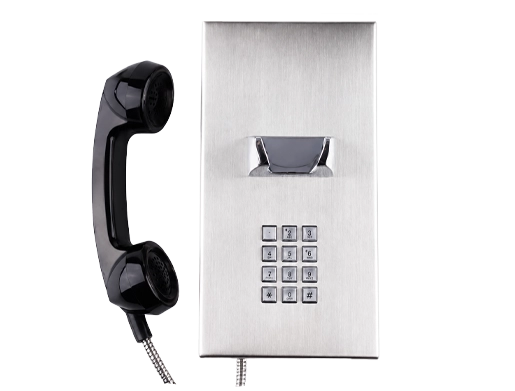
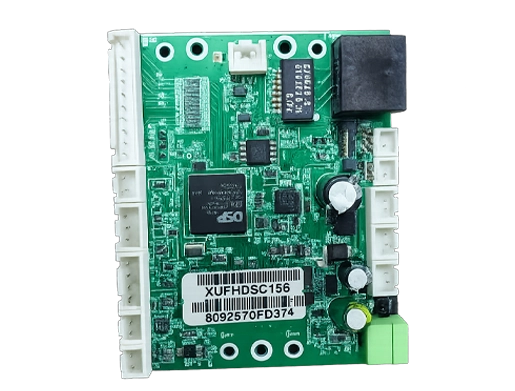
GSM mobile communication is one of the foundational technologies in the history of digital cellular networks. Short for Global System for Mobile Communications, GSM was developed as a standardized digital mobile system for voice communication, mobility management, and later messaging and data services. For many readers, GSM is simply associated with “2G mobile service,” but in practice it represents a complete communication framework that shaped how mobile networks were built, operated, and expanded worldwide.
Even though newer generations such as 3G, 4G, and 5G have taken over the spotlight, GSM still matters for understanding mobile network evolution. It introduced a standardized subscriber model based on the SIM card, enabled large-scale international roaming, supported reliable circuit-switched voice service, and laid the groundwork for packet-data extensions such as GPRS and EDGE. In many industrial, machine-to-machine, and legacy communication environments, GSM concepts still appear in device design, gateway deployment, and network planning.
GSM mobile communication combines radio access, mobility control, switching, subscriber databases, and service platforms into a unified 2G cellular system.
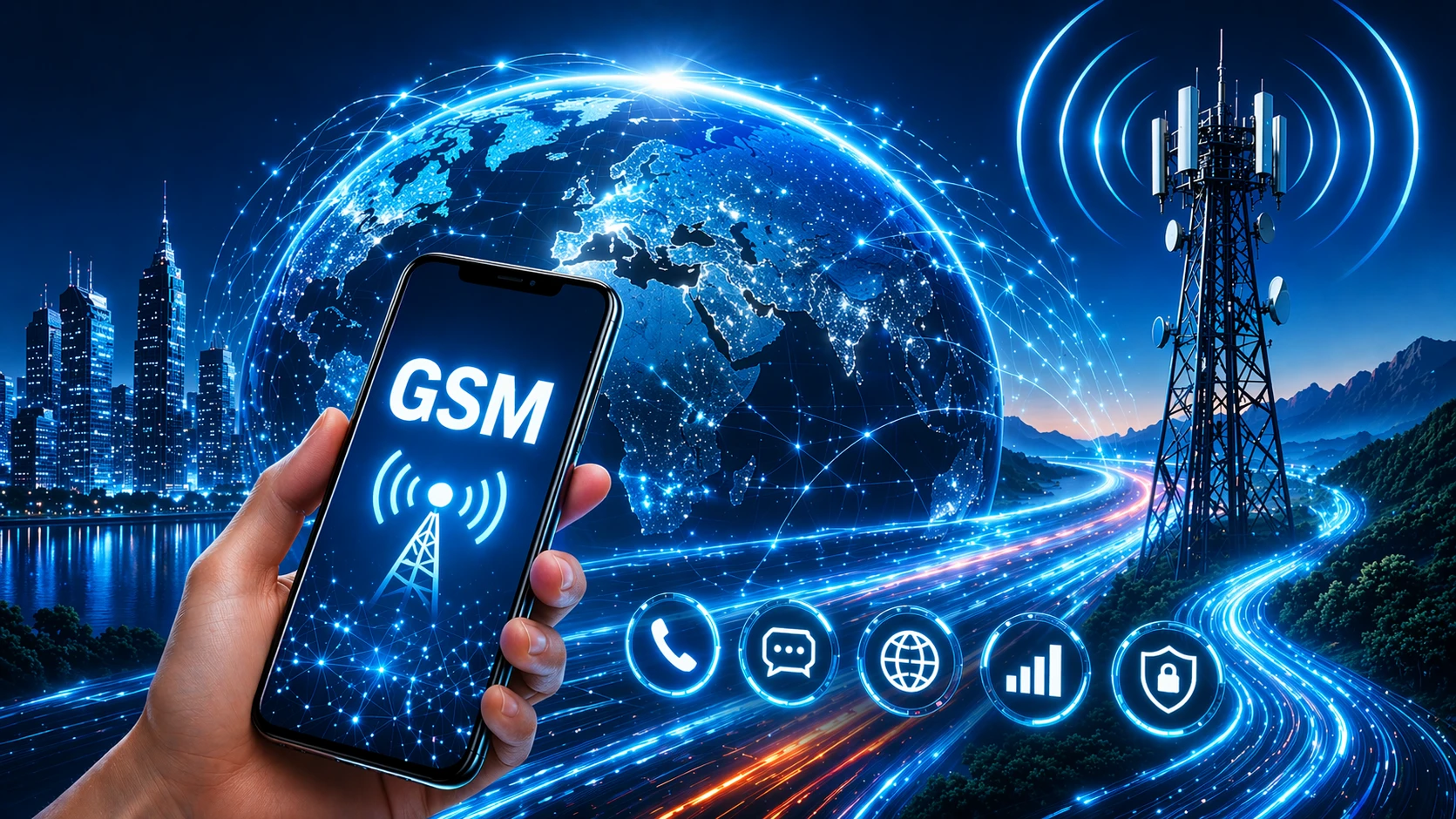
What Is GSM Mobile Communication?
GSM mobile communication is a second-generation digital cellular system designed to provide mobile voice service, short messaging, subscriber authentication, and mobility support across large public land mobile networks. It replaced many earlier analog mobile systems with a more structured and interoperable digital framework. In practical terms, GSM defines how a mobile phone identifies itself to the network, how the network assigns radio resources, how calls are switched, and how users remain reachable while moving between coverage areas.
One reason GSM became so influential is that it was not just a radio air interface. It was a complete ecosystem. It covered user identity, radio access, network switching, signaling, roaming, and service support. That broader design made it easier for operators, handset makers, and infrastructure vendors to build compatible products and deploy networks at scale.
When people refer to GSM today, they often include not only basic circuit-switched voice service but also the GSM family of enhancements, especially GPRS for packet data and EDGE for higher-rate data on the same general radio foundation. That is why GSM is best understood as a mobile communication platform rather than a single narrow voice technology.
How GSM Evolved Beyond Basic 2G Voice
Early GSM was mainly associated with digital voice and limited circuit-switched data. As mobile use expanded, operators needed more efficient ways to handle internet access, telemetry, and always-on data sessions. This led to the introduction of General Packet Radio Service (GPRS), which added packet-switched capability to GSM networks. Instead of reserving a dedicated circuit for the whole session, GPRS allowed more flexible data transmission and made mobile data services more practical.
Later, Enhanced Data rates for GSM Evolution (EDGE) improved the bit rate further by using more advanced modulation in the same bandwidth. In engineering terms, EDGE did not replace GSM overnight. It extended the GSM family, allowing operators to improve data performance while reusing much of their existing network foundation. That upgrade path was one reason GSM remained commercially relevant for such a long time.
So, when an engineer or system planner talks about GSM mobile communication, the discussion often includes three layers of capability: classic GSM voice and signaling, GPRS packet data, and EDGE-based performance enhancement. Together, they formed the practical core of many 2G and 2.5G deployments.
Key Features of GSM Mobile Communication
1. Digital Cellular Voice Communication
At its core, GSM introduced standardized digital voice service for public mobile networks. Compared with older analog systems, this meant better capacity planning, more predictable signaling, structured handover procedures, and a clearer path to interoperable mobile infrastructure. For end users, GSM made mobile communication feel more consistent from network to network.
2. SIM-Based Subscriber Identity
One of GSM’s most important practical contributions is the subscriber identity model built around the SIM card. The SIM separated the subscriber from the handset itself. This sounds ordinary now, but it was a major operational advantage. It enabled easier device replacement, more flexible subscriber management, and a straightforward framework for authentication and roaming.
3. Mobility and Roaming Support
GSM was built for mobile users who move between cells, locations, and even countries. Its architecture supports location updating, roaming agreements, and service continuity across different operator domains. That roaming model helped GSM become a truly international system rather than a regional mobile technology with incompatible islands of deployment.
4. Short Message Service (SMS)
SMS became one of GSM’s most widely recognized services. Long before smartphones made mobile apps common, SMS gave operators and users a simple, dependable, low-bandwidth way to exchange text messages. The same basic concept also made GSM attractive for alarms, device notifications, one-time passwords, and machine-generated messaging.
5. Packet Data Through GPRS and EDGE
While classic GSM was voice-centric, GPRS and EDGE expanded the system into packet-data territory. This gave GSM networks enough flexibility to support light mobile internet access, telemetry, remote monitoring, point-of-sale terminals, and many low-to-moderate bandwidth machine communication tasks. In practice, this is one reason GSM stayed useful well beyond the period when it was the leading consumer mobile platform.
The GSM architecture is commonly described through the mobile station, the base station subsystem, the core switching domain, and the packet-data domain for GPRS and EDGE services.
GSM Network Architecture Explained
One of the best ways to understand GSM is to look at its architecture in layers. A GSM network is not just a tower and a phone. It is a coordinated system that includes the user device, radio access nodes, switching entities, subscriber databases, and operation systems.
Mobile Station (MS)
The Mobile Station is the user side of the GSM system. It includes the mobile equipment and the SIM. This is the endpoint that communicates over the radio interface with the network. It handles user identity, radio access, voice or data sessions, and signaling procedures such as registration and location updates.
Base Station Subsystem (BSS)
The Base Station Subsystem forms the radio access part of the GSM network. It usually includes:
BTS (Base Transceiver Station) for radio transmission and reception within a cell.
BSC (Base Station Controller) for managing radio resources, supervising multiple BTS units, and coordinating functions such as handover and channel assignment.
In simple terms, the BTS talks over the air to the phone, while the BSC manages how radio resources are organized across several base stations.
Core Circuit-Switched Network
For classic GSM voice service, the core network includes switching and subscriber management entities such as:
MSC (Mobile-services Switching Centre) for call control and circuit-switched service handling.
GMSC (Gateway MSC) for interconnection with external networks such as PSTN or other mobile networks.
HLR (Home Location Register) for storing permanent subscriber information.
VLR (Visitor Location Register) for storing temporary data about subscribers currently served in an MSC area.
AuC (Authentication Centre) for subscriber authentication support.
EIR (Equipment Identity Register) for device identity control.
This part of the network is what makes GSM more than radio coverage. It is responsible for making users reachable, routing calls, checking identities, and supporting mobility.
Packet-Switched Domain for GPRS and EDGE
When GPRS and EDGE are added, the GSM environment also includes packet-data entities such as:
SGSN (Serving GPRS Support Node) for packet mobility management and session handling.
GGSN (Gateway GPRS Support Node) for connecting the packet-data domain to external packet networks.
This packet core is what allowed GSM networks to support more flexible data communication instead of relying only on circuit-switched methods.
Operation and Support Systems
Behind the visible service layer, GSM networks also rely on operation, maintenance, and management systems. These are used for configuration, fault management, performance supervision, and service provisioning. In real deployments, stable operation depends as much on these support layers as on the radio network itself.
How GSM Mobile Communication Works
A simplified GSM communication process looks like this:
The mobile station powers on and searches for an available GSM network.
The network identifies the subscriber through the SIM-related identity framework and performs authentication procedures.
The mobile registers its location in the relevant network databases so that incoming services can be routed correctly.
When the user places a call, sends an SMS, or starts a data session, the radio access network allocates resources and forwards signaling to the core network.
The core network sets up the voice path or data path, checks subscriber permissions, and routes traffic toward the destination network or service platform.
As the user moves, the network manages location updates and handovers to maintain service continuity.
This flow is one reason GSM became so practical at scale. It combines structured radio control with centralized subscriber intelligence, allowing networks to manage large populations of users across wide areas.
GSM’s long-term success came from the fact that it solved multiple problems at once: digital voice, subscriber identity, roaming, switching, and service interoperability.
Main Applications of GSM Mobile Communication
Consumer Mobile Voice and SMS
The most familiar GSM application is public mobile telephony. For years, GSM was the main platform for mobile calling and texting in many regions. Even today, its service model still shapes how people understand mobile numbers, roaming, and SIM-based subscriptions.
Machine-to-Machine and Remote Monitoring
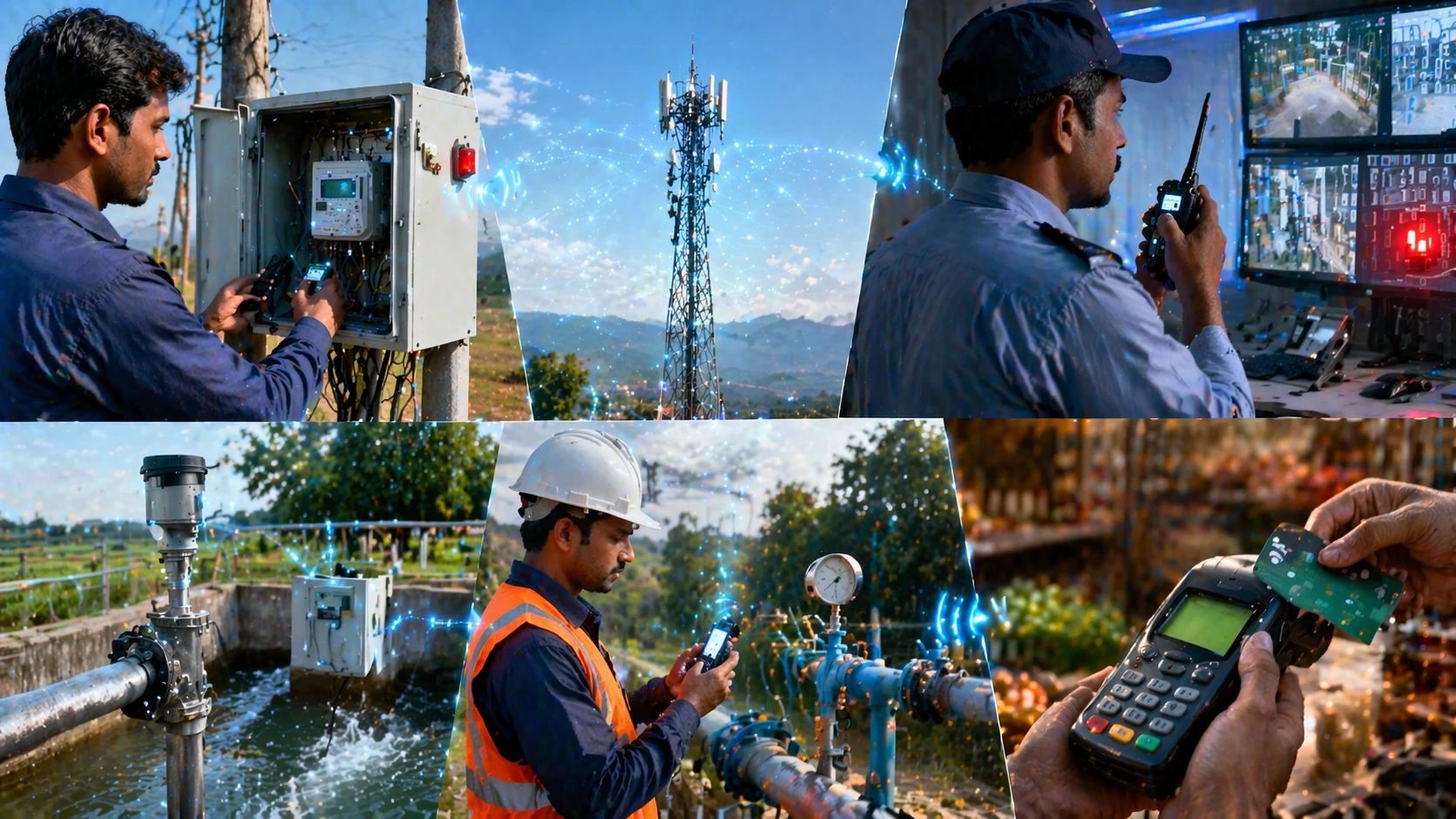
GSM became widely used in M2M environments because it offered broad coverage, mature modules, and practical support for SMS and low-rate data. Remote meters, telemetry units, industrial monitors, alarm panels, and vehicle tracking devices often adopted GSM-based communication because it was easier to deploy than building a dedicated private wide-area network.
Industrial and Utility Alerting
In industrial settings, GSM has often been used for alert transmission, maintenance notification, backup communication, and field asset status reporting. For example, a remote cabinet, pump station, roadside terminal, or unmanned utility site may use GSM or GSM-derived packet service to report alarms back to a control center.
Payment, Retail, and Service Terminals
Point-of-sale devices, kiosks, vending systems, and service terminals have historically relied on GSM or GPRS connectivity where fixed broadband was unavailable, impractical, or too expensive. For low-bandwidth transactional communication, GSM-family connectivity was often sufficient.
Backup Connectivity for Voice and Field Communication
In some communication systems, GSM links have been used as backup channels for voice gateways, alarm systems, intercom endpoints, and mobile service restoration kits. While newer cellular technologies now play a larger role in this area, GSM remains part of the design vocabulary in many legacy or cost-sensitive deployments.
Beyond personal mobile calling, GSM has long been used in telemetry, alarm reporting, utility monitoring, payment terminals, and other low-bandwidth field communication tasks.
Advantages of GSM Mobile Communication
Global standardization: GSM created a highly interoperable ecosystem across operators and vendors.
Strong roaming model: It helped make international mobile service practical at scale.
SIM-based flexibility: Subscriber identity could move more easily between devices.
Mature infrastructure: GSM equipment, modules, and service logic became widely available.
Useful service mix: Voice, SMS, and later packet data supported both people and machines.
Limitations of GSM in Modern Networks
GSM is historically important, but it is not a modern high-capacity broadband platform. Its main limitations include:
Lower data performance than 3G, 4G, and 5G systems.
Less spectral efficiency compared with newer radio technologies.
Limited suitability for bandwidth-intensive applications such as HD video or advanced real-time cloud services.
Dependence on operator support, which may vary as some networks refarm spectrum or retire older 2G layers.
That does not make GSM irrelevant. It simply means GSM is best matched to legacy voice, simple messaging, low-rate data, and applications where network maturity and module availability are more important than broadband performance.
GSM vs Newer Mobile Communication Technologies
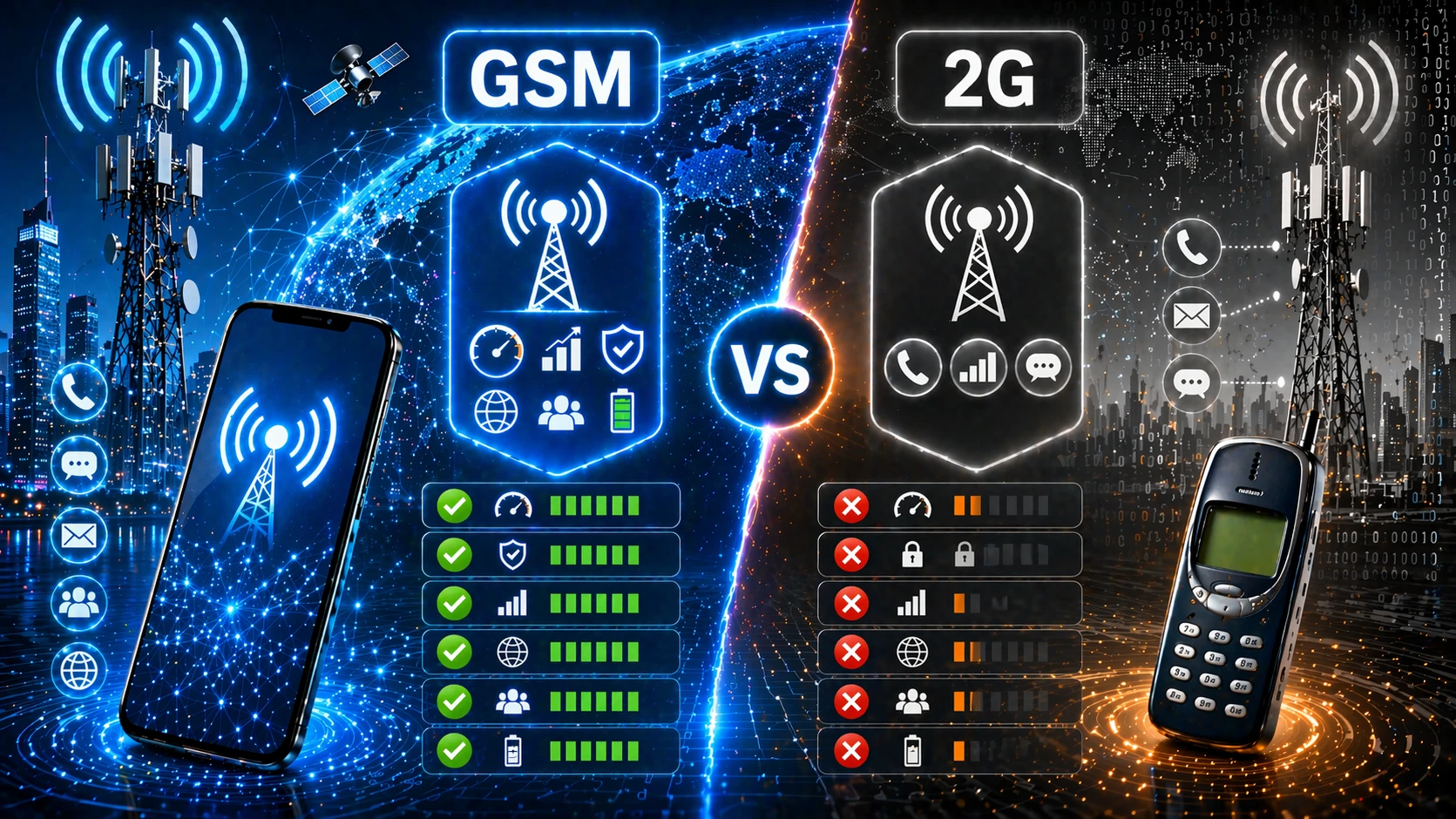
Compared with 3G, 4G, and 5G, GSM is simpler and narrower in capability. It is stronger in legacy compatibility, mature field deployment, and basic service continuity, but weaker in bandwidth, latency, and modern application support. Newer mobile systems are designed for broadband, low-latency services, rich multimedia, and cloud-native architectures. GSM was designed for dependable digital mobile service in an era when voice, mobility, and signaling were the central priorities.
That is why GSM still appears in training, integration work, legacy support, and industrial communication discussions. It is not because GSM is the future of mobile broadband. It is because GSM remains part of the technical foundation on which much of modern mobile communication was built.
Conclusion
GSM mobile communication is more than a historical label for 2G. It is a complete digital mobile framework that introduced standardized subscriber identity, structured radio access, international roaming, circuit-switched voice, SMS, and later practical packet data through GPRS and EDGE. Its architecture, from the mobile station and BSS to the switching core and packet domain, shows how early mobile networks were engineered to balance mobility, service control, and broad-area coverage.
For engineers, integrators, and technical buyers, understanding GSM still has practical value. It helps explain legacy device behavior, field gateway design, SIM-based subscriber control, and the evolution from classic mobile voice networks to today’s multi-generation communication environments. Even where GSM is no longer the primary public mobile service, its architecture and service concepts continue to shape mobile communication thinking.
FAQ
Is GSM the same as 2G?
GSM is the best-known 2G digital cellular system, so the two are often used interchangeably in everyday language. Strictly speaking, GSM is a specific standards-based mobile communication system within the broader second-generation category.
Does GSM only support voice calls?
No. Classic GSM is strongly associated with circuit-switched voice and SMS, but the GSM family also includes GPRS and EDGE for packet-data communication.
What is the role of the SIM in GSM?
The SIM stores subscriber identity-related information and supports authentication and service access. It is one of the key features that made GSM operationally flexible and globally scalable.
What is the difference between BTS and BSC in a GSM network?
The BTS handles radio transmission within the cell, while the BSC manages multiple BTS units and controls radio resources, handovers, and related access functions.
Why is GSM still discussed in industrial communication?
Because many field devices, telemetry units, alarms, and legacy communication systems were built around GSM, SMS, GPRS, or EDGE. Even when newer cellular options are available, engineers often still encounter GSM-based designs in service and replacement projects.
Is GSM still suitable for new projects?
That depends on the local operator environment, service lifetime expectations, and bandwidth requirements. For long-life new deployments, planners usually need to review regional network support policies carefully rather than assuming legacy 2G service will always remain available.