


Why Frequency Response Matters in Audio Systems
Frequency response is one of the most important specifications used to describe how an audio device handles different sound frequencies. It shows whether a speaker, microphone, headset, amplifier, audio processor, or room system reproduces bass, midrange, and treble evenly, or whether some parts of the sound spectrum are boosted or reduced.
In practical use, frequency response affects how clear speech sounds, how natural music feels, how comfortable long listening sessions are, and how accurately an audio system performs in a real environment. A device with poor frequency response may sound muddy, thin, harsh, muffled, or unbalanced, even if it is loud enough.
Frequency response is not only a laboratory measurement. It directly shapes what listeners hear: clearer speech, stronger bass, smoother music, sharper warnings, or more natural voice communication.
Basic Meaning of Frequency Response
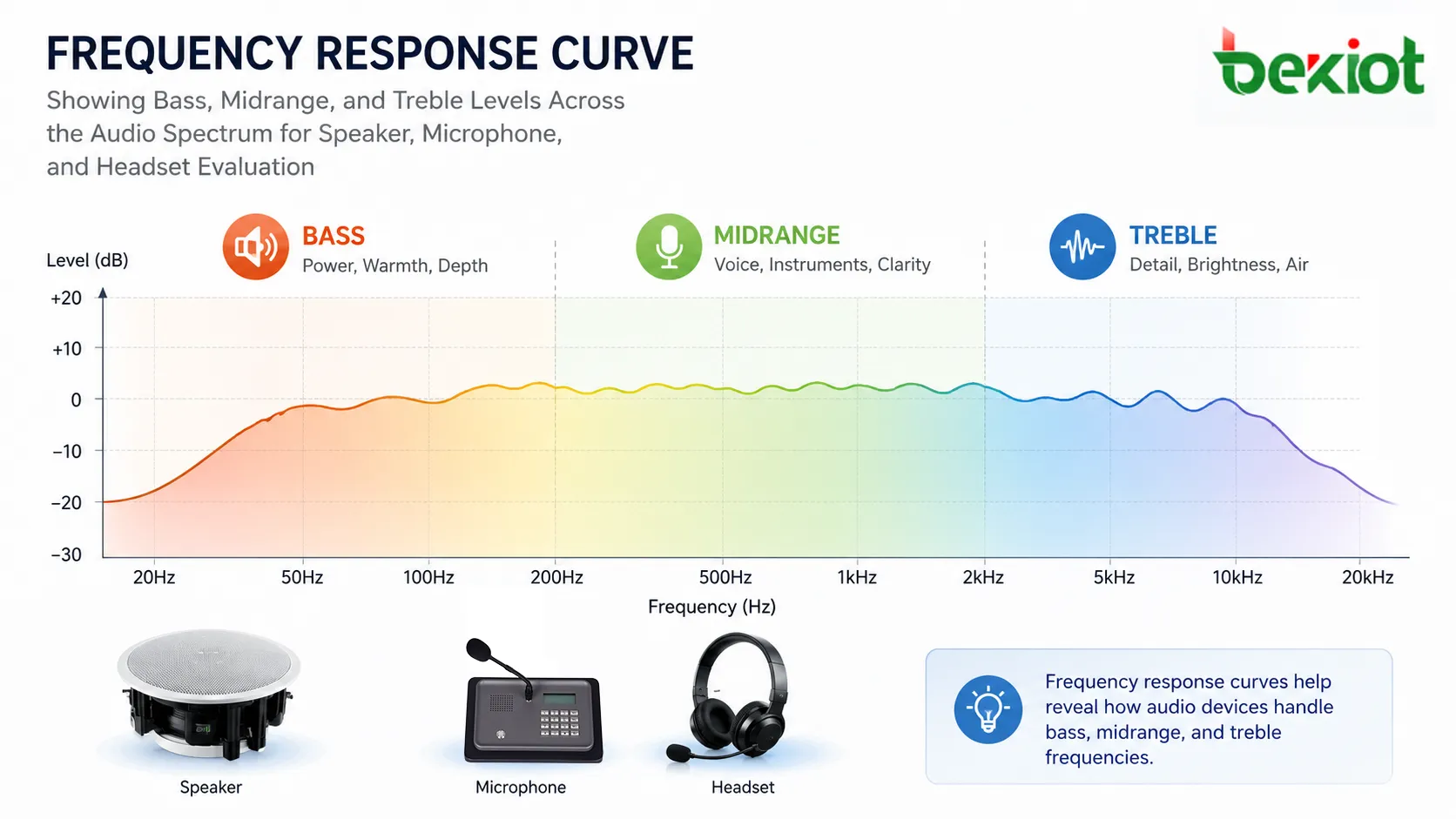
Frequency response describes how much output or sensitivity an audio device has at different frequencies. Frequency is measured in hertz, or Hz. Low frequencies are associated with bass, middle frequencies carry much of the voice and instrument body, and high frequencies provide detail, brightness, and clarity.
A frequency response specification may appear as a range, such as 80 Hz to 18 kHz, or as a curve showing level changes across the frequency spectrum. The curve is usually more useful than the range alone because it reveals whether the device is balanced or uneven.
Frequency Range
Frequency range shows the lowest and highest frequencies a device can reproduce or capture under specific test conditions. For example, a small ceiling speaker may focus on speech and background music, while a studio monitor may cover a wider range for detailed music production.
However, a wide frequency range does not automatically mean better sound. A device may claim a broad range but have large peaks and dips inside that range. This is why tolerance and curve shape are important.
Frequency Response Curve
A frequency response curve shows how the level changes from low to high frequencies. A relatively flat curve means the device reproduces frequencies more evenly. A curve with large peaks and dips means the device changes the tonal balance more strongly.
For reference monitoring, a flatter response is often preferred. For public address, speech communication, headphones, or alarm systems, the response may be intentionally shaped to match the application.
How Frequency Response Affects Sound
Frequency response affects tonal balance. If the low-frequency area is too strong, the sound may feel heavy or boomy. If the midrange is weak, voices may lose presence. If the high-frequency area is too sharp, the sound may become bright, harsh, or tiring.
Different applications require different balance. A music speaker may need full-range warmth and detail. A conference microphone may need natural speech pickup. A public address speaker may need strong speech intelligibility more than deep bass.
Low Frequencies
Low frequencies usually cover the bass region. They give music power, warmth, and weight. In speech systems, low frequencies help voices sound fuller, but too much bass can reduce clarity and create muddiness.
Small speakers often have limited low-frequency extension. This does not always mean they are poor products. For speech announcements, voice paging, and compact communication devices, deep bass may be less important than clear midrange response.
Midrange Frequencies
Midrange frequencies are critical for voice, many musical instruments, and overall sound identity. Human speech depends heavily on this region, especially for vowel body and vocal presence.
If the midrange is uneven, speech can sound hollow, nasal, distant, or unclear. For conference rooms, classrooms, intercoms, call centers, and public address systems, controlled midrange response is essential.
High Frequencies
High frequencies provide detail, brightness, air, and consonant clarity. They help listeners distinguish sounds such as “s,” “t,” “f,” and “sh.”
Too little high-frequency output may make speech dull or muffled. Too much may make audio sharp, noisy, or fatiguing. A good system balances clarity with comfort.
Audio Benefits of Good Frequency Response
Good frequency response improves both technical performance and user experience. It helps audio sound clearer, more balanced, and more suitable for the listening environment.
Clearer Speech
Speech clarity depends on the correct balance of low, mid, and high frequencies. If low frequencies dominate, words may become muddy. If upper-mid and high frequencies are too weak, consonants may be hard to understand.
In meeting rooms, paging systems, transport stations, classrooms, control rooms, and customer service environments, clear speech is often more important than high volume. A system that sounds loud but unclear is not effective.
More Natural Music
Music contains a wide range of frequencies. Bass instruments, vocals, guitars, keyboards, drums, strings, and cymbals all occupy different parts of the spectrum. Good frequency response helps these elements sound balanced.
If the response is uneven, music may sound exaggerated or incomplete. A speaker with too much bass may hide vocals, while a speaker with too much treble may make music feel sharp.
Reduced Listening Fatigue
Listening fatigue happens when audio becomes tiring over time. Harsh high frequencies, unclear midrange, boomy bass, distortion, and uneven response can all make long listening uncomfortable.
Balanced frequency response is especially important for call center agents, dispatch operators, studio engineers, remote workers, teachers, and conference participants who listen for long periods.
Better System Consistency
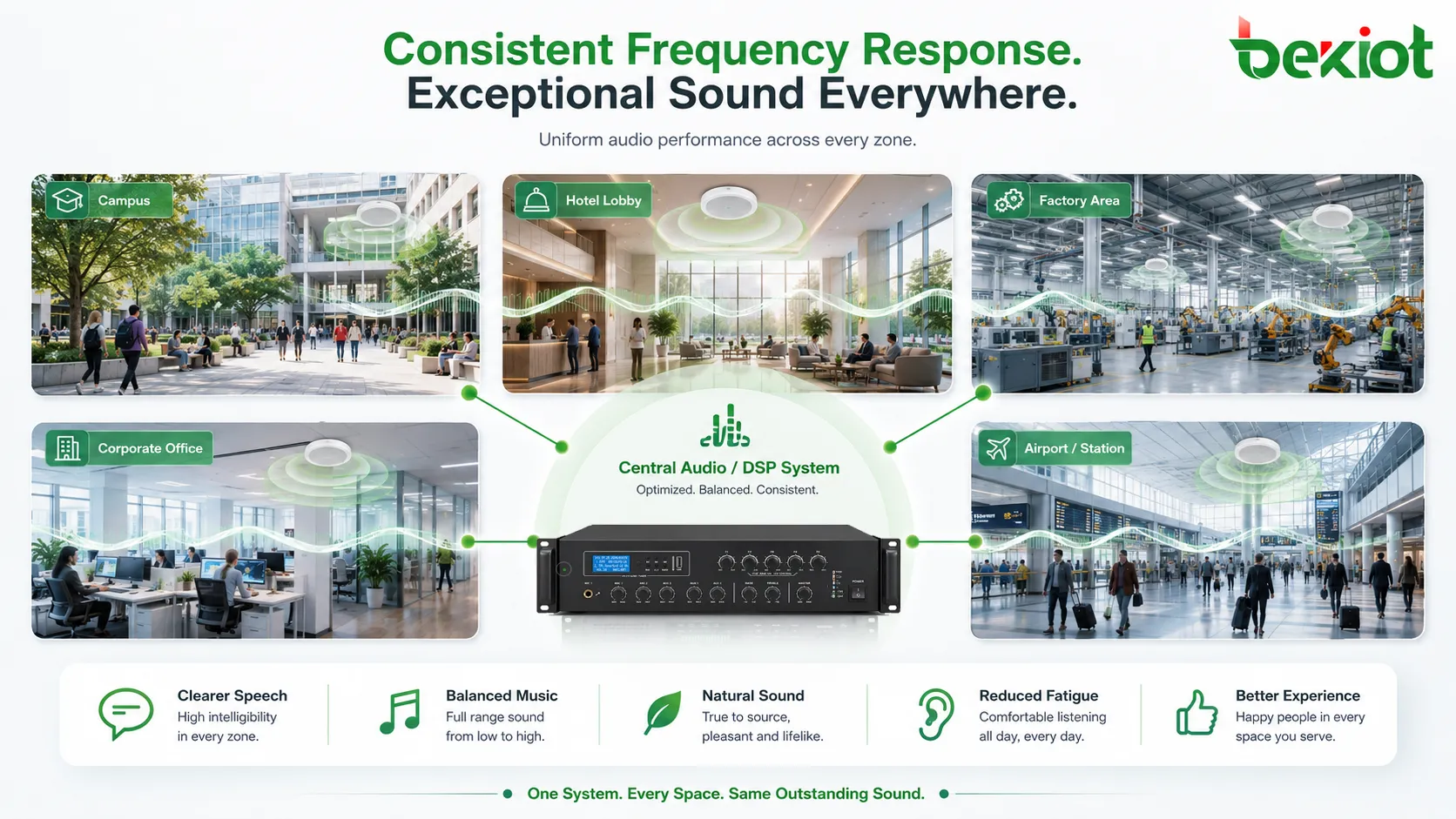
In multi-zone or multi-room systems, consistent frequency response helps audio sound similar across different areas. This is useful in campuses, hotels, factories, commercial buildings, airports, stations, and large office facilities.
Without consistency, one area may sound sharp while another sounds muffled. This makes system tuning harder and reduces the quality of the listening experience.
Technical Features Behind Frequency Response
Frequency response is shaped by physical design, electronic circuits, digital processing, acoustic environment, and measurement method. It is not determined by one part alone.
Speaker Driver Design
In speakers, the driver converts electrical energy into sound. Driver size, diaphragm material, magnet structure, suspension, voice coil design, cabinet structure, and crossover network all affect frequency response.
A woofer is usually better for low frequencies, while a tweeter is better for high frequencies. Multi-way speaker systems divide the frequency range between different drivers so each driver works in a suitable range.
Microphone Capsule Design
In microphones, the capsule determines how sound is captured. Capsule size, diaphragm tension, acoustic ports, grille design, polar pattern, and internal electronics all affect the response curve.
Some microphones are designed to be neutral. Others intentionally boost certain frequencies to improve vocal presence or reduce low-frequency noise. The right choice depends on the application.
Enclosure and Acoustic Structure
Speaker enclosures strongly affect low-frequency performance. Sealed cabinets, bass reflex designs, horns, line arrays, and ceiling-mounted speaker structures all behave differently.
The same driver can sound different in different enclosures. This is why frequency response is a system-level result, not just a driver specification.
Amplifier and Signal Chain
Amplifiers, processors, cables, converters, and digital audio systems can also affect frequency response. A well-designed amplifier should reproduce the input signal without unwanted tonal change within its operating range.
In real systems, filters, limiters, equalizers, crossovers, and DSP presets may intentionally shape the frequency response for protection, tuning, or application performance.
Room and Installation Effects
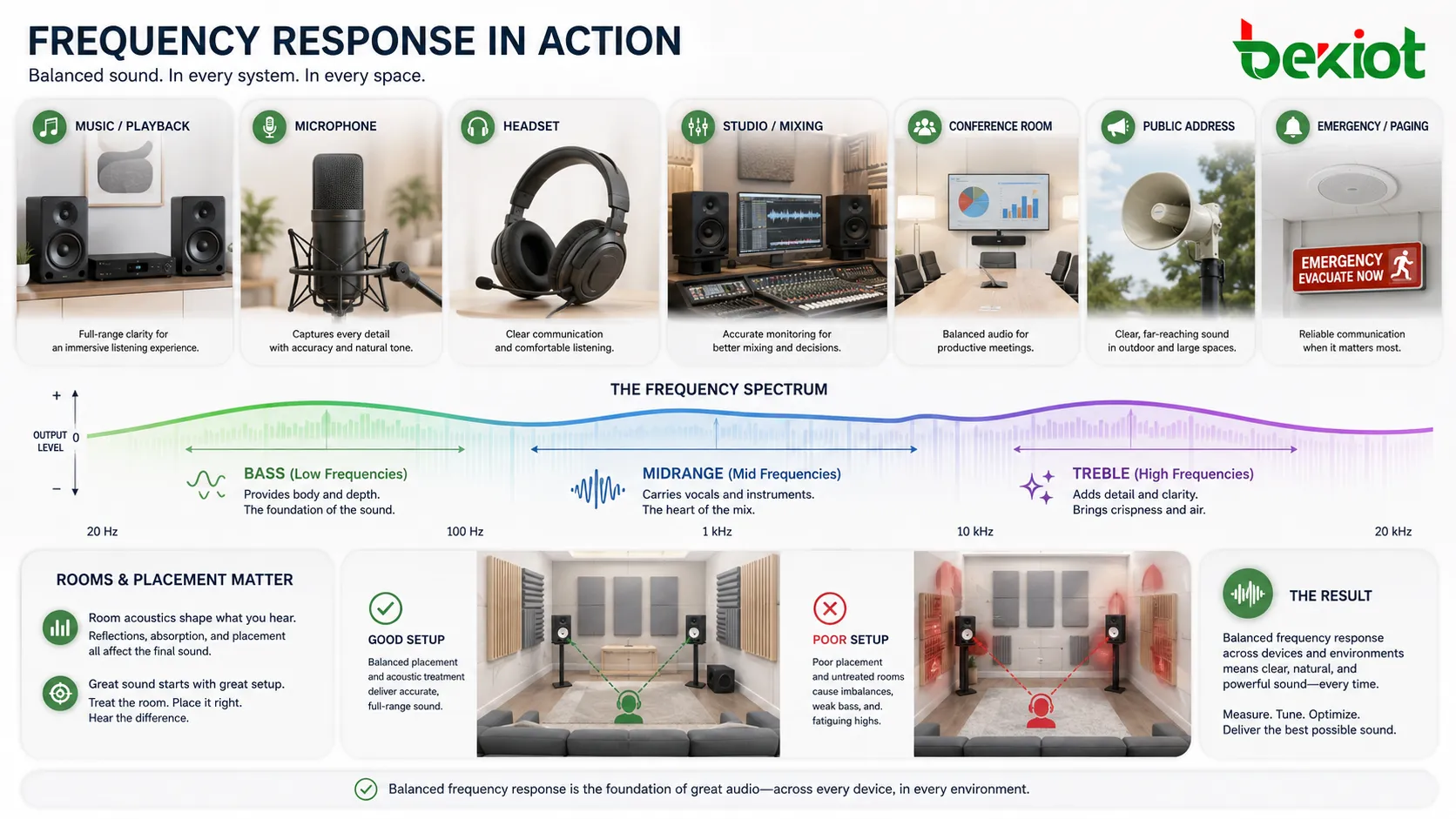
The room can change frequency response dramatically. Reflections, absorption, standing waves, glass walls, hard floors, ceiling height, furniture, and speaker placement all affect what listeners hear.
A speaker that measures well in a laboratory may sound very different in a reverberant hall, small meeting room, warehouse, vehicle, or outdoor area.
Reading Frequency Response Specifications
Frequency response specifications should be read carefully. A simple range number is not enough to judge real sound quality. Tolerance, measurement conditions, curve shape, and intended application matter.
Understanding ±dB Tolerance
A specification such as 60 Hz to 18 kHz ±3 dB means the device stays within a 3 dB variation across that range under the stated conditions. This is more useful than a range without tolerance.
If a product only says “20 Hz to 20 kHz” without tolerance, it may not tell users how evenly the device performs. The response may still have strong peaks or dips.
Flat Response and Shaped Response
Flat response means the device outputs frequencies at a relatively even level. This is useful for studio monitors, measurement microphones, and reference systems where accuracy is important.
Shaped response means the device is intentionally tuned. For example, a speech speaker may emphasize clarity frequencies, while a consumer headphone may have stronger bass for a preferred listening style.
Measurement Conditions
Frequency response can vary depending on test distance, microphone position, room condition, smoothing method, input level, mounting method, and measurement standard.
When comparing products, users should check whether the measurements were made under similar conditions. Otherwise, the numbers may not be directly comparable.
| Specification Item | Meaning | Practical Value |
|---|---|---|
| Frequency range | Lowest and highest stated frequencies | Shows basic bandwidth capability |
| ±dB tolerance | Level variation within the stated range | Shows how even the response may be |
| Response curve | Detailed level changes across frequency | Shows tonal balance and problem areas |
| Measurement condition | How the response was tested | Helps compare specifications more fairly |
| Application tuning | Response adjusted for a specific use | Helps match product to real scenarios |
Applications in Audio Equipment
Frequency response is used across almost every audio product category. The ideal response depends on whether the system is used for speech, music, monitoring, conferencing, warning, or recording.
Speakers
Speakers use frequency response to describe how they reproduce sound. A full-range music speaker needs balanced bass, midrange, and treble. A paging speaker may focus more on vocal clarity and coverage.
For installed sound systems, speaker response should be evaluated together with coverage angle, sensitivity, maximum SPL, power handling, mounting method, and room acoustics.
Microphones
Microphones use frequency response to describe how they capture sound. A broadcast microphone may be tuned for warm voice, while a measurement microphone may aim for neutral response.
For conference and communication systems, the microphone should capture speech clearly while reducing unwanted room noise, handling noise, and low-frequency rumble.
Headsets and Headphones
Headsets and headphones rely heavily on frequency response tuning. A call center headset should prioritize speech clarity and long-term comfort. A music headphone may provide wider bandwidth and stronger low-frequency extension.
For professional monitoring, predictable response is important. Engineers need to hear audio accurately so that their decisions translate well to other systems.
Amplifiers and Audio Processors
Amplifiers and processors should maintain stable frequency response across the intended operating range. DSP processors may also adjust response through equalization, crossovers, filters, limiters, and room correction.
In installed systems, DSP tuning is often used to improve clarity, reduce feedback risk, and adapt speaker output to the acoustic environment.
Public Address and Emergency Audio
Public address and emergency notification systems need strong speech intelligibility. Their frequency response should support clear announcements rather than only loud output.
In noisy or reverberant spaces, frequency response, speaker placement, coverage, delay, and acoustic treatment all affect whether people can understand the message.
Applications in Different Environments
Frequency response should be considered according to the environment where the audio system is used. A device that works well in one setting may not perform well in another.
Conference Rooms
In conference rooms, microphones and speakers must support natural speech. If the system has too much low-frequency buildup, speech may sound muddy. If the high frequencies are too strong, the room may sound harsh.
Good frequency response helps remote participants understand speakers clearly and reduces listening fatigue during long meetings.
Classrooms and Lecture Halls
Education spaces need clear voice reproduction. Teachers and presenters must be understood by listeners across the room.
Frequency response should support speech intelligibility without creating feedback or excessive loudness. Speaker placement and room acoustics are just as important as the equipment specification.
Recording Studios
Studios require accurate monitoring. If studio monitors exaggerate bass or treble, the mix may sound wrong on other playback systems.
Frequency response in studios should be evaluated together with room treatment, monitor placement, listening position, and calibration.
Industrial and Public Spaces
Factories, warehouses, stations, airports, parking areas, and public facilities often have noise and reverberation. Audio systems in these spaces must prioritize intelligibility and coverage.
Speakers should be selected and tuned to make announcements clear under real operating conditions. A wide frequency response alone does not guarantee effective communication.
Home and Commercial Music Systems
Music playback systems benefit from balanced full-range response. Low frequencies provide body, midrange carries vocals and instruments, and high frequencies provide detail.
Room placement and acoustic treatment can strongly influence the final sound. Even good speakers may sound poor if placed incorrectly.
Measurement and Testing Methods
Frequency response can be measured with test signals, calibrated microphones, audio analyzers, and software tools. Testing helps engineers understand how a device or room behaves across the sound spectrum.
Sweep Testing
A sweep test plays frequencies from low to high and measures the output level. This can reveal peaks, dips, resonance, and weak frequency areas.
Sweep testing is useful for speakers, rooms, headphones, and audio systems. It gives a detailed view of response behavior across the frequency range.
Pink Noise Testing
Pink noise contains energy across the frequency spectrum and is often used for system tuning. When combined with measurement software, it can help engineers adjust equalization and speaker balance.
Pink noise testing is common in live sound, installed audio, public address systems, and room calibration.
Anechoic and In-Room Testing
Anechoic testing measures device performance without room reflections. It is useful for comparing equipment. In-room testing measures what listeners actually hear in a real environment.
Both are valuable. Product evaluation benefits from controlled measurement, while commissioning benefits from real-site measurement.
Listening Evaluation
Measurement data should be combined with listening tests. Human listeners can notice harshness, muffled speech, weak bass, poor balance, or fatigue that may not be obvious from one simplified number.
Professional tuning often uses both objective measurement and subjective listening.
Common Misunderstandings
Frequency response is often misunderstood because many people focus only on wide frequency range claims. Real audio quality depends on response smoothness, distortion, directivity, room acoustics, and application fit.
Wider Range Is Not Always Better
A wider range can be useful, but it does not guarantee better sound. A speaker with a narrow but smooth speech-focused response may perform better for announcements than a full-range speaker with uneven output.
For many communication systems, clarity is more important than deep bass extension.
Flat Response Is Not Always the Goal
Flat response is useful for monitoring and measurement, but not every system needs to be completely flat. Some systems are tuned for speech presence, listening preference, room compensation, or safety notification.
The best response is the one that supports the actual use case.
Specifications May Not Match Real Installation
A product specification is usually measured under controlled conditions. Real installation may change the sound because of room reflections, wall mounting, ceiling height, background noise, or listener position.
This is why site testing and tuning are important for installed systems.
Selection and Tuning Tips
Good frequency response planning starts with the application. The equipment, installation, and tuning should all support the intended audio result.
Match Response to the Use Case
For speech, prioritize midrange clarity and intelligibility. For music, choose balanced full-range performance. For studio monitoring, look for controlled and predictable response. For emergency audio, focus on message clarity and coverage.
A system chosen only by the widest frequency range may not be the best choice for the actual environment.
Review Curves, Not Only Numbers
When available, review the response curve. It gives more information than a simple range. Look for large peaks, deep dips, or strong imbalance that may affect tonal quality.
Specifications with tolerance values are more useful than broad numbers without context.
Consider Placement and Acoustics
Speaker and microphone placement strongly affect real response. Wall boundaries, corners, reflective surfaces, and distance can change tonal balance.
Before applying heavy equalization, check whether placement or acoustic treatment can solve the problem more naturally.
Use Equalization Carefully
Equalization can improve tonal balance, but excessive boost may cause distortion, feedback, or equipment stress. EQ should fine-tune a suitable system, not force unsuitable equipment to do something it cannot handle.
For critical systems, tuning should be measured and verified at listener positions.
FAQ
Why can a small speaker sound clearer than a large speaker?
A small speaker may have a response tuned for speech clarity, while a large speaker may emphasize bass or be poorly positioned. Clear midrange and good placement can matter more than size for voice applications.
Can frequency response change over time?
Yes. Speaker drivers, microphone capsules, foam surrounds, dust, moisture, heat, mechanical damage, and aging components can change response over time. Periodic testing is useful for critical systems.
Why does the same speaker sound different in two rooms?
Room size, wall materials, reflections, furniture, ceiling height, floor type, and speaker placement all affect frequency response at the listener position. The room becomes part of the audio system.
Can equalization damage speakers?
Yes, if excessive boost forces the speaker to reproduce frequencies beyond its safe capability. Large low-frequency boosts are especially risky for small speakers and can cause distortion or driver damage.
Is frequency response important for voice calls?
Yes. Even though voice calls do not need deep bass or extreme treble, the response must support speech intelligibility. Poor microphone or speaker response can make calls sound muffled, thin, or tiring.
How should frequency response be checked in an installed system?
Use calibrated measurement tools at real listener positions, then verify the result with speech and music listening tests. The goal is not only a good curve, but clear and comfortable audio in the actual space.







