


Frequency response describes how an audio device, system, or acoustic space responds to different frequencies across the sound spectrum. It shows whether bass, midrange, and treble are reproduced evenly, boosted, or reduced. This concept is widely used when evaluating speakers, microphones, headphones, amplifiers, audio interfaces, public address systems, conference systems, recording equipment, and communication devices.
In simple terms, frequency response helps answer one question: does the device reproduce sound naturally, or does it change the tonal balance? A good frequency response does not always mean perfectly flat in every application, but it should match the intended use, listening environment, and audio requirement.
Frequency response is one of the most important audio specifications because it directly affects how voices, music, alarms, and announcements sound to listeners.
Basic Meaning of Frequency Response
Frequency response is usually expressed as a frequency range, such as 20 Hz to 20 kHz, or as a curve showing output level across different frequencies. Human hearing is commonly described as covering about 20 Hz to 20 kHz, although real hearing sensitivity varies by age, environment, and individual condition.
For audio equipment, frequency response indicates how strongly the device outputs or captures each frequency. If a speaker has too much low-frequency output, the sound may feel boomy. If it lacks high-frequency output, speech may sound dull. If the midrange is uneven, voices may become unclear or unnatural.
Frequency Range
Frequency range tells the lowest and highest frequencies a device can reproduce or capture under specified conditions. For example, a speaker may be listed as 80 Hz to 18 kHz, while a studio microphone may be listed as 20 Hz to 20 kHz.
However, the range alone is not enough. A device may claim a wide range but reproduce some frequencies much louder or quieter than others. That is why frequency response tolerance and response curve shape are important.
Response Curve
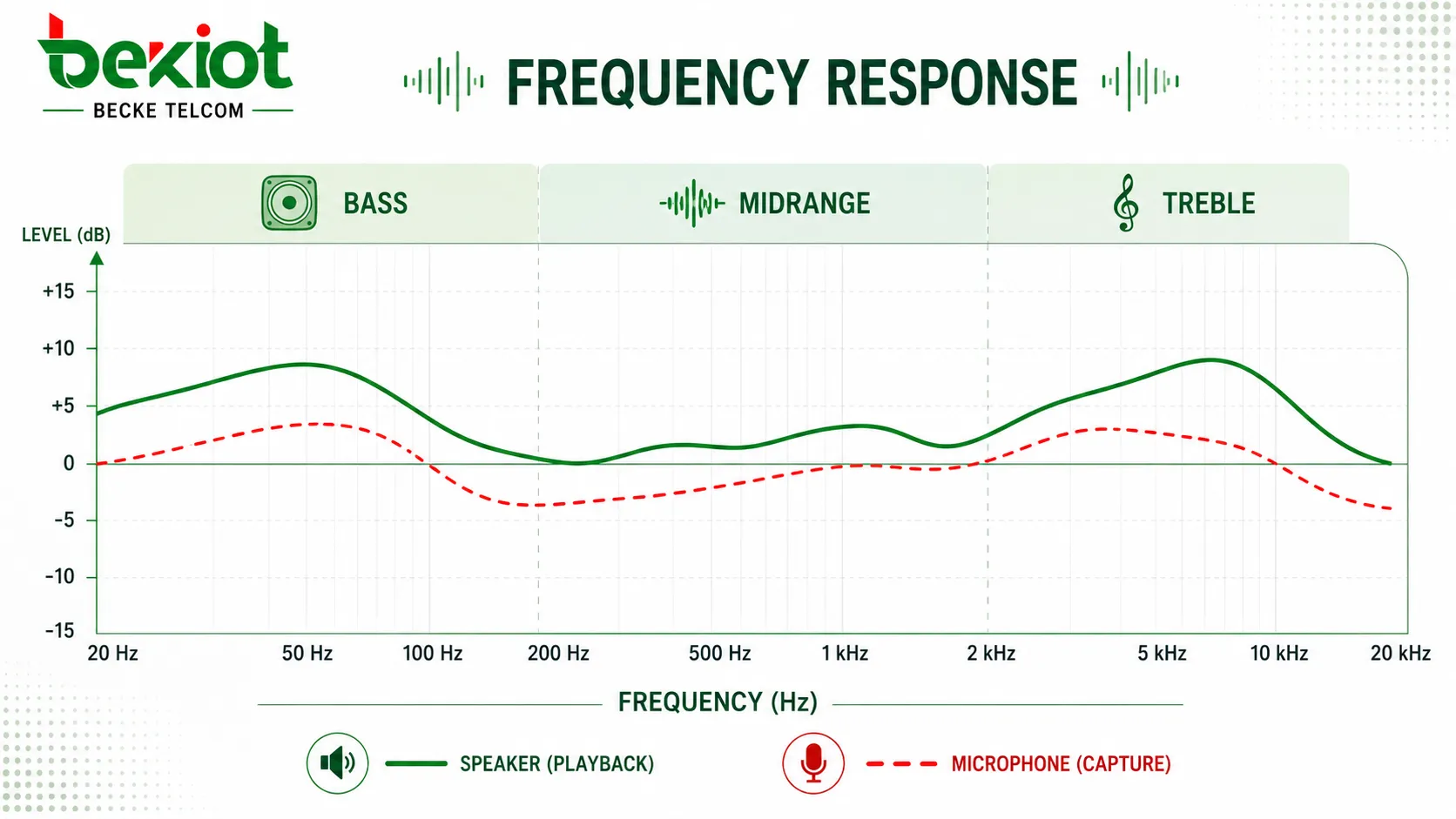
A frequency response curve shows how output level changes across frequency. The horizontal axis usually represents frequency, and the vertical axis represents level in decibels. A flatter curve means the device changes the tonal balance less.
In real-world audio, perfectly flat response is difficult and not always desirable. Some headphones are tuned for a specific listening preference, some speakers are designed for speech projection, and some microphones are shaped to highlight vocal clarity.
Why It Matters in Audio Quality
Frequency response matters because audio quality is not only about volume. Two speakers may play at the same loudness but sound completely different if one emphasizes bass while the other emphasizes high frequencies. The tonal balance affects clarity, comfort, realism, and intelligibility.
For speech systems, frequency response affects whether words are easy to understand. For music systems, it affects whether instruments sound balanced. For public address and emergency systems, it affects whether announcements can be heard clearly in real environments.
Speech Clarity
Human speech depends strongly on midrange and upper-midrange frequencies. If these frequencies are weak, speech may sound muffled. If they are too strong, speech may become harsh or tiring.
Clear speech reproduction is important in conference rooms, classrooms, call centers, intercom systems, public address systems, transportation announcements, and emergency notification systems.
Music Balance
Music contains low-frequency rhythm, midrange body, and high-frequency detail. A system with poor low-frequency response may sound thin. A system with uneven treble may sound sharp or dull.
Good frequency response helps instruments and vocals remain balanced. This is important in home audio, studio monitoring, live sound, background music, broadcasting, and multimedia systems.
Listening Comfort
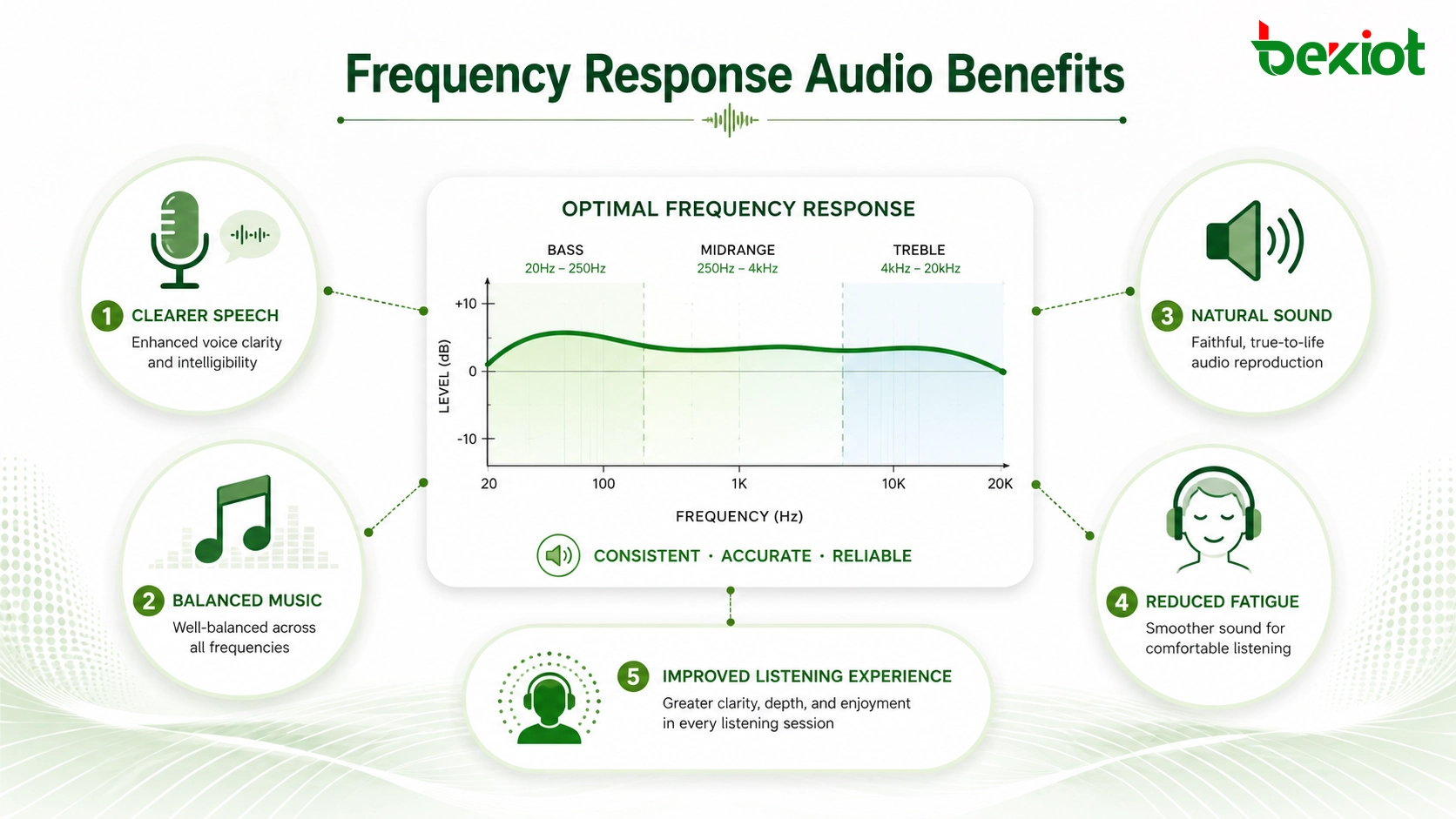
Uneven frequency response can cause listening fatigue. Excessive high-frequency energy may feel piercing, while too much low-frequency energy may feel muddy or overwhelming.
For long meetings, call center work, control room operation, online education, and professional monitoring, comfortable tonal balance is important because users may listen for many hours.
Technical Features Behind Frequency Response
Frequency response is affected by hardware design, acoustic structure, electrical circuits, signal processing, installation environment, and measurement method. It is not a single isolated number.
Driver and Diaphragm Design
In speakers and headphones, the driver converts electrical signals into sound. Driver size, diaphragm material, magnet structure, suspension, enclosure design, and crossover network all affect frequency response.
Larger drivers may reproduce lower frequencies more effectively, while smaller drivers may handle higher frequencies more efficiently. Multi-driver systems use crossovers to divide audio frequencies between woofers, midrange drivers, and tweeters.
Microphone Capsule Response
In microphones, frequency response depends on capsule type, diaphragm size, acoustic chamber, grille design, polar pattern, and internal electronics. Some microphones are designed to sound neutral, while others intentionally emphasize vocal presence.
For measurement, recording, conferencing, and speech pickup, choosing the right microphone response is important. A microphone that sounds good for singing may not be ideal for meeting rooms or industrial voice communication.
Enclosure and Acoustic Loading
Speaker enclosures strongly affect low-frequency response. A sealed cabinet, bass reflex port, horn-loaded design, or line array structure will produce different frequency behavior.
Acoustic loading also matters in installed audio. A speaker mounted in a ceiling, wall, cabinet, vehicle, or outdoor horn may behave differently from the same driver measured in free space.
Signal Processing and Equalization
Digital signal processing can adjust frequency response through equalization, filters, room correction, loudness compensation, and crossover control. This allows systems to correct tonal imbalance or adapt to different spaces.
However, equalization cannot solve every problem. If a speaker cannot physically reproduce deep bass, boosting low frequencies may cause distortion or damage. Good system design starts with suitable equipment before applying correction.
Understanding Frequency Response Specifications
Frequency response specifications can be misunderstood if users only read the frequency range. A meaningful specification should include tolerance, measurement condition, and sometimes the response curve.
Decibel Tolerance
Frequency response is often written with a tolerance such as 50 Hz to 18 kHz ±3 dB. This means the device’s output stays within a 3 dB variation across that range under specified test conditions.
A range without tolerance is less useful because it does not show how evenly the device performs. A speaker listed as 40 Hz to 20 kHz may sound very different depending on whether that range is measured at ±3 dB, ±6 dB, or without a clear limit.
Flat Response
Flat response means the device reproduces all frequencies at roughly equal level. Studio monitors, measurement microphones, and reference headphones often aim for controlled and predictable response.
In practical listening, flat measured response does not always mean the most pleasing sound. Room acoustics, listener position, playback level, and user preference also affect perceived tonal balance.
Frequency Extension
Frequency extension describes how low or high a device can reproduce sound. Low-frequency extension is important for bass and full-bodied music. High-frequency extension affects detail, brightness, and airiness.
For speech-focused systems, extreme bass extension may not be necessary. For music playback, cinema, and studio monitoring, wider extension may be more important.
| Specification Item | Meaning | Why It Matters |
|---|---|---|
| Frequency range | Lowest and highest stated frequencies | Shows basic bandwidth capability |
| ±dB tolerance | Allowed level variation within the range | Shows how even the response is |
| Response curve | Level changes across frequency | Reveals tonal character and problem areas |
| Measurement condition | How and where the response was tested | Affects comparison between products |
| Application tuning | Response shaped for speech, music, monitoring, or alerts | Determines practical suitability |
Audio Benefits of Good Frequency Response
Good frequency response improves how users perceive sound. It helps audio remain clear, balanced, natural, and suitable for the intended environment.
More Natural Sound
When frequency response is well controlled, voices and instruments sound closer to their original character. This makes communication and listening more natural.
Natural sound is important for conference communication, remote meetings, music playback, broadcast production, training content, and customer service calls.
Better Intelligibility
Speech intelligibility improves when the important vocal frequency range is reproduced clearly without excessive masking. Too much bass can cover speech detail, while weak upper-midrange can reduce consonant clarity.
For public spaces, industrial sites, classrooms, and transport stations, intelligibility can be more important than overall loudness.
Improved System Consistency
Consistent frequency response helps audio sound similar across different rooms, devices, and zones. This is useful in multi-room audio, paging systems, conference facilities, and distributed public address systems.
Without consistency, one zone may sound bright while another sounds muffled. This makes system management harder and reduces user satisfaction.
Reduced Distortion Risk
Choosing equipment with suitable frequency response reduces the need for extreme equalization. When a system is forced to reproduce frequencies outside its practical capability, distortion and overload become more likely.
A well-matched speaker, amplifier, microphone, and processor can achieve better results with less correction.
Applications in Audio Systems
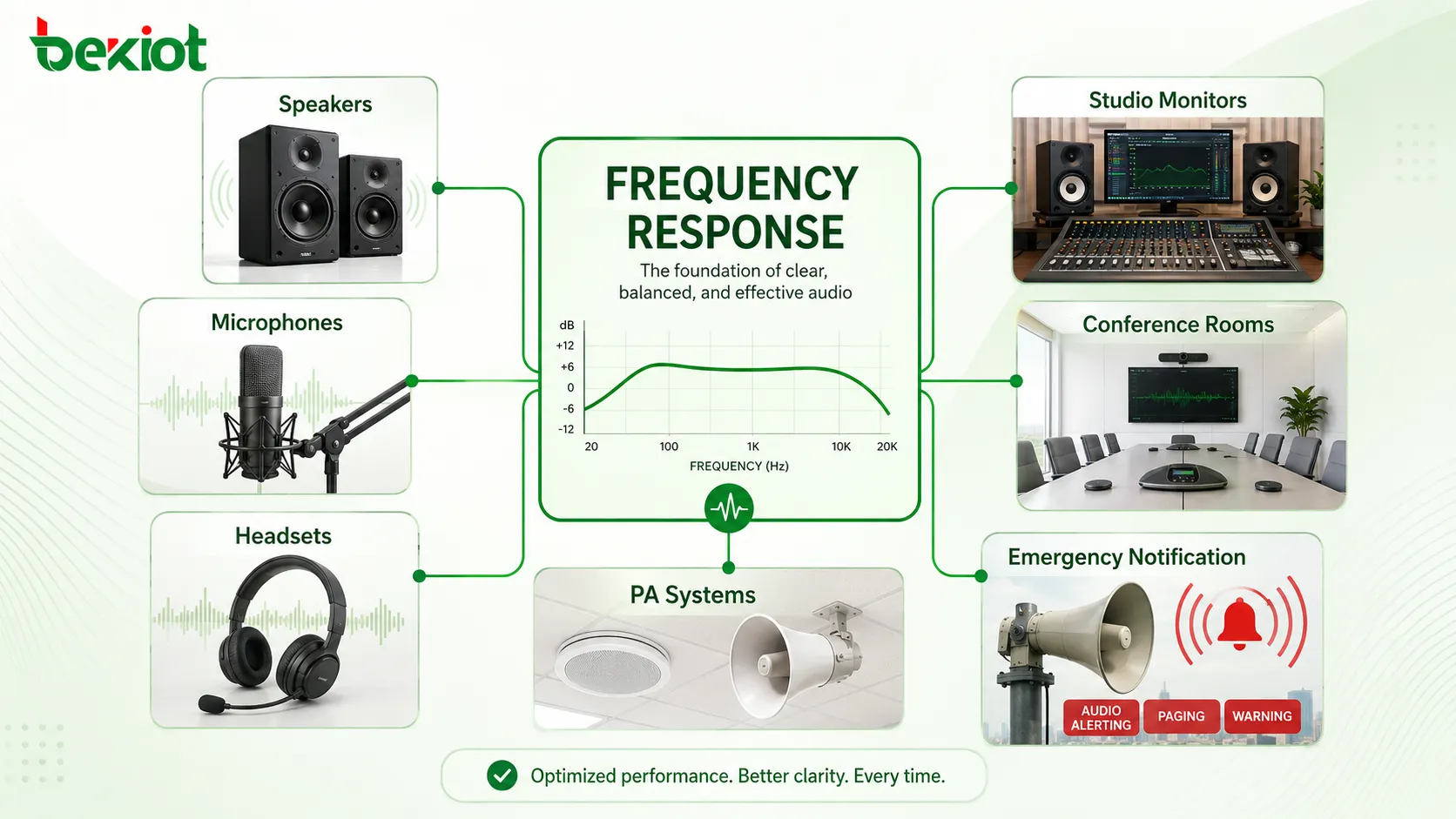
Frequency response is used in many audio applications because every microphone, speaker, headset, amplifier, and room affects the final sound. The ideal response depends on the purpose.
Speakers and Public Address Systems
Speakers are often selected according to coverage, output power, sensitivity, and frequency response. A speech announcement speaker should reproduce the voice range clearly, while a music speaker may require deeper bass and smoother treble.
In public address systems, frequency response affects whether announcements are understandable. In large or reverberant spaces, controlled midrange and treble response can help improve clarity.
Microphones and Voice Pickup
Microphones use frequency response to shape how voices and instruments are captured. A vocal microphone may boost presence frequencies to improve clarity. A measurement microphone may aim for a flat response.
For conference rooms and communication systems, microphones should capture speech clearly while avoiding excessive room noise, handling noise, and low-frequency rumble.
Headphones and Headsets
Headphones and headsets rely heavily on frequency response tuning. A headset for call centers may prioritize speech clarity, while a music headphone may focus on full-range listening.
For long work sessions, overly sharp treble or exaggerated bass can cause fatigue. Balanced response improves comfort and communication accuracy.
Recording and Studio Monitoring
Studio monitors and reference headphones need controlled frequency response so engineers can make accurate mixing decisions. If the monitor exaggerates bass, the final mix may sound weak on other systems.
Room treatment is also important. Even a high-quality monitor can produce inaccurate results in a poorly treated room with strong reflections or standing waves.
Conference and Meeting Rooms
In meeting rooms, frequency response affects speech pickup and playback. Microphones must capture clear voices, while speakers must reproduce speech without echo, harshness, or muddiness.
DSP tuning, microphone placement, speaker placement, and acoustic treatment can all improve frequency response in conference environments.
Emergency and Notification Audio
Emergency messages must be clear and understandable. Frequency response should support speech intelligibility rather than only loudness. Harsh or distorted sound can reduce message comprehension.
In noisy environments, system designers may need speakers with strong speech-band performance, proper placement, and suitable equalization.
Measurement and Testing Methods
Frequency response can be measured using test signals, calibrated microphones, audio analyzers, software tools, and controlled environments. The goal is to understand how the device or system behaves across the audio spectrum.
Sweep and Pink Noise Testing
A frequency sweep plays tones across a range of frequencies and measures output level. Pink noise contains equal energy per octave and is often used for system tuning and room analysis.
These test methods help identify peaks, dips, resonances, and uneven response areas. They are useful in speaker testing, room tuning, and installed audio commissioning.
Anechoic and In-Room Measurement
Anechoic measurement removes room reflections and shows the device’s direct response more clearly. In-room measurement shows how the device performs in the actual listening environment.
Both measurements are useful. Anechoic data helps compare products, while in-room data helps tune real installations.
Listening Tests
Measurement is important, but listening tests are also necessary. Users may notice harshness, muddiness, weak vocals, or poor clarity even when basic measurements look acceptable.
Professional evaluation often combines measurements with listening tests using speech, music, and real program material.
Factors That Affect Real-World Response
The frequency response experienced by listeners is not determined by equipment alone. Installation, room acoustics, placement, processing, and listening position all affect the final result.
Room Acoustics
Rooms can strongly change frequency response. Reflections, standing waves, absorption, furniture, glass walls, ceiling height, and room shape can create peaks and dips.
Low frequencies are especially affected by room modes. A speaker may sound bass-heavy in one position and bass-light in another location within the same room.
Speaker Placement
Speaker placement affects tonal balance. Placing a speaker near a wall or corner can increase low-frequency output. Mounting height and angle affect midrange and high-frequency coverage.
Good placement can improve clarity before equalization is applied. Poor placement may require more correction and still produce uneven sound.
Microphone Position
Microphone position affects captured frequency response. A microphone too close to a sound source may produce excessive bass due to proximity effect. A microphone too far away may capture more room reflections than direct sound.
For speech pickup, microphone placement should balance clarity, comfort, noise rejection, and natural tone.
Equalization Settings
Equalization can correct tonal imbalance, but it should be used carefully. Excessive boost may cause distortion, feedback, or overload. Excessive cut may make audio thin or unnatural.
EQ works best when used to fine-tune a well-designed system, not to compensate for unsuitable equipment or poor installation.
Common Misunderstandings
Frequency response specifications are often used in marketing, but they are easy to misread. Understanding common misunderstandings helps buyers and system designers make better decisions.
Wider Range Is Not Always Better
A wider frequency range does not automatically mean better sound. A speaker rated from 20 Hz to 20 kHz may still sound poor if the response is uneven, distorted, or measured without a clear tolerance.
For speech systems, a narrower but well-controlled response may be more useful than an exaggerated full-range claim.
Flat Is Not Always Ideal
Flat response is valuable for reference monitoring and measurement, but many applications use intentional tuning. For example, public address speakers may emphasize speech clarity, while consumer headphones may be tuned for a preferred listening curve.
The best response depends on the application, listening environment, and user expectation.
Specifications Are Not Always Comparable
Different manufacturers may use different measurement methods, smoothing, reference levels, and tolerance definitions. This makes direct comparison difficult if only the frequency range is provided.
Response curves, measurement conditions, and independent testing are more useful than a simple range number.
Selection and Design Tips
Choosing audio equipment based on frequency response requires matching the device to the application. The same response curve may be excellent for one use and unsuitable for another.
Start with the Application
For speech communication, prioritize clarity in the vocal range. For music playback, look for balanced full-range performance. For studio monitoring, choose controlled and predictable response. For emergency systems, prioritize intelligibility and reliability.
The intended use should guide product selection more than the largest frequency range number.
Check Tolerance and Curves
When possible, review the response curve and tolerance. A specification such as 60 Hz to 18 kHz ±3 dB is more informative than a broad range without tolerance.
Curves can reveal whether a device has boosted bass, recessed midrange, sharp treble, or uneven response that may affect real performance.
Consider the Environment
A device that measures well in a lab may perform differently in a real room. Room size, ceiling height, wall materials, background noise, and mounting position should be considered.
For installed systems, on-site tuning and measurement are often necessary to achieve the desired result.
Avoid Overcorrection
Equalization should improve the system without pushing equipment beyond its limits. Large boosts at frequencies the device cannot reproduce well may create distortion or reduce reliability.
If heavy correction is required, the better solution may be different equipment, improved placement, acoustic treatment, or additional speakers.
FAQ
Why do two speakers with the same frequency range sound different?
The same frequency range does not mean the same response curve. Driver design, enclosure structure, crossover tuning, distortion, dispersion, and measurement tolerance can make two speakers sound very different.
Is frequency response more important than sensitivity?
They describe different things. Frequency response shows tonal balance across frequencies, while sensitivity shows how loud a speaker becomes with a given input. Both matter for system design.
Can room correction software fix all frequency response problems?
No. Room correction can improve some issues, but it cannot fully solve poor speaker placement, severe room acoustics, weak hardware capability, bad microphone positioning, or excessive reverberation.
Why does a microphone sound different when used close to the mouth?
Directional microphones may produce proximity effect, which increases low-frequency response when the sound source is very close. This can make voices sound warmer or boomy depending on distance and microphone design.
Should emergency announcement systems use full-range speakers?
Not always. Emergency announcement systems need intelligible speech first. A speaker with strong speech-band clarity and suitable coverage may be more appropriate than a full-range music speaker.
How can frequency response be checked during commissioning?
Technicians can use calibrated microphones, test signals, audio analysis software, speech playback, and listening tests. The result should be checked at real listener positions, not only near the speaker.







