


Electrostatic Discharge, commonly abbreviated as ESD, is the sudden transfer of static electricity between objects with different electrical potentials. It can happen when a person touches an electronic device, when a cable is plugged into equipment, when packaging rubs against a component, or when a charged object comes close enough for a spark to jump through air.
ESD may look harmless in daily life, such as a small shock after walking on carpet, but it can damage electronic circuits, disturb communication devices, reset control systems, corrupt data, shorten component life, or create safety concerns in sensitive environments. For this reason, ESD protection is important in product design, manufacturing, installation, maintenance, transportation, and field operation.
ESD protection is not only a factory handling issue. It is also a product reliability issue, a field service issue, and a system-level immunity requirement for electronic equipment.
Basic Meaning of Electrostatic Discharge
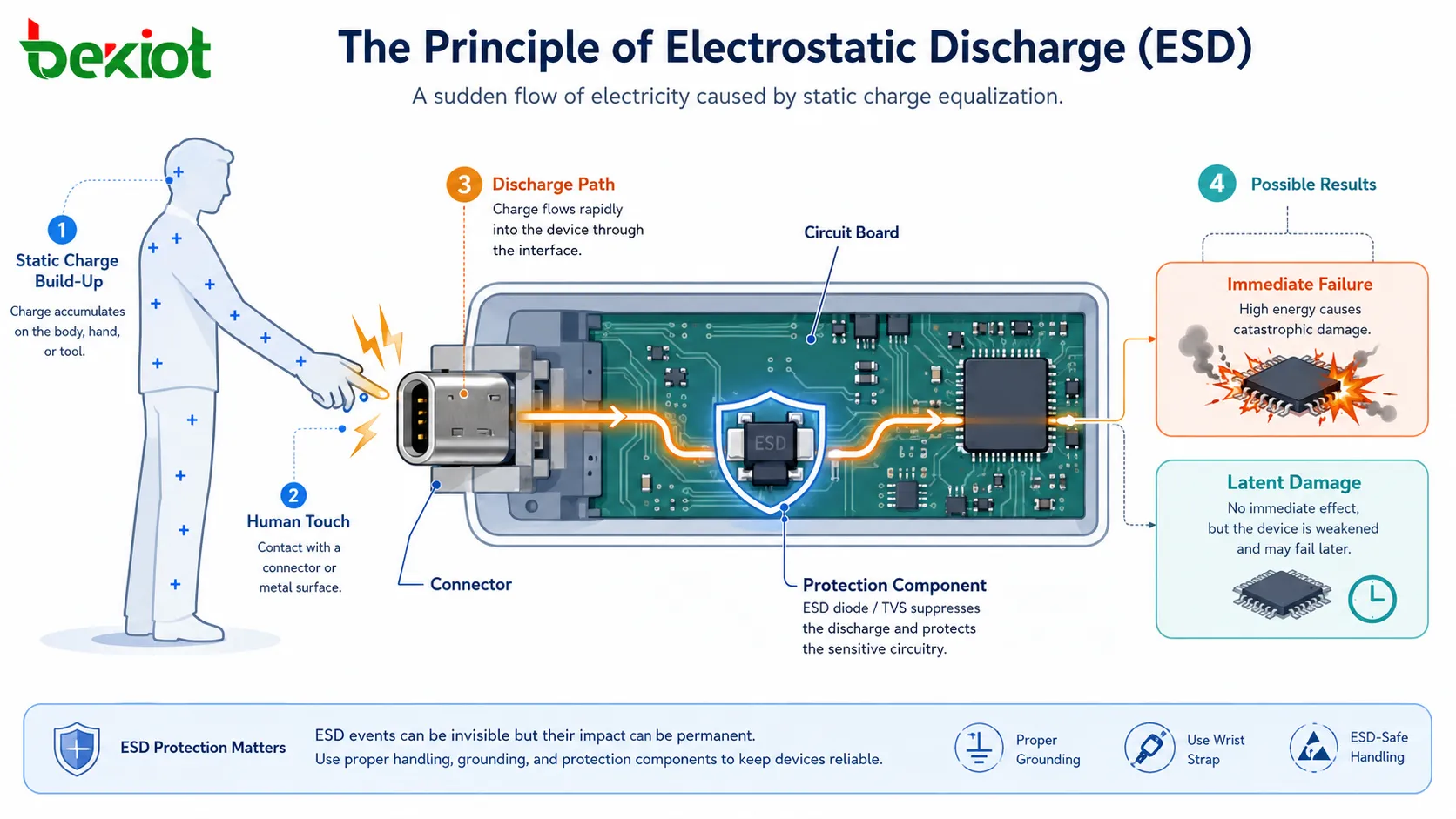
Electrostatic discharge occurs when accumulated static charge finds a path to equalize. The discharge may happen through direct contact, through a small air gap, or through a conductive tool, cable, connector, enclosure, or human body. The event is usually very fast, but the voltage can be high enough to affect electronic components.
Static charge can build up through friction, separation, movement, dry air, plastic surfaces, synthetic clothing, packaging materials, conveyor belts, footwear, or handling processes. The discharge may be visible as a spark, felt as a shock, or completely invisible while still damaging sensitive electronics.
Static Charge Build-Up
Static charge builds up when electrons transfer between materials. This may happen when two surfaces touch and separate, when a person walks across an insulating floor, when plastic packaging slides across a table, or when equipment moves through a dry environment.
Humidity, material type, grounding condition, surface resistance, and movement speed all affect charge build-up. Dry environments often increase ESD risk because static charge dissipates more slowly.
Discharge Event
A discharge event happens when the stored charge moves suddenly to another object. If the discharge enters an electronic circuit through a connector, button, metal case, antenna, cable, sensor, or interface port, it can cause electrical stress.
Some ESD events cause immediate failure. Others cause latent damage, where the device still works but becomes weaker and may fail later under normal use.
Why ESD Matters in Electronic Systems
ESD matters because electronic components continue to become smaller, faster, and more sensitive. Integrated circuits, sensors, communication chips, displays, memory devices, microcontrollers, radio modules, and interface ports may be affected by discharge energy that users never notice.
In finished products, ESD can also affect system behavior. A device may restart, freeze, lose network connection, generate false alarms, damage an interface, or show unstable operation after a discharge event.
Component Damage
ESD can damage semiconductor junctions, oxide layers, metal traces, input pins, and protection structures. The damage may be catastrophic or hidden. Catastrophic damage causes immediate failure, while latent damage weakens the component.
Latent damage is difficult to identify because the product may pass basic testing after the event. Later, it may fail during operation, temperature changes, vibration, or repeated electrical stress.
System Malfunction
Even if no permanent hardware damage occurs, ESD can disturb normal system operation. It may cause temporary logic errors, communication loss, display flicker, audio noise, false key input, alarm misreporting, or device reboot.
For communication terminals, access control devices, medical electronics, industrial controllers, and emergency equipment, these temporary faults can still create serious operational problems.
Field Reliability
Products used in public, industrial, outdoor, transportation, healthcare, or service environments may be touched frequently by users. Buttons, touchscreens, metal panels, ports, and handsets are common discharge points.
Field reliability requires product-level ESD protection, proper enclosure design, grounding, surge protection, cable shielding, and installation practices that reduce discharge risk.
Common ESD Sources
ESD can come from people, tools, packaging, cables, equipment surfaces, furniture, flooring, moving parts, and environmental conditions. Understanding the source helps engineers and maintenance teams select the right control method.
Human Body Discharge
A person can accumulate static charge and discharge it when touching an electronic product. This is one of the most common ESD scenarios in daily use.
Touch points such as buttons, metal housings, connector shells, keypads, handsets, card readers, displays, and ports should be considered during product design and testing.
Charged Devices and Tools
Tools, fixtures, trays, test equipment, cables, or devices can become charged and discharge into sensitive electronics. This is a common concern in manufacturing, repair, assembly, and laboratory environments.
ESD-safe workstations, grounded tools, ionizers, conductive containers, and controlled handling procedures help reduce this risk.
Packaging and Transport
Plastic bags, foam, trays, labels, and shipping materials may generate static charge. Sensitive components and circuit boards can be damaged during packaging, shipping, receiving, or storage if ESD-safe materials are not used.
ESD protective packaging should be selected according to the sensitivity of the item and the expected handling environment.
Cables and External Interfaces
External cables can introduce ESD into a device through connectors or exposed metal parts. Ethernet ports, USB ports, RS-485 terminals, audio connectors, power inputs, antenna connectors, and alarm inputs may all need protection.
Interface protection should consider both normal operation and real-world user handling. A port that is frequently touched or hot-plugged needs careful protection design.
ESD Standards and Test References
ESD standards help define how products, components, and workplaces should be tested or controlled. Different standards focus on different layers: product immunity, component sensitivity, workplace control, packaging, and manufacturing process management.
IEC 61000-4-2
IEC 61000-4-2 is widely used for electrostatic discharge immunity testing of electrical and electronic equipment. It defines test methods used to evaluate how equipment responds to ESD events, including contact discharge and air discharge.
Contact discharge applies the ESD pulse through direct contact with the equipment surface or test point. Air discharge applies the test through an air gap where the spark occurs as the test tip approaches the equipment. Product standards or project requirements usually define which levels and performance criteria must be met.
IEC 61340-5-1
IEC 61340-5-1 focuses on ESD control programs for protecting electrostatic-discharge-sensitive devices. It addresses the administrative and technical measures needed to establish, implement, and maintain an ESD control program.
This type of standard is important for manufacturing, assembly, service, packaging, and handling processes. It helps organizations control personnel grounding, work areas, materials, packaging, training, verification, and handling discipline.
ANSI/ESD S20.20
ANSI/ESD S20.20 is another major ESD control program standard used by organizations that handle sensitive electrical and electronic parts, assemblies, and equipment. It provides requirements for building a structured ESD control program.
It is often used in electronics manufacturing and quality systems where organizations need documented procedures, training, product qualification, compliance verification, grounding, packaging, and ESD protected area management.
Component-Level ESD Models
Components may be tested using models such as Human Body Model and Charged Device Model. These tests help classify component sensitivity and guide handling requirements.
Component-level ratings do not automatically prove finished product immunity. A finished product also needs system-level design and testing because enclosures, connectors, cabling, grounding, layout, and protection components all affect real ESD behavior.
Understanding ESD Protection Ratings
ESD protection ratings describe how much discharge stress a product, component, or interface is designed or tested to withstand. In product datasheets, ratings may appear as contact discharge voltage, air discharge voltage, human body model voltage, charged device model value, or interface protection level.
These numbers should be read carefully. A higher number may indicate stronger tested immunity under specific conditions, but it does not guarantee unlimited protection in every installation.
| Rating Type | What It Indicates | Typical Use |
|---|---|---|
| Contact discharge rating | ESD stress applied directly to a conductive surface or test point | Product immunity testing for enclosures, connectors, panels, and interfaces |
| Air discharge rating | ESD stress applied through an air gap before contact | Testing plastic surfaces, gaps, buttons, and touch areas where direct contact may not occur |
| HBM rating | Component sensitivity to discharge from a charged human body model | Electronic component handling and qualification |
| CDM rating | Component sensitivity when a charged device discharges suddenly | Manufacturing, assembly, and automated handling risk control |
| System-level immunity | Finished product response under defined ESD test conditions | Equipment compliance, reliability design, and field installation planning |
Contact Discharge
Contact discharge is often more repeatable than air discharge because the test electrode touches the target before the discharge occurs. It is commonly used on conductive surfaces, metal panels, connector shells, and specified test points.
For product design, contact discharge results help engineers evaluate how exposed conductive parts handle ESD stress and whether the discharge path is controlled safely.
Air Discharge
Air discharge is used where contact discharge is not practical, such as insulating surfaces, gaps, plastic enclosures, buttons, and areas where a spark may jump through air.
Air discharge can be more variable because humidity, approach speed, surface condition, and gap distance influence the actual event. This makes design margins and practical testing important.
Performance Criteria
ESD testing is not only about whether a product survives physically. Performance criteria define how the equipment is allowed to behave during and after the test.
A product may be required to continue operating normally, recover automatically, require user reset, or avoid unsafe behavior depending on its application and applicable standard. Critical equipment usually needs stricter performance expectations.
ESD Protection Design Methods
ESD protection is usually built from several layers. A single protection component is rarely enough if the enclosure, circuit board, connector layout, grounding, and cable design are weak.
Controlled Discharge Path
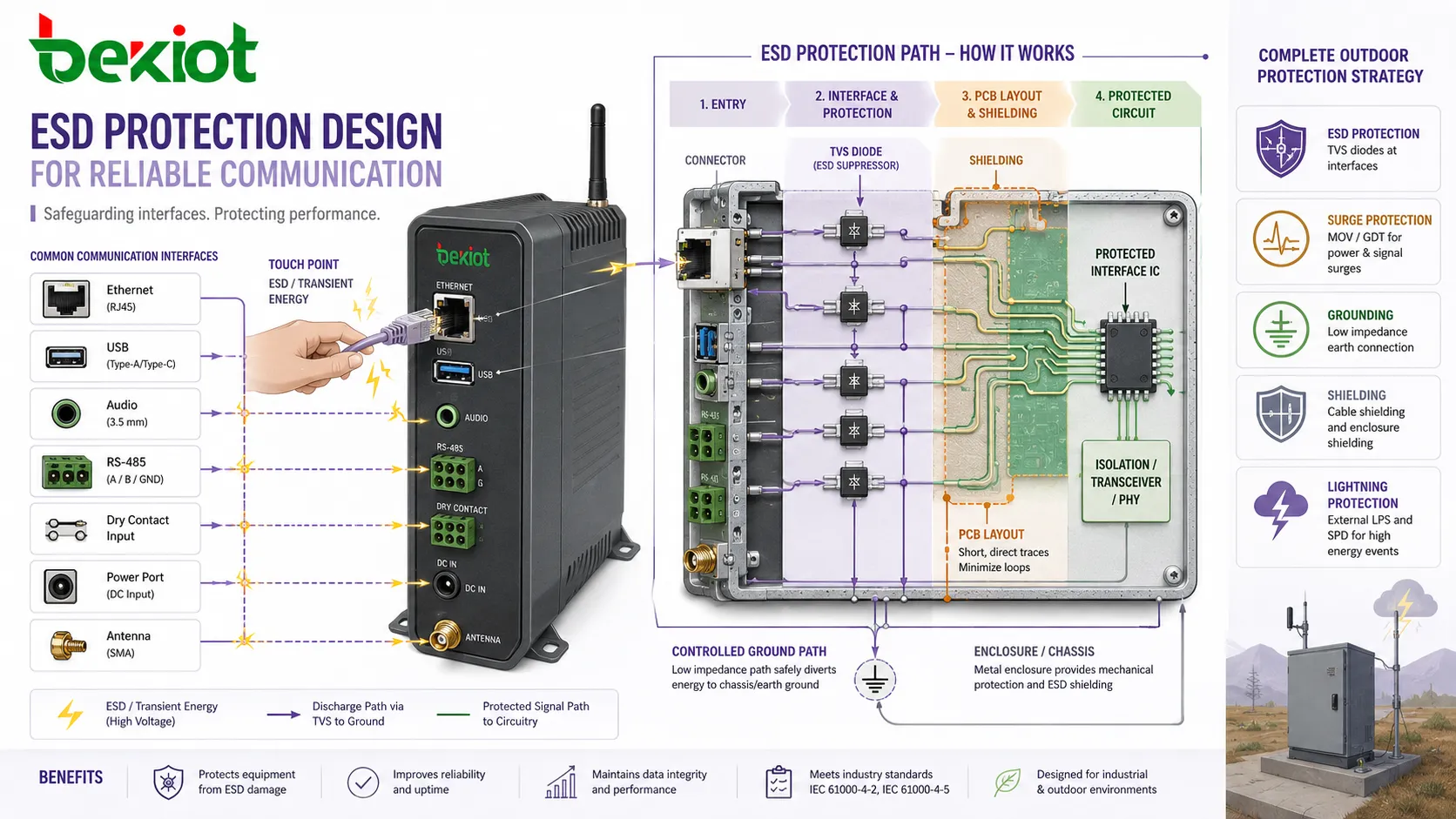
A good design gives ESD energy a safer path away from sensitive circuits. This may involve chassis grounding, metal shielding, protective components, spark gaps, ground planes, and low-impedance discharge paths.
If the discharge path is not controlled, ESD energy may travel through signal lines, microcontroller pins, audio circuits, sensors, or communication interfaces, increasing the risk of failure.
Protection Components
Protection components such as TVS diodes, ESD suppressors, resistors, capacitors, common-mode chokes, and transient protection arrays are commonly used on exposed interfaces.
Component selection should consider working voltage, capacitance, clamping voltage, response time, discharge current, interface speed, leakage current, and layout position. A poorly placed protection component may not protect the circuit effectively.
PCB Layout
PCB layout is critical for ESD performance. Protection components should be placed close to the entry point, with short paths to ground or chassis reference. Long traces can increase inductance and reduce protection effectiveness.
Ground planes, guard traces, separation distances, shielding, and connector placement all influence the discharge path. ESD design should begin early, not after the board is complete.
Enclosure and Mechanical Design
The enclosure affects where users can touch the product and where discharge energy may enter. Plastic gaps, metal panels, connector openings, keypads, seams, and mounting screws all need review.
Mechanical design can help redirect discharge away from sensitive electronics by using shielding, spacing, insulation, conductive coatings, gasket design, and careful placement of exposed metal parts.
Cable and Interface Protection
External cables can carry ESD and transient energy into equipment. Interfaces such as Ethernet, USB, audio, RS-485, dry contact inputs, power ports, and antenna connections may need protection according to exposure risk.
For outdoor or industrial installations, ESD protection may also need to work with surge protection, grounding, shielding, and lightning protection strategy.
ESD Control in Manufacturing and Service
ESD protection is not only designed into products. It must also be controlled during manufacturing, assembly, repair, testing, storage, and transport. Sensitive components can be damaged before they ever reach the customer.
ESD Protected Area
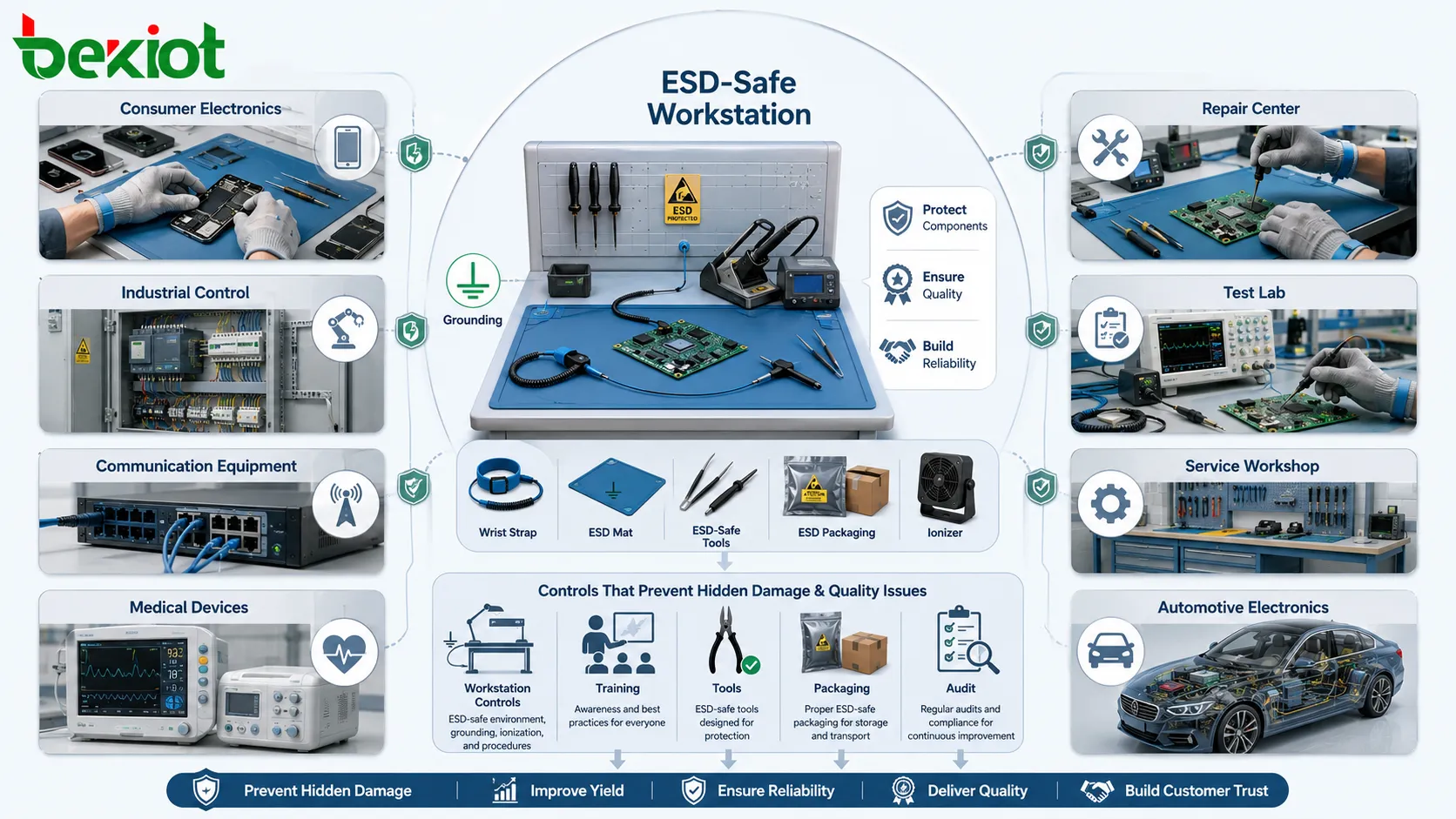
An ESD protected area is a controlled workspace where static charge is managed. It may include grounded work surfaces, wrist straps, ESD flooring, conductive containers, ionizers, humidity control, and approved tools.
The purpose is to reduce charge build-up and provide safe dissipation paths. Personnel should understand the rules before handling sensitive parts.
Personnel Grounding
People are a major source of static discharge. Wrist straps, heel grounders, conductive footwear, ESD floors, and grounding checks are used to reduce the risk of human body discharge.
Grounding devices should be tested regularly. A wrist strap that is worn but not connected correctly may provide false confidence.
ESD-Safe Packaging
Sensitive components and circuit boards should be stored and transported in suitable ESD protective packaging. Ordinary plastic bags or foam can generate static and should not be used for sensitive electronics unless specifically designed for ESD protection.
Packaging selection should consider whether the item needs shielding, low charging, cushioning, moisture protection, or labeling.
Training and Verification
Training helps staff understand why ESD control matters and how to follow procedures. Verification confirms that the program is working through audits, resistance checks, workstation inspections, and process review.
Without training and verification, ESD rules may exist on paper but fail in daily handling.
Applications in Different Systems
ESD protection is needed wherever electronic devices are touched, handled, installed, serviced, or connected to external interfaces. The required protection level depends on the environment and risk.
Consumer Electronics
Phones, tablets, laptops, wearables, game controllers, headphones, smart home devices, and chargers are frequently touched by users. Buttons, screens, ports, cases, and connectors must tolerate everyday ESD events.
Good ESD design helps prevent resets, touch failures, port damage, charging problems, and user-visible malfunction.
Industrial Control Systems
Industrial controllers, HMIs, sensors, PLC modules, motor drives, and remote I/O devices may be installed in electrically noisy environments. Operators may touch panels, cables, terminals, and metal enclosures during normal work.
Industrial ESD protection should be coordinated with EMC design, grounding, cabinet wiring, shielding, and surge protection.
Communication and Intercom Equipment
Communication devices often include handsets, speakers, microphones, buttons, Ethernet ports, power inputs, relay outputs, and user-accessible panels. These touch points and interfaces need ESD consideration.
In outdoor help-point or facility communication projects, Becke Telcom BHP-SOS intercom series can be considered where rugged emergency calling, button interaction, and interface protection need to be reviewed together with site grounding and installation conditions.
Medical and Laboratory Devices
Medical and laboratory equipment may contain sensitive sensors, displays, measurement circuits, and data interfaces. ESD can affect accuracy, reliability, or device availability.
Design and handling procedures should be aligned with the device risk level, operating environment, and regulatory requirements.
Automotive and Transportation Systems
Vehicles, rail systems, charging stations, ticket machines, passenger information displays, and transport terminals face frequent human touch and changing environmental conditions.
ESD protection helps improve reliability for buttons, screens, connectors, communication modules, and control electronics.
Manufacturing and Repair Workstations
Electronics manufacturing, repair centers, test labs, and service workshops must control ESD during handling. Components may be more vulnerable before they are assembled into protected products.
Workstation controls, training, tools, packaging, and audits are essential for reducing hidden damage and quality issues.
Common ESD Problems
ESD problems can appear as obvious hardware failure or subtle instability. Because discharge events are fast and often invisible, the root cause may be difficult to find without structured testing.
Unexpected Device Reset
A device may restart when a user touches a button, cable, metal frame, or connector. This may indicate that discharge energy is entering reset lines, power circuits, communication interfaces, or processor pins.
Improved grounding, protection components, filtering, layout changes, and enclosure design may be needed.
Communication Port Failure
Ports such as Ethernet, USB, serial, audio, dry contact, and power inputs can be damaged by ESD events. Failures may appear as lost connection, intermittent communication, high error rate, or complete port damage.
Interface-specific protection should be selected according to data rate, capacitance limits, working voltage, and exposure level.
False Alarms or Input Errors
ESD can trigger false input signals, key presses, alarm events, sensor readings, or control commands. This is especially problematic for access control, alarm systems, industrial controls, and emergency devices.
Debouncing, filtering, shielding, grounding, and input protection can reduce false triggering.
Latent Reliability Failures
A product may pass final testing but fail later because ESD weakened a component during production or service. These failures are expensive because they may appear after shipment or installation.
This is why ESD control programs are important in manufacturing and repair processes, not only in product design.
Selection and Deployment Considerations
When evaluating ESD protection, buyers and engineers should review both datasheet ratings and real installation conditions. A product rating is meaningful only when the application, wiring, grounding, and environment are considered.
Check the Rated Test Method
A datasheet may state an ESD value, but it should also show whether the rating refers to contact discharge, air discharge, HBM, CDM, or another test method. These are not interchangeable.
For finished equipment, system-level immunity testing is usually more relevant than component-only ratings.
Review Exposed Touch Points
Any part that users touch should be reviewed. Buttons, handles, screens, connector shells, keypads, metal housings, screws, and external ports can become discharge points.
In public or industrial devices, touch points may be exposed to more frequent and stronger ESD events than indoor consumer products.
Consider Installation Grounding
ESD protection often depends on grounding and bonding. If the installation does not provide a proper reference or discharge path, protection may be less effective.
Outdoor cabinets, metal poles, control panels, racks, shielded cables, and power systems should be reviewed as part of the whole installation.
Coordinate ESD with EMC and Surge Protection
ESD is one part of electromagnetic compatibility. Products may also need protection against electrical fast transients, surge, radiated interference, conducted interference, and lightning-related events.
For outdoor and industrial systems, ESD protection should be coordinated with broader EMC and surge protection design rather than treated separately.
Best Practices for ESD Protection
Good ESD protection combines product design, controlled handling, correct installation, and periodic inspection. No single measure can solve every ESD risk.
Design Protection Early
ESD protection should be included early in product design. Waiting until after compliance testing often leads to difficult redesigns, extra cost, and layout compromises.
Early planning allows engineers to place protection components correctly, shape discharge paths, design enclosures, and select suitable connectors.
Use Layered Protection
Layered protection may include mechanical spacing, shielding, grounding, TVS diodes, filtering, isolation, software recovery, and handling controls.
If one layer is imperfect, other layers can help reduce risk. This approach is more robust than relying on one component alone.
Control the Workplace
For manufacturing and repair, use ESD-safe work areas, grounding tools, approved packaging, training, and verification. Sensitive boards should not be placed on ordinary plastic, foam, carpet, or ungrounded surfaces.
Workplace control reduces hidden damage and improves product quality before the equipment reaches the field.
Test Real Use Scenarios
ESD testing should reflect real touch points and usage patterns. Test connectors, buttons, metal parts, seams, ports, and user-accessible areas. Consider both powered and operating conditions where applicable.
Realistic testing helps identify problems that may not appear in simple laboratory checks.
Document Ratings and Limits
ESD ratings, test conditions, protected ports, installation requirements, and handling precautions should be documented clearly. Maintenance teams and system integrators need this information during deployment.
Clear documentation prevents misuse and helps teams understand what the product is designed to tolerate.
FAQ
Can ESD damage a device even if no spark is visible?
Yes. Many ESD events are too small to see or feel but still strong enough to damage sensitive electronic components or create latent reliability problems.
Does a plastic enclosure prevent all ESD problems?
No. Plastic can reduce direct contact with internal circuits, but discharge may still enter through seams, buttons, connectors, cables, screws, or nearby air gaps. Enclosure design must be reviewed together with circuit protection.
Why do some devices pass factory testing but fail later from ESD?
Latent ESD damage can weaken components without causing immediate failure. The device may pass basic testing but fail later after temperature changes, repeated operation, or additional electrical stress.
Are ESD and surge protection the same thing?
No. ESD is a very fast discharge event usually related to static electricity and human or object contact. Surge events are often higher-energy transients from power systems, switching, or lightning-related effects. Both may need protection, but the design methods differ.
How can service technicians reduce ESD risk in the field?
They can use ESD wrist straps where appropriate, avoid ordinary plastic surfaces, keep boards in protective packaging, ground themselves and tools correctly, control handling procedures, and avoid touching exposed components unnecessarily.
What should be checked if a device resets when touched?
Check grounding, enclosure bonding, button and connector protection, PCB layout, reset circuit filtering, cable shielding, power stability, and whether the exposed touch point has a proper discharge path.







