


Dry contact input is a signal interface that detects whether an external switch, relay, push button, sensor contact, or alarm output is open or closed without receiving external voltage from that device. It is widely used in industrial automation, building management, security systems, fire alarm interfaces, access control, elevator monitoring, HVAC control, and remote equipment supervision.
In many control systems, dry contact input provides a simple and reliable way to convert physical events into digital status signals. Instead of transmitting complex data, the connected device only changes contact state. The controller, PLC, alarm panel, gateway, or monitoring module then reads that state and triggers the required action.
Basic Meaning of a Voltage-Free Contact
A dry contact is often called a voltage-free contact or potential-free contact. This means the contact itself does not provide power, voltage, or active electrical output. It behaves like a simple mechanical connection that can be open or closed.
For example, a relay output inside a sensor may close when motion is detected, when a door is opened, or when an alarm is triggered. The relay contact does not send voltage by itself. The receiving device supplies a small detection voltage or sensing current internally, then determines whether the circuit is open or closed.
Normally Open and Normally Closed Logic
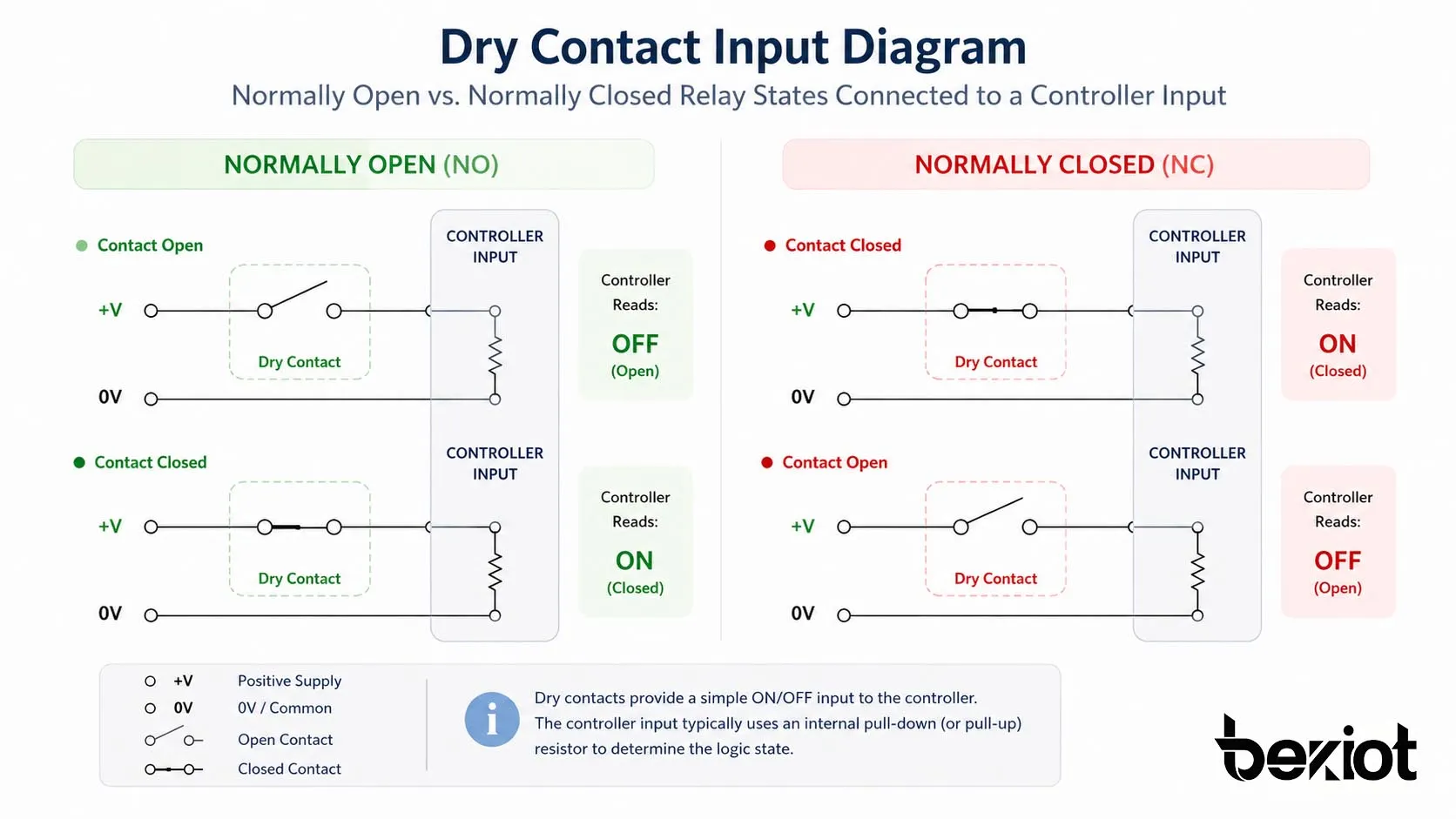
Dry contact input commonly supports two contact states: normally open and normally closed. A normally open contact remains disconnected in its default state and closes when an event occurs. A normally closed contact remains connected in its default state and opens when an event occurs.
This logic is important for system design. Normally open wiring is often used for simple event triggering, while normally closed wiring is common in security and safety-related monitoring because cable breaks or contact failures may be easier to detect in some configurations.
How It Works in a Control Circuit
A dry contact input terminal usually has two connection points. The external device connects a relay contact, switch contact, magnetic door contact, alarm contact, or push button across these terminals. When the contact closes, the input circuit detects continuity. When the contact opens, the input circuit detects disconnection.
The receiving device may use an internal pull-up resistor, pull-down resistor, opto-isolator, or input detection circuit to identify the contact state. The external contact does not need to provide voltage, which helps reduce wiring complexity and improves compatibility between different systems.
Signal Detection Instead of Power Transmission
The key point is that dry contact input is used for status detection, not power delivery. It does not drive a motor, power a siren, energize a lamp, or operate a heavy electrical load directly. It only tells the controller that a condition has changed.
Once the input state is detected, the system can perform a programmed action. This may include sending an alarm, starting a ventilation fan, opening a door relay, activating a notification, logging an event, switching a device mode, or forwarding a signal to a central platform.
Core Features for Reliable Integration
Dry contact input remains popular because it is simple, low-cost, and highly compatible with many field devices. It does not require protocol conversion for basic event monitoring, and it can often be wired over relatively long distances when proper cable type and protection methods are used.
Simple On-Off Status Monitoring
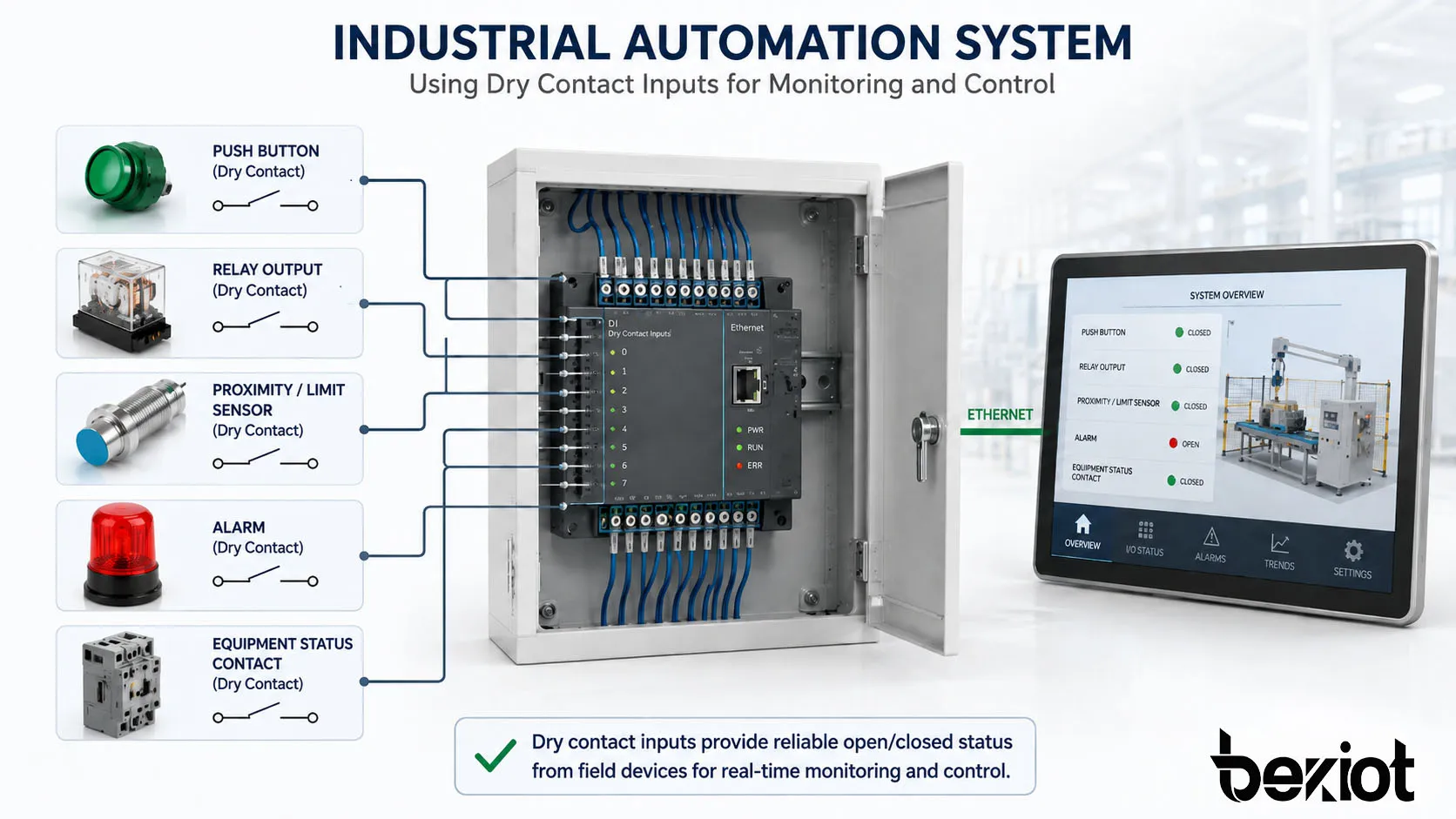
The most important feature is binary state detection. The input reads whether a contact is open or closed, making it suitable for alarms, limit switches, emergency buttons, float switches, door sensors, relay outputs, equipment fault contacts, and many other simple status points.
This simplicity makes dry contact input useful in both old and new systems. Legacy relay-based equipment can often be connected to modern gateways, PLCs, BMS controllers, or remote monitoring platforms without replacing the original field device.
Electrical Isolation and System Protection
Many dry contact input modules are designed with isolation features such as opto-isolation or separated low-voltage input circuits. This helps reduce the risk of interference between different systems and protects the controller from unwanted electrical influence.
However, dry contact input should not be confused with a universal high-voltage input. If the input is designed for voltage-free contacts only, applying external voltage may damage the equipment. Installers should always check the input type, rated voltage, wiring diagram, and manufacturer instructions before connecting field wiring.
Flexible Trigger Configuration
In software, dry contact input can usually be configured for different trigger modes. The system may treat contact closure as an alarm, contact opening as an alarm, or both state changes as loggable events. Some devices also provide delay, debounce, edge triggering, pulse counting, or latching logic.
Debounce and delay settings are especially useful when mechanical switches produce unstable signals during fast contact movement. Without filtering, the controller may detect several rapid changes instead of one clean event.
Common Interface Types and Wiring Considerations
Dry contact input wiring is straightforward, but correct planning is still important. A simple two-wire connection may be enough for a basic switch, while safety and security applications may require supervised circuits, end-of-line resistors, shielded cables, or fault detection.
Two-Wire Contact Connection
The most common wiring method uses two wires between the external contact and the input terminal. When the external contact closes, the input circuit is completed. When the contact opens, the input circuit is broken.
This method is easy to deploy and suitable for many basic monitoring points. It is commonly used for push buttons, relay outputs, water level switches, door contacts, machine status contacts, and simple alarm contacts.
Supervised Input with End-of-Line Resistor
Some security and fire-related systems use supervised input circuits. Instead of only detecting open or closed states, the controller monitors circuit resistance. This allows the system to distinguish normal state, alarm state, short circuit, and cable break conditions.
End-of-line resistor values must match the controller design. Incorrect resistance values, poor wiring, or mixed circuit types may cause false alarms or supervision faults. For regulated fire alarm and life-safety applications, installation should follow local codes and the equipment manufacturer’s certified wiring method.
Where This Interface Is Commonly Used
Dry contact input is widely used because many devices can provide a relay output or switch contact. It is not limited to one industry. The same basic principle appears in industrial plants, smart buildings, transportation facilities, energy sites, campuses, warehouses, hotels, hospitals, and public infrastructure.
Industrial Automation and Equipment Monitoring
In industrial environments, dry contact input is often used to monitor machine running status, fault alarms, emergency stop feedback, limit switches, pressure switches, level switches, temperature alarm relays, and power system status contacts.
These signals can be connected to PLCs, RTUs, SCADA gateways, industrial computers, or remote I/O modules. Once collected, the system can display equipment status, trigger alarms, record maintenance events, or support automatic control logic.
Building Management and HVAC Systems
In building automation, dry contact input may be used for fan status, pump fault, filter alarm, water leakage detection, smoke damper feedback, occupancy switches, elevator status, access door position, and energy management signals.
Because many building devices still provide relay outputs, dry contact input is useful for connecting traditional electromechanical equipment to modern BMS platforms. It supports centralized monitoring without requiring every device to support the same communication protocol.
Security, Access Control, and Alarm Systems
Security systems frequently use dry contact inputs for magnetic door contacts, motion detector relay outputs, panic buttons, tamper switches, intrusion alarms, gate status, and access control event feedback.
In these systems, response speed and reliability are important. The input should be configured with the correct NO or NC logic, and wiring should be protected against accidental disconnection, interference, or unauthorized tampering where required.
Communication, Notification, and Remote Control
Dry contact input can also connect physical events to communication systems. For example, an alarm relay may trigger an IP notification gateway, paging controller, voice alarm system, SMS module, remote monitoring device, or dispatch platform.
This makes dry contact input useful in projects where older equipment must be connected to digital communication workflows. A simple relay output from a field device can become a trigger for voice calls, broadcast messages, visual alerts, event logs, or remote maintenance tickets.
Benefits for System Designers
The value of dry contact input is not only technical simplicity. It also helps system designers integrate different brands, different generations of equipment, and different control platforms in a practical way.
High Compatibility Across Devices
Because dry contact signaling is based on open and closed contact states, it can work across many product categories. A sensor, relay, controller, alarm panel, or machine output does not need to speak the same digital protocol as the receiving system.
This is especially useful in retrofit projects. Instead of replacing all legacy equipment, integrators can use dry contact input modules to collect important status signals and bring them into a newer management platform.
Low Complexity and Easy Maintenance
Dry contact wiring is easier to understand than many data communication interfaces. Technicians can often test the contact state with basic tools, verify wiring continuity, and identify whether the problem is caused by the field device, cable, or input module.
For maintenance teams, this simplicity reduces troubleshooting time. It also makes documentation easier because each input point can be labeled according to its physical function, such as “pump fault,” “door open,” “alarm active,” or “manual call button.”
Reliable Event Triggering
Dry contact input is suitable for reliable event triggering when the wiring, contact rating, and input settings are properly designed. It avoids the need for complex software communication when only a simple condition needs to be detected.
For critical applications, reliability can be improved with shielded cables, surge protection, supervised loops, proper grounding, debounce settings, and clear maintenance procedures.
Dry Contact Input Compared with Wet Contact Input
The main difference between dry contact and wet contact is whether the field signal provides voltage. A dry contact does not provide voltage; it only opens or closes a circuit. A wet contact input receives an active voltage signal from the external device, such as 12V DC, 24V DC, or another rated signal level.
This difference matters during installation. Connecting a powered wet signal to a dry contact input may damage the input circuit if the device is not designed for it. Similarly, connecting a dry relay contact to a wet contact input may not work unless the input circuit receives the required voltage from the correct source.
| Item | Dry Contact Input | Wet Contact Input |
|---|---|---|
| Signal type | Open or closed contact state | External voltage signal |
| Power from field device | No external voltage output required | Voltage is supplied by the field device or circuit |
| Typical use | Relay contacts, switches, alarm outputs | Powered digital outputs, voltage status signals |
| Installation risk | Damage may occur if voltage is applied to a dry-only input | Incorrect voltage level may cause false detection or damage |
Selection and Deployment Notes
Choosing the right dry contact input module depends on the application environment, number of input points, wiring distance, response time, supervision requirements, and integration platform. A simple indoor switch may only need a basic input terminal, while industrial and outdoor systems may require stronger protection.
Check Input Specifications Before Wiring
Before installation, confirm whether the input is truly dry contact, wet contact, or configurable. The manual should specify input voltage, sensing current, isolation method, maximum cable length, terminal type, supported NO or NC logic, and recommended wiring diagram.
When connecting to third-party equipment, also check the relay contact rating on the output side. Although the dry contact input usually uses a small sensing current, the relay contact must still be suitable for the input circuit and operating environment.
Consider Noise, Distance, and Environment
Long cable runs, nearby motors, high-voltage power lines, lightning exposure, and industrial electromagnetic interference may affect signal reliability. Shielded cable, separation from power wiring, surge protection, and proper grounding can help improve stability.
Outdoor or harsh environments may require waterproof junction boxes, corrosion-resistant terminals, cable glands, and regular inspection. In safety-related systems, wiring should be documented clearly and tested as part of scheduled maintenance.
Map Each Input to a Clear System Action
A dry contact input is only useful when the receiving system knows what to do with the signal. Each input should have a clear name, event logic, alarm priority, notification rule, reset method, and maintenance procedure.
For example, a “door forced open” input may trigger a security alarm, while a “pump fault” input may notify maintenance staff. A “manual emergency button” input may require immediate escalation, event recording, and linkage with video or public address systems.
Typical Design Mistakes to Avoid
One common mistake is assuming all digital inputs are the same. Dry contact input, wet contact input, analog input, pulse input, and communication interfaces serve different purposes. Using the wrong input type can cause unreliable detection or equipment damage.
Another mistake is ignoring contact logic. If normally open and normally closed settings are reversed, the system may show an alarm during normal operation or fail to detect a real event. Clear labeling and commissioning tests are necessary before handover.
It is also important not to overload the dry contact concept. A dry contact input should not be used as a power output, load driver, or replacement for a proper communication protocol when detailed device data is required. It is best suited for simple status and event detection.
FAQ
Is dry contact input the same as a relay input?
They are closely related but not always identical. A dry contact input often receives a relay contact signal, but it can also receive signals from switches, buttons, magnetic contacts, or other voltage-free contacts. The key requirement is that the connected contact does not apply external voltage unless the input is designed to accept it.
Can I connect 24V DC directly to a dry contact input?
Only if the device manual clearly states that the input accepts that voltage or supports wet contact operation. Many dry contact inputs are designed for voltage-free contacts only. Applying 24V DC to a dry-only input may damage the circuit.
What is the difference between normally open and normally closed dry contact wiring?
Normally open wiring means the contact is open in its default state and closes when an event occurs. Normally closed wiring means the contact is closed in its default state and opens when an event occurs. The correct choice depends on the application, fail-safe requirements, and alarm logic.
Where is dry contact input most commonly used?
It is commonly used in PLC systems, building automation, alarm panels, access control, HVAC equipment, industrial machines, pump stations, remote monitoring systems, emergency buttons, and notification gateways. It is especially useful when simple open or closed status needs to be monitored.
Does dry contact input support data communication?
No. Dry contact input only detects contact state. It cannot transmit detailed data such as temperature values, device diagnostics, user information, or network messages. For detailed data exchange, systems usually need protocols such as Modbus, BACnet, SIP, MQTT, Ethernet/IP, or other communication methods.







