


The Basic Concept
Definition
Frame Relay is a legacy wide area network technology used to connect remote sites through a service provider network. It operates mainly at Layer 2, the data link layer, and transports user data in variable-length frames. Before MPLS, Carrier Ethernet, broadband VPN, and SD-WAN became common, Frame Relay was widely used for enterprise WAN connectivity.
The main idea is virtual circuit-based communication. Instead of installing a dedicated physical leased line between every pair of sites, an organization could connect each site to a Frame Relay provider network and use logical paths to exchange data between locations.
Frame Relay is now mostly considered a legacy technology, but it remains important for network history, certification study, telecom migration, old enterprise WAN support, and modernization projects where older branch or industrial networks still exist.
Core Meaning
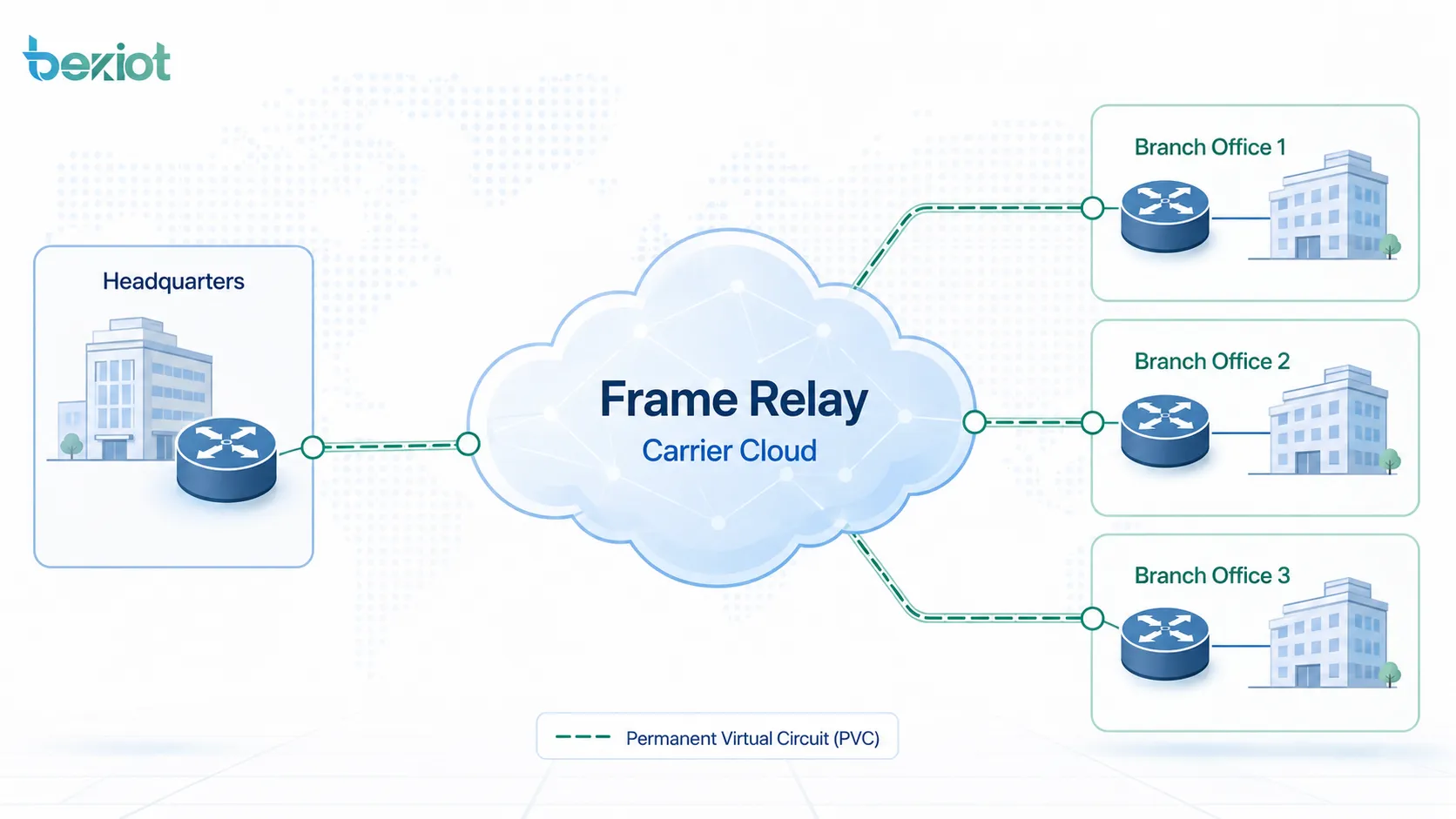
Frame Relay can be understood as a shared carrier WAN service that provides private logical connections between customer routers. A customer router sends frames into the provider network. The provider network switches those frames through the correct virtual circuit and delivers them to the remote site.
The customer usually manages routers, IP addressing, routing protocols, and applications. The carrier manages the Frame Relay cloud and the virtual circuit service inside it. This division made Frame Relay attractive for organizations that needed multi-site connectivity without building a full physical private network.
Frame Relay itself is not an IP routing protocol. It can carry IP traffic, but it provides the Layer 2 transport structure beneath the IP layer.
Frame Relay is best understood as a legacy Layer 2 WAN service that connects remote networks through virtual circuits inside a shared provider infrastructure.
How the WAN Service Carries Data
Virtual Circuits
Frame Relay uses virtual circuits to create logical paths between endpoints. A virtual circuit is not a dedicated cable from one site to another. It is a logical connection provisioned across the provider network.
Permanent Virtual Circuits, or PVCs, were the most common type in enterprise Frame Relay deployments. A PVC remains configured and available even when no traffic is being sent. This made it suitable for branch offices, data centers, and headquarters connections that needed regular communication.
Switched Virtual Circuits, or SVCs, could be established dynamically in some environments, but PVCs were far more common because they were easier to plan, provision, monitor, and troubleshoot.
DLCI Identification
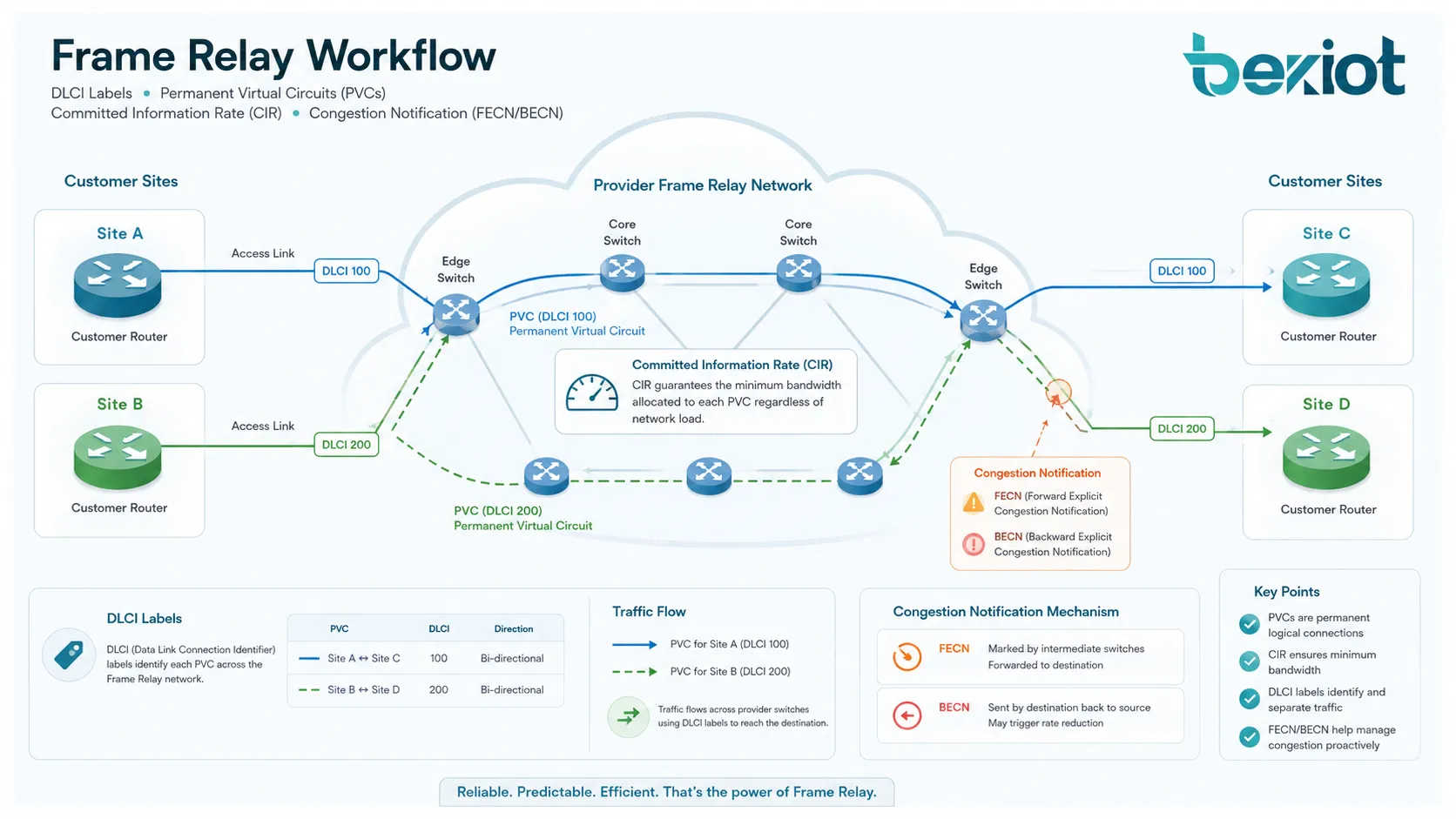
A Data Link Connection Identifier, or DLCI, identifies a virtual circuit on a local Frame Relay interface. When a router sends a frame into the provider network, the DLCI tells the local Frame Relay switch which logical path the frame belongs to.
DLCIs are usually locally significant. This means the same DLCI number may mean different things on different access links. The service provider maps local DLCIs through its internal network so that frames reach the correct remote endpoint.
Correct DLCI mapping is essential. If the DLCI is wrong, traffic may fail even when the physical access circuit is up.
The Provider Cloud
Network diagrams often show Frame Relay as a cloud. The cloud represents the carrier’s switching infrastructure. Customers connect to the cloud through access circuits, while the carrier switches frames internally based on virtual circuit configuration.
This model made it possible for multiple branches to communicate through one service provider infrastructure. A branch could use one physical connection to the provider network while reaching several remote sites through different virtual circuits.
The cloud simplified the physical cabling problem, but it required careful logical design, routing configuration, and provider coordination.
Committed Information Rate
Committed Information Rate, or CIR, is the data rate that the provider commits to support for a virtual circuit under normal conditions. It helped customers and carriers define expected traffic capacity for each logical path.
Frame Relay could allow traffic bursts above the CIR when network resources were available. However, excess traffic could be marked or dropped during congestion. This supported efficient shared network use but required careful planning.
CIR was one of the most important service design values because it affected cost, application performance, and congestion behavior.
Congestion Signals
Frame Relay includes congestion notification mechanisms. FECN, or Forward Explicit Congestion Notification, indicates congestion in the direction that frames are traveling. BECN, or Backward Explicit Congestion Notification, informs the sending side that congestion exists in the opposite direction.
The DE bit, or Discard Eligibility bit, marks frames that may be dropped first during congestion. This helped the provider network manage overload when traffic exceeded committed levels.
These mechanisms were useful in their time, but they were not as application-aware or flexible as modern WAN traffic engineering systems.
Key Characteristics
Layer 2 Transport
Frame Relay works mainly as a Layer 2 transport service. It moves frames between customer routers across a WAN provider network. The customer’s routers usually handle IP routing and application traffic above that layer.
This separation allowed enterprises to run their own routing designs while using the carrier’s Frame Relay network as the underlying transport service.
In most business deployments, Frame Relay carried IP traffic, although the technology itself was not limited to IP.
Logical Connections Instead of Full Physical Mesh
The use of virtual circuits allowed organizations to avoid installing a separate physical circuit between every pair of sites. This was especially valuable for enterprises with many branches.
A company could connect branches to the Frame Relay network and define logical connections to headquarters, data centers, or selected regional sites. This was more flexible than building a large physical leased-line mesh.
The trade-off was that logical design became important. PVC layout, routing behavior, and CIR allocation needed careful planning.
Statistical Multiplexing
Frame Relay used statistical multiplexing, which means provider network capacity could be shared among many customers and virtual circuits based on actual traffic demand. This matched the bursty nature of many business applications.
When many circuits were quiet, available capacity could be used efficiently. When many circuits became busy at the same time, congestion could occur.
This design reduced cost compared with fully dedicated capacity but required traffic monitoring and performance management.
Lower Overhead Than Older Packet Networks
Frame Relay was designed for cleaner digital networks and removed much of the heavy error correction associated with older technologies such as X.25. It generally left retransmission and reliability to higher-layer protocols.
This lower overhead improved efficiency for many data applications and made Frame Relay more suitable for enterprise IP traffic during its peak usage period.
The simplified design was one reason Frame Relay became a popular WAN service in the 1990s and early 2000s.
Common Deployment Patterns
Hub-and-Spoke
Hub-and-spoke was one of the most common Frame Relay topologies. Many branch offices connected to a central headquarters or data center through PVCs. Branch-to-branch traffic often passed through the hub.
This design was cost-effective when most traffic naturally flowed to central systems. It reduced the number of virtual circuits compared with a full mesh.
The disadvantage was dependence on the hub. If the hub router, access circuit, or central capacity was overloaded or unavailable, many branches could be affected.
Full Mesh
A full mesh topology provides direct virtual circuits between all sites. This supports direct branch-to-branch communication without passing traffic through a central hub.
Full mesh can improve performance for distributed communication, but it becomes complex and costly as the number of sites grows. Every new site requires multiple additional PVCs.
This design was usually reserved for smaller networks or environments with strong site-to-site traffic requirements.
Partial Mesh
A partial mesh connects selected sites directly while keeping others connected through a hub. It balances cost, performance, and complexity.
Important regional offices or data centers may have direct PVCs, while smaller branches may use hub-based connectivity. This design was useful when traffic patterns were partly centralized and partly distributed.
Partial mesh planning required a clear understanding of application flows and site importance.
Common Use Cases
Branch Office Connectivity
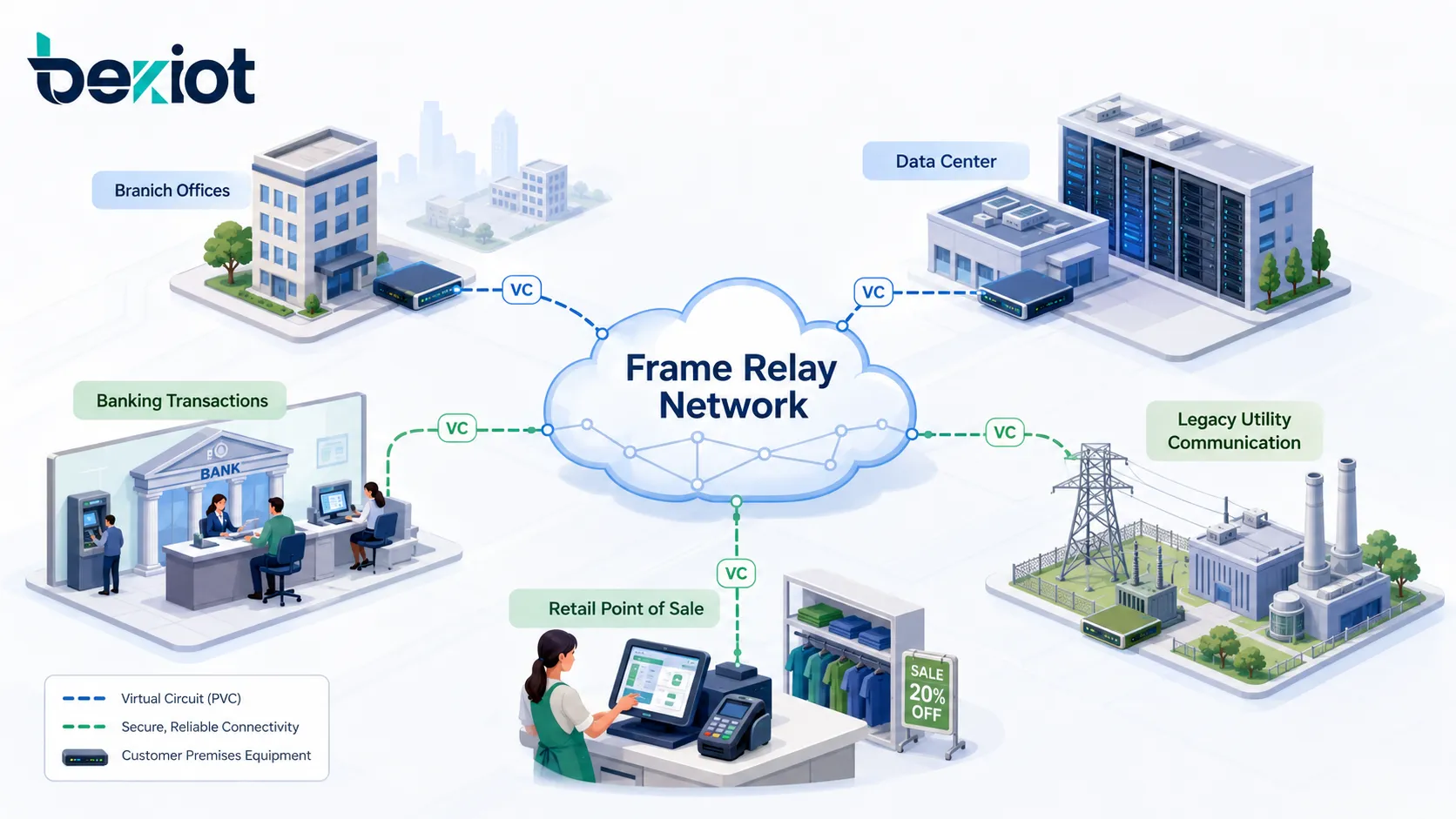
Branch office WAN connectivity was the most common Frame Relay use case. Banks, retail chains, insurance offices, government agencies, and distributed enterprises used Frame Relay to connect many branches to headquarters or central data centers.
Branches could access email, file servers, transaction systems, databases, internal applications, and reporting platforms over the WAN.
Frame Relay was attractive because it reduced the need for many separate leased lines while still providing a managed private WAN service.
LAN Interconnection
Frame Relay was also used to connect local area networks across long distances. Routers at each location connected local users to the Frame Relay WAN, allowing different office LANs to communicate.
This was useful before internet VPNs, MPLS, and cloud networking became common. It gave enterprises a structured way to connect multiple private networks through a carrier service.
LAN interconnection over Frame Relay often required careful IP addressing, routing protocol configuration, and PVC mapping.
Data Center Access
Many organizations used Frame Relay to connect branches to centralized data centers. Older enterprise applications were often hosted at headquarters or in a central computing facility, so branches needed reliable access to those systems.
PVCs allowed remote offices to reach core applications, databases, terminal services, transaction platforms, and file systems.
Data center access required proper CIR planning because many branches could compete for central WAN capacity.
Banking and Transaction Networks
Banks and transaction-based organizations used Frame Relay for branch connectivity, ATM access, payment systems, back-office communication, and financial data exchange.
These environments needed managed connectivity across many locations. Frame Relay provided a practical service model for connecting distributed sites before newer WAN technologies matured.
Reliability, backup circuits, monitoring, and service provider coordination were important in these deployments.
Retail and Point-of-Sale Systems
Retail chains used Frame Relay to connect stores with central systems for sales reporting, inventory updates, credit authorization, pricing data, and operational management.
A hub-and-spoke design was common because stores often needed to communicate mainly with headquarters or a central data center.
Many retail networks later migrated to MPLS, broadband VPN, or SD-WAN, but Frame Relay played an important role in earlier multi-site retail networking.
Legacy Industrial and Utility Networks
Some industrial, transportation, and utility systems used Frame Relay for remote site communication. Substations, monitoring stations, control centers, pipelines, and field offices could be linked through carrier-managed WAN circuits.
Today, these environments may still appear in modernization projects. Engineers may need to understand Frame Relay to replace old routers, migrate circuits, or maintain service continuity during network upgrades.
In such cases, the main task is usually controlled migration rather than new Frame Relay deployment.
Important Terms
PVC
A PVC, or Permanent Virtual Circuit, is a preconfigured logical path between two endpoints in a Frame Relay network. It remains available even when no traffic is flowing.
PVCs were widely used because enterprise sites usually needed stable, predictable connectivity.
DLCI
A DLCI identifies a virtual circuit on a local Frame Relay interface. It tells the router and provider network which logical path a frame should follow.
Because DLCIs are locally significant, documentation is important. The same number can be used differently on different access links.
CIR
CIR stands for Committed Information Rate. It defines the committed traffic rate for a virtual circuit under normal provider service conditions.
Traffic above the CIR may be allowed as burst traffic, but it may be marked or dropped during congestion.
FECN and BECN
FECN and BECN are congestion notification bits. FECN indicates congestion in the forward direction, while BECN informs the sender side about congestion in the reverse direction.
These signals helped routers and networks respond to congestion, although they were limited compared with modern traffic control systems.
DE Bit
The Discard Eligibility bit marks frames that can be dropped first when the network is congested.
Traffic above the committed rate was often more likely to be marked discard eligible.
Advantages in Its Era
Lower Cost Than Full Leased-Line Mesh
Frame Relay reduced the cost of multi-site WAN connectivity by replacing many physical leased lines with virtual circuits over shared provider infrastructure.
This was especially valuable for organizations with many branches and centralized applications.
Flexible Site Expansion
Adding a new branch did not always require building physical connections to every other site. The provider could provision logical PVCs through the Frame Relay network.
This made Frame Relay more scalable than a large leased-line mesh for many enterprise networks.
Efficient Use of Provider Capacity
Statistical multiplexing allowed carriers to share capacity efficiently between customers and virtual circuits. This matched bursty data traffic better than permanently reserving full physical capacity for every connection.
The model helped reduce cost, although congestion management remained important.
Useful Managed WAN Model
Frame Relay gave customers a carrier-managed WAN transport service while allowing them to control routing and applications at their own routers.
This model was practical for organizations that needed private WAN connectivity but did not want to build the underlying provider infrastructure themselves.
Limitations and Modern Relevance
Legacy Status
Frame Relay is rarely selected for new networks today. Most organizations now use MPLS, Ethernet services, IPsec VPN, private fiber, broadband WAN, SD-WAN, or cloud connectivity.
Existing Frame Relay environments are usually legacy systems that must be supported, documented, or migrated.
Limited Fit for Cloud Applications
Frame Relay was designed for an era of centralized enterprise applications, not modern cloud-first architectures. SaaS, real-time collaboration, cloud storage, and internet-based workloads often need more flexible routing and higher bandwidth.
Modern WAN technologies provide better support for cloud breakout, encryption, dynamic path selection, application awareness, and centralized policy.
Routing Complexity
Frame Relay networks can behave as non-broadcast multi-access environments. Routing protocols may require special configuration for neighbors, split horizon, subinterfaces, or broadcast handling.
These details made Frame Relay an important topic in network engineering education and troubleshooting.
Migration Pressure
Many carriers have retired or reduced support for Frame Relay services. Hardware, expertise, and service availability may be limited.
Organizations that still use Frame Relay should plan migration before service retirement or equipment failure creates urgent risk.
Migration Planning
Document Existing Circuits
Migration should begin with full documentation. Engineers should identify sites, access circuits, routers, DLCIs, PVCs, CIR values, IP addressing, routing protocols, applications, and carrier records.
Many old networks contain undocumented paths. Removing a circuit without understanding its role can interrupt business operations.
Analyze Application Dependencies
Old Frame Relay networks may carry transaction systems, terminal sessions, monitoring traffic, control data, or branch applications. These dependencies should be identified before migration.
The replacement network must support required bandwidth, latency, security, addressing, routing, and availability.
Select a Replacement Service
Replacement options may include MPLS, Carrier Ethernet, private line, broadband VPN, IPsec VPN, SD-WAN, cloud interconnect, or hybrid WAN.
The right choice depends on site importance, application needs, budget, carrier availability, security requirements, and cloud strategy.
Test Before Cutover
A phased migration reduces risk. New circuits or tunnels can be tested while the old Frame Relay service remains available. Critical sites should have rollback plans.
Testing should include routing, application access, performance, failover, monitoring, and user validation.
Retire Old Services Carefully
Old circuits should be retired only after monitoring confirms that no important traffic remains. Carrier billing, router configuration, monitoring tools, and documentation should be updated.
Safe retirement prevents unnecessary cost and avoids confusion during future troubleshooting.
Frame Relay is mainly a legacy WAN technology today, but understanding its virtual circuit model is still valuable for migration, troubleshooting, and network education.
Comparison With Other WAN Technologies
Frame Relay and Leased Lines
Leased lines provide dedicated point-to-point connections. Frame Relay provides logical virtual circuits through shared provider infrastructure.
Leased lines are predictable but can become expensive for many sites. Frame Relay reduced the cost and complexity of multi-site WANs.
Frame Relay and X.25
X.25 is older and includes more network-level error correction. Frame Relay is lighter and more efficient because it was designed for cleaner digital links.
Frame Relay became a practical replacement for many X.25 data networking applications.
Frame Relay and MPLS
MPLS became a major successor to Frame Relay in enterprise WANs. It supports IP VPN services, traffic engineering, quality of service, and more scalable provider-managed networks.
Many enterprises migrated Frame Relay circuits to MPLS before later considering SD-WAN or cloud-oriented WAN models.
Frame Relay and SD-WAN
SD-WAN is a modern WAN architecture that can use broadband, MPLS, LTE, 5G, Ethernet, or other links with centralized policies and application-aware routing.
Compared with Frame Relay, SD-WAN is better suited for cloud access, encrypted overlays, dynamic failover, and multi-link optimization.
Conclusion
Frame Relay is a legacy Layer 2 WAN technology that uses virtual circuits to connect remote sites through a carrier-managed network. It helped enterprises build cost-effective multi-site WANs before MPLS, Ethernet VPN, broadband VPN, and SD-WAN became common.
Its key concepts include PVCs, DLCIs, CIR, statistical multiplexing, FECN, BECN, discard eligibility, provider clouds, and hub-and-spoke or mesh topologies. Common use cases included branch office connectivity, LAN interconnection, data center access, banking networks, retail point-of-sale systems, and legacy industrial or utility communication.
Although Frame Relay is no longer a modern first-choice WAN service, it remains relevant for legacy support, migration planning, network troubleshooting, and historical understanding of carrier-based enterprise networking. Organizations that still rely on it should document dependencies and plan a careful migration to newer WAN technologies.
FAQ
What is Frame Relay in simple terms?
Frame Relay is a legacy WAN service that connects remote sites through virtual circuits inside a service provider network.
It allowed organizations to connect branches and data centers without using a dedicated physical line between every location.
What layer does Frame Relay operate at?
Frame Relay operates mainly at Layer 2, the data link layer.
It can carry IP traffic, but it is not an IP routing protocol itself.
What is a DLCI?
A DLCI, or Data Link Connection Identifier, identifies a virtual circuit on a local Frame Relay interface.
It helps the router and provider network know which logical path a frame should use.
What is a PVC?
A PVC, or Permanent Virtual Circuit, is a preconfigured logical connection between two endpoints in a Frame Relay network.
PVCs were commonly used for branch, headquarters, and data center connectivity.
What was Frame Relay used for?
Frame Relay was used for branch office WANs, LAN interconnection, data center access, banking networks, retail point-of-sale systems, and legacy industrial or utility networks.
It was especially useful before MPLS, internet VPN, and SD-WAN became common.
Is Frame Relay still used today?
Frame Relay is now mostly a legacy technology. New deployments are rare.
It may still appear in old enterprise networks, telecom migration projects, training labs, and legacy infrastructure environments.
What replaced Frame Relay?
Frame Relay was commonly replaced by MPLS, Carrier Ethernet, IPsec VPN, broadband WAN, private fiber, and later SD-WAN.
The right replacement depends on application needs, budget, security requirements, carrier availability, and cloud strategy.







