In professional audio systems, a clean signal is not only about the microphone, speaker, mixer, or amplifier. It also depends on how the signal travels through the cable.
Balanced audio is an audio signal transmission method designed to reduce noise, hum, and electromagnetic interference, especially when audio cables run over long distances or pass through electrically noisy environments. It is widely used in recording studios, live sound systems, broadcast facilities, conference rooms, public address systems, theaters, houses of worship, commercial AV installations, and professional intercom or communication systems.
The Basic Idea Behind Balanced Signal Transmission
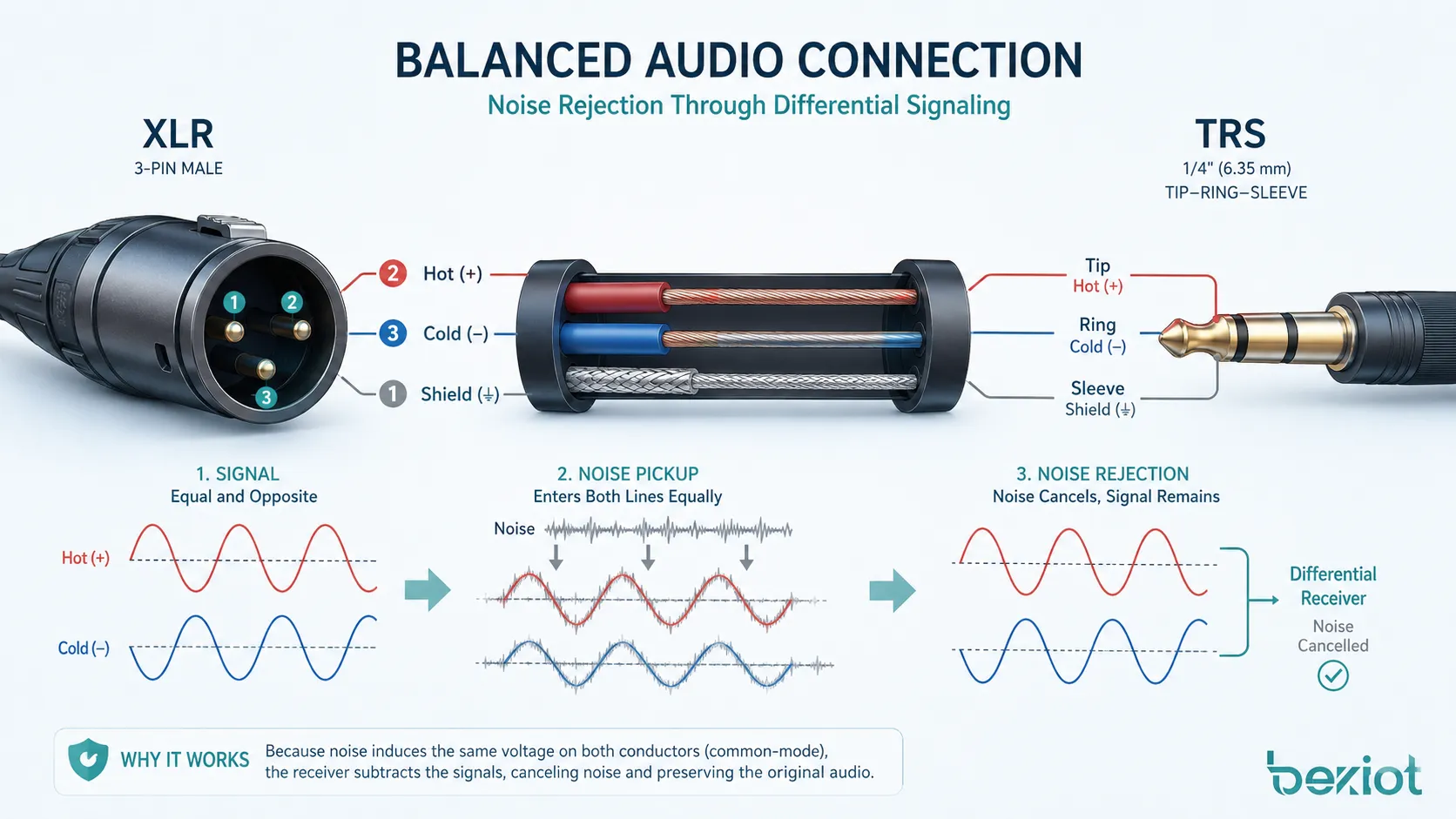
A balanced audio connection normally uses three conductors: a positive signal line, a negative signal line, and a shield or ground. The two signal lines carry the same audio information, but one line carries it in opposite polarity. At the receiving end, the balanced input compares the two lines and reconstructs the original audio signal.
The key advantage is that noise picked up along the cable tends to appear equally on both signal lines. Because the receiving circuit responds to the difference between the two signal conductors, much of the common noise can be rejected. This is the reason balanced audio is especially valuable in professional systems where long cable runs and electrical interference are common.
Positive, Negative, and Shield Conductors
In a typical balanced cable, the positive conductor is often called hot, the negative conductor is often called cold, and the shield provides grounding and protection against interference. In XLR wiring, pin 2 is commonly hot, pin 3 is cold, and pin 1 is shield or ground. In balanced TRS wiring, the tip is hot, the ring is cold, and the sleeve is shield.
The shield is not intended to carry the main audio signal in the same way as the two balanced signal conductors. Its job is mainly to protect the signal pair from external interference and provide a reference path where required by the equipment design. Good shielding and proper grounding are both important for stable audio performance.
How Noise Cancellation Works
The noise-reduction principle of balanced audio is based on differential signal transmission. When a balanced cable passes near power cables, lighting dimmers, motors, radio-frequency sources, or other electrical equipment, interference may be induced into the cable. Ideally, this interference appears almost equally on both signal conductors.
At the receiving end, the balanced input amplifies the difference between the hot and cold lines. Since the wanted audio signal is opposite in polarity on the two lines, it is preserved. Since the unwanted noise is similar on both lines, it is largely cancelled out. This process is commonly described as common-mode rejection.
Common-Mode Rejection
Common-mode rejection is the ability of a balanced input to reject signals that are common to both conductors. The stronger this rejection, the better the system can reduce hum, buzz, and electromagnetic interference. Professional audio equipment often lists this performance as common-mode rejection ratio, or CMRR.
CMRR is not only determined by the cable. It also depends on the quality of the input circuit, connector wiring, cable balance, grounding method, and the electrical environment. A poor input design or badly wired connector can reduce the benefit of a balanced connection even if the cable itself is high quality.
Why Cable Length Matters
Short audio cables may work acceptably even when they are unbalanced, especially in simple desktop or consumer setups. However, long cable runs are much more likely to pick up interference. A microphone cable running across a stage, a line-level cable routed through a rack, or an audio connection passing through a building can all be exposed to noise sources.
Balanced audio is preferred in these situations because it is designed for cleaner transmission over distance. This does not mean balanced cables are unlimited in length, but they are far more suitable for professional installations than standard unbalanced connections.
Main Features of Balanced Audio
Balanced audio is not just a cable type. It is a complete signal interface that involves the output circuit, cable, connector, and input circuit. To get the full benefit, the source device and receiving device should both support balanced operation.
Three-Conductor Connection
The most recognizable feature of balanced audio is the use of three conductors. This may appear as a 3-pin XLR connector, a 1/4-inch TRS connector, a terminal block, or other professional audio connector formats. The physical connector alone does not always guarantee balanced operation, so equipment specifications should always be checked.
For example, a TRS connector can be used for balanced mono audio, but it can also be used for unbalanced stereo headphones. An XLR connector is commonly balanced, but some equipment may use XLR connectors for other signal types. Correct wiring and device compatibility matter.
Strong Resistance to Interference
Balanced audio is designed to reduce hum, buzz, radio-frequency interference, and noise caused by electromagnetic fields. This is especially important in venues and facilities with lighting systems, power distribution equipment, elevators, HVAC equipment, motors, projectors, LED displays, wireless systems, or high-density AV racks.
In real installations, balanced audio can help maintain speech clarity, music quality, and system reliability. It is one of the reasons professional microphones, mixers, audio interfaces, DSP processors, amplifiers, and stage boxes usually provide balanced inputs and outputs.
Compatibility with Professional Equipment
Professional audio systems are commonly built around balanced connections. Microphones, mixing consoles, preamps, audio interfaces, broadcast consoles, digital signal processors, powered speakers, and professional amplifiers often support balanced audio to keep signal quality stable across complex systems.
This makes balanced audio a practical standard for environments where multiple devices from different brands must work together. When the signal chain is correctly matched, balanced interfaces help reduce troubleshooting time and improve long-term system performance.
Common Connector Types
Balanced audio can be carried through several connector formats. The most common are XLR and TRS, but fixed installations may also use screw terminals, Euroblock connectors, D-sub connectors, or RJ45-based audio transport systems depending on the system design.
| Connector Type | Typical Use | Balanced Audio Notes |
|---|---|---|
| XLR | Microphones, mixers, stage boxes, powered speakers | Common professional connector for balanced mono audio |
| TRS | Audio interfaces, mixers, patch bays, studio equipment | Can carry balanced mono audio when wired as tip-ring-sleeve |
| Terminal Block | Commercial AV, DSP, paging, installed sound systems | Often used for fixed balanced line-level wiring |
| DB25 or Multipin | Studios, broadcast racks, multichannel audio systems | Can carry multiple balanced channels in one connector assembly |
XLR Connections
XLR connectors are widely used for microphones and professional line-level connections. They are mechanically secure, durable, and suitable for stage and field use. A standard 3-pin XLR balanced connection carries hot, cold, and shield conductors.
Because XLR is common in microphones, it is also associated with phantom power. Phantom power can be sent through balanced microphone lines to power condenser microphones or active DI boxes. However, phantom power should only be used with equipment designed to accept it.
TRS Connections
A 1/4-inch TRS connector can carry balanced mono audio when used between compatible devices. It has three contact points: tip, ring, and sleeve. In balanced wiring, the tip carries the hot signal, the ring carries the cold signal, and the sleeve is shield or ground.
TRS can also be used for stereo headphone outputs, insert cables, or other signal arrangements. This creates confusion for some users. The connector shape alone does not define the signal format; the equipment manual and wiring purpose should always be checked.
Balanced Audio vs Unbalanced Audio
Unbalanced audio usually uses two conductors: one signal conductor and one ground or shield. This type of connection is common in consumer audio devices, guitars, keyboards, home stereo systems, RCA cables, and many short cable runs. It is simple and low-cost, but it is more vulnerable to noise over distance.
Balanced audio uses two signal conductors plus a shield, which allows noise rejection at the receiving end. This makes it more suitable for professional, commercial, and mission-critical audio environments where signal quality must remain stable.
| Item | Balanced Audio | Unbalanced Audio |
|---|---|---|
| Conductors | Hot, cold, and shield | Signal and ground or shield |
| Noise rejection | Strong common-mode noise rejection | More vulnerable to hum and interference |
| Typical distance | Suitable for longer cable runs | Best for short cable runs |
| Common connectors | XLR, TRS, terminal block | RCA, TS, 3.5 mm, some instrument cables |
| Common use | Professional audio, broadcast, live sound, installed AV | Consumer audio, instruments, short desktop connections |
Balanced Does Not Mean Stereo
A common misunderstanding is that balanced audio means stereo audio. In most professional audio systems, a balanced connection usually carries one mono audio channel. The two signal conductors are not left and right channels; they are opposite-polarity versions of the same audio signal.
Stereo balanced audio normally requires two balanced channels, such as left balanced and right balanced. Each channel needs its own hot, cold, and shield conductors. This is why professional stereo systems often use two XLR cables or two TRS balanced connections.
When Unbalanced Audio Is Still Acceptable
Unbalanced audio is not automatically bad. It can work well for short connections, consumer audio devices, guitar signals, home systems, and simple setups where interference is not a major issue. Many devices are designed around unbalanced inputs and outputs, and they can perform well when installed correctly.
The problem appears when unbalanced cables become too long or run through noisy environments. In these cases, hum, buzz, or signal degradation may become noticeable. Balanced audio is the preferred solution when cable length, noise control, and professional reliability are important.
Benefits in Real Audio Systems
The benefits of balanced audio become clear in systems where audio must remain clean, stable, and intelligible. It is especially important for speech reinforcement, music production, live performance, broadcast transmission, conferencing, and installed sound systems.
Cleaner Sound Over Long Runs
Balanced audio helps preserve sound quality across longer cable runs by reducing the effect of external interference. This is useful when microphones are far from mixers, equipment racks are separated from control rooms, or audio lines must travel through walls, ceilings, stages, or technical rooms.
Cleaner signal transmission means less background hum, fewer noise problems, and better overall system performance. In speech applications, this can improve intelligibility. In music applications, it can help preserve detail and dynamic range.
Better Reliability in Complex Installations
Commercial and professional AV systems often include many devices connected together. Mixers, DSP processors, amplifiers, wireless receivers, paging controllers, conference systems, and recording equipment may all share the same technical environment. Balanced audio helps reduce the risk that one cable run will become a noise problem.
This reliability is valuable for permanent installations where service access may be limited after construction. Correctly designed balanced wiring can reduce future troubleshooting and support stable operation over time.
Improved Compatibility with Professional Workflows
Professional workflows are often built around balanced signal paths. Microphones feed balanced preamps, mixers send balanced outputs, processors receive balanced line-level signals, and amplifiers accept balanced inputs. Using balanced audio throughout the chain helps maintain a consistent technical standard.
This also makes system expansion easier. When new equipment is added, balanced interfaces are more likely to integrate smoothly with existing professional audio infrastructure.
Where It Is Commonly Used
Balanced audio appears in many industries because the need for reliable sound transmission is not limited to music production. Any environment that requires clear audio over distance can benefit from balanced signal design.
Recording Studios and Music Production
Recording studios use balanced audio for microphones, preamps, audio interfaces, patch bays, monitor controllers, outboard processors, and studio monitors. Because studios require low noise and accurate sound capture, balanced connections are essential in most professional signal chains.
In recording, even small amounts of noise can become noticeable during mixing and mastering. Balanced wiring helps protect the signal before it reaches the recorder, digital audio workstation, or processing equipment.
Live Sound and Performance Venues
Live sound systems rely heavily on balanced audio because stages often have long cable runs, high-power lighting, amplifiers, wireless systems, LED screens, and many other potential noise sources. Microphone lines, snake cables, stage boxes, and mixer inputs are typically balanced.
Balanced audio helps maintain stable signal quality during concerts, conferences, theater shows, worship services, and public events. It also allows technicians to build larger systems without being limited by short cable distances.
Broadcast, Conference, and Installed AV
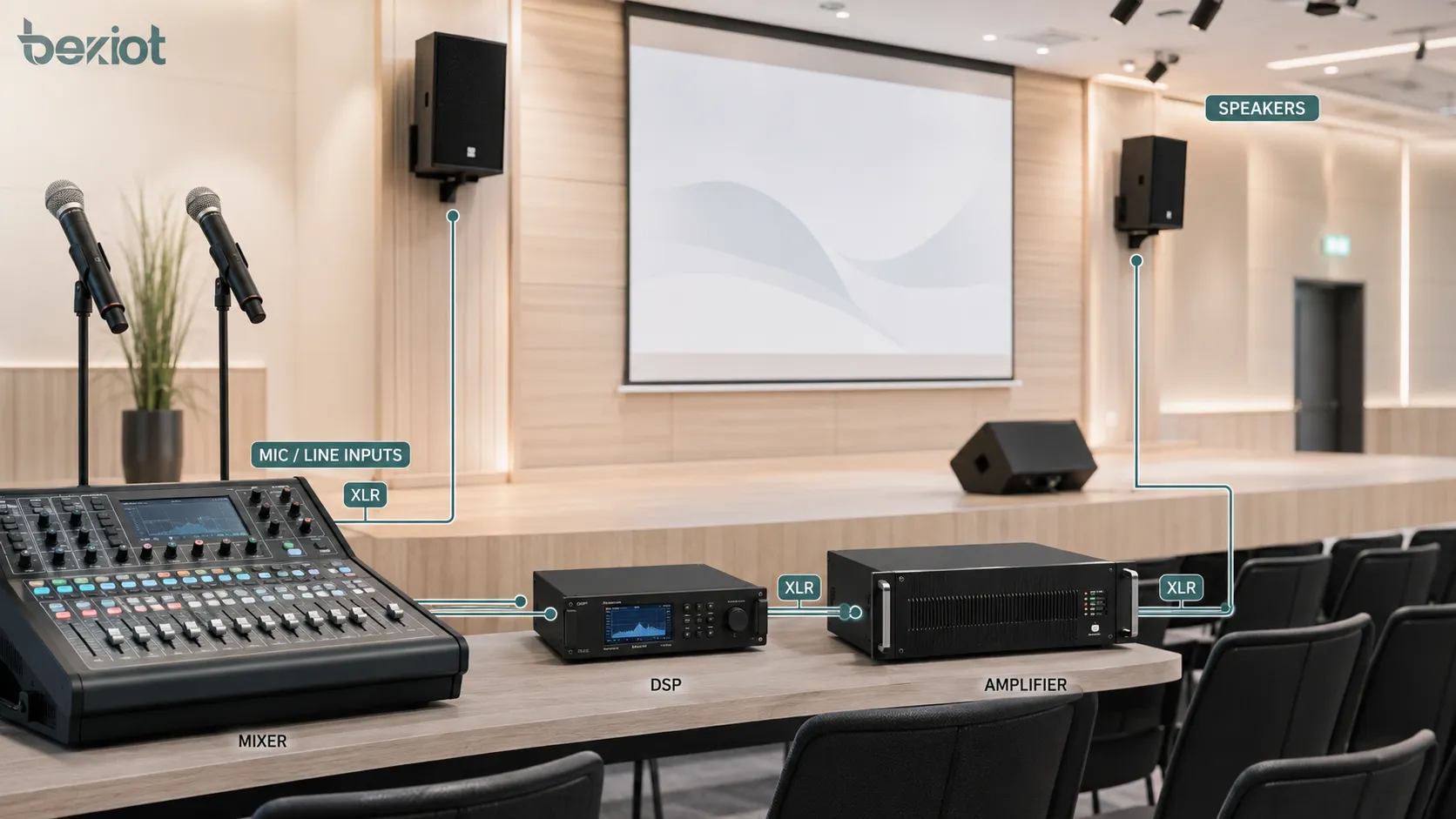
Broadcast studios, meeting rooms, courtrooms, classrooms, control centers, and corporate AV spaces commonly use balanced audio for microphones, DSP systems, mixers, recorders, and amplifiers. Clear speech transmission is especially important in these environments.
In installed AV, balanced audio is often routed through conduits, racks, wall plates, and ceiling spaces. Proper cable selection and termination help the system remain quiet and serviceable after installation.
Public Address and Commercial Sound
Public address systems, background music systems, paging systems, transportation facilities, shopping centers, schools, hospitals, and industrial sites may use balanced line-level audio between controllers, mixers, processors, and amplifiers.
Although loudspeaker distribution may use a different format such as low-impedance or constant-voltage speaker lines, balanced audio is still valuable in the front-end signal path where clean source transmission is required.
Important Installation Notes
Balanced audio works best when the entire connection is designed correctly. A balanced cable connected to an unbalanced output may not provide full noise rejection. A balanced output connected to a poorly wired input may also create noise, level loss, or grounding problems.
Use the Correct Cable Type
Balanced microphone and line-level cables should use a twisted pair with shielding. The twisted pair helps both signal conductors pick up interference equally, while the shield helps reduce external noise. Cable quality matters, especially in long runs or demanding environments.
Using random cable types can reduce the benefit of balanced audio. For permanent installation, cable selection should match the environment, fire rating, flexibility requirement, shielding requirement, and connector or terminal method.
Avoid Grounding Mistakes
Improper grounding can cause hum, buzz, or ground-loop problems. Balanced audio reduces many noise issues, but it does not make grounding irrelevant. The shield should be connected according to the equipment manufacturer’s recommendations and good professional audio practice.
In complex systems, isolating transformers, proper rack grounding, star grounding methods, or differential input design may be used to solve difficult noise problems. Randomly lifting grounds without understanding the system can create safety and reliability risks.
Match Signal Levels Correctly
Balanced connections may carry microphone-level signals or line-level signals. A microphone-level signal is much weaker and usually requires a preamp. A line-level signal is stronger and is used between mixers, processors, and amplifiers.
Connecting the wrong signal level may cause weak audio, distortion, clipping, or noise. Before installation, confirm whether the equipment uses mic level, line level, consumer level, professional level, analog audio, AES digital audio, or another signal format.
Typical Problems and How to Avoid Them
Many balanced audio problems are caused by incorrect assumptions. A cable may have the right connector but the wrong wiring. A device may have a TRS connector but not a balanced output. A system may use balanced connections but still suffer from noise because of grounding or installation mistakes.
Connector Confusion
TRS, TS, XLR, RCA, and terminal block connectors can look simple, but they serve different purposes. A TRS cable is not always balanced, and an XLR connector is not always used for analog audio. Installers should confirm the signal type instead of relying only on connector appearance.
This is especially important in mixed systems where consumer devices, professional devices, laptops, instruments, mixers, amplifiers, and DSP units are connected together. Adapters may be needed, but they should be selected carefully to avoid signal loss or noise.
Unbalanced-to-Balanced Connections
Sometimes an unbalanced device must connect to a balanced input. This can work, but the wiring method matters. A direct adapter may be enough for short runs, while longer runs may require a DI box, transformer isolator, or active balancing device.
For example, connecting a laptop or media player to a professional mixer often works better through a DI box or interface designed to convert unbalanced consumer audio into a balanced signal. This reduces hum and improves system reliability.
Incorrect Shield Termination
Shield termination can affect noise performance. In many standard cables, the shield is connected at both ends. In some fixed installations, special grounding strategies may be used to reduce ground-loop noise. The right approach depends on the equipment design and site conditions.
Random shield disconnection can create new problems. If hum or buzz appears, it is better to troubleshoot the full signal path, power distribution, grounding, cable route, and equipment compatibility instead of changing wiring without a clear reason.
How to Choose Between Balanced and Unbalanced
The choice depends on cable length, equipment type, noise environment, signal level, and performance requirements. For professional audio, balanced should usually be the default choice when the equipment supports it. For simple consumer systems with short cables, unbalanced may be acceptable.
Choose Balanced for Professional or Long-Distance Runs
Balanced audio is the better choice for microphone cables, stage systems, rack-to-rack audio, conference rooms, installed AV, broadcast systems, public address equipment, and any connection that may pass near electrical noise sources.
It is also the safer choice when the system may expand in the future. A balanced infrastructure gives integrators more flexibility and reduces the chance of noise problems when equipment locations change.
Use Unbalanced Only Where It Fits
Unbalanced audio is still useful for short connections between consumer devices, instruments, media players, small mixers, and desktop equipment. It is simple and widely supported. The key is to keep cable runs short and avoid routing them near power supplies, lighting dimmers, motors, or high-current cables.
When an unbalanced source must feed a professional balanced system, conversion equipment should be considered. DI boxes, audio interfaces, isolation transformers, or proper line converters can make the signal chain cleaner and more dependable.
FAQ
What does balanced audio mean?
Balanced audio is a method of sending audio through two opposite-polarity signal conductors plus a shield. The receiving device compares the two signal lines and rejects noise that appears equally on both, helping maintain a cleaner audio signal.
Is balanced audio better than unbalanced audio?
Balanced audio is usually better for long cable runs, professional equipment, and noisy electrical environments because it provides stronger noise rejection. Unbalanced audio can still work well for short consumer or instrument connections where interference is not a major problem.
Does balanced audio mean stereo?
No. A balanced audio connection usually carries one mono channel. The hot and cold lines are not left and right audio channels. Stereo balanced audio requires two separate balanced channels, one for left and one for right.
What connectors are used for balanced audio?
The most common balanced audio connectors are XLR and TRS. Fixed commercial AV systems may also use terminal blocks or multipin connectors. The connector alone does not guarantee balanced operation, so the equipment specifications should be checked.
Can I connect an unbalanced output to a balanced input?
Yes, but the correct wiring or conversion method is important. For short runs, an adapter may work. For longer runs or professional systems, a DI box, transformer isolator, or active converter is often a better choice to reduce noise and level problems.
Why does balanced audio reduce noise?
Balanced audio reduces noise because interference is usually picked up equally by both signal conductors. The receiving input rejects the common noise and keeps the difference between the two conductors, which contains the original audio signal.