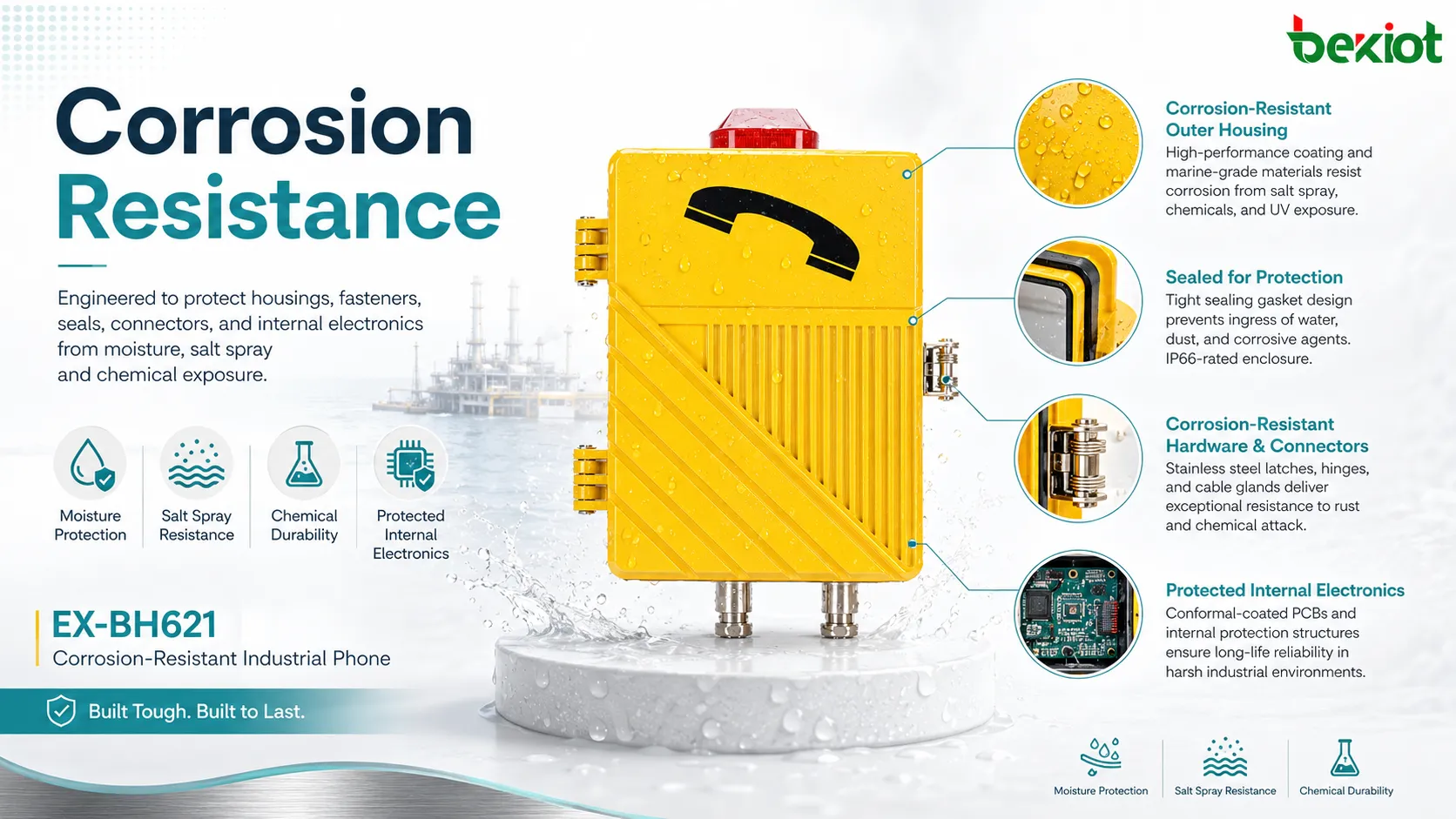
Corrosion resistance is the ability of a material, coating, enclosure, component, or finished product to withstand chemical or electrochemical damage caused by moisture, salt, acids, alkalis, industrial gases, cleaning agents, temperature changes, and harsh outdoor conditions. It is a key performance requirement for equipment used in marine, chemical, oil and gas, mining, transportation, energy, food processing, wastewater, coastal, and industrial environments.
For many products, corrosion is not only an appearance problem. It can weaken structures, damage seals, increase electrical resistance, affect grounding, block buttons, degrade connectors, reduce enclosure strength, and shorten equipment life. A corrosion-resistant design protects both the external housing and the internal functional system, helping equipment remain safe, reliable, and maintainable over long service periods.
Why Harsh Environments Damage Equipment
Corrosion occurs when materials react with their environment. Metals may oxidize, coatings may break down, and surface protection may fail after long exposure to water, salt, chemicals, or pollutants. In electrical and communication equipment, corrosion may also appear on terminals, screws, circuit contacts, cable entries, hinges, and grounding points.
Outdoor environments accelerate this process because equipment is exposed to rain, humidity, ultraviolet radiation, dust, wind-driven salt, freeze-thaw cycles, and temperature changes. Industrial environments add more stress through chemical vapors, oil mist, alkaline cleaning fluids, acidic gases, metal dust, and process contaminants.
The challenge is that corrosion rarely happens evenly. It often begins at weak points: scratches, unsealed joints, bolt holes, weld seams, cable glands, paint edges, dissimilar metal contact points, or areas where moisture can stay trapped. Good corrosion-resistant design must therefore consider the whole product, not just the main shell material.
Materials That Improve Long-Term Protection
Stainless Steel
Stainless steel is widely used because it forms a passive oxide layer that helps protect the surface from further corrosion. Common grades such as 304 stainless steel are suitable for many indoor and general outdoor applications, while 316 stainless steel provides better resistance in marine, coastal, chemical, and chloride-rich environments.
However, stainless steel is not completely immune to corrosion. In areas with salt deposits, acidic chemicals, poor drainage, or surface contamination, pitting and crevice corrosion may still occur. Proper grade selection, surface finishing, cleaning, and drainage design remain important.
Aluminum Alloys
Aluminum is lightweight and naturally forms a protective oxide layer. It is often used for equipment housings, outdoor enclosures, communication terminals, and industrial components where weight reduction matters.
Aluminum can be further protected through anodizing, powder coating, painting, or chemical conversion coating. In marine or chemical environments, coating quality and fastener compatibility should be reviewed carefully because galvanic corrosion can occur when aluminum contacts dissimilar metals in the presence of moisture.
Engineering Plastics
Engineering plastics such as ABS, polycarbonate, glass-fiber-reinforced polyester, nylon, and other industrial polymers are often used where non-metallic corrosion resistance is valuable. They do not rust like steel and can resist many water-based and chemical exposures.
Plastic materials must still be selected carefully. UV resistance, impact strength, flame retardancy, temperature stability, chemical compatibility, and aging performance vary by formulation. A plastic enclosure used outdoors should not be selected only because it avoids rust; it must also withstand sunlight, heat, cold, and mechanical stress.
Coated Carbon Steel
Carbon steel is strong and cost-effective, but it needs surface protection in corrosive environments. Protective methods may include galvanizing, epoxy coating, powder coating, polyurethane paint, zinc-rich primers, or multi-layer coating systems.
Coated steel can perform well when the coating remains intact. The risk appears when scratches, chips, edges, or mounting holes expose the base metal. For equipment exposed to frequent impact or chemical washdown, coating repair and inspection should be part of maintenance planning.
Copper Alloys and Brass
Copper alloys and brass may be used in connectors, terminals, fittings, grounding parts, and mechanical components. They offer good electrical conductivity and can resist certain environments better than plain steel.
In harsh atmospheres, copper alloys may develop surface tarnish or corrosion products. For electrical contact areas, plating, sealing, and suitable connector design are important to prevent signal degradation or increased resistance.
Material selection should begin with the real exposure environment: salt, humidity, chemicals, temperature, UV, cleaning methods, impact risk, and expected service life.
Surface Treatments and Protective Coatings
Materials provide the foundation, but coatings often determine how long a product can survive in the field. A high-quality coating system can protect metal from moisture and chemical contact, improve appearance, increase abrasion resistance, and reduce maintenance needs.
Powder coating is common for industrial housings because it creates a durable and uniform finish. Epoxy coatings offer strong chemical and corrosion protection, while polyurethane topcoats may provide better UV resistance. Anodizing improves aluminum surface hardness and corrosion resistance. Hot-dip galvanizing protects steel through a zinc layer that provides sacrificial protection.
The coating process matters as much as the coating type. Surface preparation, cleaning, blasting, pretreatment, coating thickness, curing temperature, edge coverage, and quality inspection all influence performance. A poorly prepared surface may fail early even if the coating material itself is high quality.
Protection Ratings and What They Really Indicate
IP Ratings
Ingress Protection ratings, such as IP65, IP66, IP67, and IP68, describe resistance to dust and water entry. These ratings are important because moisture intrusion often accelerates corrosion inside the product. A sealed enclosure helps protect circuit boards, terminals, microphones, speakers, relays, and connectors.
However, an IP rating does not automatically prove chemical corrosion resistance. A device may resist water jets but still be vulnerable to salt spray, acidic vapor, or alkaline cleaning fluid. IP ratings should be considered together with material selection and corrosion testing.
NEMA Enclosure Types
NEMA enclosure types are commonly used in North America to describe environmental protection for electrical enclosures. Some NEMA types address outdoor exposure, rain, dust, hose-directed water, and corrosion protection.
For industrial users, NEMA ratings can help identify enclosure suitability, but they should still be matched with the exact environment. A washdown food processing area, a coastal pumping station, and a petrochemical plant may all need different material and sealing strategies.
IK Impact Ratings
IK ratings describe resistance to mechanical impact. While IK is not a corrosion rating, impact resistance affects corrosion performance indirectly. If an enclosure is easily dented, cracked, or chipped, protective coatings and seals may be damaged, allowing moisture or chemicals to reach vulnerable areas.
For public, industrial, railway, mining, and outdoor equipment, impact resistance and corrosion protection should often be evaluated together.
Explosion-Proof and Hazardous Area Protection
In hazardous environments, equipment may also need explosion-proof or flameproof construction. Corrosion resistance becomes especially important because enclosure integrity, threaded joints, fasteners, cable entries, and sealing surfaces must remain reliable over time.
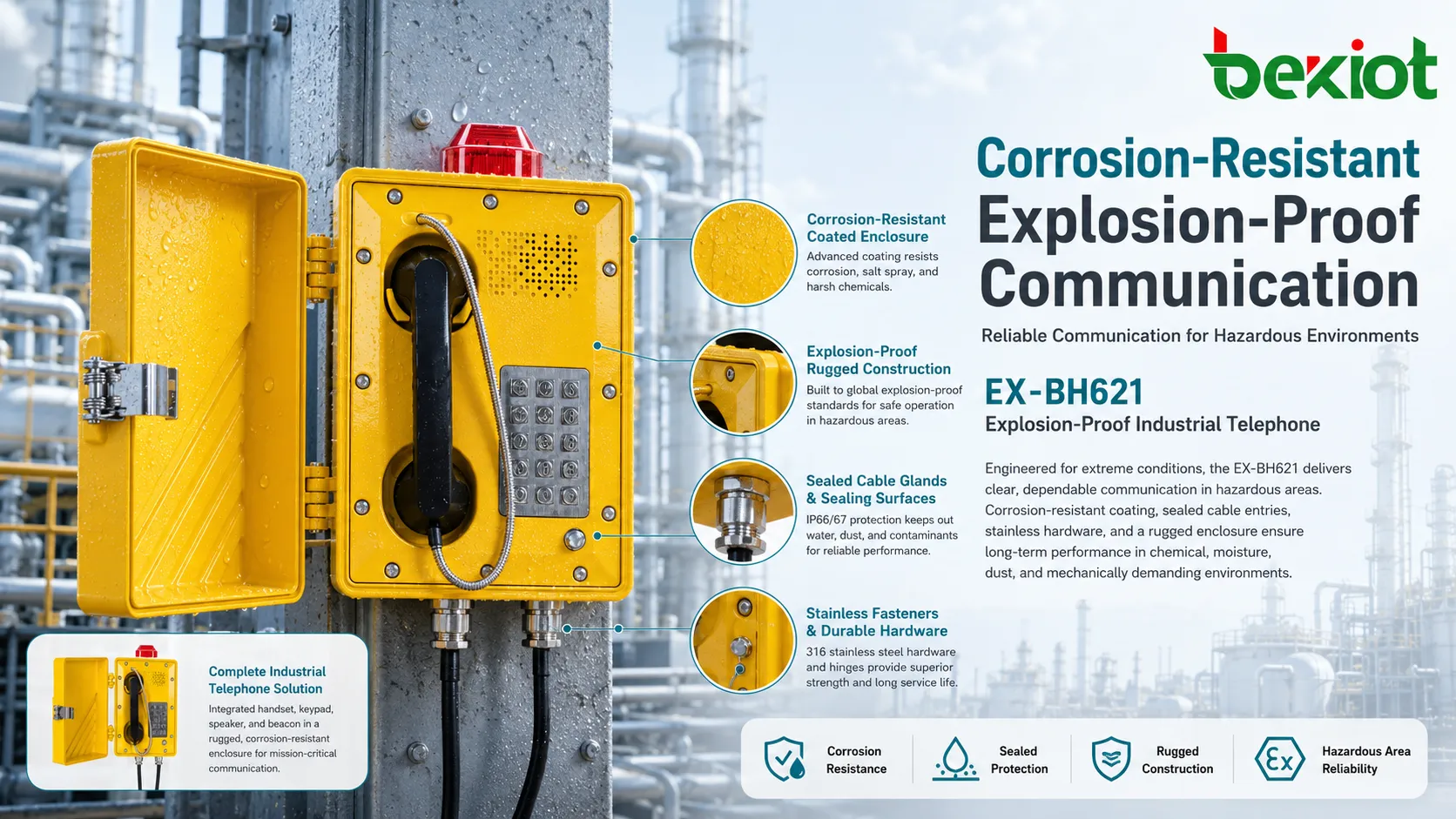
For example, a product such as the Becke Telcom EX-BH621 explosion-proof telephone may be considered in industrial communication environments where rugged enclosure design, hazardous-area suitability, and resistance to harsh site conditions are important for reliable field communication. The practical value is not only the phone function, but the ability to keep communication available where moisture, dust, chemicals, and mechanical stress may exist together.
Testing Standards Used for Evaluation
Corrosion performance is often evaluated through laboratory tests and environmental simulation. These tests help compare materials, coatings, and enclosure designs under controlled conditions. Common references may include salt spray testing, cyclic corrosion testing, humidity testing, chemical exposure testing, coating adhesion testing, and accelerated aging methods.
Salt spray testing is frequently used to evaluate coating and metal resistance in chloride-rich conditions. Cyclic corrosion tests may be more realistic because they include changing wet and dry periods. Humidity tests evaluate long-term moisture exposure. Chemical resistance tests check whether a material or coating can withstand specific acids, alkalis, solvents, oils, or cleaning agents.
Testing results should be interpreted carefully. A high number of laboratory test hours does not always translate directly into exact field service years. Real environments include sunlight, dirt, vibration, installation damage, mixed chemicals, temperature cycling, maintenance practices, and human handling. Standards are useful for comparison, but site conditions still matter.
Material and Function Selection Guide
| Environment | Recommended Material or Protection | Functional Focus |
|---|---|---|
| Coastal and Marine Areas | 316 stainless steel, marine-grade aluminum coating, sealed cable entries, corrosion-resistant fasteners. | Salt spray resistance, moisture sealing, long-term outdoor durability. |
| Chemical Plants | Stainless steel, epoxy coating, chemical-resistant plastics, protected gaskets, compatible cable glands. | Resistance to vapor, acid, alkali, solvents, and cleaning chemicals. |
| Food and Beverage Sites | Stainless steel, smooth surfaces, washdown-rated seals, hygienic design, corrosion-resistant hardware. | Washdown protection, easy cleaning, reduced contamination points. |
| Mining and Heavy Industry | Coated metal housing, rugged polymer, impact-resistant design, dust-proof seals, protected connectors. | Impact durability, dust control, vibration resistance, field maintainability. |
| Outdoor Public Infrastructure | UV-resistant coating, weatherproof housing, stainless fasteners, anti-vandal design, sealed joints. | Rain, sunlight, pollution, public use, and long maintenance intervals. |
Functional Design Beyond the Outer Housing
Seals and Gaskets
Seals and gaskets prevent water, dust, and chemical particles from entering the enclosure. Their material must match the environment. Rubber, silicone, EPDM, fluorocarbon, and other elastomers have different resistance to heat, oil, ozone, chemicals, and aging.
A good housing can still fail if the gasket cracks, compresses permanently, absorbs chemicals, or is installed incorrectly. Gasket design should consider compression, replacement, surface finish, and long-term elasticity.
Fasteners and Hinges
Screws, bolts, hinges, brackets, and mounting plates are common corrosion points. If fasteners corrode, the product may become hard to open, difficult to service, or structurally weak. Rust stains can also spread across coated surfaces and create maintenance concerns.
Stainless steel fasteners, coated hardware, anti-seize compounds, compatible metals, and protected hinge designs can improve long-term durability. Dissimilar metal contact should be reviewed to reduce galvanic corrosion risk.
Cable Entries and Connectors
Cable glands, connectors, ports, and terminals are critical because they create openings in the enclosure. If these areas are not sealed properly, moisture can enter and damage the internal electronics.
For outdoor and industrial devices, cable entries should match the enclosure rating and installation environment. Corrosion-resistant glands, proper torque, suitable sealing rings, drip loops, and strain relief all help protect the system.
Drainage and Mounting Orientation
Water trapped on surfaces can accelerate corrosion. Enclosure shape, mounting angle, drainage paths, and surface geometry should prevent water accumulation where possible.
Even corrosion-resistant materials perform better when water and chemical deposits do not remain on the surface for long periods. Installation orientation should follow the manufacturer’s recommendations.
Where Durable Materials Add the Most Value
Petrochemical and Hazardous Areas
Petrochemical sites may expose equipment to moisture, hydrocarbons, salt air, chemical vapor, explosive atmospheres, and temperature variation. Equipment in these areas needs more than basic weather protection. Enclosure integrity, cable entry sealing, corrosion-resistant fasteners, and hazardous-area compatibility may all be required.
Communication devices, alarm stations, control boxes, sensors, and emergency terminals in such environments should be selected with both safety and maintainability in mind.
Marine, Port, and Offshore Facilities
Marine environments are among the most demanding because salt, humidity, wind, and sunlight work together. Corrosion can appear quickly on unprotected metal surfaces, especially at fasteners, exposed edges, and connector points.
For port and offshore communication equipment, 316 stainless steel, marine-grade coating, sealed connectors, and regular washdown maintenance may be necessary to preserve performance.
Transportation Infrastructure
Railways, tunnels, highways, airports, and metro systems expose equipment to vibration, outdoor weather, exhaust pollutants, deicing salts, cleaning chemicals, and public use. Corrosion-resistant equipment helps reduce service interruptions and maintenance visits.
Emergency phones, intercoms, cameras, speakers, cabinets, and control panels should be selected based on both environmental and mechanical stress.
Water Treatment and Wastewater Plants
Water and wastewater facilities may contain high humidity, chlorine compounds, hydrogen sulfide, cleaning chemicals, and corrosive gases. These conditions can attack metals, seals, and electrical terminals.
Materials should be selected based on the specific chemical environment. Stainless steel, coated enclosures, polymer housings, and sealed connectors are often used to extend service life.
Food Processing and Clean Areas
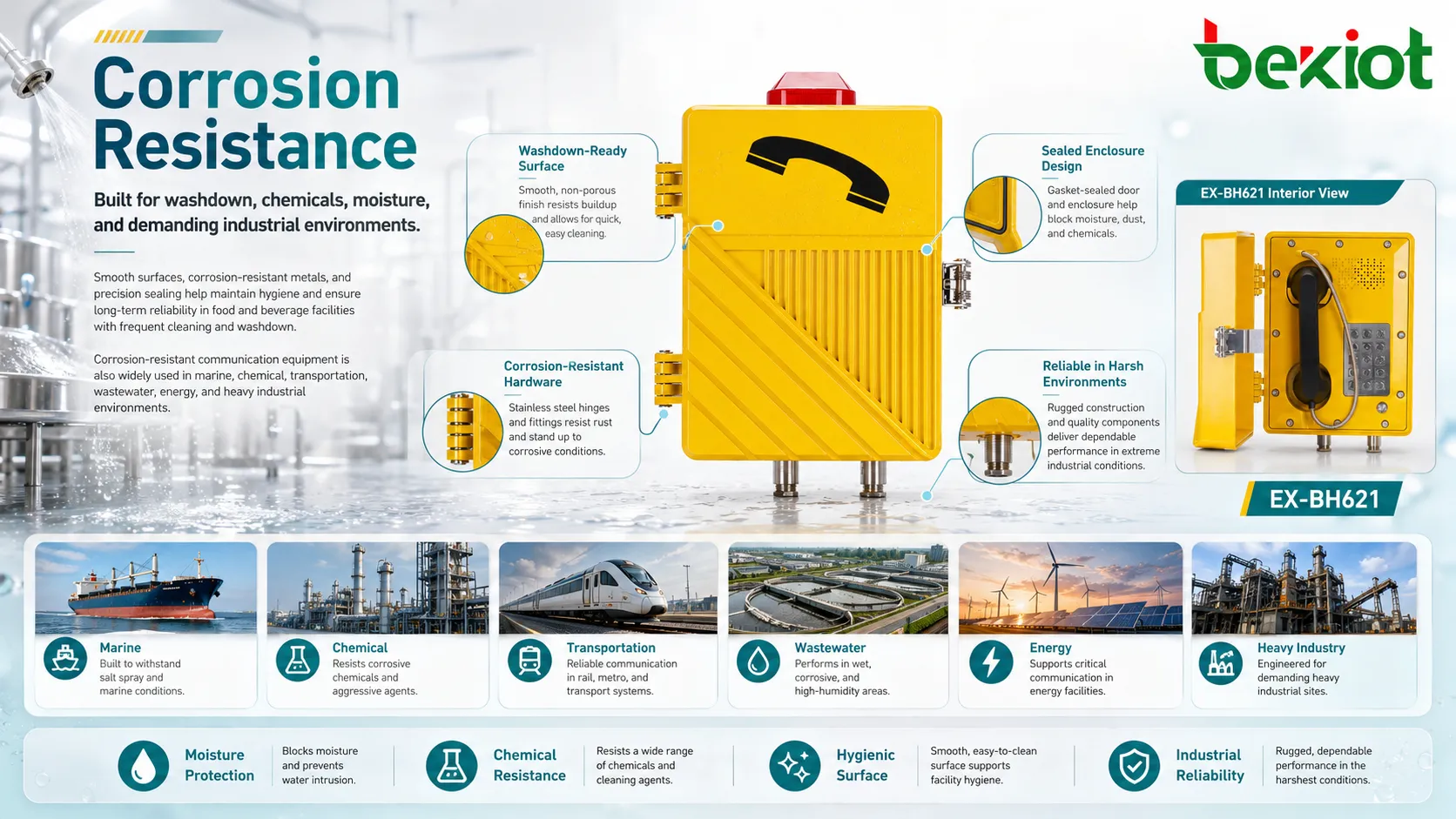
Food and beverage facilities require equipment that can withstand frequent cleaning, sanitizing agents, moisture, and sometimes high-pressure washdown. Smooth surfaces, corrosion-resistant metals, and suitable sealing design are important.
In these environments, corrosion resistance supports hygiene as well as equipment reliability. Flaking paint, rust, or damaged surfaces may create contamination concerns.
Maintenance Practices That Extend Service Life
Corrosion-resistant products still need maintenance. Surfaces should be inspected for scratches, coating damage, rust stains, loose fasteners, cracked seals, blocked drainage points, and chemical residue. Early repair is usually easier and cheaper than replacing heavily damaged equipment.
Cleaning should use compatible methods. Some strong chemicals can damage coatings, plastics, seals, labels, or gaskets. If equipment is installed in a salt-rich environment, periodic fresh-water cleaning may help remove chloride deposits. If it is installed in a chemical plant, the cleaning method should match the chemicals present on site.
Maintenance teams should also check hidden areas such as cable entries, bottom edges, hinge lines, mounting brackets, and rear surfaces. These areas often collect moisture and contaminants while remaining less visible during routine inspection.
Common Selection Mistakes
Choosing Only by IP Rating
An IP rating is important, but it does not fully describe corrosion resistance. A sealed enclosure may still corrode if the material or coating is not suitable for the environment. Always consider IP rating together with material, coating, fasteners, gaskets, and exposure conditions.
Ignoring Small Components
Many failures begin with small parts. A housing may be corrosion-resistant, but screws, hinges, connectors, labels, springs, or cable glands may fail first. All exposed components should be reviewed as part of the protection design.
Underestimating Cleaning Chemicals
Cleaning agents can be more aggressive than rainwater. Food plants, healthcare sites, laboratories, and industrial facilities may use disinfectants, solvents, alkalis, or acidic cleaning products that attack unsuitable materials.
Assuming Indoor Means Safe
Indoor equipment can still corrode in humid, chemical, coastal, or process environments. Pump rooms, tunnels, basements, production lines, and wastewater buildings may be more corrosive than ordinary outdoor areas.
How to Specify the Right Product
A good specification should describe the environment clearly. Instead of only saying “outdoor use,” it should identify whether the site is coastal, chemical, dusty, humid, exposed to washdown, subject to vibration, located in a hazardous area, or exposed to public impact.
The specification should also define expected protection levels, such as enclosure material, coating system, IP rating, NEMA type where relevant, impact resistance, operating temperature, UV resistance, cable entry protection, and maintenance access requirements.
For communication and safety devices, functional reliability should be included. A corrosion-resistant enclosure is valuable only if the device continues to deliver clear audio, stable power, reliable signaling, and maintainable field operation after long exposure.
The best corrosion-resistant design combines material selection, surface protection, sealing, drainage, connector protection, and realistic maintenance planning.
FAQ
Can rust appear on stainless steel?
Yes. Stainless steel can still show rust staining or pitting if exposed to chlorides, contamination, poor cleaning, or trapped moisture. The correct grade, surface finish, and maintenance method are important.
Is powder coating enough for marine environments?
It depends on the coating system, base metal, surface preparation, edge coverage, and exposure level. Marine environments often require stronger protection, careful fastener selection, and regular cleaning to remove salt deposits.
Why do cable glands corrode faster than the enclosure?
Cable glands may use different materials, have more exposed edges, or collect moisture around entry points. If gland material and sealing rings are not suitable for the environment, they may become weak points.
How often should field equipment be inspected?
Inspection frequency depends on exposure severity. Coastal, chemical, wastewater, and heavy industrial sites usually need more frequent checks than ordinary indoor environments. After storms, washdown changes, or chemical spills, extra inspection may be useful.
Does corrosion resistance affect electrical safety?
Yes. Corrosion can affect grounding points, terminals, conductive paths, cable entries, and enclosure integrity. For electrical and communication equipment, corrosion control supports both reliability and safety.