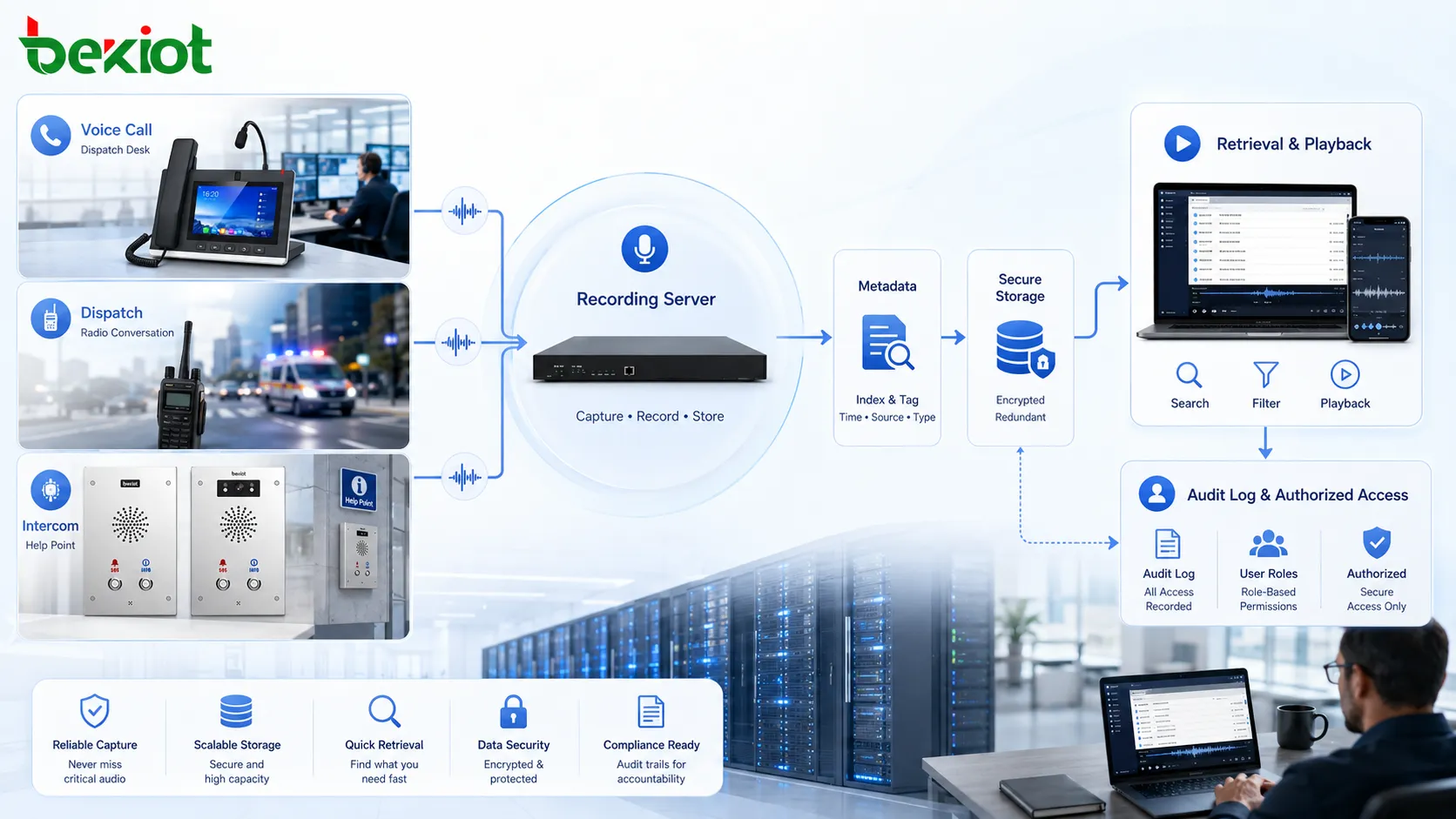
Communication recording refers to the process of capturing, storing, indexing, and managing communication content and related metadata. It may include telephone calls, VoIP calls, dispatch conversations, intercom audio, radio communication, emergency calls, video meetings, paging announcements, command center instructions, customer service calls, and multi-party conferences. In many systems, recording is not only an audio file. It also includes time, caller identity, called party, channel, device, location, event type, operator, call duration, and handling result.
The question of whether communication recording is indispensable cannot be answered with a simple yes or no. In low-risk daily office communication, recording may be optional or even unnecessary. In emergency dispatch, customer service, financial service, public safety, industrial operation, medical assistance, transportation control, security response, and command management, recording can become a critical part of accountability and incident reconstruction. Its necessity depends on the risk of the communication, the need for traceability, legal or policy requirements, and the consequences of not having a reliable record.
Understanding communication recording
More than call recording
Many people understand communication recording as call recording, but the scope is broader. A modern communication system may record SIP calls, analog phone calls, radio gateway conversations, dispatch console instructions, emergency intercom calls, video conference audio, paging announcements, alarm-triggered conversations, and operator-to-field communication. These records may come from different devices and platforms but serve the same basic purpose: preserving important communication for later review.
In enterprise and industrial environments, communication does not happen through one channel only. A control room may use IP phones, intercom terminals, public address systems, radios, mobile apps, video systems, and dispatch consoles at the same time. Recording design should therefore consider the whole communication workflow instead of only one telephone line.
Content and metadata together
A useful recording system should store both content and metadata. The content is the actual audio or video stream. Metadata describes the communication event: who initiated it, who received it, when it happened, how long it lasted, which channel was used, whether it was related to an alarm, and whether the event was acknowledged or closed.
Metadata makes recordings searchable and meaningful. Without metadata, administrators may only have a folder of audio files that are difficult to identify. With proper indexing, users can search by time, extension, operator, caller number, incident ID, department, location, or event type. This turns recording from simple storage into an operational management tool.
Recording as part of traceability
Communication recording supports traceability. It helps an organization reconstruct what was said, who gave instructions, who confirmed actions, what time the communication occurred, and how the response developed. This is important when an incident needs to be reviewed later.
Traceability is not only for disputes. It also supports training, service improvement, safety analysis, process optimization, and management review. A recording can show whether procedures were followed, whether operators communicated clearly, and whether response time met expectations.
How communication recording works
Audio capture point
The first design question is where the audio is captured. Recording may happen at the PBX, VoIP server, SIP trunk, dispatch platform, gateway, endpoint, recorder appliance, radio gateway, conference platform, or contact center system. Each capture point has different advantages and limitations.
For example, recording at the communication server may centralize management. Recording at the trunk may capture external calls. Recording at the dispatch platform may connect audio with command events. Recording at the endpoint may capture local conversations but may be harder to manage centrally. The correct choice depends on the communication architecture.
Media stream recording
In IP communication systems, voice is often transmitted as RTP media streams. The recording system can capture media directly, receive a mirrored stream, use server-side recording, or rely on conference-style recording. In analog or radio systems, the audio may need to be converted through gateways or recorder interfaces before storage.
Media stream design affects recording completeness. If the system records only one side of the conversation, the file may not be useful. If recording starts too late, important opening instructions may be missed. If the media path changes during transfer or conference, the recorder must still capture the full communication where required.
Triggering and recording rules
Recording may be always-on, on-demand, event-triggered, schedule-based, or rule-based. Always-on recording captures all defined communications. On-demand recording allows authorized users to start recording manually. Event-triggered recording may start when an emergency call, alarm, dispatch event, or specific number is involved.
Rule design should match operational needs. A call center may record all customer calls. A command center may record emergency calls and dispatch conversations. A factory may record only alarm-related intercom calls. A meeting system may require user confirmation before recording. Recording rules should be clear and documented.
Storage and indexing
After capture, the recording must be stored securely and indexed correctly. Storage may be local, centralized, network-attached, cloud-based, or part of a dedicated recording server. Indexing should connect recordings with time, user, number, channel, event ID, and other useful fields.
Storage design should consider capacity, retention period, access speed, backup, encryption, disaster recovery, and deletion policy. Recording files can grow quickly, especially in high-call-volume environments. Without storage planning, the system may overwrite important files or fail when the disk is full.
Retrieval and playback
The value of recording depends on retrieval. Users should be able to find the needed record quickly, play it back, download it if authorized, attach it to an incident, or export it for review. Poor retrieval design makes recording difficult to use when evidence or analysis is needed.
Playback should also be controlled by permission. Not everyone should be able to listen to every recording. Sensitive communication may include personal information, business data, emergency details, or security information. Access control is therefore a core part of the recording workflow.
Main functions and system values
Incident reconstruction
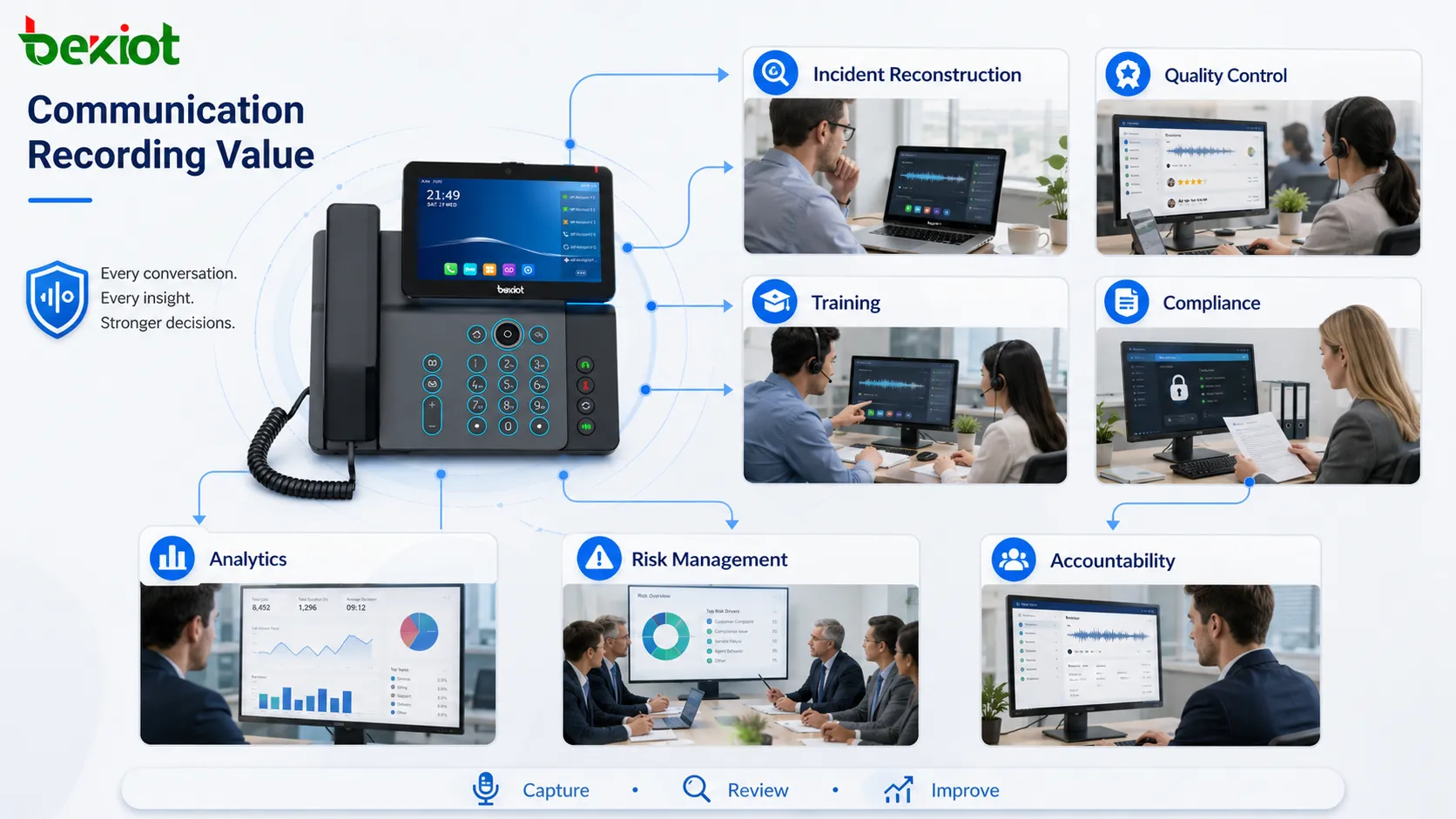
One of the most important functions of communication recording is incident reconstruction. When an incident occurs, people may remember details differently. A recording can help confirm the exact instructions, timing, response sequence, and communication content. This is valuable for emergency response, dispatch, security, industrial safety, and service disputes.
Incident reconstruction helps organizations move from guesswork to evidence-based review. It can reveal whether a message was delivered clearly, whether the receiver confirmed it, whether escalation happened on time, and whether procedures need improvement.
Quality control
Communication recording is widely used for quality control. In customer service, it helps supervisors review call handling, language, accuracy, response attitude, and problem-solving ability. In dispatch or command environments, it helps review clarity, urgency, command discipline, and coordination effectiveness.
Quality control should not be limited to finding mistakes. Recordings can also identify good examples. High-quality calls can be used for training and standardization. Over time, recording analysis helps improve communication professionalism.
Training and knowledge transfer
Recordings are useful training materials. New employees can learn how experienced operators handle difficult calls, emergency reports, customer complaints, technical support, or field coordination. Real examples are often more effective than abstract instructions.
Training value is especially strong in roles where communication pressure is high. Dispatchers, support agents, security operators, emergency coordinators, help desk staff, and maintenance supervisors can learn from real scenarios. Recordings help turn practical experience into reusable knowledge.
Accountability and dispute review
Communication recording can support accountability when there is disagreement about what was said or promised. It can help review service commitments, dispatch instructions, emergency communications, customer complaints, maintenance coordination, or authorization decisions.
Accountability does not mean blaming individuals. A recording may show that the operator followed procedure correctly, or that the procedure itself was unclear. It provides a factual basis for fair review and process improvement.
Compliance and policy support
Some industries and organizations require certain communications to be recorded according to internal policies, regulatory expectations, contractual obligations, or risk management rules. The exact requirements vary by country, region, industry, and communication type. Organizations should design recording policies according to applicable legal and operational requirements.
Compliance value depends on more than recording files. The system must also manage retention, privacy, access control, tamper prevention, audit logs, secure storage, and deletion rules. A recording that is uncontrolled or easily modified may not meet serious compliance needs.
Operational analytics
Recording systems can support operational analysis. Even without advanced speech analytics, call metadata can show call volume, peak periods, average duration, missed communication, repeated issues, response time, and department workload. In more advanced systems, recordings may be analyzed for keywords, sentiment, topics, or procedure compliance.
Analytics helps managers understand communication patterns. A high number of repeated calls may show a process bottleneck. Long handling time may indicate training needs. Frequent emergency calls from one area may reveal safety risk. Recording data can support continuous improvement.
Is communication recording indispensable?
Not indispensable in every environment
Communication recording is not automatically indispensable for every organization. In small offices, informal internal calls, low-risk team communication, or casual collaboration, recording may provide limited value and may create privacy, storage, and management burdens. Recording should not be deployed only because the technology is available.
Organizations should ask what problem recording is expected to solve. If there is no clear need for evidence, training, quality review, compliance, incident analysis, or operational accountability, recording may be unnecessary or should be limited to specific channels.
Indispensable in high-risk communication
Recording becomes close to indispensable when communication has safety, legal, service, or operational consequences. Emergency dispatch, security response, industrial control, transportation operation, financial service, public assistance, medical coordination, command center instructions, and customer service may all require reliable communication records.
In these scenarios, not having a recording may create serious difficulty after an incident. The organization may be unable to prove what happened, review response quality, defend staff actions, improve procedures, or understand failure points. Recording becomes part of risk control.
Indispensable when accountability is required
If communication involves promises, approvals, dispatch orders, emergency instructions, service commitments, safety decisions, or complaint handling, recording may be necessary for accountability. It helps confirm whether the correct message was delivered and whether the receiver understood it.
Accountability is especially important when multiple departments or external parties are involved. A recorded conversation can help clarify responsibility and reduce misunderstanding. It also protects both the organization and the operator when disputes arise.
Optional when privacy cost is higher than value
Recording may be optional or unsuitable when privacy impact is high and operational value is low. Some conversations involve sensitive personal information, confidential discussions, or private staff communication. If recording is not required, organizations should consider whether it creates unnecessary risk.
Good recording design is selective. It should record what is necessary, protect what is recorded, and avoid excessive collection. A system that records everything without policy may create problems later.
Decision criteria
The decision should be based on risk level, legal requirements, service accountability, emergency needs, dispute probability, training value, management goals, privacy impact, storage cost, and maintenance capability. Recording is indispensable when the consequence of missing a record is higher than the cost and responsibility of maintaining it.
In practical terms, organizations should classify communication channels. Some channels may require full recording, some may need event-based recording, some may use on-demand recording, and some may not be recorded. This layered approach is usually better than a simple all-or-nothing decision.
Application areas
Call centers and customer service
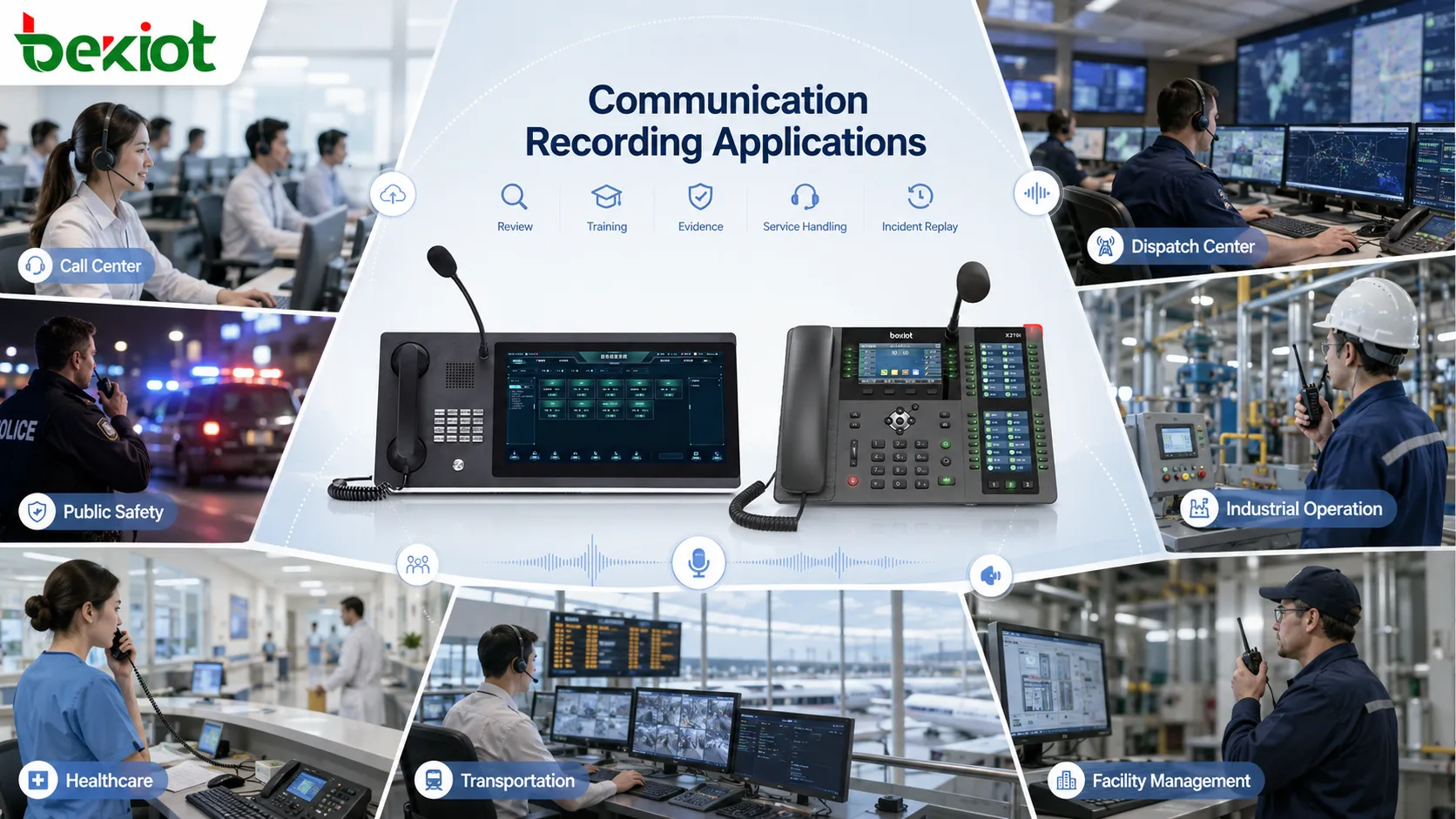
Call centers use communication recording for service quality, complaint handling, training, agent evaluation, dispute review, and process improvement. Customer calls often involve service promises, technical support, billing questions, after-sales issues, and problem escalation. Recordings help supervisors verify what happened.
In this environment, recording is often a core management tool. It supports coaching, quality scoring, script improvement, and customer experience analysis. However, customer notice, privacy rules, retention policy, and access control should be handled carefully.
Command and dispatch centers
Command and dispatch centers record operator instructions, emergency calls, field team communication, intercom calls, radio channels, conference dispatch, and alarm-related conversations. These records help reconstruct response timelines and evaluate command quality.
For dispatch environments, communication recording is often highly valuable because voice instructions can directly affect safety and response outcomes. The recording should be linked with event ID, alarm source, operator, channel, and timeline where possible.
Public safety and emergency response
Emergency communication may involve urgent assistance, rescue coordination, evacuation orders, security events, fire response, traffic incidents, or public assistance calls. Recording helps confirm what was reported, what instructions were given, and how the response developed.
In these scenarios, recording may be considered essential from an operational perspective. It supports after-action review, training, accountability, and continuous improvement. Retention and access policies should follow the organization’s rules and applicable requirements.
Industrial and energy operations
Industrial plants, power facilities, utilities, petrochemical sites, mines, tunnels, and large logistics centers may use recording for control room communication, maintenance dispatch, safety alarms, equipment fault handling, and emergency instructions. Voice records help review how abnormal situations were handled.
Industrial communication can involve high-risk decisions. If a field team reports a gas alarm, power fault, pressure abnormality, or safety incident, the exact conversation may matter later. Recording supports both safety management and technical analysis.
Healthcare and service coordination
Healthcare facilities may record certain communication channels such as emergency assistance calls, service hotlines, dispatch calls, or facility support calls, depending on policy and local requirements. The purpose may include response review, service quality, safety management, and dispute handling.
Because healthcare environments may involve sensitive information, recording should be designed carefully. Scope, access, notice, retention, and privacy protection should be clearly defined. Not all conversations should be recorded simply because the system can do so.
Transportation and public facility management
Railway stations, airports, bus terminals, ports, tunnels, highways, stadiums, campuses, commercial complexes, and government facilities may record communication between control rooms, field teams, service desks, security posts, and emergency points. These recordings help review incidents and service handling.
Large public facilities often involve many teams. A recording can help confirm whether information was passed correctly between departments. It also supports training for crowd control, emergency announcements, public assistance, and maintenance response.
Design and deployment considerations
Define recording scope
The first design task is defining what should be recorded. Scope may include external calls, internal calls, emergency calls, dispatch channels, radio gateway audio, intercom calls, public assistance calls, conferences, paging announcements, or alarm-related communication. The scope should match operational need and policy.
Recording too little may leave important gaps. Recording too much may create privacy risk, storage pressure, and management burden. A clear scope helps balance value and responsibility.
Set retention and deletion rules
Retention defines how long recordings are kept. Different communication types may require different retention periods. Emergency records, complaint records, routine service calls, and internal training calls may not need the same storage duration.
Deletion rules are as important as retention. Keeping recordings forever may create unnecessary risk and storage cost. Deleting them too early may reduce accountability. The organization should define a practical and compliant retention strategy.
Protect privacy and sensitive data
Communication recordings may contain personal information, customer data, security details, medical information, business secrets, or operational instructions. Access should be restricted according to role. Playback, download, export, deletion, and sharing should be logged where possible.
Privacy protection also includes notification and consent where required by local law or organizational policy. Users and callers should not be surprised by recording in situations where notice is expected. Legal requirements vary, so organizations should confirm applicable rules before deployment.
Ensure recording completeness
A recording system should capture the full required conversation. Transfers, conferences, hold states, consultation calls, trunk changes, mobile extensions, radio bridges, and emergency escalation may complicate recording. If the recording stops when the call is transferred, the record may be incomplete.
Testing should include real communication scenarios, not only a simple one-to-one call. Organizations should test inbound calls, outbound calls, transfers, conferences, dispatch calls, emergency triggers, and multi-party communication.
Plan storage and backup
Recording storage can grow quickly. Capacity planning should consider call volume, recording format, compression, video recording if used, retention period, redundancy, backup, and disaster recovery. Storage alarms should be configured before the disk becomes full.
Backups should protect important records, but backup access should also be controlled. A secure primary system is not enough if backup files can be copied freely. Recording data should be protected throughout its lifecycle.
Integrate with event and management systems
Recording becomes more valuable when it is linked with events. A dispatch call can be linked to an incident ticket. An emergency intercom recording can be linked to a location. A customer call can be linked to a case number. A security call can be linked to an alarm record.
Integration reduces search time and improves review quality. Instead of manually searching recordings by approximate time, users can open the relevant record directly from the incident or service case.
Operation and maintenance management
Regular recording checks
Recording systems should be checked regularly. Administrators should verify that recording is active, files are being created, metadata is correct, playback works, storage is healthy, and alarms are functioning. A recording system may fail silently if no one checks it.
Routine checks are especially important for emergency and compliance-related recording. The organization should not discover after an incident that the recorder stopped weeks earlier because of storage failure or configuration changes.
User permission review
Access to recordings should be reviewed periodically. People change roles, departments, and responsibilities. Old permissions may remain if not removed. Excessive access increases privacy and security risk.
Permission review should cover playback, search, download, export, deletion, retention change, and administrator rights. Sensitive recordings may require stricter access control and approval workflow.
Quality sampling
Recording value increases when organizations actually review samples. Quality sampling can identify training needs, unclear procedures, weak communication habits, repeated customer issues, or response delays. Sampling should follow a fair and documented method.
For dispatch and emergency environments, review should focus on clarity, timing, escalation, confirmation, and procedure compliance. For customer service, review may focus on accuracy, tone, solution quality, and customer experience.
Audit logs
Audit logs show who accessed, played, downloaded, exported, deleted, or modified recordings. They are important for accountability and privacy protection. Without audit logs, sensitive recordings may be misused without trace.
Audit logs should be protected from tampering. Administrators should review unusual access patterns, especially for sensitive incidents, complaints, or private communication records.
System updates and compatibility
Recording systems depend on compatibility with PBX, SIP platforms, gateways, dispatch systems, codecs, browsers, storage systems, and security certificates. Updates in one system may affect recording behavior. After major upgrades, recording should be tested again.
Compatibility testing should include codec changes, SIP trunk changes, network changes, endpoint updates, browser playback, and storage path changes. Small technical changes can create recording gaps if not tested.
Common problems and optimization
Recording exists but cannot be found
This usually indicates poor metadata, weak indexing, inconsistent naming, or missing integration. The file may exist, but users cannot locate it quickly when needed. This reduces the practical value of the recording system.
Optimization should improve indexing fields, search filters, case linkage, event IDs, caller information, and time synchronization. The system should be designed for retrieval, not only storage.
Only one side of the call is recorded
One-sided recording may be caused by incorrect media capture point, NAT, codec negotiation, transfer behavior, conference changes, or recording server configuration. It can make the record incomplete or unusable.
Troubleshooting should check the media path. Engineers should verify whether both inbound and outbound RTP streams reach the recorder and whether the system records all legs of transferred or conferenced calls.
Storage fills up unexpectedly
Recording storage may fill because call volume increased, retention is too long, compression is inefficient, video recording was enabled, old files were not deleted, or backups duplicated data. When storage fills, recording may stop.
Optimization includes capacity monitoring, retention rules, compression settings, archive storage, deletion policy, and storage alarms. Important systems should warn administrators before space becomes critical.
Access control is too loose
If too many users can search and play recordings, privacy and security risks increase. Sensitive calls may be exposed unnecessarily. Loose access control can also create compliance problems.
Optimization includes role-based permissions, approval workflow, audit logs, restricted download rights, masking of sensitive fields, and regular permission review.
Recording policy is unclear
If users do not know which calls are recorded, how long they are kept, who can access them, or why recording exists, misunderstandings may occur. A technical system without policy can create distrust or misuse.
Optimization requires clear recording rules, user training, caller notice where required, management responsibilities, and documented review procedures. Recording should be governed, not hidden.
Evaluation standards
Coverage accuracy
The system should record the communication channels that are required by policy and workflow. It should not miss important calls, emergency channels, dispatch conversations, or service interactions that are supposed to be recorded.
Audio and video quality
Recordings should be clear enough for review. Low volume, distortion, noise, missing speech, poor synchronization, or incomplete video may reduce evidential and training value. Quality should be tested under real conditions.
Search efficiency
Users should be able to find recordings quickly by time, number, user, event, case, channel, department, location, or keyword where supported. Search efficiency determines whether recordings are useful during urgent review.
Security and privacy control
Access to recordings should be controlled, logged, and aligned with policy. Sensitive recordings should not be casually available to all users. Secure storage, encryption, permission management, and audit logs are important evaluation points.
Reliability and maintainability
The recording system should operate continuously, alert administrators when faults occur, support backup and recovery, allow configuration management, and remain compatible with communication system changes. Maintainability protects long-term value.
Closing Notes
Communication recording is the process of capturing, storing, indexing, and managing communication content and related metadata. It may apply to telephone calls, VoIP calls, dispatch conversations, intercom audio, radio channels, emergency calls, conferences, paging announcements, and command center communication.
Its functions include incident reconstruction, quality control, training, accountability, dispute review, compliance support, operational analytics, and process improvement. It helps organizations understand what happened, how people communicated, and whether procedures were followed.
Communication recording is not indispensable in every environment. For low-risk informal communication, it may be optional. For high-risk, regulated, service-sensitive, emergency, dispatch, security, customer-facing, or accountability-heavy communication, it can become essential. The decision should be based on risk, policy, privacy, cost, and operational value.
A good recording system should define scope, triggers, retention, access control, privacy protection, storage, backup, retrieval, audit logs, and integration with events or cases. Recording should not be treated as a simple technical add-on. When designed responsibly, it becomes an important foundation for reliable communication management and organizational accountability.
FAQ
What is communication recording?
Communication recording is the capture and storage of voice, video, dispatch, intercom, radio, paging, or call communication, together with related metadata such as time, user, channel, number, and event information.
Is communication recording always necessary?
No. It is not always necessary for low-risk communication. It becomes important or essential when communication involves safety, service accountability, legal risk, emergency response, customer disputes, training, or compliance requirements.
What is the difference between recording content and metadata?
Content is the actual audio or video. Metadata describes the communication event, such as caller, receiver, time, duration, channel, location, and related incident. Metadata makes recordings easier to search and manage.
What should be considered before enabling recording?
Organizations should consider recording scope, user notice, consent where required, privacy impact, retention period, access permissions, storage capacity, security, audit logs, and legal or policy requirements.
Why do some recordings capture only one side of a call?
This may happen when the recording point does not receive both media streams, or when NAT, transfer behavior, conference structure, codec negotiation, or media routing is incorrect. The media path should be checked during troubleshooting.