


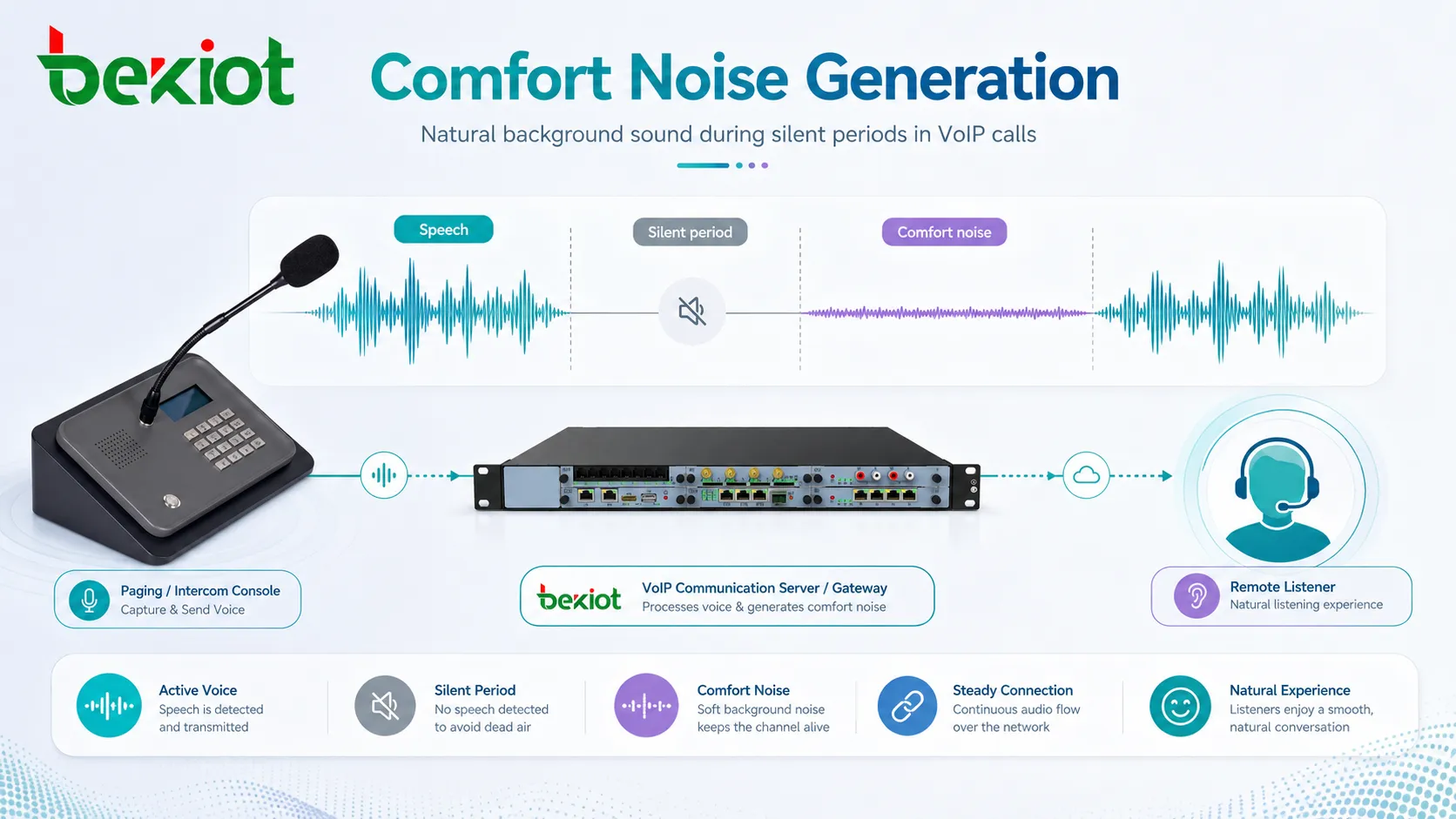
Comfort Noise Generation, commonly known as CNG, is an audio processing technique used in voice communication systems to generate a low-level background sound during periods of silence. Instead of making the call sound completely silent when no one is speaking, the system adds a subtle noise that makes the conversation feel more natural to the listener.
CNG is widely used in VoIP systems, mobile networks, video conferencing platforms, contact centers, push-to-talk systems, radio gateways, softphones, and real-time communication applications. It is especially useful when combined with voice activity detection, silence suppression, and discontinuous transmission, because it helps reduce bandwidth usage without making the call feel broken or disconnected.
Why Comfort Noise Exists
In a normal face-to-face conversation, silence is rarely completely silent. People still hear room tone, air movement, equipment hum, distant activity, or other low-level background sound. These subtle sounds help the brain understand that the communication channel is still open.
In a digital voice system, however, silent periods may be processed differently. If the system stops sending audio packets when no speech is detected, the receiving side may suddenly hear absolute silence. This can make users think the call has dropped, the microphone has failed, or the other party has muted unexpectedly.
Comfort Noise Generation solves this problem by filling silent periods with a controlled background sound. The noise is not meant to distract the listener. It is designed to be soft, steady, and similar to the background noise that would naturally exist if the audio path remained active.
How Comfort Noise Generation Works
Speech and Silence Detection
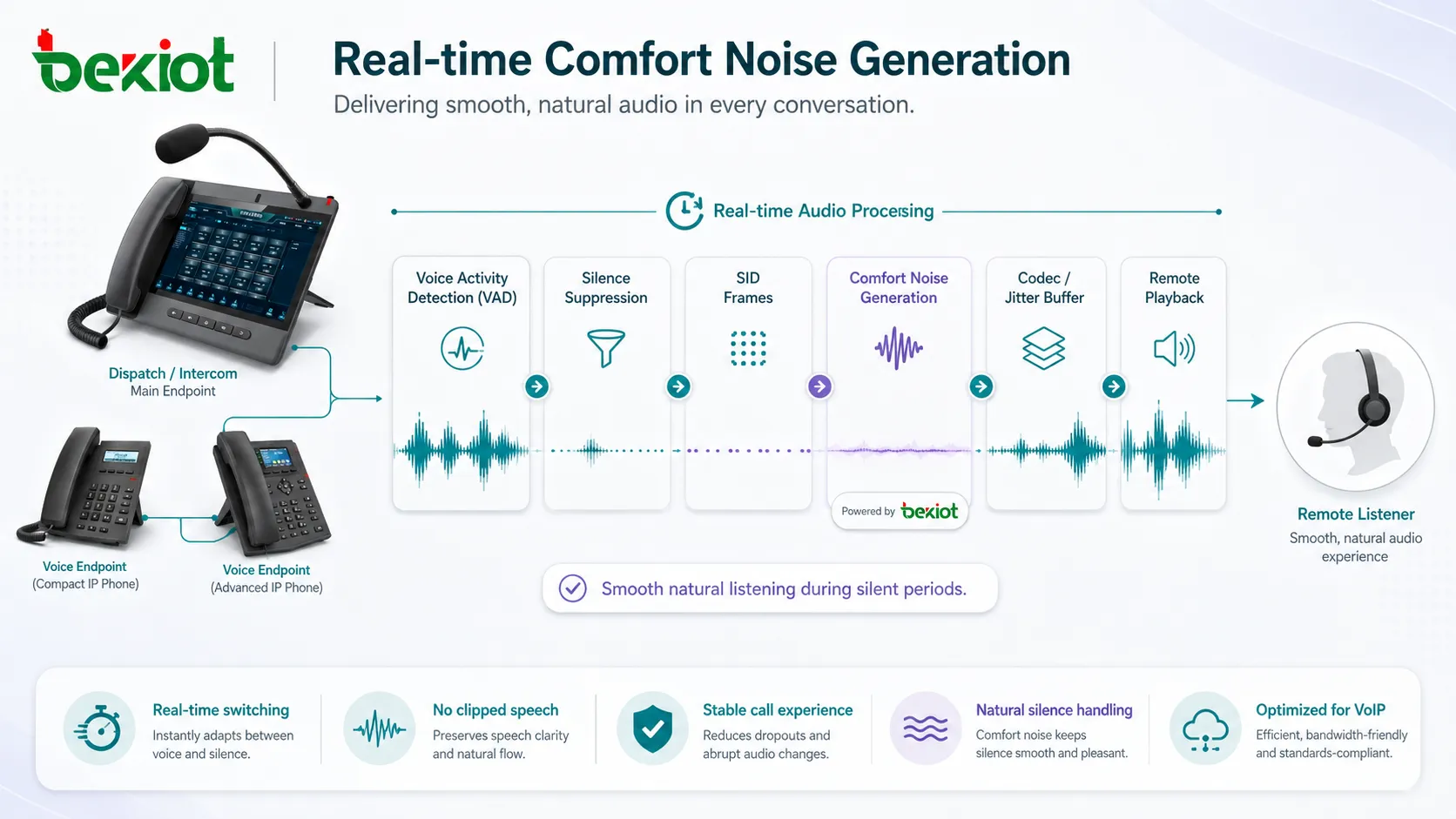
CNG usually works together with Voice Activity Detection, or VAD. VAD analyzes the incoming audio stream and determines whether the signal contains active speech or mostly background noise. When speech is detected, the system transmits normal voice packets. When speech stops, the system may reduce or stop regular audio transmission.
This does not mean the receiving side should hear nothing. Instead, the system estimates the characteristics of the background noise and uses that information to generate a similar comfort noise at the far end.
Noise Estimation
Before comfort noise can be generated, the system needs to understand what the background environment sounds like. It may estimate noise level, spectral shape, energy, and other acoustic characteristics from the original signal.
For example, a quiet office, a factory control room, a moving vehicle, and a call center floor all have different background noise profiles. A good CNG process should generate noise that feels consistent with the original environment instead of producing a generic hiss that sounds artificial.
Silence Descriptor Transmission
In many voice systems, the sender does not transmit full audio packets during silence. Instead, it may send a smaller silence descriptor packet, often called a SID frame. This packet describes the background noise characteristics so the receiver can recreate a suitable comfort noise locally.
This method saves bandwidth because SID frames are much smaller and less frequent than normal voice packets. The receiver uses the descriptor information to synthesize background sound until active speech resumes.
Local Noise Generation
After receiving the silence descriptor, the receiving endpoint generates comfort noise locally. This may happen inside a codec, IP phone, softphone, mobile device, media server, gateway, or conferencing platform.
The generated noise should change smoothly over time. If comfort noise starts or stops too abruptly, users may hear clicks, pumping effects, or unnatural changes in the background. Smooth transitions are important for a comfortable listening experience.
Key Features of Comfort Noise Generation
Natural Silence Handling
The most important feature of CNG is making silence sound natural. In a real conversation, people expect some acoustic presence even when nobody is speaking. CNG prevents the audio path from feeling empty or dead.
This improves user confidence during pauses. When one person stops speaking to think, read, listen, or wait for a response, the other party still feels that the call is active.
Bandwidth Reduction Support
CNG is often used with silence suppression or discontinuous transmission. During silent periods, the system can reduce the number of transmitted audio packets. This lowers bandwidth usage, especially in large voice networks, wireless systems, and multi-party conferencing environments.
Bandwidth savings may seem small for one call, but the effect becomes meaningful when thousands of concurrent calls are active. This is one reason CNG is common in carrier networks, enterprise VoIP systems, and contact centers.
Codec Integration
Comfort noise may be implemented as part of the audio codec or as a related media processing function. Some codecs include built-in support for VAD, SID frames, and comfort noise generation. Others may require separate handling by the endpoint or media platform.
Codec compatibility matters. If one side supports CNG and the other side does not, silent periods may behave differently than expected. This can affect perceived audio quality, especially across gateways, SIP trunks, and mixed endpoint environments.
Smooth Transition Control
A good CNG implementation should transition smoothly between speech, background noise, and silence descriptors. Abrupt changes can make the call sound unnatural, even if the voice itself is clear.
Transition control is especially important in noisy environments where the background sound changes quickly. Poor handling may cause the listener to hear sudden drops, bursts, or unstable noise levels.
Low Processing Overhead
CNG is usually designed to operate with low processing overhead because it is often used in real-time communication. The system must analyze audio, estimate noise, send descriptors, and generate background sound without adding noticeable delay.
This makes efficient implementation important for IP phones, embedded devices, mobile clients, gateways, and high-density media servers handling many simultaneous sessions.
Comfort Noise Generation is not added to make a call noisier. It is used to make digital silence feel more realistic, stable, and trustworthy to human listeners.
CNG, VAD, and Silence Suppression
Comfort Noise Generation is closely related to Voice Activity Detection and silence suppression, but they are not the same thing. VAD decides whether speech is present. Silence suppression reduces or stops audio packet transmission when speech is not present. CNG creates a natural background sound at the receiving side during those silent periods.
If VAD and silence suppression are used without CNG, the call may become uncomfortable because the listener hears sudden dead silence. If CNG is used without good VAD, the system may generate noise at the wrong time or fail to detect real speech correctly.
These functions work best as a coordinated audio processing chain. The system should detect speech accurately, reduce unnecessary transmission during silence, and generate background noise that matches the listening context.
Audio Benefits of Comfort Noise Generation
Improves Perceived Call Continuity
One major benefit of CNG is that it makes users feel the call is still connected. Complete silence during pauses can be confusing, especially in VoIP calls where users may already worry about network quality or dropped sessions.
By adding a soft background sound, CNG helps maintain the perception of an open audio channel. This small detail can significantly improve the user experience during longer conversations.
Reduces Listener Fatigue
Unnatural audio behavior can make conversations tiring. Sudden silence, abrupt background changes, or repeated audio gating can force listeners to pay extra attention just to confirm that the call is still active.
Comfort noise reduces this listening effort. It creates a more stable audio environment, making conversations feel smoother and less tiring, especially during long support calls, meetings, dispatch sessions, or conference calls.
Supports Bandwidth Efficiency Without Harsh Silence
Voice systems often use silence suppression to save bandwidth. However, aggressive silence suppression can make the audio experience feel unnatural. CNG allows systems to gain bandwidth efficiency while preserving a more comfortable listening experience.
This balance is important in wireless networks, satellite links, WAN environments, and large-scale VoIP deployments where bandwidth efficiency and user experience must both be considered.
Improves Multi-Party Communication
In conference calls, sudden silence from one participant can make others wonder whether that person is still connected. Comfort noise can help maintain a sense of presence for participants who are listening but not speaking.
Conference platforms must handle CNG carefully because multiple background noise sources can become distracting. A well-designed system manages noise levels so that comfort noise does not accumulate or interfere with active speakers.
Technical Considerations
Noise Level Accuracy
If comfort noise is too loud, it becomes distracting. If it is too quiet, the call may still feel disconnected. The generated noise level should match the original background environment as closely as possible.
Accurate noise estimation is especially important in environments with changing background sound, such as open offices, warehouses, vehicles, factories, or outdoor locations.
Codec and Endpoint Support
Not all codecs and endpoints handle comfort noise in the same way. Some support standardized silence descriptors and local generation. Others may use proprietary behavior or disable silence suppression entirely.
When deploying CNG in enterprise communication systems, administrators should test endpoints, softphones, gateways, mobile apps, SIP trunks, and conferencing platforms to confirm that silent periods sound consistent.
Packet Loss and Jitter Impact
Although CNG is mostly associated with silent periods, network quality still matters. Packet loss or jitter can affect how silence descriptors are received and how smoothly the receiver transitions between speech and comfort noise.
If the network is unstable, users may hear choppy speech, delayed transitions, or inconsistent background sound. CNG can improve comfort, but it cannot fully hide poor network performance.
Interaction with Noise Suppression
Modern communication systems may also use noise suppression, echo cancellation, automatic gain control, and acoustic echo control. These features interact with CNG and must be tuned carefully.
If noise suppression removes too much background sound before the system estimates the noise profile, the generated comfort noise may sound artificial. If automatic gain control raises background noise too much, CNG may become more noticeable than intended.
Delay and Real-Time Performance
Comfort noise must be generated in real time. Any delay in switching between speech and comfort noise can affect conversation quality. The transition should occur quickly enough to feel natural but not so aggressively that speech is clipped.
This requires proper tuning of VAD thresholds, hangover time, codec settings, and jitter buffer behavior.
Applications of Comfort Noise Generation
VoIP and IP Telephony
VoIP systems commonly use CNG to improve the listening experience during calls between IP phones, softphones, SIP trunks, and media gateways. When silence suppression is enabled, CNG prevents the far end from hearing an unnatural empty audio path.
In enterprise telephony, CNG can be useful for remote users, branch offices, and low-bandwidth network links. It helps maintain call comfort while reducing unnecessary media traffic.
Mobile Voice Networks
Mobile networks use silence handling techniques to improve radio resource efficiency and battery performance. Comfort noise helps users perceive the call as active even when transmission is reduced during non-speech periods.
This is important because mobile users often speak from environments with changing background noise. A realistic comfort noise profile can make the call sound more stable and less mechanical.
Contact Centers
Contact centers handle large numbers of calls, and call quality directly affects customer experience. CNG can make agent-customer conversations feel more natural during pauses, data lookup, identity verification, or waiting moments.
However, contact centers must balance CNG with call recording, speech analytics, background noise control, and agent headset quality. Poor tuning may affect recordings or analytics accuracy.
Video Conferencing
In video meetings, participants often remain silent while listening. If silence suppression makes their audio channel sound completely dead, other participants may wonder whether the connection is still active.
CNG helps preserve a natural sense of presence. It can be especially useful in meetings where participants frequently pause, take turns, or stay muted and unmuted at different moments.
Radio over IP and Push-to-Talk Systems
Radio over IP, push-to-talk, and dispatch communication systems may use comfort noise to make packet-based audio feel more familiar to users accustomed to radio background noise. In some operational environments, a completely silent channel may be perceived as inactive or unreliable.
CNG can help bridge the user experience between traditional radio behavior and IP-based media transport. It should be tuned carefully so it does not mask important short voice bursts or operational audio cues.
Low-Bandwidth and Satellite Links
In bandwidth-constrained environments, such as satellite communication, maritime links, remote sites, and rural networks, silence suppression can reduce media traffic. CNG helps preserve audio comfort while saving bandwidth.
These environments may also have higher latency and jitter, so audio tuning must consider the full media path rather than only the comfort noise function.
Common Problems and How to Avoid Them
Unnatural Background Sound
If comfort noise does not match the actual background environment, users may notice the difference. For example, a call from a quiet office should not suddenly sound like a noisy factory during silence.
Better noise estimation and careful codec configuration can reduce this problem. Testing should include realistic environments, not only clean laboratory audio.
Speech Clipping
Speech clipping happens when the system detects speech too late or returns from silence mode too slowly. The beginning of words may be cut off, making conversations harder to understand.
This issue is usually related to VAD settings rather than CNG alone. Adjusting detection thresholds and hangover timing can help preserve natural speech starts.
Noise Pumping
Noise pumping occurs when background sound rises and falls in a noticeable way. This may happen when noise suppression, gain control, and CNG interact poorly.
To avoid this, audio processing features should be tested together. A single feature may work well alone but create artifacts when combined with other processing functions.
Inconsistent Behavior Across Devices
Different endpoints may handle CNG differently. One softphone may generate smooth comfort noise, while another device may produce abrupt silence. This can create inconsistent user experience across the same organization.
Administrators should test major endpoint models, firmware versions, codecs, and SIP trunk paths before enabling silence suppression and CNG widely.
Best Practices for Implementation
Organizations should start by confirming whether CNG is needed for the specific communication environment. In some high-bandwidth LAN environments, disabling silence suppression may be acceptable. In bandwidth-sensitive or large-scale environments, CNG can provide a better balance between efficiency and comfort.
VAD settings should be tuned carefully. If detection is too aggressive, soft speech may be treated as silence. If it is too relaxed, bandwidth savings may be reduced. The best configuration depends on user behavior, background noise, codec type, and network conditions.
Testing should include real endpoints and real acoustic environments. Office calls, contact center calls, mobile calls, radio gateway audio, and conference calls may all behave differently. Testing only one scenario can lead to poor results in another.
Monitoring is also useful. If users report dead air, clipped words, robotic silence, or strange background sound, administrators should review codec negotiation, VAD settings, packet loss, jitter, endpoint firmware, and media gateway behavior.
The best comfort noise is almost invisible to the listener: present enough to make the call feel alive, but subtle enough to avoid drawing attention.
Limitations of Comfort Noise Generation
CNG improves the listening experience during silent periods, but it does not fix all audio quality problems. It cannot solve severe packet loss, excessive latency, poor microphones, echo, unstable Wi-Fi, overloaded gateways, or weak codec selection.
It can also create problems if configured poorly. Artificial noise, mismatched levels, clipped speech, or inconsistent endpoint behavior may reduce call quality instead of improving it.
For critical communication environments, CNG should be evaluated as part of the complete audio chain. This includes microphones, speakers, headsets, codecs, jitter buffers, network quality, echo cancellation, noise suppression, recording systems, and user training.
How to Evaluate CNG Quality
Evaluating CNG quality should include both technical testing and human listening. Technical teams can check packet behavior, SID frames, codec negotiation, bandwidth usage, and transition timing. However, users ultimately judge whether the call sounds natural.
Listening tests should include active speech, short pauses, long pauses, double-talk, noisy backgrounds, quiet rooms, and network stress conditions. The goal is to confirm that comfort noise supports the conversation without becoming noticeable or distracting.
Organizations that rely heavily on voice communication should also compare call quality before and after enabling CNG. If bandwidth savings are achieved but users complain about clipped words or strange silence, the configuration should be adjusted.
FAQ
Is comfort noise the same as background noise?
No. Background noise is the real sound captured from the caller’s environment. Comfort noise is artificially generated by the receiving side to make silent periods sound more natural when real audio transmission is reduced.
Does CNG improve speech clarity?
CNG does not directly make speech clearer. Its main purpose is to improve perceived call continuity during silence. Speech clarity depends more on codec quality, microphone performance, network stability, echo control, and noise suppression.
Can comfort noise save bandwidth?
CNG itself generates local sound, but it supports bandwidth savings when used with silence suppression or discontinuous transmission. During silent periods, fewer full audio packets need to be sent.
Why does a call sometimes sound completely dead during pauses?
This may happen when silence suppression is active but comfort noise is disabled, unsupported, or not negotiated correctly between endpoints. The receiver may stop hearing background sound and assume the call has dropped.
Should CNG always be enabled?
Not always. It depends on the network, codec, endpoints, and user expectations. In some environments, continuous audio transmission may be preferred. In others, CNG is useful because it supports bandwidth efficiency while keeping the call natural.







