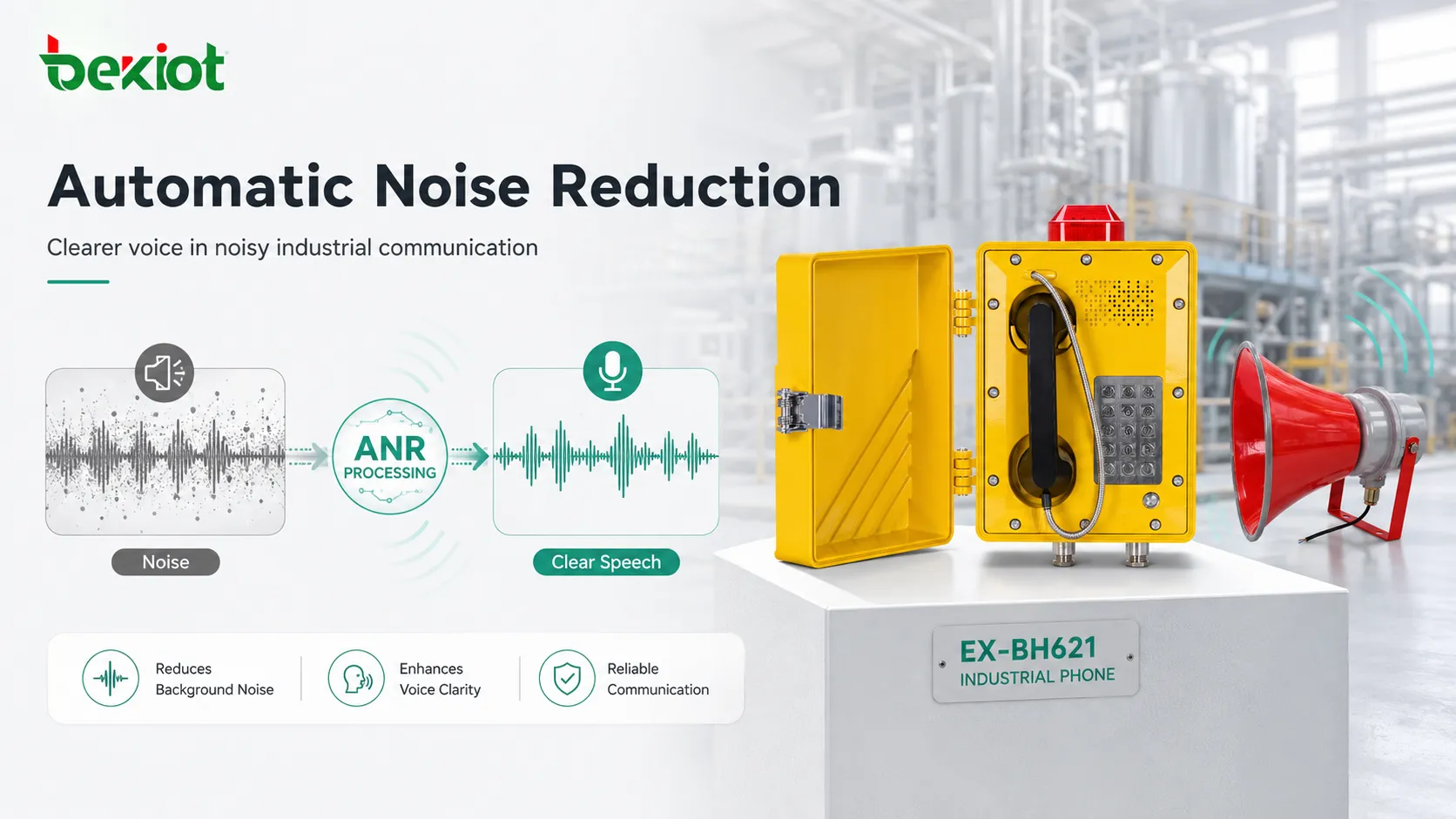
Automatic Noise Reduction, commonly known as ANR, is an audio processing technology that reduces unwanted background noise from voice communication. It is used in telephones, headsets, intercom systems, radios, dispatch consoles, video conferencing platforms, contact centers, mobile devices, industrial communication terminals, and public safety systems where clear speech is important.
The purpose of ANR is not to remove every sound from the environment. Instead, it tries to reduce noise that interferes with speech intelligibility while keeping the human voice natural and understandable. In real communication environments, this balance is important because excessive noise reduction can make speech sound thin, robotic, or distorted.
What Automatic Noise Reduction Means
Automatic Noise Reduction refers to a set of signal processing methods that detect background noise and reduce its level during voice transmission or playback. The system analyzes the audio signal, separates speech-like components from noise-like components, and applies processing to make the desired voice clearer.
Noise may come from fans, engines, machinery, wind, traffic, electrical hum, air conditioning, crowds, keyboards, alarms, radio interference, or open-space office activity. In a communication system, these sounds can mask speech, increase listening fatigue, and cause users to repeat information.
ANR is called “automatic” because the system adjusts the processing without requiring the user to manually tune every noise condition. Modern ANR may adapt in real time as the background environment changes, such as when a user walks from a quiet office into a noisy workshop or when a vehicle starts moving.
How Automatic Noise Reduction Works
Audio Capture
ANR begins when a microphone captures both the speaker’s voice and surrounding environmental noise. The quality of this captured signal affects the final result. A poor microphone position, weak input level, overloaded microphone, or strong wind noise can make noise reduction more difficult.
In professional communication systems, microphone design is often combined with digital processing. Directional microphones, acoustic chambers, wind screens, noise-resistant housings, and proper installation can improve the input signal before ANR even begins.
Noise Detection
The system then analyzes the audio to identify what part of the signal is likely to be noise. Some noise is steady, such as fan hum or air conditioning. Some noise is changing, such as traffic, footsteps, crowd sound, or machine operation.
Basic ANR systems may focus on reducing steady background noise. More advanced systems can adapt to changing noise patterns and separate speech from complex acoustic environments. The goal is to reduce noise without removing important speech information.
Signal Processing
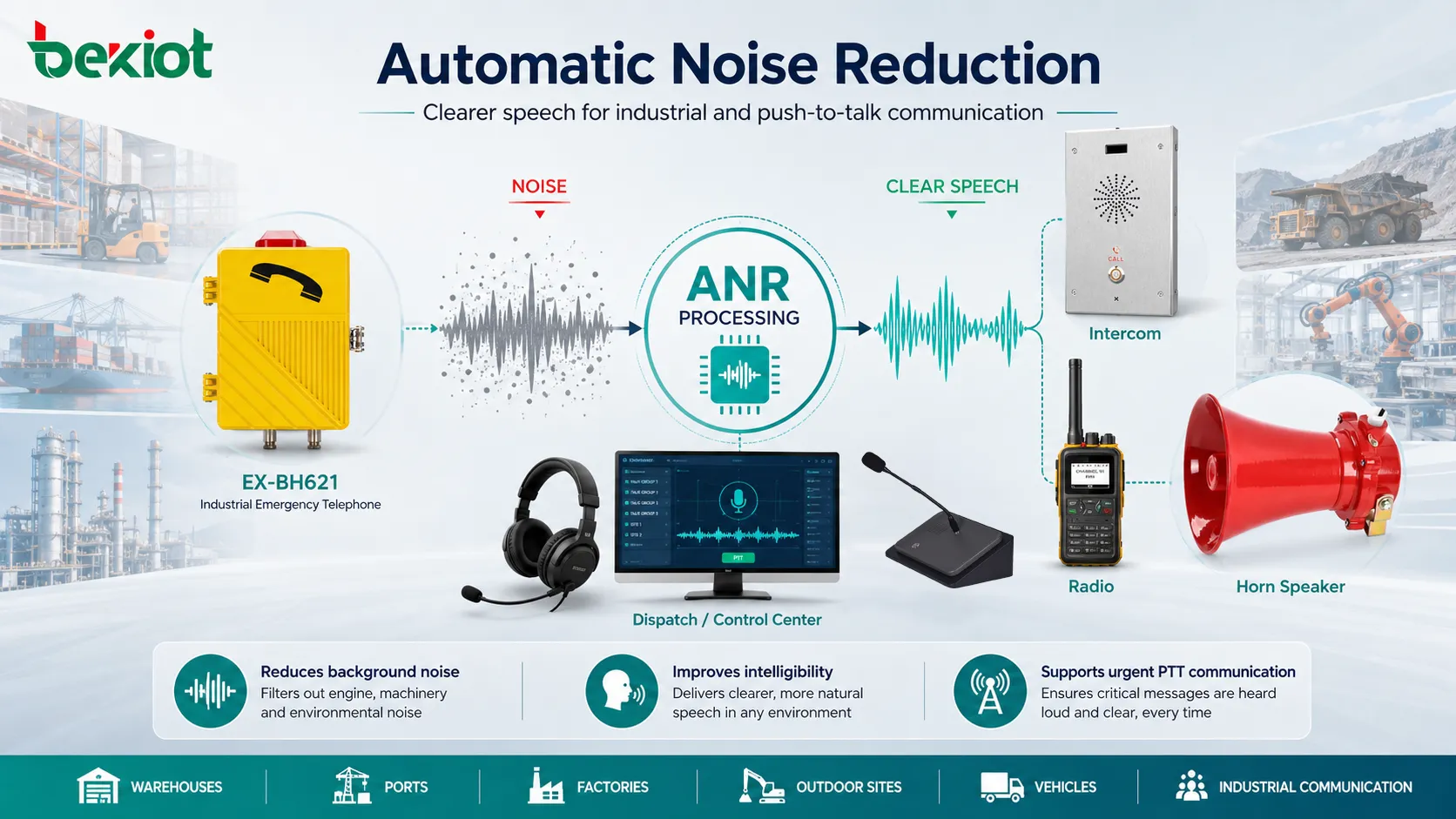
After detecting noise, the system applies processing to reduce it. This may involve filtering, spectral subtraction, adaptive noise estimation, dynamic gain control, microphone beamforming, echo control, or machine learning-based speech enhancement.
Different systems use different methods. A headset may use built-in microphones and onboard processing. A VoIP platform may process audio in a software client or media server. An industrial intercom may combine hardware filtering, microphone placement, and digital signal processing to improve speech pickup in noisy areas.
Output Optimization
The processed audio is then sent to the other party, stored in a recording, broadcast over a speaker, or delivered through a communication platform. A good ANR system should improve clarity while keeping speech natural.
If processing is too aggressive, it may reduce background noise but also damage the voice. If processing is too weak, users may still struggle to understand speech. Effective ANR depends on real-time adjustment, proper tuning, and suitable hardware design.
Audio Benefits of ANR
Improves Speech Intelligibility
The most important benefit of ANR is improved speech intelligibility. When noise is reduced, listeners can understand words more accurately. This is especially important when information includes names, numbers, instructions, locations, emergency messages, or technical details.
In business and industrial environments, unclear speech can lead to repeated calls, delayed actions, incorrect instructions, and operational mistakes. ANR helps reduce these risks by improving the usable voice signal.
Reduces Listening Fatigue
Listening to noisy audio for a long time is tiring. Users may need to concentrate harder, turn up the volume, or ask the speaker to repeat information. In contact centers, dispatch rooms, control centers, and long conference calls, this can affect comfort and productivity.
ANR reduces the mental effort needed to follow a conversation. Even when it does not remove all noise, lowering the most distracting background sound can make communication feel more stable and less stressful.
Improves Call Professionalism
In customer-facing communication, background noise can make an organization sound unprofessional. Customers may hear office chatter, keyboard noise, street traffic, or equipment noise and assume the service environment is disorganized.
ANR helps create a cleaner voice experience. This is useful for customer service teams, remote workers, sales calls, healthcare communication, online meetings, and support centers where voice quality affects trust.
Supports Safer Communication
In industrial, transportation, energy, and public safety environments, speech clarity can directly affect safety. If a warning, command, or confirmation is misunderstood, the result may be more serious than a simple inconvenience.
ANR can support safer communication by making spoken instructions easier to hear over machinery, engines, alarms, wind, or crowd noise. It should be used together with proper operating procedures, clear call protocols, and reliable communication equipment.
ANR is most valuable when it improves clarity without making the speaker sound artificial. The best noise reduction is effective but not distracting.
Technical Features of Automatic Noise Reduction
Adaptive Noise Estimation
Adaptive noise estimation allows the system to update its understanding of the background environment. This is important because real-world noise rarely stays the same. A workshop may become louder when equipment starts, a vehicle may create more vibration at higher speed, and a public area may change as people move around.
By continuously estimating noise, ANR can adjust processing strength and avoid relying on a fixed noise profile that may quickly become inaccurate.
Frequency-Based Filtering
Many noise reduction systems analyze audio by frequency. Human speech occupies certain frequency ranges, while some noise sources occupy lower, higher, or more repetitive frequency bands. Filtering can reduce noise components that are less important for speech understanding.
However, speech and noise often overlap. If filtering is too simple, it may remove useful speech details. Good ANR systems must avoid damaging consonants, voice texture, and natural speech dynamics.
Directional Microphone Support
Some ANR systems work with directional microphones or microphone arrays. These microphones are designed to focus more on sound from the speaker’s direction and less on sound from other directions.
This is common in headsets, conference devices, vehicle communication systems, and control room equipment. Directional capture improves the signal before digital noise reduction is applied, which can produce a better result than processing alone.
Real-Time Processing
Voice communication is interactive, so ANR must work in real time. Processing delay should be low enough that users can speak naturally without noticeable lag. This is especially important in phone calls, push-to-talk systems, dispatch communication, and video meetings.
Low-latency processing requires efficient algorithms and suitable hardware. If ANR introduces too much delay, the call may sound clean but feel uncomfortable.
Integration with Echo Cancellation
Noise reduction often works alongside echo cancellation. Echo cancellation removes sound that is played through a speaker and captured again by the microphone. Noise reduction removes unwanted environmental sound.
These two functions must be coordinated. Poor interaction between ANR, echo cancellation, automatic gain control, and voice activity detection can create pumping, clipping, distortion, or unstable volume changes.
ANR Compared with Related Audio Technologies
Automatic Noise Reduction is often confused with other audio processing technologies. They may work together, but they solve different problems.
| Technology | Main Purpose | Typical Use |
|---|---|---|
| ANR | Reduces unwanted background noise from voice audio. | Calls, intercoms, headsets, radios, meetings, industrial voice communication. |
| Echo Cancellation | Prevents speaker audio from returning into the microphone. | Speakerphones, conference rooms, intercoms, hands-free calling. |
| Automatic Gain Control | Adjusts audio level to keep speech volume more consistent. | Softphones, recorders, conferencing systems, dispatch consoles. |
| Voice Activity Detection | Detects whether speech is present or absent. | Silence suppression, recording triggers, speech processing, bandwidth saving. |
| Beamforming | Focuses microphone pickup toward the desired speaker direction. | Microphone arrays, meeting devices, smart terminals, vehicle systems. |
In high-quality voice systems, these technologies are often used together. The challenge is not simply enabling every feature, but tuning them so they support each other without damaging voice quality.
Applications of Automatic Noise Reduction
VoIP and IP Telephony
VoIP systems often operate across offices, homes, branch locations, and mobile networks. Users may speak from quiet rooms, shared spaces, vehicles, factory offices, or public places. ANR helps maintain a more consistent voice experience across these different environments.
In IP telephony, ANR may be implemented in desk phones, softphones, media servers, headsets, or endpoint firmware. It is especially helpful when users rely on open microphones or work in environments that cannot always be acoustically controlled.
Contact Centers
Contact centers use ANR to improve the clarity of agent-customer communication. Even small background noises can affect customer perception, especially when calls involve billing, support, healthcare, finance, travel, or technical service.
ANR can help reduce office noise, keyboard sounds, nearby conversations, and ventilation noise. However, it should be tested with call recording and speech analytics systems, because heavy processing may affect transcription accuracy or quality monitoring.
Industrial Communication
Industrial sites often contain machinery, motors, compressors, alarms, ventilation systems, vehicles, and outdoor environmental noise. In these locations, ANR can help workers and control rooms communicate more clearly.
For example, an explosion-proof amplified telephone such as Becke Telcom EX-BH621 may be used in hazardous or noisy areas where rugged construction, loud audio, and clearer voice pickup are important for operational communication. In such scenarios, ANR-related audio design can help reduce background interference and make spoken information easier to understand.
Public Safety and Dispatch
Dispatchers, emergency responders, transportation operators, and security teams often communicate in stressful and noisy environments. ANR can improve voice clarity when users speak from vehicles, streets, incident scenes, control rooms, or radio-connected systems.
In public safety applications, noise reduction should be carefully balanced. The system should reduce harmful noise while preserving important audio cues, urgency, and speaker emotion.
Video Conferencing and Hybrid Work
Remote workers often join meetings from homes, shared offices, cafes, vehicles, or temporary workspaces. ANR helps reduce background distractions such as fans, typing, pets, traffic, children, and room noise.
For hybrid meetings, ANR can make participation more equal. A remote participant with background noise may otherwise be harder to understand than someone speaking from a conference room.
Radio and Push-to-Talk Systems
Radio and push-to-talk communication often occurs in vehicles, warehouses, construction sites, logistics yards, ports, factories, and outdoor areas. ANR can improve the intelligibility of speech transmitted through radio gateways or IP-based push-to-talk platforms.
Because push-to-talk speech can be short and urgent, processing must avoid clipping the beginning of words. Testing with real user behavior is important.
Deployment Considerations
Acoustic Environment
The type of background noise affects ANR performance. Steady fan noise is usually easier to reduce than sudden impacts, alarms, voices from nearby people, wind bursts, or moving machinery. Before deployment, organizations should identify the most common noise sources in the real operating environment.
Testing should happen where the system will actually be used. A solution that sounds excellent in a quiet lab may behave differently in a plant room, tunnel, vehicle, control center, or open office.
Microphone Placement
Microphone placement can determine whether ANR succeeds or struggles. If the microphone is too far from the speaker, it captures more room noise. If it is too close, it may capture breath noise or overload during loud speech.
For fixed devices such as intercom panels, industrial telephones, and speakerphones, installation height, direction, enclosure design, and surrounding surfaces should be considered. For headsets, microphone boom position and user training matter.
Processing Strength
More noise reduction is not always better. Strong processing may make speech less natural, remove soft speech details, or create watery artifacts. Weak processing may preserve voice quality but fail to solve the noise problem.
The best setting depends on the use case. A customer service call may prioritize natural sound, while an industrial emergency call may prioritize intelligibility under high noise.
Network and Codec Impact
ANR can improve the signal before it enters a codec, but network and codec conditions still matter. Packet loss, jitter, low-bitrate codecs, transcoding, and poor endpoint quality can reduce the final listening experience.
For VoIP systems, ANR should be evaluated together with codec selection, jitter buffer behavior, echo control, gain levels, and network quality.
Common Problems and How to Avoid Them
Robotic Voice
A robotic or metallic voice may occur when noise reduction is too aggressive or when speech and noise overlap heavily. Users may hear fewer background sounds, but the speaker’s voice becomes unnatural.
To reduce this problem, administrators should test different processing levels and avoid applying multiple noise reduction functions in the same audio path unless they are designed to work together.
Speech Clipping
Speech clipping happens when the system incorrectly treats the beginning or end of speech as noise. This may cut off short words, low-volume speech, or fast responses.
Clipping can be reduced by tuning voice detection thresholds, hangover time, microphone level, and endpoint processing. Push-to-talk and dispatch systems need special attention because messages are often short.
Noise Pumping
Noise pumping is an unstable rise and fall of background sound. It can happen when gain control and noise reduction interact poorly. The listener may hear the background noise move up and down in an unnatural way.
Proper audio chain design is important. ANR should be tested with echo cancellation, automatic gain control, compression, and codec processing enabled, not only as an isolated feature.
Inconsistent Results Across Devices
Different endpoints may implement ANR differently. A headset, softphone, desk phone, mobile app, and intercom may all process noise in different ways. This can create inconsistent voice quality across an organization.
Standardizing approved devices and testing firmware versions can help maintain a predictable audio experience.
Successful ANR deployment depends on the full audio path: microphone, environment, processing, codec, network, endpoint, and user behavior.
Best Practices for Using ANR
Organizations should begin with the acoustic environment. Identify whether the main problem is steady noise, impulse noise, wind, nearby speech, echo, room reverberation, or microphone distance. ANR is powerful, but it works best when the input signal is already reasonably well captured.
Use suitable devices for the environment. A quiet office may only need a good headset or softphone setting. A factory, tunnel, port, power plant, or transportation site may require rugged devices, higher speaker output, directional pickup, and stronger noise handling.
Test with real conversations. Reading a test sentence in a quiet room is not enough. Testing should include normal speaking, fast instructions, numbers, background machinery, alarms, double-talk, long calls, and low-volume speech.
Review the entire communication chain. If users still report poor audio after ANR is enabled, check network quality, codec negotiation, microphone gain, echo cancellation, headset condition, firmware, and endpoint placement.
How to Evaluate ANR Quality
ANR quality should be evaluated by both technical measurements and human listening. Engineers may look at signal-to-noise ratio, frequency response, packet statistics, codec behavior, and audio waveform changes. Users judge whether speech is easier to understand and whether the voice still sounds natural.
A practical evaluation should compare the same call scenario with ANR disabled, lightly applied, and strongly applied. This helps determine whether the processing is improving clarity or simply changing the sound.
For enterprise systems, evaluation should also include recordings. A live call may sound acceptable, but recordings used for compliance, training, or speech analytics may reveal artifacts that were not obvious during the conversation.
Limitations of Automatic Noise Reduction
ANR cannot solve every audio problem. If the microphone is too far from the speaker, if the background noise is louder than the voice, or if the network is unstable, noise reduction alone may not create clear communication.
ANR may also struggle with nearby competing speech because human voices share similar frequency characteristics. In an open office, it may reduce general room noise but may not fully remove another person speaking close to the microphone.
For critical applications, ANR should be combined with proper device selection, acoustic design, user training, network quality management, and communication procedures.
FAQ
Is ANR the same as noise cancellation?
Not exactly. Noise cancellation is a broad term that may include active cancellation, passive isolation, microphone processing, or playback-side control. ANR usually refers to automatic signal processing that reduces background noise in captured or transmitted voice audio.
Does ANR remove all background noise?
No. ANR reduces unwanted noise, but it usually does not remove every sound. Some background audio may remain to preserve natural speech quality and avoid processing artifacts.
Can ANR improve call recordings?
Yes, ANR can make recordings easier to understand if it is applied properly. However, overly aggressive processing may create artifacts or affect speech analytics, so recording workflows should be tested.
Why does noise reduction sometimes make voices sound unnatural?
This usually happens when the system removes parts of the speech signal together with the noise. It may also occur when several audio processing features interact poorly, such as ANR, gain control, echo cancellation, and compression.
What environments benefit most from ANR?
ANR is most useful in places where speech must remain clear despite background noise, such as contact centers, industrial sites, vehicles, dispatch rooms, open offices, public safety environments, and remote workspaces.