


A brownout is a condition in which the electrical supply voltage drops below its normal level for a period of time without completely cutting off power. Unlike a blackout, where power is lost entirely, a brownout allows electricity to remain available, but at a reduced voltage. This lower voltage can affect lighting, motors, power supplies, control systems, computers, communication equipment, HVAC systems, elevators, industrial machinery, and sensitive electronic devices.
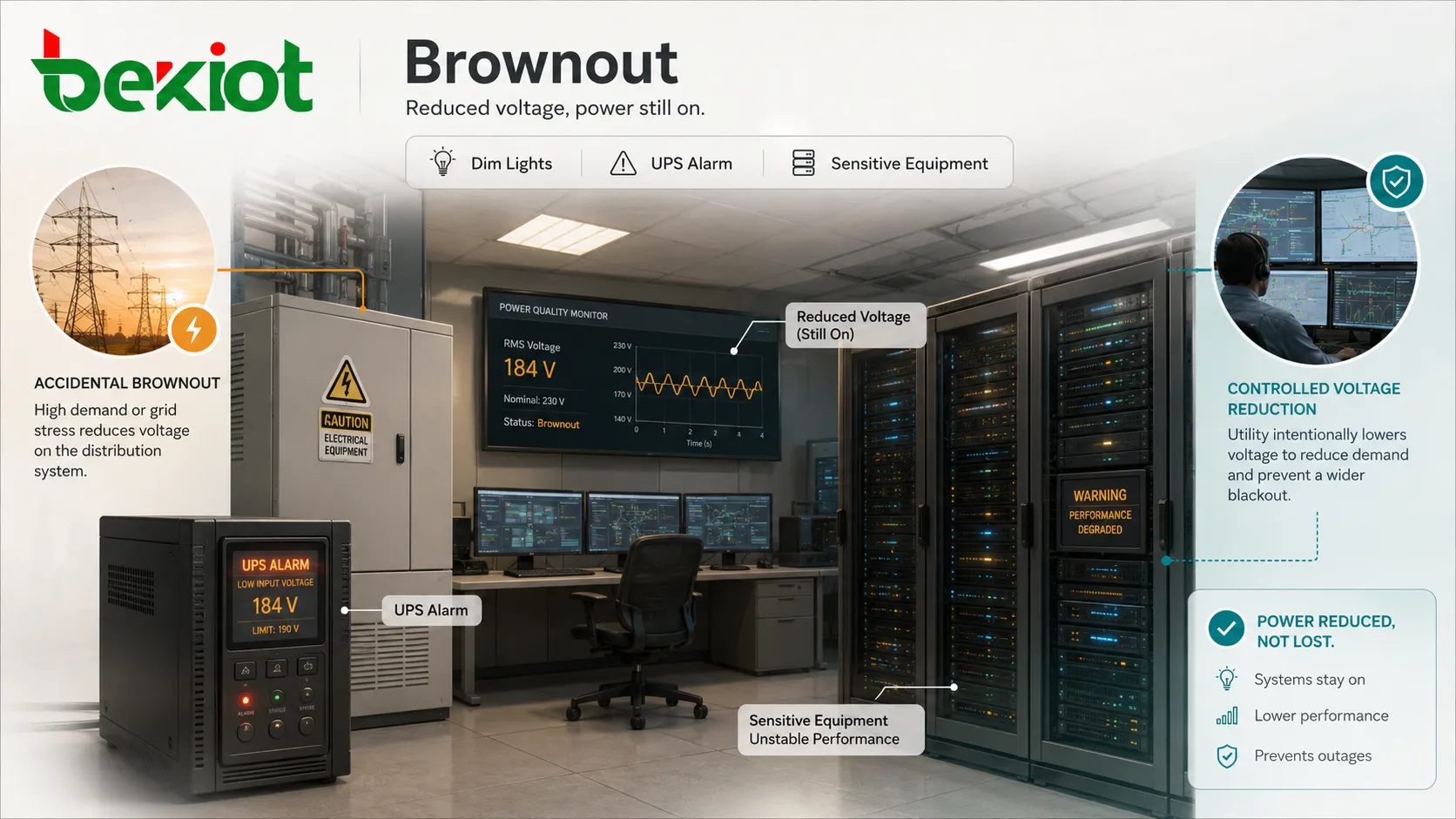
Brownouts may happen because of grid overload, high electricity demand, utility equipment stress, weak distribution infrastructure, long feeder lines, transformer limitations, large motor starting, or intentional voltage reduction by a power utility. In many cases, users notice dim lights, slow motors, equipment resets, unstable operation, or alarms from UPS and power monitoring systems.
A Power Quality Problem with Two Faces
Brownout can be accidental or intentional. An accidental brownout occurs when the power system cannot maintain normal voltage because of load pressure, infrastructure weakness, faults, or distribution limitations. An intentional brownout may be used by a utility as a controlled voltage reduction strategy to reduce demand and prevent a wider outage.
This dual nature makes the topic easy to misunderstand. For end users and equipment, reduced voltage is often a risk. For grid operators, controlled voltage reduction may sometimes help stabilize the system under extreme load. The value depends on who is managing the event and whether the connected equipment can tolerate the voltage range.
In engineering terms, brownout belongs to the wider field of power quality. It is related to undervoltage, voltage sag, voltage dip, and supply instability, although exact definitions may vary by standard, region, and measurement duration.
How Reduced Voltage Develops
Demand Exceeds Local Capacity
One common cause is excessive demand on the electrical grid. During heat waves, cold snaps, industrial peaks, or evening load surges, many users may consume power at the same time. If generation, transmission, or distribution capacity is under stress, voltage may fall.
In this situation, the grid may still deliver electricity, but the voltage cannot remain at the expected level. Buildings at the end of long distribution lines may experience the effect more clearly.
Distribution Network Limitations
Transformers, feeders, cables, switchgear, and local distribution networks have capacity limits. If equipment is overloaded or aging, voltage regulation may become less stable. Long cable runs and undersized conductors can also cause voltage drop under heavy load.
This is common in older facilities, temporary power systems, rural feeders, construction sites, industrial parks, and buildings where electrical loads have grown beyond the original design.
Large Equipment Starting
Large motors, compressors, pumps, elevators, HVAC units, welding machines, and heavy industrial loads can draw high inrush current when starting. This sudden current demand can pull voltage down temporarily.
If the supply system is strong, the voltage drop may be small and brief. If the system is weak, the drop may disturb nearby equipment or trigger protective devices.
Utility-Controlled Voltage Reduction
In some cases, the power utility may intentionally reduce voltage within a controlled range to lower demand and avoid a larger outage. This is usually part of grid management rather than a random failure.
However, even controlled reduction must remain within acceptable limits. If voltage drops too far or lasts too long, equipment performance and safety can be affected.
What Happens Inside Electrical Equipment
Different equipment responds differently to reduced voltage. Some devices continue operating normally within a wide input range. Others become unstable quickly. The result depends on power supply design, motor characteristics, control logic, protection settings, load type, and voltage tolerance.
Electronic power supplies may draw more current to maintain output power when input voltage falls. This can increase heating and stress components. Devices with poor power supply design may reset, freeze, or shut down.
Motors may slow down, overheat, fail to start, or draw excessive current under low-voltage conditions. This is especially important for compressors, pumps, fans, conveyors, elevators, and industrial machinery.
Control systems may behave unpredictably if voltage falls below the reliable operating range. Relays may chatter, contactors may drop out, sensors may give unstable readings, and programmable controllers may restart.
Visible Signs in Buildings and Facilities
Lighting Changes
One of the most visible signs is dimming lights. Traditional incandescent lighting becomes noticeably dimmer when voltage drops. Some LED drivers may flicker, dim, or shut down depending on their design.
Lighting symptoms are useful warning signs, but they do not reveal the full electrical condition. A building can have serious voltage problems even if lights appear only slightly affected.
Equipment Restarting
Computers, routers, switches, communication terminals, servers, controllers, and security devices may reboot when input voltage falls below their power supply threshold. Repeated restarting can interrupt work and may corrupt data.
UPS alarms, power supply fault logs, and monitoring records often provide better evidence than user observations alone.
Motor Strain
Motors may sound different, start slowly, stall, or run hotter. In refrigeration, HVAC, pumping, and industrial systems, low voltage can shorten motor life and increase maintenance risk.
Motor protection relays, overload devices, and voltage monitoring should be checked if brownout conditions are suspected.
Difference from Blackout, Voltage Sag, and Power Surge
A blackout is a complete power interruption. During a blackout, electricity is unavailable. During a brownout, power remains present, but voltage is lower than normal.
A voltage sag or dip is often shorter in duration and may occur for milliseconds to seconds. A brownout usually implies a longer or more noticeable reduction, though terminology can vary depending on context and standard.
A power surge is the opposite type of disturbance. It is a temporary rise in voltage or transient energy. Surge protection and brownout protection address different electrical problems, although both may be part of a complete power quality strategy.
These distinctions matter because the protective measures are different. A surge protector does not solve low voltage. A UPS may help with short brownouts or outages, but it must be correctly sized. A voltage regulator may stabilize input voltage, but it has limits.
Possible Benefits of Controlled Voltage Reduction
Although brownouts are usually viewed as a problem by end users, controlled voltage reduction can have specific grid-management benefits. When used carefully by utilities, reducing voltage slightly may lower total load across a distribution area and help avoid a complete blackout.
This can support grid stability during peak demand, generation shortage, emergency operating conditions, or infrastructure stress. For a utility, a controlled reduction may be less disruptive than cutting power entirely.
However, this benefit does not mean reduced voltage is harmless. Sensitive equipment, motors, medical devices, industrial processes, and communication systems may still require stable voltage. Therefore, controlled voltage reduction should be managed within safe limits and supported by proper equipment protection on the user side.
The benefit of a controlled brownout belongs mainly to grid stability. For equipment owners, the priority is detection, protection, and continuity planning.
Applications and Scenarios Where It Matters
Commercial Buildings
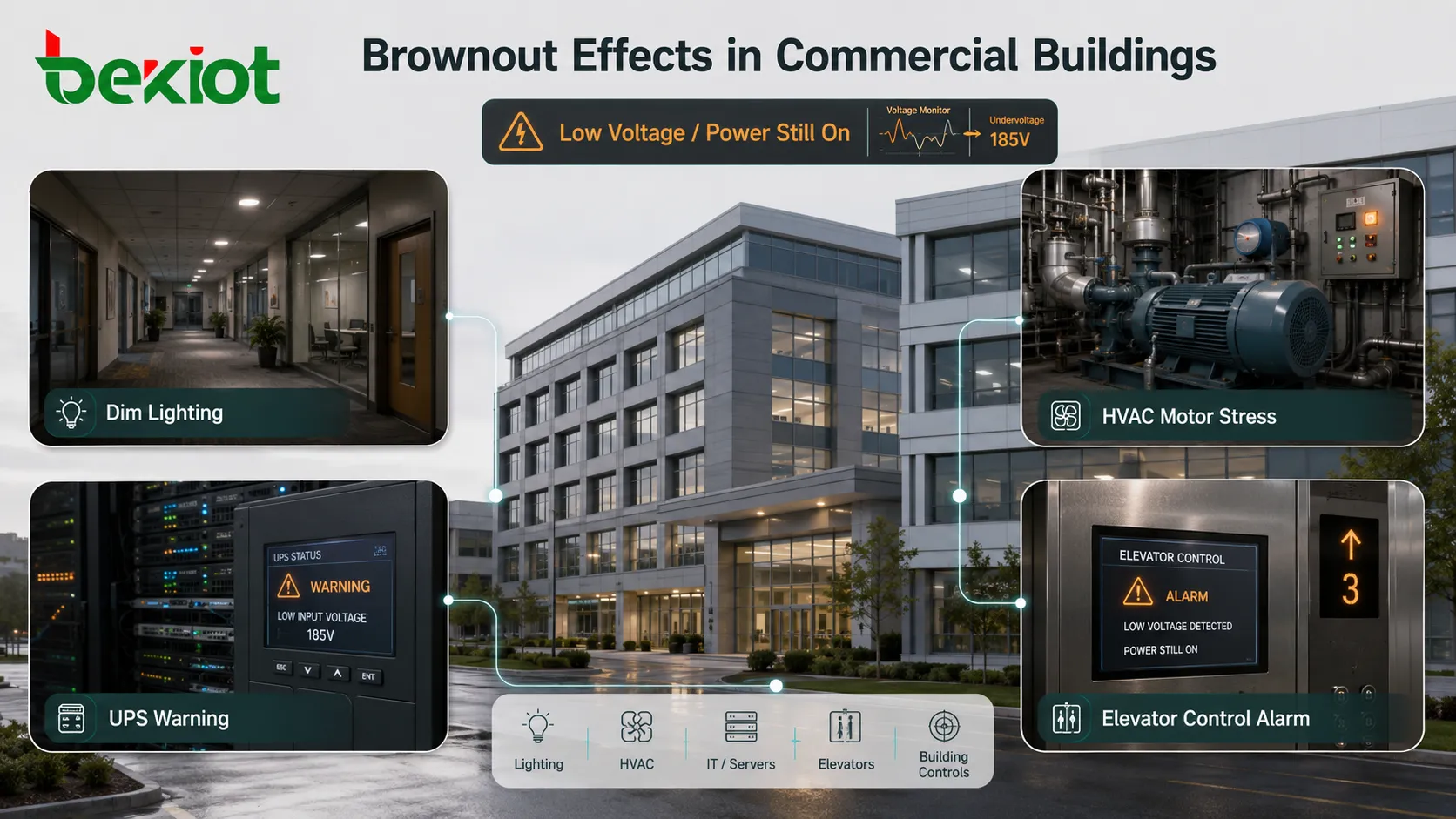
Office buildings, hotels, shopping centers, hospitals, schools, and public facilities may experience voltage reduction during high load periods or local distribution problems. Brownouts can affect elevators, lighting, HVAC, access control, fire alarm interfaces, IT rooms, and security systems.
Building managers should monitor power quality and protect critical loads with suitable UPS, voltage regulation, backup power, and alarm reporting.
Industrial Facilities
Factories, warehouses, workshops, production lines, pumping stations, and processing plants are sensitive to low voltage because they often use motors, drives, PLCs, sensors, robots, and control cabinets.
A brownout may stop a line, damage motor windings, cause drive faults, reset controllers, or create product quality issues. Industrial sites often need voltage monitoring, motor protection, power factor review, and electrical capacity planning.
Data and Communication Rooms
Servers, switches, routers, storage devices, PBX systems, gateways, and monitoring platforms need stable power. Even a brief low-voltage event can trigger reboot, storage errors, service interruption, or network instability.
UPS systems, dual power supplies, power distribution units, monitoring logs, and generator integration are commonly used to reduce the impact.
Residential and Small Business Sites
Homes and small businesses may notice dim lights, slow fans, appliances behaving abnormally, routers restarting, or refrigerators struggling to start. Repeated low voltage can reduce appliance life and cause nuisance faults.
Users should not ignore frequent events. A licensed electrician or utility provider may need to check service voltage, wiring, panel loading, neutral connection, and transformer condition.
Remote and Temporary Power Systems
Construction sites, temporary events, mobile facilities, rural buildings, generators, and off-grid systems can experience voltage drops because of long cable runs, generator overload, poor distribution design, or sudden load changes.
Load planning, cable sizing, generator capacity, voltage regulation, and staged motor starting are important in these environments.
Protection Methods
Voltage Monitoring
Power meters, voltage relays, smart PDUs, UPS logs, and building monitoring systems can detect low-voltage events. Monitoring provides evidence and helps identify whether the issue is local, facility-wide, or utility-related.
Without measurement, users may confuse brownouts with device faults, software problems, or network failures.
UPS Systems
A UPS can protect critical equipment by supplying stable power during short voltage reductions or outages. Line-interactive and online UPS systems may also provide voltage regulation depending on design.
UPS sizing should consider load power, runtime, inrush current, battery condition, transfer behavior, and whether the protected equipment includes motors or only electronics.
Automatic Voltage Regulation
Voltage regulators and power conditioners can correct moderate voltage variation. They are useful where voltage is unstable but within a correctable range.
They cannot solve every problem. Severe undervoltage, overloaded circuits, poor wiring, or utility faults may require infrastructure correction.
Motor Protection
Motors should be protected against undervoltage, phase loss, overload, and locked rotor conditions. Protection relays can disconnect motors before damage occurs.
For important equipment, soft starters, variable frequency drives, staged startup, and proper feeder design can reduce voltage drop during starting.
Electrical Capacity Review
If brownouts occur frequently inside a facility, the electrical system may be undersized or poorly distributed. Load studies, conductor sizing, transformer capacity, panel balance, grounding, and neutral integrity should be reviewed.
Correcting the underlying power distribution problem is often more effective than adding small point-of-use devices everywhere.
Design Considerations for Critical Systems
Critical systems should define acceptable voltage range, runtime requirement, load priority, alarm threshold, and recovery behavior. A server room and a pump station may need very different protection strategies.
Recovery behavior is important. Some equipment does not restart safely after voltage returns. HVAC compressors, industrial drives, process controllers, and communication systems may require staged restart or operator confirmation.
Alarm design should also be practical. If voltage drops slightly for a short time, the system may record an event. If voltage falls below a dangerous threshold, it may trigger urgent notification or automatic load shedding.
For multi-site organizations, power quality records should be centralized. Comparing events across sites can help identify utility patterns, seasonal demand problems, equipment aging, or facility-specific issues.
Common Mistakes
Relying Only on Surge Protectors
Surge protectors are designed to limit overvoltage transients. They do not correct sustained low voltage. A complete power strategy may need both surge protection and undervoltage protection.
Ignoring Motor Loads
Motors are often more vulnerable to low voltage than office electronics. If a site has pumps, compressors, fans, conveyors, or elevators, brownout planning should include motor protection.
Oversizing the Load on a Generator
Generators can produce voltage instability when overloaded or when large loads start suddenly. Generator sizing should include starting current, load sequencing, power factor, and voltage regulation capability.
Not Testing UPS Batteries
A UPS may appear normal during daily operation but fail when voltage drops if its batteries are weak. Battery testing and replacement are essential.
Restarting Everything at Once
After voltage returns to normal, simultaneous restart of many loads can create another voltage drop. Staggered restart and load prioritization can reduce this risk.
A brownout should be treated as a system-level power quality event, not only as a brief inconvenience. Its impact depends on voltage depth, duration, load type, and protection design.
FAQ
Can a brownout damage electronics immediately?
It can, especially if the device has a weak power supply or repeatedly resets. Some electronics tolerate moderate voltage variation, but repeated undervoltage can still shorten service life.
Why do lights dim but some devices keep working?
Different devices have different voltage tolerance. Some power supplies can operate across a wide input range, while lighting and motors may show visible effects sooner.
Should equipment be turned off during a brownout?
For non-critical devices, turning them off may reduce stress. For critical systems, shutdown should follow a planned procedure to avoid data loss, process interruption, or unsafe restart.
Can a UPS solve every brownout problem?
No. A UPS can protect selected loads, but it must be properly sized and maintained. Whole-building or motor-related voltage problems may require electrical system improvements.
What should be checked after frequent low-voltage events?
Check utility supply records, panel loading, transformer capacity, cable sizing, neutral connections, grounding, motor starting current, UPS logs, and power quality measurements.







