


Duty roster scheduling is the process of arranging personnel, shifts, responsibilities, rest periods, on-call duties, backup roles, and coverage plans over a defined time period. It is used wherever work must continue beyond a single person’s availability or where staffing coverage must match changing demand, safety needs, service hours, or operational rules.
Unlike a simple attendance list, a roster connects people, time, skills, workload, locations, and operational responsibilities. A well-designed schedule helps organizations avoid understaffing, reduce fatigue, manage labor costs, improve response speed, support compliance, and make daily work more predictable for managers and employees.
Why Many Fields Need Structured Staffing
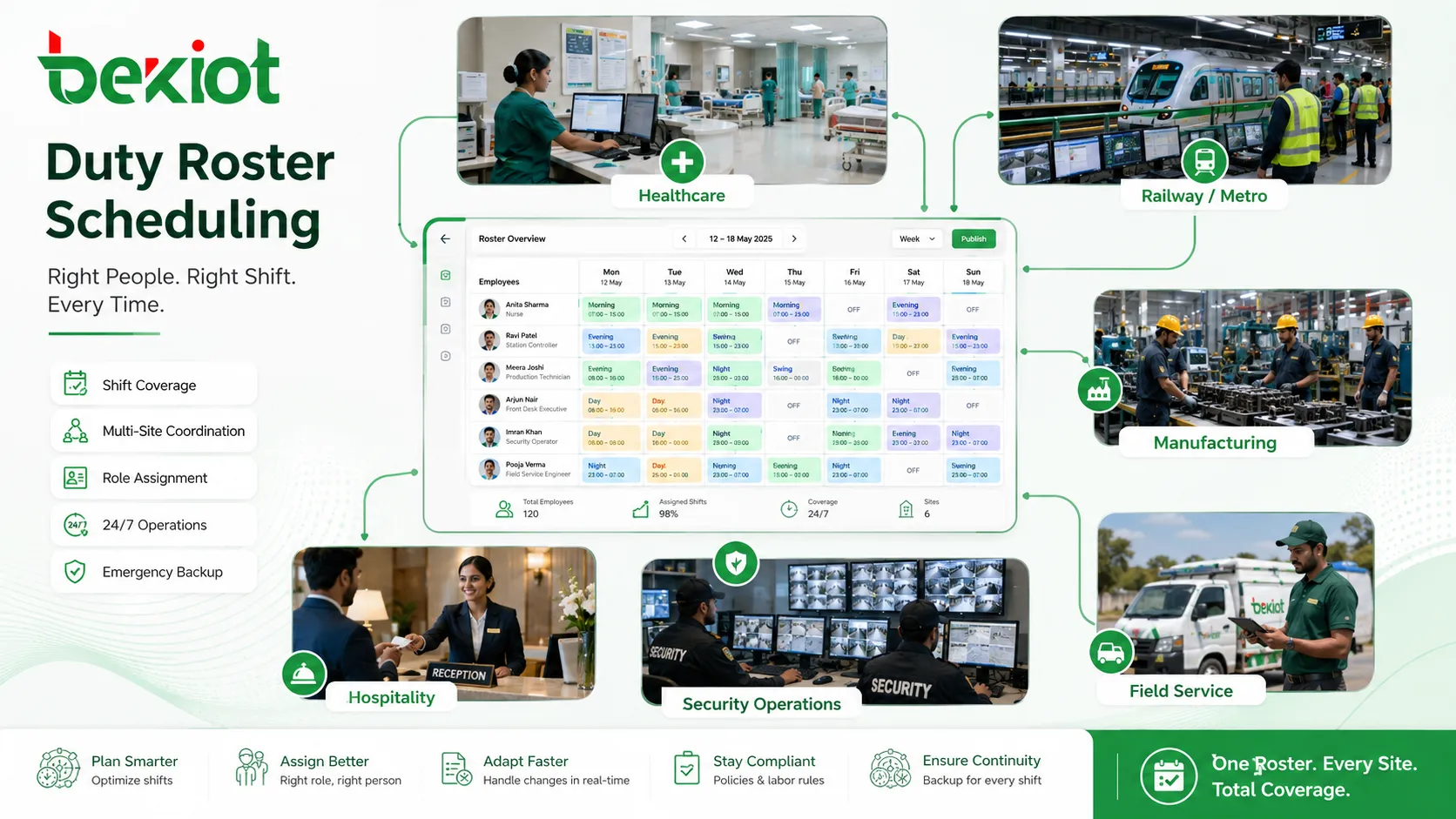
Different industries face different scheduling pressures. A hospital must ensure medical coverage at all hours. A railway station must cover peak passenger flow. A factory must keep production lines running. A hotel must serve guests across day and night. A security company must assign guards to sites without leaving gaps.
These requirements cannot be managed reliably with memory, informal chat messages, or last-minute phone calls. Structured scheduling creates a visible plan that shows who is working, when they are working, where they are assigned, what role they perform, and who replaces them if something changes.
The value becomes stronger when the organization has multiple sites, rotating teams, legal rest requirements, specialized skills, emergency coverage, seasonal demand, or 24/7 operations.
Healthcare and Medical Services
Healthcare is one of the most schedule-sensitive sectors. Hospitals, clinics, emergency rooms, nursing homes, laboratories, pharmacies, ambulance services, and telemedicine centers need reliable staffing across day shifts, night shifts, weekends, holidays, and emergency periods.
Rosters must consider professional qualifications, department coverage, patient load, legal working hours, fatigue risk, handover timing, and specialist availability. A nurse, surgeon, radiologist, pharmacist, lab technician, and emergency responder may not be interchangeable, so skills-based planning is essential.
In healthcare, poor scheduling can affect patient care, staff stress, response time, and safety. This is why many organizations combine roster planning with attendance systems, hospital information systems, on-call management, and escalation procedures.
Security and Public Safety
Security teams, control rooms, emergency response centers, fire services, campus patrols, property guards, public safety departments, and monitoring centers rely heavily on shift planning. Their work often continues 24 hours a day, including nights, weekends, and holidays.
Scheduling in this field must ensure that key posts are never left unattended. Gatehouses, patrol routes, CCTV rooms, access control desks, incident response teams, and emergency lines may all require assigned personnel.
Supervisors also need backup arrangements. If a guard is absent, an alarm occurs, or a major event happens, the roster should show who can respond, who is on standby, and who has authority to escalate.
Transportation and Mobility Operations
Railway and Metro Systems
Railway and metro systems need roster planning for station staff, train operators, dispatchers, maintenance teams, platform personnel, ticketing staff, cleaning teams, and emergency response groups. Demand changes during rush hours, events, weather disruptions, and holiday travel.
Rosters must align with service timetables, safety rules, shift handovers, rest periods, and route coverage. A missing operator or dispatcher can affect service continuity.
Airports and Airlines
Airports use duty planning for ground staff, security screening, baggage handling, check-in counters, gate teams, aircraft maintenance, cleaners, operations centers, and emergency services. Airlines also schedule pilots, cabin crew, dispatchers, and technical crews according to strict duty-time rules.
Because flight schedules change frequently, roster systems need flexibility. Delays, cancellations, weather events, and crew limitations can all require rapid reassignment.
Ports and Logistics Hubs
Ports, freight terminals, warehouses, and distribution centers schedule crane operators, drivers, inspectors, yard staff, customs support, equipment maintenance, and warehouse teams. Workload often depends on ship arrivals, truck flow, order volume, and seasonal demand.
Structured rosters help match labor capacity with real operational peaks.

Manufacturing and Industrial Sites
Factories, refineries, power plants, mines, water treatment facilities, warehouses, chemical plants, and assembly lines often use rotating shifts. Production may run continuously, and equipment may require supervision even outside normal office hours.
Scheduling must consider machine operators, quality inspectors, maintenance engineers, control room staff, safety officers, warehouse workers, and supervisors. Some roles require certification or equipment-specific training, so the roster must match skills to job positions.
Industrial sites also need emergency coverage. A maintenance fault, alarm, process deviation, or safety incident may require an on-call engineer or emergency response team. This makes standby and escalation planning part of the scheduling process.
Hospitality, Retail, and Customer Service
Hotels, restaurants, shopping centers, supermarkets, entertainment venues, call centers, and customer service teams use rosters to match staffing with customer traffic. Workload may vary by time of day, weekday, season, event, or promotion.
Hotels need front desk, housekeeping, maintenance, security, kitchen, restaurant, concierge, and night-shift coverage. Restaurants and retail stores need staff during peak hours while controlling labor cost during quiet periods.
Call centers use scheduling to match agent availability with call volume forecasts. Skills may include language, product knowledge, customer tier, technical support level, or sales qualification.
IT, Data Centers, and Technical Support
IT operations teams often use duty schedules for help desks, network operations centers, data centers, cybersecurity monitoring, cloud operations, database administration, and incident response. Many services must remain available after office hours.
Rosters define who handles first-level alerts, who is on call for escalation, who covers weekends, and who manages planned maintenance windows. In cybersecurity and infrastructure operations, delayed response can increase business risk.
Technical rosters should include skill coverage. A general help desk agent may not be able to solve a firewall failure, database outage, or cloud platform incident. Escalation paths must be clear.
Energy, Utilities, and Infrastructure Services
Power grids, water utilities, gas distribution, telecom networks, renewable energy plants, district heating systems, and public infrastructure operators require continuous monitoring and rapid fault response. Their schedules often include control room shifts, field crews, standby engineers, and emergency repair teams.
Utility operations are highly dependent on response readiness. A cable fault, pump failure, gas leak, transformer alarm, or network outage may require technicians with the right tools and certifications.
Rosters in this sector are often linked to geographic coverage. The closest qualified team may need to respond to a site, so location and travel time are important scheduling factors.
Education, Campuses, and Public Institutions
Schools, universities, libraries, government offices, museums, sports centers, and public service buildings use schedules for teaching assistants, security, reception, facility teams, lab support, IT help desks, cleaning, and event staff.
Campuses often have mixed operating hours. Classrooms, dormitories, laboratories, libraries, gates, sports areas, and administrative offices may each require different coverage patterns.
During exams, ceremonies, public events, or emergencies, rosters help coordinate temporary staffing increases and cross-department support.
Field Service and Maintenance Teams
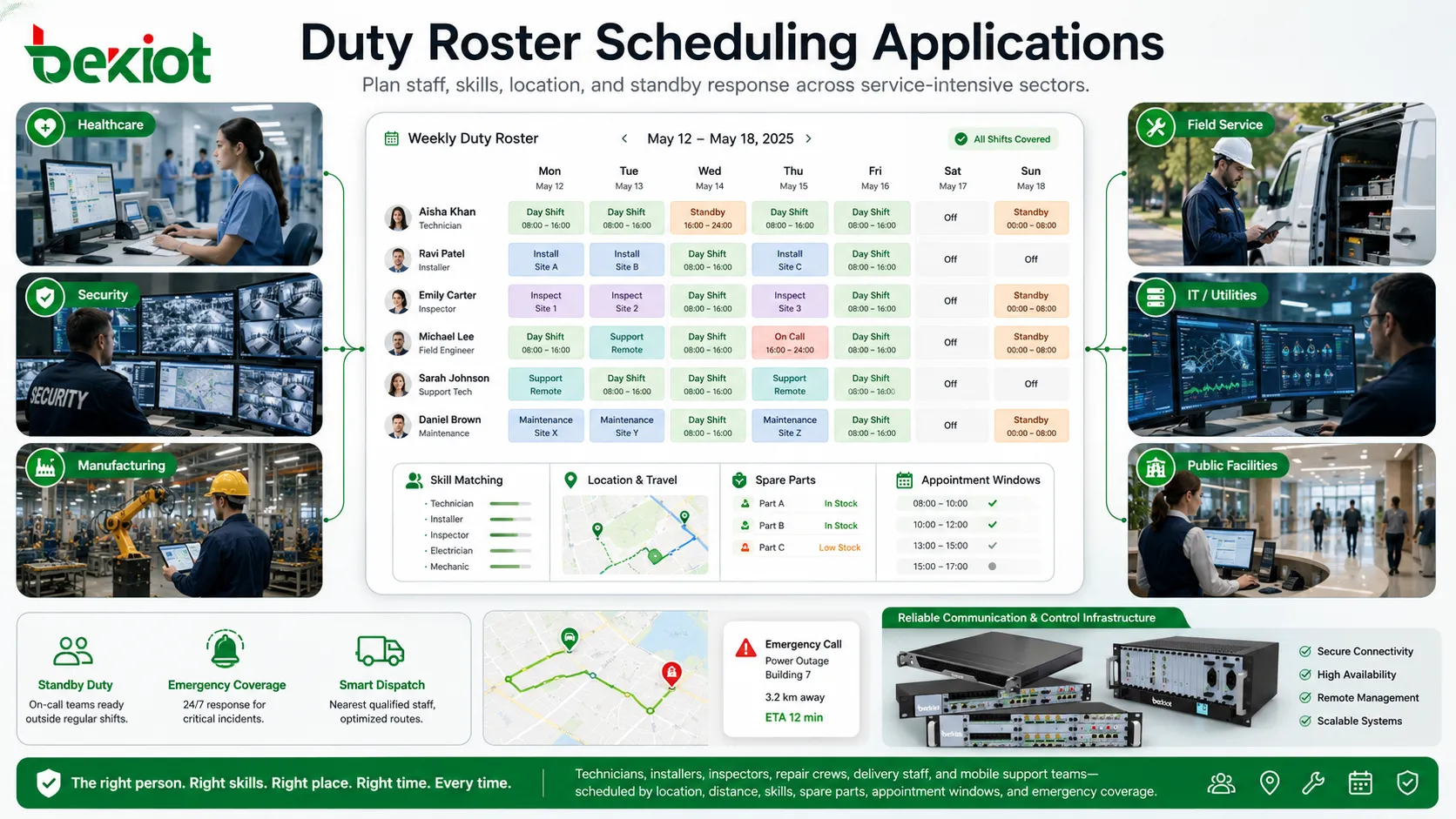
Field service organizations schedule technicians, installers, inspectors, repair crews, delivery staff, and mobile support teams. Their planning must consider location, travel distance, skill requirements, spare parts, customer appointment windows, and emergency calls.
For maintenance companies, a roster is not only a shift plan. It is also a resource allocation tool. The right technician must be available at the right place with the right tools and permissions.
Standby duty is common in this field. If equipment fails outside normal hours, the roster should identify who can be contacted and how quickly they can respond.
Common Scheduling Requirements Across Sectors
Coverage Planning
Every schedule must ensure that required positions are covered. This may mean one receptionist during quiet hours, multiple nurses during peak care periods, several operators in a control room, or rotating field crews for emergency coverage.
Coverage planning should consider real demand instead of using the same staff level at all times.
Skill Matching
Many positions require specific qualifications. A roster should show not only who is available but also whether they are qualified for the role. This is important in healthcare, aviation, utilities, industrial work, IT operations, and public safety.
Rest and Fatigue Control
Shift work can create fatigue if schedules are poorly designed. Long hours, short rest periods, frequent night shifts, and unpredictable changes can reduce safety and performance.
Good scheduling balances business needs with employee health and legal working-time rules.
Leave and Absence Handling
Vacations, sickness, training, public holidays, and emergency leave must be included in the planning process. A good roster has backup logic rather than collapsing when one person is unavailable.
Communication and Visibility
Employees and managers need clear visibility. The latest schedule should be easy to access, and changes should be communicated quickly. Confusion about shift time or location can cause service gaps.
Digital Tools and Automation
Many organizations now use workforce management platforms, scheduling software, HR systems, mobile apps, attendance terminals, payroll integration, and notification tools. These systems reduce manual errors and make schedule updates easier.
Automation can help generate shifts, detect conflicts, enforce rest rules, match skills, send reminders, handle swap requests, and record attendance. However, automation still needs human oversight because real operations include exceptions.
The best systems allow managers to adjust schedules quickly while keeping records. This is important when audits, payroll disputes, safety investigations, or compliance reviews occur.
Practical Design Principles
Start with demand patterns. A schedule should reflect when work actually occurs, not only when managers prefer staff to be present. Historical workload, peak hours, service levels, and seasonal changes should be reviewed.
Separate fixed roles from flexible roles. Some positions must be covered at all times, while others can move according to workload. This distinction makes scheduling more efficient.
Build backup capacity. Absence, emergencies, overtime limits, and sudden workload increases are normal. A roster without backup options is fragile.
Make handover visible. In 24-hour operations, one shift must pass information to the next. The roster should support clear handover windows and responsibility transfer.
Review performance regularly. Missed shifts, overtime, fatigue complaints, service delays, and employee turnover may indicate that the schedule needs redesign.
A duty roster is effective when it connects business demand, employee availability, required skills, compliance rules, and real-time operational changes into one manageable plan.
FAQ
Can small businesses use duty roster scheduling?
Yes. Even a small team can benefit from clear shift planning, leave tracking, backup coverage, and fair workload distribution.
What is the difference between a roster and a timesheet?
A roster is a plan for who should work and when. A timesheet records what was actually worked. Both are useful, but they serve different purposes.
How can shift swaps be controlled?
Shift swaps should require approval, skill verification, rest-rule checking, and schedule update confirmation so that coverage and compliance are not affected.
Why do some schedules fail even when every shift is filled?
A shift may be filled by the wrong skill level, the workload forecast may be inaccurate, handover may be weak, or fatigue may reduce performance.
What should be included in a roster policy?
A policy should define shift rules, rest periods, overtime approval, swap process, leave handling, on-call duties, emergency coverage, notification method, and responsibility for updates.







