An APN, or Access Point Name, is a key mobile network parameter that tells a cellular device how to connect to a packet data network. It identifies the access gateway, routing environment, authentication rules, IP address policy, and service network that should be used when a mobile terminal accesses data services through a cellular operator.
For most smartphone users, APN settings are almost invisible. After a SIM card is inserted, the device usually receives the correct operator profile automatically and can start using mobile data for browsing, video, messaging, payment, navigation, and cloud applications. However, in enterprise communication, public safety, industrial IoT, mobile video backhaul, and private network projects, APN becomes much more than a simple phone setting. It can be used as a controlled access method that connects authorized mobile terminals to a dedicated service network.
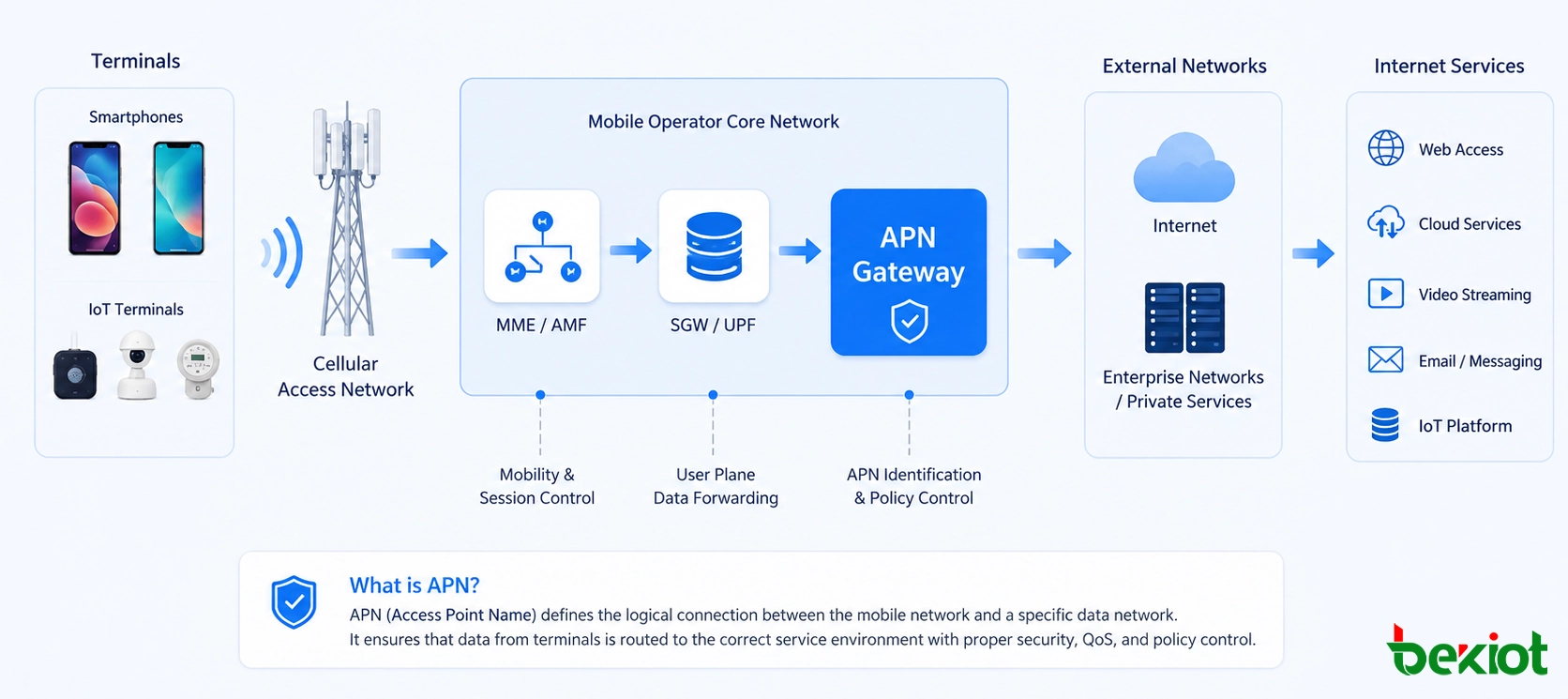
How mobile data reaches an external network
The early internet was mainly built around fixed network access. Computers, servers, and enterprise systems were connected through wired broadband, dedicated lines, or local area networks. When mobile internet became widely used, phones and cellular terminals also needed a way to reach external data networks through radio access networks.
A mobile device cannot simply send data directly from the cellular air interface to the public internet or to an enterprise intranet. The traffic must pass through operator-side network systems that manage subscriber identity, authentication, IP address allocation, routing, billing, and service access. The APN is the name used by the device and operator network to determine which data gateway and service path should be used.
In this process, the cellular device first registers with the mobile network through the SIM card. When the device requests mobile data service, it includes the APN profile. The operator network checks whether the SIM card is allowed to use that APN. If access is approved, the network establishes a data session and assigns the device an IP address according to the corresponding policy.
The role of the operator gateway
The APN gateway is normally provided and managed by the mobile operator. It acts as the transition point between the cellular network and the destination data network. For ordinary consumer mobile data, this gateway usually routes traffic to the public internet. For dedicated enterprise services, the gateway may route traffic to a private customer network, a data center, a command platform, or an industry application system.
A common example is a public mobile data APN used by an operator. When a mobile phone uses a standard SIM card, the device automatically selects the operator’s default APN and connects to the corresponding gateway. The network then assigns an IP address and allows the device to access normal internet services.
Operators usually deploy multiple APN gateway resources across different regions and service domains. This helps distribute user traffic, reduce network pressure, improve access reliability, and support different service types. In some projects, certain SIM cards may also be configured to use a designated access node or a dedicated APN profile according to the customer’s service requirements.
APN is not only a configuration item on a phone. In a complete mobile network, it is part of the access control, routing, addressing, and service separation mechanism.
Standard APN access for consumer mobile data
For individual users, APN configuration is usually automatic. The SIM card, mobile operating system, and operator profile work together to provide the correct mobile data settings. This is why most users do not need to manually enter an APN name when using a modern smartphone.
A standard APN profile may include the APN name, authentication type, username, password, IP protocol type, proxy setting, MMS setting, and other optional parameters. In many cases, only the APN name is essential. Other fields are either left empty or automatically defined by the operator.
When the APN is correctly configured, the mobile device can obtain a data session. If the APN name is wrong, missing, or not allowed for the SIM card, the device may show mobile signal but fail to access data services. This is a common reason why some industrial routers, cellular cameras, vehicle gateways, or IoT terminals cannot connect even though the SIM card is active.
Private access for industry and enterprise users
One of the most important uses of APN is to provide a dedicated access point for industry customers. Some organizations need mobile terminals to access internal systems through the operator’s cellular network without exposing those systems directly to the public internet. In this situation, the operator can create a private APN for the customer.
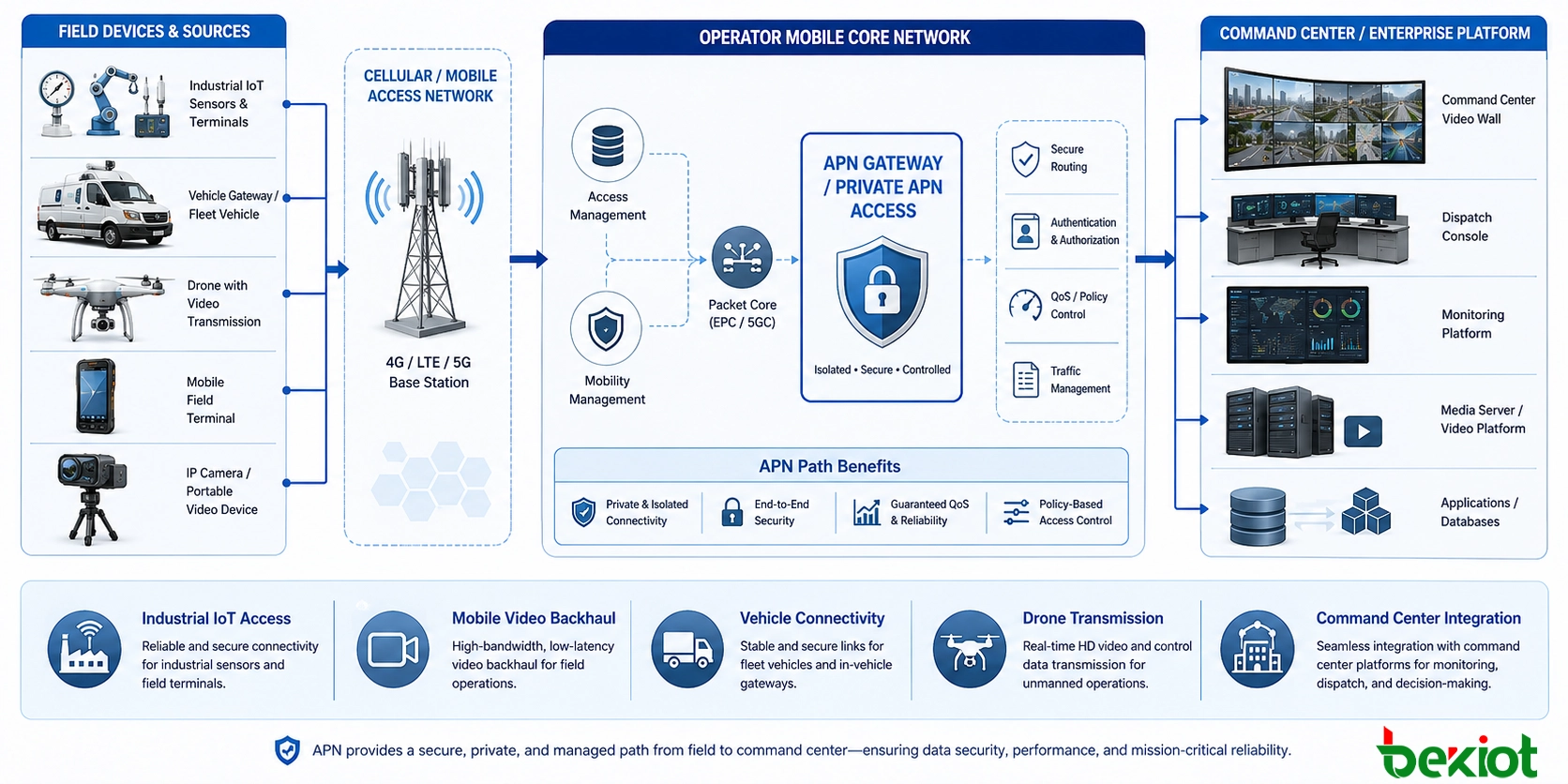
With a private APN, approved SIM cards can be configured to connect to a dedicated gateway. After authentication, the device traffic is forwarded to the customer’s private network, command center, data platform, video platform, or application server. This allows mobile terminals to communicate with internal systems while keeping the access path separated from ordinary consumer mobile internet traffic.
Depending on the project design, the private APN gateway may be deployed in the operator network, connected to the customer’s data center, or integrated with enterprise-side infrastructure through optical fiber, dedicated line, VPN, MPLS, SD-WAN, or other secure transport methods. The enterprise and operator can jointly define routing policies, IP address ranges, SIM card permissions, traffic packages, and gateway capacity.
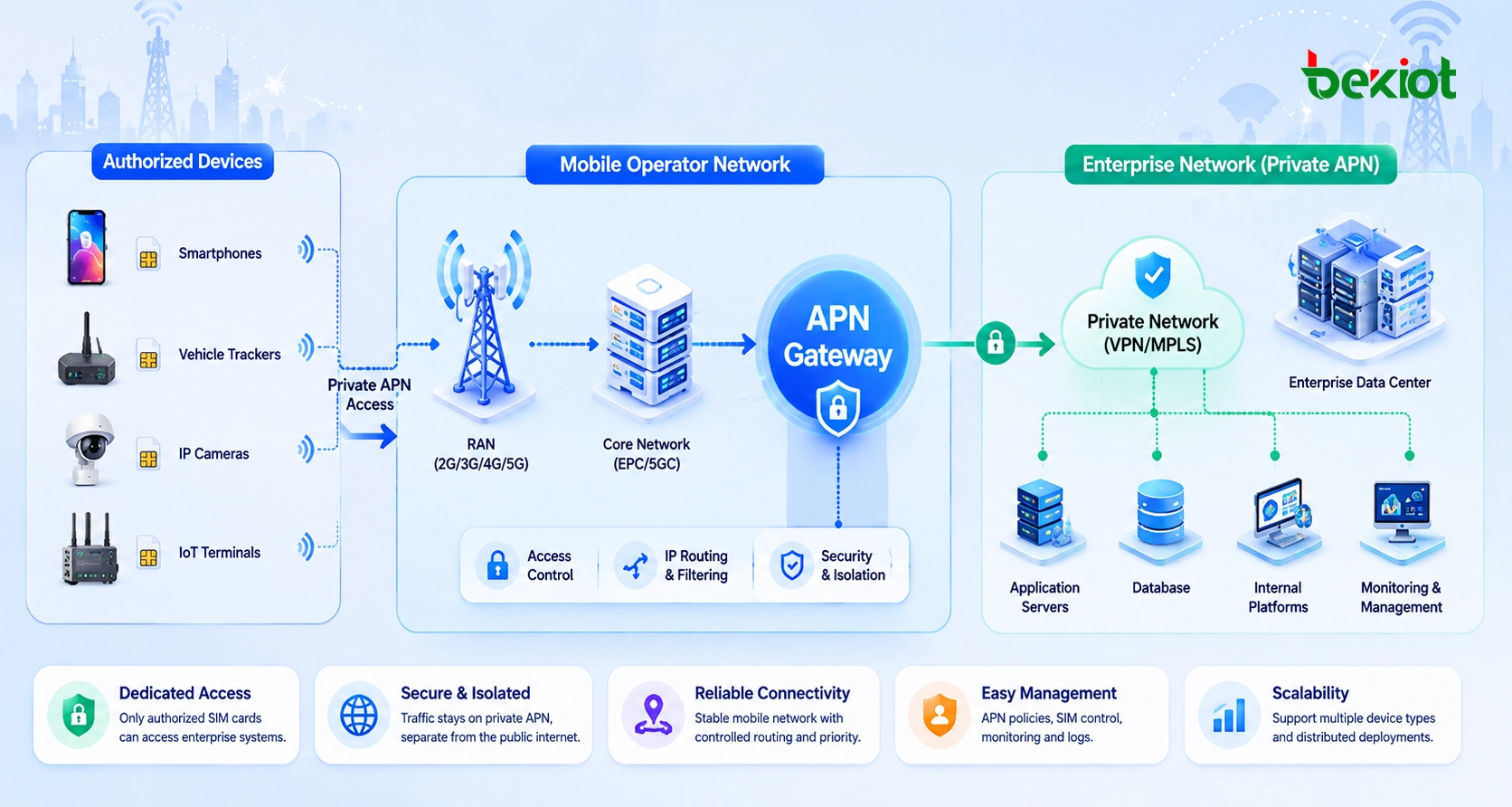
Typical private APN architecture
A complete private APN solution usually includes cellular terminals, dedicated SIM cards, base station access, the operator core network, APN gateway resources, enterprise-side network connection, and the final business platform. The device side may be a smartphone, industrial router, vehicle-mounted gateway, mobile video terminal, IoT sensor, unmanned system, or field communication device.
The terminal first connects to the cellular network using the SIM card. It then requests a data session through the configured APN name. The operator verifies whether the SIM card is authorized for that APN. Once the request is approved, the terminal receives an IP address and the traffic is forwarded to the designated enterprise network.
In many projects, the customer may require private IP addressing so that devices can be managed as part of a closed enterprise network. In other projects, the operator may assign addresses and route traffic according to agreed service rules. The correct design depends on the number of devices, traffic volume, security requirements, routing model, maintenance method, and application platform.
Why enterprises use dedicated mobile access
Private APN access is useful when an organization needs more control than ordinary public mobile data can provide. Public internet access is convenient, but it may not be suitable for systems that require controlled routing, fixed service access, private addressing, centralized device management, or separation from consumer traffic.
For example, a command center may need field terminals to send video, location, voice, telemetry, or event data back to an internal platform. A logistics company may need vehicle-mounted devices to report positioning and operating status. A utility company may need remote monitoring units to transmit meter data or alarm events. A public safety organization may need emergency communication terminals to connect to a dispatch system during field operations.
In these scenarios, APN-based private access helps simplify mobile deployment. Devices can be installed in vehicles, temporary sites, remote stations, construction zones, outdoor facilities, emergency sites, or mobile command units. As long as cellular coverage is available and the SIM card is authorized, the device can reach the designated network through the configured APN.
Application scenarios across different industries
APN is widely used in mobile communication projects where devices must connect to specific business systems. In industrial IoT, it supports remote sensors, PLC communication gateways, smart meters, environmental monitoring stations, and equipment status collection terminals. These devices often need stable access to a central platform rather than unrestricted internet browsing.
In mobile video projects, APN can support body-worn cameras, vehicle cameras, drone video gateways, portable transmission backpacks, 4G and 5G video encoders, and emergency site video terminals. Through a private APN, video streams can be sent to a command center, media server, recording system, or video management platform using a more controlled access route.
In transportation and logistics, APN can be used for fleet tracking, onboard monitoring, dispatch data, electronic waybills, mobile terminals, and remote diagnostics. In energy, utilities, mining, and chemical plants, it can support unattended sites, inspection terminals, remote alarm reporting, and mobile maintenance devices. In government and emergency management, it can support mobile command, temporary communication, field coordination, and cross-site data access.
Public internet access, private APN, and VPN
APN, private APN, and VPN are often discussed together, but they are not the same thing. A standard public APN normally allows a device to reach the public internet. A private APN controls which mobile terminals can enter a specific access environment and where their traffic is routed. A VPN creates an encrypted tunnel over an existing network connection.
| Access Method | Main Purpose | Typical Use |
|---|---|---|
| Public APN | Provides standard mobile internet access | Smartphones, tablets, consumer mobile data, ordinary app access |
| Private APN | Separates authorized SIM traffic and routes it to a dedicated network | Enterprise terminals, IoT devices, private platforms, command systems |
| VPN | Encrypts data transmission over an existing IP connection | Secure remote access, encrypted application traffic, cross-network protection |
A private APN can improve access control and network separation, but it does not automatically replace all security measures. For critical communication systems, private APN access is often combined with VPN encryption, firewall policies, device certificates, platform authentication, access control lists, monitoring, logging, and security auditing.
Technical factors that affect project design
Before deploying an APN-based enterprise solution, the organization should define the target application clearly. A video transmission system has different requirements from a low-bandwidth telemetry system. A mobile command vehicle has different requirements from a fixed remote monitoring cabinet. The number of terminals, expected bandwidth, online duration, uplink traffic, downlink traffic, and regional coverage must all be considered.
IP addressing is another key factor. Some projects require fixed private IP addresses for easier device management. Others can use dynamic addressing if the device initiates all connections to the platform. When devices need to be accessed from the platform side, routing, NAT traversal, firewall rules, and security permissions must be carefully planned.
The enterprise should also evaluate whether the device supports manual APN configuration, automatic reconnection, SIM binding, multi-SIM redundancy, 4G/5G fallback, remote configuration, traffic monitoring, firmware upgrade, and log export. These functions are especially important in outdoor, mobile, industrial, or emergency communication environments where on-site maintenance may be difficult.
Capacity, traffic, and reliability planning
Private APN projects should not only focus on whether the device can connect. They also need to consider long-term capacity and service stability. When a large number of terminals connect at the same time, the APN gateway, operator access resources, enterprise-side link, firewall, server platform, and storage system must all be able to handle the expected traffic.
For IoT systems, traffic may be small but continuous. For video backhaul, uplink traffic may be heavy and highly variable. For emergency communication, the system may remain lightly used during normal periods but suddenly require high concurrency during incidents. These differences affect SIM package planning, gateway capacity, access bandwidth, platform sizing, and redundancy design.
Reliable APN deployment may also require backup links, dual-SIM devices, multi-operator access, local data buffering, automatic reconnection, and health monitoring. In mission-related communication, the system should be designed not only for normal operation but also for weak signal areas, temporary congestion, power interruption, equipment reboot, and unexpected field conditions.
A well-designed APN solution should consider access permission, routing, addressing, bandwidth, security, device management, and operational maintenance as one complete system.
Security and access control considerations
A private APN can separate enterprise device traffic from public mobile internet access, but secure system design still requires multiple layers. The first layer is SIM authorization. Only SIM cards approved by the operator and enterprise should be allowed to use the dedicated APN. This prevents ordinary consumer users from entering the same access environment.
The second layer is network-side control. The enterprise can define which IP ranges, ports, services, and platforms are reachable from the APN network. Firewalls and access control policies should prevent unnecessary exposure of internal systems. If the project involves sensitive video, command data, public safety information, or industrial control data, encrypted tunnels and strict authentication should be considered.
The third layer is platform and device management. Even if a terminal can access the APN, it should still authenticate with the application platform. Device IDs, certificates, login accounts, API keys, role permissions, and operation logs can help prevent unauthorized use and support incident tracing.
Common problems in APN configuration
Many APN connection problems are caused by simple configuration errors. The APN name may be typed incorrectly, the SIM card may not be authorized for the private APN, the device may use the wrong authentication type, or the operator profile may not match the enterprise service. In industrial routers and video gateways, some devices also require manual selection of IP protocol type or network mode.
Another common issue is that the device appears online in the cellular network but cannot reach the enterprise platform. In this case, the problem may not be the APN name itself. It may be caused by routing rules, firewall restrictions, DNS configuration, private IP address conflicts, NAT policies, or platform-side access permissions.
For troubleshooting, engineers should check the SIM status, signal strength, APN name, authentication settings, assigned IP address, gateway route, DNS response, ping result, port reachability, VPN status if used, and platform connection logs. A complete troubleshooting process is much faster than repeatedly changing APN names without confirming the network path.
Deployment checklist for enterprise projects
A practical APN project should begin with clear service planning. The organization should confirm which terminals need mobile access, where they will be deployed, what data they will transmit, how often they will connect, and which internal platforms they must reach. This helps determine the APN type, SIM policy, bandwidth plan, and access architecture.
The next step is coordination with the operator. The enterprise should confirm the APN name, SIM authorization method, gateway deployment model, enterprise-side connection method, IP address allocation plan, routing rules, traffic package, security policy, and service-level requirements. If the system supports critical operations, redundancy and fault recovery should be discussed early.
After the network is ready, device testing should be performed before mass deployment. Test items should include APN registration, IP assignment, access to the target platform, uplink and downlink performance, reconnect behavior, weak-signal recovery, SIM replacement process, traffic monitoring, and remote maintenance. Only after these items are verified should the project move into wider rollout.
Why APN remains important in 4G and 5G networks
Although mobile network technology continues to evolve, APN remains an important concept in cellular data access. In 4G LTE and many practical 5G deployments, APN-related configuration still affects how devices connect to data services, how traffic is routed, and how different service networks are separated.
For enterprises adopting 5G routers, mobile video terminals, industrial gateways, or IoT devices, APN settings are still part of the deployment process. Even when the device interface looks simple, the underlying logic still involves access selection, subscriber permission, gateway routing, IP session establishment, and service network definition.
As more organizations use cellular networks for industrial communication, remote operation, mobile command, unmanned systems, and large-scale IoT, APN-based private access will continue to be valuable. It gives enterprises a practical way to connect distributed mobile terminals to controlled application environments without relying only on open internet exposure.
FAQ
Is APN the same as a mobile data plan?
No. A mobile data plan defines commercial usage conditions such as traffic volume, billing, speed policy, and service package. APN defines the network access path used by the device. A SIM card may have a data plan but still need the correct APN to access the intended network.
Can one SIM card use more than one APN?
It depends on the operator policy and SIM authorization. Some SIM cards are allowed to use only one APN, while others may support multiple APN profiles for different services. In enterprise projects, the allowed APN is usually controlled to prevent incorrect access.
Does private APN guarantee higher bandwidth?
Not automatically. A private APN can provide controlled routing and network separation, but bandwidth still depends on cellular coverage, radio conditions, operator resources, gateway capacity, enterprise-side links, device capability, and service agreement.
Why can a device show signal but fail to connect to data?
Cellular signal only means the device can see and register with the mobile network. Data access also requires the correct APN, SIM permission, authentication setting, IP assignment, and route to the target service. Any error in these items may cause data failure.
Should enterprises use private APN for all IoT devices?
Not always. Small or low-risk projects may work with ordinary mobile internet access. Private APN is more suitable when the organization needs controlled access, private addressing, traffic separation, platform isolation, centralized management, or stronger operational control.