


A Registrar Server is a key component in SIP-based communication networks. Its main purpose is to receive registration requests from SIP endpoints, verify their identity, record their current contact address, and make that information available for call routing. Without this registration process, a SIP system may know a user’s logical identity but not know where that user can currently be reached.
In practical VoIP, IP PBX, unified communication, dispatch, intercom, mobile softphone, and enterprise voice systems, users and devices are not always fixed in one place. A desk phone may reboot, a softphone may move between networks, a mobile app may switch from Wi-Fi to cellular, and a branch endpoint may sit behind NAT. The registration layer helps the system keep track of these changing contact points.
Why Registration Exists in SIP Networks
SIP uses logical identities such as user extensions, SIP URIs, and Address-of-Record values. These identities are stable from the user’s point of view. For example, a person may be known as extension 1008 or as a SIP address such as sip:1008@example.com. However, the device currently used by that person may have a changing IP address, port, transport protocol, or network route.
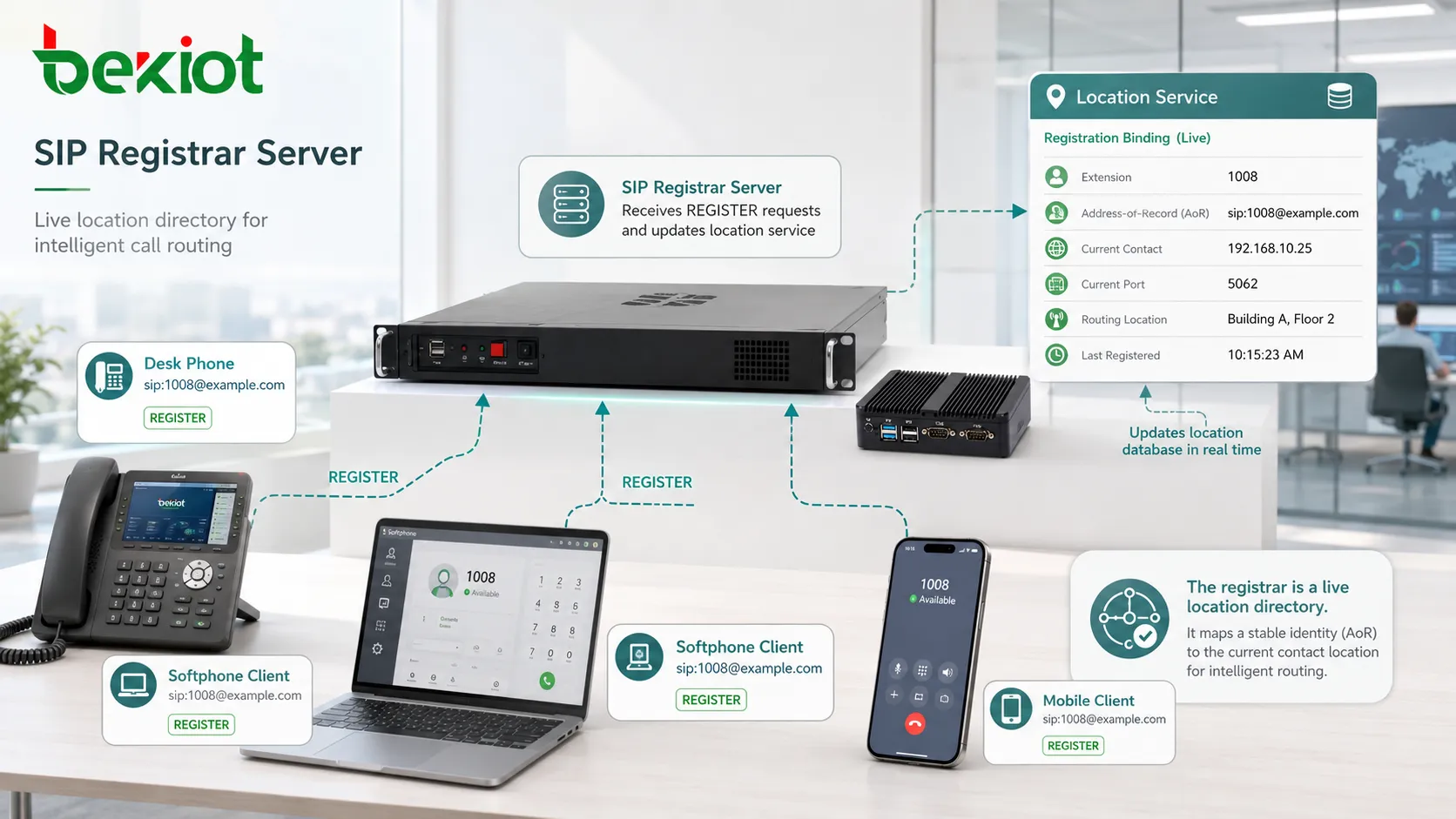
The registration process solves this mapping problem. When a phone or client comes online, it sends a REGISTER request to tell the system where it can receive future SIP requests. The server stores this binding and later allows proxy or call-routing components to locate the user.
This is why the registrar is not only a login checkpoint. It is a live location directory for SIP endpoints. It answers a practical question: “Where should the system send a call if someone wants to reach this user right now?”
The Identity-to-Contact Mapping Role
Address-of-Record
An Address-of-Record is the stable public identity of a user or endpoint. It is the address other users dial or reference. In an enterprise system, this may correspond to an extension, department account, SIP user, service number, or device identity.
The Address-of-Record does not necessarily show the user’s current device address. It is more like the name in a directory, while the registered Contact tells the system where that name can currently be reached.
Contact Binding
The Contact value tells the system the actual reachable address of the endpoint. It may include IP address, port, transport method, and other parameters. When a device registers, it creates or updates a binding between the logical identity and the current contact address.
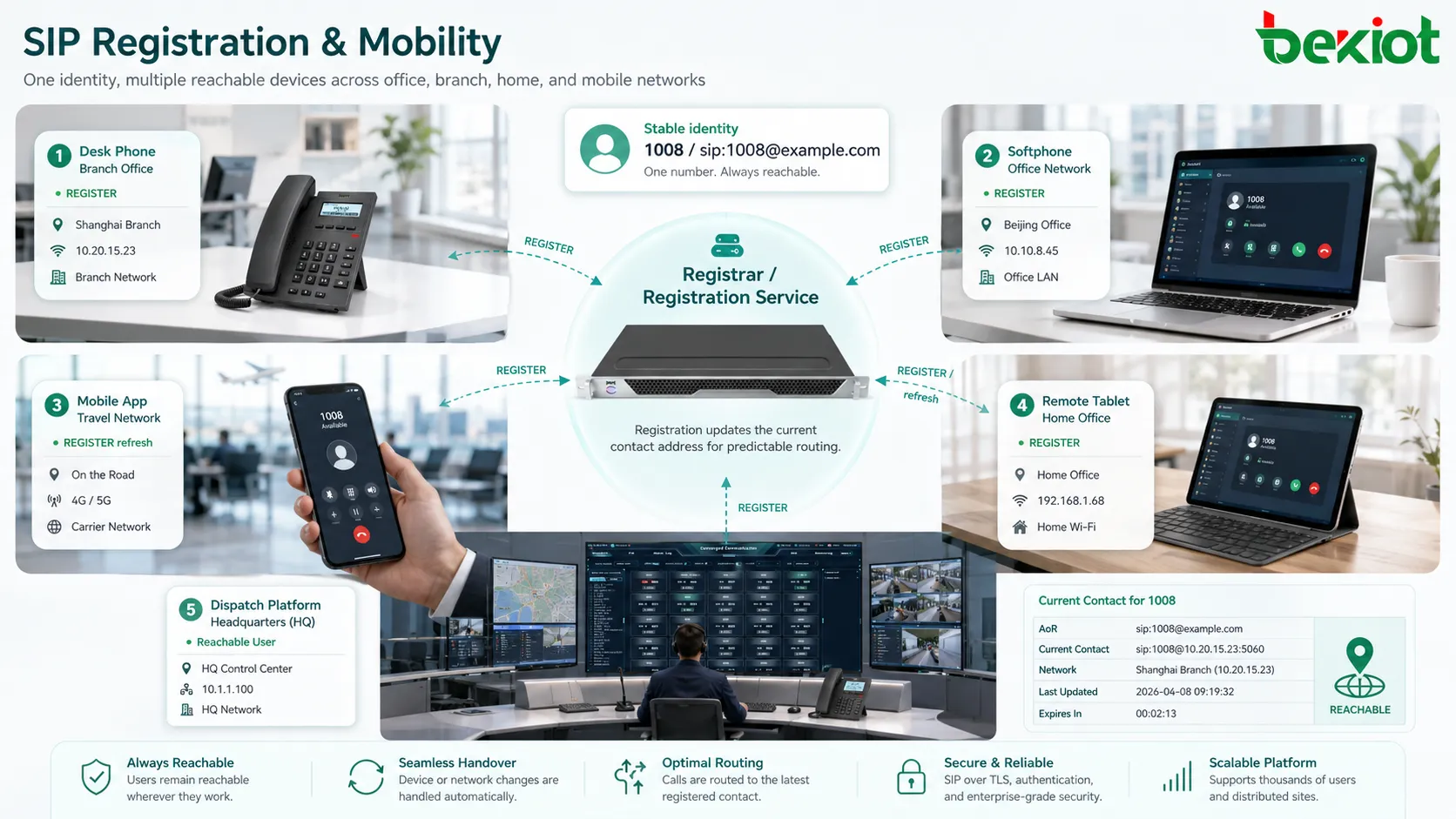
For example, the same extension may register from a desk phone in the office, a softphone on a laptop, and a mobile app. Depending on system policy, the server may store one contact or multiple contacts for the same identity.
Expiration Time
Registrations are temporary. A device usually asks for a registration duration, and the server grants an expiration interval. Before that interval ends, the device must refresh its registration. If it does not refresh, the binding may be removed.
This temporary design prevents stale records from remaining forever. If a phone loses power, moves away, or disconnects unexpectedly, its contact record will eventually expire.
How the Registration Flow Works
Endpoint Sends REGISTER
The endpoint begins by sending a REGISTER request to the SIP domain or server. This request includes identity information, Contact details, sequence information, and requested expiration settings.
If authentication is required, the first request may receive a challenge response from the server. The endpoint then resends the request with the correct authentication data.
Server Verifies the Request
The server checks whether the endpoint is allowed to register for that identity. It may verify username, password digest, certificate, source policy, domain, tenant, device profile, IP address, or account status.
This step is important because registration affects call routing. If an attacker can register as another user, incoming calls may be hijacked or redirected.
Location Record Is Updated
After successful validation, the server updates the location database. This database may be internal to the SIP server, shared with a proxy, stored in memory, replicated to another node, or written to a database depending on the platform architecture.
The record usually includes the user identity, Contact address, expiration time, path information, transport type, user agent details, and other parameters useful for routing and administration.
Response Confirms the Binding
The server replies with a success response that confirms the accepted registration and expiration behavior. The endpoint then remains reachable until the binding expires or is updated.
During normal operation, the endpoint sends refresh registrations periodically. If the device shuts down normally, it may unregister by sending a registration with expiration set to zero.
Supporting Call Routing and Reachability
When another user calls a registered identity, the SIP proxy or call-control server needs to locate the destination. It checks the location information associated with the target Address-of-Record and then routes the call toward the stored Contact address.
This makes registration directly connected to call completion. If the registration is missing, expired, or wrong, the call may fail, route to voicemail, reach the wrong device, or show the user as unavailable.
In systems with multiple registered devices, routing policy becomes important. The platform may ring all registered contacts, choose the most recent contact, prioritize a desk phone, fork the call to several endpoints, or apply user presence and device status rules.
The registrar does not usually carry the voice media. Its main value is making the correct endpoint reachable before the call can be established.
Authentication and Access Control Purpose
Protecting User Identity
Registration is closely tied to identity protection. A SIP account should only be registered by approved devices or users. If unauthorized registration is allowed, attackers may impersonate users, receive calls, create toll fraud, or disrupt normal communication.
Authentication methods may include digest authentication, TLS client certificates, IP restrictions, device provisioning credentials, or integration with identity systems. The exact method depends on the platform and security policy.
Preventing Registration Hijacking
Registration hijacking occurs when an attacker successfully registers a Contact address for another user’s identity. Once this happens, calls intended for the real user may be routed to the attacker-controlled device.
Strong credentials, rate limiting, source filtering, TLS, device certificates, alerting, and abnormal registration monitoring help reduce this risk.
Tenant and Domain Separation
Hosted communication systems may serve many organizations or domains. The registration layer must ensure that one tenant cannot register identities belonging to another tenant.
Domain-based policy, account scope, registration realm, and access-control rules help maintain separation in multi-tenant environments.
Handling Mobility and Multiple Devices
A modern user may not rely on one fixed desk phone. They may use a softphone in the office, a mobile client during travel, a tablet at home, and a desk phone at a branch site. The registration service allows each active device to announce where it can be reached.
This makes mobility possible. When the user changes network, the device can refresh its registration with a new contact address. The system does not need the caller to know the user’s current IP address or physical location.
For enterprise and industrial communication projects, Becke Telcom can be used in solution planning where SIP endpoints, gateways, dispatch terminals, and communication platforms need stable identity registration and predictable routing behavior across multiple sites.
NAT, Firewall, and Remote Endpoint Challenges
Changing Network Paths
Many endpoints are behind NAT devices or firewalls. The internal address seen by the phone may not be reachable from the SIP server. The registration process may therefore need additional support such as keepalives, received address handling, Path headers, outbound connections, or SBC assistance.
Without proper handling, the server may store a Contact address that looks valid but cannot actually be reached from outside the local network.
Registration Refresh as Keepalive
Some systems use frequent registration refreshes or separate keepalive packets to keep NAT mappings open. This helps the server continue reaching the endpoint through the same network path.
The refresh interval should be balanced. Too long may allow NAT bindings to expire. Too short may create unnecessary signaling load on the server.
Session Border Controller Assistance
An SBC can help manage registration from remote endpoints by anchoring signaling, handling NAT traversal, enforcing security policy, hiding topology, and protecting the SIP core from direct exposure.
In distributed networks, SBCs often sit between public or branch networks and the internal SIP platform. They help make registration more stable and more secure.
Registration Data Used by Other Services
Presence and Availability
Registration state can support presence or availability logic. If a device is not registered, the user may appear offline or unreachable. If several devices are registered, the platform may show more detailed availability.
Registration alone does not always equal “available to talk.” A user may be registered but busy, in do-not-disturb mode, or away. Still, registration is an important basic signal.
Device Inventory
Administrators can use registration records to see which phones, softphones, gateways, or clients are online. The user agent string, IP address, transport type, and contact history can help with inventory and troubleshooting.
This is useful in large deployments where hundreds or thousands of endpoints need monitoring.
Security Monitoring
Registration events can reveal suspicious behavior. Examples include repeated failed attempts, registrations from unusual countries, sudden device changes, duplicate contacts, impossible travel patterns, or unexpected user agent values.
Security teams can use registration logs to detect attacks, misconfiguration, credential leaks, and unauthorized endpoint activity.
Important Technical Features
Credential Validation
The server should verify that the registering endpoint is authorized to use the identity. Weak validation can lead to call interception, toll fraud, impersonation, and service disruption.
For sensitive systems, registration access should be protected with strong password policy, TLS, device provisioning control, and monitoring.
Contact Expiration Management
Expiration control keeps the location database accurate. Short expiration values detect disconnected devices faster but increase registration traffic. Long expiration values reduce signaling load but may leave stale contacts for longer.
The correct value depends on network stability, endpoint type, NAT behavior, and server capacity.
Multiple Binding Control
The server may allow several contacts for one identity or restrict one identity to a single active contact. Multi-device support improves flexibility, while single-binding policy can reduce complexity and security risk.
Enterprises should define how many devices one user can register and whether mobile clients, desk phones, and softphones should ring together.
High Availability
Registration services are critical. If the registrar fails, new devices may not register, and existing bindings may expire. High-availability designs may use clustering, database replication, shared location service, DNS SRV records, SBC failover, or redundant SIP nodes.
Failover testing should verify whether registered endpoints remain reachable after a server fault.
Logging and Audit Records
Registration logs help administrators troubleshoot and investigate incidents. Useful data includes user identity, source IP, Contact address, timestamp, expiration, authentication result, device type, transport, and response code.
Logs should be retained according to operational and security requirements while avoiding unnecessary exposure of sensitive credentials.
Deployment Scenarios
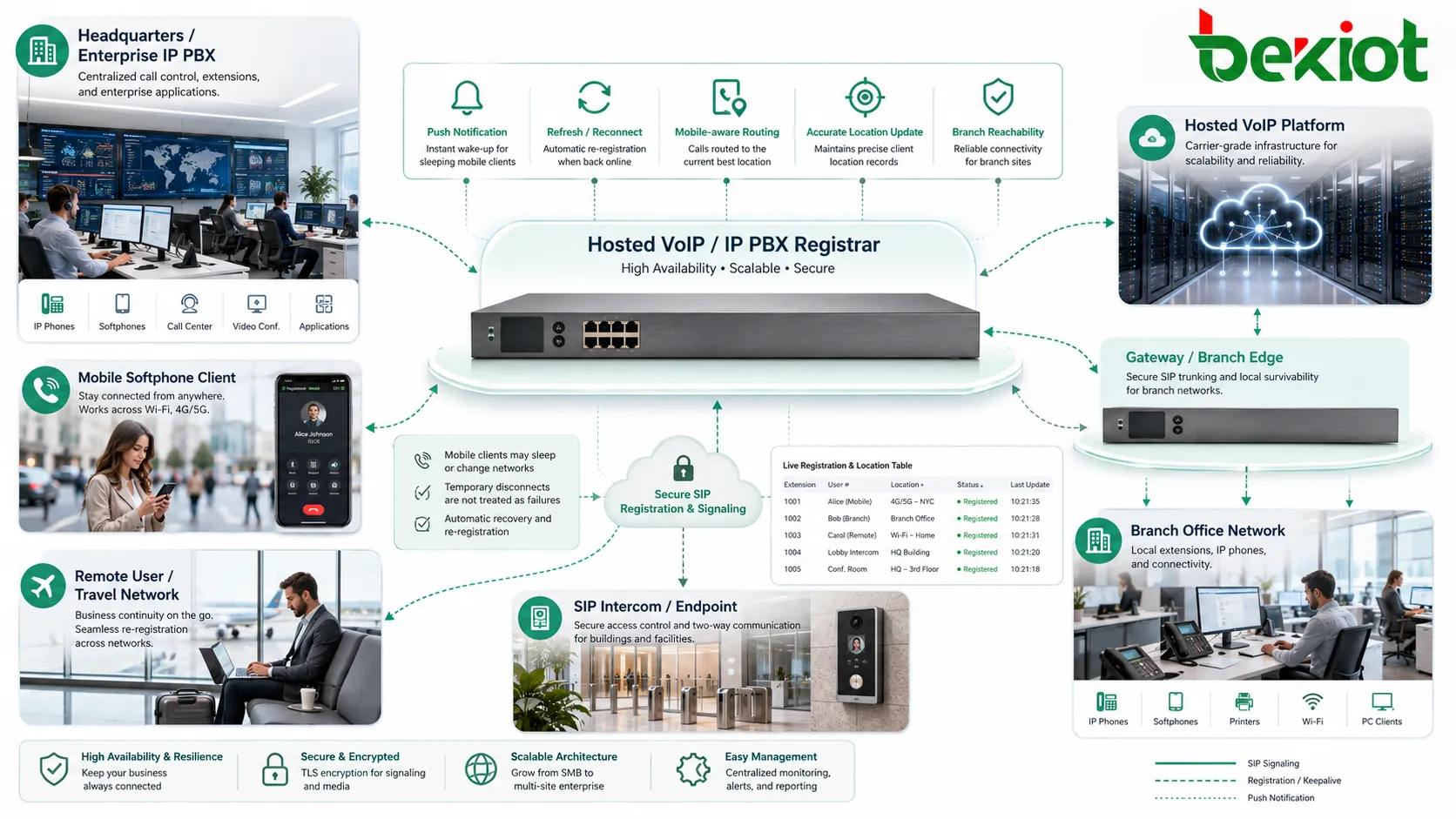
Enterprise IP PBX
In an office phone system, the registrar keeps track of desk phones, softphones, conference phones, and operator consoles. Calls can then be routed to the correct registered endpoint instead of relying on static network addresses.
This supports flexible office seating, device replacement, remote work, and extension mobility.
Hosted VoIP Platform
A hosted provider may manage registration for many customer domains. The server must separate tenants, enforce credentials, handle large endpoint volumes, and survive internet-based registration attempts.
Scalability and security become especially important in this environment.
Branch and Multi-Site Networks
Branch phones may register across WAN links, VPNs, SBCs, or local survivability gateways. Registration records help the central platform know which branch endpoints are online and reachable.
Network outages should be planned carefully. Some branches may need local fallback registration when the central platform is unreachable.
Mobile Softphone Systems
Mobile clients often change network state and may sleep to save battery. Registration design may involve push notification, shorter refresh cycles, reconnect logic, and mobile-aware routing.
The platform should avoid treating every temporary mobile disconnect as a permanent failure, while still keeping location data accurate.
Common Registration Problems
Authentication Failure
Authentication failure may be caused by wrong password, incorrect realm, outdated provisioning, clock problems, account lockout, or mismatched username format. The endpoint may repeatedly send REGISTER requests and receive rejection responses.
Checking SIP logs and endpoint configuration usually reveals whether the issue is credential-related.
Expired Contact
If a device stops refreshing its registration, the contact may expire. Incoming calls may then fail or route to fallback destinations. Causes may include network failure, device reboot, NAT timeout, firmware crash, or power loss.
Monitoring registration expiry helps detect offline endpoints before users complain.
Wrong Contact Address
A device behind NAT may register an unreachable private address. The server may store the contact successfully, but calls cannot reach the device.
SBC support, NAT-aware configuration, received address handling, or outbound connection mechanisms can help solve this issue.
Duplicate Client Identity
Two devices may attempt to register with the same identity or contact settings. Depending on policy, one registration may overwrite the other, or both may exist and cause unexpected ringing behavior.
Device provisioning should prevent accidental identity duplication.
Registration Flooding
Misconfigured devices or attacks may send excessive registration attempts. This can increase server load and hide real endpoint problems.
Rate limits, source filtering, fail2ban-style controls, SBC protection, and monitoring can reduce risk.
Most registration faults are not call media problems. They usually come from identity, contact address, authentication, expiration, NAT path, or endpoint provisioning issues.
Operational Checklist
Define the SIP domain and user identity format clearly. Endpoints should register using consistent usernames, realms, and Address-of-Record values.
Protect registration credentials. Avoid shared passwords, weak default credentials, and publicly exposed registration interfaces without filtering or monitoring.
Plan refresh intervals according to network behavior. Remote endpoints behind NAT may need different settings from phones on a stable local LAN.
Monitor online and offline status. Registration dashboards and alerts help administrators detect endpoint failures, branch outages, and suspicious activity.
Back up registrar configuration and location service settings. If the server is restored or migrated, account records, credentials, domain settings, and routing relationships must remain consistent.
FAQ
Can a SIP call work without registration?
Yes, in some static peer-to-peer or trunk configurations. However, user endpoints normally rely on registration so the system knows where to route incoming requests.
Why does a phone show registered but still cannot receive calls?
The stored Contact may be unreachable, firewall rules may block signaling or media, routing may be wrong, or the PBX may not use that registration record for inbound calls.
Does the registrar handle voice audio?
Usually no. It manages endpoint location and registration state. Voice media is commonly carried separately through RTP paths, media servers, SBCs, or direct endpoint connections.
How often should devices refresh registration?
The interval depends on server policy, NAT behavior, endpoint type, and network stability. Very short intervals increase load, while very long intervals may leave stale records.
What should be checked when many phones unregister at once?
Check network connectivity, DNS, SIP server health, authentication service, firewall changes, certificate expiry, power events, SBC status, and whether a configuration update was recently pushed.







