


Surge protection is the use of protective devices, grounding, bonding, wiring design, and coordinated installation methods to limit transient overvoltage and divert surge current away from sensitive equipment. It is used to protect power distribution systems, control cabinets, telecom lines, data networks, security systems, industrial automation, renewable energy systems, building electronics, and outdoor equipment.
A surge may last only microseconds, but its impact can be serious. It can damage power supplies, communication ports, circuit boards, sensors, controllers, network switches, cameras, access control panels, routers, meters, alarms, and field devices. In severe cases, the result is not only equipment replacement cost but also service interruption, data loss, safety risk, and repeated hidden failures.
Where Transient Overvoltage Comes From
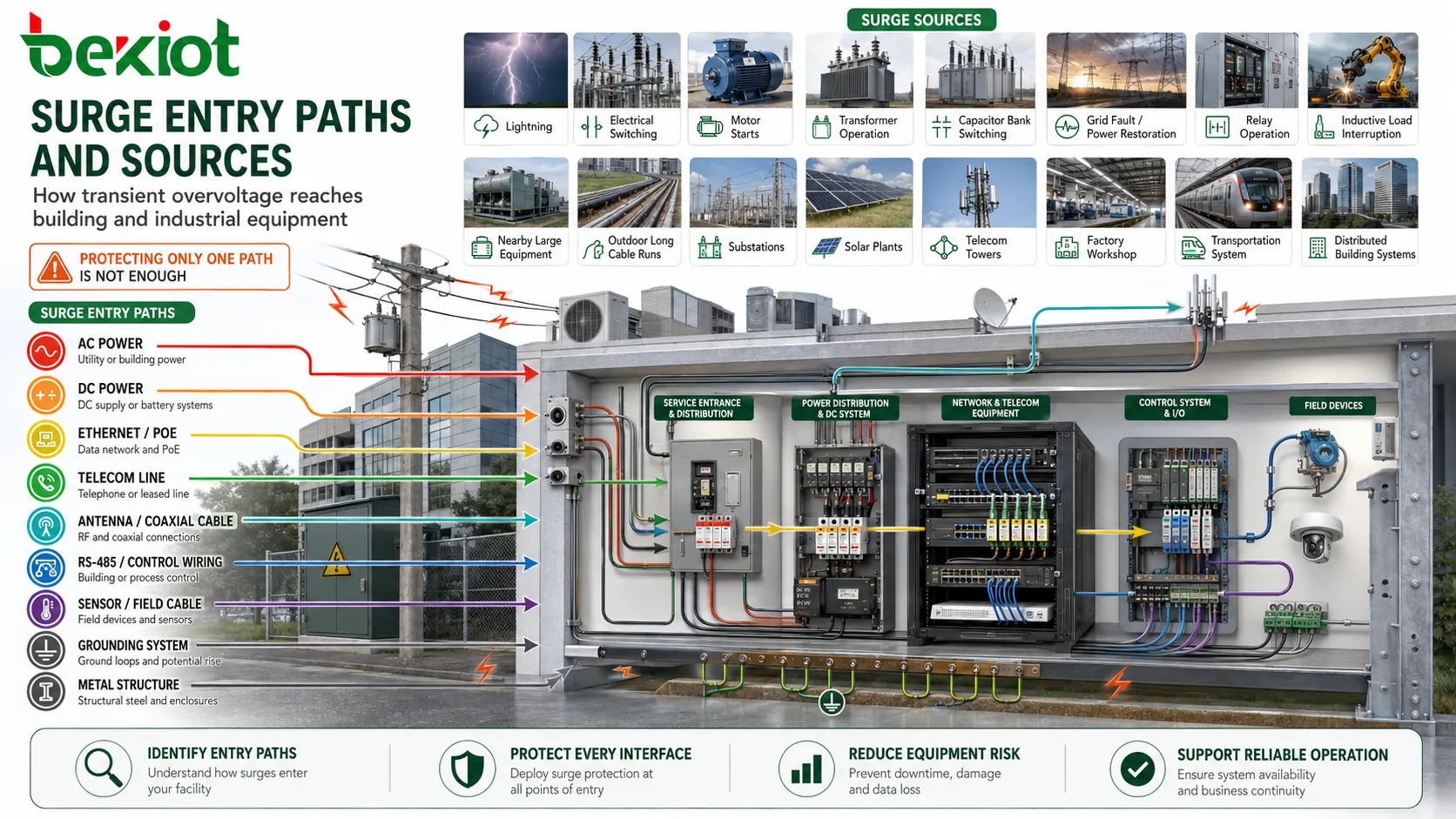
Surges are often associated with lightning, but lightning is only one source. Electrical switching, motor starts, transformer operation, capacitor bank switching, grid faults, power restoration, relay operation, inductive load interruption, and nearby large equipment can also create short-duration overvoltage events.
Outdoor installations, long cable runs, rooftop equipment, utility entrances, substations, solar plants, telecom towers, factory workshops, transportation systems, and distributed building systems are more exposed because their wiring can collect and carry surge energy across long distances.
Protection planning should begin by identifying entry paths. Surge energy may enter through AC power, DC power, Ethernet, PoE, coaxial cable, RS-485, telephone lines, antenna feeders, control wiring, sensor cables, grounding conductors, or metal structures. Protecting only one path may leave another path open.
Standards That Guide Product Selection
IEC 61643 Series
The IEC 61643 series is widely used for surge protective devices. Different parts apply to different circuits and applications. Low-voltage AC power systems, DC power systems, photovoltaic installations, telecommunications networks, signalling networks, and surge protection components may each require different standard references.
For AC low-voltage power circuits, IEC 61643-11 defines requirements and test methods for devices connected to AC systems. For telecom and signalling networks, IEC 61643-21 addresses devices used on communication and signal lines, including lines that may also carry power such as PoE.
UL 1449
UL 1449 is a major North American safety standard for surge protective devices. It is commonly referenced when selecting equipment for U.S. or UL-listed installations. It covers device safety and performance evaluation for products intended to limit transient voltage surges.
When a project requires UL-listed SPDs, the exact product type, voltage rating, installation location, enclosure, short-circuit current rating, and marking information should be checked carefully.
NEC and Local Electrical Codes
Electrical codes define how protection devices should be installed, connected, grounded, and coordinated in real buildings and facilities. In the United States, NEC requirements are important, but adoption may vary by state or local authority.
For any region, the installer should verify the currently adopted code, local inspection requirements, building use, service entrance conditions, and special requirements for emergency systems, dwellings, healthcare, industrial sites, or public facilities.
EN, CE, and Regional Rules
For European markets, EN versions of IEC standards and applicable CE conformity routes may be relevant. For other regions, local electrical regulations, utility standards, fire codes, telecom rules, and product certification schemes may also apply.
International projects should not assume that one certification automatically satisfies all markets. Product documentation should match the destination region and installation category.
Industry-Specific Requirements
Railway, marine, photovoltaic, wind power, oil and gas, data centers, medical facilities, airports, telecom towers, and industrial control systems may require additional protection levels or installation practices. These environments often involve higher exposure, critical continuity needs, or stricter safety requirements.
Project teams should review both product standards and system-level design standards. A qualified SPD alone does not guarantee a qualified protection system if grounding, bonding, cable routing, and coordination are poor.
How Protection Levels Are Usually Expressed
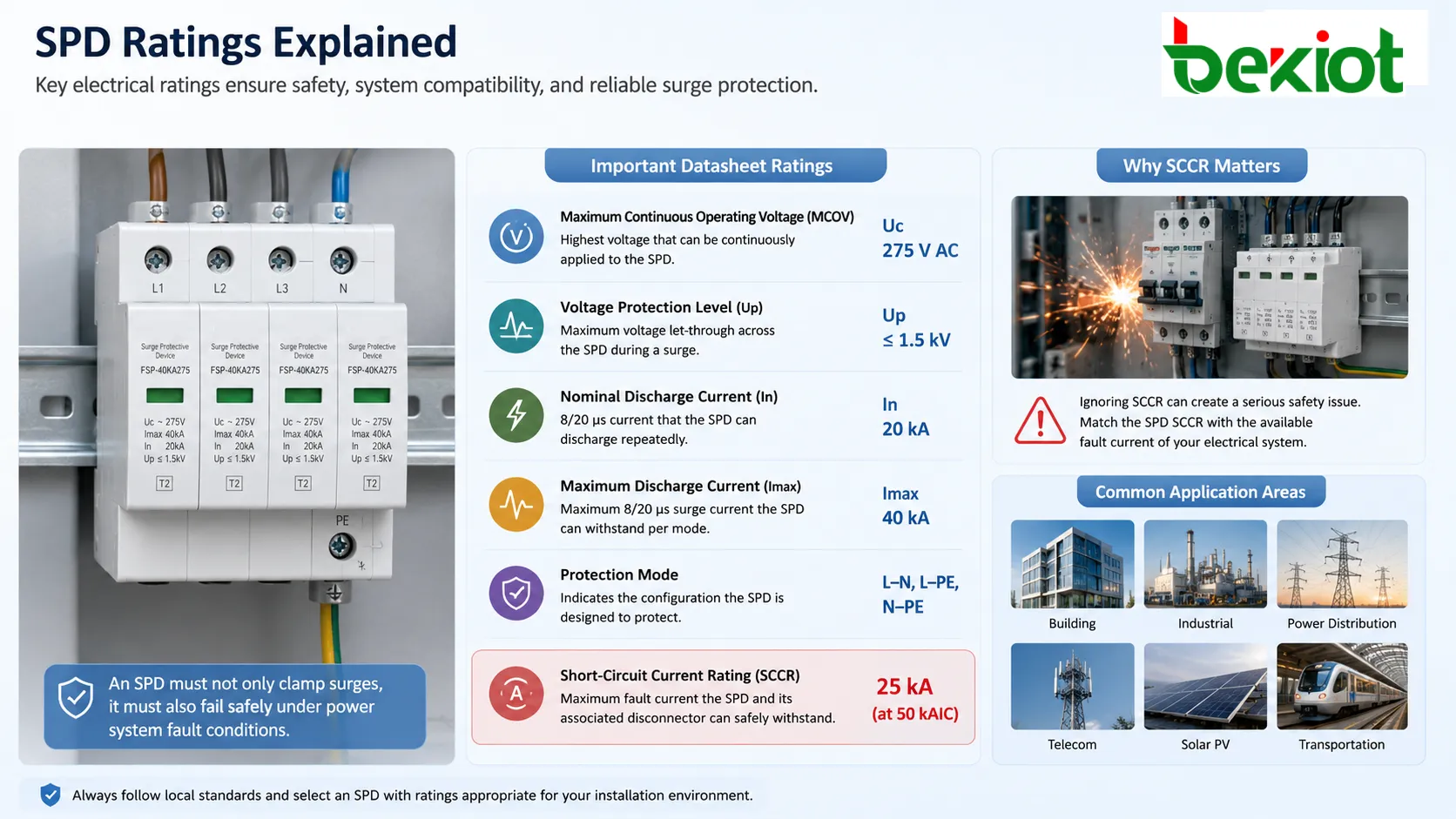
Protection level is not a single number. It is described through several ratings and parameters, including maximum continuous operating voltage, voltage protection level, nominal discharge current, maximum discharge current, impulse current, short-circuit current rating, response behavior, protection mode, and installation type.
A low voltage protection value may look attractive, but it must be suitable for the system voltage and expected surge current. A device with high discharge capacity may still protect poorly if it is installed with long leads, weak grounding, or wrong coordination with downstream devices.
For this reason, protection levels should be interpreted together with installation position, upstream protection, system earthing type, cable length, exposure risk, and the withstand capability of protected equipment.
Type 1, Type 2, and Type 3 Coordination
Type 1 at the Service Entrance
Type 1 devices are commonly used at the origin of the installation or service entrance where high-energy surges may enter the building. They are often selected when there is external lightning protection, overhead lines, high exposure, or a need to handle larger impulse currents.
The purpose is to reduce the major incoming surge energy before it spreads through the internal distribution system. Placement and bonding are critical because this level handles the first major surge path.
Type 2 at Distribution Panels
Type 2 devices are commonly installed at distribution boards, sub-panels, control cabinets, and internal power distribution points. They reduce residual surge energy that remains after upstream protection or that is generated inside the facility.
In many buildings and industrial sites, Type 2 protection is the central layer of low-voltage surge control. It protects groups of downstream circuits and helps reduce stress on terminal equipment.
Type 3 Near Sensitive Loads
Type 3 devices are used close to sensitive equipment or final loads. They are intended to limit remaining transient voltage at the point of use. Examples include protection for control devices, computers, data equipment, security panels, instrumentation, or communication terminals.
Type 3 protection should usually not be used as the only protective layer in high-exposure installations. It works best when coordinated with upstream Type 1 or Type 2 devices.
| Layer | Typical Location | Main Purpose | Design Note |
|---|---|---|---|
| Type 1 | Service entrance or main incoming panel. | Handles high-energy incoming surge current. | Needs strong bonding and very short connection paths. |
| Type 2 | Distribution board, sub-panel, or control cabinet. | Limits residual surge energy inside the installation. | Often used as the main panel-level protection layer. |
| Type 3 | Near final equipment or protected load. | Reduces remaining voltage at sensitive terminals. | Should be coordinated with upstream protection. |
Key Ratings to Read on a Datasheet
Maximum Continuous Operating Voltage
Maximum continuous operating voltage defines the highest normal voltage the device can withstand continuously without operating incorrectly. It must be selected according to the power system voltage and expected voltage variation.
If this value is too low, the device may age quickly, overheat, or fail under normal voltage fluctuations. If it is too high, the protected equipment may see higher residual voltage during a surge.
Voltage Protection Level
Voltage protection level indicates the residual voltage that appears across the protected side during a defined surge test. Lower residual voltage generally means better limitation, but the value must be considered together with discharge current and installation lead length.
Long connection wires can add extra voltage during fast surge events. Even a good device can perform poorly if installed with long, looped, or poorly routed leads.
Nominal and Maximum Discharge Current
Nominal discharge current represents a surge current level the device can handle repeatedly under defined test conditions. Maximum discharge current represents a higher single-event capability under specified conditions.
These ratings help compare device robustness, but they should not be used alone. Site exposure, upstream protection, system grounding, and expected fault conditions must also be considered.
Impulse Current
Impulse current is especially important for high-energy protection near the service entrance or lightning exposure areas. It is often associated with devices designed to handle larger lightning-related surge energy.
Projects with external lightning protection systems, overhead supply, exposed outdoor structures, or critical incoming power lines may require higher impulse current capability.
Short-Circuit Current Rating
The short-circuit current rating indicates the level of fault current the device and its associated disconnector can safely withstand at the installation point. This must match the available fault current of the electrical system.
Ignoring this rating can create a serious safety issue. An SPD must not only clamp surges; it must also fail safely under power system fault conditions.
Protection Modes and Wiring Paths
Line to Neutral
Line-to-neutral protection controls differential-mode surges between active conductors. It is important for equipment connected between phase and neutral.
This mode helps reduce voltage stress across power supply inputs, control circuits, and electronic loads.
Line to Ground
Line-to-ground protection diverts surge energy from live conductors toward the protective earth path. It is often important for lightning-related and common-mode events.
The quality of the grounding and bonding system directly affects this mode. A weak earth path can limit protection performance and increase touch or equipment risk.
Neutral to Ground
Neutral-to-ground protection may be needed depending on earthing system, wiring configuration, and device design. It helps manage voltage rise between neutral and protective earth during certain surge events.
This mode should be selected according to the electrical system type and local code requirements.
Signal Pair Protection
Data and control lines need protection across signal pairs and from signal conductors to ground. Ethernet, RS-485, telephone, coaxial, sensor loops, and alarm circuits each require suitable device types.
The protection device must match signal voltage, data rate, connector type, line impedance, PoE requirements, and grounding strategy. A power SPD cannot be used blindly on a data line.
Power, Data, and Telecom Protection
AC power protection is usually placed at main panels, sub-panels, equipment cabinets, and sensitive load points. It protects against surges entering through supply conductors and internal switching disturbances.
DC power protection is used in photovoltaic systems, battery systems, telecom power plants, DC distribution, transportation systems, and remote equipment. DC SPDs must be designed for DC arc behavior and voltage characteristics.
Data and telecom protection is used for Ethernet, PoE, telephone, serial communication, coaxial video, antenna feeders, sensors, and control wiring. These devices must preserve signal integrity while limiting transient overvoltage.
Good design protects all connected paths at the same boundary. If power is protected but Ethernet is not, surge energy may still damage the equipment through the network port.
Installation Quality Determines Performance
Short Lead Length
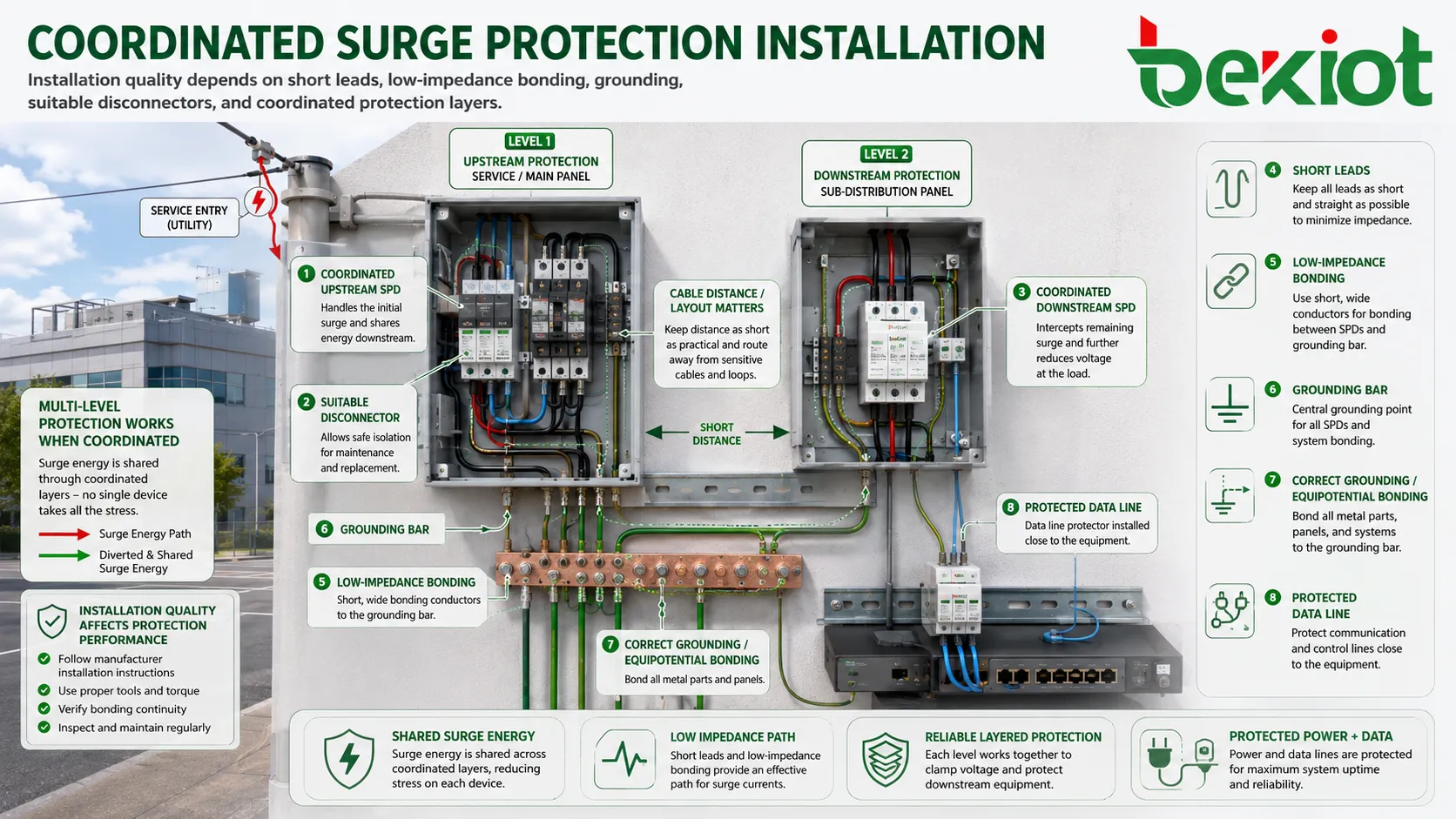
Connection leads should be as short and straight as possible. Fast surge currents create voltage across wire inductance, so long leads increase the voltage seen by protected equipment.
A neat installation is not always an effective installation. The shortest protected path is often more important than visual cable symmetry.
Low-Impedance Bonding
Bonding connects metal parts, protective earth, surge devices, shields, and reference points so that surge energy has a controlled path. Poor bonding can leave large voltage differences across equipment.
Bonding conductors should be properly sized, securely connected, corrosion-resistant, and routed to reduce impedance.
Correct Upstream Protection
Many SPDs require upstream overcurrent protection or an internal/external disconnector. This protects against end-of-life failure, short-circuit conditions, or abnormal operating states.
The disconnect device should match the manufacturer’s instructions, available fault current, and electrical code requirements.
Coordination Between Layers
Multi-level protection only works if the devices are coordinated. Upstream and downstream devices should share surge energy properly and avoid one device carrying the entire stress.
Coordination depends on device type, cable distance, voltage protection level, current rating, and system layout. Manufacturer guidance should be followed where available.
Where It Is Applied
Commercial Buildings
Office towers, hotels, shopping centers, campuses, and public buildings use protective devices for power distribution, IT rooms, elevators, access control, CCTV, public address, fire alarm interfaces, and building automation systems.
These sites often need coordinated protection across main switchboards, sub-panels, rooftop equipment, outdoor cameras, entrance systems, and network cabinets.
Industrial Facilities
Factories, warehouses, mines, refineries, power plants, and water treatment sites often contain motors, drives, PLCs, sensors, communication networks, control cabinets, and outdoor field devices. Surges can cause downtime, false signals, or equipment damage.
Industrial protection should consider both external lightning risk and internal switching disturbances from heavy electrical equipment.
Telecom and Data Networks
Telecom rooms, base stations, outdoor cabinets, fiber nodes, network switches, routers, PoE devices, antennas, and communication gateways require protection on power and signal paths.
Grounding and bonding are especially important because telecom systems may connect equipment across buildings, towers, outdoor enclosures, and long cable routes.
Security and Surveillance
Outdoor cameras, access controllers, gate systems, alarm panels, intercoms, barrier gates, and perimeter devices are often exposed to lightning-induced surges through power and signal cables.
Protection should be installed at building entry points and near exposed field devices where necessary.
Renewable Energy Systems
Solar photovoltaic systems, battery storage, wind power, and inverter systems require protection on DC strings, AC output, communication lines, monitoring equipment, and grounding networks.
DC protection requires suitable device selection because DC fault behavior differs from AC systems.
Maintenance and End-of-Life Monitoring
Surge protective devices are sacrificial by nature. They absorb or divert transient energy and may degrade over time. A device that has handled repeated surges may no longer provide the same protection level.
Many products include status windows, alarm contacts, remote monitoring outputs, replaceable cartridges, or end-of-life indicators. These should be checked during routine maintenance.
After a lightning event, major power fault, unexplained equipment failure, or repeated breaker trip, the protection system should be inspected. Replacing damaged devices is part of keeping the protection layer effective.
Selection Checklist
Identify the protected circuit first. AC power, DC power, Ethernet, PoE, RS-485, telephone, coaxial, sensor, and control circuits require different devices.
Match the rated voltage and system type. The device must fit the normal operating voltage, earthing system, frequency, current path, and fault conditions.
Choose the installation level. Service entrance, distribution panel, equipment cabinet, and point-of-use protection have different roles.
Review important ratings. Check maximum continuous operating voltage, voltage protection level, discharge current, impulse current, short-circuit current rating, protection modes, and certification marks.
Plan the physical installation. Lead length, grounding bar position, bonding path, cable routing, enclosure rating, and upstream disconnector selection are just as important as the device itself.
Effective surge protection is not a single component. It is a coordinated system of standards-based device selection, layered placement, short connections, grounding, bonding, and regular inspection.
FAQ
Can one device protect an entire building?
A main-panel device can reduce incoming surge energy, but sensitive equipment often still needs downstream protection. Large or complex buildings usually require layered protection.
Does a higher surge current rating always mean better protection?
Not always. Current rating shows energy-handling capability, but residual voltage, installation quality, coordination, and circuit type also determine protection performance.
Why do protected devices still fail sometimes?
Possible causes include unprotected signal paths, poor grounding, long lead wires, insufficient rating, wrong device type, expired protection modules, or surge energy beyond the design level.
Should Ethernet and PoE lines have separate protection?
Yes, when exposure risk exists. Ethernet and PoE lines need protection designed for data speed, PoE power level, connector type, and signal integrity.
What should be checked during routine inspection?
Check status indicators, alarm contacts, cartridge condition, grounding connections, bonding conductors, lead length, discoloration, loose terminals, water ingress, and whether any recent surge event occurred.







